On July 28, 2015, OSHA cited Wilbert Plastic Services of Bellevue, Ohio, $48,900 after a 36-year-old worker suffered burns to the face, eyes, and hands while clearing a mold inside a running injection press. The plant had not controlled the machine’s stored energy.
| Injection Molding Risk Assessment: Key Takeaways |
| An injection molding risk assessment has to control two signature hazards first: a clamp that exerts 50 to 400 tons and plastic melted to 400 to 600 degrees Fahrenheit. |
| The legal backbone is OSHA: 29 CFR 1910.212 (machine guarding), 1910.147 (lockout/tagout), 1910.219 (power transmission), and 1910.95 (noise), with ANSI/PLASTICS B151.1-2017 setting machine-specific rules. For the assessment method itself, the ISO 12100 risk assessment template turns those duties into scored rows. |
| Most amputations happen during non-routine mold-area access: setup, purging, and clearing a stuck part while the machine can still cycle. |
| B151.1 requires multiple independent interlocks on the operator gate, a hardwired electrical interlock plus an independent hydraulic interlock, backed by presence sensing and two-hand control. |
| FMEA turns the assessment into numbers. The reach-into-the-mold failure mode scores a Risk Priority Number of 420 before controls and 40 after, because engineering controls remove the reliance on behavior. |
| OSHA renewed its National Emphasis Program on amputations on June 26, 2025 for five years, so machine guarding in plastics plants is under active federal scrutiny. |
That case is an injection molding risk assessment in miniature: a routine jam, a worker reaching in, and a guarding or lockout step that was missing. An injection molding machine pairs 50-to-400-ton clamp force with plastic melted to 400 to 600 degrees Fahrenheit.
This guide builds an injection molding risk assessment from the hazards up. It covers the OSHA and ANSI standards that govern the machine, guarding for the mold area, an FMEA scoring method with a worked example, and a checklist you can run this week.
Why an Injection Molding Risk Assessment Starts at the Clamp and the Barrel
Two hazards dominate every injection molding risk assessment, and they are the two that maim. The clamp unit closes the mold with enough force to crush or amputate, and the barrel holds a charge of molten polymer hot enough to cause third-degree burns on contact.
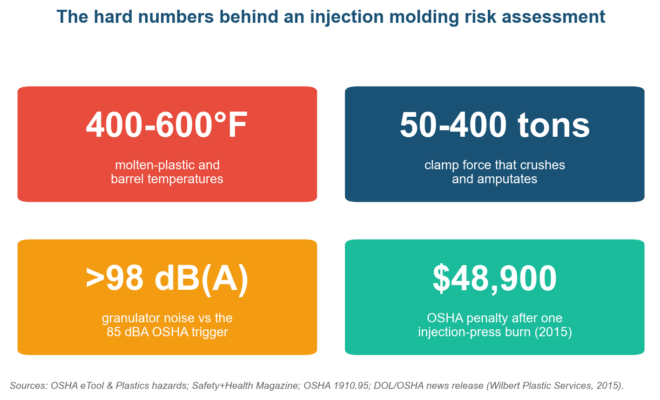
Figure 1. The magnitudes an injection molding risk assessment is built to contain.
The OSHA machine-guarding eTool is blunt about the clamp: crushing injuries or amputations occur if hands or limbs are placed between the mold halves while the machine cycles. The danger peaks during mold changes and when an operator reaches in to free a stuck part.
Heat is the second killer. Safety and Health Magazine puts barrel and melt temperatures at 400 to 600 degrees Fahrenheit, and burns also come from splattered plastic and escaping gases during purging or maintenance.
Mapping the Hazards in an Injection Molding Risk Assessment
Past the clamp and barrel, the machine and its cell hold a wider hazard set. A complete injection molding risk assessment lists every one, because the difference between a hazard and a risk is where most thin checklists quietly stop.
| Hazard | Mechanism | Primary control |
| Clamp crush / amputation | Reaching into the mold area while the platen can still close | Gate interlocks, light curtain, lockout/tagout |
| Molten-plastic burn | Contact with the 400-600F barrel, nozzle, or ejected melt | Barrel guards and insulation, purge shields, heat PPE |
| Entanglement | Hands caught at the feed throat clearing trapped material | Feed-throat guarding, lockout before clearing |
| Electrical shock | Heater-band and control voltages during service | De-energize and lock out, qualified maintenance only |
| Auxiliary equipment | Granulators, robots, conveyors, and hot runners | Guard each unit, interlock the robot cell |
| Noise | Granulators measured above 98 dB(A) | Acoustic enclosure, hearing conservation above 85 dBA |
| Ergonomic / WMSD | Repetitive part removal and packing | Job rotation, automation, workstation design |
| Slips and trips | Spilled resin pellets on walking surfaces | Housekeeping and spill containment |
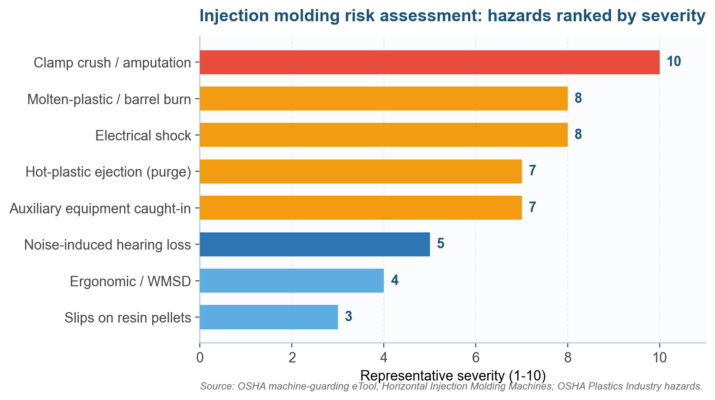
Figure 2. Ranking the hazards lets an injection molding risk assessment spend control money where harm is worst.
Rank the list before you spend a dollar on controls. A structured approach to risk identification keeps low-frequency, high-severity hazards like amputation at the top, where a qualitative and quantitative view belongs.
Melt Temperatures Every Injection Molding Risk Assessment Should Log
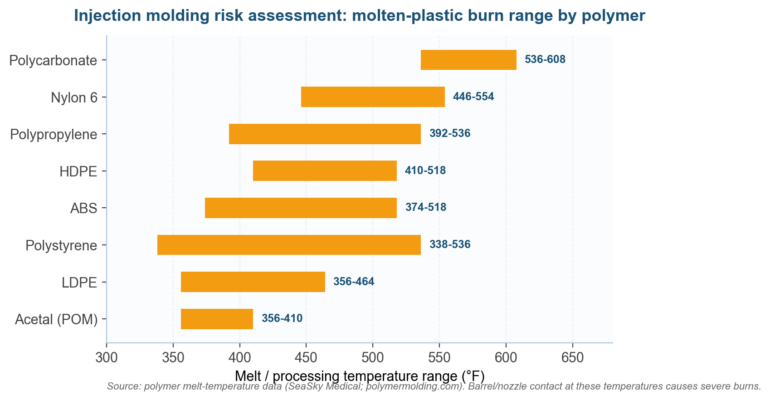
Figure 3. Burn severity tracks the polymer; an injection molding risk assessment should record the resin’s range.
Burn risk is not one number. Polycarbonate runs to 608 degrees Fahrenheit while acetal stays nearer 410, so the injection molding risk assessment should record each resin’s processing range and the purge volumes that come with it.
The OSHA Standards Behind an Injection Molding Risk Assessment
An injection molding risk assessment is also a compliance document. Four OSHA standards do most of the work, and an inspector will cite them by number if guarding fails.
| Standard | Scope | Role in the assessment |
| 29 CFR 1910.212 | General machine guarding | Guard the point of operation and moving parts |
| 29 CFR 1910.147 | Control of hazardous energy (lockout/tagout) | De-energize for mold changes, purging, jam clearing |
| 29 CFR 1910.219 | Mechanical power transmission | Guard belts, gears, and shafts on auxiliaries |
| 29 CFR 1910.95 | Occupational noise exposure | Hearing conservation above an 85 dBA eight-hour average |
Lockout is the standard most often broken. The Wilbert burn and the great majority of amputation citations trace to energy that was never controlled before a worker reached in, which is why the control of hazardous energy sits at the center of the assessment, not its edges.
Enforcement is climbing. OSHA renewed its National Emphasis Program on amputations on June 26, 2025 for five years, and the directive names plastics manufacturing among its targets. The agency has cited molding plants directly, including a 21-violation case against Plastic Molding Technology in El Paso.
ANSI B151.1 and Machine Guarding in an Injection Molding Risk Assessment
Where OSHA sets the duty, ANSI sets the method. ANSI/PLASTICS B151.1-2017 is the machine-specific safety standard, and an injection molding risk assessment should test the press against it gate by gate.
The operator gate carries layered protection. B151.1 requires a hardwired electrical interlock that stops platen close, injection, and screw rotation when the gate opens, plus an independent hydraulic interlock actuated by separate means, so a single failure cannot expose the mold area.
The 2017 edition modernized the rest. It allows non-contact and coded interlock switches in place of position sensors, expands the annexes on light curtains and two-hand control, and keeps presence sensing as a core safeguard on the mold area.
Treat a defeated interlock as a stop-work event. Bypassing the gate to speed a cycle is the exact behavior the standard exists to block, and a risk-based internal audit should hunt for taped switches and propped gates first.
Scoring an Injection Molding Risk Assessment with FMEA
Ranking hazards by feel does not survive an audit. Failure Mode and Effects Analysis gives an injection molding risk assessment defensible math: a Risk Priority Number equal to Severity times Occurrence times Detection, each scored 1 to 10.
Read the three scores plainly. Severity is the harm if the failure happens, occurrence is how often it arises, and detection is the chance current controls catch it first. Any severity of 9 or 10 demands action whatever the total, because the worst case is amputation.
An Injection Molding Risk Assessment FMEA, Worked
| FMEA element | Reaching into the mold area to clear a stuck part |
| Failure mode | Operator reaches into the mold area while the machine can still cycle |
| Effect | The clamp closes on a hand or arm; crush or amputation |
| Severity (S) | 10 of 10: permanent, life-altering injury |
| Occurrence (O) | 6 of 10: jams are routine and reaching in is a documented habit |
| Detection (D) | 7 of 10: relies on behavior; a defeated interlock stops nothing |
| RPN before controls | 10 x 6 x 7 = 420 (well above any action threshold) |
| Action | Verified gate-interlock chain (B151.1), light curtain, enforced lockout, no interlock defeat |
| RPN after controls | 10 x 2 x 2 = 40: severity is unchanged, but engineering controls cut occurrence and improve detection |
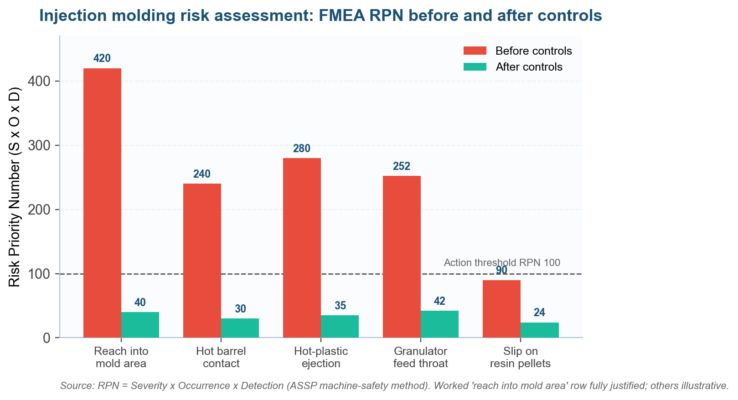
Figure 4. An injection molding risk assessment FMEA drives each Risk Priority Number below the action threshold.
Notice that severity never moves. Engineering controls cut occurrence and detection, which is why a verified interlock beats another training poster, and why the risk mitigation plan should fund guarding before it funds signage.
The Hierarchy of Controls in an Injection Molding Risk Assessment
FMEA tells you what to fix; the hierarchy of controls tells you how. An injection molding risk assessment ranks fixes by reliability, because a control that does not depend on a tired operator at 2 a.m. is worth more than one that does.
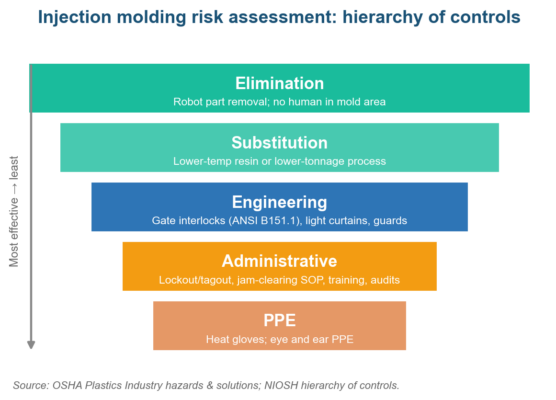
Figure 5. The hierarchy an injection molding risk assessment should climb before settling for PPE.
Start at the top and work down only when you must. Automating part removal with a robot removes the human from the mold area entirely, while OSHA’s plastics guidance treats PPE as the last line, never the first.
PPE still matters at the bottom. Heat-resistant gloves, face and eye protection, and hearing protection close the residual gap, but an assessment that leans on them to cover a missing guard has inverted the hierarchy and will fail an inspection.
An Injection Molding Risk Assessment Checklist
Turn the analysis into tasks an auditor can follow. This checklist converts the injection molding risk assessment into owned actions, each with an artifact behind it.
| # | Action | Evidence to retain |
| 1 | Inventory every press, auxiliary, and cell in scope | Equipment register with sign-off |
| 2 | Map hazards per machine, including melt range and tonnage | Hazard map keyed to the risk register |
| 3 | Test each operator gate against ANSI B151.1 interlocks | Interlock verification record |
| 4 | Confirm lockout/tagout for mold changes, purge, and jams | Machine-specific LOTO procedures |
| 5 | Score each failure mode with FMEA and set the threshold | Completed FMEA worksheet with RPNs |
| 6 | Apply controls top-down through the hierarchy | Control plan and residual-risk re-score |
| 7 | Re-assess on change and on a fixed cadence | Dated review log and version history |
Keep the record where inspectors expect it. A live risk register linked to interlock checks and the FMEA worksheet, plus a step-by-step assessment the floor can repeat, turns a binder into a working system.
Set the cadence deliberately. Our guide to how often assessments should run applies on the molding floor: reopen the file on any new tool, resin, robot change, or near miss. Our risk assessment templates give you a structure to adapt.
Frequently Asked Questions About Injection Molding Risk Assessment
What is an injection molding risk assessment?
An injection molding risk assessment is a documented review of the hazards on and around an injection molding machine, from clamp crush and molten-plastic burns to noise and ergonomics. It rates each hazard, applies controls in priority order, and records the residual risk.
Which OSHA standards apply to an injection molding risk assessment?
The core four are 29 CFR 1910.212 for machine guarding, 1910.147 for lockout/tagout, 1910.219 for power transmission, and 1910.95 for noise. A thorough compliance-minded assessment maps each hazard to the standard that governs it.
What are the top hazards in an injection molding risk assessment?
Clamp crush and amputation rank first, followed by burns from the 400-to-600-degree barrel and ejected melt. Electrical shock, entanglement at the feed throat, granulator noise, and ergonomic strain round out the list that every assessment should cover.
How does FMEA fit into an injection molding risk assessment?
FMEA scores each failure mode by Severity, Occurrence, and Detection, then multiplies them into a Risk Priority Number. It gives the injection molding risk assessment defensible priorities and a before-and-after measure of whether a control actually worked.
What does ANSI B151.1 require in an injection molding risk assessment?
ANSI/PLASTICS B151.1-2017 requires multiple independent interlocks on the operator gate, a hardwired electrical interlock plus an independent hydraulic interlock, supported by presence-sensing devices and two-hand control. The assessment should verify each one rather than assume it works.
Who should perform an injection molding risk assessment?
A competent person who understands the machine, its energy sources, and the controls, usually an EHS lead working with the maintenance and process engineers who know the presses. Outside specialists help where in-house operational risk capacity is thin.
How often should an injection molding risk assessment be reviewed?
Review on every change of tool, resin, robot, or layout, after any incident or near miss, and on a fixed periodic cadence. A dated version history shows an OSHA inspector exactly when each control and score was last confirmed.
Where Injection Molding Risk Assessments Fail
Most failed assessments share a short list of mistakes, and none of them are exotic. Each row pairs the trap with the fix that the enforcement record keeps proving out.
| Pitfall | Root cause | Fix |
| Assessing normal running only | Ignoring setup, purge, and jam clearing | Score the non-routine tasks where injuries cluster |
| Tolerating defeated interlocks | Production pressure to speed cycles | Treat a bypassed gate as a stop-work event |
| No lockout for jam clearing | Reaching in feels faster than locking out | Require LOTO before any mold-area access |
| PPE used to cover a missing guard | Inverting the hierarchy of controls | Engineer the guard first, then add PPE |
| A one-time binder | No change-triggered review | Reopen on every tool, resin, or robot change |
| No FMEA or scoring | Hazards ranked by opinion | Score Severity, Occurrence, and Detection on record |
The first row causes the most harm. The OSHA eTool and the citation history agree that the machine running normally is rarely the problem; the worker reaching in during a jam, with the guard bypassed, is.
The Injection Molding Risk Assessment Horizon: 2026 and Beyond
Federal pressure is the near-term story. With the amputations emphasis program running through 2030, a molding plant with weak guarding now faces a higher chance of a programmed inspection, not just a complaint-driven one.
Automation is changing the hazard map. Collaborative robots and full cell automation pull operators out of the mold area, which is elimination at the top of the hierarchy, but they add robot-cell and integration hazards an assessment now has to score.
Standards keep tightening around sensing. As coded and non-contact interlocks become routine under B151.1, the audit question shifts from whether a guard exists to whether its safety function has been validated and recorded.
The durable lesson is the same one the Guarding is one worked example of a control hierarchy, and the wider activity risk assessment method applies the same logic to any task. Wilbert case taught in 2015. The plants that stay clear of the citation list treat the injection molding risk assessment as a living control system, reviewed on change, not a binder pulled out for the auditor.
Strengthen Your Injection Molding Risk Assessment
Risk Publishing helps US manufacturers turn floor hazards into defensible programs, from quality risk management to the operational risk process behind a safe cell. Read about the practice, then contact us when your injection molding risk assessment needs to stand up to an OSHA inspection.

Chris Ekai is a Risk Management expert with over 10 years of experience in the field. He has a Master’s(MSc) degree in Risk Management from University of Portsmouth and is a CPA and Finance professional. He currently works as a Content Manager at Risk Publishing, writing about Enterprise Risk Management, Business Continuity Management and Project Management.