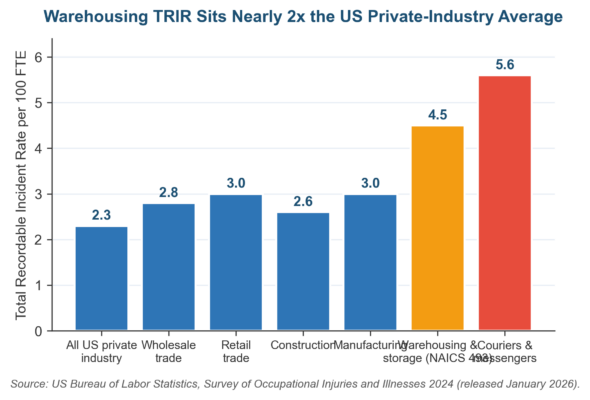
US warehouse workers logged injuries at a rate of 4.5 cases per 100 full-time equivalents in 2024, almost double the 2.3 average across all private industry. The Bureau of Labor Statistics released the figure in January 2026. For a warehouse with 40 FTE, that benchmark predicts about two recordable cases each calendar year, every year.
That injury frequency is why OSHA recordkeeping sits at the top of every small warehouse compliance file in the United States. The duties live in 29 CFR Part 1904, with a partial exemption for companies of 10 or fewer employees and a separate list of low-hazard industries that do not include warehousing NAICS 493.
| Key Takeaways: OSHA Recordkeeping Risks for Small US Warehouses |
| OSHA recordkeeping under 29 CFR 1904 applies to every US warehouse with more than 10 employees company-wide. The 1904.1 partial exemption ends the moment headcount crosses 10 at any point in the calendar year, and warehousing NAICS 493 is not on the low-hazard list in 1904.2. |
| The OSHA recordkeeping package is three forms. Form 300 is the running log, Form 301 is the detailed incident report filed within seven days, and Form 300A is the year-end summary posted at the establishment from 1 February through 30 April with a senior executive signature on the certification block. |
| The OSHA 2024 electronic submission rule pulled warehouses NAICS 493 into Appendix B reporting. Warehouses with 20 or more employees must now upload Form 300A through the OSHA Injury Tracking Application each year by 2 March, and those with 100 or more must also submit Forms 300 and 301. |
| OSHA recordkeeping civil penalties reach $16,550 per violation for serious or other-than-serious findings and $165,514 per violation for repeat or willful conduct, inflation-adjusted in January 2025. Each unrecorded case is its own violation, which is how small-warehouse settlements quickly cross $100,000. |
| Severe incident reporting under 1904.39 applies to every warehouse regardless of size. A workplace fatality must be reported to OSHA within 8 hours; a hospitalization, amputation, or loss of an eye within 24 hours. The OSHA Establishment Search tool will display the citation if the report is late. |
| Warehousing TRIR sits at 4.5 cases per 100 FTE in the BLS 2024 data, nearly twice the 2.3 national private-industry average. That gap is why warehouses with 20-249 employees in NAICS 493 are a permanent OSHA enforcement priority, and why a small-warehouse OSHA recordkeeping program runs as a continuous control rather than a year-end task. |
| Records must be retained for the five years after the calendar year they cover, on top of the current year. OSHA recordkeeping audits will request the prior five 300 logs, the corresponding 300A certifications, the matching 301 incident reports, and any reasonable allegation of an unreported injury that surfaced inside that window. |
Five duties carry the OSHA recordkeeping load for a small US warehouse: the partial exemption test, the three required forms, the 2024 electronic submission rule, severe incident reporting timers, and the penalty bands a single missed entry can trip.
Each duty maps to a compliance risk analysis step a third-party safety auditor will recognize on sight. A 40 FTE warehouse moves to a defensible file inside six weeks.
OSHA Recordkeeping Risks: Why Small Warehouses Cannot Skip the 300 Log
Every US warehouse with more than 10 employees company-wide is subject to OSHA recordkeeping under 29 CFR 1904. Warehousing NAICS 493 is excluded from the low-hazard partial exemption list. The 300 log opens on 1 January each year and runs continuously, regardless of whether the warehouse is union, non-union, single-shift, or multi-shift.
OSHA Recordkeeping Risks: The 4.5 TRIR That Keeps Warehouses on the Radar
Warehousing and storage clocked 4.5 nonfatal recordable cases per 100 full-time workers in 2024, on top of a 2.6 DART rate (days away, restricted, or transferred).
Couriers and messengers, an adjacent code, ran even higher at 5.6. The BLS Survey of Occupational Injuries and Illnesses is the public data set OSHA mines when picking enforcement targets.
Lift-truck strikes, slips on dock plates, struck-by from improperly secured pallets, and overexertion strains dominate the small-warehouse case mix.
An OSHA recordkeeping log that shows zero cases in a 40 FTE warehouse for three straight years is statistically improbable. That improbability is itself an enforcement flag inside the OSHA Establishment Search tool.
OSHA Recordkeeping: NAICS 493 Is Not on the Partial Exemption List
Section 1904.2 lists about 80 NAICS codes that are partially exempt from routine OSHA recordkeeping based on historically low injury rates.
Warehousing and storage (NAICS 493110, 493120, 493130, 493190) is absent. Couriers, freight transportation, and most logistics codes are also absent. A warehouse operator who claims a 1904.2 exemption is reading the wrong code.
The OSHA partial exemption regulation text at 29 CFR 1904.2 is the authoritative source. If the warehouse principal NAICS code starts with 493 or sits in 484 (truck transportation), full OSHA recordkeeping applies. A standard operating risk assessment methodology walks the operator through the NAICS check inside the first hour.
OSHA Recordkeeping Risks: The 1904.1 Ten-Employee Question
Section 1904.1 grants a partial exemption to companies that had 10 or fewer employees at all times during the prior calendar year. The count is company-wide, not single-location.
A warehouse with 8 staff but a parent company employing 12 people across the group is not exempt and must run the full OSHA recordkeeping program.
OSHA Recordkeeping: Counting Employees Across the Whole Company
Full-time, part-time, seasonal, temporary, and per-diem workers all count toward the 10-employee threshold. The count is taken at the company level, summed across every establishment and every payroll line.
Independent contractors generally do not count, but the contractor relationship must be genuine under the FLSA-derived control test that OSHA borrows in 1904.31.
The threshold is binary and unforgiving. A 9-person warehouse that adds one seasonal forklift driver in October crosses the 10-employee line for the calendar year and owes a full OSHA recordkeeping back-log.
A guide to risk and control self assessment (RCSA) tracks the headcount control monthly so the operator catches the trigger inside the same payroll cycle.
OSHA Recordkeeping: What the Partial Exemption Does and Does Not Cover
The 1904.1 partial exemption removes the duty to keep Form 300, Form 300A, and Form 301 on a routine basis. It does not remove the severe incident reporting duty under 1904.39, which applies to every employer regardless of size.
A fatality still calls for an 8-hour notice. A hospitalization, amputation, or loss of an eye still calls for a 24-hour notice.
The exemption also does not block OSHA or the Bureau of Labor Statistics from issuing a written notice that turns recordkeeping back on for a specific small employer.
The OSHA recordkeeping resource center lists the agency contact path. Small warehouses sometimes get pulled into the OSHA Data Initiative even at 7 FTE, and the notice obligates immediate compliance from receipt.
OSHA Recordkeeping Risks: The Three Required Forms for a Small Warehouse
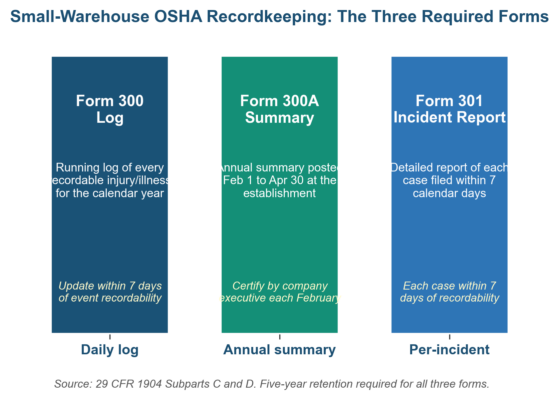
Figure 2. OSHA recordkeeping. The three forms a small warehouse maintains under 29 CFR 1904 Subparts C and D.
Form 300 is the running log of every recordable case, kept current to within seven days. Form 301 is the detailed per-incident report filed inside the same seven-day window.
Form 300A is the annual summary, certified by a senior executive, posted at the establishment from 1 February through 30 April.
OSHA Recordkeeping: Form 300 Log of Work-Related Injuries
Form 300 captures the case number, employee name (or designated privacy code for sensitive cases), job title, date of injury or illness onset, where the event occurred, a description of the injury and the body part affected, and the classification (death, days away from work, job transfer or restriction, or other recordable case). One log per establishment, refreshed every calendar year.
OSHA accepts an electronic spreadsheet or a paper book as long as the columns mirror the official template.
The OSHA Form 300 template at osha.gov gives the operator a ready-to-print layout. Common mistakes include leaving days-away counts at zero when the employee never returned, and listing the supervisor instead of the injured worker.
OSHA Recordkeeping: Form 300A Summary Posted 1 February to 30 April
Form 300A summarizes the year, with totals across each recordable category, average annual employment, and total hours worked.
A company executive signs the certification block (owner, principal officer, or highest-ranking executive at the establishment). The signed summary is posted in a visible employee area for at least three months.
The 300A is the form OSHA pulls first during a programmed inspection. Hours worked and average employment drive the establishment’s TRIR calculation.
A five steps of the risk management process sequence layered on top of the OSHA recordkeeping cycle confirms that the underlying hours data ties to payroll, not estimates.
OSHA Recordkeeping: Form 301 Incident Report Within Seven Days
Form 301 captures one case per page: employee identifiers, treating physician, treatment location, when the case happened, what the employee was doing immediately before, and what specifically caused the injury.
The form is filed within seven calendar days of the case becoming recordable, which is often the day of the event for visible injuries.
OSHA recordkeeping rules at 1904.29(b) accept an equivalent form (workers’ compensation first report of injury, third-party insurer form) so long as every required field is captured.
Many small warehouses run their workers’ compensation intake form and tag it as their Form 301 equivalent. The how to manage third party risk lens applies if the equivalent form lives at a payroll vendor or PEO.
OSHA Recordkeeping: Electronic Submission Under the 2024 Rule
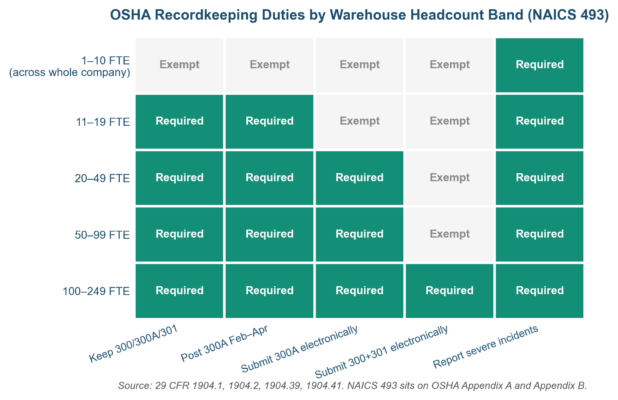
Figure 3. OSHA recordkeeping duty matrix. Warehousing NAICS 493 sits on both Appendix B and Appendix A of the 2024 electronic submission rule.
The OSHA recordkeeping electronic submission rule, finalized 17 July 2023 and effective 1 January 2024, pulls NAICS 493 establishments into mandatory annual upload through the OSHA Injury Tracking Application.
Warehouses with 20 or more employees submit Form 300A. Warehouses with 100 or more also submit Forms 300 and 301.
OSHA Recordkeeping: The 20-249 Employee Form 300A Submission
Appendix B of the 2024 rule covers warehousing NAICS 493 at the 20 to 249 employee band. Establishments in this range upload Form 300A annually by 2 March, covering the prior calendar year.
A 35 FTE warehouse files 300A for calendar 2025 no later than 2 March 2026, then 300A for calendar 2026 no later than 2 March 2027.
The submission happens through the OSHA Injury Tracking Application (ITA). The ITA account is registered once and reused each year. Establishments that miss the 2 March deadline trigger a written notice and a follow-up inspection request. Filing late is the easiest OSHA recordkeeping violation to avoid and the most common one to receive.
OSHA Recordkeeping: The 100+ Employee Form 300 and 301 Filing
Appendix A of the 2024 rule lifts the bar for NAICS 493 establishments at 100 or more employees. These employers submit Forms 300 and 301 in addition to Form 300A, all by 2 March each year.
The 300 and 301 data is published on the OSHA Establishment Search after personally identifiable information is removed.
Although this article focuses on warehouses under 50 employees, the 100-employee threshold matters because OSHA recordkeeping data is published at the establishment level, not the company level.
A logistics operator with two 45 FTE warehouses sits comfortably under both thresholds. A merger or single facility expansion above 100 drops the operator straight into Appendix A duties.
OSHA Recordkeeping: Severe Incident Reporting Under 1904.39
Severe incident reporting applies to every US employer, including warehouses below the 10-employee partial exemption.
A workplace fatality is reported to OSHA within 8 hours of the employer’s knowledge. A work-related hospitalization, amputation, or loss of an eye is reported within 24 hours. The clock starts when a manager learns of the event.
OSHA Recordkeeping: Fatalities Trigger the 8-Hour Clock
OSHA accepts the report through the OSHA area office, by phone at 1-800-321-OSHA, or through the OSHA online reporting form.
The submission captures business name, location, time of incident, type of incident, number of fatalities, and the contact person at the warehouse. Missing the 8-hour clock is a separate citable violation from any underlying safety standard.
Small-warehouse EHS leads pre-stage the report template at the front desk and inside the safety officer’s phone. The incident response plan vs business continuity distinction matters here. The OSHA recordkeeping report is one of the first calls inside the broader incident response, not something to wait for the lawyer’s approval before sending.
OSHA Recordkeeping: Hospitalizations, Amputations, Loss of an Eye
A work-related in-patient hospitalization (overnight stay for medical treatment, not observation alone), an amputation (including partial fingertip amputations with bone loss), and a loss of an eye each carry a 24-hour reporting clock.
The clock starts when the warehouse manager first learns of the event, not when the employee returns from the emergency room with discharge paperwork.
OSHA’s severe injury reporting page carries the operative definitions. A common small-warehouse error is treating an overnight observation as a non-reportable hospitalization.
Observation alone is not reportable; in-patient admission for treatment is. When in doubt, file inside the 24-hour window and supplement later.
OSHA Recordkeeping: Penalty Structure and Enforcement Trends
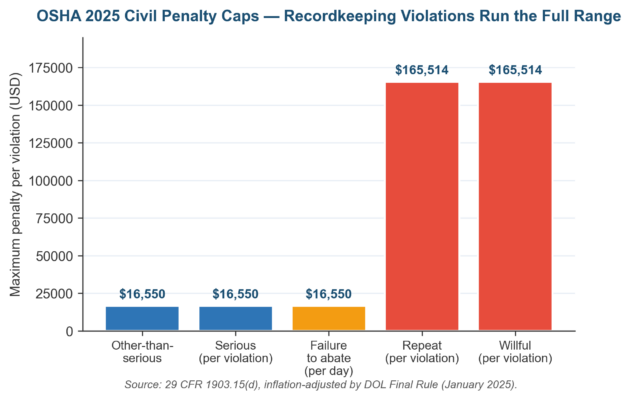
Figure 4. OSHA recordkeeping civil penalty caps after the January 2025 inflation adjustment. Repeat and willful findings sit ten times above the routine band.
OSHA recordkeeping civil penalty caps reset on 15 January 2025. Serious and other-than-serious violations cap at $16,550 per violation.
Failure-to-abate runs $16,550 per day after the abatement date. Repeat and willful violations cap at $165,514 per violation. Each unrecorded case can be cited as its own violation.
OSHA Recordkeeping: The Per-Violation Counting Trap
OSHA recordkeeping citations stack. A warehouse with five unrecorded cases on the Form 300 log faces five separate counts, each capped at $16,550.
The aggregate exposure on that small slip alone reaches $82,750 before any seriousness or repeat enhancements. Settlement negotiations typically halve the gross figure, but the published settlement still surfaces on the OSHA Establishment Search.
Failure-to-abate is calculated per day past the abatement deadline. A 90-day delay on a $5,000 abatement order generates exposure of up to $1.49 million at the daily cap.
Most enforcement orders settle well below the ceiling, but the structure exists and a stubborn dispute against OSHA recordkeeping findings will draw it.
OSHA Recordkeeping: National Emphasis Programs Touching Warehouses
OSHA published a National Emphasis Program for warehousing and distribution operations in July 2023, refreshed in 2025.
The program directs area offices to schedule programmed inspections at warehouses and high-injury-rate distribution centers, with explicit attention to the OSHA recordkeeping log.
The convergence of risk oversight with strategic planning matters because each NEP inspection arrives with a recordkeeping subpoena attached.
Smaller warehouses (under 50 FTE) are not the primary NEP target, but they are caught in the inspection net when a referral, complaint, or fatality surfaces in the area office.
NEP-driven inspections pulled in over 1,300 warehousing establishments through 2024 and into 2025. OSHA recordkeeping was the first line of inquiry in roughly 80% of those visits.
Frequently Asked Questions on OSHA Recordkeeping for Small Warehouses
Does OSHA recordkeeping apply to a warehouse with 9 employees?
Probably not for routine records, under 29 CFR 1904.1. A company that had 10 or fewer employees at all times during the prior calendar year is partially exempt from Form 300, 300A, and 301. The exemption disappears the moment headcount touches 11 anywhere in the company, including a one-week seasonal hire.
Does the OSHA recordkeeping partial exemption cover severe injury reporting?
No. Section 1904.39 severe injury reporting applies to every US employer under the OSH Act. A 7-person warehouse still calls OSHA within 8 hours of a workplace fatality and within 24 hours of a hospitalization, amputation, or loss of an eye. The partial exemption only releases routine paperwork.
How long must OSHA recordkeeping forms be retained at a small warehouse?
Five years past the end of the calendar year they cover, under 1904.33. The current year’s log is also kept on hand. A warehouse running calendar 2025 records can be asked at any time in 2026 to produce the 300, 300A, and 301 forms for calendar 2020 through 2025. Records must be available within 4 business hours of an OSHA request.
Do temporary staffing agency workers count for OSHA recordkeeping headcount?
The agency that pays them counts them. The host warehouse counts them for severe incident reporting and may also need to record their cases on its own 300 log if it supervises day-to-day work. OSHA’s 1904.31 joint-employer test follows the day-to-day supervision question, not the W-2 question.
When does a warehouse need to upload Form 300A to the OSHA Injury Tracking Application?
Every year by 2 March, if the establishment carried 20 or more employees at any point in the prior calendar year and the principal NAICS sits in Appendix B. Warehousing NAICS 493 is on Appendix B. A 25 FTE warehouse uploads 300A for calendar 2025 by 2 March 2026 through the OSHA ITA portal.
What is the maximum OSHA recordkeeping penalty in 2025?
$16,550 per violation for serious or other-than-serious findings, and $165,514 per violation for repeat or willful conduct.
The caps were inflation-adjusted by the Department of Labor effective 15 January 2025. Each unrecorded case can be cited as a separate violation, which is how small-warehouse settlements quickly cross six figures.
Does OSHA recordkeeping include first-aid-only injuries?
No. First aid is defined narrowly at 1904.7(b)(5)(ii) and covers items like non-prescription medicine at non-prescription strength, simple bandages, eye flushing, and finger guards. Anything beyond that list (prescription drugs, sutures, splints, restricted duty, days away) makes the case recordable. Misclassifying a recordable case as first aid is the single most common OSHA recordkeeping audit finding.
OSHA Recordkeeping: Common Pitfalls and How to Avoid Them
| Pitfall | Root cause | Remedy |
| Treating restricted-duty cases as non-recordable | Misreading 1904.7 to exclude any return-to-work case | If the employee cannot do routine job functions or works partial hours, the case is recordable for OSHA recordkeeping |
| Counting only the warehouse staff for 1904.1 | Treating each location as its own company | Aggregate every employee in the parent company across all locations; the threshold is company-wide |
| Filing Form 301 late or skipping it entirely | Confusing the workers’ compensation form with the OSHA recordkeeping form | Either tag the workers’ comp report as the 301 equivalent or stand up a dedicated 301 inside the case file |
| Missing the 2 March electronic submission deadline | Treating it as a quarter-end task and forgetting the date | Add the upload to the closing checklist for the prior calendar year; the ITA portal opens 1 January each year |
| Posting Form 300A only inside the office | Posting at the front desk where production staff never visit | Post 300A in the employee break room or by the time clock; the posting must be visible to every worker |
| Forgetting the senior executive certification on 300A | Letting the safety officer sign in place of the principal | Owner or top-ranking site executive signs; without that signature the 300A is treated as unfiled for OSHA recordkeeping |
| Failing to update the 300 log within seven days | Waiting for medical confirmation before recording | Record on the working diagnosis; reclassify later inside the same calendar year if new evidence emerges |
| Throwing the prior year log away after 31 December | Treating it as old paperwork | Five years past the calendar year, plus the current year, kept on-site under 1904.33 |
OSHA Recordkeeping: Looking Ahead Through 2027
OSHA published a proposed expansion of the National Emphasis Program for warehousing through 2027, with refreshed criteria for high-injury-rate establishments and explicit reference to the OSHA recordkeeping data uploaded through the ITA.
Smaller warehouses are not the primary scope, but a 40 FTE site that shows a TRIR above 6 invites an unannounced visit.
Heat-illness rulemaking continues. The proposed Heat Injury and Illness Prevention standard reached its public comment close in early 2026 and is moving toward final rule in late 2026 or early 2027. When it lands, every warehouse will add heat-related incidents to the OSHA recordkeeping log. Indoor warehouses without climate control are squarely in scope.
Robotics and automation are reshaping the warehouse injury profile. AMRs, cobotic palletizers, and goods-to-person conveyance shift the case mix from lift-truck strikes toward struck-by and pinch-point injuries.
The OSHA recordkeeping log will keep showing the case totals, while the underlying mechanisms change. A cybersecurity risk management overlay is now part of the safety brief for automated cells.
State-plan jurisdictions (California Cal/OSHA, Michigan MIOSHA, Washington DOSH, and 22 others) continue to publish stricter local rules layered on top of 29 CFR 1904.
A small warehouse operating across state lines tracks each jurisdiction separately. The federal OSHA recordkeeping baseline is the floor, not the ceiling, and 2025 to 2027 will widen the gap between state and federal duties.
OSHA Recordkeeping Support for Your Warehouse
Need a documented OSHA recordkeeping program for your warehouse before the next 2 March electronic submission window? riskpublishing.com helps US warehouse operators under 50 FTE stand up the 300, 300A, and 301 file, run the prior-year reconciliation, and certify the senior-executive block in six to eight weeks.
Engagements run on a fixed scope and a fixed timeline, with a named owner inside the warehouse to maintain the file after handover. See riskpublishing services for the full package list, or contact Chris Ekai directly to scope an OSHA recordkeeping review against your current evidence file and headcount.

Chris Ekai is a Risk Management expert with over 10 years of experience in the field. He has a Master’s(MSc) degree in Risk Management from University of Portsmouth and is a CPA and Finance professional. He currently works as a Content Manager at Risk Publishing, writing about Enterprise Risk Management, Business Continuity Management and Project Management.