
Artificial intelligence moved from the innovation lab to the boardroom faster than most risk teams could keep up. If you are a risk manager, compliance officer, or CRO reading this in early 2026, you already know the pressure: your organization is deploying AI across hiring, customer service, fraud detection, and investment analysis, and the board wants assurance that someone is managing what could go wrong.
The numbers tell the story. The Allianz Risk Barometer 2026 ranked AI as the number two global business risk, jumping from tenth place in just one year. The International AI Safety Report 2026, authored by over 100 AI experts across 30 countries, warned that current AI systems sometimes fabricate information, produce flawed code, and give misleading advice, and that AI agents pose heightened risks because they act autonomously.
Meanwhile, the regulatory walls are closing in. The EU AI Act high-risk enforcement deadline hits August 2, 2026, with penalties reaching 35 million euros or 7% of global turnover. In the US, the SEC’s 2026 examination priorities now explicitly flag AI governance alongside cybersecurity. State legislatures from Colorado to Illinois are passing their own AI accountability laws.
This is not a theoretical problem. In 2025, a federal judge certified a class-action lawsuit against Workday after allegations that its AI-powered screening tools disproportionately rejected applicants over 40. A customer chatbot at a major financial services firm gave confident but incorrect advice to thousands of users before anyone caught it. A facial recognition tool led to wrongful arrests.
The common thread across these failures was not the technology. It was weak governance: unclear ownership, absent controls, and misplaced trust in systems that nobody was monitoring. As ISACA noted, the biggest AI failures of 2025 were organizational, not technical.
That is exactly what an AI risk management framework solves. An AI risk management framework gives you the structure, the language, and the control architecture to bring AI deployments under the same governance discipline you already apply to financial risk, operational risk, and compliance.
This guide walks you through how to build an AI risk management framework, step by step, grounded in the NIST AI Risk Management Framework (AI RMF 1.0) and practical lessons from organizations that are doing this work right now.
What Is an AI Risk Management Framework?
An AI risk management framework is a structured approach for identifying, assessing, monitoring, and mitigating the risks that arise from developing, deploying, and operating artificial intelligence systems.
Think of it as the connective tissue between your existing enterprise risk management (ERM) program and the specific challenges that AI introduces: algorithmic bias, data quality failures, model drift, opacity in decision-making, and regulatory non-compliance.
If you already run a mature ERM program built on ISO 31000 or COSO, you are not starting from zero. An AI risk management framework extends what you have. It adds AI-specific risk categories, governance structures, and control mechanisms to your existing risk architecture.
The most widely referenced model in the United States is the NIST AI RMF 1.0, published in January 2023. Unlike the EU AI Act (which is binding law), the NIST AI Risk Management Framework is voluntary, risk-based guidance designed to help organizations govern, map, measure, and manage AI risks so that AI systems are safe, fair, accountable, and aligned with organizational values.
Why Traditional ERM Is Not Enough for AI
Your current risk register probably captures operational risk, financial risk, strategic risk, and compliance risk. But AI introduces failure modes that do not fit neatly into those categories:
- Emergent behavior: AI systems can develop capabilities that were not anticipated during design. The International AI Safety Report 2026 found that new capabilities sometimes emerge unpredictably, and performance on pre-deployment tests does not reliably predict real-world risk.
- Compounding bias: A biased training dataset does not just produce one bad decision. It produces thousands of biased decisions at machine speed, each one reinforcing the pattern. The Workday lawsuit illustrates this: hundreds of automated rejections before anyone noticed.
- Opacity: Many AI models, especially deep learning systems, operate as black boxes. You cannot trace the reasoning behind a specific decision the way you can with a rules-based system.
- Autonomy risk: AI agents that take actions without human approval create liability exposure that traditional control frameworks were not designed to address.
- Speed of harm: A flawed credit model deployed at scale can affect millions of customers in hours. The feedback loop between deployment and damage is compressed to near-zero.
These characteristics mean you need a dedicated AI risk management framework, not just an extra line item on your operational risk register. The NIST AI RMF provides the scaffolding. Your job is to adapt it to your organization’s risk appetite, regulatory environment, and AI maturity.
The NIST AI Risk Management Framework: Four Core Functions
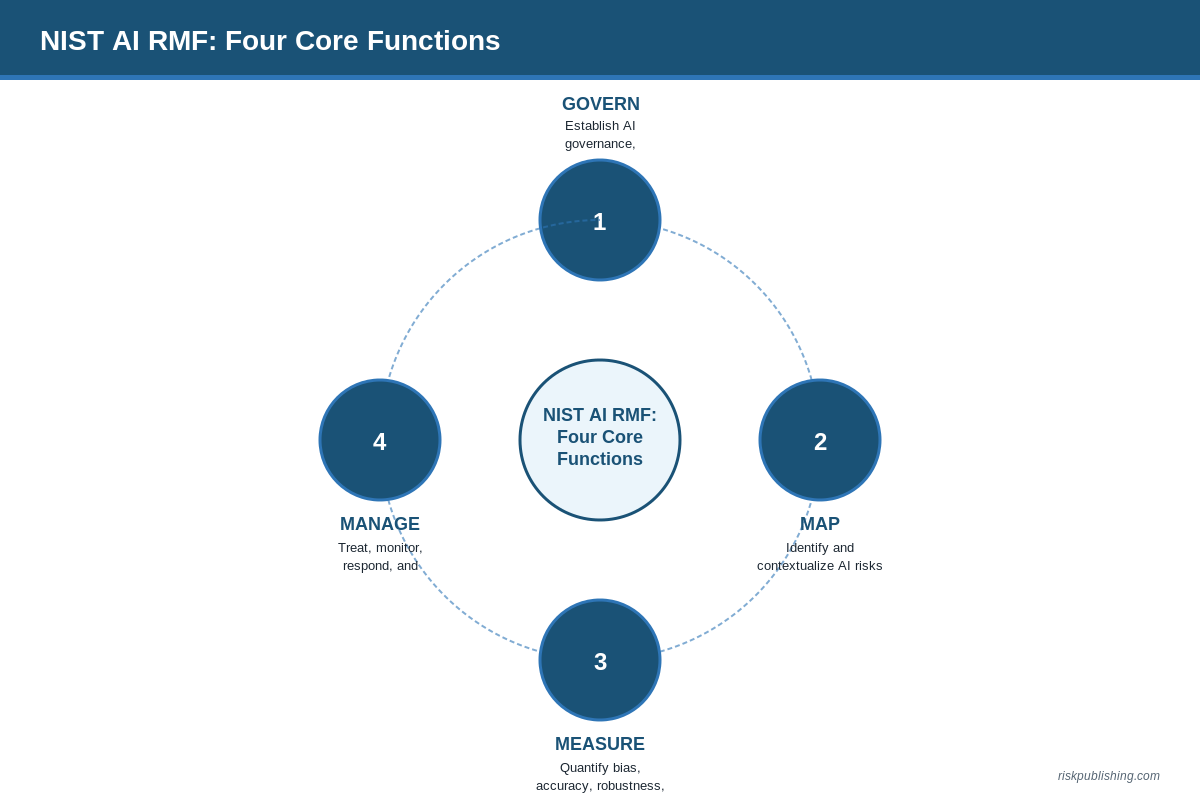
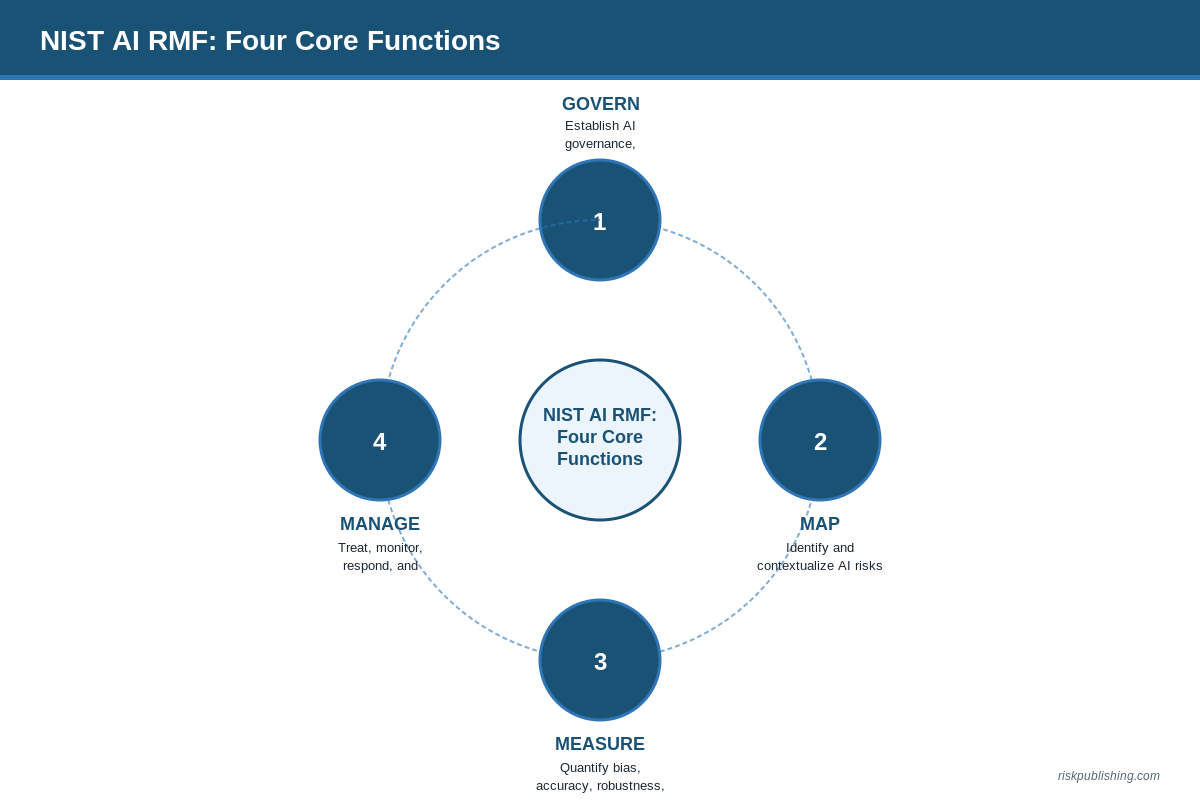
The NIST AI Risk Management Framework is organized around four core functions: Govern, Map, Measure, and Manage. These are not sequential steps. They operate as an interconnected system, much like the Identify-Protect-Detect-Respond-Recover structure in the NIST Cybersecurity Framework. If you are familiar with the risk management process flow, this structure will feel intuitive.
1. GOVERN: Establish AI Governance and Accountability
The Govern function is the foundation. Without it, everything else is theater. Govern requires you to establish clear roles, responsibilities, and accountability structures for AI risk across the organization.
In practice, this means:
- Defining who owns AI risk at the board, executive, and operational levels. If nobody owns it, nobody manages it.
- Creating or adapting an AI-specific risk policy that defines your organization’s risk appetite for AI use cases, including where AI is permitted, where it requires enhanced oversight, and where it is prohibited.
- Establishing an AI governance committee (or extending the mandate of your existing risk committee) with cross-functional representation: risk, legal, compliance, IT, data science, and the business lines deploying AI.
- Building AI literacy across the organization. The EU AI Act already requires AI literacy training for all providers and deployers, and this is increasingly considered best practice in the US as well.
Govern also addresses culture. If your organization treats AI deployment as purely a technology decision, with risk and compliance brought in after launch, you have a governance gap. The most effective AI governance models embed risk assessment into the AI development lifecycle from day one.
2. MAP: Identify and Contextualize AI Risks
Map is about understanding the specific risks associated with each AI system in its operational context. This is not a generic risk assessment. It requires you to document:
- The intended purpose, scope, and limitations of each AI system.
- The stakeholders affected, both directly (users, employees, customers) and indirectly (communities, markets, regulatory bodies).
- The data inputs, including their sources, quality, representativeness, and potential for bias.
- The operational environment, including how the AI system interacts with human decision-makers, other systems, and business processes.
- The likelihood and magnitude of potential impacts, including harms to individuals, groups, organizations, and society.
Mapping is where many organizations struggle because it requires collaboration between technical teams (who understand the model) and business teams (who understand the operational context). A data scientist can tell you that a model has a 3% false positive rate. A business owner can tell you that a 3% false positive rate in a fraud detection system means wrongly freezing 30,000 customer accounts per month. You need both perspectives in the room.
3. MEASURE: Quantify and Evaluate AI Risks
Measure is where you move from qualitative risk identification to quantitative assessment. This function requires you to test, evaluate, verify, and validate (TEVV) AI systems against defined metrics and benchmarks.
Key measurement activities include:
- Bias and fairness testing across protected characteristics (race, gender, age, disability) using statistical methods appropriate to the use case.
- Performance monitoring: accuracy, precision, recall, and false positive/negative rates, tracked continuously rather than assessed once at deployment.
- Robustness testing: how does the model perform under adversarial conditions, edge cases, or data drift?
- Explainability assessment: can the system provide meaningful explanations for its decisions to the affected individuals and to oversight bodies?
- Security testing: vulnerability to data poisoning, model inversion, prompt injection, and other AI-specific attack vectors.
The International AI Safety Report 2026 flagged a critical measurement challenge: pre-deployment tests do not reliably predict real-world risk. This means your measurement program cannot stop at launch. You need continuous monitoring, with key risk indicators (KRIs) and thresholds that trigger escalation when model performance degrades or when the operating environment shifts.
4. MANAGE: Treat, Monitor, and Respond to AI Risks
Manage is where you take action. Based on the risks you identified in Map and quantified in Measure, Manage requires you to:
- Prioritize risks based on your risk appetite and allocate resources accordingly.
- Implement controls: technical controls (guardrails, human-in-the-loop checkpoints, automated monitoring), process controls (approval workflows, change management), and governance controls (escalation paths, board reporting).
- Develop incident response plans for AI-related failures, including communication protocols, remediation procedures, and post-incident review processes.
- Establish appeal and override mechanisms for decisions made by AI systems that affect individuals.
- Plan for decommissioning: what happens when an AI system needs to be retired, replaced, or rolled back?
The Manage function should feed directly into your existing operational risk management processes, your business continuity plans, and your board reporting cadence. AI risk is not a separate reporting silo. It is a dimension of enterprise risk that should appear in your consolidated risk dashboard.
How to Build an AI Risk Management Framework: A Practical Roadmap
Theory is useful. Execution is what matters. Here is a six-step roadmap for building an AI risk management framework that actually works in a real organization.
Step 1: Inventory Your AI Systems
You cannot manage what you cannot see. Your AI risk management framework starts with a comprehensive AI inventory that covers every AI and machine learning system in production, in development, and in procurement.
Include vendor-supplied AI embedded in third-party products (your CRM’s lead scoring, your HR platform’s resume screening, your cybersecurity vendor’s threat detection). Many organizations are surprised to discover they have 3x to 5x more AI systems than they thought once they count embedded AI in vendor products.
For each system, document: the business owner, the vendor or development team, the data sources, the decision domain, the affected stakeholders, and the current governance arrangements.
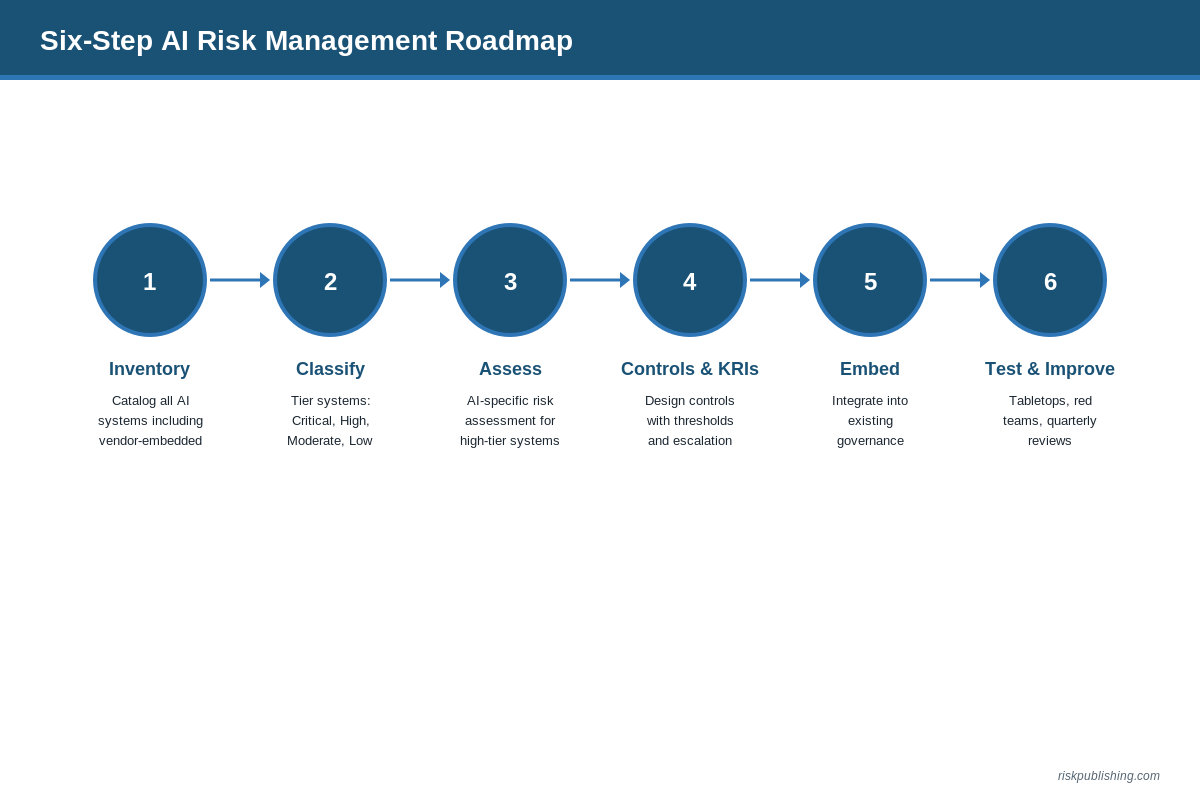
Step 2: Classify AI Systems by Risk Tier
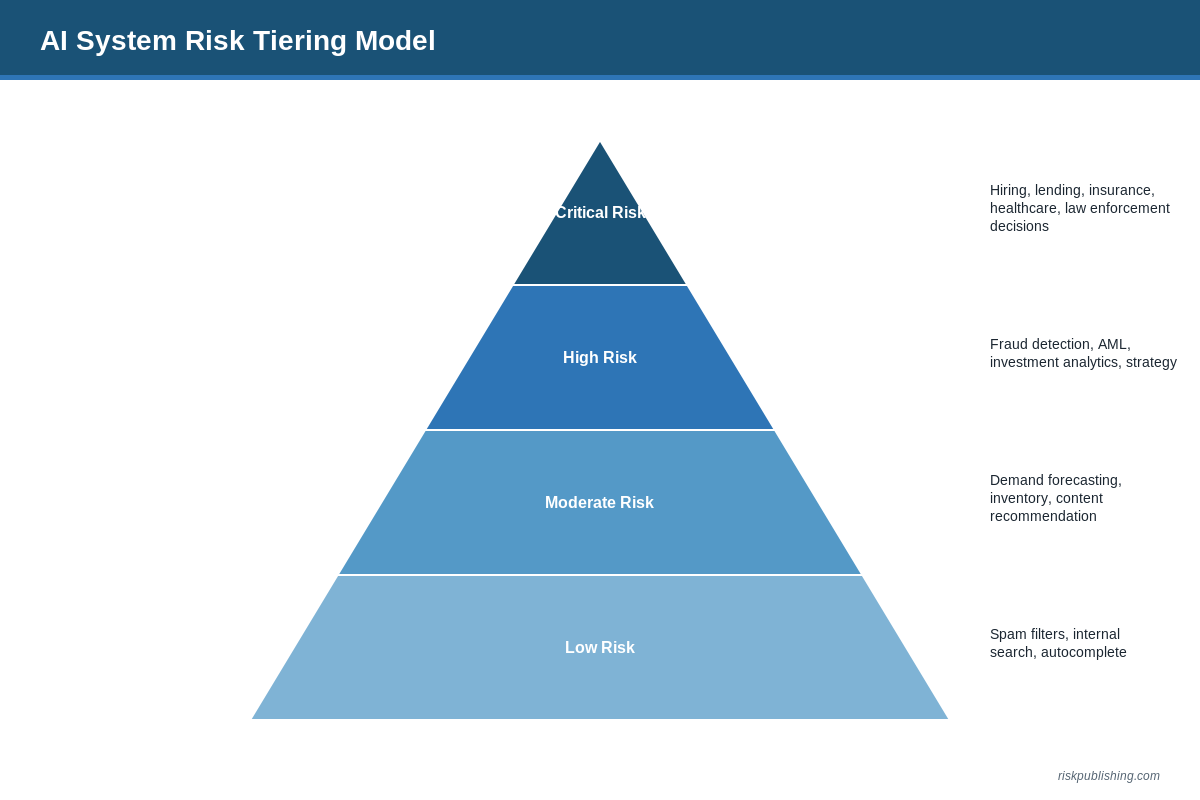
Not every AI system carries the same risk. A spam filter and a loan approval algorithm require fundamentally different levels of oversight. Adopt a risk tiering model that reflects both the EU AI Act’s four-tier classification (unacceptable, high, limited, minimal) and your organization’s own risk appetite.
A practical tiering approach for US organizations:
- Critical risk: AI systems that make or materially influence decisions about individuals (hiring, lending, insurance, healthcare, law enforcement). These get the full treatment: bias testing, explainability requirements, human oversight, and board-level reporting.
- High risk: AI systems that affect business strategy, financial performance, or regulatory compliance (fraud detection, AML monitoring, investment analytics). Requires formal risk assessment, KRIs, and periodic independent review.
- Moderate risk: AI systems that automate operational processes with limited individual impact (demand forecasting, inventory optimization, content recommendation). Standard monitoring and periodic review.
- Low risk: AI systems with negligible impact (spam filters, internal search tools, autocomplete). Lightweight documentation and exception-based monitoring.
Step 3: Conduct AI-Specific Risk Assessments
For every critical and high-risk AI system, conduct a dedicated AI risk assessment. This is not your standard risk assessment. It needs to cover AI-specific risk categories:
- Data risk: Training data quality, representativeness, provenance, and consent. Is the data biased? Is it current? Was it legally obtained?
- Model risk: Accuracy, reliability, robustness, and degradation over time (model drift). What happens when the real world diverges from the training data?
- Fairness and bias risk: Disparate impact on protected groups. Statistical testing against defined fairness metrics.
- Transparency and explainability risk: Can affected individuals understand why the AI made a specific decision? Can regulators?
- Security and adversarial risk: Vulnerability to prompt injection, data poisoning, model extraction, and evasion attacks.
- Third-party and supply chain risk: Where vendor AI models run, what data they retain, how incidents are handled, and who carries liability.
- Regulatory and legal risk: Compliance with applicable laws (EU AI Act, state AI laws, sector-specific regulations, anti-discrimination statutes).
Step 4: Design Controls and KRIs
For each identified risk, design controls mapped to your risk appetite and the NIST AI RMF’s Manage function. Then establish KRIs with thresholds and escalation rules. Here are examples:
- Model accuracy drift KRI: Track accuracy scores weekly; trigger review when accuracy drops more than 2% from baseline; trigger escalation when it drops more than 5%.
- Bias monitoring KRI: Run monthly fairness audits across protected characteristics; trigger review when disparate impact exceeds 80% rule threshold.
- Incident rate KRI: Track AI-related incidents per month; trigger escalation when rate exceeds 3x baseline.
- Data quality KRI: Monitor input data completeness, freshness, and schema compliance; trigger alert on deviation.
- Human override rate KRI: Track how often human reviewers override AI decisions; investigate if rate exceeds 15% (suggests model degradation) or drops below 1% (suggests rubber-stamping).
Step 5: Embed AI Risk Into Existing Governance Structures
Do not build a parallel governance universe for your AI risk management framework. Embed AI risk into the structures you already have:
- Add AI risk as a standing agenda item on your existing risk committee or audit and risk committee.
- Integrate AI risk assessments into your project risk management process for new AI deployments.
- Include AI systems in your existing vendor risk management program for third-party AI.
- Add AI-specific scenarios to your business continuity and disaster recovery exercises.
- Report AI risk metrics in your regular board pack alongside other enterprise risks.
Step 6: Test, Exercise, and Continuously Improve
An AI risk management framework is a living system, not a one-time compliance artifact. Build a cadence of continuous improvement:
- Conduct tabletop exercises simulating AI failures (biased hiring algorithm exposed by media, customer chatbot providing harmful advice, deepfake fraud targeting executives).
- Run red team exercises against high-risk AI systems to identify vulnerabilities.
- Perform annual independent reviews of your AI risk management framework against NIST AI RMF Playbook suggested actions.
- Track lessons learned from internal incidents and industry events, and update your risk register and controls accordingly.
The Regulatory Landscape: What US Organizations Need to Know in 2026
Even though the US does not yet have a single federal AI law equivalent to the EU AI Act, the regulatory environment is tightening rapidly from multiple directions.
Federal Level
- NIST AI RMF: Voluntary but increasingly referenced by regulators and courts as the standard of care. Organizations that can demonstrate alignment with the NIST AI Risk Management Framework are better positioned to defend AI-related claims.
- SEC: The SEC’s 2026 examination priorities explicitly flag AI governance and cybersecurity. Registered firms using AI in trading, advisory, or compliance functions should expect scrutiny.
- EEOC: Active enforcement of Title VII and the ADA in the context of AI-powered hiring tools. The Workday class-action is the tip of the iceberg.
- FTC: Enforcement actions against deceptive or unfair AI practices, including AI-generated content and algorithmic pricing.
- Banking regulators (OCC, FDIC, Fed): Model risk management guidance (SR 11-7) applies to AI models used in lending, credit, and capital allocation. Examiners are asking for AI-specific model validation documentation.
State Level
- Colorado AI Act: Requires developers and deployers of high-risk AI systems to use reasonable care to protect consumers from algorithmic discrimination. Effective February 2026.
- Illinois BIPA and AI Video Interview Act: Restrictions on biometric data collection and AI-based video interview analysis.
- New York City Local Law 144: Requires bias audits for automated employment decision tools.
- California: Multiple proposed AI bills addressing deepfakes, algorithmic accountability, and automated decision-making.
International (Affecting US Companies)
If your organization operates in or sells into the EU, the AI Act’s high-risk system requirements become enforceable on August 2, 2026. Penalties reach up to 35 million euros or 7% of global turnover. The compliance requirements include risk management systems, data governance, technical documentation, human oversight, and registration in the EU database for high-risk AI systems.
Prudent organizations are treating the NIST AI Risk Management Framework and EU AI Act as complementary frameworks, using the NIST AI Risk Management Framework for internal risk management and mapping their NIST outputs to EU AI Act compliance requirements.
Common Mistakes to Avoid
After working with organizations at various stages of AI risk management framework maturity, these are the mistakes that keep showing up:
- Treating AI risk as an IT problem. AI risk is an enterprise risk. It crosses legal, compliance, HR, finance, operations, and reputation. If your AI governance lives entirely within the technology function, you have a blind spot.
- Assessing once and forgetting. AI systems change. Data drifts. Regulations evolve. A risk assessment done at deployment that is never revisited is worse than useless because it creates false assurance.
- Ignoring third-party AI. Most organizations have more AI exposure through vendor products than through internally built models. If you are not assessing vendor AI, you are flying blind on your largest AI risk surface.
- Over-relying on technical controls. Guardrails and automated monitoring are necessary but not sufficient. You also need governance controls (who decides?), process controls (how do we escalate?), and cultural controls (do people feel empowered to flag concerns?).
- Waiting for regulation. By the time a regulation tells you what to do, the compliance deadline is already close. Organizations that proactively build an AI risk management framework now will have a competitive advantage over those scrambling to comply later.
Frequently Asked Questions About AI Risk Management
What is the NIST AI Risk Management Framework?
The NIST AI Risk Management Framework (AI RMF 1.0) is voluntary guidance published by the National Institute of Standards and Technology in January 2023. It provides a structured approach for organizations to govern, map, measure, and manage AI risks. It is designed to integrate with existing risk management frameworks like ISO 31000, COSO, and the NIST Cybersecurity Framework. NIST is expected to release updated guidance and expanded profiles through 2026 and beyond.
How is AI risk different from traditional operational risk?
AI risk introduces failure modes that traditional operational risk management frameworks were not designed to handle: emergent behavior, compounding bias at scale, opacity in decision-making, autonomy risk from AI agents, and the speed at which harm can scale. These characteristics require dedicated AI-specific risk categories, controls, and monitoring, though they should be integrated into your existing ERM architecture rather than managed as a separate silo.
Do I need to comply with the EU AI Act if my organization is based in the US?
Yes, if your AI systems are used by or affect people in the EU. The EU AI Act applies to providers and deployers of AI systems regardless of where they are based, similar to how GDPR applies to any organization processing EU residents’ data. If you sell products or services in the EU that use AI, or if your AI-powered decisions affect EU residents, you should prepare for compliance before the August 2, 2026 enforcement date for high-risk systems.
What are the penalties for non-compliance with AI regulations?
Under the EU AI Act, penalties reach up to 35 million euros or 7% of global annual turnover for deploying prohibited AI practices, up to 15 million euros or 3% for other violations, and up to 7.5 million euros or 1% for providing incorrect information.
In the US, penalties vary by regulator and statute: EEOC enforcement actions, FTC fines, state attorney general actions under consumer protection statutes, and private litigation (as in the Workday class action) all create material financial and reputational exposure.
How do I get started with an AI risk management framework?
Start with three actions: (1) Build a comprehensive inventory of every AI system in your organization, including vendor-supplied AI. (2) Classify each system by risk tier based on its decision domain and potential for harm.
(3) Conduct AI-specific risk assessments for your critical and high-risk systems using the NIST AI Risk Management Framework’s Govern-Map-Measure-Manage structure. From there, design controls, establish KRIs, embed AI risk into your existing governance structures, and build a cadence of continuous monitoring and improvement.
The Bottom Line
AI risk management is not optional anymore. Whether you are driven by regulatory pressure, board expectations, or the simple recognition that unmanaged AI creates unmanaged liability, the time to build your AI risk management framework is now.
The good news about building an AI risk management framework: you are not starting from scratch. If you have a functioning ERM program, you have the governance infrastructure, the risk assessment methodology, and the board reporting channels. What you need to add is AI-specific risk categories, dedicated controls and KRIs, and the cross-functional collaboration between risk teams and AI teams that makes governance real rather than performative.
The NIST AI Risk Management Framework gives you the structure. The EU AI Act gives you the deadline. The incidents of 2025 give you the case studies. This guide gives you the roadmap. The rest is execution.
Start with your AI inventory. Classify your systems. Assess the risks. Build the controls. Report to the board. And revisit everything quarterly, because in AI, the risk landscape changes faster than your annual planning cycle.
Sources and Further Reading
NIST AI Risk Management Framework (AI RMF 1.0): nist.gov/ai-rmf
NIST AI RMF Playbook: nist.gov/ai-rmf-playbook
Allianz Risk Barometer 2026: allianz.com
International AI Safety Report 2026: internationalaisafetyreport.org
EU AI Act High-Level Summary: artificialintelligenceact.eu
ISACA – AI Pitfalls and Lessons Learned: isaca.org
Splunk – AI Risk Management in 2026: splunk.com
Related AI Policy, Governance, and Compliance Resources
An AI risk management framework only delivers value when paired with concrete enterprise policies, regulatory checklists, and guardrails for new AI architectures. The companion guides below extend the framework above with practical artifacts, jurisdiction-specific obligations, and emerging agentic-AI considerations.
- AI Governance Framework: Building an Enterprise AI Risk Policy details the policy structure, committees, and artefacts needed to operationalise an AI RMF inside a company.
- EU AI Act Compliance Checklist for US Companies offers a step-by-step compliance plan for US providers and deployers reaching EU users.
- How to Build a Generative AI Acceptable Use Policy: Template and Guide provides a template AUP that aligns generative AI use with risk-management policies.
- Agentic AI Risk Management: How to Govern Autonomous AI Systems covers governance of autonomous, tool-using AI agents that traditional model-risk frameworks struggle to capture.

Chris Ekai is a Risk Management expert with over 10 years of experience in the field. He has a Master’s(MSc) degree in Risk Management from University of Portsmouth and is a CPA and Finance professional. He currently works as a Content Manager at Risk Publishing, writing about Enterprise Risk Management, Business Continuity Management and Project Management.