In February 2024, the ransomware crew ALPHV/BlackCat breached Change Healthcare, a UnitedHealth Group subsidiary that clears roughly one in three U.S. medical claims. Pharmacies and hospitals nationwide stopped getting paid for weeks.
UnitedHealth later estimated that 190 million people were affected and booked about $2.46 billion in direct response costs. It remains the most expensive third-party breach in U.S. healthcare history.
Here is the part that should change how you budget: Change Healthcare was not the victim’s own network. It was a vendor. That single distinction is the entire premise of third-party risk management software. The right platform automates the TPRM framework the software should automate.
The exposure is no longer an edge case. The Verizon 2025 Data Breach Investigations Report found that 30% of breaches now involve a third party, double the share it reported a year earlier. Yet most teams still track vendors in spreadsheets and once-a-year questionnaires.
This guide compares the 12 best third-party risk management software platforms for 2026 across assessment depth, automation, continuous monitoring, integrations, pricing, and regulatory fit. Whether you manage 50 vendors or 5,000, you will find a TPRM software match for your program maturity and budget.
| Key Takeaways |
| Third-party risk is now a primary breach vector. Verizon’s 2025 DBIR puts third-party involvement at 30% of breaches, double the prior year, and IBM pegs the average supply-chain breach at $4.91 million. |
| The 12 platforms split into four categories: dedicated TPRM (Prevalent, ProcessUnity, Venminder, Aravo), enterprise GRC suites (OneTrust, ServiceNow), cyber-risk ratings (Bitsight, SecurityScorecard, UpGuard, Black Kite), and compliance-first tools (Drata, Vanta). |
| Most programs are under-resourced. Mitratech’s 2025 study finds teams actively manage only about 40% of their vendor base and 41% still rely on spreadsheets, which is the core business case for TPRM software. |
| Regulation made continuous monitoring mandatory, not optional, through the EU’s DORA, NYDFS Part 500, SEC cyber-disclosure rules, and the 2023 U.S. interagency third-party guidance. |
| No single platform covers every domain. Start your TPRM software shortlist from vendor-portfolio size, risk domains (cyber, compliance, ESG, financial), and the systems you already run. |
Beyond the tools, see how to score vendors with supplier performance risk management.
What Third-Party Risk Management Software Does and Why It Matters
Third-party risk management software automates how an organization identifies, assesses, monitors, and retires the risks created by its vendors, suppliers, and service providers. It replaces scattered spreadsheets and email chains with one system of record for the whole vendor lifecycle.
A quick vocabulary note clears up most confusion. Vendor risk management (VRM) usually means the cyber and operational risk of a single supplier, while third-party risk management software takes the wider view across cyber, financial, compliance, ESG, and concentration risk. Most buyers searching for VRM actually need full TPRM software.
The business case is blunt. IBM’s 2025 Cost of a Data Breach Report puts the global average breach at $4.44 million, the U.S. average at an all-time-high $10.22 million, and a supply-chain compromise at $4.91 million, the costliest and slowest breach type to contain.
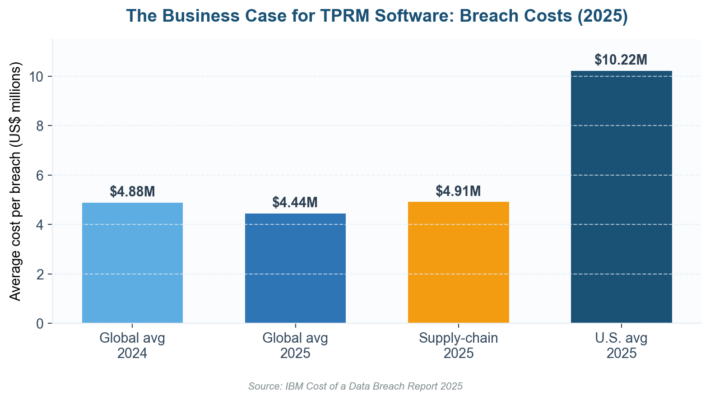
Figure 1. Why third-party risk management software earns its budget: supply-chain and U.S. breach costs in 2025.
Regulators turned what was once good practice into a filing requirement. Frameworks from the EU’s DORA and NIS2 to NYDFS Part 500 and the SEC’s cyber-disclosure rules now demand documented, continuous third-party oversight that no manual process can sustain at scale.
U.S. bank regulators reinforced the point. The 2023 interagency guidance on third-party relationships from the OCC, Federal Reserve, and FDIC set lifecycle expectations that effectively assume a system of record for vendor risk.
The Third-Party Risk Management Software Market: Size and Growth
Spending on third-party risk management software is one of the fastest-growing corners of the governance, risk, and compliance technology market. Analyst estimates differ on scope, but the trajectory is not in dispute.
Public projections put the market near $8.3 billion in 2024, rising toward $18.7 billion by 2030 at roughly a 14.5% compound annual growth rate. Other analyst houses model an even steeper climb, with several forecasting 16% to 18% annual growth through the early 2030s.
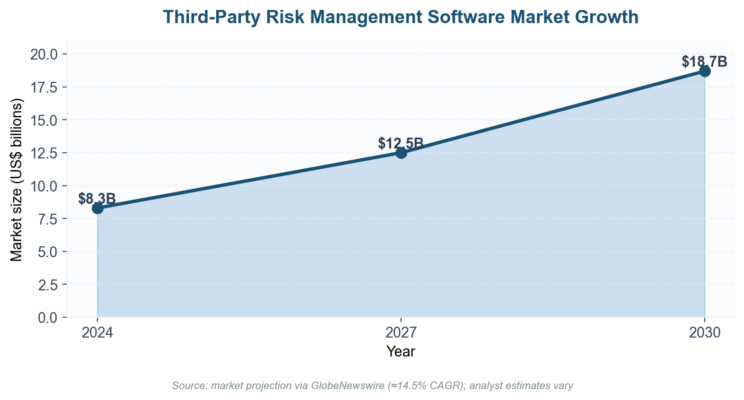
Figure 2. Third-party risk management software market growth, with the caveat that analyst sizing varies widely.
Three forces drive the spend. Regulatory density keeps rising; cyber supply-chain attacks like the Cl0p MOVEit campaign and the Snowflake-customer wave moved vendor risk to the board agenda; and AI now makes continuous monitoring affordable even for mid-market buyers of TPRM software.
The World Economic Forum’s 2025 Global Cybersecurity Outlook named supply-chain interdependence the top barrier to cyber resilience. When 54% of large organizations cite third-party risk as their biggest obstacle, software budgets follow.
The State of Third-Party Risk: Statistics Driving TPRM Software Adoption
The numbers describe a discipline under pressure and a market racing to keep up. They also explain why TPRM software has shifted from a nice-to-have to a control regulators expect to see.
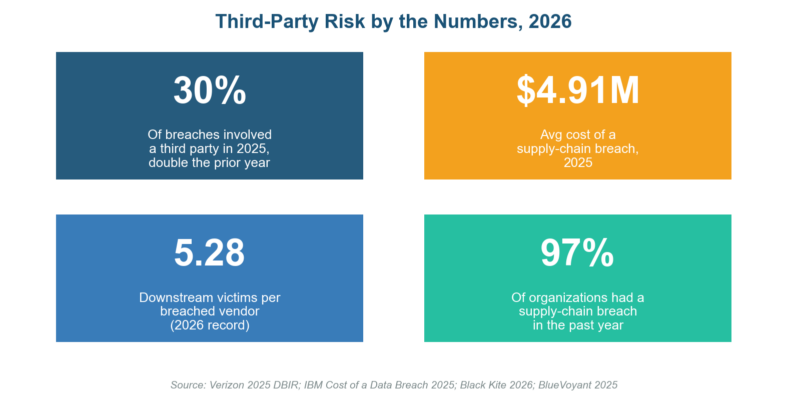
Figure 3. Third-party risk by the numbers: the data behind rising TPRM software investment.
Breach exposure is climbing fast. SecurityScorecard research found 35.5% of 2024 incidents originated through a third party, and that 98% of organizations have a relationship with at least one breached vendor. Cascading failure is now the norm.
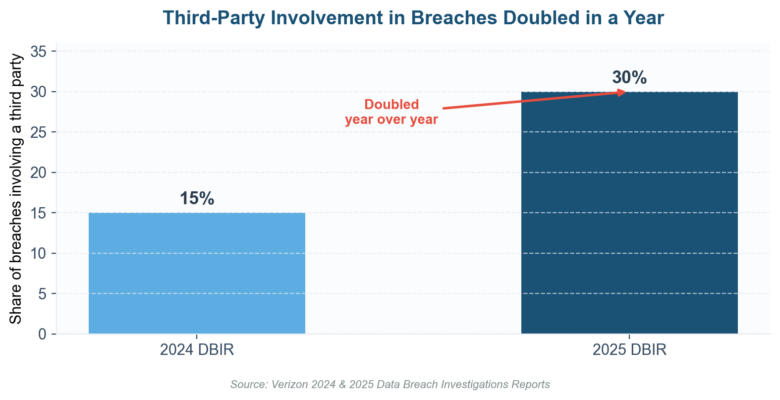
Figure 4. Third-party involvement in breaches doubled between Verizon’s 2024 and 2025 reports.
The newest data is starker still. Black Kite’s 2026 Third-Party Breach Report traced 136 major incidents to 719 named companies and roughly 26,000 downstream victims, a record 5.28 victims per breached vendor, while disclosure delays stretched from 76 to 117 days.
Capacity has not kept pace. Mitratech’s 2025 TPRM study reports that teams actively manage only about 40% of their vendors, 41% still rely on spreadsheets, and roughly 70% describe themselves as understaffed. Only 14% actively use AI, though most are now exploring it.
The workload math is unforgiving. Whistic’s 2025 data shows the average vendor now fields 37.3 assessment requests a month and spends about 179 hours responding, the equivalent of a full-time hire. Automating that load is the clearest return on TPRM software.
How We Evaluated These Third-Party Risk Management Software Platforms
A buyer’s guide is only as trustworthy as its method, so here is ours. We scored each third-party risk management software platform against six weighted criteria, then cross-checked the picks against independent analyst and peer-review sources.
| Evaluation criterion | Weight | What we looked for |
| Risk assessment depth | 20% | Questionnaire libraries, evidence vaults, framework mapping, scoring models |
| Automation and AI | 20% | Auto-scoring, GenAI summarization, workflow automation, anomaly flagging |
| Continuous monitoring | 20% | Cyber ratings, dark-web and financial monitoring, real-time alerts |
| Integrations | 15% | ITSM, GRC, SIEM, ticketing, and API breadth |
| Ease of use and support | 15% | Onboarding, vendor portals, managed services, review sentiment |
| Pricing and transparency | 10% | Published pricing, predictable scaling, time-to-value |
Table 1. The weighted criteria behind our third-party risk management software rankings.
Ratings draw on Gartner’s Peer Insights for TPRM solutions, the Forrester TPRM platforms landscape (Q3 2025) and the Forrester Wave (Q1 2026), G2 review data, and vendor documentation. No vendor paid for placement, and managed-service add-ons were judged separately from core software.
Best Third-Party Risk Management Software: Top 12 Platforms Compared for 2026
The market sorts into four buyer-friendly categories, shown below. Reading the field this way keeps you from comparing a cyber-ratings tool against an enterprise GRC suite as if they solved the same problem.
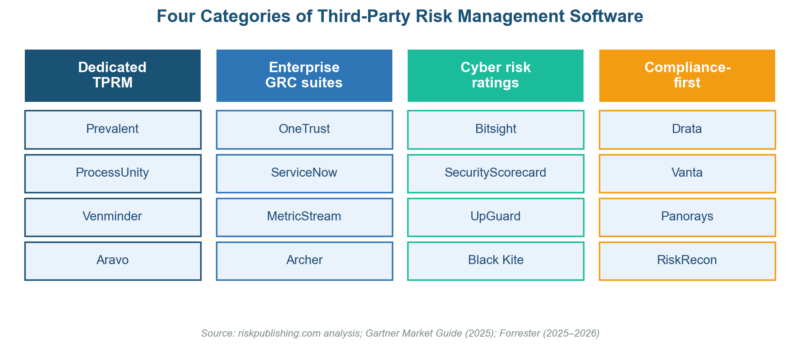
Figure 5. The four categories of third-party risk management software, with representative platforms.
Use the category map to set your shortlist, then read the profiles for fit. Each entry names who the TPRM software serves best, what it does well, and indicative pricing.
1. OneTrust: Best TPRM Software for Multi-Domain GRC
Best for: enterprises that want vendor risk embedded in a broader privacy, ESG, and security platform. OneTrust’s TPRM module sits inside its Trust Intelligence Platform, sharing one data model across domains.
It ships 100-plus pre-built integrations, automated questionnaire distribution, real-time scoring, and built-in regulatory mapping for DORA, GDPR, and the NIST Cybersecurity Framework. The unified model removes the siloed, duplicated assessments that slow large programs.
Pricing: quote-based; expect $50,000 to $250,000-plus annually depending on modules and vendor count.
2. Prevalent (Mitratech): Best TPRM Software for Dedicated Programs With Managed Services
Best for: teams wanting a pure-play TPRM platform plus optional managed services. Acquired by Mitratech in October 2024, Prevalent pairs SaaS workflows with vendor-intelligence networks and analyst-run assessments.
Customers report identifying risks 44% faster and cutting manual work by half. The dual software-plus-services model lets lean teams scale third-party risk management software without hiring a full internal bench.
Pricing: quote-based, available on AWS Marketplace; mid-market to enterprise.
3. ServiceNow: Best TPRM Software for ITSM-Centric Enterprises
Best for: organizations already standardized on ServiceNow that want vendor risk wired into IT workflows. Its TPRM module runs on the Now Platform, linking vendor risk to asset management and incident response.
Native integration eliminates data transfer between systems, and the Now Assist AI automates questionnaire analysis and anomaly detection. ServiceNow was named a Leader in the Forrester Wave for TPRM platforms.
Pricing: enterprise, typically bundled with the GRC or IRM suite; $75,000 to $300,000-plus annually.
4. ProcessUnity: Best TPRM Software for Mature, Automation-Heavy Programs
Best for: established programs that need deep workflow automation and evidence management. ProcessUnity earned a 9.7 of 10 for assessment content on G2 and a perfect 10 for monitoring and alerts.
Configurable lifecycle workflows cover intake, routing, approvals, and reassessments, and its 2024 CyberGRX acquisition added an exchange of pre-completed assessments. It integrates with Bitsight and SecurityScorecard for continuous cyber monitoring.
Pricing: quote-based; noted for predictable ROI.
5. Venminder: Best TPRM Software for Regulated Mid-Market Buyers
Best for: banks, insurers, and healthcare firms needing TPRM software plus control assessments. Venminder blends a SaaS platform with an a-la-carte managed service for SOC report analysis, financial-health reviews, and business-continuity checks.
New users get a dedicated relationship manager, and templates cover information security, business continuity, ESG, and NIST frameworks. It is a strong fit for examiner-ready banking and insurance compliance programs.
Pricing: Professional and Enterprise tiers, quote-based.
6. Panorays: Best TPRM Software for Vendor-Friendly Assessments
Best for: programs that struggle with low questionnaire response rates. Panorays combines external attack-surface scanning with internal assessments to produce a unified score, and its vendor-friendly design lifts completion rates.
Real-time supply-chain mapping extends visibility to fourth-party subcontractors, an increasingly important lens for supply chain risk management under ISO 28000. Continuous monitoring keeps scores current between formal reviews.
Pricing: quote-based; mid-market and enterprise.
7. Bitsight: Best TPRM Software for Cyber Risk Ratings at Scale
Best for: cyber-led teams that need continuous external monitoring without vendor cooperation. Bitsight unifies vendor ratings, exposure management, and threat intelligence, and reports a 75% reduction in assessment time for automated workflows.
Its external attack-surface scanning evaluates a vendor’s security posture from the outside in, so onboarding does not stall waiting on questionnaires. Bitsight is widely deployed across financial services and recognized by Gartner and Forrester.
Pricing: enterprise, quote-based; roughly $40,000 to $200,000-plus by portfolio size.
8. SecurityScorecard: Best TPRM Software for Board-Ready Cyber Ratings
Best for: teams that want instant, communicable vendor security grades. SecurityScorecard rates more than 12 million companies on an A-to-F scale that boards and executives grasp immediately.
Continuous monitoring tracks ten risk-factor groups, from patching cadence to DNS health, and alerts when a vendor’s grade slips. Integrations with ServiceNow, Jira, and Splunk drive automated remediation, supporting a broader cyber security risk management plan.
Pricing: quote-based, with a free self-monitoring tier; enterprise plans from about $25,000 a year.
9. UpGuard: Best TPRM Software for Data-Leak Detection
Best for: IT and security teams that want vendor monitoring plus exposed-data discovery. UpGuard manages risk from onboarding to offboarding and adds a data-leak engine that scans the surface, deep, and dark web for exposed credentials tied to your vendors.
Customizable questionnaires map to NIST, ISO 27001, and SOC 2 versus ISO 27001 requirements, and its pricing is unusually transparent for the category.
Pricing: published, from about $5,999 a year for up to 20 vendors; enterprise scales up.
10. Drata: Best TPRM Software for Compliance-First Growth Companies
Best for: growth-stage firms unifying compliance automation with vendor risk. Drata’s AI-native Trust Management Platform tracks internal controls and third-party risk in one place, with real-time visibility across both.
It is strongest for organizations pursuing SOC 2, ISO 27001, HIPAA, or PCI DSS that also assess vendors against the same frameworks. Automated evidence collection makes it usable by teams without dedicated TPRM specialists.
Pricing: Growth, Business, and Enterprise tiers, from roughly $10,000 a year.
11. Black Kite: Best TPRM Software for Financial-Risk Quantification
Best for: programs that want third-party cyber risk expressed in dollars, not letter grades. Black Kite pairs technical ratings with an Open FAIR-based financial model and a compliance-correlation view across frameworks.
Its 2026 breach research, cited throughout this guide, reflects unusually deep visibility into cascading vendor incidents. The platform is a frequent addition alongside a primary ratings tool for buyers who need quantified exposure.
Pricing: quote-based; mid-market to enterprise.
12. Vanta: Best TPRM Software for Startups Scaling Compliance
Best for: startups and scale-ups bolting vendor risk onto fast compliance automation. Fresh off a 2025 funding round that valued it at $4.15 billion, Vanta added an AI agent that drafts assessments and surfaces vendor gaps.
It suits teams that adopted Vanta for SOC 2 or ISO 27001 and want vendor reviews in the same console. Depth trails the dedicated platforms, but time-to-value is hard to beat for smaller TPRM software buyers.
Pricing: tiered and quote-based; accessible for early-stage teams.
Beyond the top 12, you will also encounter Aravo and Riskonnect on the enterprise GRC side, Archer and MetricStream in large financial institutions, RiskRecon (Mastercard) among cyber-ratings tools, and Whistic for assessment exchange. Each can be the right third-party risk management software for a specific stack.
Third-Party Risk Management Software Comparison Matrix
The table below distills our picks for the best third-party risk management software into a side-by-side view. Use this matrix to scan the field at a glance, then dig into the profiles for the two or three platforms that fit your category and budget. Analyst recognition reflects the latest Gartner and Forrester cycles.
| Platform | Best for | Primary domains | Continuous monitoring | Pricing tier |
| OneTrust | Multi-domain GRC | Cyber, privacy, ESG | Yes | Enterprise ($50K+) |
| Prevalent (Mitratech) | Dedicated TPRM + services | Cyber, financial, compliance | Yes + intel network | Mid to enterprise |
| ServiceNow | ITSM-integrated risk | Cyber, IT, compliance | Yes (Now Assist AI) | Enterprise ($75K+) |
| ProcessUnity | Mature, automated programs | Cyber, compliance, ops | Via integrations | Mid to enterprise |
| Venminder | Regulated mid-market | Cyber, financial, BCM | Via Exchange | Mid-market |
| Panorays | Vendor-friendly assessments | Cyber, supply chain | Yes + fourth-party | Mid to enterprise |
| Bitsight | Cyber ratings at scale | Cyber, exposure | Continuous | Enterprise ($40K+) |
| SecurityScorecard | Board-ready ratings | Cyber (10 factors) | Continuous (A–F) | Free tier + enterprise |
| UpGuard | Data-leak detection | Cyber, data leaks | Continuous + dark web | From $5,999/yr |
| Drata | Compliance-first | Cyber, compliance | Yes | From ~$10K/yr |
| Black Kite | Financial-risk quantification | Cyber, financial (FAIR) | Continuous | Mid to enterprise |
| Vanta | Startups scaling compliance | Cyber, compliance | Yes (AI agent) | Tiered / quote |
Table 2. Third-party risk management software comparison matrix for 2026.
How to Evaluate Third-Party Risk Management Software: The Vendor Risk Lifecycle
The fastest way to judge any third-party risk management software is to map its features against the six-stage vendor lifecycle. A platform that shines at monitoring but stumbles at intake will still leave gaps where risk slips in.
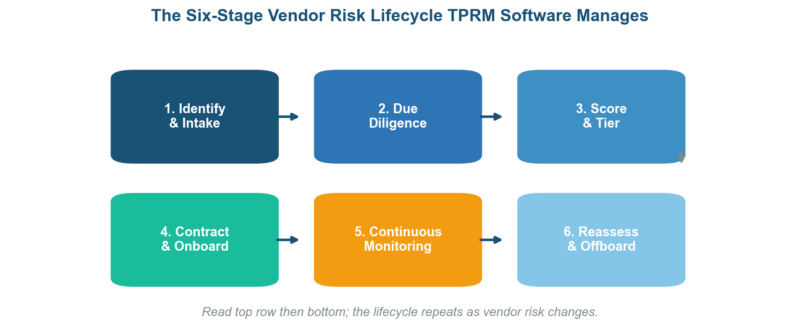
Figure 6. Map third-party risk management software against the six-stage vendor risk lifecycle.
| Lifecycle stage | What happens | Key software features |
| 1. Identify & intake | Vendors are catalogued and risk-tiered | Intake portals, auto-categorization, inherent risk scoring |
| 2. Due diligence | Questionnaires and evidence collected | Questionnaire libraries, evidence vaults, vendor portals |
| 3. Score & tier | Responses scored; residual risk set | Configurable scoring, risk matrices, benchmarking |
| 4. Contract & onboard | Risk terms embedded; SLAs tracked | Contract management, obligation monitoring |
| 5. Continuous monitoring | Ongoing posture and news surveillance | Cyber ratings, dark-web and financial monitoring |
| 6. Reassess & offboard | Periodic review; structured exit | Reassessment workflows, data-destruction verification |
Table 3. The vendor risk lifecycle and the TPRM software features that support each stage.
Due diligence and continuous monitoring are where automation pays off most; together they consume the bulk of program effort. A vendor risk assessment questionnaire template shows the manual baseline that good TPRM software is meant to replace. Monitoring matters because customers and regulators rarely distinguish a supplier failure from your own, which is why supplier conduct becomes your reputational problem.
How to Choose the Right Third-Party Risk Management Software
Selection comes down to three variables: vendor-portfolio size, your primary risk domains, and program maturity. Match those to the framework below before you book a single demo. Strong platforms also support critical supplier identification and tiering so you can focus effort where it matters most.
There is no single best third-party risk management software for every organization; the best third-party risk management software is the one that matches your portfolio size, risk domains, and program maturity. Use the matrix below to shortlist the right fit.
| If your program is… | Your priority is… | Consider these platforms |
| Startup (<100 vendors) | Fast deployment, compliance-first | Vanta, Drata, UpGuard |
| Developing (100–1,000 vendors) | Automation, managed services | Venminder, Prevalent, ProcessUnity |
| Advanced (1,000+ vendors) | Enterprise integration, AI, depth | OneTrust, ServiceNow, Bitsight |
| Cyber-focused (security-led) | Continuous external monitoring | Bitsight, SecurityScorecard, Black Kite |
Table 4. A decision framework for choosing third-party risk management software.
A worked example makes it concrete. When a 400-person healthcare SaaS firm evaluated TPRM software in late 2025, it was tracking 180 vendors in a spreadsheet and burning 22 hours a week on questionnaire follow-ups.
It chose Venminder for the managed-service model and healthcare templates. Within 90 days, follow-up time fell to six hours a week, and its SOC 2 auditor flagged the automated evidence trail as the single biggest improvement in the vendor program.
Whichever tool wins, feed its output into your wider program. Vendor risk belongs in the enterprise risk register and the broader GRC framework, not in a standalone silo only the procurement team ever reads. For many organisations that means consolidating vendor risk into the same enterprise risk management software that runs the rest of the risk register.
Building the Business Case for Third-Party Risk Management Software
Finance will ask what the platform returns, so quantify it before the meeting. The case for third-party risk management software rests on three measurable levers: labor saved, breaches avoided, and audits passed faster.
Start with labor. If analysts spend 179 hours a month chasing assessments and your blended cost is about $116,000 per TPRM hire, automating even half of that workload frees roughly a full-time equivalent, often more than the software’s annual license.
Then weigh loss avoidance. Against a $4.91 million average supply-chain breach, a platform that catches one material vendor failure a year pays for itself many times over, before counting regulatory penalties or lost customers.
| A quick TPRM software ROI sketch
• Labor saved: automate 50% of 179 monthly assessment hours ≈ 1 FTE (~$116K/year) recovered. • Risk reduced: one avoided supply-chain breach ≈ $4.91M in expected loss removed from the books. • Audit speed: automated evidence collection cuts examiner-prep time and the consulting hours that go with it. • Coverage gained: moving from 40% to 90%+ of vendors monitored closes the gaps where breaches start. |
Implementing Third-Party Risk Management Software: A 90-Day Rollout
Buying the platform is the easy part; a disciplined rollout is what earns the ROI. Most successful third-party risk management software deployments follow a three-phase, 90-day arc rather than a big-bang launch.
- Foundation (days 1–30): import the vendor inventory, define risk tiers, and integrate the platform with your ITSM, procurement, and SIEM systems so data flows automatically.
- Critical vendors first (days 31–60): run full assessments on your tier-one and tier-two vendors, turn on continuous monitoring, and route findings to named risk owners.
- Scale and report (days 61–90): extend assessments to the long tail, automate reassessment schedules, and stand up the board dashboard that ties vendor risk to key risk indicators.
Two habits separate programs that stick from those that stall. Assign every vendor a first-line owner so accountability is never ambiguous, and connect the rollout to supply-chain key risk indicators so monitoring drives action rather than dashboards nobody reads.
Third-Party Risk Management Software Trends Shaping 2026–2028
The category is moving quickly, and four shifts will define the next buying cycle. Reading them now keeps a 2026 purchase from feeling dated by 2027.
Agentic AI Is the New TPRM Software Differentiator
Gartner’s 2025 Market Guide named embedded AI the top competitive differentiator. Leading platforms now auto-score questionnaires, flag inconsistencies against external data, and draft risk summaries, with vendors like Drata, Vanta, and Panorays moving toward autonomous, agentic monitoring.
Continuous Monitoring Becomes the TPRM Software Default
The shift from annual questionnaires to continuous monitoring is accelerating, pushed by DORA’s ongoing-surveillance mandate. Organizations that rely solely on point-in-time assessments will be out of step with multiple frameworks well before 2027. Continuous monitoring also underpins effective supplier performance risk management.
Fourth-Party Risk Pushes TPRM Software Deeper
Your vendors have vendors. Platforms like Panorays and Black Kite now map dependencies beyond the direct relationship, and the MOVEit and Snowflake-customer waves showed how a single upstream flaw can cascade across thousands of organizations at once.
TPRM Software Converges With Enterprise Risk Management
Vendor risk is being pulled into broader enterprise risk management platforms and risk registers, giving CROs one view across operational, financial, and strategic risk. The convergence reflects ISO 31000 principles of integrated, not siloed, risk management.
Frequently Asked Questions About Third-Party Risk Management Software
What is third-party risk management software?
Third-party risk management software is a platform that automates how organizations identify, assess, monitor, and offboard the risks created by vendors, suppliers, and service providers. It centralizes questionnaires, evidence, risk scoring, and continuous monitoring in one system, replacing the spreadsheets and email chains most programs outgrow as their vendor count rises.
How much does TPRM software cost?
Pricing spans a wide range. Entry-level platforms such as UpGuard start near $5,999 a year for small portfolios, mid-market tools like Venminder and Drata run roughly $10,000 to $75,000, and enterprise suites such as OneTrust and ServiceNow typically cost $50,000 to $300,000-plus depending on modules, vendor count, and managed services.
What is the difference between TPRM software and VRM software?
Vendor risk management (VRM) software usually focuses on the cyber and operational risk of individual suppliers, while third-party risk management software takes the broader view across cyber, financial, compliance, ESG, and concentration risk for every external relationship. In practice the terms overlap, and many buyers searching for VRM need full TPRM software.
What are the stages of the vendor risk lifecycle?
Most third-party risk management software organizes work into six stages: identification and intake, due diligence and assessment, risk scoring and tiering, contracting and onboarding, continuous monitoring, and reassessment and offboarding. Mapping a platform’s features against these stages is the clearest way to spot coverage gaps before you buy.
Can TPRM software replace manual vendor assessments?
Not entirely, but it can automate 60% to 80% of the workflow. Platforms handle questionnaire distribution, evidence collection, scoring, and monitoring, while human judgment is still needed to interpret complex scenarios, negotiate contractual controls, and make accept-or-reject calls on critical vendors. The goal is to free analysts for judgment, not to remove them.
How often should vendors be reassessed?
Critical and high-risk vendors are typically reassessed annually, with continuous monitoring running in between, while lower-tier vendors may be reviewed every two to three years. The strength of modern TPRM software is that continuous monitoring replaces the long gaps between formal reviews, surfacing posture changes the moment they happen rather than at the next cycle.
Which TPRM software is best for financial services?
Financial institutions usually need deep regulatory mapping for OCC, FFIEC, DORA, and NYDFS, managed services for audit readiness, and continuous monitoring. Prevalent, Venminder, and ServiceNow are the most commonly deployed in banking and insurance, often paired with Bitsight, SecurityScorecard, or Black Kite for continuous cyber-risk ratings.
Is third-party risk management software worth it for a small team?
For most teams managing more than a few dozen vendors, yes. Once assessment volume exceeds what a person can track in a spreadsheet, the labor saved and breaches avoided usually outweigh the license cost, especially with transparent entry-level tools. Smaller teams often start with a compliance-first platform like Vanta or Drata and expand later.
The Bottom Line on Third-Party Risk Management Software
The Change Healthcare lesson is that your worst breach may never touch your own network. With third-party involvement in breaches now doubling year over year, manual vendor oversight has become the gap attackers and examiners both exploit.
The right third-party risk management software is the one matched to your vendor count, risk domains, and maturity, not the one with the longest feature list. Shortlist by category, weigh automation and continuous monitoring heavily, and insist on transparent pricing before you commit. That principle is the spine of our guide to the criteria that should decide a purchase, written to be used before any demo is booked.
Above all, treat the platform as one part of a connected program. Vendor failures are also a continuity trigger, so the strongest programs connect TPRM to their business continuity management software as well. Tools fail without named owners, a continuous cadence, and a link to the wider risk framework, but a well-chosen TPRM software turns vendor risk from a blind spot into a managed, board-visible discipline.
Strengthen Your Third-Party Risk Management Program
Choosing the best third-party risk management software is one of the highest-leverage decisions a modern risk program can make, but the tool is only as strong as the process behind it.
riskpublishing.com helps US risk officers, procurement leaders, and security teams build third-party risk programs to a 2026 examiner standard. Explore our third-party risk management framework for 2026, compare vendor risk management platforms, and align controls with our guides to compliance management software, incident management tools, and NIST CSF versus ISO 27001.

Chris Ekai is a Risk Management expert with over 10 years of experience in the field. He has a Master’s(MSc) degree in Risk Management from University of Portsmouth and is a CPA and Finance professional. He currently works as a Content Manager at Risk Publishing, writing about Enterprise Risk Management, Business Continuity Management and Project Management.