On the morning of July 19, 2024, CrowdStrike pushed a faulty update to its Falcon sensor and crashed about 8.5 million Windows machines, the largest IT outage in history. Airlines, hospitals, banks, and broadcasters went dark at the same moment.
The outage was identical for every airline, but the recovery was not. Delta cancelled more than 7,000 flights over five days and put the cost at $500 million, while American and United were flying normally within a day or two.
That gap is what a business continuity maturity model measures. It scores how prepared an organization actually is to keep running through a shock, on a ladder from ad hoc to optimized, so the weakness shows up on a scorecard instead of on the evening news.
| Business Continuity Maturity Model: Key Takeaways |
| A business continuity maturity model rates how developed and reliable a BCM program is on a five-level scale, from ad hoc to optimized, turning a vague sense of readiness into a score you can track. |
| The 2024 CrowdStrike outage proved the point: the same shock hit every airline, but Delta’s six-day recovery and $500 million loss exposed a maturity gap that rivals recovering in a day did not have. |
| Maturity is capability, not paperwork. An untested plan scores level two, not four, no matter how complete the binder looks on a shelf. |
| A business continuity maturity model scores several dimensions, governance, business impact analysis, strategy, plans, exercising, and improvement, then targets the weakest rather than an average. |
| The target is rarely level five everywhere; it is the maturity each process needs given its criticality and the organization’s risk appetite, and the gap to target becomes the funded roadmap. |
| Anchor the model to ISO 22301, ISO 22313, and the BCI Good Practice Guidelines so the scores mean the same thing to an auditor, a regulator, and the board. |
What a Business Continuity Maturity Model Is
A business continuity maturity model is a framework that rates how developed and reliable an organization’s continuity program is, usually on a five-level scale from initial to optimized. It turns a vague sense of readiness into a score you can compare, track, and defend.
Maturity is about capability, not paperwork. A binder of untested plans can look complete and still collapse on contact, so a business continuity maturity model asks whether the program works under pressure, the way the CrowdStrike outage tested it without warning.
Business Continuity Maturity Model vs a Compliance Checklist
A compliance checklist asks whether a control exists. A business continuity maturity model asks how well it works and whether it improves over time. One ticks a box for a recovery plan, while the other asks when it was last exercised and what broke.
| Question | Compliance checklist | Business continuity maturity model |
| What it asks | Does a control exist? | How well does it work, and is it improving? |
| Evidence | A document on file | Exercise results, metrics, and incident history |
| Output | Pass or fail | A level from one to five per dimension |
| Use | Prove compliance once | Track readiness and target the weakest area |
Treat the checklist as the floor. ISO 22301 certification proves a management system exists, but a business continuity maturity model shows whether that system is merely defined or actively managed, a distinction our ISO 22301 guide draws out.
Why a Business Continuity Maturity Model Matters: The CrowdStrike Lesson
Resilience is now a financial line item. Delta’s $500 million loss came not from the outage itself, which hit everyone, but from a recovery that lagged its rivals by days, the exact gap a business continuity maturity model surfaces before the incident.
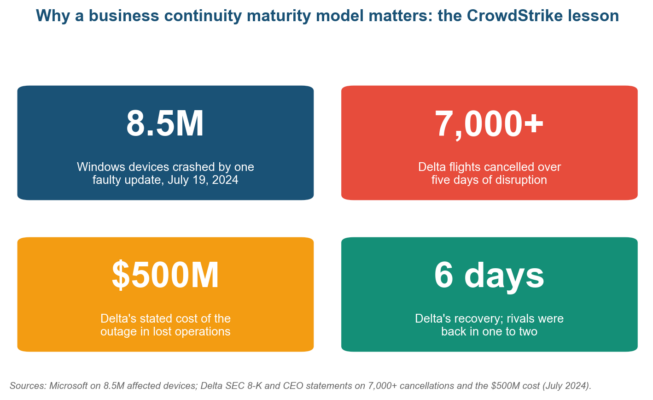
Figure 1. The CrowdStrike numbers that turned business continuity maturity into a board question.
The cause was a single point of failure. Delta’s crew-tracking system could not catch up once thousands of pilots and flight attendants were out of position, a level-two weakness hiding inside an otherwise large program.
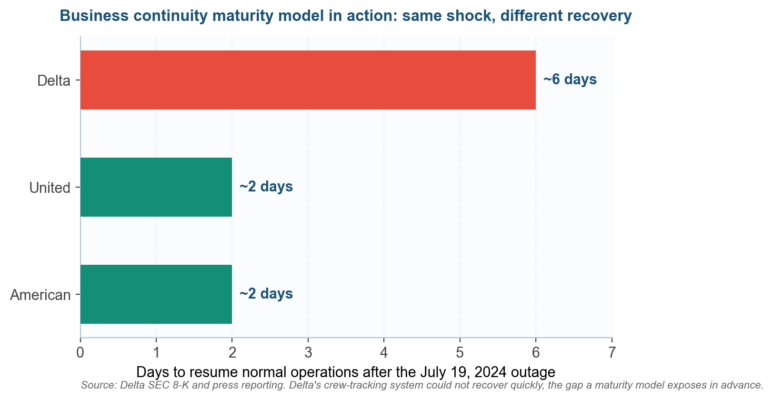
Figure 2. Same shock, different recovery, the difference a business continuity maturity model predicts.
Maturity predicts recovery time. The carriers that bounced back in a day had tested failover and current recovery procedures, while the one that took six had plans on paper that had never met an actual disruption.
The Five Levels of a Business Continuity Maturity Model
Most business continuity maturity models use five levels borrowed from CMMI, climbing from ad hoc to continuous improvement. Each level describes how an organization plans, tests, and recovers, and where it is likely to break.
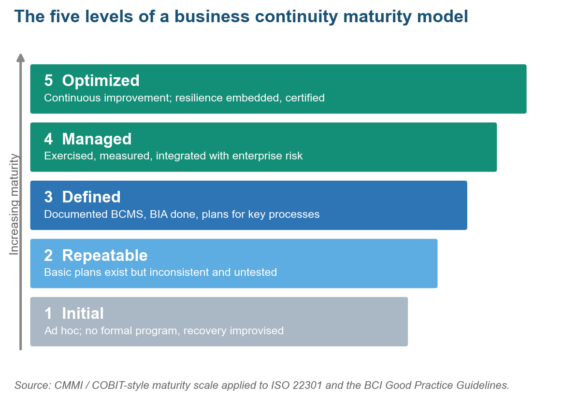
Figure 3. The five levels of a business continuity maturity model, from ad hoc to optimized.
| Level | What the program looks like | Recovery reality |
| 1 Initial | No formal program; continuity is ad hoc | Improvised, slow, and dependent on individuals |
| 2 Repeatable | Basic plans exist but are inconsistent and untested | Works sometimes, fails under a novel shock |
| 3 Defined | Documented BCMS, BIA complete, plans for key processes | Predictable for known scenarios |
| 4 Managed | Exercised, measured, integrated with enterprise risk | Fast and proven against real disruption |
| 5 Optimized | Continuous improvement; resilience embedded and certified | Recovers with minimal loss and adapts |
Be honest about the jump from three to four. A program reaches level four only when it is exercised and measured, not when the plans are merely written, which is where many large organizations quietly stall.
What a Business Continuity Maturity Model Scores
A business continuity maturity model does not score one number; it scores several dimensions and finds the weakest. A program can be strong on governance and weak on exercising, and a single average would hide the gap that fails it.
| Dimension | Low maturity (level 1-2) | High maturity (level 4-5) |
| Leadership and governance | No owner, no policy, no budget | Board-sponsored, resourced, accountable |
| Business impact analysis | Guesswork or none | Quantified RTOs and RPOs, reviewed yearly |
| Risk assessment | Informal, undocumented | Linked to the risk register and treatment |
| Strategy and solutions | Hope and a backup tape | Tested failover matched to the BIA |
| Plans and procedures | Generic, out of date | Specific, current, version-controlled |
| Training and exercises | Rare or never | Scheduled, scenario-based, and measured |
Score each dimension on its own evidence. Business impact analysis, recovery strategy, and exercising tend to lag governance and policy, so the business impact analysis deserves as hard a look as the org chart.
How to Run a Business Continuity Maturity Model Assessment
The assessment is a repeatable cycle you re-run on a cadence. Six steps take a business continuity maturity model from picking the scale to tracking the gap to target over time.
| Step | Action | Output |
| 1. Define | Set the dimensions and a 1-to-5 scale | An anchored scoring rubric |
| 2. Gather | Collect plans, BIA, exercises, and metrics | An evidence pack per dimension |
| 3. Score | Rate current maturity on proof, not opinion | A current-state profile |
| 4. Target | Set the level each dimension needs | A target profile by criticality |
| 5. Roadmap | Turn each gap into owned, dated actions | A prioritized improvement plan |
| 6. Re-assess | Re-score on a cadence and after events | A maturity trend over time |
Step one decides everything downstream. Anchor the scale to ISO 22301 and the BCI Good Practice Guidelines so the scores mean the same thing across business units and over time.
Scoring Current and Target State in a Business Continuity Maturity Model
Score the current state first, then set a target for each dimension. The target is rarely level five everywhere; it is the maturity each process needs given its criticality and the organization’s risk appetite.
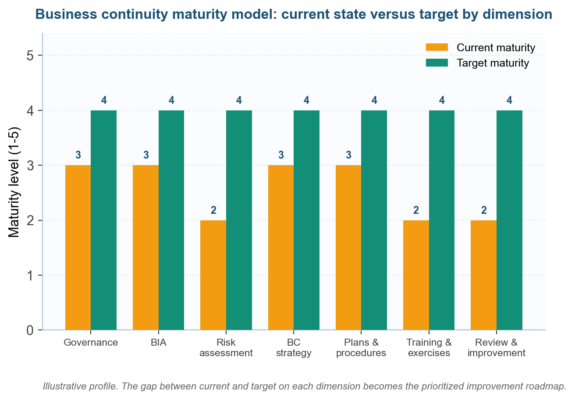
Figure 4. A business continuity maturity model compares current and target maturity to expose the gap.
The gap is the roadmap. The distance between current and target on each dimension becomes a prioritized list of funded actions, which keeps a business continuity maturity model from being a score that changes nothing and ties it to the risk management lifecycle.
Standards Behind a Business Continuity Maturity Model
Recognized standards give a business continuity maturity model its authority. A handful of references, listed below, define the levels and dimensions so the score holds up under challenge from an auditor or a board.
| Standard | Scope | Role in the model |
| ISO 22301 | Business continuity management systems | The requirements maturity is scored against |
| ISO 22313 | Guidance on applying ISO 22301 | What good looks like at each level |
| BCI Good Practice Guidelines | Professional BC practice | The dimensions and lifecycle to assess |
| NIST SP 800-34 | Contingency planning for systems | IT recovery depth behind the score |
ISO 22301 supplies the management-system requirements, while the BCI guidelines and ISO 22313 supply the practice detail. Together they let a business continuity maturity model speak to an auditor, a regulator, and a board in one language, the same way ISO 31000 frames enterprise risk.
Regulated sectors raise the floor. The FFIEC business continuity booklet expects financial institutions to demonstrate a mature, tested program, so business continuity maturity is a supervisory expectation there, not just good practice.
Frequently Asked Questions About the Business Continuity Maturity Model
What is a business continuity maturity model?
A business continuity maturity model is a framework that rates how developed and reliable an organization’s continuity program is, usually on a five-level scale from initial to optimized. It scores several dimensions on evidence rather than paperwork, so leaders can see how ready the organization actually is and where to invest first.
What are the levels of a business continuity maturity model?
Most business continuity maturity models use five levels: initial or ad hoc, repeatable, defined, managed, and optimized. The scale climbs from improvised recovery with no formal program to a tested, measured, continuously improving program, mirroring the CMMI maturity levels applied to ISO 22301.
How do you assess business continuity maturity?
Define the dimensions and a one-to-five scale, gather evidence such as plans, BIA results, and exercise reports, then score each dimension on proof. Set a target level per dimension, build a roadmap from the gaps, and re-assess on a cadence. A business continuity maturity model is a cycle, not a one-time audit.
What is the difference between a business continuity maturity model and ISO 22301?
ISO 22301 is the standard that defines the requirements for a business continuity management system, while a business continuity maturity model measures how well an organization meets and exceeds them over time. Certification proves the system exists; the maturity model shows whether it is merely defined or genuinely managed and improving.
What dimensions does a business continuity maturity model score?
A business continuity maturity model typically scores leadership and governance, business impact analysis, risk assessment, strategy and solutions, plans and procedures, training and exercises, and review and improvement. Scoring each separately exposes the weakest dimension, which a single overall average would otherwise hide from decision-makers.
What target level should a business continuity maturity model aim for?
The target is rarely level five across the board. A business continuity maturity model sets each dimension’s target by how critical the process is and the organization’s risk appetite, so a mission-critical service may need level four or five while a minor function is fine at level three. Over-investing everywhere wastes budget.
How often should a business continuity maturity model be reassessed?
Reassess a business continuity maturity model at least annually, and after every major exercise, incident, merger, or technology change. Maturity slides back when programs are not re-measured, which is why the CrowdStrike outage caught organizations whose last honest assessment was years out of date.
Where Business Continuity Maturity Model Assessments Fail
Failed maturity assessments tend to fail in the same few ways. The table pairs each common trap with the fix that exercises and past incidents keep validating.
| Pitfall | Root cause | Remedy |
| Scoring on paperwork | Plans counted as maturity | Score on tested evidence, not documents |
| Inflated self-scores | No independent challenge | Validate scores with exercises and review |
| One average number | Dimensions collapsed into a single score | Score each dimension and target the weakest |
| Level five everywhere | No link to criticality | Set targets by risk appetite and impact |
| A score with no roadmap | Assessment ends at the rating | Turn every gap into an owned, dated action |
| Assess once and forget | No reassessment cadence | Re-score yearly and after exercises or events |
Inflated self-scores cause the most surprise on the day. A program that rates itself level four on paper but has never been exercised is a level two in practice, the gap that one honest exercise of the continuity plan exposes.
The Business Continuity Maturity Model Horizon: 2026 and Beyond
Regulators are turning maturity into a requirement. Operational resilience rules in banking and the aftermath of CrowdStrike are pushing boards to evidence a tested program, so a business continuity maturity model is becoming a board-level reporting artifact.
Concentration risk is reshaping the scoring. The outage showed how one vendor can take down thousands of organizations at once, so a modern business continuity maturity model now weighs third-party and operational risk far more heavily than a decade ago.
Continuous assurance is replacing the annual review. Automated evidence collection and live recovery testing let organizations track maturity in closer to real time, rather than discovering during an incident that the score had quietly decayed.
The lasting lesson is the one Delta paid $500 million to learn. Treat a business continuity maturity model as a living measure, scored on tested evidence and re-checked on change, and the weak dimension shows up on a dashboard long before it shows up at a gate full of stranded passengers.
Infographic: The Business Continuity Maturity Model Lifecycle
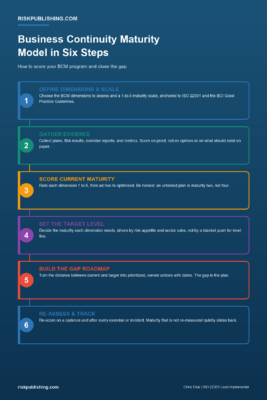
Figure 5. A business continuity maturity model as a six-step loop from scale to score to funded roadmap.
Raise Your Business Continuity Maturity Model Score
Risk Publishing helps US organizations score and level up a business continuity maturity model, from the business impact analysis to the tested plans behind it. See our services, then contact us when your business continuity maturity model needs to show real readiness, not a binder on a shelf.

Chris Ekai is a Risk Management expert with over 10 years of experience in the field. He has a Master’s(MSc) degree in Risk Management from University of Portsmouth and is a CPA and Finance professional. He currently works as a Content Manager at Risk Publishing, writing about Enterprise Risk Management, Business Continuity Management and Project Management.