In December 2020, the security firm FireEye traced its own breach to an unlikely source: a routine software update from SolarWinds, a network-monitoring vendor trusted inside thousands of corporate and government networks. Attackers had hidden a backdoor, later named SUNBURST, in the Orion update itself.
About 18,000 organizations installed the poisoned update, and roughly nine US federal agencies were compromised, including the Treasury and Commerce departments. The backdoor sat undetected for months, because it arrived as trusted code, signed and delivered through the vendor’s own pipeline.
SolarWinds is the case that made NIST supply chain risk management a federal priority. Known as C-SCRM, it secures the software, hardware, and vendors an organization depends on, and NIST codified it in Special Publication 800-161.
| NIST Supply Chain Risk Management: Key Takeaways |
| NIST supply chain risk management, known as C-SCRM, reduces the cyber risk an organization inherits from its software, hardware, and vendors, on the assumption that a trusted supplier can become the attack path. |
| The 2020 SolarWinds attack is the defining case: a poisoned Orion update reached about 18,000 organizations and compromised roughly nine US federal agencies while sitting undetected for months. |
| NIST codified the response in SP 800-161 Revision 1, a multi-level framework with about 20 practices, after Executive Order 14028 mandated software bills of materials for federal suppliers. |
| C-SCRM runs on three levels: enterprise strategy, mission and business-process policy, and operational controls such as SBOMs and supplier assessments at the system. |
| The NIST 800-53 Supply Chain Risk (SR) control family supplies the specific safeguards, and the NIST Cybersecurity Framework and RMF tie C-SCRM to the wider security program. |
| Acquisition is the cheapest place to act: writing C-SCRM requirements into contracts before onboarding beats bolting controls onto software already running in production. |
What NIST Supply Chain Risk Management Is
NIST supply chain risk management, or C-SCRM, is the discipline of identifying and reducing the cyber risk an organization inherits from its suppliers, software, and components. It assumes that a trusted vendor can become the attack path, the way SolarWinds did.
The scope is wider than most teams expect. C-SCRM covers commercial software, open-source dependencies, hardware and firmware, cloud services, and the fourth parties behind your vendors, anywhere a compromise can ride into your environment.
C-SCRM vs Traditional Third-Party Risk Management
Traditional third-party risk management screens a vendor’s business health and compliance. NIST supply chain risk management goes deeper into the technology itself, asking how the software was built, what it is made of, and whether its integrity can be verified.
| Dimension | Third-party risk management | NIST supply chain risk management (C-SCRM) |
| Focus | Vendor finances and compliance | Software, hardware, and code integrity |
| Key question | Is the vendor reputable? | Can the product’s provenance be verified? |
| Core artifact | A risk questionnaire | A software bill of materials (SBOM) |
| Reach | The direct supplier | Open-source and fourth parties too |
The two are complements, not rivals. A third-party risk management framework handles the contract and the questionnaire, while C-SCRM handles the code, the build pipeline, and the bill of materials behind it.
Why NIST Supply Chain Risk Management Matters: The SolarWinds Lesson
The damage from a supply chain attack multiplies. One compromised vendor handed the attackers a path into thousands of networks at once, a scale of access the GAO documented across federal and private targets.
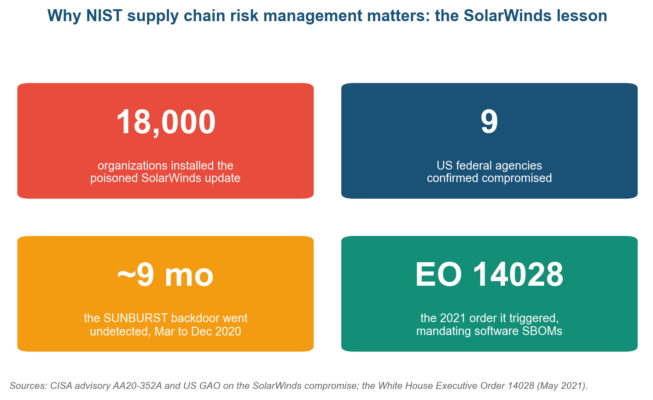
Figure 1. The SolarWinds numbers that made NIST supply chain risk management a federal mandate.
Washington responded with mandates. Executive Order 14028, signed in May 2021, required software bills of materials for federal suppliers, and NIST issued SP 800-161 Revision 1 a year later to operationalize C-SCRM.
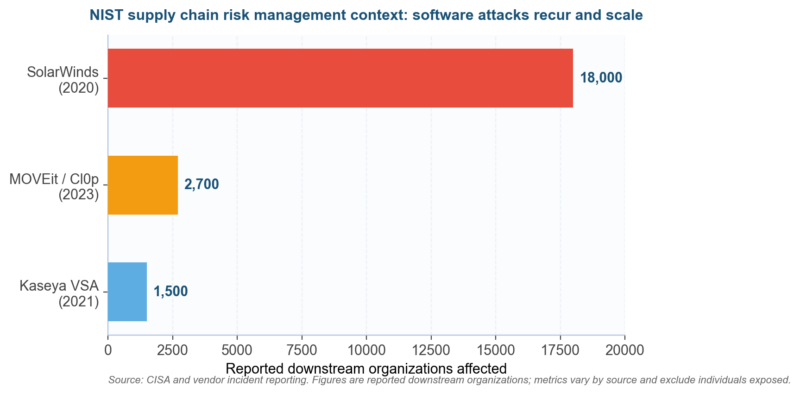
Figure 2. Software supply chain attacks recur and scale, the threat NIST supply chain risk management addresses.
The pattern did not stop with SolarWinds. The 2023 MOVEit breach cascaded through more than 2,700 organizations, and a 2024 backdoor in the open-source XZ utility was caught only days before it shipped widely.
The Three Levels of NIST Supply Chain Risk Management
NIST supply chain risk management runs on three levels, so strategy and operations stay connected. The model pushes risk decisions up to executives and pushes controls down to the systems where suppliers actually touch the environment.
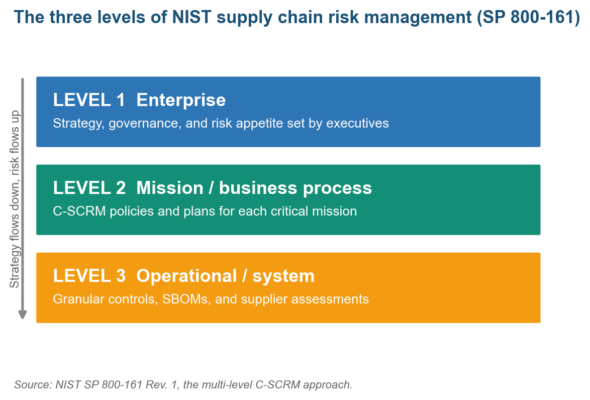
Figure 3. The three levels of NIST supply chain risk management under SP 800-161.
| Level | Focus | Key outputs |
| 1. Enterprise | Strategy, governance, risk appetite | C-SCRM strategy and policy |
| 2. Mission / business | C-SCRM for each critical mission | Process-level plans and requirements |
| 3. Operational / system | Granular controls at the system | SBOMs, supplier assessments, SR controls |
Most programs fail by living on one level only. A policy with no operational SBOM checks is theater, and granular controls with no executive mandate run out of budget, so a C-SCRM program has to occupy all three at once.
Core Practices in NIST Supply Chain Risk Management
SP 800-161 turns the levels into about 20 practices across organizational, acquisition, and operational categories. They give NIST supply chain risk management a concrete to-do list rather than a principle to admire.
| Practice area | What NIST supply chain risk management requires |
| Strategy and policy | A documented C-SCRM strategy with an executive owner |
| Supplier inventory | A current map of suppliers, software, and components |
| Acquisition and contracts | Security requirements written into purchasing terms |
| Provenance and integrity | Verified origin and tamper checks for code and hardware |
| SBOM and vulnerability | A bill of materials and tracking of known weaknesses |
| Monitoring and response | Continuous supplier monitoring and a breach response plan |
Acquisition is where a program gets the most return. Building C-SCRM requirements into contracts and purchasing, before a vendor is onboarded, costs far less than bolting controls on after the software is already running in production, the lesson behind every vendor risk questionnaire that arrives too late.
How to Implement NIST Supply Chain Risk Management
Implementation follows the NIST Risk Management Framework, adapted for suppliers. Six steps take NIST supply chain risk management from an enterprise strategy to continuous monitoring of the vendors that matter most.
| Step | Action | Output |
| 1. Frame | Set C-SCRM strategy and governance | A strategy with an executive owner |
| 2. Map | Inventory suppliers, software, components | A supplier and component register |
| 3. Assess | Score cyber risk per supplier and part | Ranked supply chain risk scores |
| 4. Control | Apply the 800-53 SR control family | A control plan and residual score |
| 5. Verify | Require SBOMs and monitor continuously | Verified provenance and live monitoring |
| 6. Respond | Plan, exercise, and re-assess on change | A tested supplier-incident playbook |
Start by mapping what you actually depend on. You cannot secure a software component or a fourth-party vendor you have never inventoried, which is why discovery comes before any control or supply chain key risk indicator.
Scoring Supplier Cyber Risk in NIST Supply Chain Risk Management
Score each supplier and component on cyber risk, combining likelihood and impact with how critical it is to the mission. Standardize inputs with our NIST vendor assessment questionnaire. Apply the controls, re-score the residual, and the program can prove a fix reduced exposure rather than just adding paperwork.
| Scenario | L | I | Risk | Top control |
| Compromised software update | 10 | 10 | 100 | SBOM, build-integrity checks, monitoring |
| Vulnerable open-source dependency | 10 | 8 | 80 | Dependency scanning and patch SLAs |
| Counterfeit or tampered hardware | 8 | 8 | 64 | Provenance and authorized resellers |
| Over-privileged vendor access | 9 | 8 | 72 | Least privilege and access reviews |
| Unknown fourth-party exposure | 7 | 10 | 70 | Fourth-party mapping and contract flow-down |
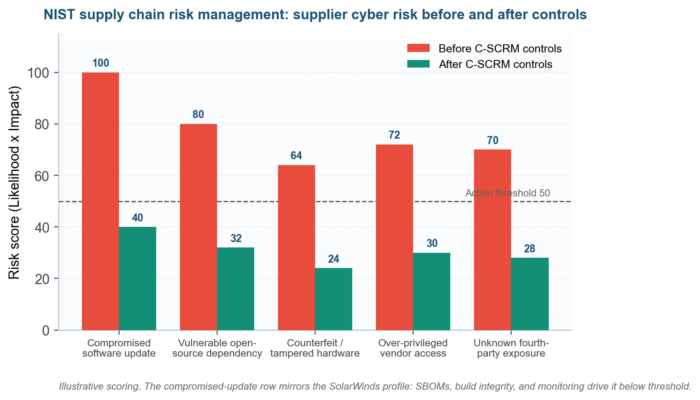
Figure 4. NIST supply chain risk management drives each supplier scenario from inherent to residual risk.
The compromised-update row is the one SolarWinds wrote. A software update from a trusted vendor scores at the top until software bills of materials, build-integrity checks, and monitoring bring the residual down.
Hold one scale across suppliers and feed every score into a live risk register, so the program ranks vendors consistently instead of reacting to whichever breach made the news.
Standards and Mandates Behind NIST Supply Chain Risk Management
NIST supply chain risk management plugs into the wider NIST stack and the federal mandates around it. A handful of references define the controls and the legal expectations. For the broader cybersecurity foundation, see our NIST CSF 2.0 implementation guide.
| Reference | Scope | Role in C-SCRM |
| NIST SP 800-161 | Cyber supply chain risk practices | The C-SCRM framework and 20 practices |
| NIST SP 800-53 (SR) | Security and privacy controls | The Supply Chain Risk control family |
| NIST CSF | Cybersecurity outcomes | Ties C-SCRM to the security program |
| Executive Order 14028 | Federal cybersecurity mandate | Requires SBOMs from federal suppliers |
The 800-53 SR control family is the engine room. Where 800-161 sets the strategy, the Supply Chain Risk controls name the specific safeguards, and the NIST Cybersecurity Framework ties them to the rest of the security program.
ISO offers a parallel track. For organizations outside the federal orbit, ISO 28000 for supply chain security covers similar ground, and many firms map C-SCRM and ISO 28000 together to satisfy both audiences.
Frequently Asked Questions About NIST Supply Chain Risk Management
What is NIST supply chain risk management?
NIST supply chain risk management, or C-SCRM, is the practice of identifying and reducing the cyber risk an organization inherits from its suppliers, software, and components. It treats a trusted vendor as a potential attack path and applies controls such as provenance checks, SBOMs, and continuous monitoring, guided by NIST Special Publication 800-161.
What is C-SCRM and how does it relate to NIST SP 800-161?
C-SCRM stands for cybersecurity supply chain risk management, and NIST SP 800-161 Revision 1 is the publication that defines its practices. The standard sets out a multi-level framework and about 20 practices, turning NIST supply chain risk management from a principle into a concrete program organizations can implement and audit.
What are the three levels of NIST supply chain risk management?
NIST supply chain risk management uses three levels: enterprise, mission or business process, and operational or system. The enterprise level sets strategy and risk appetite, the mission level writes policies for each critical process, and the operational level runs the SBOMs, supplier assessments, and controls where suppliers touch the system.
How is NIST supply chain risk management different from third-party risk management?
Third-party risk management screens a vendor’s finances and compliance, while NIST supply chain risk management examines the technology itself, including how software was built and whether its integrity can be verified. The two are complementary: TPRM covers the relationship, and C-SCRM covers the code, components, and build pipeline behind it.
What is an SBOM in NIST supply chain risk management?
An SBOM, or software bill of materials, is a list of the components and dependencies inside a piece of software. In NIST supply chain risk management it lets an organization see what is really in its code, so a newly disclosed vulnerability can be traced to every affected product, a requirement Executive Order 14028 placed on federal suppliers.
What standards support NIST supply chain risk management?
NIST SP 800-161 provides the C-SCRM framework, NIST SP 800-53 supplies the Supply Chain Risk control family, and the NIST Cybersecurity Framework and Risk Management Framework connect it to the wider program. For non-federal organizations, ISO 28000 covers similar supply chain security ground alongside NIST supply chain risk management.
How do you implement NIST supply chain risk management?
Frame a C-SCRM strategy with executive ownership, map your suppliers and software, assess each on cyber risk, apply the 800-53 SR controls, require SBOMs and monitor continuously, then plan and exercise a supplier-incident response. NIST supply chain risk management follows the Risk Management Framework, repeated on change rather than run once.
Where NIST Supply Chain Risk Management Programs Fail
Failed NIST supply chain risk management programs tend to fail in the same few ways. The table pairs each common trap with the fix that the breach record keeps validating.
| Pitfall | Root cause | Remedy |
| Trusting signed updates blindly | Provenance equated with safety | Verify build integrity and require SBOMs |
| Mapping only direct vendors | No fourth-party visibility | Trace open-source and downstream suppliers |
| Policy without operations | C-SCRM lives at one level | Connect strategy to system-level controls |
| Onboarding-only checks | No continuous monitoring | Watch suppliers between assessments |
| Security after purchase | No C-SCRM in acquisition | Write requirements into contracts first |
| No supplier incident plan | Response improvised on the day | Pre-plan and exercise a compromise |
The first row is the SolarWinds trap exactly. A signed update from a trusted vendor felt safe, so no one checked its integrity, which is why a cyber security risk management plan now treats provenance as a claim to verify, not a guarantee.
The NIST Supply Chain Risk Management Horizon: 2026 and Beyond
SBOMs are moving from optional to expected. What Executive Order 14028 required of federal suppliers is spreading to regulated industries, so NIST supply chain risk management increasingly means producing and consuming a bill of materials as routine practice.
Open-source and AI dependencies widen the attack surface. The 2024 XZ backdoor showed how a single maintainer can endanger millions of systems, and AI models now arrive with their own supply chain and IT risk that a C-SCRM program has to score.
Fourth-party risk is the next frontier. Organizations are learning that their exposure runs through their vendors’ vendors, so NIST supply chain risk management is pushing visibility deeper than the direct supplier most programs stop at.
The lasting lesson is the one SolarWinds taught at national scale. Treat NIST supply chain risk management as a verify-then-trust discipline, scored and monitored on every change, and a poisoned update shows up in an assessment long before it shows up in a breach notification.
Infographic: The NIST Supply Chain Risk Management Lifecycle
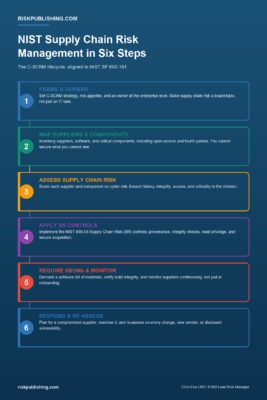
Figure 5. NIST supply chain risk management as a six-step C-SCRM loop from strategy to response.
Build Your NIST Supply Chain Risk Management Program
Risk Publishing helps US organizations turn SP 800-161 into a working NIST supply chain risk management program, from the supplier map to the operational risk controls behind it. See our services, then contact us when your NIST supply chain risk management needs to verify a vendor before an attacker uses it.

Chris Ekai is a Risk Management expert with over 10 years of experience in the field. He has a Master’s(MSc) degree in Risk Management from University of Portsmouth and is a CPA and Finance professional. He currently works as a Content Manager at Risk Publishing, writing about Enterprise Risk Management, Business Continuity Management and Project Management.