On March 10, 2023, California regulators seized Silicon Valley Bank, the second-largest bank failure in US history at that point. The trigger was the most basic external force any strategist is supposed to watch: interest rates.
The PESTLE vs PESTEL question starts right here, because the letter E for Economic is exactly the signal SVB misread. The Federal Reserve raised rates by more than five percentage points, and the bank’s bond portfolio, bought when money was cheap, lost value fast.
PESTLE vs PESTEL is not a real contest. The two spellings name the same six-factor scan of the outside world, and STEEPLE extends that scan with a seventh factor. The practical question is which one to reach for, and when that seventh factor earns its place.
| PESTLE vs PESTEL vs STEEPLE: Key Takeaways |
| PESTLE vs PESTEL is a spelling argument, not a strategy one. Both name the same six external factors, with the L and E swapped only to make the acronym easier to say. |
| STEEPLE keeps those six factors and adds a seventh, Ethical, so the choice between PESTLE vs PESTEL and STEEPLE is really whether ethics deserves its own line. |
| PEST came first. Harvard professor Francis Aguilar framed the original four-factor scan in his 1967 book Scanning the Business Environment, and every later variant builds on it. |
| Silicon Valley Bank shows the stakes. The bank misread the Economic factor any PESTLE vs PESTEL scan tracks, lost $1.8 billion on a bond sale, and failed on March 10, 2023. |
| Use PESTLE or PESTEL for a fast, complete external scan. Reach for STEEPLE in ESG, public-sector, and reputation-sensitive work where the Ethical factor earns a separate column. |
| Whichever acronym you pick, the scan is only useful when its findings feed a risk register with owners, ratings, and a refresh date, not a slide that is filed and forgotten. |
PESTLE vs PESTEL: The Same Framework, Different Letters
Start with the headline answer. In the PESTLE vs PESTEL debate, there is no difference in meaning: both cover Political, Economic, Social, Technological, Legal, and Environmental factors. Only the order of the final two letters changes.
The split is about pronunciation. Adding Legal and Environmental to PEST first produced PESTLE, then writers reordered the tail to PESTEL because it reads more smoothly. The CIPD’s PESTLE factsheet treats them as one tool.
What PESTLE vs PESTEL Actually Stands For
Each letter is a lens on the world outside the organization. A PESTLE vs PESTEL scan walks all six and asks what is changing in each, which is the discipline behind any serious approach to risk identification.
| Letter | Factor | What a PESTLE vs PESTEL scan asks |
| P | Political | What government policy, elections, or trade rules could shift the ground? |
| E | Economic | Where are rates, inflation, and growth heading, and who is exposed? |
| S | Social | How are demographics, values, and buyer behavior moving? |
| T | Technological | Which innovations could disrupt the model or the cost base? |
| L | Legal | What laws, standards, or litigation are tightening the rules? |
| E | Environmental | How do climate, resources, and sustainability reshape the risk? |
Notice that PESTLE vs PESTEL splits Legal from Political. The original PEST buried legal change inside the Political factor, and breaking it out gave regulation and litigation a column of their own, which matters for any compliance-heavy risk assessment.
Why the PESTLE vs PESTEL Spelling Splits by Region
Geography drives most of the PESTLE vs PESTEL preference. PESTLE took hold in UK business schools, marketing courses, and human-resources training, while PESTEL became the common form in strategy texts and consulting decks.
US practitioners see both and should not overthink it. Pick one spelling, define the six factors once, and stay consistent across the team so a PESTLE vs PESTEL label never becomes a debate inside a strategic risk discussion.
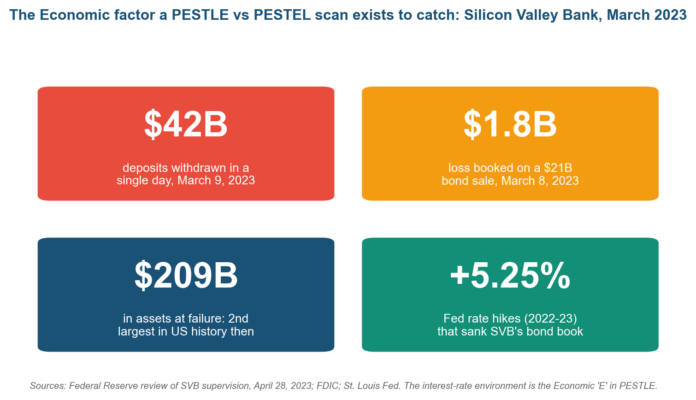
Figure 1. The Economic factor a PESTLE vs PESTEL scan is built to catch, in the numbers SVB missed.
Where STEEPLE Sits in the PESTLE vs PESTEL Family
STEEPLE extends PESTLE vs PESTEL. The acronym reshuffles the same factors into Social, Technological, Economic, Environmental, Political, and Legal, then adds one more letter for Ethical.
That seventh factor is the whole point. Where a PESTLE vs PESTEL scan folds ethics into Social and Legal, STEEPLE pulls it into the open, which suits boards now answering for conduct, culture, and integrated risk oversight.
STEEPLE Adds Ethics to the PESTLE vs PESTEL Base
The acronym family is wider than PESTLE vs PESTEL alone. STEEP drops a separate Legal column, STEEPLE adds Ethical, and STEEPLED bolts on a Demographic factor for people-intensive analysis.
| Acronym | Factors covered | What it adds vs PEST |
| PEST (1967) | Political, Economic, Social, Technological | The original four-factor scan |
| PESTLE / PESTEL | PEST plus Legal and Environmental | Two factors; same tool, reordered letters |
| STEEP | Social, Technological, Economic, Environmental, Political | Environmental, with Legal folded into Political |
| STEEPLE | STEEP plus Legal and Ethical | Ethics as its own explicit factor |
| STEEPLED | STEEPLE plus Demographic | A demographic lens for workforce and market shifts |
| SLEPT / PESTLIED | Reorderings and niche additions | Course-specific and regional variants |
The pattern is simple once you see it. Every variant is PEST with extra letters, so choosing among PESTLE vs PESTEL, STEEP, and STEEPLE is choosing how many external factors you want named explicitly on the page.
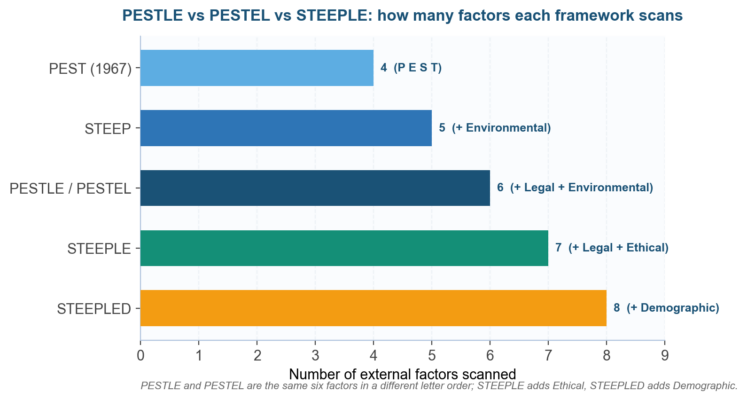
Figure 2. How many external factors each framework scans, from PEST through the PESTLE vs PESTEL pair to STEEPLED.
The Origin Behind PESTLE vs PESTEL: Aguilar’s 1967 Scan
The PESTLE vs PESTEL story begins at Harvard. Professor Francis Aguilar introduced the idea of scanning the business environment in his 1967 book, grouping outside forces into economic, technical, political, and social categories.
His original label was ETPS, not PEST. Later writers reordered the letters to PEST, then bolted on Legal and Environmental to reach the PESTLE vs PESTEL form most US strategists use today, and the timeline shows a steady accretion of factors.
The motive behind every version is the same. Aguilar wanted managers to look outward before they planned, the instinct that still anchors the first step in the risk management process and a defensible risk assessment methodology.
PESTLE vs PESTEL vs STEEPLE: A Side-by-Side Comparison
Lay the three options next to each other and the decision gets easy. The PESTLE vs PESTEL pair is one choice, STEEPLE is the other, and the difference comes down to the Ethical factor and the setting you work in.
| Dimension | PESTLE / PESTEL | STEEPLE |
| Factors scanned | Six external factors | Seven external factors |
| Adds vs PEST | Legal, Environmental | Legal, Environmental, Ethical |
| Ethics | Implied inside Social and Legal | Named as its own factor |
| Best setting | Fast, general external scan | ESG, public sector, reputation work |
| Effort | Lower; six lenses to fill | Higher; a seventh lens to evidence |
| Risk-management fit | ISO 31000 context step | ESG and conduct risk reviews |
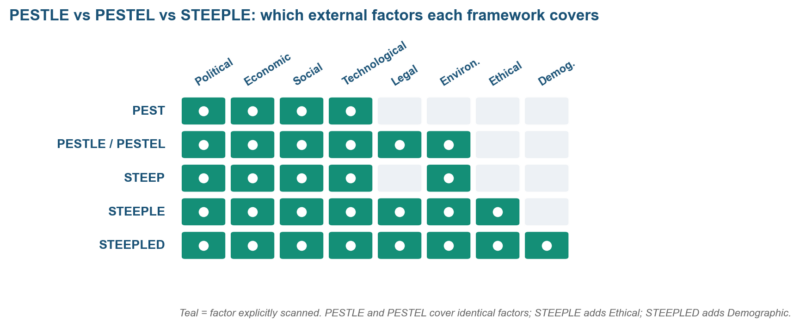
Figure 3. Which external factors each framework covers, with PESTLE vs PESTEL identical and STEEPLE adding Ethical.
The honest verdict is anticlimactic. For most US strategy and enterprise risk management work, PESTLE vs PESTEL is enough, and STEEPLE earns its place only when ethics is a live, board-level question.
How to Run a PESTLE vs PESTEL Analysis Step by Step
A framework is only as good as the routine around it. These six steps turn a PESTLE vs PESTEL acronym into a repeatable scan that produces rated risks, not a wall of sticky notes, and they fold neatly into a step-by-step risk assessment.
| Step | Action in a PESTLE vs PESTEL scan | Output |
| 1. Frame | Fix the objective and the boundary of the scan | A short scoping note |
| 2. Scan | Gather signals under each of the six factors | A longlist of external drivers |
| 3. Filter | Keep only what is material to the objective | A shortlist of real drivers |
| 4. Assess | Rate likelihood and impact for each driver | Rated external risks |
| 5. Link | Move drivers into the live risk register | Register entries with owners |
| 6. Refresh | Re-run on a cadence and on any major change | A living external scan |
Step three is where most scans go wrong. A PESTLE vs PESTEL longlist will surface dozens of trends, and the skill is cutting it to the handful that actually move the objective, the same triage behind any critical component of a risk assessment.
Scoring What a PESTLE vs PESTEL Scan Surfaces
Rating turns observation into priority. Score each external driver a PESTLE vs PESTEL scan finds on likelihood and impact, then rank, so the scan ends with an ordered list, the biggest external risks on top.
| External driver | Likelihood | Impact | Factor in a PESTLE vs PESTEL scan |
| Fed rate hikes repricing assets | High | High | Economic |
| State privacy laws tightening | High | Medium | Legal |
| Generative AI disrupting workflows | High | High | Technological |
| Climate disclosure rules expanding | Medium | Medium | Environmental |
| Workforce values and demographics shifting | Medium | Medium | Social |
The top row is the SVB lesson in one line. A high-likelihood, high-impact Economic driver should never sit unranked, which is why a PESTLE vs PESTEL scan that skips scoring offers false comfort. Pair it with qualitative and quantitative methods for weight.
PESTLE vs PESTEL Inside ISO 31000 Risk Management
In a risk program, a PESTLE vs PESTEL scan feeds everything downstream. It populates the external-context step that ISO 31000 places at the front of the process, before any risk is rated or treated.
That placement gives the scan teeth. The six factors become structured inputs to the risk register, so a PESTLE vs PESTEL finding gets an owner and a treatment rather than dying on a planning slide, the discipline our ERM framework guide stresses.
| PESTLE factor | What it scans | A 2024-2026 US signal |
| Political | Policy, elections, trade rules | Shifting tariff policy and a 2024 election cycle |
| Economic | Rates, inflation, growth | OECD growth outlook |
| Social | Demographics, values, behavior | Census population projections |
| Technological | Innovation and disruption | NIST AI Risk Management Framework |
| Legal | Laws, standards, litigation | SEC climate disclosure rule, 2024 |
| Environmental | Climate, resources, sustainability | WEF Global Risks Report 2025 |
Frameworks share this outward gaze. Whether you anchor on ISO 31000 or COSO ERM, both expect an external-environment scan, and the choice between them is the subject of our ISO 31000 versus COSO comparison.
Frequently Asked Questions About PESTLE vs PESTEL vs STEEPLE
Is the PESTLE vs PESTEL difference real or just spelling?
It is just spelling. PESTLE vs PESTEL name the identical six factors, Political, Economic, Social, Technological, Legal, and Environmental, with only the last two letters reordered for easier pronunciation. Choose one spelling and apply it consistently.
What does STEEPLE add over PESTLE vs PESTEL?
STEEPLE keeps the six factors in a PESTLE vs PESTEL scan and adds a seventh, Ethical. That extra factor pulls business ethics, conduct, and corporate responsibility out of the Social and Legal columns and gives them an explicit line of their own.
Which should I use: PESTLE vs PESTEL or STEEPLE?
Use PESTLE or PESTEL for a fast, complete external scan in most strategy and risk work. Switch to STEEPLE when ethics is a live concern, such as ESG reporting, public-sector decisions, or reputation-sensitive industries where conduct sits on the board agenda.
How does a PESTLE vs PESTEL analysis fit risk management?
A PESTLE vs PESTEL scan feeds the external-context step of ISO 31000, then hands rated drivers to the risk management lifecycle. The scan identifies external risks, and the wider process scores, treats, and monitors them so findings do not stall at the analysis stage.
Who invented the PESTLE vs PESTEL framework?
Harvard professor Francis Aguilar is credited with the original idea in his 1967 book Scanning the Business Environment, where he used the label ETPS. Later writers reordered it to PEST and added Legal and Environmental to produce the PESTLE vs PESTEL form.
What are the other PESTLE vs PESTEL variants?
Beyond PESTLE vs PESTEL, the common variants are PEST, STEEP, STEEPLE, and STEEPLED, plus niche forms like SLEPT and PESTLIED. Each is PEST with factors added or reordered, so they share the same outward-scanning logic and differ only in which factors they name explicitly.
How often should a PESTLE vs PESTEL analysis be refreshed?
Refresh a PESTLE vs PESTEL scan at least annually, and sooner on any major external shock such as a rate move, an election, or a new regulation. A static scan ages badly, which is exactly how the interest-rate signal behind SVB went unheeded.
Where PESTLE vs PESTEL Analyses Fail
A PESTLE vs PESTEL scan fails in predictable ways, and none are exotic. Each row below pairs the trap with the fix that keeps the scan honest and useful, the same habits that protect any operational risk review.
| Pitfall | Root cause | Remedy |
| Listing without ranking | Every trend treated as equal | Score likelihood and impact, then prioritize |
| Spelling debates | Arguing PESTLE vs PESTEL not substance | Pick one form and move to the factors |
| One-and-done scan | No refresh cadence set | Re-run annually and on major shocks |
| No owner for findings | Scan ends on a slide | Push drivers into the risk register |
| Inside-out bias | Only internal data consulted | Use external sources for each factor |
| Ethics ignored | PESTLE used where conduct matters | Switch to STEEPLE and evidence it |
The first two rows cause most wasted scans. Teams burn an hour on PESTLE vs PESTEL spelling, then list trends without scoring them, and the output never reaches the risk appetite conversation it was meant to inform.
The PESTLE vs PESTEL Horizon: 2026 and Beyond
Regulation is widening the Legal factor fast. US state privacy laws, the SEC’s climate disclosure rule, and the EU’s AI Act mean a PESTLE vs PESTEL scan now tracks more rules across more borders than it did even two years ago.
Technology is reshaping the T and the S together. Generative AI is both a disruptor to scan and a tool that helps run the scan, so a PESTLE vs PESTEL exercise increasingly leans on the cybersecurity risk lens alongside the strategic one.
STEEPLE gains ground here, because ethics keeps climbing the agenda. As ESG reporting and the EU’s GDPR-era expectations push conduct into board view, the seventh factor stops being optional in the sectors that touch consumer data and public trust.
The constant is the discipline, not the acronym. Whether the team writes PESTLE, PESTEL, or STEEPLE, the test is the same one SVB failed: scan the outside world, rate what you find, and connect it to oversight and strategy before the market does it for you.
Infographic: PESTLE vs PESTEL vs STEEPLE Compared
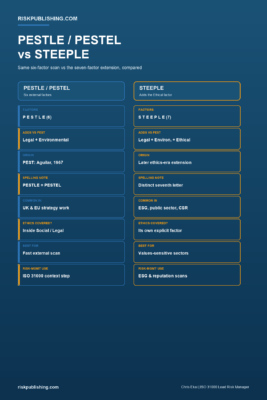
Figure 4. PESTLE vs PESTEL vs STEEPLE side by side: the same six-factor scan beside the ethics-led extension.
Put a PESTLE vs PESTEL Scan to Work
Risk Publishing helps US strategy and risk teams turn a PESTLE vs PESTEL scan into rated, owned entries in a live register, with the STEEPLE extension where ethics demands it. See our services, then contact us when your external scan needs to reach the board before the next surprise does.

Chris Ekai is a Risk Management expert with over 10 years of experience in the field. He has a Master’s(MSc) degree in Risk Management from University of Portsmouth and is a CPA and Finance professional. He currently works as a Content Manager at Risk Publishing, writing about Enterprise Risk Management, Business Continuity Management and Project Management.