
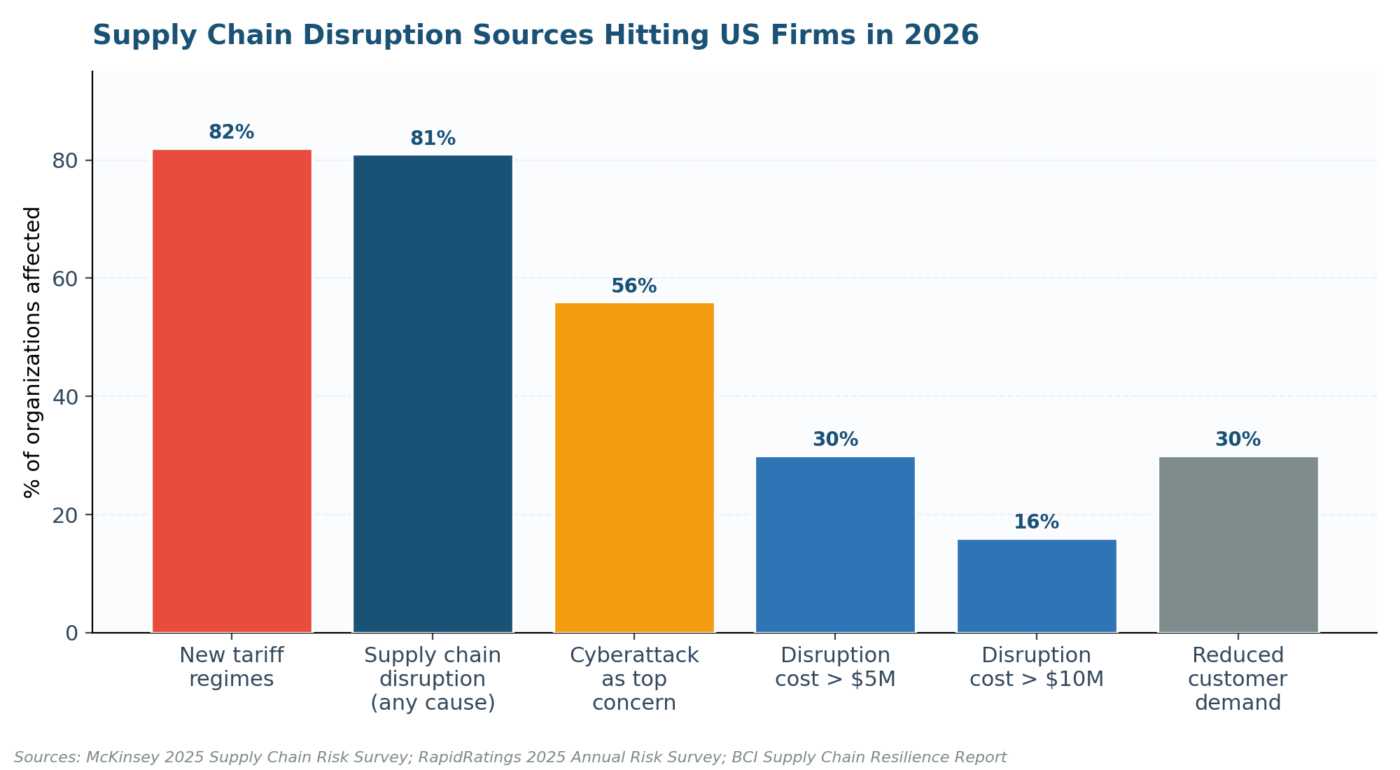
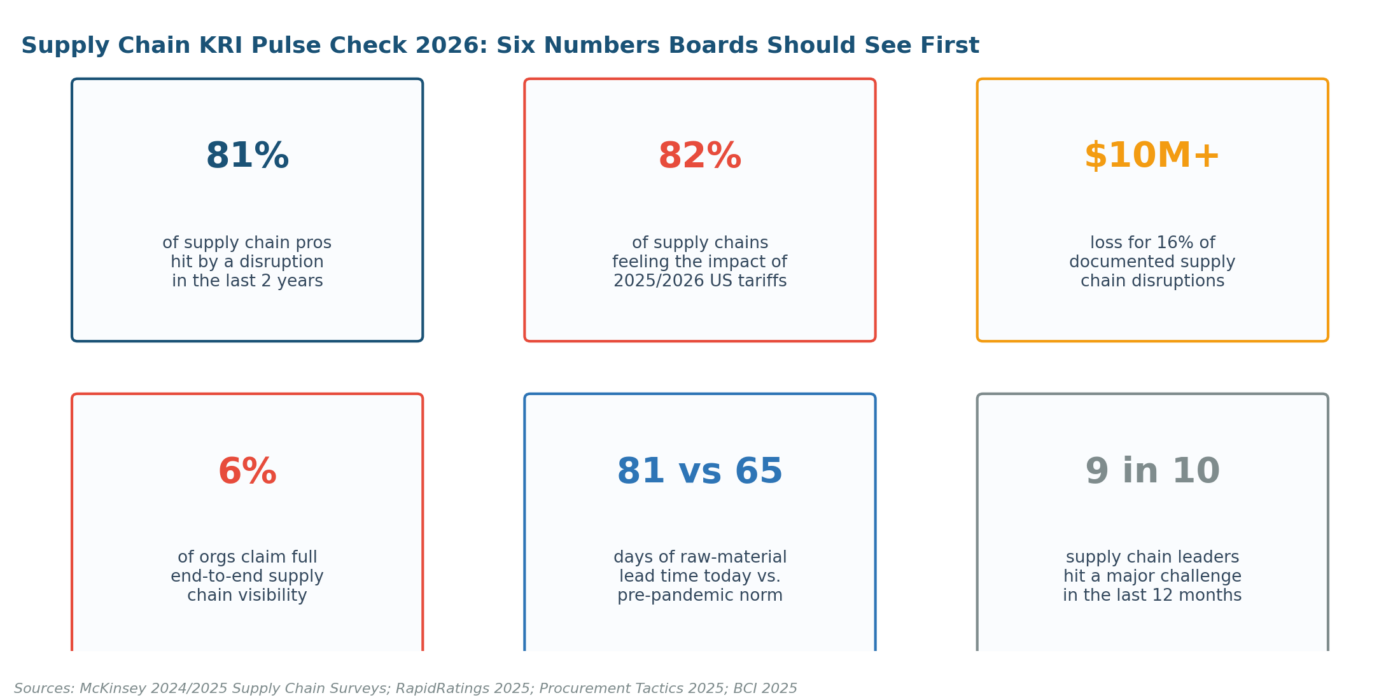
Supply Chain Key Risk Indicators Examples are essential because eighty-one percent of supply chain and procurement professionals had their business impacted by supplier disruptions in the past two years.
Nearly 30% of those disruption events cost organizations more than $5 million each, with 16% exceeding $10 million per event. And 68% of supply chain professionals expect risks to escalate further in 2025 and beyond.
Those numbers come from the RapidRatings 2025 Annual Risk Survey, and they tell a story that most risk managers already feel: the post-pandemic promise that supply chains would “stabilize” has not materialized.
Instead, organizations now face a compounding stack of disruption drivers. Tariffs and trade wars, with McKinsey’s 2025 Supply Chain Risk Survey reporting that 82% of supply chains are affected by new tariff regimes.
Geopolitical instability reshuffling sourcing strategies across continents. Cyberattacks, which the BCI Supply Chain Resilience Report identifies as the primary concern for 55.6% of businesses.
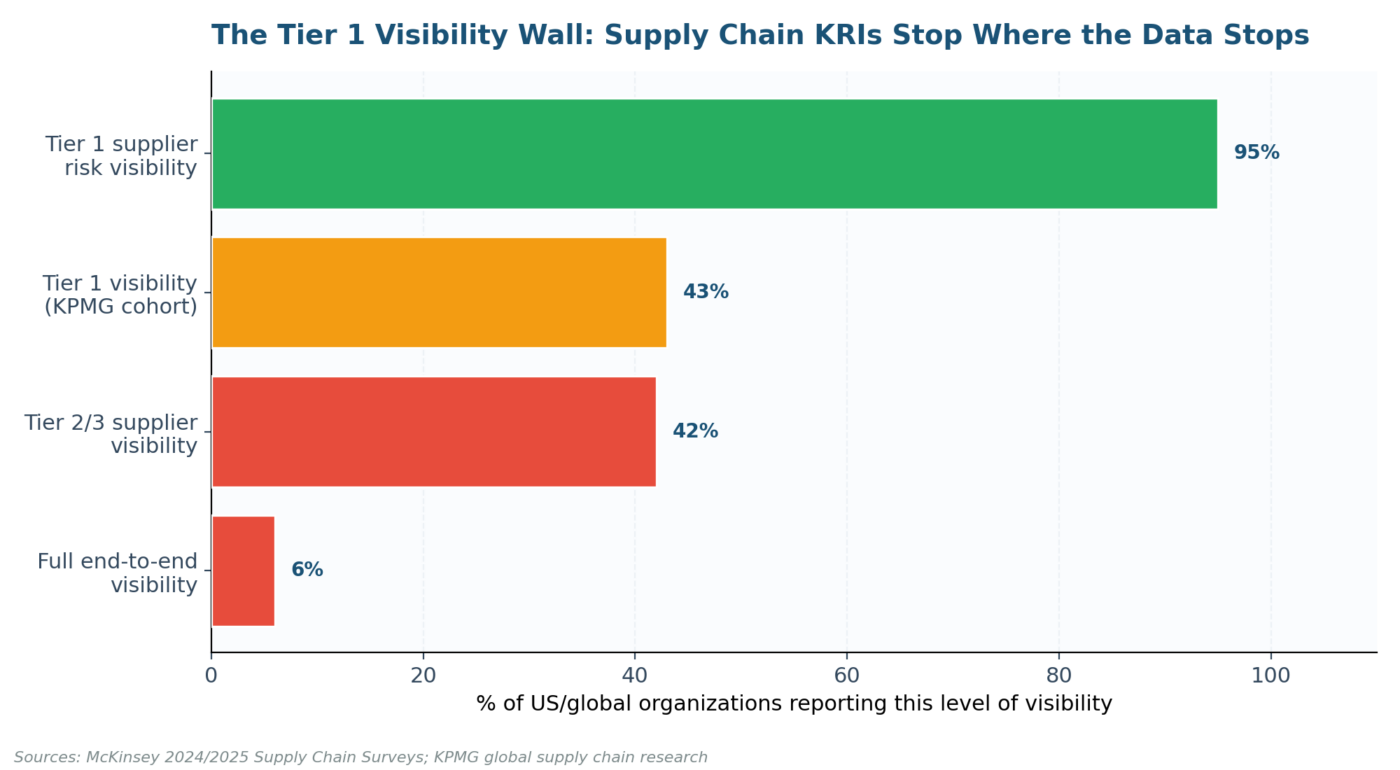
And a persistent visibility gap: KPMG research shows only 43% of organizations have visibility into even their Tier 1 supplier performance.
The problem is not a lack of awareness. It is a lack of measurement, which is why structured Supply Chain Key Risk Indicators Examples matter so much. Most organizations know supply chain risk is significant.
Far fewer have structured, quantitative indicators that provide early warning of disruptions, vendor failures, and concentration exposures before they become financial losses.
This article provides 15 specific, measurable Supply Chain Key Risk Indicators Examples (KRIs) for supply chain risk management. Each comes with a definition, measurement approach, threshold logic, and practical guidance on how to deploy it within your enterprise risk management framework.
These Supply Chain Key Risk Indicators Examples are vendor-neutral metrics that work in Excel, your existing GRC platform, or whatever tool you already use. For foundational KRI concepts and how dashboards function, see: How to Use a Key Risk Indicators Dashboard.
These indicators support a NIST supply chain risk management program.Why Supply Chain Risk Needs Dedicated KRIs
Supply chain risk has moved from an operational nuisance to a board-level strategic concern, and Supply Chain Key Risk Indicators Examples are how risk leaders translate that concern into measurable oversight. Global supply chain disruptions in 2024 led companies to incur financial losses averaging around 8% of their annual revenues.
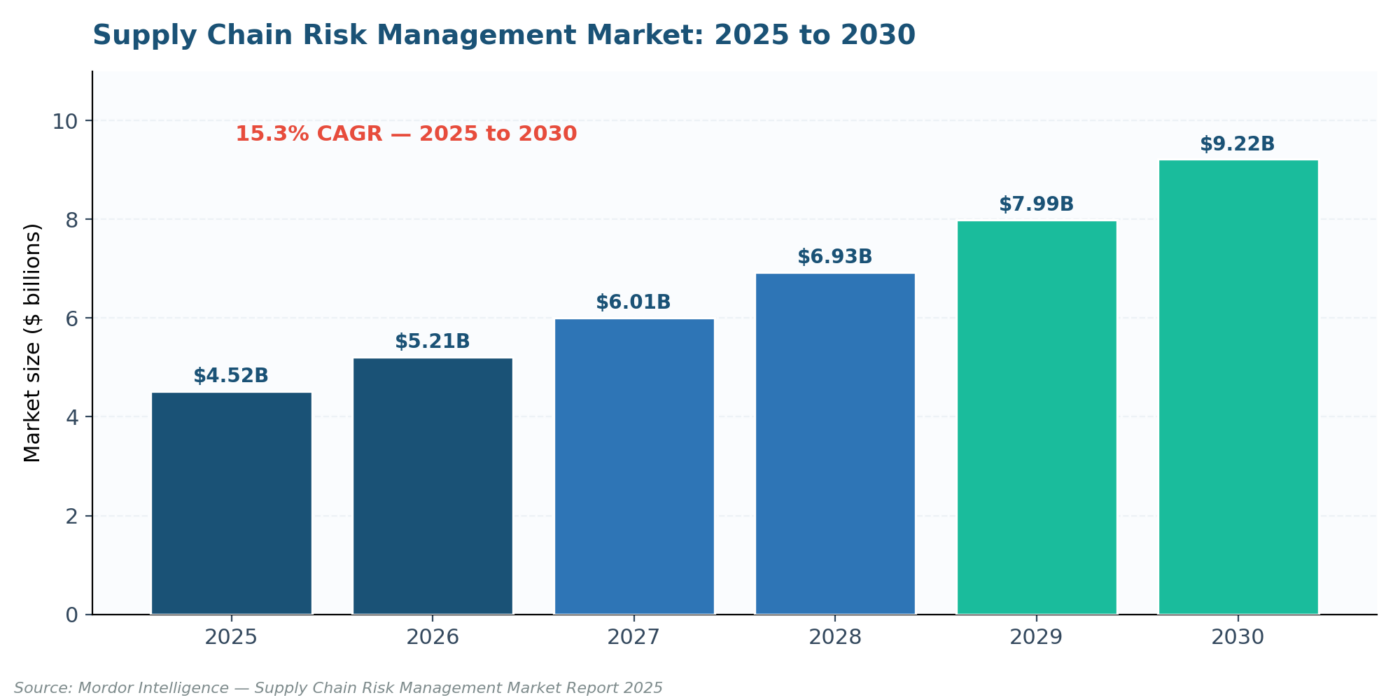
The supply chain risk management market generated $4.52 billion in 2025 and is projected to reach $9.22 billion by 2030 at a 15.3% CAGR, reflecting how seriously organizations are investing in this space. Factory fires, labor strikes, and extreme weather events expanded 38% year-over-year in 2024 alone.
Yet despite this investment, nine in ten respondents in McKinsey’s 2024 Global Supply Chain Leader Survey reported encountering supply chain challenges during the year. The gap between spending on supply chain risk management and actually measuring it effectively remains wide, which is exactly the void that well-designed Supply Chain Key Risk Indicators Examples are built to fill.
Only 6% of organizations achieve full end-to-end supply chain visibility. Average delivery times for raw materials still stand at 81 days, compared to 65 days pre-pandemic, a roughly 25% increase that shows no sign of normalizing.
Traditional enterprise risk management frameworks treat supply chain risk as a subcategory of operational risk, which is technically correct but practically insufficient. Supply chain risk is cross-functional, and effective Supply Chain Key Risk Indicators Examples must reflect that reality.
It touches procurement, finance, operations, IT security, compliance, and strategic planning simultaneously.
A single supplier bankruptcy can cascade through production schedules, customer commitments, revenue targets, and regulatory compliance in ways that a generic operational KRI like “process error rate” will never capture.
Supply chain risk needs dedicated KRIs designed specifically for its unique characteristics: multi-tier dependencies, geographic concentration, lead time sensitivity, and the compounding nature of cascading failures. The Supply Chain Key Risk Indicators Examples covered below address each of these dimensions.
For the broader operational risk context into which supply chain KRIs feed, see: What Is the Primary Objective of Operational Risk Management.
Supply Chain Key Risk Indicators Examples: The 15 KRIs Complete Reference
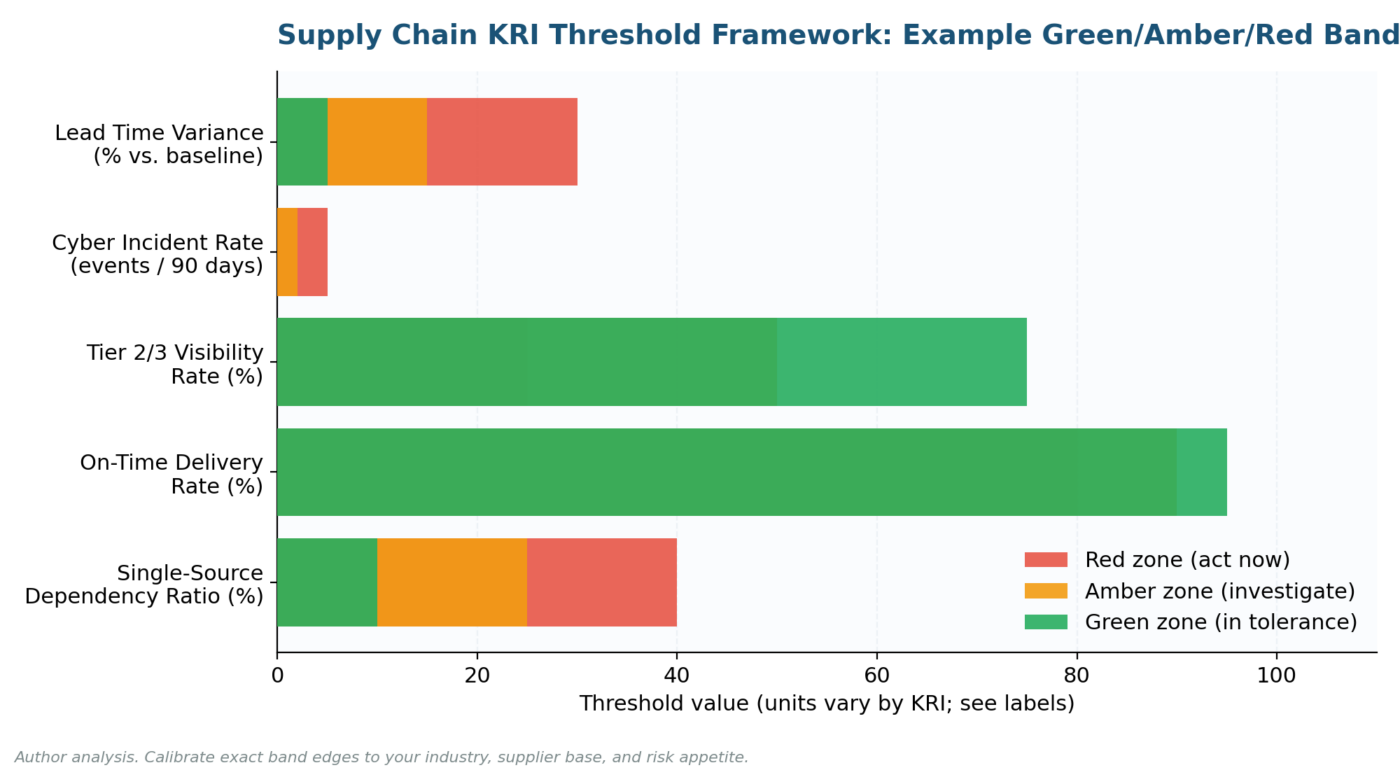
The following table provides all 15 Supply Chain Key Risk Indicators Examples in a single reference. Detailed guidance for each follows in the sections below.
Every KRI is designed to be leading (predictive of future disruptions), measurable (quantifiable with available data), and actionable (triggering specific management responses when thresholds are breached).
| # | KRI Name | What It Measures | How to Calculate | Amber/Red Thresholds | Frequency |
| 1 | Single-Source Dependency Ratio | % of critical materials or components sourced from a single supplier with no qualified alternative | Count of single-sourced critical items / Total critical items x 100 | Amber: >15%. Red: >30% | Quarterly |
| 2 | Supplier Financial Health Score | Composite financial viability rating of critical suppliers (e.g., Altman Z-score, D&B rating, or RapidRatings FHR) | Weighted average financial health score across critical suppliers | Amber: Score decline >10% QoQ. Red: Score below distress threshold | Quarterly |
| 3 | Supplier On-Time Delivery Rate | % of supplier deliveries arriving within the agreed delivery window | On-time deliveries / Total deliveries x 100 | Amber: <92%. Red: <85% | Monthly |
| 4 | Average Supplier Lead Time Variance | Deviation between actual lead times and contractual/planned lead times | (Actual lead time – Planned lead time) / Planned lead time x 100 | Amber: Variance >15%. Red: Variance >25% | Monthly |
| 5 | Supplier Quality Rejection Rate | % of incoming materials or components failing quality inspection | Rejected units / Total received units x 100 | Amber: >3%. Red: >5% | Monthly |
| 6 | Geographic Concentration Index | Degree of supplier concentration in high-risk geographic regions | % of critical spend sourced from top single country or region | Amber: >40% from one country. Red: >60% from one country | Quarterly |
| 7 | Tier 2/3 Supplier Visibility Rate | % of critical Tier 2 and Tier 3 suppliers identified and monitored | Mapped Tier 2/3 suppliers / Estimated total Tier 2/3 suppliers x 100 | Amber: <40%. Red: <20% | Quarterly |
| 8 | Supply Chain Cyber Incident Rate | Number of cyber incidents affecting supply chain partners per period | Count of reported cyber incidents across supply chain partners | Amber: >2/quarter. Red: >5/quarter or any incident affecting data integrity | Monthly |
| 9 | Inventory Days of Supply for Critical Items | Number of days current inventory can sustain operations for critical items without resupply | Current inventory / Average daily usage | Amber: <15 days. Red: <7 days (adjust per industry) | Weekly |
| 10 | Contract Compliance Rate | % of active supplier contracts with current terms, SLAs, and risk provisions | Compliant contracts / Total active contracts x 100 | Amber: <90%. Red: <80% | Quarterly |
| 11 | Supplier Risk Assessment Coverage | % of critical suppliers with completed, current risk assessments | Assessed suppliers / Total critical suppliers x 100 | Amber: <85%. Red: <70% | Quarterly |
| 12 | Supply Chain Cost Volatility Index | Degree of price fluctuation in key input materials relative to budget | (Actual cost – Budgeted cost) / Budgeted cost x 100, across key inputs | Amber: Variance >10%. Red: Variance >20% | Monthly |
| 13 | Supplier ESG/Compliance Incident Count | Number of regulatory, environmental, labor, or ethical violations by suppliers | Count of reported ESG/compliance incidents across supplier base | Amber: >1/quarter for critical suppliers. Red: Any incident triggering regulatory exposure | Quarterly |
| 14 | Order Fulfillment Cycle Time Trend | Trend in time from order placement to customer delivery, capturing cumulative supply chain efficiency | Average fulfillment cycle time vs. trailing 12-month baseline | Amber: >10% increase from baseline. Red: >20% increase | Monthly |
| 15 | Supply Chain Recovery Time | Time to restore normal operations after a significant supply chain disruption event | Hours/days from disruption onset to operational recovery | Amber: Recovery >5 business days. Red: Recovery >10 business days | Per event + quarterly review |
Now let us walk through each of the Supply Chain Key Risk Indicators Examples in detail, grouped by the risk category it addresses.
Supplier Dependency and Concentration Risk (KRIs 1, 6, 7)
KRI 1: Single-Source Dependency Ratio. Among all Supply Chain Key Risk Indicators Examples, this one tends to deliver the earliest warning of structural fragility.
This is arguably the most important supply chain KRI and the one most organization measure poorly or not at all.
Single-source dependency means a critical material, component, or service comes from exactly one supplier with no qualified, tested alternative.
When that supplier experiences a disruption, whether a factory fire, a bankruptcy, a cyberattack, or a tariff-driven export restriction, your production stops. In regulated manufacturing that stoppage becomes a patient safety problem, which is why quality risk management now counts product availability as a quality risk.
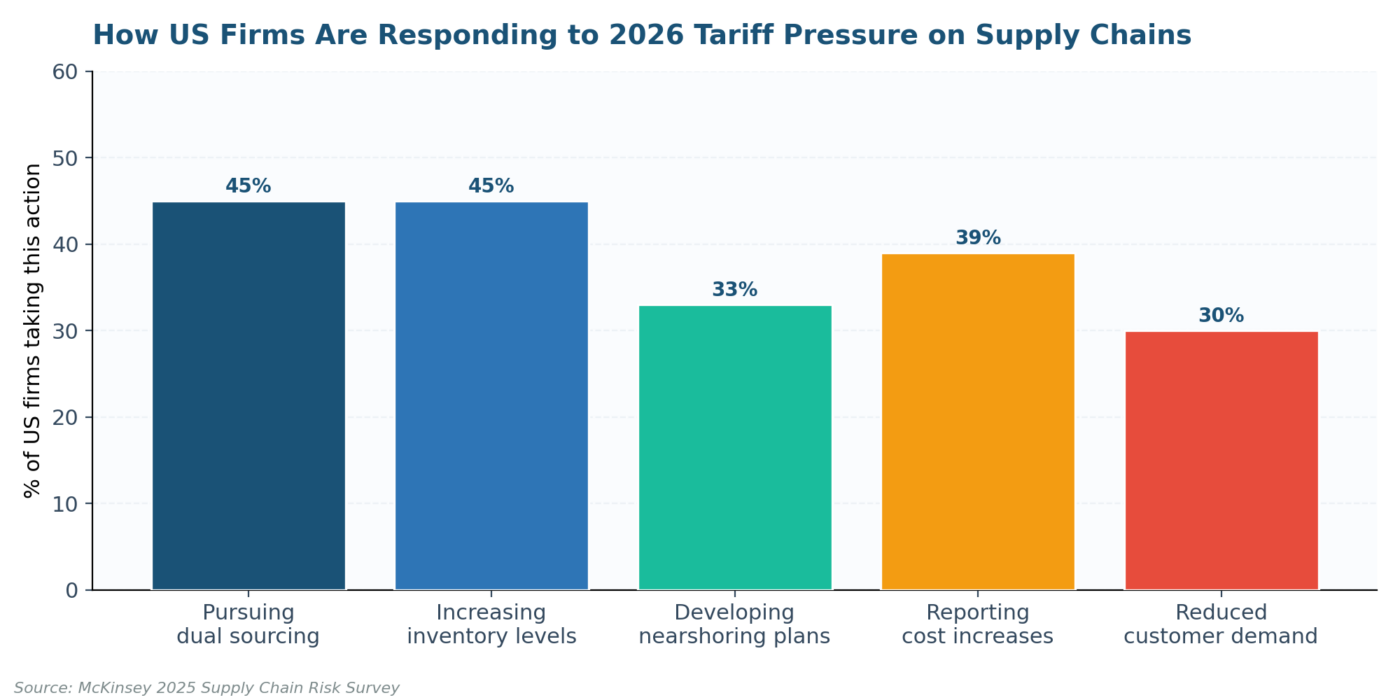
McKinsey’s 2025 survey found that 45% of companies facing tariff impacts are now pursuing dual sourcing strategies, and 33% are developing nearshoring plans.
These are reactive measures driven by pain that a proactive KRI would have flagged earlier. Measure this quarterly. If more than 30% of your critical items are single-sourced, your supply chain has a structural vulnerability that no amount of inventory buffering can fully address.
KRI 6: Geographic Concentration Index. This is one of the Supply Chain Key Risk Indicators Examples that has gained the most prominence in the 2026 tariff environment. If 60% of your critical spend flows through a single country or region, you are exposed to every risk that region faces: tariffs, natural disasters, political instability, infrastructure failures, and regulatory changes.
McKinsey’s 2025 data shows that supply chains with a U.S. connection were most likely to feel tariff impacts, with 70% of respondents reporting greater effects on U.S. customer demand than elsewhere.
Meanwhile, the Asia-Pacific region and China were perceived as the most likely source of supply chain disruption by large margins. Geographic concentration is a structural risk that compounds with every additional disruption driver.
KRI 7: Tier 2/3 Supplier Visibility Rate. You cannot manage risk you cannot see. McKinsey’s 2025 survey found a 22 percentage-point increase in organizations with visibility into Tier 2 suppliers, reversing years of declining visibility. Still, only 42% of organizations have visibility that extends beyond Tier 1.
The 2024 survey noted that 95% of respondents have visibility into Tier 1 supplier risks, but this drops dramatically at deeper tiers.
If your critical path depends on a Tier 3 supplier you have never heard of, located in a region you have never assessed, your risk register has a blind spot. For how KRI frameworks integrate into broader enterprise risk architecture, see: Enterprise Risk Management Framework.
Supplier Performance and Reliability Risk (KRIs 3, 4, 5)
KRI 3: Supplier On-Time Delivery Rate. Of all the performance-oriented Supply Chain Key Risk Indicators Examples, this is the one most procurement teams already track in some form. Late deliveries are the canary in the coal mine for broader supplier problems.
When a supplier’s on-time delivery rate starts declining, it frequently signals financial stress (they are prioritizing customers who pay faster), operational problems (equipment failures, labor issues), or capacity constraints (they have taken on more business than they can handle).
Average delivery times for raw materials remain at 81 days as of October 2024, compared to 65 days pre-pandemic. Track this monthly. A drop below 92% warrants investigation; below 85% warrants an action plan with escalation to the risk committee.
KRI 4: Average Supplier Lead Time Variance. On-time delivery rate tells you whether suppliers hit the window. Lead time variance tells you whether the window itself is shifting. A supplier may technically deliver “on time” against a lead time that has quietly expanded from 30 to 45 days.
If you only track on-time delivery, you miss the deterioration.
Lead time variance captures the trend.
A variance exceeding 25% from planned lead times indicates a systemic problem that will eventually cascade into your production schedules, inventory levels, and customer commitments.
KRI 5: Supplier Quality Rejection Rate. Quality failures arriving at your dock are expensive. They trigger rework, scrap, production delays, and potentially customer-facing quality issues.
More importantly, a rising rejection rate is a leading indicator of broader supplier deterioration.
Suppliers under financial pressure cut corners. Suppliers losing key personnel let quality systems slip.
A rejection rate exceeding 5% for any critical supplier should trigger a formal corrective action request and, if persistent, a qualification review.
For practical guidance on embedding these measurements into risk and control self-assessment processes, see: Guide to Incorporating RCSA in Risk Management.
Supplier Financial Health and Cyber Risk (KRIs 2, 8, 12)
KRI 2: Supplier Financial Health Score. This is one of the most underused Supply Chain Key Risk Indicators Examples despite its strong predictive value.
The RapidRatings 2025 survey found that 62% of respondents perceived global supply chain risks as “high” or “very high.”
Financial distress in your supplier base is one of the highest-impact, most preventable supply chain risks.
A supplier heading toward insolvency gives off signals months before it fails: declining profitability ratios, deteriorating cash flow, increasing days payable outstanding, and credit rating downgrades.
Tools like the Altman Z-score, Dun & Bradstreet ratings, or specialized platforms like RapidRatings’ Financial Health Rating can quantify this.
The key is monitoring the trend, not just the snapshot. A supplier whose financial health score declines more than 10% quarter-over-quarter warrants deeper investigation even if the absolute score is still acceptable.
KRI 8: Supply Chain Cyber Incident Rate. The BCI Supply Chain Resilience Report identified cyberattacks and data breaches as the primary threat to supply chains for the upcoming five years. Gartner predicted that by 2025, 45% of organizations worldwide would have experienced attacks on their software supply chains, a threefold increase from 2021.
IBM’s 2025 data shows the global average data breach cost reached $4.88 million, with supply chain breaches frequently costing more due to cascading impacts. Only 13% of businesses review the risks posed by their immediate suppliers, and just 7% review their wider supply chain for cyber risk. Closing that visibility gap is exactly what modern TPRM software platforms are designed to do, automating continuous monitoring across every tier of suppliers.
Track every cyber incident reported by supply chain partners. More than two per quarter warrants a formal review of your supply chain cyber resilience strategy. For cybersecurity-specific KRI examples, see: Cyber Security Key Risk Indicators Examples.
KRI 12: Supply Chain Cost Volatility Index. When input costs swing more than 10% from budget, your margin projections become unreliable.
When they swing more than 20%, your business model is under stress.
McKinsey’s 2025 survey found that 39% of respondents facing tariff impacts reported increases in supplier and material costs, and 30% saw reductions in customer demand.
UNCTAD reports that freight rates skyrocketed in 2024 due to rerouted vessels, port congestion, and higher operational costs, with global consumer prices anticipated to increase by 0.6% as shipping costs filter through supply chains.
Cost volatility is not just a finance problem; it is a risk indicator that signals broader supply chain stress, trade disruptions, or market imbalances that will eventually affect availability and quality.
Compliance, Contract, and ESG Risk (KRIs 10, 11, 13)
KRI 10: Contract Compliance Rate. Among the governance-oriented Supply Chain Key Risk Indicators Examples, this one often surfaces the largest exposures with the least effort. A supplier contract that is expired, missing current SLAs, or lacking risk provisions (force majeure clauses, cybersecurity requirements, audit rights, termination triggers) is a risk exposure hiding in plain sight.
PwC found that 77% of executives reported their companies were negatively impacted by compliance complexity.
Track the percentage of active contracts with current, complete terms. Below 90% is amber. Below 80% means you are operating significant portions of your supply chain on handshake arrangements that provide no legal protection in a disruption.
KRI 11: Supplier Risk Assessment Coverage. You should have a current risk assessment for every critical supplier. “Current” means completed within the last 12 months and reflecting the supplier’s actual risk profile, not a checkbox exercise from three years ago.
KPMG’s research showing that only 43% of organizations have visibility into Tier 1 supplier performance suggests that many organizations cannot even identify which suppliers are critical, let alone assess them systematically.
If fewer than 70% of your critical suppliers have current risk assessments, your supply chain risk register is incomplete. For broader KRI examples that complement supply chain monitoring, see: KRI: Key Risk Indicators Examples.
KRI 13: Supplier ESG/Compliance Incident Count. The regulatory landscape for supply chain compliance is expanding rapidly. The EU’s Corporate Sustainability Due Diligence Directive requires multi-tier risk audits.
In the U.S., SEC climate disclosure rules, forced labor import restrictions (the Uyghur Forced Labor Prevention Act), and industry-specific regulations impose growing liability for supplier conduct.
QIMA’s 2024 audit data found that 37% of factories in Bangladesh reported critical violations related to working hours and wages, more than double the rate seen in 2023.
Any supplier ESG or compliance incident that triggers regulatory exposure for your organization is a red-level event requiring immediate board notification. For compliance-specific KRI architecture, see: Compliance Key Risk Indicators Examples.
Operational Resilience and Recovery (KRIs 9, 14, 15)
KRI 9: Inventory Days of Supply for Critical Items. This is one of the operational Supply Chain Key Risk Indicators Examples that directly connects to business continuity planning. This KRI bridges supply chain risk and business continuity. How many days can you sustain operations if a critical supply line is cut? The answer determines your actual resilience, not your theoretical resilience described in a business continuity plan that has never been tested against a real supply disruption.
McKinsey’s 2025 data shows 45% of companies facing tariff impacts are increasing inventories as mitigation. That is a reactive strategy. A proactive approach monitors days of supply continuously and triggers investigation when buffer levels approach minimums.
The right threshold varies dramatically by industry: seven days may be adequate for a service organization but catastrophically low for a manufacturer with 90-day procurement cycles. Calibrate to your specific operational reality. For business continuity integration, see: Business Continuity Plan Case Study: Lessons Learned.
KRI 14: Order Fulfillment Cycle Time Trend. This is the downstream KRI that tells you whether all the upstream supply chain risks are actually translating into customer-facing impact.
Rising cycle times, measured as a trend against your trailing 12-month baseline, indicate that disruptions, delays, quality problems, or capacity constraints are accumulating faster than your mitigation efforts are resolving them.
A 10% increase from baseline warrants investigation. A 20% increase signals a systemic problem that is likely already visible to customers.
KRI 15: Supply Chain Recovery Time. How quickly can you restore normal operations after a significant supply chain disruption? This is the supply chain equivalent of a Recovery Time Objective (RTO) in business continuity planning. Measure it after every significant event and review the trend quarterly.
Organizations with tested, exercised supply chain contingency plans recover faster. Those relying on ad-hoc responses do not.
The RapidRatings survey found that operational costs, revenue targets, and productivity are among the hardest-hit areas during disruptions.
Recovery time directly determines how much of that financial impact accumulates. For how risk monitoring processes work in practice, see: How to Monitor Risk in 7 Steps.
Building a Dashboard for Supply Chain Key Risk Indicators Examples: Architecture and Reporting
Fifteen Supply Chain Key Risk Indicators Examples is the right number for a comprehensive supply chain risk monitoring program. It is too many for a board dashboard. The solution is a tiered reporting structure:
Tier 1: Board/Audit Committee (5 KRIs). Select the five KRIs most critical to your organization’s strategic risk profile. For most U.S. organizations in 2025, those will include: Single-Source Dependency Ratio (KRI 1),
Supplier Financial Health Score (KRI 2), Geographic Concentration Index (KRI 6), Supply Chain Cyber Incident Rate (KRI 8), and Supply Chain Recovery Time (KRI 15). Report quarterly using RAG (Red/Amber/Green) status with trend arrows and the “What, So What, Now What” framework.
Tier 2: Risk Committee/Senior Management (All 15 KRIs). Report monthly or quarterly depending on industry. Include detailed trend charts (minimum 4 periods), root cause analysis for any amber or red KRIs, management action plans with owners and target dates,
and the Three Lines accountability structure: first-line risk owner (typically procurement or supply chain operations), second-line oversight (enterprise risk management or compliance), and third-line assurance (internal audit periodic review).
Tier 3: Operational Management (15 KRIs + Supplementary Metrics). Report weekly or monthly. This is where the full granularity lives: individual supplier scorecards, commodity-level tracking, regional risk heatmaps, and real-time alerts for threshold breaches.
For comprehensive guidance on building KRI dashboards and presenting them to the board, see: Key Risk Indicators Dashboard and KRI Dashboard Best Practices: Board Reporting.
Setting Thresholds: From Generic to Calibrated
The thresholds for the Supply Chain Key Risk Indicators Examples in the table above are starting points. Your organization must calibrate them based on three factors:
1. Risk appetite. What level of supply chain disruption is your board willing to accept?
If the board has stated that no single supplier failure should halt production for more than 48 hours, your Single-Source Dependency Ratio threshold must be set tight enough to prevent that scenario.
Risk appetite drives thresholds, not the other way around. For how risk appetite connects to KRI frameworks, see: Enterprise Risk Management Key Risk Indicators.
2. Industry benchmarks. A 3% supplier quality rejection rate may be catastrophic in pharmaceutical manufacturing and acceptable in bulk construction materials. A 15-day inventory buffer may be luxurious in fast fashion and dangerously thin in semiconductor fabrication.
Benchmarks from your industry associations, peer comparisons, and historical performance provide the calibration context.
3. Historical performance. Your own data is your best calibrator. If your supplier on-time delivery rate has historically averaged 96%, an amber threshold at 92% gives you meaningful early warning.
If it has historically been 88%, the same threshold would be permanently amber and therefore useless. Set thresholds that distinguish normal variation from signal.
Review and recalibrate thresholds at least annually, after any major disruption event, after material changes in your supplier base, and after changes in the regulatory or trade environment.
The tariff-driven reshuffling of global supply chains in 2025 is exactly the kind of environment change that should trigger a threshold review. For additional KRI threshold design guidance, see: Key Elements of a Risk Register.
Frequently Asked Questions on Supply Chain Key Risk Indicators
The eight questions below are the ones US procurement leads, CROs, and audit committee chairs put to us most often after the 15-KRI reference above.
Each answer takes the practitioner view: what to track, who owns it, and what action a triggered KRI should drive inside an ISO 28000 supply security standard or NIST SP 800-161 SCRM program.
What are supply chain key risk indicators and why do they matter in 2026?
Supply chain key risk indicators are quantified leading signals that flag where a sourcing, vendor, or logistics exposure is moving toward unacceptable territory before a disruption hits.
They matter because McKinsey’s 2025 Supply Chain Risk Survey found 82% of US supply chains feel the impact of new tariff regimes, and 81% of supply chain professionals report at least one significant disruption in the last two years.
How many supply chain key risk indicators should a US company actually track?
Twelve to fifteen supply chain key risk indicators is the working US benchmark for a mid-market firm. Fewer than twelve and the program leaves blind spots in supplier financial health, cyber, or geographic concentration.
More than twenty and the dashboard turns into noise. The 15-indicator reference above maps to that benchmark and works for most US organizations from $50M to $5B in revenue.
Which supply chain key risk indicators get the most board attention?
US boards consistently focus on five supply chain key risk indicators: single-source dependency ratio, supplier financial health score, supply chain cyber incident rate, Tier 2/3 visibility rate, and inventory days of supply for critical items.
These five tie directly to public-disclosure risk, third-party risk management expectations, and the kind of headline event that lands in proxy statements.
Are supply chain key risk indicators different from supply chain KPIs?
Yes. Supply chain KPIs measure performance after the fact (on-time delivery, cost per unit, fill rate).
Supply chain key risk indicators measure the probability that performance is about to break (lead time variance, supplier financial decline, geographic concentration creep).
The two should sit side by side on a dashboard. KPIs answer ‘how did we do?’ KRIs answer ‘where are we exposed next quarter?’
Where should a supply chain key risk indicators dashboard live in the org?
The supply chain key risk indicators dashboard should live with the second line of defense: enterprise risk management or a dedicated supplier risk function, not with procurement operations alone.
Procurement supplies the data and acts on triggers. Risk owns the calibration, the threshold review, and the board reporting. Our KRI dashboard structure guide covers the architecture in detail.
What thresholds make supply chain key risk indicators decision-useful?
Three-band thresholds (green, amber, red) tied to a clear action are the floor. For example, a single-source dependency ratio above 25% goes amber and forces a sourcing review; above 40% goes red and triggers an executive escalation.
Generic thresholds copied from a vendor template are the most common failure mode we see. Calibrate every band against your own loss data and risk appetite.
How do US tariffs in 2026 reshape supply chain key risk indicators?
The 2026 tariff cycle pushed three supply chain key risk indicators to the top of US dashboards: geographic concentration index, supply chain cost volatility index, and supplier risk assessment coverage.
McKinsey reports that 45% of tariff-impacted US firms are pursuing dual sourcing and 33% are developing nearshoring plans. Each of those moves is itself a new KRI worth tracking until the strategy stabilizes.
What does a 90-day rollout of supply chain key risk indicators look like?
A 90-day rollout has three blocks. Days 1 to 30: pick the 12 to 15 indicators, define data sources, and assign owners.
Days 31 to 60: build the dashboard, lock thresholds, and run a parallel report against current data. Days 61 to 90: brief the audit committee, run the first formal review, and close one named action per triggered KRI. Our supply chain risk management plan template walks the same arc.
Implementation Roadmap: From Zero to Monitored in 90 Days
Weeks 1–2: Identify Critical Suppliers and Items as the foundation for your Supply Chain Key Risk Indicators Examples program. Define “critical” based on revenue impact, production dependency, and substitutability. Most organizations find that 15–25% of their suppliers account for 70–80% of their risk exposure. Focus your KRI program here first.
Weeks 3–4: Data Inventory and Gap Analysis. For each of the 15 KRIs, identify where the data currently exists (procurement systems, ERP, supplier portals, financial databases, manual tracking), whether it is collected at the right frequency, and what gaps need to be filled.
The most common gaps are supplier financial health data (requires third-party data or direct financial disclosure), Tier 2/3 supplier mapping (requires supplier cooperation or supply chain mapping tools), and supply chain cyber incident reporting (requires contractual obligation and supplier willingness to report).
Weeks 5–8: Build the Dashboard and Set Initial Thresholds. Start with the data you have. Imperfect data with defined thresholds is more useful than perfect data aspirations with no monitoring. Build the dashboard in your existing tool.
Set initial thresholds based on the guidelines in this article, adjusted for your industry and historical performance. For risk management framework integration, see: How to Develop an Enterprise Risk Management Framework.
Weeks 9–12: First Reporting Cycle and Calibration. Run the first full cycle. Report to the risk committee. Collect feedback.
Calibrate thresholds that are too tight (permanently amber, generating noise) or too loose (permanently green, providing false comfort). Assign first-line risk owners for each KRI. Schedule the first internal audit review of the KRI framework.
Next Steps: Moving from Reading to Doing
This week: Pull your current supplier list and begin applying the Supply Chain Key Risk Indicators Examples framework. Identify how many critical items are single-sourced (KRI 1). If you do not know, that is your first finding.
Check whether you have current financial health data for your top 20 suppliers (KRI 2). If you do not, you are flying blind on the risk that most frequently kills supply chains.
This month: Map your geographic concentration (KRI 6). Identify what percentage of critical spend flows through the three highest-risk countries for your industry.
Compare against your risk appetite. If you do not have a stated risk appetite for supply chain concentration, that is a gap that needs board attention.
This quarter: Implement the full 15-KRI framework using the 90-day roadmap above. Present the initial supply chain KRI dashboard to your risk committee using the tiered reporting structure.
Request formal threshold approval. Commission internal audit to include the supply chain KRI framework in the next audit cycle.
The organizations that weathered recent disruptions best were not the ones with the most sophisticated technology. They were the ones that had early warning systems, defined tolerance levels, and tested response plans.
These 15 Supply Chain Key Risk Indicators Examples give you that early warning system. The thresholds give you tolerance levels. The rest depends on acting on what the data tells you. For the full portfolio of KRI guidance and risk management resources, explore: What Is Enterprise Risk Management and Effective Risk Management Implementation: 5 Essential Steps.
Sources
RapidRatings 2025 Annual Risk Survey (81% impacted by supplier disruptions, 30% of events >$5M, 68% expect escalation) | McKinsey 2025 Supply Chain Risk Pulse Survey (82% affected by tariffs, 45% increasing inventories, 39% pursuing dual sourcing, 70% U.S. demand impact, 22pp increase in Tier 2 visibility) | McKinsey 2024 Global Supply Chain Leader Survey (9 in 10 encountered challenges, 60% Tier 1 visibility, 95% Tier 1 but only 42% beyond) | BCI Supply Chain Resilience Report (55.6% cite cybersecurity as primary supply chain concern) | KPMG (only 43% visibility into Tier 1 supplier performance) | IBM Cost of a Data Breach Report 2025 ($4.88M global average) | Mordor Intelligence Supply Chain Risk Management Market 2025 ($4.52B in 2025, 15.3% CAGR to $9.22B by 2030, factory fires/strikes/weather up 38% YoY) | Procurement Tactics 2025 (8% revenue losses from disruptions, 81-day raw material delivery times vs. 65 pre-pandemic, 82% increased IT spending) | UNCTAD (freight rate increases, 0.6% consumer price impact) | Gartner (45% of organizations to experience software supply chain attacks by 2025) | QIMA 2024 (37% Bangladesh factories with critical violations, double 2023 rate) | PwC (77% executives negatively impacted by compliance complexity) | Warehousewiz/industry research (only 6% achieve full visibility, 62% limited visibility) | Xeneta Global Supply Chain Risks 2024 (only 13% review immediate supplier cyber risk, 7% review wider chain) | Tradeverifyd/BCI (80% of organizations faced disruptions in 2024, disruptions every 3.7 years per McKinsey)
Which supply chain KRI is most urgent for your organization right now? Share your biggest supply chain risk challenge in the comments below. For more on KRI frameworks, operational risk, and vendor risk management, explore our KRI and risk management archives at riskpublishing.com.

Chris Ekai is a Risk Management expert with over 10 years of experience in the field. He has a Master’s(MSc) degree in Risk Management from University of Portsmouth and is a CPA and Finance professional. He currently works as a Content Manager at Risk Publishing, writing about Enterprise Risk Management, Business Continuity Management and Project Management.