
Key Risk Indicators for Construction Firms give US contractors an early-warning view of safety, financial, operational, cyber, and ESG exposure. These indicators report into the wider construction risk management framework that sets the categories and owners. On November 18, 2025, two workers were trapped when a trench collapsed at a Revoli Construction water and sewer site in Yarmouth, Massachusetts.
One worker was engulfed and died. OSHA cited the contractor with seven willful, 33 repeat, and 17 serious violations, and proposed $4,699,362 in penalties.
| Key Takeaways |
| Falls remain the leading cause of US construction deaths. The BLS counted 389 fatalities in 2024, roughly 38% of the industry total, so fall-protection metrics belong on the first screen of every construction KRI dashboard. |
| Industry-average TRIR is 2.3 and DART is 1.5. Best-in-class US contractors target TRIR below 1.0 and DART below 0.5, with EMR under 0.85 for refinery and infrastructure work. |
| Leading indicators predict next quarter’s incidents better than TRIR. Near-miss reporting rates of 50 to 100 per recordable, plus 95% safety observation completion, mark the contractors that stay off OSHA’s emphasis lists. |
| OSHA’s 2025 penalty floor of $16,500 per serious citation and $165,000 per willful citation makes compliance KRIs a board-level concern. The $4.7 million Revoli Construction trench case shows what an uncontrolled hazard looks like in dollars. |
| Construction is the most-attacked sector by ransomware in 2025, taking 11.4% of reported victims. Cyber KRIs belong next to safety KRIs on every contractor’s dashboard. |
| A defensible KRI dashboard tracks 40 to 50 indicators across five categories: safety, financial, operational, cybersecurity, and ESG/climate. Every indicator needs three anchors: a quantitative threshold, a named C-suite owner, and a scheduled review. |
| KRIs are forward-looking by design. Pair every lagging indicator with at least one leading indicator that gives the team time to act before the lagging number moves. |
Most of those hazards were trackable. A serious key risk indicators construction program would have caught the unsupported underground utilities, the spoil pile inside the two-foot exclusion zone, and the damaged shoring well before a fatality.
This guide lays out the safety, financial, operational, cyber, and ESG indicators US contractors should be watching in 2026, anchored in OSHA construction standards and ISO 31000:2018.
Construction is also the deadliest industry in the United States. The Bureau of Labor Statistics recorded 1,032 fatal injuries in construction and extraction in 2024, a fatality rate of 9.2 per 100,000 full-time equivalent workers.
TRIR alone does not catch the leading edge of that risk. The rest of this guide explains what does, and how to build a dashboard the board, the bond surety, and the OSHA inspector all read the same way.
The economic backdrop sharpens the point. AGC’s 2026 industry outlook shows demand shifting and uncertainty rising. Contractor backlog slipped to a four-year low in early 2026 while input prices climbed on copper, cable, iron, and steel.
Tight margins amplify the cost of every uncontrolled risk, which is why KRI rigor separates the contractors who survive a downcycle from the ones who hand back keys.
Why Key Risk Indicators for Construction Firms Need More Than TRIR in 2026
TRIR is the construction industry’s default safety scorecard. The BLS 2023 construction average sits at 2.3 recordables per 100 full-time workers, and most general contractors require subcontractors to beat it before they can bid. But TRIR is a lagging indicator. It tells you what already happened, after the medical bills landed. Key Risk Indicators for Construction Firms close that gap with leading metrics that move first.
The 2024 fatality data shows where TRIR misses the signal. Falls, slips, and trips killed 389 construction workers, 38% of all industry deaths.
Transportation incidents killed another 244. Both categories build up through small, observable warning signs that never reach the OSHA 300 log: unprotected leading edges, missing wheel chocks, drivers running over hours. A dashboard tied only to TRIR sees none of it until someone files a claim.
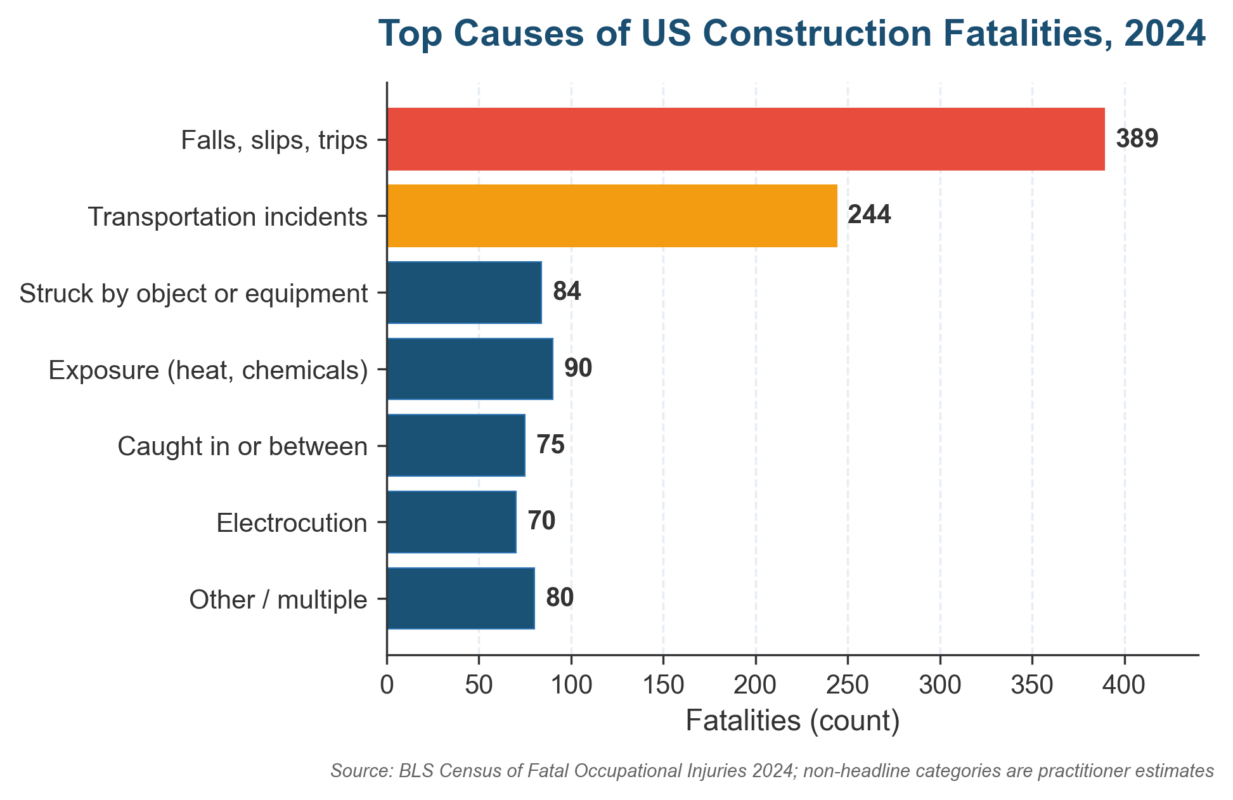
Falls and transportation account for 61% of all US construction fatalities. Lagging indicators like TRIR catch these only after a death.
Modern key risk indicators construction programs pair every lagging measure with a leading one. the wider key risk indicators dashboard guide calls this the lead-lag balance: each metric has a partner that moves first.
The Campbell Institute and the National Safety Council rank near-miss reporting rate, observation completion, and corrective action close-out as the three strongest predictors of next-quarter incident rates.
| Indicator type | Construction examples | What it tells you |
| Lagging | TRIR, DART, EMR, lost-time injury frequency, OSHA recordables, fatality count | What already happened. Useful for benchmarking, bonding, and prequalification, but reactive. |
| Leading | Near-miss reporting rate, safety observation completion, JHA quality score, toolbox-talk attendance, corrective action close-out, training hours per worker | What is about to happen. Moves weeks or months before lagging metrics, gives the team time to intervene. |
What a Key Risk Indicator Means for a Construction Firm
A key risk indicator is a measurable metric that signals a change in risk exposure before that risk turns into an incident, a claim, or a regulatory finding. It is forward-looking by design. our primer on what a key risk indicator is defines it as the early-warning signal sitting between the operational metric and the realized loss.
KRIs differ from KPIs in two ways. First, they measure exposure, not performance. A falling near-miss reporting rate is bad news, while a rising production rate is good news.
Second, they are tied to risk appetite: a KRI breach signals that exposure has moved past a tolerance line drawn by the executive team or the board. ISO 31000:2018 clause 6.5 on monitoring and review formalizes that distinction inside the wider risk management process.
On a construction firm’s dashboard, a useful key risk indicator has five things: a defined threshold, an accountable owner, a review cadence, a data source, and an escalation path. Without all five, the indicator decorates a report without changing behavior. the wider 50-KRI reference list shows the same structure across industries; construction’s version simply substitutes the industry-specific data sources.
Safety Key Risk Indicators for Construction Sites Track First
Safety sits at the top of every key risk indicators construction dashboard for a clear reason: the financial, legal, and reputational consequences of a fatality dwarf every other category. Key Risk Indicators for Construction Firms turn that exposure into measurable thresholds the executive team can defend.
The OSHA General Duty Clause, Section 5(a)(1) places the legal duty squarely on the employer, and 2025’s revised penalty schedule pushed serious citations to $16,500 and willful or repeat citations to $165,000 per violation.
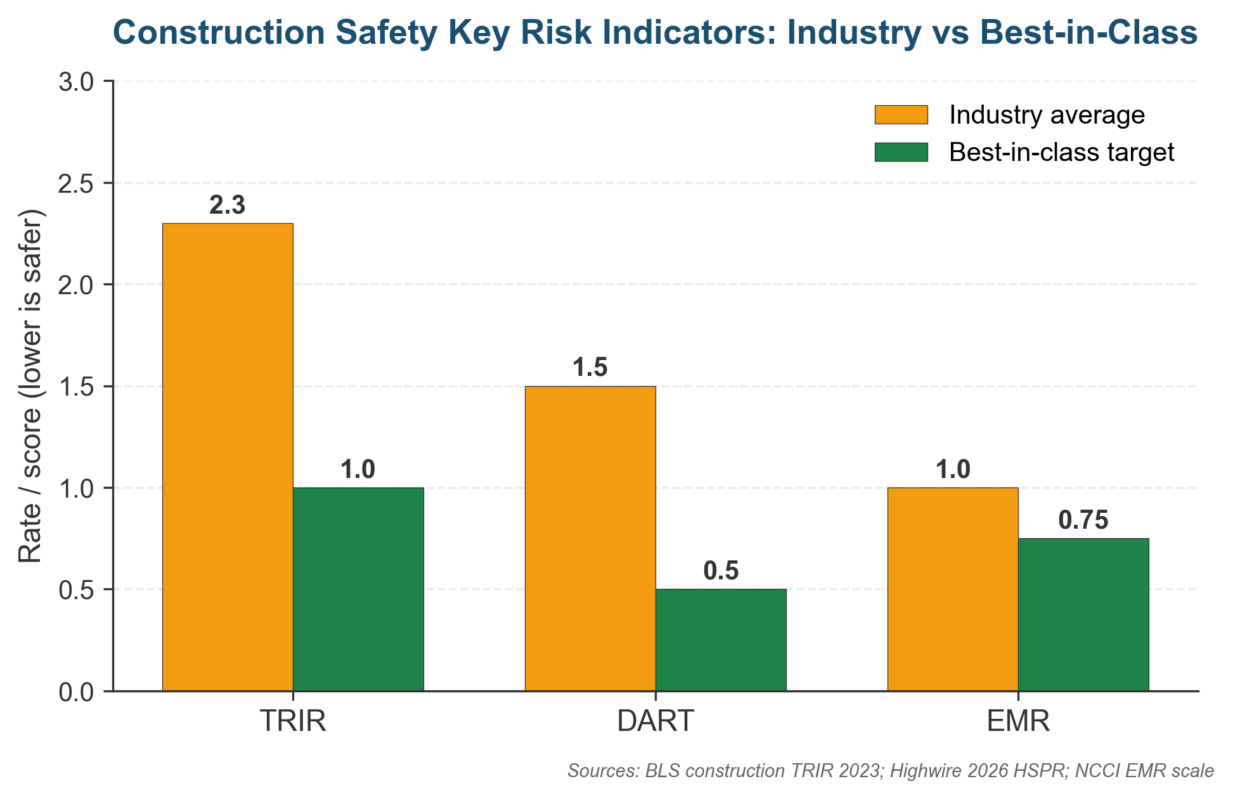
Best-in-class US construction firms target a TRIR below 1.0, DART below 0.5, and EMR below 0.85. Industry averages still sit roughly 2x higher.
Lagging safety indicators every contractor reports
TRIR, DART, and EMR are the three lagging KRIs that bonding companies, GCs, and project owners ask for by name. OSHA’s recordkeeping standard 29 CFR 1904 defines how each is built.
Bonding requires EMR below 1.0; large industrial owners often require below 0.85. The our pre-construction risk assessment guide maps these lagging numbers back to the hazard register that creates them.
| Lagging KRI | Formula | US construction benchmark |
| TRIR (Total Recordable Incident Rate) | (Recordable incidents x 200,000) / Hours worked | Industry avg 2.3 (BLS 2023); best-in-class <1.0 |
| DART rate | (DART cases x 200,000) / Hours worked | Industry avg ~1.5; best-in-class <0.5 |
| EMR (Experience Modification Rate) | NCCI experience formula vs class code | 1.0 industry avg; <0.85 required by most large industrial owners |
| Fatality count and rate | BLS CFOI formula: deaths / 100,000 FTE | 9.2 per 100,000 FTE (2024); top quartile under 4.0 |
| Lost-time injury frequency | (LTI x 200,000) / Hours worked | Tracked monthly; rolling 12-month trend matters more than spot value |
Leading safety indicators that move first
Leading indicators are where the differentiated work happens. They move weeks before TRIR does and give site teams something to fix. Three leading KRIs sit at the top of the Campbell Institute and OSHA published research: near-miss reporting rate, safety observation completion, and corrective action close-out.
The NIOSH hierarchy of controls is the reference for what to do when an observation flags a hazard.
| Leading KRI | How to measure | Threshold (green/amber/red) |
| Near-miss reporting rate | Near misses reported per recordable per month | Green >75:1; amber 50-75:1; red <50:1 |
| Safety observation completion | % of scheduled observations completed per month | Green >=95%; amber 80-95%; red <80% |
| JHA quality score | % of JHAs scoring >=4/5 on supervisor review | Green >=90%; amber 70-90%; red <70% |
| Corrective action close-out | % of CARs closed within target window (30 days) | Green >=90%; amber 70-90%; red <70% |
| Toolbox-talk attendance | % of workforce attending weekly talks | Green >=95%; amber 85-95%; red <85% |
| Stop-work authority usage | Stop-work events per 100,000 hours | Watch trend, not absolute; rising is healthy if injuries also fall |
| Heat-stress KRI (WBGT exceedance) | Hours per week WBGT exceeds NIOSH action limit | Green 0; amber 1-8; red >8 |
Financial Indicators That Predict Project Stress and Bonding Loss
Construction is famously profitable on paper and broke in cash. The ABC Construction Backlog Indicator rose to 8.8 months in April 2026, but Procore’s 2025 contractor survey found 70% of US contractors regularly face delayed payments. Financial KRIs sit second on the dashboard because cash failures kill more contractors each year than safety failures do. Key Risk Indicators for Construction Firms flag the cash-flow stress months before a bonding-line review.
Bonding companies, secured lenders, and project owners watch the same financial KRIs the CFO does. our financial key risk indicators guide maps the ratios to their underlying drivers. Most US contractors who lose bonding capacity do so after a sustained breach in one of three indicators: current ratio, days in cash, or backlog-to-working-capital.
| Financial KRI | Formula | Construction benchmark |
| Months in backlog | Backlog / (Annual revenue / 12) | 6-9 months healthy; <4 months red flag |
| Current ratio | Current assets / Current liabilities | >=1.6 healthy; bonding floor 1.5 |
| Quick ratio | (Cash + AR) / Current liabilities | >=1.4 healthy |
| Backlog to working capital | Backlog / (Current assets – Current liabilities) | <5:1 healthy; >10:1 stress |
| Days revenue in AR | (AR / Annual revenue) x 365 | 40-50 days; >60 days red |
| Days expenses in AP | (AP / Annual cost of revenue) x 365 | 45-60 days; rising fast is a warning |
| Days in cash | ((Cash + Securities) x 365) / Revenue | 60-90 days; <30 days red |
| Debt to equity | Total debt / Net worth | <2.0 healthy |
| Workers’ comp claim severity | Average paid + reserved per claim | Watch trend; >$15,000 per claim signals control gaps |
Credit risk and accounts-receivable aging
Construction credit risk is rising fast. Experian’s February 2026 industry report flags rising delinquency on commercial construction receivables, with severe delinquency over 90 days creeping up across most sub-sectors.
AR aging is the leanest leading indicator a CFO has. Once 90+ day past-due balances rise above 8% of total receivables, the cash crunch is six to ten weeks out.
Pair the AR aging KRI with a billing-cycle KRI tied to retainage release. Track aging by client tier (Tier 1 public, Tier 2 Fortune 500, Tier 3 mid-market) so concentration risk surfaces ahead of a single blended number.
The our guide on the importance of risk management in projects walks through the same tiering approach for project-level financial controls.
Operational and Subcontractor Indicators That Surface Hidden Risk
Operational KRIs sit between safety and finance. They often move first when a project is sliding sideways. Schedule variance, RFI close-out cycle time, and change order rate are the three most useful project-level leading indicators.
The our construction schedule risk analysis software primer walks through how Monte Carlo simulation feeds these indicators.
Subcontractor risk is the other operational story. CCDC 5B-2025 specifically lists subcontractor default as a delay event outside the construction manager’s control. A prequalification KRI bundle (financial capacity score, EMR, OSHA citation history, backlog-to-capacity ratio) catches the subs most likely to default before the contract is signed.
| Operational KRI | What it tracks | Threshold |
| Schedule variance | % deviation between earned value and planned value | Green ±2%; amber ±5%; red >±10% |
| RFI close-out cycle time | Average days from RFI raise to design response | Green <7 days; red >14 days |
| Change order rate | Change order value / Original contract value | Green <5%; red >15% |
| Productivity index (PI) | Earned labor hours / Actual labor hours | Green >=1.0; red <0.85 |
| Subcontractor default risk score | Composite: financial, EMR, citations, backlog | Define internal pass/fail; revisit annually |
| Permit and inspection rework rate | % of inspections requiring re-inspection | Green <5%; red >10% |
| Punchlist close-out | % of punchlist items closed by handover target | Green >=95%; red <85% |
Prequalification scoring is the single best place to install operational KRIs. our how-to-assess-and-mitigate construction risks guide covers a four-pillar scoring model: financial capacity, safety record, workforce capacity, and reputation.
Most contractors apply weights of 30/30/25/15 across the four, then convert to a 0-100 score that triggers tier-1 (clear), tier-2 (require LOI plus bond), or tier-3 (decline) decisions inside the bid review.
Cyber, ESG, and Climate KRIs Reshaping US Construction
Cybersecurity key risk indicators construction firms now need
Construction has gone digital faster than its cyber maturity has caught up. Rapid7’s 2025 building and construction threat landscape report ranks construction as the most-targeted sector by ransomware, taking 11.4% of reported victims in September 2025 alone.
BIM platforms, IoT sensors on heavy equipment, and GPS-tracked fleets all add attack surface. The our cyber key risk indicators guide maps the indicators that translate from finance and healthcare into construction-specific contexts.
The September 2025 Volvo Group ransomware attack, routed through HR vendor Miljödata, shows the supply-chain pattern construction CISOs should expect.
Vendor cyber-posture and operational-technology patch latency are the two indicators that catch this pattern earliest.
NIST SP 800-30 Rev. 1 provides the underlying risk-assessment method; CISA’s critical-infrastructure resources cover construction-adjacent sector guidance.
ESG and climate KRIs on US job sites
ESG indicators used to be a European story. Climate-driven losses and SEC climate disclosure rules have brought them onto US construction dashboards.
OSHA’s heat-related illness prevention initiative and the NIOSH heat-stress resources provide the federal references. Wet Bulb Globe Temperature (WBGT) exceedance hours is the single most useful climate KRI on a US job site, particularly in the Sun Belt.
| Cyber / ESG / Climate KRI | What it tracks | Threshold |
| Phishing click-through rate (PCR) | % of staff clicking simulated phishing emails | Green <3%; amber 3-7%; red >7% |
| MFA coverage | % of privileged accounts with MFA enforced | Green 100%; red <95% |
| Operational technology patch latency | Days between vendor patch release and field deployment | Green <30 days; red >90 days |
| Vendor cyber posture score | % of critical vendors scoring above threshold | Define per vendor tier |
| WBGT exceedance hours | Hours/week WBGT exceeds NIOSH action limit | Green 0; red >8 |
| Scope 1+2 emissions intensity | tCO2e per $M revenue (or per square foot built) | Trend-based; target 5-7% annual reduction |
| Diverse hours on site | % of project hours worked by certified diverse trades | Per project owner spec |
| EPA stormwater non-compliance | Notices of non-compliance per quarter | Green 0; red >1 |
Building a Key Risk Indicators for Construction Dashboard That Boards Use
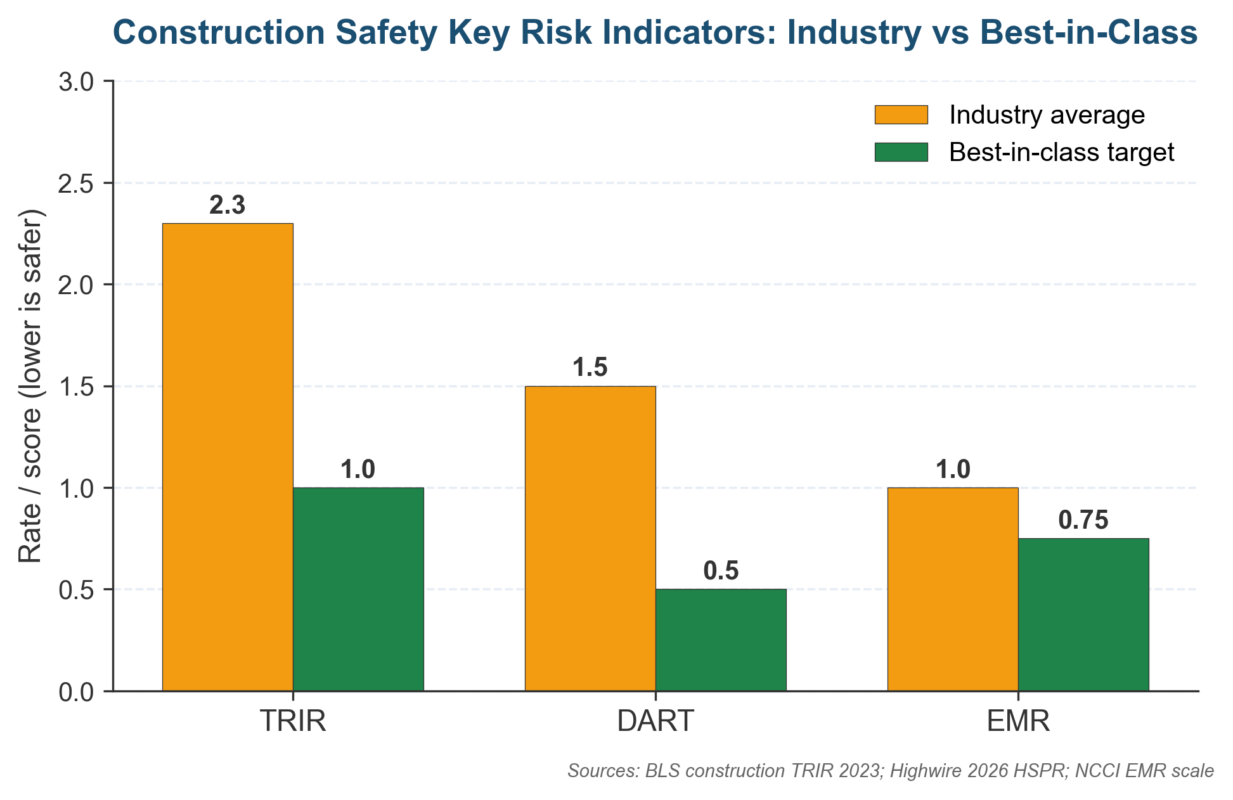
A defensible key risk indicators construction dashboard usually covers 40-50 indicators across five categories, with safety the largest share.
A KRI dashboard fails for predictable reasons: bands set without quantitative thresholds, anonymous indicators no executive will sign off on, and a review schedule that nobody runs.
Our KRI dashboard guide describes these as the structural minimums. Get them in place and the same indicators drive board conversations that move money; skip them and the dashboard turns into wallpaper.
Five categories make up a defensible dashboard: safety (typically 32% of indicators), financial (24%), operational (22%), cybersecurity (12%), and ESG/climate (10%).
The mix matches the risk profile of a US contractor working under OSHA, IRS, SEC, and EPA jurisdiction at once. our wider KRI examples library covers each category with sample threshold values that contractors adapt to their own appetite statements.
Set thresholds with green, amber, and red bands
Every KRI gets three bands tied to the firm’s risk appetite. Green is below the action threshold, amber triggers a review, red triggers an escalation to the executive risk committee.
COSO’s Enterprise Risk Management framework expects the bands to map back to documented appetite and tolerance statements, not back-of-the-envelope rules. The board signs off on the bands annually, the same way it signs off on the audit plan.
Assign owners and accountability
Each indicator gets one named owner. Safety lives with the VP of Safety; financial with the CFO; operational with the COO; cyber with the CISO; ESG with the Chief Sustainability Officer. The best key risk indicators guide makes the case for C-suite ownership: only at that altitude does a breach carry enough weight to trigger a corrective response inside the fiscal year.
Set review cadence and escalation paths
Cadence matches the velocity of the risk. Safety KRIs review weekly at the project level and monthly at the corporate level. Financial KRIs run monthly. Cyber KRIs run weekly with continuous-monitoring overlays, and ESG indicators run quarterly.
Any red breach escalates within 24 hours to the executive risk committee, with a written corrective action plan inside five business days. Pre-construction risk assessment template includes the cadence and escalation table most US contractors copy verbatim into their dashboards.
Frequently Asked Questions
How many key risk indicators should a construction company track?
Most US contractors land at 40 to 50 active KRIs split across safety, financial, operational, cyber, and ESG categories.
Below 25 the dashboard misses entire risk buckets; above 70 the team stops reading it. Our 50-KRI reference list is a good starting menu. Pick the indicators that map to your top 10 enterprise risks, then add category-specific ones.
What is the difference between a KRI and a KPI in construction?
A KPI measures performance; a KRI measures exposure. A productivity rate of 1.05 is a KPI. A near-miss reporting rate of 30 per recordable is a KRI — it tells you the workforce is under-reporting and your TRIR will worsen in the next quarter.
ISO 31000:2018 treats KRIs as part of the monitoring and review step, separate from operational performance metrics.
Which OSHA standards drive the most useful construction KRIs?
The four OSHA standards that anchor most construction KRIs are 29 CFR 1926 Subpart M (fall protection), Subpart P (excavations), Subpart K (electrical), and 29 CFR 1904 (recordkeeping).
Fall and excavation citations dominate the agency’s top enforcement list every year. OSHA’s construction industry page links each subpart to current emphasis programs.
How do I benchmark my construction TRIR against the industry?
The BLS Survey of Occupational Injuries and Illnesses publishes annual incidence rates by NAICS code. For construction (NAICS 23), the 2023 average TRIR was 2.3 — beat that and you sit in the top half, push below 1.0 and you sit in the top quartile.
For prequalification scoring, Highwire and ISN benchmark databases are also widely used by US general contractors and owners.
Are leading safety indicators actually predictive?
Yes. Three leading indicators repeatedly outperform chance in predicting next-quarter incident rates: near-miss reporting rate, observation completion rate, and corrective-action close-out rate.
The Construction Industry Institute and NSC Campbell Institute both publish the underlying field research. Sites with high near-miss reporting are not more dangerous. They are better at reporting, and that culture predicts lower future TRIR.
What KRIs do bonding companies actually check?
Sureties focus on three financial and two safety KRIs: current ratio (floor 1.5), working capital trend, backlog-to-working-capital ratio (under 5:1), TRIR versus industry, and EMR (below 1.0).
A breach in two or more of those simultaneously is what triggers a bonding line review. Our financial KRI guide covers the full bonding-line scoring approach.
How do I add cybersecurity KRIs to a construction dashboard that’s never had them?
Start with four indicators every IT team already collects: phishing click-through rate, MFA coverage on privileged accounts, patch latency on operational technology, and vendor cyber-posture scores.
Layer those onto the safety dashboard with the same green/amber/red bands. CISA’s cybersecurity resources and the our cyber KRI examples cover the thresholds and escalation logic.
How often should I refresh my construction KRI list?
Refresh the full list annually, in lockstep with the enterprise risk assessment. Update thresholds quarterly so they track the firm’s current risk appetite.
Add or retire individual indicators whenever a major incident, acquisition, new contract type, or regulatory change hits the business. our guide on the importance of risk management in projects frames KRI hygiene as part of the wider ERM cycle.
Common Pitfalls When Implementing Construction KRIs
KRI rollouts fail predictably. The same seven pitfalls keep surfacing in audit findings and post-incident reviews across the industry, from mid-size general contractors to ENR Top 100 firms.
Our 2022 construction risk management guide and OSHA’s voluntary safety management guidelines flag the same patterns. The table below captures each failure mode, the root cause, and the remedy a defensible program applies before the next quarterly review.
| Pitfall | Root cause | Remedy |
| Lagging-only dashboard | Team copies TRIR/DART/EMR from prequalification forms without adding leading indicators | Pair every lagging KRI with at least one leading partner; track near-miss reporting and observation completion in parallel |
| Thresholds set by gut feel | Owner assigns green/amber/red bands without tying them to documented risk appetite | Anchor bands in board-approved risk appetite statements; review annually with the audit committee |
| No accountable owner | KRI lives on a slide deck owned by no single executive | Assign one named C-suite owner per indicator; tie a portion of bonus to threshold breaches and corrective action |
| Under-reporting culture | Workers fear retaliation for raising near-miss or stop-work events | Track reporting rate as a positive indicator; reward sites with high reporting, audit sites with implausibly low numbers |
| Cyber KRIs missing entirely | IT and HSE operate in separate silos with separate dashboards | Consolidate phishing, MFA, patch latency, and vendor posture into the enterprise KRI report alongside safety metrics |
| Dashboard fatigue | Forty indicators reviewed by the same committee at the same cadence | Tier the dashboard: project-level (weekly), corporate (monthly), board (quarterly); show only red and amber to the board by default |
| No escalation path | Red breaches sit in the report without consequence | Define a 24-hour escalation to the executive risk committee; require a written corrective action plan within five days |
Looking Ahead: Construction KRIs Through 2027
Three forces will reshape key risk indicators construction firms track over the next 18 months. First, regulatory pressure: OSHA’s expected national heat-illness prevention standard will move WBGT exceedance hours from a voluntary KRI to a near-mandatory one. Worker advocacy and insurer pressure are already pulling the industry in that direction.
Second, cyber convergence: as BIM, drones, robotics, and IoT-instrumented heavy equipment scale, the boundary between safety and cyber KRIs collapses.
A ransomware lock on a tower-crane control system is an OSHA-reportable hazard, not just a cyber incident. Expect joint dashboards across CISO and VP Safety to be the norm by 2027, with shared thresholds and a single executive escalation path.
Third, labor: the Engineering and Construction industry needs 499,000 net new workers by end of 2026, up from 439,000 in 2025. Wage inflation has pushed construction earnings up 4.2% year-over-year.
Recruitment cycle time, retention rate, certified-trade ratio, and overtime hours per worker move from HR dashboards into the enterprise risk register, because tight labor turns into quality, safety, and schedule risk inside three quarters.
Fourth, ESG quantification: the SEC’s climate-related disclosure rules and state-level reporting in California are pushing Scope 1-3 emissions, water use, and diverse hours onto the KRI list.
Contractors who can produce credible ESG KRIs win the data-center, hyperscaler, and federal-infrastructure pursuits. Contractors who cannot will see their bid lists shrink.
The underlying principle does not change. KRIs are early-warning signals, not vanity metrics. The firms that pair lagging numbers with leading partners, anchor thresholds in documented risk appetite, and assign single accountable owners will keep beating the industry average on incidents, on cash, and on the bonding line.
Need help building a key risk indicators construction dashboard for your firm? We work with US contractors on safety, financial, cyber, and ESG indicators.
Engagements cover threshold setting against your documented risk appetite, owner assignment, and escalation paths into the executive risk committee. Visit our services page for the full scope, or contact us to schedule a 30-minute implementation review.
Sibling industry KRI guides: For practitioners benchmarking across sectors, see our companion deep-dives on Key Risk Indicators for energy and utilities, Key Risk Indicators for real estate companies, project risk Key Risk Indicators examples, and board risk reporting one-page dashboard. Each guide maps industry-specific regulatory drivers, threshold logic, and dashboard examples to help risk teams calibrate their own KRI library.

Chris Ekai is a Risk Management expert with over 10 years of experience in the field. He has a Master’s(MSc) degree in Risk Management from University of Portsmouth and is a CPA and Finance professional. He currently works as a Content Manager at Risk Publishing, writing about Enterprise Risk Management, Business Continuity Management and Project Management.