
In January 2026, the office CMBS delinquency rate hit a record 12.34%, more than a full percentage point above the 2010 financial-crisis peak. Key Risk Indicators for Real Estate Companies are the leading-metric layer that surfaces this kind of cliff edge while a building still has options.
Approximately $957 billion in CRE loans matured in 2025, nearly triple the 20-year average. S&P Global projects the maturity wall to peak at $1.26 trillion in 2027, with average new-loan coupons running near 6.2% against maturing-loan coupons closer to 4.3%.
| Key Takeaways |
| A 2026 program of Key Risk Indicators for Real Estate Companies spans six categories: capital markets, operating, tenant credit, climate and ESG, REIT compliance, and property-technology cyber. Typical catalogs run 50 to 70 indicators across a publicly traded REIT and 30 to 45 for a private operator. |
| Office CMBS delinquency reached a record 12.34% in January 2026 per Trepp, exceeding the 2010 financial-crisis peak by over a percentage point. The office sector now sits well above multifamily (6.85% in February 2026) and industrial (under 1%). |
| US CRE loan maturities totaled $957 billion in 2025, nearly triple the 20-year average. S&P Global projects the maturity wall to peak at $1.26 trillion in 2027. Average new-loan rates ran near 6.2% against maturing-loan rates closer to 4.3%. |
| The SEC climate disclosure rule (Release No. 33-11275, March 2024) and TCFD-aligned frameworks turned Scope 1, 2, and 3 emissions into board-level KRIs. Real estate generates roughly 40% of global carbon emissions per the World Green Building Council. |
| REIT compliance rests on four pillars: tax qualification under IRC Sections 856-858 (75% asset and 95% income tests), GAAP and SEC financial reporting, SOX 404 governance, and SEC climate plus cybersecurity disclosure. Each pillar generates its own KRI subset. |
| Standards anchoring Key Risk Indicators for Real Estate Companies: NCREIF property-level reporting, NAREIT industry standards, SEC climate and cybersecurity rules, COSO ERM, IFRS S2, SASB Real Estate Industry Standards, TCFD, GRESB, and OCC supervisory guidance on CRE concentrations. |
| A working dashboard pulls 12 to 18 indicators to the executive risk committee each quarter. LTV, DSCR, top-10 tenant concentration, refinancing wall exposure, REIT test margins, and Scope 1+2 emissions sit on the same page as occupancy, NOI variance, and physical climate exposure. |
Office property vacancy reached a record 19.6% in Q1 2025 per CoStar, and the special servicing rate for office CMBS reached 15.8% in October 2025. Multifamily CMBS delinquency climbed to 6.85% in February 2026 from 1.3% in 2022, driven by floating-rate debt and operating-expense inflation.
Key Risk Indicators for Real Estate Companies now anchor to NCREIF property reporting, NAREIT standards, SEC climate and cybersecurity disclosure rules, COSO ERM, TCFD recommendations, and OCC supervisory guidance on CRE concentrations.
Every indicator earns its place by tying a measurable threshold to a documented authority and the quarterly board pack the audit committee already reads.
What Are Key Risk Indicators for Real Estate Companies?
A Key Risk Indicator is a forward-looking metric that flags rising exposure before the cap-rate move, the anchor tenant default, or the refinancing failure shows up in the audited financial statements. Real estate companies face exposure across capital structure, building operations, tenant credit, physical climate, and REIT compliance.
Useful Key Risk Indicators examples on a real estate dashboard share four traits. Each indicator is measurable from existing accounting and operating data, owned by one named accountable person, calibrated to a documented threshold, and moves ahead of the loss event rather than after it.
Key Risk Indicators for Real Estate Companies differ from generic enterprise KRIs because of property-level granularity.
A building either renews its anchor tenant or it does not. A single REIT tax test failure flips the federal tax treatment of the entire entity. Those binary events demand purpose-built indicators.
KPIs measure performance against an internal goal such as same-store NOI growth. KRIs measure exposure against a tolerance the board has approved. Portfolio occupancy can be a KPI when reported against budget; the same number becomes a KRI when reported against OCC concentration thresholds or a loan covenant minimum.
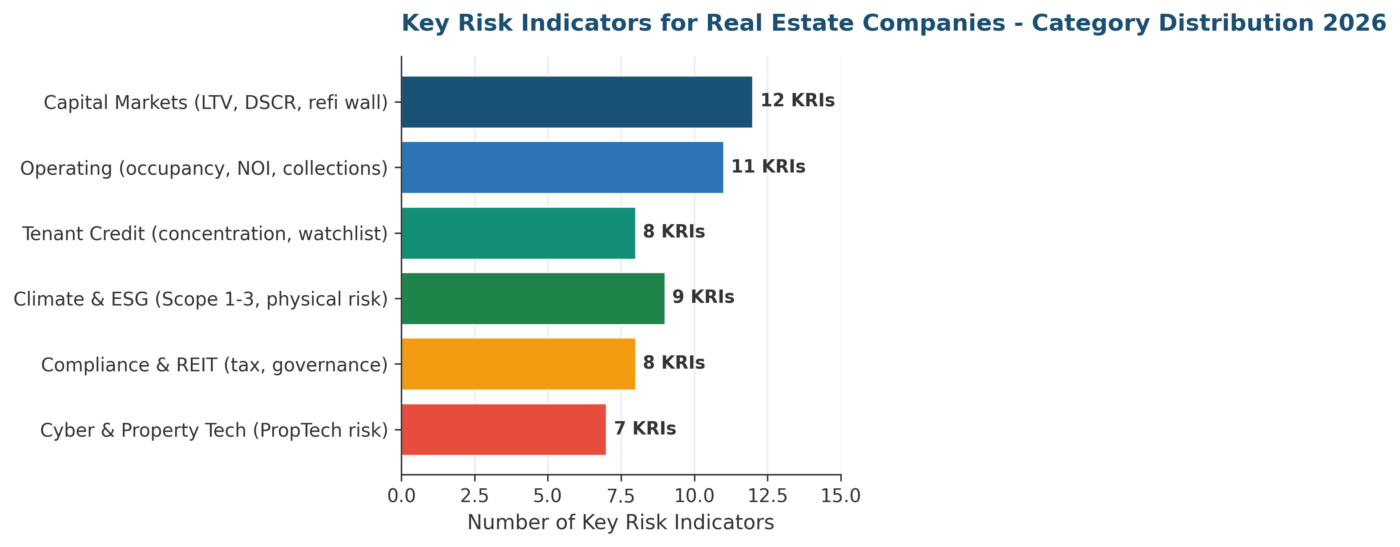
Figure 1. Distribution of Key Risk Indicators for Real Estate Companies across the six 2026 categories.
Capital Markets Key Risk Indicators for Real Estate Companies
Capital structure is where the 2024-2026 cycle hurts most. Loan-to-value (LTV) at the portfolio and asset level, debt service coverage ratio (DSCR), weighted average debt maturity, fixed-versus-floating split, and unencumbered NOI as a share of total NOI form the core capital-markets indicators in any 2026 Real Estate KRI catalog.
Specific indicators worth tracking quarterly: refinancing wall exposure (debt maturing within 12, 24, and 36 months), property-level DSCR below 1.20x, properties with current LTV above the original loan covenant, and the spread between current cap-rate assumption and last-appraisal cap-rate. Each ties to a documented covenant or risk appetite threshold.
For a US REIT with $5 billion of debt, the S&P maturity wall data translates into a 24-month refinancing budget, a forward swap program, and a watchlist of properties whose interest expense will jump 200 basis points at maturity. The KRI catalog operationalizes that translation.
The how to develop Key Risk Indicators methodology forces each metric to a named owner. For real estate companies that means the CFO owns DSCR thresholds, treasury owns refinancing wall metrics, and asset management owns property-level LTV breaches across the portfolio.
| Capital Markets KRI | What It Measures | Typical Green Band | Owner |
| Portfolio LTV | Debt as percentage of current asset value | ≤55% | CFO |
| Portfolio DSCR | NOI divided by total debt service | ≥1.40x | CFO / Treasury |
| Refinancing wall – 24 months | Debt maturing within 24 months as % of total debt | ≤25% | Treasury |
| Weighted avg debt maturity | Years until weighted-average loan maturity | ≥5.5 years | Treasury |
| Floating-rate debt share | Floating-rate debt as % of total debt | ≤25% | Treasury |
| Unencumbered NOI share | Unencumbered NOI as % of total NOI | ≥40% | Asset Mgmt |
Table 2. Capital-markets Key Risk Indicators for Real Estate Companies with green bands and accountable owners.
Operating Key Risk Indicators for Real Estate Companies
Operating KRIs track building-level performance against budget and against the local market. Same-store occupancy, weighted average remaining lease term (WARLT), rent collections within 30 days, NOI variance versus budget, and operating-expense reimbursement ratio are the workhorse indicators on a 2026 dashboard.
CoStar reported US office vacancy at a record 19.6% in Q1 2025. That market-level data point creates a useful peer-pressure read against any individual REIT’s office occupancy. A portfolio sitting 200 basis points below market across multiple quarters triggers an immediate leasing strategy review.
Capex-related indicators belong on the same page. TI/LC (tenant improvement and leasing commission) burn rate per signed lease, capex deferred against the five-year plan, and the percentage of property NOI dependent on tenant improvements scheduled in the next 12 months are core capital-improvement indicators. Each ties back to free cash flow.
Energy and utility cost ratios round out the operating dashboard. Properties with year-over-year utility cost variance above 8%, water consumption per rentable building area (RBA), and the percentage of buildings with active energy benchmarking are operational indicators that also feed the climate disclosure narrative.
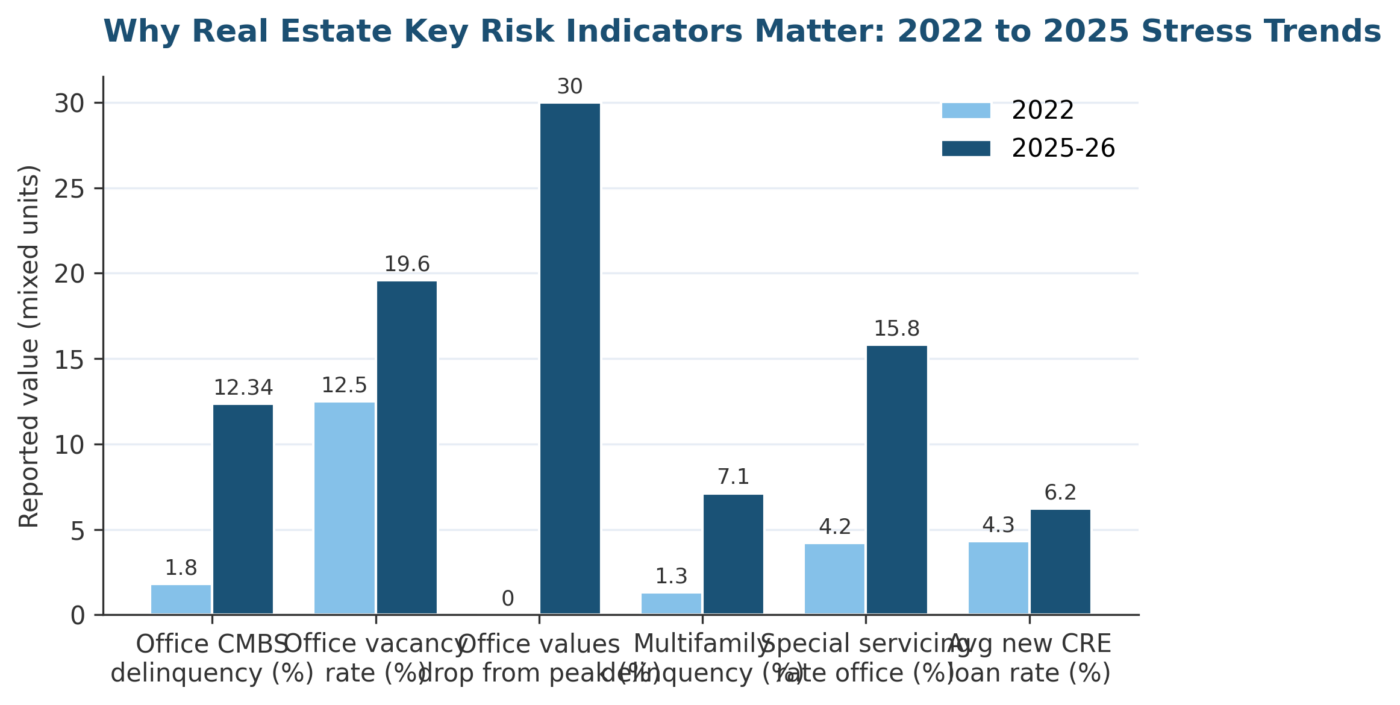
Figure 2. Real estate market stress 2022 to 2025-26 driving Real Estate KRI adoption.
Tenant Credit Key Risk Indicators for Real Estate Companies
Tenant credit determines whether rent gets paid. Top 10 tenant revenue concentration, tenant watchlist count, weighted average tenant credit rating, and dollar exposure to tenants in industries facing structural decline (legacy retail, single-tenant office, certain biotech) are the standard tenant-credit indicators.
Add concrete dollar-exposure metrics on the same page. Annualized base rent (ABR) attributable to non-investment-grade tenants, ABR exposure to tenants with declining same-store sales, and lease maturity concentration in any single quarter.
Equifax’s CRE tenant risk assessment is one third-party data source that backstops the internal scoring.
A Class A office landlord with 18% revenue concentration in two financial-services tenants and a 2027 lease cliff has two KRI breaches that compound.
The board paper needs to show both, not aggregate them away. Granular property-level indicators force the right conversation across the leasing and asset-management teams.
Tenant indicators connect upstream to supply chain Key Risk Indicators for vertically integrated operators handling fit-out and tenant-improvement procurement, and to operational risk management practice for in-house property management businesses. Each connection point has its own threshold and named accountable owner inside the organization.
Climate and ESG Key Risk Indicators for Real Estate Companies
Real estate accounts for roughly 40% of global carbon emissions per the World Green Building Council. The SEC’s climate disclosure rule and TCFD-aligned frameworks turned that figure into board-level KRIs for US public-company REITs and any private operator with bank or insurance counterparties tracking financed emissions.
Specific climate KRIs to track quarterly: Scope 1, Scope 2, and Scope 3 emissions versus prior year against a documented baseline, percentage of portfolio in FEMA-designated flood Zone A or other high-hazard zones, properties exposed to wildfire WUI zones, and physical-asset insurance premium year-over-year change.
Most US REITs report through TCFD, SASB Real Estate Industry Standards, and GRESB. The frameworks are not interchangeable, but the underlying climate KRIs are.
Carbon intensity per square foot, percentage of LEED or BREEAM certified RBA, and stranded-asset exposure to 2030 emissions targets each show up across the three reports.
Climate-physical risk indicators are not theoretical. Hurricane Helene damaged Florida and Carolina real estate worth tens of billions in September 2024. A portfolio’s percentage of NOI generated by properties within 50 miles of the Gulf or Atlantic coast is a credible KRI for quarterly board review.
| Climate & ESG KRI | Reporting Framework Source | Typical Cadence |
| Scope 1 emissions vs baseline | SEC climate rule, TCFD, IFRS S2 | Annually (interim quarterly) |
| Scope 2 emissions vs baseline | SEC climate rule, TCFD, IFRS S2 | Annually (interim quarterly) |
| Scope 3 financed emissions | SEC climate rule (phased), GRESB | Annually |
| Properties in FEMA flood Zone A (%) | TCFD physical risk, internal | Quarterly |
| Carbon intensity per square foot | SASB Real Estate Standards, GRESB | Quarterly |
| LEED / BREEAM certified RBA (%) | GRESB, voluntary | Annually |
| Climate insurance premium YoY change | Internal, insurance disclosures | Quarterly |
Table 5. Climate and ESG Key Risk Indicators for Real Estate Companies mapped to reporting frameworks.
Compliance and REIT-Specific Key Risk Indicators for Real Estate Companies
Publicly traded US REITs face a four-pillar compliance burden: tax qualification under IRC Sections 856-858, financial reporting under GAAP and SEC rules, governance and internal controls under SOX 404, and disclosure under SEC climate and cybersecurity rules. Each pillar generates its own KRI subset.
The two binding REIT tax tests are the 75% asset test and the 95% income test. Quarterly compliance margin against each test (expressed as basis points of headroom) and the count of qualifying-asset reclassifications are core REIT compliance KRIs. A failed quarter flips the entity to C-corp taxation, with cascading effects on shareholders.
Compliance KRIs also cover Form 10-K filing readiness, material weakness count from the latest SOX testing cycle, and percentage of material contracts with current force-majeure and SEC-disclosure language.
The compliance risk analysis approach feeds the indicator selection and threshold design across each compliance pillar.
Property-technology adoption added a cybersecurity KRI layer. Building management system vulnerabilities, smart-building IoT device coverage in the vulnerability scan, and tenant data breach exposure round out the compliance dashboard for any REIT operating Class A office or multifamily portfolios with significant tech footprint.
Setting Thresholds for Key Risk Indicators for Real Estate Companies
Indicators without thresholds are decoration on a slide. The threshold-setting workshop is where Key Risk Indicators for Real Estate Companies become risk-management tools rather than monthly reporting noise.
Green-amber-red bands tie directly to the documented risk appetite the board has approved each cycle.
Build thresholds from three inputs: lender-imposed covenants (DSCR 1.20x, LTV 65% on agency multifamily), internal historical baselines, and peer benchmarks from NCREIF, NAREIT, Trepp, and Federal Reserve CRE data.
Bank syndicates publish their CRE concentration limits, which give a useful peer-pressure read against internal positioning.
Thresholds need recalibration at least annually and after every material refinancing, acquisition, or disposition. A 60% LTV threshold built on 2021 cap rates may need to tighten to 55% under 2026 cap rates.
The Key Risk Indicators developing risk appetite article maps the recalibration exercise step by step.
Document each threshold with owner, escalation path, board reporting trigger, and the rationale that ties to a specific covenant clause or risk-appetite statement.
Auditors and lenders test the rationale, not the band itself. A band without rationale will not survive the first lender inquiry on a refinancing call.
| Sample KRI | Green (within tolerance) | Amber (escalate) | Red (board breach) |
| Portfolio LTV | ≤55% | 55-65% | >65% |
| Portfolio DSCR | ≥1.40x | 1.20-1.39x | <1.20x |
| Top 10 tenant revenue concentration | ≤25% | 26-35% | >35% |
| Rent collections within 30 days | ≥98% | 95-97.9% | <95% |
| Refinancing wall – 24 months | ≤25% | 26-40% | >40% |
| REIT 95% income test margin | ≥250 bps | 100-249 bps | <100 bps |
Table 3. Sample threshold bands for core Key Risk Indicators for Real Estate Companies, tied to covenants and REIT tax tests.
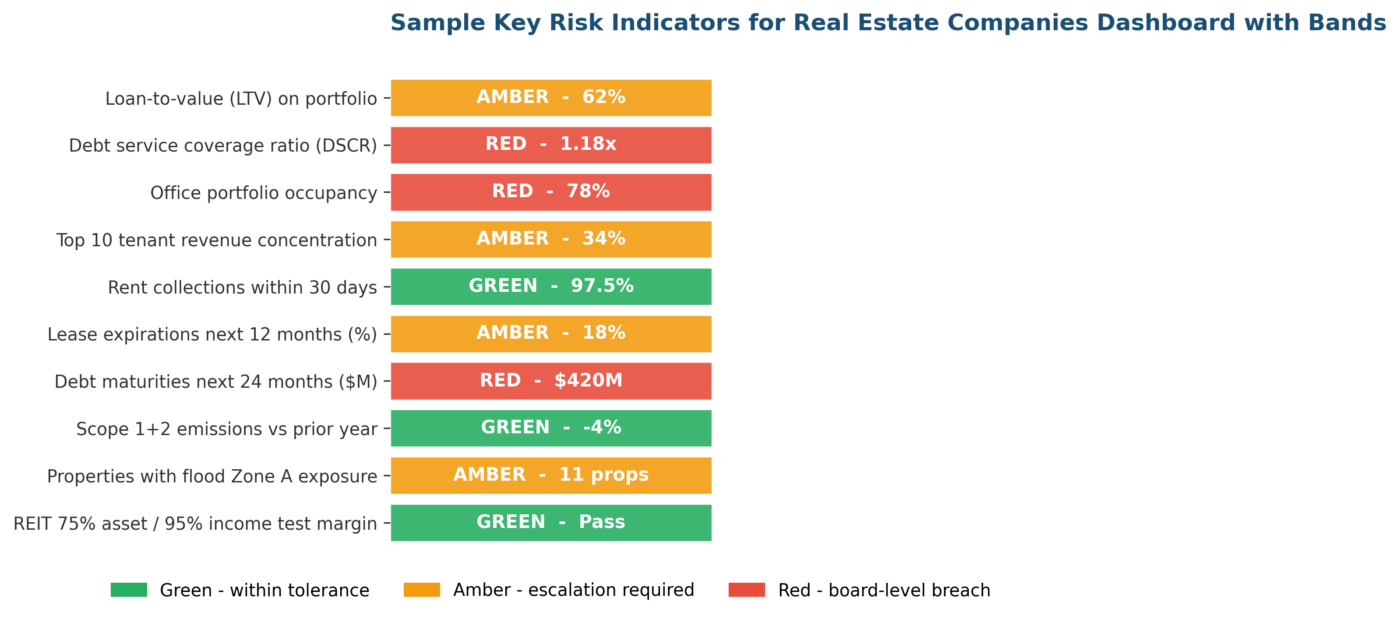
Figure 3. Sample executive Key Risk Indicators for Real Estate Companies dashboard with traffic-light threshold bands.
Reporting Cadence for Key Risk Indicators for Real Estate Companies
Cadence depends on what the indicator measures and who consumes the report at each layer.
Property-level operating KRIs run weekly. Treasury indicators run monthly.
ESG and climate indicators run quarterly. REIT tax tests run quarterly with daily monitoring during the last week of each quarter.
A defensible reporting stack runs four tiers. Asset managers see weekly building-level digests. The CFO and treasurer review monthly capital-markets dashboards.
The enterprise risk committee receives a monthly heat map. The audit-and-risk committee gets a quarterly Real Estate KRI scorecard with trend, threshold breaches, and remediation status.
Bank stress tests, OCC supervisory letters, and SEC climate disclosure milestones pushed boards to ask for monthly cyber-and-climate reads from the CFO.
The Key Risk Indicators dashboard template carries the standard tiered structure, with a one-page executive view and drill-downs by KRI category and property type.
| Authority | Document or Program | Relevance to Real Estate KRIs |
| SEC | Climate Disclosure Rule (Release 33-11275) | Mandates Scope 1, 2, 3 emissions and physical risk KRIs |
| SEC | Form 8-K Cybersecurity Disclosure Rule (2023) | Four-business-day disclosure on material cyber incidents |
| IRS | IRC Sections 856-858 (REIT qualification) | 75% asset test and 95% income test KRI bases |
| NCREIF | Property Index (NPI) and Quarterly Performance | Peer benchmarks for property-level operating KRIs |
| NAREIT | REIT industry reporting standards | Industry KRI definitions and benchmarks |
| OCC | Concentrations in Commercial Real Estate Lending | Bank-side CRE concentration thresholds informing KRIs |
| TCFD / IFRS S2 | Climate-related disclosure frameworks | Climate KRI structure for board reporting |
Table 4. Authoritative sources anchoring Key Risk Indicators for Real Estate Companies citations.
Common Pitfalls in Key Risk Indicators for Real Estate Companies Programs
Real estate operators discover the same five or six structural problems when they audit their first generation of property-portfolio KRIs.
Each pitfall has a root cause and a documented remedy that maps to operational risk management practice and to specific SEC, OCC, or REIT compliance requirements.
| Pitfall | Root Cause | Remedy |
| Catalog grows past 80 indicators | Adding a KRI for every audit finding without retiring stale ones | Cap executive view at 18; retire indicators not breached in 8 quarters |
| Property-level KRIs averaged into portfolio metrics | Aggregation eliminates the granularity that drove the indicator | Report top 10 outliers separately; never aggregate to averages alone |
| LTV thresholds left at acquisition values | Cap rates moved 100-200 bps since 2022 | Mark-to-current-cap-rate quarterly; rebase thresholds annually |
| REIT tax tests reviewed only at quarter-end | Daily IRA-asset/CFO checks not in place during quarter | Daily monitoring last week of quarter; weekly throughout |
| Climate KRIs siloed in ESG reporting | SEC climate rule treats it as financial-material | Embed climate KRIs in main risk register; assign Finance owner |
| Tenant concentration measured by lease count | Revenue and NOI are the real exposures | Switch to ABR and NOI concentration measures; track both |
| Dashboard built around a single property type | Mixed-portfolio REITs have very different risk shapes | Build category-specific dashboards (office, multifamily, industrial, retail) |
Frequently Asked Questions About Key Risk Indicators for Real Estate Companies
How many Key Risk Indicators for Real Estate Companies should a REIT report?
Most US publicly traded REITs and large private operators run between 50 and 70 active Key Risk Indicators for Real Estate Companies.
The catalog scales with property-type mix, debt profile, geographic spread, and SEC disclosure obligations. Sector-specialist REITs (single-family rental, data center, healthcare) tend to land at the lower end of that band.
The executive risk committee typically sees the top 12 to 18 indicators each quarter. Drill-downs live in category-specific and property-type-specific dashboards.
A private operator with under $500 million of debt and a single property type may report 25 to 35 indicators total without compromising regulatory or lender defensibility.
Do Key Risk Indicators for Real Estate Companies cover both public and private REITs?
Yes, with calibration. Public-company REITs add SEC disclosure indicators (climate, cyber, Form 10-K, Form 8-K materiality timing) on top of the core catalog.
Private REITs and non-traded real estate funds skip the SEC layer but still face bank covenants, lender reporting cycles, FINRA rules where applicable, and increasingly IRS and tax-qualification scrutiny.
Private operators benefit from the same catalog structure with a 25 to 40 indicator subset. Capital markets, operating, tenant credit, and climate KRIs apply across ownership structures.
The compliance and disclosure indicators thin out for non-public entities but never disappear entirely, especially under bank-syndicate reporting requirements.
How does the SEC climate disclosure rule change Key Risk Indicators for Real Estate Companies?
The SEC’s climate disclosure rule (Release No. 33-11275, March 2024) turned Scope 1 and Scope 2 emissions, climate-related risk governance, and material physical-risk exposure into board-level KRIs for US public companies. Scope 3 reporting follows on the extended SEC timeline, with phased implementation through 2027 depending on accelerated-filer status.
Real estate companies should track emissions reporting readiness, percentage of portfolio with measured rather than estimated emissions, physical-asset exposure to FEMA high-hazard zones, and the materiality-determination time for climate-related incidents. The cybersecurity risk management framework approach gives a useful parallel for structuring climate-related disclosure KRIs.
What is the role of NCREIF and NAREIT in Key Risk Indicators for Real Estate Companies?
NCREIF (National Council of Real Estate Investment Fiduciaries) publishes the NCREIF Property Index and quarterly performance data covering US commercial real estate.
The data forms the peer-benchmark layer for property-level operating KRIs, including occupancy bands, NOI growth trajectories, and cap-rate movements across property types and US regions.
NAREIT (Nareit, the National Association of Real Estate Investment Trusts) sets industry reporting standards for US REITs and maintains the REIT industry tracker.
Real estate companies use NAREIT data to calibrate same-store NOI growth thresholds, dividend coverage indicators, and capital deployment KRIs against the broader publicly traded REIT universe.
How often should Key Risk Indicators for Real Estate Companies be recalibrated?
Recalibrate the full catalog once a year as a planned exercise, and after every material refinancing, acquisition, disposition, or REIT tax test margin compression event. The annual cycle aligns to the audit committee charter review and the 10-K filing window, so the work consolidates with existing compliance milestones.
Threshold-only tweaks happen mid-cycle when interest rates move 50 bps, when a major tenant downgrade lands, when a hurricane or wildfire damages part of the portfolio, or when the board adjusts risk appetite.
Document every change with rationale, an effective date, and the named approver. Auditors test the rationale, not the threshold number itself.
Can small private real estate operators use Key Risk Indicators for Real Estate Companies?
Yes. Small private real estate operators and family-office portfolios can run a 20 to 35 indicator subset of the full catalog.
Capital markets indicators (LTV, DSCR, refinancing wall), operating KRIs (occupancy, rent collections, NOI variance), and tenant credit indicators apply at every scale, with thresholds calibrated to the operator’s actual debt structure.
ULI, Mortgage Bankers Association, and NCREIF give small operators a peer benchmark and a starter catalog. Threshold values scale with portfolio size, debt level, and geographic footprint. The underlying metric definitions do not change between a 200-unit operator and an investor-owned REIT with 50,000 units across the country.
Looking Ahead: Key Risk Indicators for Real Estate Companies in 2026 and 2027
The 2027 CRE maturity wall reshapes capital-markets KRIs through the cycle. S&P’s $1.26 trillion projection lands inside the next 18 months of board discussions, and refinancing-wall exposure becomes the single most-watched indicator for any debt-funded real estate operator with material 2026 or 2027 maturities.
SEC climate disclosure enforcement enters full swing by 2027 across all public-company REITs. Scope 3 reporting, transition-plan disclosure, and physical-risk quantification move from policy commitment to board-level KRIs with materiality determinations attached.
Public-company REITs should expect comment letters on first-year filings and follow-up enforcement attention on material omissions.
AI tooling for tenant credit and property valuation enters the KRI layer through 2027. Model-drift indicators on automated valuation models, prompt-injection attempts against tenant-onboarding LLMs, and synthetic-data exposure on credit decisions become real risk register entries. The NIST risk assessment approach pairs naturally with these AI KRIs.
A live KRI dashboard with quarterly recalibration is what holds up under SEC scrutiny, OCC supervisory examinations, bank covenant testing, and audit-committee review. Without it, boards rotate the same concerns until the next 10-K filing or covenant breach forces one to the top of the agenda.
Ready to Operationalize Key Risk Indicators for Real Estate Companies?
At riskpublishing.com we help US mid-cap REITs and private real estate operators build Key Risk Indicators for Real Estate Companies programs that hold up under SEC scrutiny, OCC supervisory letters, bank covenant testing, audit-committee review, and the inevitable lender-syndicate follow-up after a covenant test misses.
Typical engagement: the indicator catalog mapped to capital markets, operating, tenant credit, climate, REIT compliance, and PropTech cyber, a threshold-calibration workshop anchored to documented risk appetite, an executive board-paper template, and a refinancing-wall tracker for 2026 through 2027 maturities. The work usually runs eight to twelve weeks for a mid-cap REIT.
Explore our risk advisory services, or contact us to scope a Key Risk Indicators for Real Estate Companies maturity review tailored to your property-type mix, debt profile, geographic footprint, refinancing wall exposure, and 2026 through 2027 SEC disclosure and climate-rule compliance milestones.
Related reading on riskpublishing.com: Key Risk Indicators examples, how to use Key Risk Indicators, how to develop Key Risk Indicators, supply chain Key Risk Indicators, compliance risk analysis, cybersecurity risk management framework, and the integrated risk management approach.
Sibling industry KRI guides: For practitioners benchmarking across sectors, see our companion deep-dives on Key Risk Indicators for construction firms, Key Risk Indicators for banks and credit unions, Key Risk Indicators for insurance companies, and board risk reporting one-page dashboard. Each guide maps industry-specific regulatory drivers, threshold logic, and dashboard examples to help risk teams calibrate their own KRI library.

Chris Ekai is a Risk Management expert with over 10 years of experience in the field. He has a Master’s(MSc) degree in Risk Management from University of Portsmouth and is a CPA and Finance professional. He currently works as a Content Manager at Risk Publishing, writing about Enterprise Risk Management, Business Continuity Management and Project Management.