
In the first six months of 2024, 21 US law firms publicly disclosed data breaches, already 75% of the 28 incidents reported across all of 2023. Key Risk Indicators for Law Firms are the leading-metric layer that surfaces this kind of pattern before a partner reads the firm’s name in The American Lawyer.
Taft Stettinius & Hollister led the 2024 breach disclosures, with a ransomware event that exposed Social Security numbers and personal data for roughly 6,000 individuals. IBM’s 2024 Cost of a Data Breach report placed the average legal-services breach at $5.08 million, more than 10% above the 2023 figure.
| Key Takeaways |
| A 2026 program of Key Risk Indicators for Law Firms spans six categories: cybersecurity and data protection, financial performance, trust account and ethics, conflicts and client intake, AI and generative technology, and HR or lateral talent risk. Most working catalogs run 40 to 65 indicators. |
| The 2024 ABA Cybersecurity Tech Report found 36% of US law firms reported a security incident, up from 28% in 2023. IBM put the average breach cost in legal services at $5.08 million in 2024, a more than 10% increase year over year, with 21 firms publicly disclosing breaches in just the first half of 2024. |
| Taft Stettinius & Hollister disclosed a ransomware breach in 2024 affecting roughly 6,000 individuals’ Social Security numbers. Jones Day, Orrick, Kirkland and several mid-size US firms also fell to phishing or ransomware events between 2023 and 2025. |
| ABA Formal Opinion 512 (July 2024) governs generative AI use by lawyers, covering confidentiality, candor, supervision, and informed client consent. The Mata v. Avianca sanctions order in 2023 established the precedent that fabricated AI citations trigger Rule 11 and ABA Model Rule consequences for the filing attorney. |
| Trust account mismanagement (Model Rule 1.15) is the leading cause of attorney discipline nationwide per the ABA. A single day’s negative IOLTA balance routes a bank notice straight to the state bar, with defense costs running $10,000 to $50,000 before any reputational fallout. |
| The 2025 Am Law 100 generated $158.3 billion of gross revenue with 14% PEP growth. Wachtell reached $12.15 million in profits per equity partner, Kirkland crossed $10 billion in revenue, and 62 firms cleared the $1 billion threshold. |
| Standards anchoring Key Risk Indicators for Law Firms: ABA Model Rules of Professional Conduct (1.1, 1.6, 1.15, 5.1, 5.3), ABA Formal Opinions 477R and 512, state bar trust accounting rules, ISO/IEC 27001:2022, NIST CSF 2.0, ALAS loss-prevention guidance, and SEC cybersecurity disclosure rules for any law firm with public-company affiliations. |
Hallucinated AI citations now sit alongside ransomware on the partner watchlist. Mata v. Avianca produced the first sanctions order against a US attorney for ChatGPT-fabricated case citations in 2023, and ABA Formal Opinion 512 in July 2024 set the ethical floor for generative AI use by US lawyers.
Key Risk Indicators for Law Firms anchor to the ABA Model Rules of Professional Conduct, ABA Formal Opinions 477R and 512, state bar trust accounting rules, NIST CSF 2.0, ISO/IEC 27001:2022, and ALAS loss-prevention guidance. Each indicator earns its place by tying a measurable threshold to a documented authority and the partners’ executive committee quarterly pack.
What Are Key Risk Indicators for Law Firms?
A Key Risk Indicator is a forward-looking metric that flags rising exposure before the malpractice notice, the bar complaint, or the breach disclosure lands on the managing partner’s desk. Law firms face exposure across cybersecurity, financial performance, trust account compliance, conflicts management, ethics, AI use, and lateral partner risk.
Useful Key Risk Indicators examples on a law firm dashboard share four traits. Each indicator is measurable from existing billing, conflicts, and IT systems, owned by one named accountable partner or director, calibrated to a documented threshold, and moves ahead of the loss event rather than after it.
Key Risk Indicators for Law Firms differ from generic enterprise KRIs because of professional-responsibility overlay.
A single Model Rule 1.6 confidentiality breach can trigger bar discipline, malpractice exposure, client loss, and SEC reporting obligations for a public-company client. Those binary events demand purpose-built indicators with named owners.
KPIs measure performance against an internal target such as billable hours or origination credit. KRIs measure exposure against a tolerance the executive committee has approved. Realization rate can be a KPI when reported against the firm budget; the same number becomes a KRI when reported against ALAS-recommended loss-prevention floors and lender covenants.
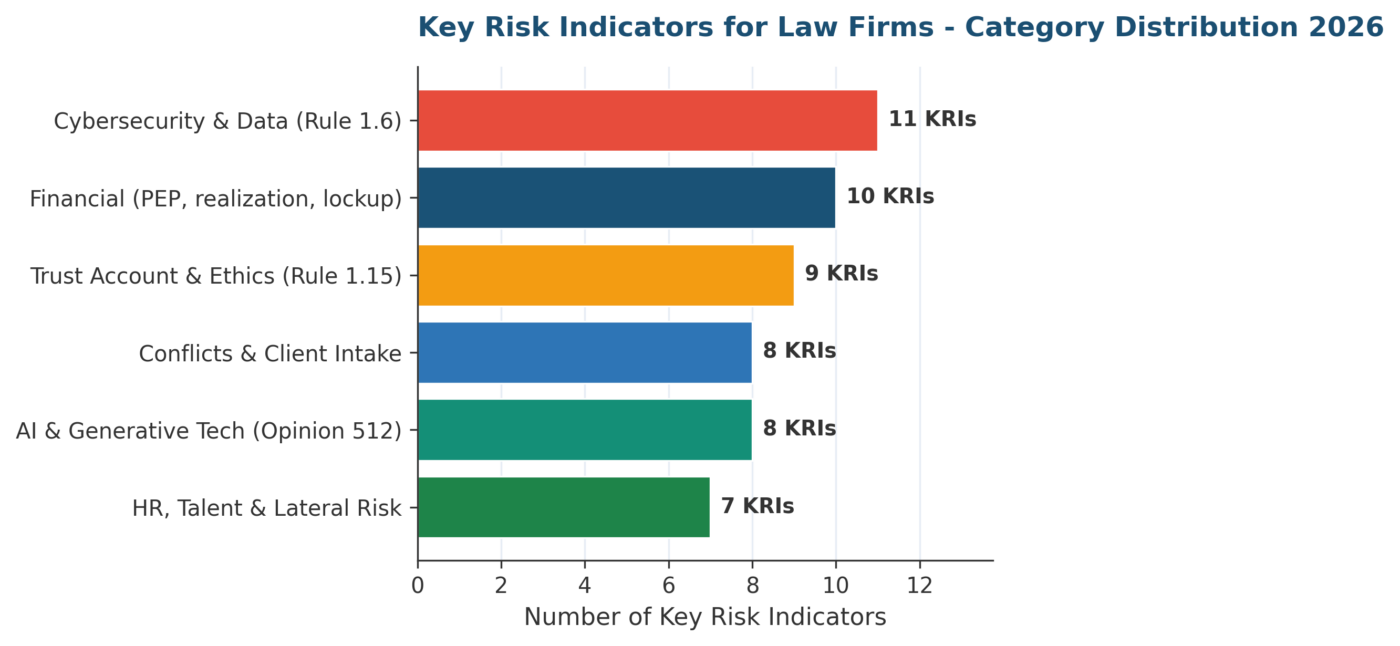
Figure 1. Distribution of Key Risk Indicators for Law Firms across the six 2026 risk categories.
Cybersecurity Key Risk Indicators for Law Firms
Cybersecurity is the largest single category in a 2026 Law Firm KRI catalog. The 2024 ABA Cybersecurity Tech Report found 36% of US law firms experienced a security incident in the prior 12 months, up from 28% in 2023. The same report flagged 22.4% of firms as failing the ABA Model Rule 1.6 confidentiality standard outright.
Core cybersecurity indicators on a partner-level dashboard: MFA coverage on attorney accounts, mean time to detect (MTTD) and mean time to respond (MTTR), CISA Known-Exploited-Vulnerability patch latency, count of phishing simulation failures by practice group, and percentage of mobile devices encrypted and remote-wipe enabled. Each ties to an ABA Opinion 477R or NIST CSF 2.0 reference.
Add client-facing indicators. Outside Counsel Guidelines compliance score per matter, secure file-share adoption rate against email attachments, and percentage of public-company clients with up-to-date incident-response runbook attestations from the firm. The cybersecurity risk management framework approach maps each indicator to a named accountable partner inside the firm.
Jones Day, Orrick, and Kirkland each disclosed phishing or ransomware events between 2023 and 2025. Those incidents share a single root: a privileged credential reached an external attacker.
Privileged-account inventory accuracy, percentage of dormant accounts revoked within 24 hours, and password-policy compliance across litigation-support vendors are the indicators that prevent the next disclosure.
| Cybersecurity KRI | What It Measures | Typical Green Band | Owner |
| MFA coverage on attorney accounts | % of attorney accounts with MFA enforced | 100% | CISO |
| CISA KEV patch latency | Days from KEV publication to patch | <14 days | IT Director |
| Phishing simulation failure rate | % of staff who failed last simulation | <5% | CISO |
| Mobile device encryption and wipe | % of devices encrypted and wipe-enabled | 100% | IT Director |
| Outside Counsel Guidelines compliance | % of matters meeting OCG requirements | ≥95% | GC / CISO |
| Mean time to detect (MTTD) | Hours from intrusion to detection | <24 hours | CISO |
Table 2. Cybersecurity Key Risk Indicators for Law Firms with green bands and accountable owners.
Financial and Profitability Key Risk Indicators for Law Firms
Financial KRIs track partnership health and operating discipline. Realization rate (standard rate billed vs collected), lockup days (work in progress plus accounts receivable divided by daily billings), profits per equity partner (PEP) versus prior year, top 10 client revenue concentration, and origination concentration in single practice groups make up the core financial indicators.
The 2025 Am Law 100 data recorded $158.3 billion of gross revenue with 14% PEP growth and average PEP at $3.59 million. Wachtell led at $12.15 million PEP. Those benchmarks form the peer-pressure layer against any individual firm’s financial KRI thresholds.
Liquidity and cash-flow indicators belong on the same page as profitability metrics. Days of cash on hand, line-of-credit utilization, capital-call shortfalls from partners exiting, and partner-departure exposure on book-of-business value sit alongside revenue metrics.
Stroock & Stroock & Lavan’s 2024 dissolution was preceded by lateral departures that a stronger KRI catalog would have surfaced quarters earlier.
The how to develop Key Risk Indicators methodology assigns each financial KRI to a named owner.
The CFO owns realization and lockup. The managing partner owns PEP. The COO owns client concentration and origination concentration across the firm’s practice groups.
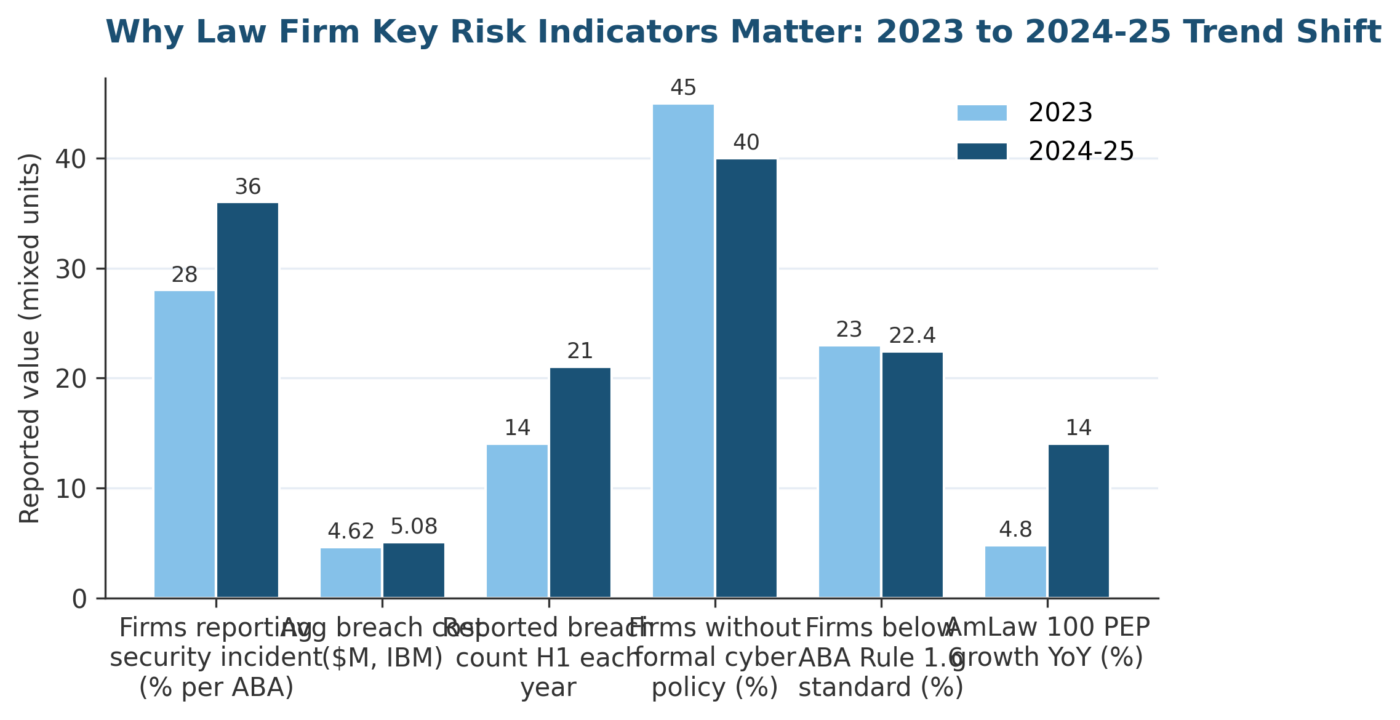
Figure 2. Law firm risk trends 2023 to 2024-25 driving Law Firm KRI adoption.
Trust Account and Ethics Key Risk Indicators for Law Firms
Trust account mismanagement is the leading cause of attorney discipline nationwide per the ABA. Model Rule 1.15 governs client funds and property, and a single day’s negative IOLTA balance routes a bank notification directly to the state bar, with defense costs typically running $10,000 to $50,000 before reputational damage.
Daily three-way reconciliation across IOLTA and non-IOLTA accounts heads the trust-account KRI list.
Track count of commingling exceptions, days between client deposit and earned-fee transfer, count of unidentified IOLTA balances older than 90 days, and percentage of closed matters with all trust balances returned within 30 days. Each ties to a state bar trust accounting rule.
Ethics KRIs extend beyond trust accounts. Model Rule 1.6 confidentiality breaches, Model Rule 5.1 and 5.3 supervisory failures on non-lawyer staff, Model Rule 1.7 current-client conflicts caught after engagement, and percentage of matters with a current engagement letter and conflict waiver belong on the same page as IOLTA reconciliation metrics.
The compliance risk analysis approach feeds the indicator design across the ethics layer. ALAS loss-prevention bulletins identify recurring discipline patterns, and firms that map their KRIs against ALAS exposure categories tend to see 20% to 30% lower malpractice premiums on renewal review cycles.
| Trust Account & Ethics KRI | ABA / State Bar Source | Typical Cadence |
| Daily three-way reconciliation pass rate | Model Rule 1.15, state trust accounting rules | Daily |
| IOLTA commingling exceptions | Model Rule 1.15(a), state bar rules | Daily |
| Unidentified IOLTA balances >90 days | Model Rule 1.15(d), state escheat rules | Monthly |
| Trust balance returned within 30 days of close | Model Rule 1.15(d), state bar rules | Per matter close |
| Conflict waivers on file by engagement | Model Rule 1.7 and 1.10 | Per engagement |
| Engagement letter on file by matter open | Model Rule 1.5(b), client expectation | Per matter |
| Open ALAS-flagged exposure categories | ALAS loss-prevention bulletins | Quarterly |
Table 3. Trust Account and Ethics Key Risk Indicators for Law Firms mapped to ABA Model Rules and ALAS guidance.
Conflicts and Client Intake Key Risk Indicators for Law Firms
Conflicts and intake form the front door of professional-responsibility risk. Percentage of matters with conflict checks completed before engagement, mean time to clear a positive conflict hit, count of matters opened with waived conflicts requiring written client consent, and AML/KYC completion rate on new client onboarding form the core intake-risk indicators.
Beneficial ownership reporting under the Corporate Transparency Act added a new layer in 2024 and 2025.
Track percentage of new entity-formation matters with FinCEN beneficial-ownership reports on file, count of clients flagged as sanctioned or PEP (politically exposed person), and percentage of matters subject to OFAC sanctions list screening before engagement.
Lateral-hire conflicts are a recurring source of disqualification motions. Lateral-hire conflict-check completeness, count of matters requiring screening walls after a lateral move, and percentage of lateral partners with current ethical-wall attestations belong on the same dashboard as new-client intake metrics.
The how to manage third party risk approach extends naturally to lateral-hire risk.
AI and Generative Technology Key Risk Indicators for Law Firms
ABA Formal Opinion 512 (July 2024) governs lawyer use of generative AI under Model Rules 1.1 (competence), 1.6 (confidentiality), 5.1 and 5.3 (supervision), and 3.3 (candor to the tribunal). Opinion 512 explicitly prohibits boilerplate engagement-letter consent to feed client information into GAI tools.
AI-specific KRIs cluster into four measurable areas. Percentage of attorneys with current Opinion 512 training and signed AI-use policy attestation, count of GAI-generated filings flagged in the firm’s mandatory pre-filing AI review, hallucination-rate sampling on representative legal research tasks, and percentage of client matters with explicit (not boilerplate) AI consent on file each earn a separate dashboard line. Each ties to a specific Opinion 512 duty.
Mata v. Avianca and the follow-on cases Park v. Kim, Kruse v. Karlen, and Wadsworth v. Walmart all turned on fabricated GAI citations. Federal-court Rule 11 sanctions ranged from $5,000 to $30,000 per incident, with public sanctions orders carried by the legal press for weeks. The NIST AI RMF overlay structures the indicator framework.
Vendor-side AI risk closes out the picture. Count of legal-tech vendors with current SOC 2 Type II reports and AI sub-processor disclosures, percentage of GAI tools using firm-controlled data residency, and elapsed time since last AI vendor risk reassessment round out the dashboard. The information security risk management framework backstops these vendor-side metrics.
Setting Thresholds for Key Risk Indicators for Law Firms
Indicators without thresholds are decoration on a partner-meeting slide. The threshold-setting workshop is where Key Risk Indicators for Law Firms become risk-management tools rather than monthly reporting noise.
Green-amber-red bands tie directly to the documented risk appetite the executive committee has approved each cycle.
Build thresholds from three inputs: state bar and ABA Model Rule minimums (Rule 1.15 zero negative balance, Rule 1.6 confidentiality floor), internal historical baselines (last four quarters of realization and lockup), and peer benchmarks from the Citi Hildebrandt Client Advisory and ALAS annual reports. ALAS publishes anonymized claim frequency and severity benchmarks.
Thresholds need recalibration at least annually and after every material incident, lateral move, or insurance renewal cycle. A 92% realization threshold built on 2023 rate cards may need to tighten to 89% if rate increases outpace collections. The Key Risk Indicators developing risk appetite article maps the recalibration exercise step by step.
Document each threshold with owner, escalation path, executive-committee reporting trigger, and the rationale that ties to a specific Model Rule, ALAS exposure category, or client covenant.
State bar examiners and ALAS underwriters test the rationale, not the band itself. A band without rationale will not survive the first ALAS renewal conversation or a state bar audit.
| Sample KRI | Green (within tolerance) | Amber (escalate) | Red (managing-partner) |
| Realization rate vs standard rate | ≥92% | 88-91.9% | <88% |
| Lockup days (WIP + AR) | ≤95 days | 96-115 days | >115 days |
| MFA coverage on attorney accounts | 100% | 98-99.9% | <98% |
| Daily IOLTA reconciliation pass rate | 100% | 99-99.9% | <99% |
| Conflict checks pre-engagement | 100% | 99-99.9% | <99% |
| AI-policy attestations on file | 100% | 95-99% | <95% |
Table 4. Sample threshold bands for core Key Risk Indicators for Law Firms tied to Model Rules and ALAS guidance.
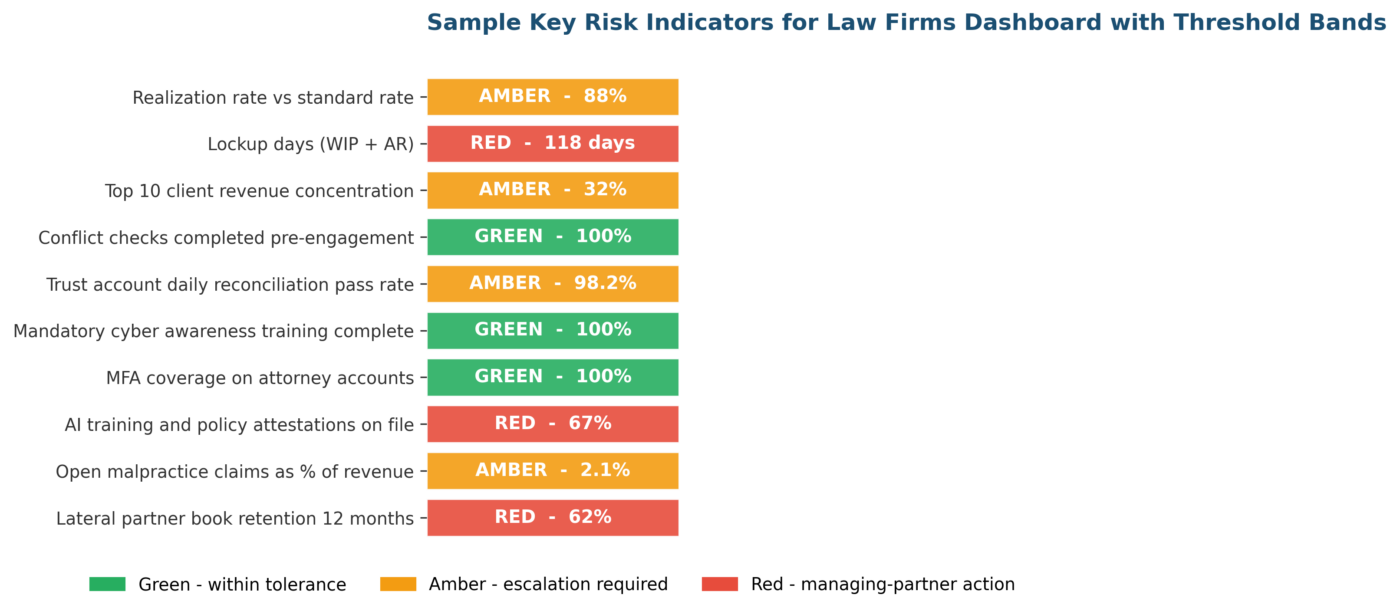
Figure 3. Sample executive Key Risk Indicators for Law Firms dashboard with traffic-light threshold bands.
Reporting Cadence for Key Risk Indicators for Law Firms
Cadence depends on what the indicator measures and who consumes the report at each layer.
Daily three-way IOLTA reconciliation runs by COB. Cybersecurity indicators run real-time alerting plus weekly digests.
Financial KRIs run monthly. ALAS-tracked ethics indicators run quarterly with annual deep-dive against the renewal application.
A defensible reporting stack runs four tiers. Practice-group leaders see weekly digests. The general counsel and CISO review monthly cyber dashboards.
The COO and CFO own the monthly financial heat map. The managing partner and executive committee receive a quarterly Key Risk Indicators for Law Firms scorecard with trend, threshold breaches, and remediation status.
ALAS renewal applications, OCG client audits, and bar association sweeps pushed managing partners to ask for monthly cyber-and-ethics reads from the GC.
The Key Risk Indicators dashboard template carries the standard tiered structure, with a one-page executive view and drill-downs by KRI category and practice group.
| Authority | Document or Program | Relevance to Law Firm KRIs |
| ABA | Model Rules of Professional Conduct (1.1, 1.6, 1.15, 5.1, 5.3) | Core professional-responsibility KRI bases |
| ABA | Formal Opinions 477R (2017) and 512 (2024) | Cybersecurity and AI duties; KRI structure |
| State bars | Trust accounting rules and discipline orders | Trust-account KRI thresholds and triggers |
| NIST | CSF 2.0; AI RMF; SP 800-53 | Cyber and AI KRI control structure |
| ISO/IEC | 27001:2022 information security management | Certification-aligned KRI framework |
| ALAS | Loss-prevention bulletins and exposure data | Malpractice-frequency KRI benchmarks |
| SEC | Cybersecurity disclosure rule (2023) | KRIs for public-company client work |
Table 5. Authoritative sources anchoring Key Risk Indicators for Law Firms citations.
Common Challenges in Key Risk Indicators for Law Firms Programs
Law firms discover the same five or six structural problems when they audit their first generation of partnership-level KRIs.
Each pitfall has a root cause and a documented remedy that maps to operational risk management practice and to specific ABA Model Rules or ALAS exposure categories.
| Pitfall | Root Cause | Remedy |
| Catalog grows past 75 indicators | Adding a KRI for every malpractice claim without retiring stale ones | Cap executive view at 18; retire indicators not breached in 8 quarters |
| Cyber KRIs siloed in IT | GC and COO not in the data review loop | Embed cyber KRIs in main risk register; assign GC co-owner |
| Realization measured at firm level only | Practice-group-level variance hidden | Report realization by practice group and by partner; surface outliers |
| IOLTA reconciliation done weekly | Daily three-way reconciliation is the state bar standard | Move to daily reconciliation; escalate any same-day exception |
| AI training treated as one-time | Opinion 512 expects ongoing competence and supervision | Annual refresher training; per-matter attestation on AI use |
| Lateral conflicts checked at offer stage only | Ethical-wall screening fails after onboarding | Lateral conflict re-check every 60 days for first 12 months |
| Threshold breaches reported without remediation | Dashboard becomes noise, not action | Each breach requires a remediation owner and 30-day close target |
Frequently Asked Questions About Key Risk Indicators for Law Firms
How many Key Risk Indicators for Law Firms should a firm report?
Most US AmLaw 200 firms and mid-size firms run between 40 and 65 active Key Risk Indicators for Law Firms. The catalog scales with practice-area mix, geographic spread, public-company client base, and ALAS exposure category breadth.
Boutique firms with a single practice area often land at the lower end of the band, around 25 to 35 indicators.
The executive committee typically sees the top 12 to 18 indicators each quarter. Drill-downs live in practice-group dashboards and in cybersecurity, ethics, and financial sub-dashboards.
A solo practitioner or small partnership can run a 15 to 25 indicator subset without compromising bar or ALAS defensibility.
Do Key Risk Indicators for Law Firms replace ALAS renewal applications?
No. ALAS renewal applications remain the underwriter-facing artifact and run on annual cycles.
Key Risk Indicators for Law Firms are the leading-metric layer that surfaces problems between renewals, well before the next ALAS questionnaire arrives. A strong KRI program shortens the renewal review.
Firms with documented KRI catalogs and threshold-breach logs tend to draw fewer follow-up questions from ALAS underwriters.
Premium pricing reflects historical loss experience and current control quality, and the KRI program is the most direct evidence of current control quality at the firm.
How does ABA Formal Opinion 512 change Key Risk Indicators for Law Firms?
Opinion 512 adds AI-specific indicators under Model Rules 1.1 (competence), 1.6 (confidentiality), 5.1 and 5.3 (supervision), and 3.3 (candor to the tribunal). Firms should track percentage of attorneys with current AI-use policy attestation, count of GAI-generated filings caught in pre-filing review, and percentage of matters with explicit client consent for AI use.
Opinion 512 explicitly rejects boilerplate engagement-letter consent for using client information in GAI tools.
The indicator design must capture matter-specific consent, not just firm-wide policy acknowledgement. Mata v. Avianca and the follow-on sanctions cases set the precedent that fabricated citations carry Rule 11 consequences.
What state bar rules drive Key Risk Indicators for Law Firms beyond the ABA Model Rules?
State bars adopt the ABA Model Rules with variations. California, New York, Florida, Texas, and Illinois carry the highest US discipline volume and the most-cited trust accounting cases. Each state’s specific Rule 1.15 implementation drives the daily reconciliation cadence and the negative-balance reporting trigger.
Firms with multistate practices must reconcile against the strictest state rule in their footprint. New York’s Part 1200 trust accounting rules and California Rule 1.15 carry distinct documentation expectations.
The KRI catalog should track per-state compliance rather than aggregating to a firm-wide average that hides the binding constraint.
How often should Key Risk Indicators for Law Firms be recalibrated?
Recalibrate the full catalog once a year, ideally aligned to the ALAS renewal cycle and the annual partnership compensation review.
The annual cycle consolidates with existing milestones and gives the executive committee a single window to update thresholds across cyber, financial, trust, and ethics KRIs without disrupting partner-level reporting.
Threshold-only tweaks happen mid-cycle when state bars issue new opinions, when a public-company client tightens its Outside Counsel Guidelines, when a material breach lands in the legal press, or when the executive committee adjusts risk appetite. Document every change with rationale, an effective date, and the named approver.
Can small and mid-size US law firms use Key Risk Indicators for Law Firms?
Yes. Small and mid-size US law firms can run a 15 to 30 indicator subset of the full catalog. Cybersecurity (MFA, patch latency, phishing simulation), financial (realization, lockup, top client concentration), trust account (daily reconciliation), and conflicts (pre-engagement checks) apply at every scale, with thresholds calibrated to the firm’s actual practice mix and resources.
The ABA Law Practice Division and state bar practice-management advisors offer a peer benchmark and starter catalogs.
Threshold values scale with firm size and complexity. The underlying metric definitions do not change between a 25-attorney boutique and an AmLaw 200 firm with 1,000 lawyers.
Looking Ahead: Key Risk Indicators for Law Firms in 2026 and 2027
AI adoption reshapes the law firm KRI catalog through 2027. Hallucination-rate sampling, prompt-injection attempts against firm-deployed LLMs, model-drift indicators on contract review tools, and percentage of matters with explicit (non-boilerplate) AI consent enter the executive committee scorecard. The NIST risk assessment approach pairs naturally with these AI-era KRIs.
Cybersecurity expectations harden as US public-company clients push SEC cybersecurity disclosure obligations downstream. Outside Counsel Guidelines now demand breach notification timelines that match the SEC’s four-business-day Form 8-K rule, plus SOC 2 Type II attestations, FedRAMP-equivalent controls, and zero-day handling commitments from outside law firms.
Lateral partner economics and partnership compensation models continue to reshape the financial KRI layer.
The Am Law 100 saw 14% PEP growth and 13% revenue growth in 2025, but nonequity partner expansion ran ahead of equity expansion, which surfaces talent-retention KRIs alongside profitability metrics in the executive committee pack.
A live KRI dashboard with quarterly recalibration is what holds up under ALAS renewal review, state bar audits, OCG client audits, and the executive committee’s annual planning cycle. Without it, the firm rotates the same concerns until the next bar complaint or disclosed breach forces one to the top of the agenda.
Ready to Operationalize Key Risk Indicators for Law Firms?
At riskpublishing.com we help US AmLaw 200 firms and mid-size US law firms build Key Risk Indicators for Law Firms programs that hold up under ALAS renewal review, state bar audits, Outside Counsel Guideline audits, and executive committee scrutiny.
Typical engagement: the indicator catalog mapped to cybersecurity, financial, trust account, conflicts, AI, and HR risk, a threshold-calibration workshop anchored to documented risk appetite, an executive committee scorecard template, and an OCG-client compliance tracker for the firm’s top 25 public-company engagements. The work usually runs eight to twelve weeks for a 200-lawyer firm.
Explore our risk advisory services, or contact us to scope a Key Risk Indicators for Law Firms maturity review tailored to your practice mix, geographic footprint, ALAS exposure profile, and 2026 through 2027 ABA Opinion 512 and OCG compliance milestones across the firm.
Related reading on riskpublishing.com: Key Risk Indicators examples, how to use Key Risk Indicators, how to develop Key Risk Indicators, cybersecurity risk management framework, NIST risk assessment, compliance risk analysis, and the integrated risk management approach.
Sibling industry KRI guides: For practitioners benchmarking across sectors, see our companion deep-dives on Key Risk Indicators for banks and credit unions, Key Risk Indicators for insurance companies, strategic risk Key Risk Indicators examples, and board risk reporting one-page dashboard. Each guide maps industry-specific regulatory drivers, threshold logic, and dashboard examples to help risk teams calibrate their own KRI library.

Chris Ekai is a Risk Management expert with over 10 years of experience in the field. He has a Master’s(MSc) degree in Risk Management from University of Portsmouth and is a CPA and Finance professional. He currently works as a Content Manager at Risk Publishing, writing about Enterprise Risk Management, Business Continuity Management and Project Management.