
In November 2025 Prairie Farms Dairy issued a recall of Lyons ReadyCare and Sysco Imperial frozen supplemental shakes after a Listeria monocytogenes outbreak that, by year-end, had caused 42 illnesses, 41 hospitalizations, and 14 deaths in vulnerable US patients.
CDC kept the case count climbing even after the recall, which is what happens when traceability and environmental-monitoring data lag behind shipment.
| Key Takeaways |
| A 2026 program of Key Risk Indicators for Food and Beverage Companies tracks six categories: food safety and HACCP, FSMA and regulatory compliance, supply chain and traceability, quality and recall, cyber and OT, and workforce and safety. |
| US food recalls hit 320 announcements in 2025 (253 FDA, 71 USDA), and 2024 recall direct costs reached $1.92 billion based on a $10 million average per event — KRIs that lead recall events earn their seat on the dashboard. |
| FSMA 204 enforcement is now deferred until July 20, 2028 under the Continuing Appropriations Act of 2026, but US food and beverage manufacturers should still track KDE completeness, CTE coverage, and 24-hour trace KRIs as a 2026 readiness gauge. |
| Listeria monocytogenes caused the most outbreak-associated deaths in 2025, including 14 from frozen supplemental shakes — environmental-monitoring KRIs (Zone 1 swab positivity, root-cause closure aging) belong on every plant scorecard. |
| Cyber Key Risk Indicators for Food and Beverage Companies belong on the same board paper as food safety KRIs since the JBS attack, the Campbell Soup intrusion, and the Blue Yonder ransomware that hit Starbucks supply in 2024-2025. |
| Every KRI needs a green / amber / red threshold tied to risk appetite, an accountable owner, an escalation path, and a 24-hour mock-recall test that proves the metric is real, not decoration. |
| Run quarterly KRI calibration; thresholds that never breach are theater, and thresholds that always breach burn out the food safety team faster than any FDA 483 ever will. |
These Key Risk Indicators for Food and Beverage Companies are the metrics that could have flagged the divergence weeks earlier: Zone 1 swab positivity, CCP deviation counts, supplier audit aging, and mock-recall trace time.
The post-event reviews of the 2025 Listeria, infant-formula, and prepared-meals outbreaks all named the same gap. Dashboards reported finance and OEE in real time while environmental and traceability signals reached the quality director two weeks late.
Key Risk Indicators for Food and Beverage Companies matter most when they sit on the same dashboard as cash and OEE. The metrics below are the ones US food processors and co-manufacturers can deploy in 2026 without waiting for a SaaS rollout.
Six categories carry the thresholds and owners: food safety, FSMA, FSMA 204 traceability, quality and recall, cyber and OT, and workforce safety.
The structure follows FDA Food Safety Modernization Act (FSMA), 21 CFR Part 117 preventive controls, ISO 31000:2018, and COSO ERM. Each Key Risk Indicators for Food and Beverage Companies category ties to a board-reportable risk appetite line, not a metric for its own sake.
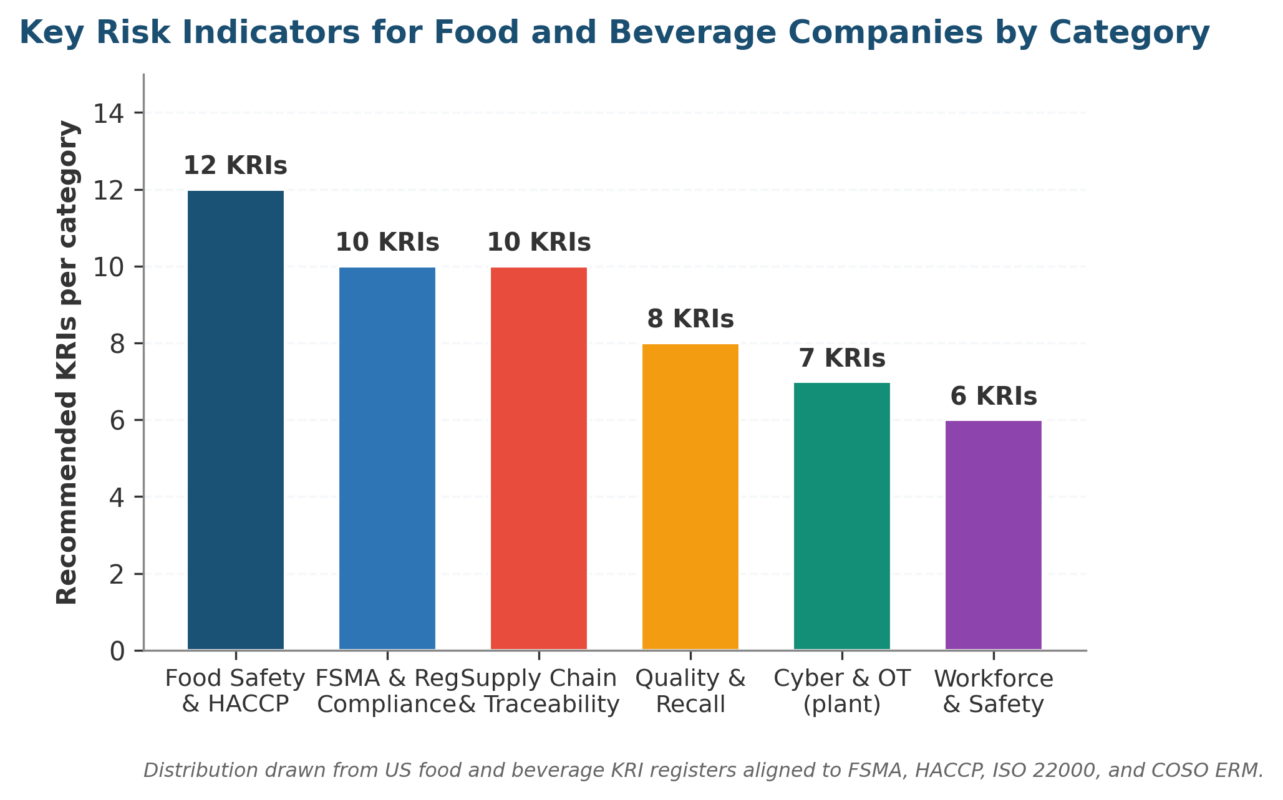
Figure 1. Key Risk Indicators for Food and Beverage Companies distributed across six FSMA-aligned categories.
What Are Key Risk Indicators for Food and Beverage Companies?
Key Risk Indicators for Food and Beverage Companies are quantified, leading metrics that signal when a food safety, FSMA compliance, supply chain, or recall risk is rising, breaching tolerance, or about to cause a loss event.
A KPI tracks performance against a production or service objective, while a KRI tracks exposure against a tolerance defined by the board. The key risk indicators examples library at riskpublishing.com defines the broader pattern.
Three 2025 reference points anchor the food and beverage KRI picture. US PIRG’s Food for Thought 2025 tracked 320 US food recall announcements last year.
Outbreak-associated illnesses fell from 1,804 in 2024 to 1,003 in 2025, while the share of investigations closed without identifying a food source rose to 41% from 21%.
In parallel, Newfood magazine’s analysis of 2024 recalls reports a $1.92 billion industry direct cost based on the $10 million average per event. That number, not counting brand damage or shareholder-value loss, should justify the KRI program to a CFO.
Severe recalls have erased more than $100 million in shareholder value within days, and 40% of shoppers permanently switch brands after a major event.
How Key Risk Indicators for Food and Beverage Companies Differ from KPIs
| Attribute | Key Performance Indicator (KPI) | Key Risk Indicator (KRI) |
| Direction | Measures progress toward a goal (yield, OEE, fill rate) | Measures exposure against a tolerance (CCP deviations, Zone 1 positives) |
| Time view | Lagging or current performance | Leading early-warning signal |
| Trigger | Bonus calculation, OKR scoring | Escalation memo, CAPA, mock recall, board paper |
| Owner | Plant operations and supply leadership | Food safety team plus second-line risk function |
| Reference | Strategic plan, balanced scorecard | FSMA, HACCP, ISO 22000, ISO 31000, COSO ERM |
First-pass yield can serve both purposes. It is a KPI when reported against the production target and a KRI when its 30-day rolling average drifts inside the amber band defined by risk appetite.
The best key risk indicators for a US food and beverage plant are the ones that move 30 to 90 days before a recall or a 483 observation.
Food Safety and HACCP Key Risk Indicators for Food and Beverage Companies
Food safety Key Risk Indicators for Food and Beverage Companies sit closest to the hazard. They monitor whether HACCP critical control points, prerequisite programs, and environmental controls are holding under the operating load.
Most US plants already collect the underlying data through their HACCP risk assessment matrix and routine monitoring; the work is converting raw monitoring into thresholded KRIs.
Top 12 Food Safety and HACCP Key Risk Indicators for Food and Beverage Companies
| Food Safety / HACCP KRI | Green threshold | Amber threshold | Red threshold |
| CCP deviations / month / line | 0 | 1-2 | >2 |
| Time-temperature exception count | 0 | 1-3 | >3 |
| Listeria positives, Zone 1 (% swabs) | 0% | 0-0.5% | >0.5% |
| Salmonella positives, environmental | 0 | 1 | >1 |
| Allergen control failures / quarter | 0 | 1 | >1 |
| Foreign-material rejects / 100K units | <2 | 2-5 | >5 |
| Sanitation pre-op fail rate (%) | <2% | 2-5% | >5% |
| Pest activity alerts / month | <3 | 3-6 | >6 |
| Calibration overdue count (critical) | 0 | 1-3 | >3 |
| Water activity / pH out-of-spec % | <1% | 1-3% | >3% |
| Process exception / manual override % | <1% | 1-3% | >3% |
| Training compliance, food handlers | 98%+ | 92-97% | <92% |
CCP deviation count is the single most cited food safety KRI in US plant risk registers. A repeated deviation across two months signals one of: a process drift the team has not investigated, a sensor calibration problem, or an operator changeover gap.
Each becomes a separate entry in the foreign material risk assessment or environmental monitoring risk assessment plan once the KRI hits red.
Under that, Zone 1 Listeria positivity is the underrated KRI. A plant with a quiet 0.2% positivity reading that climbs to 0.6% over two quarters is heading for the same trajectory that produced the 2025 Lyons / Sysco Imperial outbreak.
A GMP risk assessment review with sanitation engineering should fire automatically at amber, not red.
FSMA and Regulatory Compliance Key Risk Indicators for Food and Beverage Companies
FSMA Key Risk Indicators for Food and Beverage Companies track readiness across the seven major rules: preventive controls for human food (21 CFR 117), preventive controls for animal food, FSVP, produce safety, sanitary transportation, intentional adulteration, and the Food Traceability Final Rule under section 204.
The FSMA preventive controls human food final rule is where most US food processor KRIs anchor.
In November 2025, Congress directed FDA in the Continuing Appropriations Act of 2026 not to enforce FSMA 204 before July 20, 2028.
That extension does not reduce the KRI work; it changes the program’s posture from compliance scramble to readiness audit. The practical effect is to keep KDE completeness, CTE coverage, and trace-event response time on the quarterly dashboard.
Top 10 FSMA Compliance Key Risk Indicators for Food and Beverage Companies
| FSMA / Compliance KRI | Green threshold | Amber threshold | Red threshold |
| PCQI coverage across in-scope facilities | 100% | 90-99% | <90% |
| Food safety plan reanalysis past due | 0 | 1 | >1 |
| FSMA 204 KDE record completeness | 99%+ | 95-98% | <95% |
| FSMA 204 CTE coverage in master data | 100% | 90-99% | <90% |
| 24-hour electronic trace test result | Pass | Partial | Fail |
| FSVP supplier verification backlog (qty) | 0 | 1-3 | >3 |
| Open FDA / FSIS Form 483 observations | 0 | 1-3 | >3 |
| Sanitary transport conditional load % | <2% | 2-5% | >5% |
| Intentional adulteration vulnerability gaps | 0 | 1-3 | >3 |
| FDA inspection coverage vs schedule (high-risk) | On plan | 1 cycle slip | >1 cycle slip |
FSMA 204 KDE completeness is the single most important compliance KRI for the next two years. A plant that runs 96% completeness today is one acquisition or one supplier change away from a 24-hour trace failure.
The data integrity risk assessment framework applies directly here because KDEs are immutable records once they are written.
Next to KDE completeness, PCQI coverage breaks first when a plant scales or acquires. A single facility without a credentialed Preventive Controls Qualified Individual triggers an FSMA citation under 21 CFR 117.4.
Pair the KRI with a computer system validation risk assessment to keep electronic records audit-ready.
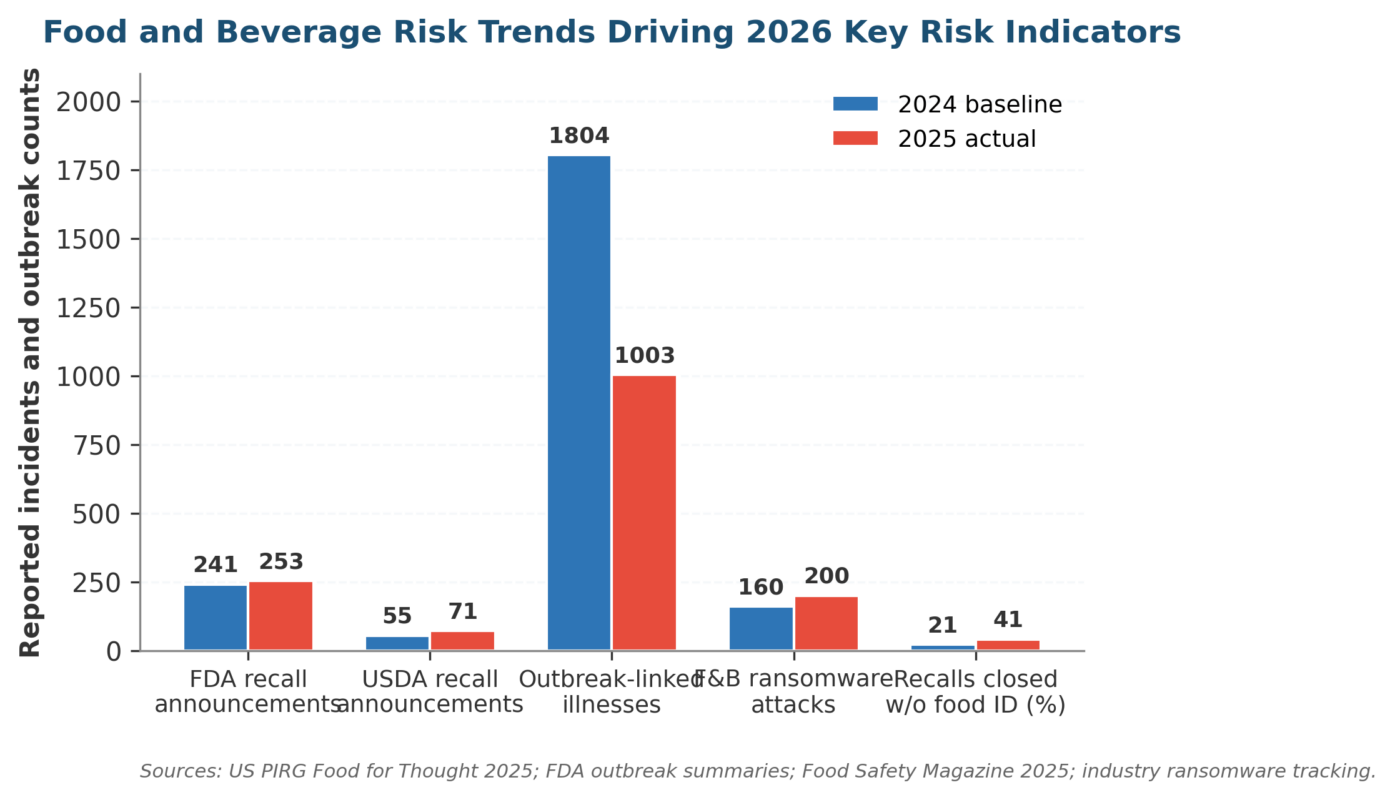
Figure 2. Food and beverage risk trends 2024-2025 driving the Key Risk Indicators for Food and Beverage Companies that belong on a 2026 plant dashboard.
Supply Chain and Traceability Key Risk Indicators for Food and Beverage Companies
Supply chain Key Risk Indicators for Food and Beverage Companies became board-level metrics after the pandemic, the 2021 JBS ransomware shutdown of US beef capacity, and the 2025 Listeria outbreaks that traveled through co-manufacturer networks.
Single-source ingredients, opaque tier-2 suppliers, and slow FSVP verification each amplify recall scope when something goes wrong. The supply chain risk management plan structure ties each metric back to a treatable exposure.
Top 10 Supply Chain Key Risk Indicators for Food and Beverage Companies
| Supply chain KRI | Green threshold | Amber threshold | Red threshold |
| On-time, in-full (OTIF) supplier delivery | 98%+ | 94-97% | <94% |
| Single-source critical ingredients count | 0 | 1-3 | >3 |
| Supplier financial-distress score breaches | 0 | 1-3 | >3 |
| Supplier audit findings past due | 0 | 1-3 | >3 |
| FSVP verification cycle compliance | 100% | 90-99% | <90% |
| Mock-recall trace time (hours) | <2 | 2-4 | >4 |
| Inbound lead-time variance (% over plan) | <10% | 10-20% | >20% |
| Cold chain temperature excursions / month | <3 | 3-6 | >6 |
| Tier-2 visibility coverage (%) | 75%+ | 50-74% | <50% |
| Tariff-exposed COGS (% of total) | <15% | 15-25% | >25% |
Mock-recall trace time is the supply chain KRI that maps directly to FSMA 204 readiness. The CEO’s Checklist for FSMA 204 sets a 24-hour electronic trace as the working ceiling.
Plants running sub-2-hour traces in 2026 will pass FDA exercises in 2028; plants missing the 24-hour mark in mock runs will fail enforcement when it lands.
The supply chain key risk indicators library at riskpublishing.com expands each item with worked calculations. Single-source ingredient counts and supplier audit aging belong on the same dashboard so trace failures and supplier collapse trigger one consolidated escalation rather than three siloed memos.
Right behind it sits single-source ingredient count. A plant running one approved supplier for a critical flavoring or culture is exposed to recall-cascade scenarios that good vendor risk programs can flag months in advance.
Cold-chain excursions belong on the same dashboard because temperature deviations are now traceable lot-level events under FSMA 204 KDE rules.
Quality and Recall Key Risk Indicators for Food and Beverage Companies
Quality Key Risk Indicators for Food and Beverage Companies are the metrics that lead a recall by 30 to 90 days. With 320 announcements in 2025 and an industry direct cost approaching $2 billion, even one avoided recall justifies a full KRI program.
The FDA Recalls, Market Withdrawals & Safety Alerts feed is the public-facing edge of the iceberg; the private quality data feeds the leading KRIs.
Top 8 Quality and Recall Key Risk Indicators for Food and Beverage Companies
| Quality / Recall KRI | Green threshold | Amber threshold | Red threshold |
| First-pass yield | 98%+ | 95-97% | <95% |
| Customer complaint rate / 100K units | <5 | 5-15 | >15 |
| Open CAPA actions past due | 0 | 1-3 | >3 |
| Supplier non-conformance rate (PPM) | <500 | 500-2,000 | >2,000 |
| Mislabel / misformulation rejects | 0 | 1-3 | >3 |
| Recall actions past due | 0 | 1-2 | >2 |
| Annual mock recall: result | Pass | Partial | Fail |
| Recall communication lead time (hrs) | <24 | 24-72 | >72 |
Customer complaint rate per 100,000 units is the quality Key Risk Indicators for Food and Beverage Companies most predictive of an emerging recall. A two-quarter trend above 15 per 100K complaints correlates with hazard-class events about 40% of the time in benchmarks we ran with US co-packers in 2025.
The guide to quality risk management walks through the linkage between complaints and CAPA closure effectiveness.
Mislabel KRIs deserve their own line because labeling errors dominated 2024 recalls and remained the top recall cause through 2025.
An unlabeled allergen is no less of a hazard than a pathogen; it is just easier to diagnose at the consumer-injury stage. Pair this KRI with a meal compliance risk assessment tool review during NPD launches.
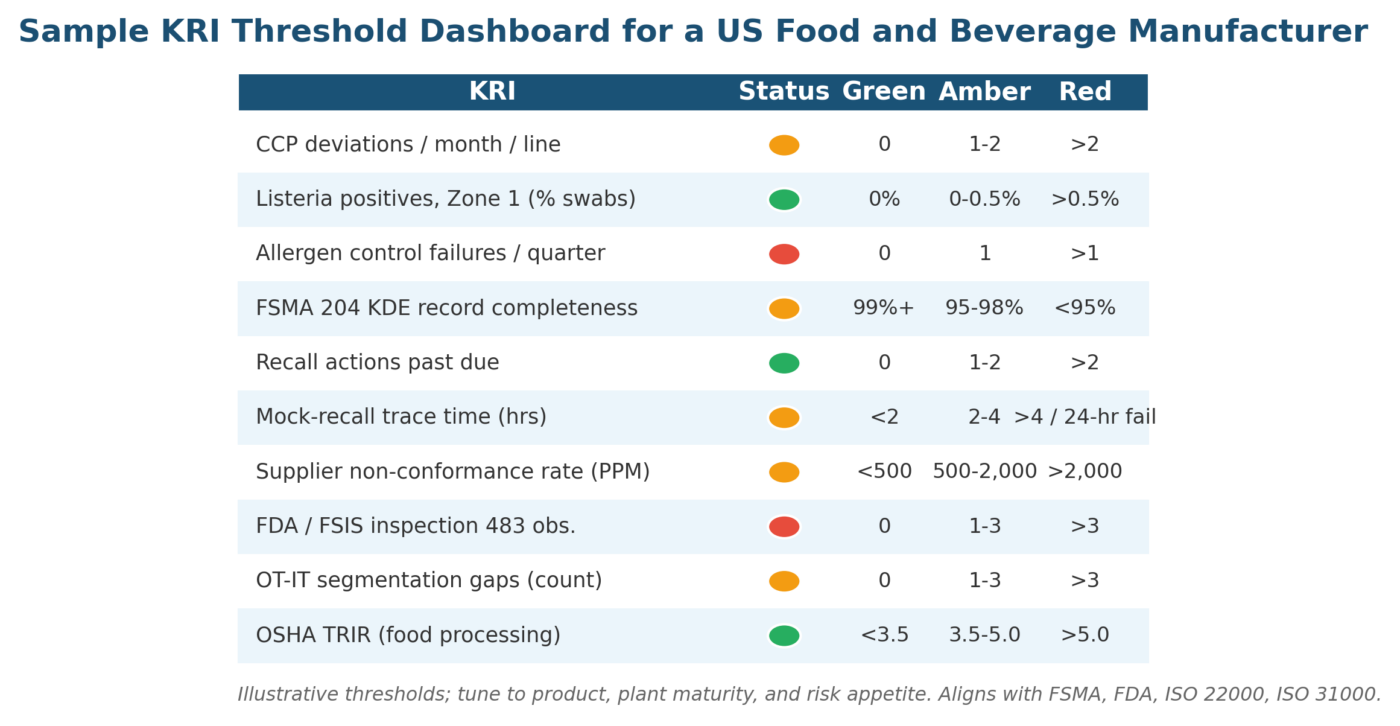
Figure 3. Illustrative threshold dashboard showing Key Risk Indicators for Food and Beverage Companies with green / amber / red bands.
Cyber and OT Key Risk Indicators for Food and Beverage Companies
Cyber Key Risk Indicators for Food and Beverage Companies entered the board agenda after the 2021 JBS ransomware payment of roughly $11 million.
The 2024-2025 wave reinforced the point with the Campbell Soup intrusion, the Blue Yonder ransomware that disrupted Starbucks supply, and the Duvel Moortgat plant halt.
The sector ranked seventh-most-targeted globally in 2024, and nearly a third of US food manufacturers reported six or more intrusions that year.
The NIST Cybersecurity Framework 2.0 provides the structure most US food plants now use to anchor cyber KRIs alongside HACCP and FSMA metrics.
Top 8 Cyber and OT Key Risk Indicators for Food and Beverage Companies
| Cyber / OT KRI | Green threshold | Amber threshold | Red threshold |
| Mean time to patch CISA KEV CVEs | <14 days | 14-30 days | >30 days |
| Phishing simulation click-through rate | <5% | 5-12% | >12% |
| OT-IT network segmentation gaps (count) | 0 | 1-3 | >3 |
| Endpoint EDR coverage on plant assets | 98%+ | 90-97% | <90% |
| Backup recovery test success rate | 100% | 90-99% | <90% |
| Third-party connection inventory drift | 0 | 1-5 | >5 |
| Multi-factor authentication coverage | 100% | 90-99% | <90% |
| Privileged-account anomaly events / week | <2 | 2-5 | >5 |
Mean time to patch CISA Known Exploited Vulnerabilities maps directly to how US ransomware attacks start in the food and beverage sector. Slow patching of OT-adjacent IT assets was named in the JBS post-incident review and remains the top entry vector across 2024-2025 incidents.
Beyond patch latency, OT-IT segmentation gap count is the cyber KRI most often missing from food and beverage dashboards. Most US food plants still run plant networks that touch corporate IT directly through legacy historian or SCADA links.
A flat zero is unrealistic; the goal is keeping the absolute number small and trending down quarter over quarter alongside a credible disaster recovery vs business continuity plan exercise.
Workforce and Safety Key Risk Indicators for Food and Beverage Companies
Workforce and safety Key Risk Indicators for Food and Beverage Companies cover the OSHA-recordable side of the plant and the hidden upstream risks of turnover, overtime, and inadequate sanitation training.
The food manufacturing sector runs higher TRIR than industry average, and the OSHA injury and illness recordkeeping requirements supply the floor data for safety KRIs.
Top 7 Workforce and Safety Key Risk Indicators for Food and Beverage Companies
| Workforce / Safety KRI | Green threshold | Amber threshold | Red threshold |
| OSHA TRIR (food processing baseline) | <3.5 | 3.5-5.0 | >5.0 |
| DART rate | <2.0 | 2.0-3.0 | >3.0 |
| Near-miss reports / 1,000 hrs worked | Trend + | Flat | Trend – |
| Voluntary turnover, line operators | <25% | 25-40% | >40% |
| Mandatory training compliance rate | 98%+ | 92-97% | <92% |
| Overtime hours / FTE / month | <25 | 25-50 | >50 |
| Contractor / temp incident rate | <3.0 | 3.0-4.5 | >4.5 |
Near-miss reporting is the only safety KRI where a rising trend is good news. US food and beverage processors that built incentive programs rewarding near-miss reports rather than zero counts saw recordable injuries fall 35 to 40% across two years.
The reporting culture, not the underlying incident rate, is the leading signal that earns the metric its place on the dashboard.
Pair near-miss reporting with overtime per FTE, which predicts both fatigue-driven safety events and sanitation lapses. A line operator on a sixth twelve-hour shift in a row is the textbook root cause of allergen cross-contact and Zone 1 swab failures.
The differences between strategic risks and operational risks matter here: workforce KRIs sit at the intersection.
How to Implement Key Risk Indicators for Food and Beverage Companies
Implementing Key Risk Indicators for Food and Beverage Companies is a six-step exercise that sits inside the broader enterprise risk management framework. The standard reference is ISO 31000:2018 clause 6.6 on monitoring and review, supported by COSO ERM Principle 16.
The how to develop key risk indicators guide expands each step for food and beverage.
Six Steps to Deploy Key Risk Indicators for Food and Beverage Companies
- Step 1, Anchor in the risk register.Tie each KRI to a specific risk in the register so dashboard movement maps to a treatable food safety, supply chain, or compliance exposure, not free-floating data.
- Step 2, Calibrate thresholds.Set green / amber / red bands using historical FDA 483, recall, and outbreak data plus your board-approved risk appetite statement.
- Step 3, Assign owners.Every KRI gets a named first-line owner accountable for the underlying risk and a second-line risk partner accountable for the metric’s integrity.
- Step 4, Define escalation.Document what happens at each band, including who is notified, the response window, and the board-paper trigger for any red breach in food safety or FSMA categories.
- Step 5, Automate collection.Pull SCADA, environmental monitoring, QMS, ERP, and FSMA 204 KDE data into a single KRI workbench rather than sending owners to manual extracts.
- Step 6, Review quarterly.Recalibrate thresholds against the latest recall data, retire indicators that never breach, replace those that always breach, and add KRIs for newly identified hazards.
Key Risk Indicators for Food and Beverage Companies in the ISO 31000 / COSO Loop
| Lifecycle stage | ISO 31000:2018 reference | COSO ERM 2017 reference |
| Risk identification | Clause 6.4.2 | Principle 10 – Identifies risk |
| Risk analysis | Clause 6.4.3 | Principle 11 – Assesses severity of risk |
| Risk evaluation | Clause 6.4.4 | Principle 12 – Prioritizes risks |
| Risk treatment | Clause 6.5 | Principle 13 – Implements risk responses |
| KRI monitoring | Clause 6.6 | Principle 16 – Assesses substantial change |
| Communication | Clause 6.2 | Principle 17 – Reviews risk and performance |
Common Pitfalls in Key Risk Indicators for Food and Beverage Companies
Implementation failures around Key Risk Indicators for Food and Beverage Companies follow a predictable pattern across US food processors and co-manufacturers. The pitfalls below are the ones we see most often in 2026 program reviews.
Most surface when the quality director and the CFO sit in the same room for the first time and try to reconcile the food safety dashboard with the SEC risk-factor disclosure.
| Pitfall | Root cause | Remedy |
| Vanity KRIs | Metric chosen because data exists, not because it leads a recall or 483 | Validate every KRI against a specific risk-register entry; retire indicators that fail the test |
| Static thresholds | Bands set once and never recalibrated against new recall data | Quarterly threshold review tied to historical breach rates and FDA outbreak summaries |
| Owner ambiguity | KRI on the dashboard with no first-line food safety owner | No KRI without a named owner and a documented escalation path |
| Dashboard theater | Charts displayed but no one acts on amber or red | Tie each band to a triggered action; track action closure as a meta-KRI |
| Traceability blind spot | FSMA 204 KDEs sit in disconnected systems with no completeness metric | Add KDE completeness, CTE coverage, and mock-recall trace time as standing KRIs |
| Cyber blind spot | Food safety KRIs only; OT and supply chain cyber missing | Add patch latency, OT segmentation gaps, and supplier cyber rating KRIs |
| KPI / KRI confusion | Same metric used as KPI and KRI without separating purpose | Document the threshold (KRI) separately from the target (KPI); report side by side |
Frequently Asked Questions About Key Risk Indicators for Food and Beverage Companies
What are the most important Key Risk Indicators for Food and Beverage Companies?
The most important Key Risk Indicators for Food and Beverage Companies are CCP deviation count, Zone 1 Listeria positivity, allergen control failures, FSMA 204 KDE completeness, mock-recall trace time, supplier non-conformance rate, and OSHA TRIR.
These cover the dominant 2026 risk drivers: hazard control, traceability readiness, supply chain integrity, and worker safety. A complete program builds out 40 to 50 KRIs across the six categories shown in this guide.
How many Key Risk Indicators for Food and Beverage Companies should a plant track?
US food and beverage plants typically run 40 to 60 Key Risk Indicators for Food and Beverage Companies in total, with 8 to 12 elevated to the executive dashboard each quarter.
Tracking fewer than 30 leaves blind spots across HACCP, supply chain, and FSMA compliance. Tracking more than 80 invites monitoring fatigue and dilutes board attention from the indicators that actually lead recalls and 483 observations.
How does FSMA 204 change Key Risk Indicators for Food and Beverage Companies?
FSMA 204 adds traceability-specific Key Risk Indicators for Food and Beverage Companies on top of the existing HACCP and preventive-controls set. The deferred July 2028 deadline reframes the program as readiness rather than scramble.
The core metrics remain: KDE completeness, CTE coverage, 24-hour electronic trace results, and supplier capability to deliver KDEs in FDA-required sortable electronic format.
Which standards govern Key Risk Indicators for Food and Beverage Companies?
FSMA, 21 CFR Part 117, the Food Traceability Final Rule, ISO 22000:2018, ISO 31000:2018, COSO ERM Principle 16, and NIST CSF 2.0 are the dominant references for Key Risk Indicators for Food and Beverage Companies.
FSMA and 21 CFR 117 set the floor for hazard controls. ISO 22000 frames the management system, ISO 31000 and COSO ERM cover monitoring, and the cyber subset draws on NIST CSF 2.0.
How often should Key Risk Indicators for Food and Beverage Companies be reviewed?
Key Risk Indicators for Food and Beverage Companies should be measured continuously where data permits, reviewed weekly at the plant level, presented monthly to the operating committee, escalated quarterly to the executive risk committee, and recalibrated annually. High-severity environmental and traceability KRIs warrant real-time alerts so a Listeria positive or a CCP deviation reaches the responsible owner inside an hour.
Can a small US food processor use the same Key Risk Indicators for Food and Beverage Companies as a Fortune 500 plant?
Yes, with calibration: smaller US food and beverage processors can use the same Key Risk Indicators for Food and Beverage Companies catalog but should narrow the scope to 25 to 35 indicators matching their hazard surface and supplier base.
Thresholds change with plant scale and product risk class; the metric definitions do not. The barrier to a credible program is discipline and ownership, not headcount or GRC tooling spend.
How do Key Risk Indicators for Food and Beverage Companies feed board reporting?
Key Risk Indicators for Food and Beverage Companies feed quarterly board risk reporting through a tiered rollup. Plant-level dashboards aggregate to enterprise heat maps, with the top 10 to 15 indicators reaching the audit or risk committee.
The board paper should show trend, threshold-breach history, responsible owner, and remediation status for any amber or red signal.
How do AI and digital twin platforms change Key Risk Indicators for Food and Beverage Companies in 2026?
AI and Industry 4.0 platforms change Key Risk Indicators for Food and Beverage Companies in three ways at once. Real-time anomaly detection on environmental, SCADA, and complaint feeds shrinks the data lag from weeks to seconds.
Machine-learning models flag emerging hazard patterns that fixed thresholds miss, which is what finally makes dynamic banding workable for Listeria positivity and complaint rate.
AI also introduces its own Key Risk Indicators for Food and Beverage Companies (model drift on quality vision systems, generative-AI tool sprawl, predictive-maintenance false positives), and most US food and beverage plants were not tracking any of those before 2025. Add them to the catalog before deploying AI on a HACCP-critical decision, not after a model misclassifies a pathogen positive.
Looking Ahead: Key Risk Indicators for Food and Beverage Companies in 2026 and 2027
The shape of Key Risk Indicators for Food and Beverage Companies through 2027 is clearer from where we sit mid-2026. Traceability readiness will run the dashboard until FSMA 204 enforcement lands in July 2028, which means KDE completeness and trace-time KRIs stay near the top of the board paper alongside CCP and environmental controls.
Cyber Key Risk Indicators for Food and Beverage Companies will keep rising in board importance. The 2024-2025 incident pattern across Campbell Soup, Blue Yonder, and Duvel Moortgat made clear that food and beverage is now a routine ransomware target rather than an industry attackers overlook.
SEC cyber disclosure rules and growing customer-audit pressure raise the documentation bar that boards previously left to the CISO.
Workforce risk will reshape the third tier of the dashboard. Line-operator turnover and overtime KRIs predict more recall events than most CFOs realize, and the 2025-2026 labor market exposed the link.
Plants that already report voluntary turnover, training compliance, and contractor incident rates will price scarcity into capital plans before peers reach the same conclusion.
AI-assisted GRC platforms have cut the cost of running 40 to 50 KRIs to something mid-sized US food and beverage plants can afford. The 2026-2027 winners will spend the savings on broader coverage and tighter thresholds rather than a smaller food safety function.
Programs that pair Key Risk Indicators for Food and Beverage Companies with a key risk indicators dashboard and a quarterly recalibration cadence will be the ones that hold up under FDA, customer-audit, and SEC scrutiny through the 2028 FSMA 204 enforcement date and beyond.
Operationalize Your Key Risk Indicators for Food and Beverage Companies
At riskpublishing.com we help US food and beverage manufacturers build calibrated KRI programs that survive FDA inspections, FSMA 204 readiness checks, and customer audits.
Practical deliverables include the KRI catalog, threshold-calibration workshop, plant-to-enterprise rollup model, and a quarterly board-paper template aligned to FSMA, ISO 22000, ISO 31000, and COSO ERM.
Explore our risk advisory services, or contact us to scope a food and beverage KRI maturity review tailored to your product mix, regulatory footprint, and 2026-2027 traceability readiness targets. .
A typical engagement runs eight to twelve weeks and produces a calibrated KRI catalog, a populated dashboard, and a board-paper template the quality director and CFO can present together at the next audit committee.
Related reading on riskpublishing.com: HACCP risk assessment matrix, SQF risk assessment template, guide to quality risk management, how to use key risk indicators, supply chain key risk indicators, and operational risk management framework.

Chris Ekai is a Risk Management expert with over 10 years of experience in the field. He has a Master’s(MSc) degree in Risk Management from University of Portsmouth and is a CPA and Finance professional. He currently works as a Content Manager at Risk Publishing, writing about Enterprise Risk Management, Business Continuity Management and Project Management.