
In August 2024, RansomHub locked Halliburton’s IT systems and cost the oilfield-services giant $35 million in disclosed losses, per the firm’s Q3 SEC filing. That single incident is exactly the exposure that Key Risk Indicators for Energy and Utilities are built to flag weeks before the wire-transfer demand reaches a CFO’s inbox.
US utilities absorbed 1,162 cyberattacks in 2024, up from 689 in 2023 according to Forescout’s annual sector report. Q3 2024 alone produced a 234% year-over-year spike, and Trustwave’s 2025 SpiderLabs report logged an 80% rise in ransomware against the energy and utilities sector.
| Key Takeaways |
| A 2026 program of Key Risk Indicators for Energy and Utilities maps to NERC CIP-002 through CIP-015 across cyber, physical, personnel, and supply chain risk. Most catalogs run 35 to 70 indicators depending on the entity’s High, Medium, or Low impact rating. |
| FERC Order 907, issued June 26, 2025, approved NERC CIP-015-1 and set a September 2028 INSM compliance deadline for control centers with real-time BES monitoring. Other entities have a further 24 months, with CIP-015-2 expanding scope outside the ESP after the March 2026 ballot. |
| US utilities absorbed 1,162 cyberattacks in 2024, a 69% jump over 689 in 2023, per Forescout’s State of Utility Cybersecurity report. The Q3 2024 spike alone hit 234% year-over-year as Volt Typhoon and Halliburton-style intrusions stayed in the news. |
| Trustwave logged an 80% rise in ransomware against the energy and utilities sector in 2024, with 84% of incidents starting via phishing. Halliburton’s August 2024 RansomHub event cost the firm $35 million in disclosed losses. |
| NERC’s maximum penalty reached $1.54 million per day per violation by 2025, and the regulator filed a 20% increase in enforcement penalties year over year. Dominion Energy Virginia paid $150,000 for FAC-008-3 R6, and LIPA paid $96,000 for similar facility-rating violations. |
| Standards anchoring Key Risk Indicators for Energy and Utilities: NERC CIP-002 through CIP-015, NIST CSF 2.0, NIST SP 800-82 Rev 3, IEC 62443, the DOE Cybersecurity Capability Maturity Model (C2M2), and CISA’s Cross-Sector Cybersecurity Performance Goals. |
| A working dashboard pulls 12 to 18 indicators to the executive risk committee each quarter. INSM coverage, mean time to detect lateral movement, CIP-007 patch backlog, and CIP-013 vendor scoring sit on the same page as physical security and load-impact metrics. |
Regulators answered. FERC Order 907, issued June 26, 2025, approved NERC CIP-015-1 and put the first internal network security monitoring deadline on the calendar. High and Medium Impact BES Cyber Systems must achieve INSM coverage by September 2028, with CIP-015-2 already in ballot to extend scope outside the electronic security perimeter.
Key Risk Indicators for Energy and Utilities now anchor to NERC CIP-002 through CIP-015, NIST CSF 2.0, NIST SP 800-82 Rev 3, and the DOE C2M2. Every indicator earns its place by tying a measurable threshold to a documented authority and the quarterly board pack the audit committee already reads.
What Are Key Risk Indicators for Energy and Utilities?
A Key Risk Indicator is a forward-looking metric that flags rising exposure before the loss event lands on the operations log. In the energy sector, that loss event might be a substation breaker trip, a ransomware encryption, an OT firmware tamper, or a Form 10-K disclosure draft that triggers SEC scrutiny.
Useful Key Risk Indicators examples on a utility dashboard share four traits. They are measurable from real instrumentation, owned by one named accountable person, calibrated to a documented threshold, and they move ahead of the underlying loss rather than after it. For LNG terminals, the LNG risk assessment guide shows which of these indicators the register should feed.
Key Risk Indicators for Energy and Utilities differ from generic enterprise KRIs because of the bulk electric system overlay. NERC CIP defines impact ratings, time-bound reporting windows, and personnel access controls that translate directly into measurable indicators with a regulator on the other side of the threshold.
KPIs measure performance against an internal goal. KRIs measure exposure against a tolerance the board has approved.
A single metric, such as patch latency on a Medium Impact BES Cyber System, can play either role depending on whether the report goes to the SOC manager or to the audit committee.
NERC CIP Standards Frame Key Risk Indicators for Energy and Utilities
Every defensible program of Key Risk Indicators for Energy and Utilities maps each indicator to a specific NERC CIP standard. The mapping matters because regulators audit against the standard, not against the dashboard, and a clean traceability line shortens the next compliance enforcement audit by weeks.
CIP-002 sets impact ratings on Bulk Electric System assets. Personnel and training fall under CIP-004. The electronic security perimeter lives inside CIP-005, with CIP-007 hardening every device behind that fence. CIP-008 carries incident reporting.
Baseline configuration and vulnerability management belong to CIP-010. Supply chain risk runs through CIP-013. From September 2028, CIP-015 layers internal network traffic monitoring on top of the existing stack.
Indicators that fail the mapping test get cut. A metric on substation HVAC uptime is operational, not a KRI for Energy and Utilities under the NERC framework. Weather exposure sits outside CIP as well, which is why a lightning risk assessment for substations and tank farms under NFPA 780 belongs in the asset-integrity register instead of the CIP dashboard. A metric on dormant CIP-004 access accounts older than 24 hours is squarely inside the framework and earns dashboard space.
The cybersecurity risk management framework your firm already runs likely uses NIST CSF 2.0 functions for board reporting. NERC CIP slots underneath. CSF Protect aligns to CIP-005 and CIP-007; CSF Detect aligns to CIP-015 INSM; CSF Respond aligns to CIP-008 reporting.
| NERC CIP Standard | Focus Area | Sample Key Risk Indicators | Threshold Example |
| CIP-002 | BES Cyber System scoping | High/Medium scope drift; new assets missing impact rating | Zero drift events per quarter |
| CIP-004 | Personnel & training | Revoked access closure time; CIP-trained workforce ratio | <24 hours from termination |
| CIP-005 | Electronic Security Perimeter | ESP firewall rule reviews; remote access session anomalies | 100% rule review annually |
| CIP-007 | System security mgmt | Patch backlog >35 days; missing log sources; account age | <5% of devices over SLA |
| CIP-008 | Incident reporting | Reportable incidents per quarter; mean time to E-ISAC notify | <1 hour to E-ISAC for Reportable |
| CIP-010 | Configuration & vuln mgmt | Unauthorized change detections; high-severity vuln open >30d | Zero open critical >30 days |
| CIP-013 | Supply chain risk | Vendor risk scores below threshold; SBOM coverage | <5% of vendors below threshold |
| CIP-015 | INSM (effective 2028) | INSM coverage of High/Medium BCS; MTTD lateral movement | >95% coverage by Sep 2028 |
Table 1. Key Risk Indicators for Energy and Utilities mapped to NERC CIP standards, with sample indicators and threshold examples.
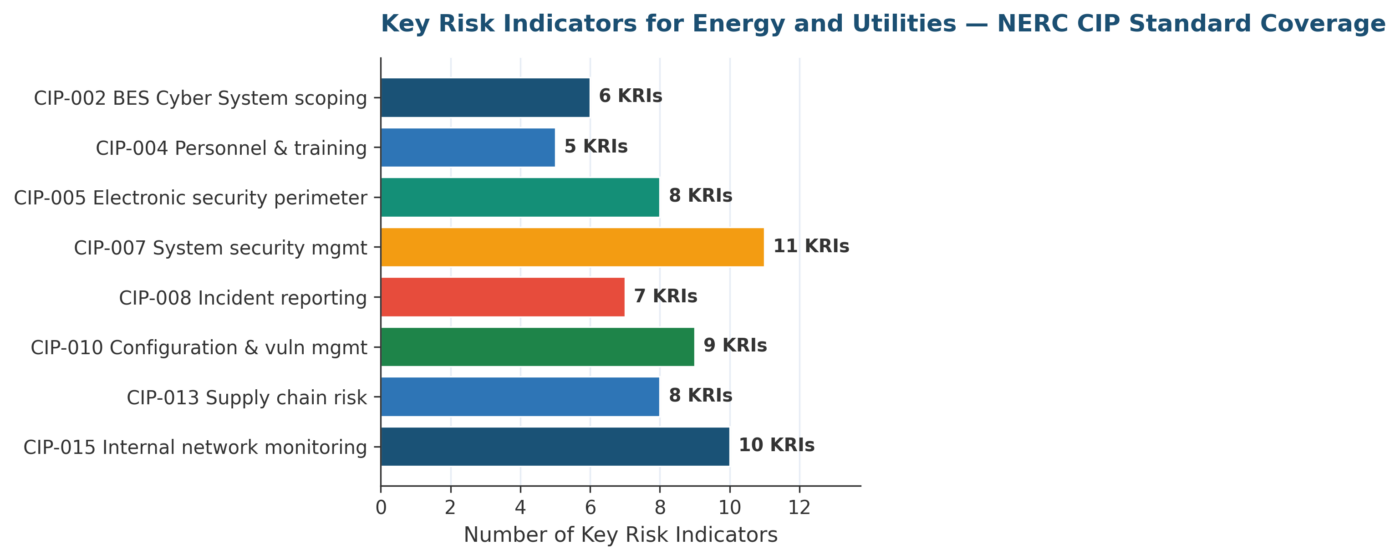
Figure 1. Distribution of Key Risk Indicators for Energy and Utilities across NERC CIP standards in a typical 2026 catalog.
Asset Identification and Perimeter Key Risk Indicators for Energy and Utilities
Every Bulk Electric System Cyber System carries an impact rating of High, Medium, or Low under CIP-002. Drift between the asset register and the live network is the most common audit finding, so the first KRI in any energy and utilities catalog tracks scope completeness.
Practical indicators: count of newly discovered assets without an assigned impact rating, days from asset detection to rating decision, and the percentage of Medium Impact assets whose ESP location matches the network diagram.
The how to develop Key Risk Indicators methodology forces each metric to a named owner and a documented threshold.
| Impact Rating | Definition | Example BES Cyber Systems | Typical KRI Count |
| High Impact | Control centers that perform real-time BES monitoring and management | ISO/RTO control center SCADA, large balancing authority EMS | 45-70 |
| Medium Impact | Generation, transmission, and load substations meeting threshold criteria | Large generation plants, key 500 kV substations, blackstart facilities | 30-50 |
| Low Impact | BES Cyber Systems not meeting High or Medium criteria but still in BES | Smaller substations, peaker plants, smaller co-op generation | 15-25 |
Table 2. CIP-002 impact ratings drive the size of the Key Risk Indicators for Energy and Utilities catalog.
CIP-004 turns personnel into a measurable risk surface. Track revoked-access closure time after employee or contractor termination, CIP-trained workforce ratio against the active access list, and background-investigation refresh aging. Field crews who tap a Medium Impact relay need a current record, or the next audit cycle finds the gap.
CIP-005 fences the electronic security perimeter. ESP firewall rule reviews completed against the annual plan, anomalous remote-access sessions, and interactive remote access tokens approaching expiry are core indicators.
A supply chain Key Risk Indicators overlay catches vendor-initiated sessions that bypass the standard ESP gate.
System Hardening Key Risk Indicators for Energy and Utilities Operations
CIP-007 is the standard that draws the most penalties. Patch backlog older than the 35-day window, log sources missing from the SIEM, unused ports left open on Medium Impact relays, and password-policy compliance on shared OT accounts make up the core of the system-hardening Key Risk Indicators for Energy and Utilities catalog. Each of these indicators monitors a row in the OT risk assessment register that produced it.
Dominion Energy Virginia paid $150,000 in 2024 under FAC-008-3 R6 for facility-rating non-compliance. Long Island Power Authority paid $96,000 for a similar issue. Both penalties traced to documentation, not to physics, which is why a documented log of CIP-007 controls is itself a KRI.
Baseline configuration and vulnerability management sit under CIP-010. Unauthorized configuration change detections, high-severity vulnerabilities open beyond 30 days, and percentage of cyber assets with an approved baseline form a three-indicator core. Add a CISA KEV alignment indicator for any vulnerability appearing in the federal known-exploited catalog.
Operational technology systems behave differently from corporate IT, and the information security risk management framework underneath must reflect that.
A patch deferred on a turbine controller is a documented engineering decision, not a CIP-007 failure, but the deferral must be tracked as an active risk register entry.
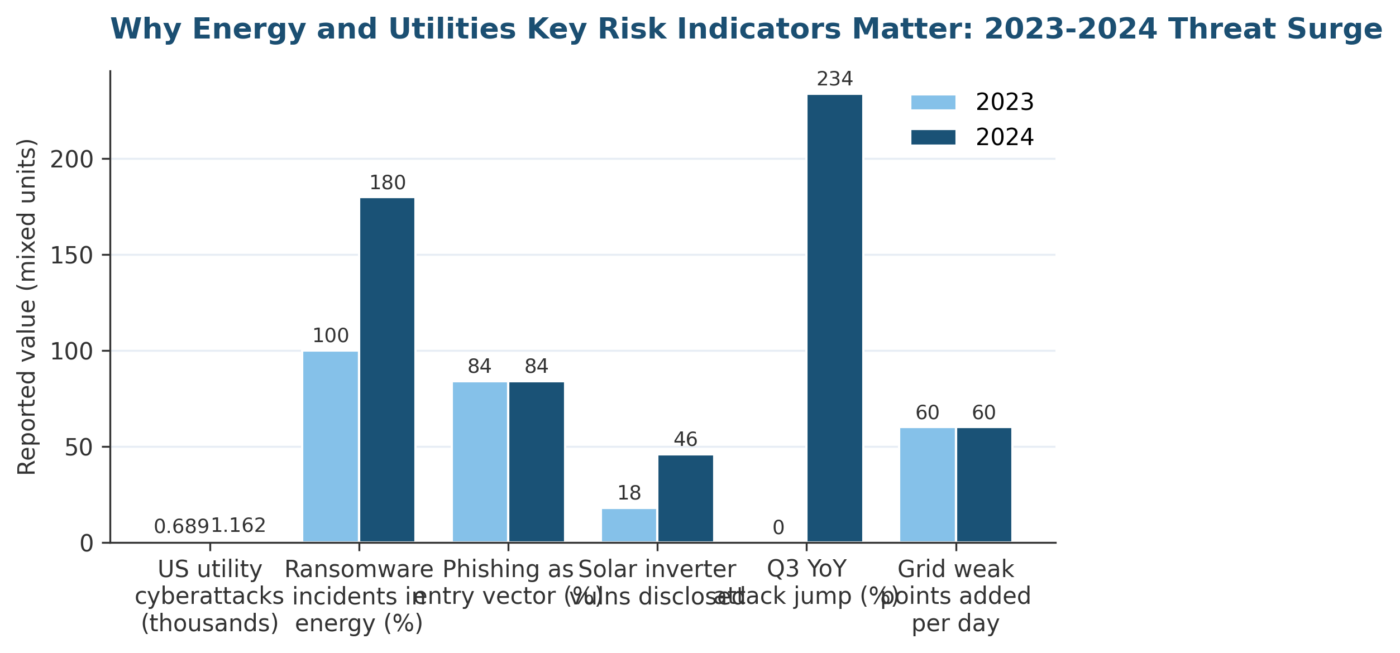
Figure 2. Threat trends driving Key Risk Indicators for Energy and Utilities adoption from 2023 into 2024.
Incident and Supply Chain Key Risk Indicators for Energy and Utilities
Reportable Cyber Security Incidents must reach the Electricity ISAC and CISA within an hour of identification under CIP-008, with attempts to compromise carrying a 24-hour reporting window. Track mean time from detection to E-ISAC submission as the operational KRI, alongside rehearsal frequency as the leading indicator.
Tabletop exercises that simulate a CIP-008 reportable event should run twice a year minimum. Track exercises completed against plan, after-action items closed, and crisis-comms playbook freshness. The incident response plan vs business continuity boundary matters here: a CIP-008 incident may also trigger a BCMS activation.
CIP-013 binds supply chain risk to the cyber program. Vendor risk scores below threshold, SBOM coverage on safety-critical software, and elapsed time since the last third-party penetration test are the supply chain Key Risk Indicators for Energy and Utilities most US Investor-Owned Utilities now report quarterly.
Forescout’s Vedere Labs disclosed 46 new solar inverter vulnerabilities in its March 2025 SUN:DOWN report, with 80% of solar power vulnerabilities over three years rated high or critical. Distributed energy resources sit inside CIP-013 scope when integrated to a Medium Impact BES Cyber System.
CIP-015 INSM Key Risk Indicators for Energy and Utilities by 2028
CIP-015-1 became enforceable when FERC issued Order 907 on June 26, 2025. The compliance deadline runs 36 calendar months from the September 2, 2025 effective date, so control centers conducting real-time BES management must report internal network security monitoring coverage by September 2028.
Other High and Medium Impact entities get an additional 24 months. The headline KRI is INSM coverage of in-scope BES Cyber Systems, measured as the percentage of assets feeding lateral-movement telemetry into a monitoring tool. Mean time to detect anomalous east-west traffic comes second on the dashboard.
CIP-015-2 went to NERC ballot in March 2026 and extends INSM beyond the electronic security perimeter to Electronic Access Control or Monitoring Systems (EACMS) and Physical Access Control Systems (PACS). That means jump hosts, identity providers, and badge readers join the KRI scope inside the next 24 months.
The NIST risk assessment approach pairs naturally with CIP-015. Both frameworks treat detection as a control objective rather than a tool category. Indicators on alert tuning quality, false-positive rate, and analyst dwell time per alert keep the program defensible against the auditor’s first question about telemetry value.
Setting Thresholds for Key Risk Indicators for Energy and Utilities
Indicators without thresholds are decoration on a slide. The threshold-setting workshop is where Key Risk Indicators for Energy and Utilities become risk-management tools rather than reporting noise. Green-amber-red bands tie directly to the documented risk appetite statement the board has formally approved and the audit committee reviews each quarter.
Build thresholds from three inputs: regulator-imposed windows (e.g., CIP-008 one-hour reporting), internal historical baselines (last four quarters of CIP-007 patch latency), and peer benchmarks. NERC publishes anonymized enforcement summaries quarterly, which gives a useful peer-pressure read on where similar entities ended up after an audit cycle closed.
Calibrate thresholds annually and after every material incident. A 2024 baseline of 14-day patch latency may need to drop to 7 days once a CIP-015 INSM tool exposes lateral-movement risk inside that window. The key risk indicators developing risk appetite article walks through the alignment exercise.
Document each threshold with owner, escalation path, board reporting trigger, and the rationale that ties to a NERC CIP requirement or a documented utility-specific risk. Auditors test the rationale, not the band. A band without rationale is a band that will not survive the first regulatory inquiry.
| Sample KRI | Green (within tolerance) | Amber (escalate) | Red (board breach) |
| INSM coverage of High/Medium BES Cyber Systems | ≥95% | 85-94% | <85% |
| CIP-007 patch backlog older than 35 days | 0 assets | 1-3 assets | ≥4 assets |
| CIP-005 ESP firewall rule reviews complete | 100% on plan | 1 review behind | ≥2 reviews behind |
| CIP-008 mean time to E-ISAC notification | <30 min | 30-59 min | ≥60 min |
| CIP-013 vendors below risk-score threshold | 0 vendors | 1 vendor | ≥2 vendors |
| Mean time to detect lateral movement (MTTD) | <15 min | 15-44 min | ≥45 min |
Table 3. Sample threshold bands for core Key Risk Indicators for Energy and Utilities, tied to NERC CIP requirements.
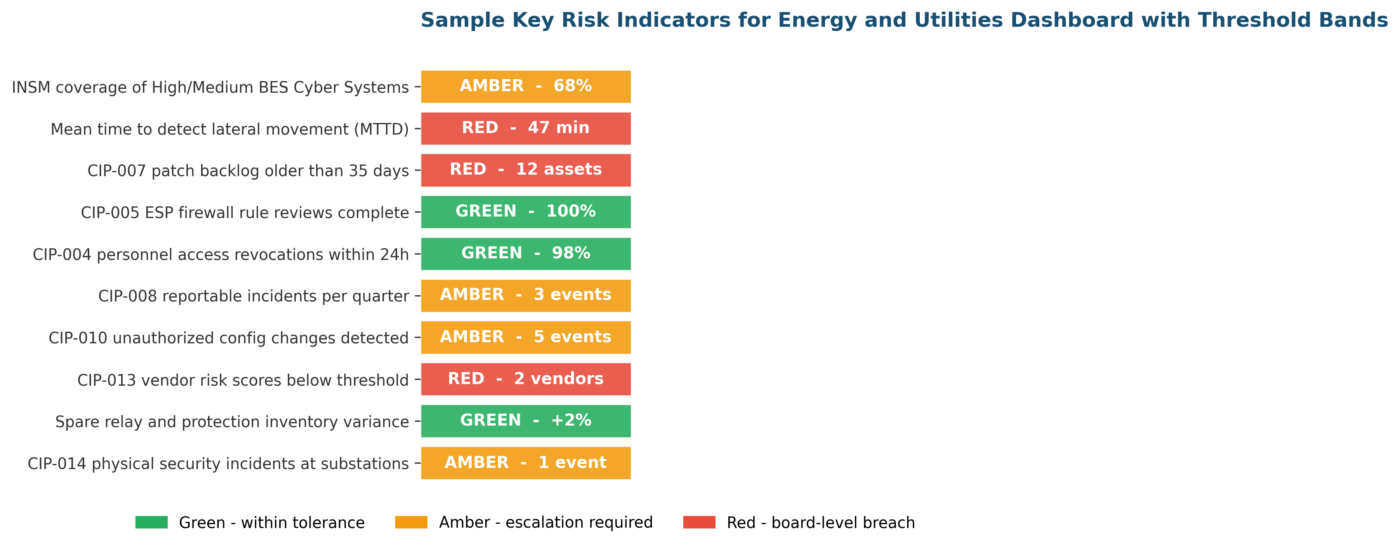
Figure 3. Sample executive Key Risk Indicators for Energy and Utilities dashboard with traffic-light threshold bands.
Reporting Cadence for Key Risk Indicators for Energy and Utilities
Cadence depends on what the indicator measures and who consumes the report at each layer. Real-time alerting fits CIP-015 INSM detections and CIP-008 reportable incidents. Daily and weekly review fits CIP-007 patch backlog, account-age, and log-source completeness metrics. Quarterly aggregation fits the audit-and-risk committee paper.
A defensible reporting stack runs four tiers. SOC operators see real-time alerts. Function leads receive weekly digests. The enterprise risk committee gets a monthly heat map. The board audit committee receives a quarterly Key Risk Indicators for Energy and Utilities scorecard with trend, threshold breaches, and remediation status.
Volt Typhoon and Salt Typhoon disclosures in 2024 and 2025 pushed boards to ask for monthly cyber-specific reads from the CISO. The key risk indicators dashboard template carries the standard tiered structure, with a one-page executive view and drill-downs by NERC CIP standard.
Common Pitfalls in Key Risk Indicators for Energy and Utilities Programs
Most utilities discover the same five or six structural problems when they audit their first generation of energy and utilities KRIs. Each pitfall has a root cause and a documented remedy that maps to specific NERC CIP requirements or to operational risk management practice.
| Pitfall | Root Cause | Remedy |
| Metric proliferation past 80 indicators | Adding a KRI for every audit finding without retiring stale ones | Retire indicators that have not breached threshold in 8 quarters; cap the executive view at 18 |
| IT-only KRI catalog with no OT coverage | GRC tooling built around corporate IT; OT data sits in plant historians | Pull OT indicators from the historian and CIP-010 baseline; assign an OT-side owner |
| Patch metrics that ignore engineering deferrals | Reporting treats turbine controllers like office endpoints | Track approved deferrals as a separate KRI with a 90-day re-review trigger |
| INSM coverage reported only in percentage | Tool default reports do not separate High from Medium Impact | Split coverage by impact rating; track High and Medium separately against the Sep 2028 deadline |
| CIP-013 vendor scoring updated annually | Procurement runs annual cycle; threats move quarterly | Quarterly delta refresh on top 20 vendors; SBOM monitoring on safety-critical software |
| Thresholds copied from sector reports | Quick path to a complete deck | Calibrate from the last four quarters of internal data; benchmark to NERC enforcement summaries |
| FAQ section in board reports is generic | Risk team writes the deck; CISO does not review pre-meeting | 30-minute pre-read with the CISO; replace generic FAQ with sector-specific questions |
Frequently Asked Questions About Key Risk Indicators for Energy and Utilities
How many Key Risk Indicators for Energy and Utilities should a utility report?
Most US Investor-Owned Utilities and large public power providers run between 35 and 70 active Key Risk Indicators for Energy and Utilities. The catalog scales with NERC CIP impact rating, generation mix, and regulatory exposure across FERC, state PUCs, and the SEC for publicly traded entities.
The executive risk committee typically sees the top 12 to 18 indicators each quarter. Drill-downs live in function-specific dashboards. A utility with no High Impact BES Cyber Systems and a small footprint may report 25 to 35 indicators total without compromising regulatory defensibility.
Do Key Risk Indicators for Energy and Utilities replace NERC CIP audits?
No, they do not. NERC Regional Entity audits remain the regulatory backstop and run on a three-year cycle for High and Medium Impact entities.
Key Risk Indicators for Energy and Utilities are the leading-metric layer that surfaces problems between scheduled audits, well before a Regional Entity team is at the door.
A strong KRI program shortens the next audit because findings get caught and remediated against an internal threshold first.
Auditors then verify the working catalog and the threshold-breach log instead of unearthing fresh non-compliance. That shift in audit posture is one of the clearest return-on-effort signals from the KRI program.
How does CIP-015 INSM change Key Risk Indicators for Energy and Utilities?
Detection coverage becomes a measurable indicator class under CIP-015-1. The headline KRI is the percentage of High and Medium Impact BES Cyber Systems feeding lateral-movement telemetry into a monitoring tool by September 2028. Mean time to detect east-west anomalies sits beside it as the operational counterpart.
CIP-015-2 extends scope to EACMS and PACS outside the electronic security perimeter after the March 2026 ballot. Expect jump hosts, identity providers, and badge readers to appear on the KRI catalog inside the next 24 months alongside the BES Cyber System core.
What external authorities should Key Risk Indicators for Energy and Utilities cite?
Primary citations are NERC CIP-002 through CIP-015, NIST CSF 2.0, NIST SP 800-82 Rev 3 (ICS security), IEC 62443 (industrial automation cybersecurity), and DOE C2M2 for maturity benchmarking. Add CISA Cross-Sector Performance Goals for utility-specific minimum baselines that regulators reference in supervisory letters.
Public-company entities layer in the SEC cybersecurity disclosure rule from 2023. Materiality-determination time and Form 8-K filing readiness become reportable indicators alongside the NERC catalog. Co-ops and municipal utilities skip the SEC layer but still face FERC and state PUC scrutiny.
| Authority | Document or Program | Relevance to Energy and Utilities KRIs |
| NERC | CIP-002 through CIP-015 Reliability Standards | Primary cyber compliance scope and audit baseline |
| FERC | Order 907 (CIP-015-1 approval, June 2025) | INSM mandate driving 2028 detection-coverage KRIs |
| NIST | CSF 2.0; SP 800-82 Rev 3; SP 800-53 | Function-level framing; ICS-specific control set |
| CISA | Cross-Sector Cybersecurity Performance Goals | Sector-specific minimum baselines for KRI floors |
| DOE | Cybersecurity Capability Maturity Model (C2M2) | Maturity-tier benchmarking across 10 domains |
| IEC | 62443 series | Industrial automation cybersecurity reference |
| E-ISAC | Threat-bulletin and incident-sharing platform | Source of CIP-008 reportable-incident benchmarks |
Table 4. Authoritative sources anchoring Key Risk Indicators for Energy and Utilities citations.
How often should Key Risk Indicators for Energy and Utilities be recalibrated?
Recalibrate the catalog once a year as a planned exercise, and after every material incident or NERC enforcement action against a peer. The annual cycle aligns to the CIP-008 incident response plan review and the CIP-004 personnel training refresh, so the work consolidates with existing compliance milestones.
Threshold-only tweaks happen mid-cycle when CIP-015 INSM tools come online, when a Volt Typhoon-style threat advisory drops, or when the board adjusts risk appetite. Document every change with rationale, an effective date, and the named approver. Auditors test the rationale, not the threshold number itself.
Can small co-ops and municipal utilities use Key Risk Indicators for Energy and Utilities?
Yes. Small co-ops and municipal utilities can run a 20 to 30 indicator subset of the full catalog. Low Impact BES Cyber Systems still attract CIP-003 Section 6 requirements, CIP-008 reporting obligations, and CIP-013 supply chain controls, all measurable with the same indicator structure.
The APPA cybersecurity guidance and NRECA-led mutual aid programs give small utilities a peer benchmark and a starter catalog. Threshold values scale with revenue, headcount, and generation portfolio. The underlying metric definitions do not change between a 50-employee co-op and an investor-owned utility with 10,000 staff.
Looking Ahead: Key Risk Indicators for Energy and Utilities in 2026 and 2027
Scope expansion under CIP-015-2 reshapes the dashboard through 2027. EACMS and PACS systems outside the ESP enter the KRI catalog after the March 2026 ballot, and the 2028 deadline for control centers brings INSM coverage from a project metric to a board-level commitment. Indicators for assets under construction sit alongside the operating set, and project-stage risk assessment for energy covers that ground.
Distributed energy resources, electric vehicle charging infrastructure, and grid-edge storage push the asset boundary outward. Forescout’s 2025 vulnerability research on solar inverters made the case that DER aggregators will need their own KRI subset by 2027, especially where they back-feed Medium Impact BES.
AI-driven attacker tooling and AI-assisted defender tooling shift dwell-time math on both sides. The 2026 program of Key Risk Indicators for Energy and Utilities adds AI-related metrics: AI-generated phishing detection rates, prompt injection attempts against grid-operations LLMs, and model-drift indicators on any predictive maintenance system that touches CIP-007 control accounts.
A live KRI dashboard with quarterly recalibration is what holds up under FERC audits, state PUC inquiries, and SEC disclosure-rule scrutiny. Without it, boards rotate the same concerns until the next 8-K filing or NERC notice of penalty forces one to the top of the agenda.
Ready to Operationalize Key Risk Indicators for Energy and Utilities?
At riskpublishing.com we help US Investor-Owned Utilities, public power providers, generation operators, and reliability-coordinator entities build Key Risk Indicators for Energy and Utilities programs that hold up under NERC Regional Entity audits, FERC enforcement scrutiny, and state PUC review.
Typical engagement: the indicator catalog mapped to NERC CIP-002 through CIP-015, a threshold-calibration workshop anchored to documented risk appetite, an executive board-paper template, and a CIP-015 INSM coverage tracker for the September 2028 deadline. The work usually runs eight to twelve weeks for a Medium Impact entity.
Explore our risk advisory services, or contact us to scope a Key Risk Indicators for Energy and Utilities maturity review tailored to your impact rating, generation mix, distributed energy footprint, and 2026 through 2028 NERC CIP compliance milestones across the bulk electric system.
Related reading on riskpublishing.com: Key Risk Indicators examples, how to use Key Risk Indicators, how to develop Key Risk Indicators, cybersecurity risk management framework, NIST risk assessment, supply chain Key Risk Indicators, and the integrated risk management approach.
Sibling industry KRI guides: For practitioners benchmarking across sectors, see our companion deep-dives on Key Risk Indicators for construction firms, Key Risk Indicators for banks and credit unions, strategic risk Key Risk Indicators examples, and board risk reporting one-page dashboard. Each guide maps industry-specific regulatory drivers, threshold logic, and dashboard examples to help risk teams calibrate their own KRI library.

Chris Ekai is a Risk Management expert with over 10 years of experience in the field. He has a Master’s(MSc) degree in Risk Management from University of Portsmouth and is a CPA and Finance professional. He currently works as a Content Manager at Risk Publishing, writing about Enterprise Risk Management, Business Continuity Management and Project Management.