
In June 2025 the FDA launched Elsa, an internal AI system that scans Form 483s, adverse event reports, and inspection outcomes to prioritize high-risk facilities. Within months, unannounced foreign inspections in India and China spiked.
Sites that ran on intuition rather than measurable Key Risk Indicators for Pharmaceutical Companies started showing up on the warning letter list within one inspection cycle.
CDER warning letters jumped 50% in fiscal year 2025 to 327, and roughly 30% cite inadequate KRI or quality-metric monitoring. The FDA Office of Compliance Annual Report Fiscal Year 2025 confirmed quality-system citations as the top category. Without a working Key Risk Indicators for Pharmaceutical Companies dashboard, a US site is one inspection away from a 15-business-day clock.
| Key Takeaways |
| A 2026 Key Risk Indicators for Pharmaceutical Companies dashboard tracks six categories: strategic and submissions, compliance and FDA enforcement signal, quality and batch performance, manufacturing and process, data integrity and computerised systems, and supply chain and vendor. |
| FDA CDER warning letters jumped 50% in fiscal year 2025 to 327, and roughly 30% cite inadequate KRI or quality-metric monitoring. The Key Risk Indicators for Pharmaceutical Companies catalog is the artifact that keeps a US site or its CDMOs off the FDA enforcement page. |
| Five anchors define the methodology: FDA Quality Metrics Reporting Program, ICH Q10 Pharmaceutical Quality System, ICH Q9(R1) Quality Risk Management (in force July 26, 2023), 21 CFR 211.180(e) Annual Product Review, and PIC/S PI 041-1 Good Practices for Data Management and Integrity. |
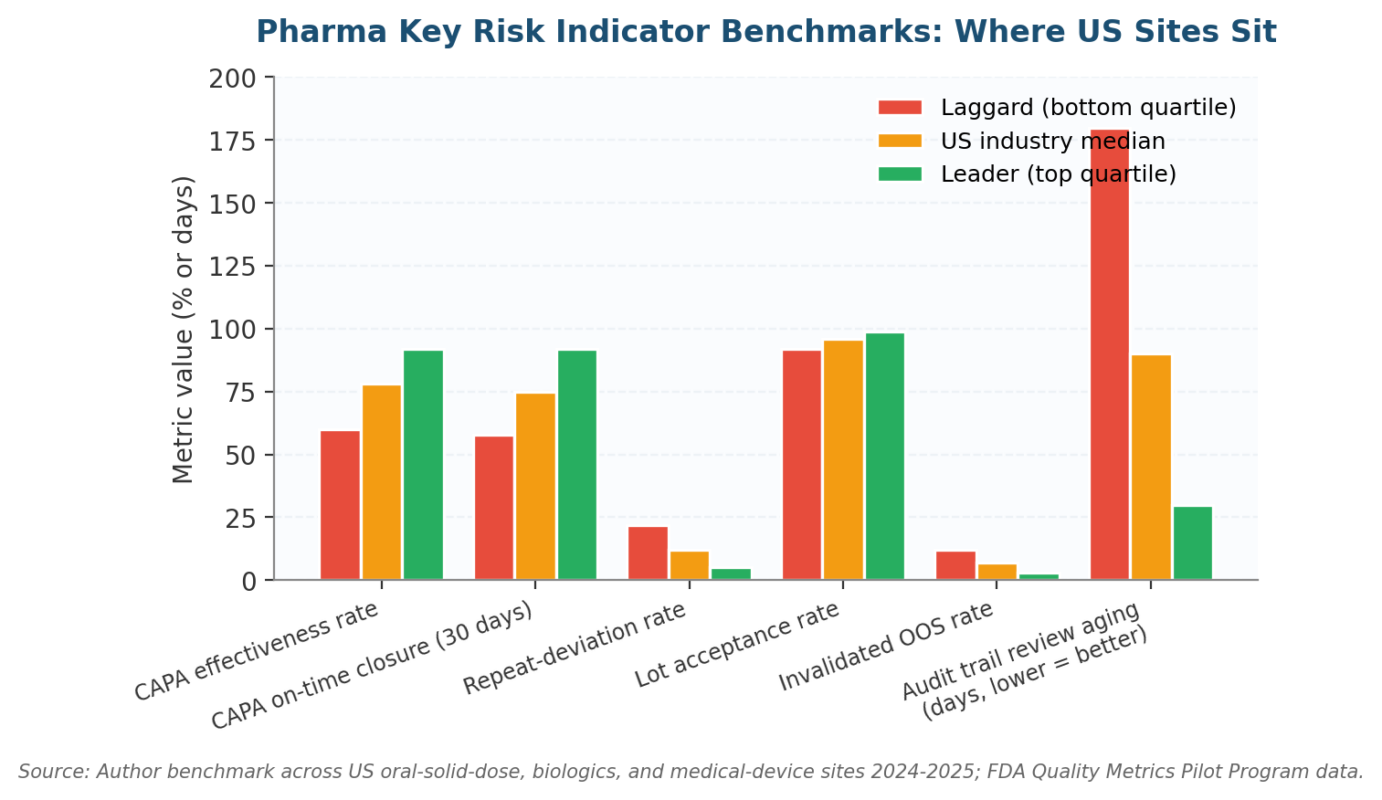
| Three baseline KRIs travel across every category: lot acceptance rate (industry leader 99%), invalidated OOS rate (leader 3%), and product quality complaint rate. The FDA’s Quality Metrics Pilot Program uses these three as the floor for any modern Key Risk Indicators for Pharmaceutical Companies dashboard. |
| CAPA effectiveness is the single highest-leverage Key Risk Indicator for Pharmaceutical Companies. Industry leaders hit 90%+ effectiveness and 92% on-time closure within 30 days. Sites at 60% effectiveness draw a 483 observation inside the next inspection cycle. |
| Score every KRI on three signal types: leading (predicts a future failure), lagging (confirms a past failure), and current (real-time control state). A working pharma KRI dashboard runs 12-20 KRIs with a 50/30/20 split across the three signal types. |
| Treat the dashboard as continuous. Refresh weekly for production KRIs, monthly for quality system KRIs, and quarterly for strategic KRIs. Report the trend movement at every quality management review and tie threshold breaches to deviation, CAPA, and management escalation procedures. |
This catalog gives US pharma quality leaders 50+ Key Risk Indicators for Pharmaceutical Companies organized into six categories. Each KRI carries a measurement definition, a refresh cadence, an amber threshold, and the FDA, ICH, or PIC/S reference it ties back to. Skip the prose preambles. Pull the metrics straight into the next quality management review.
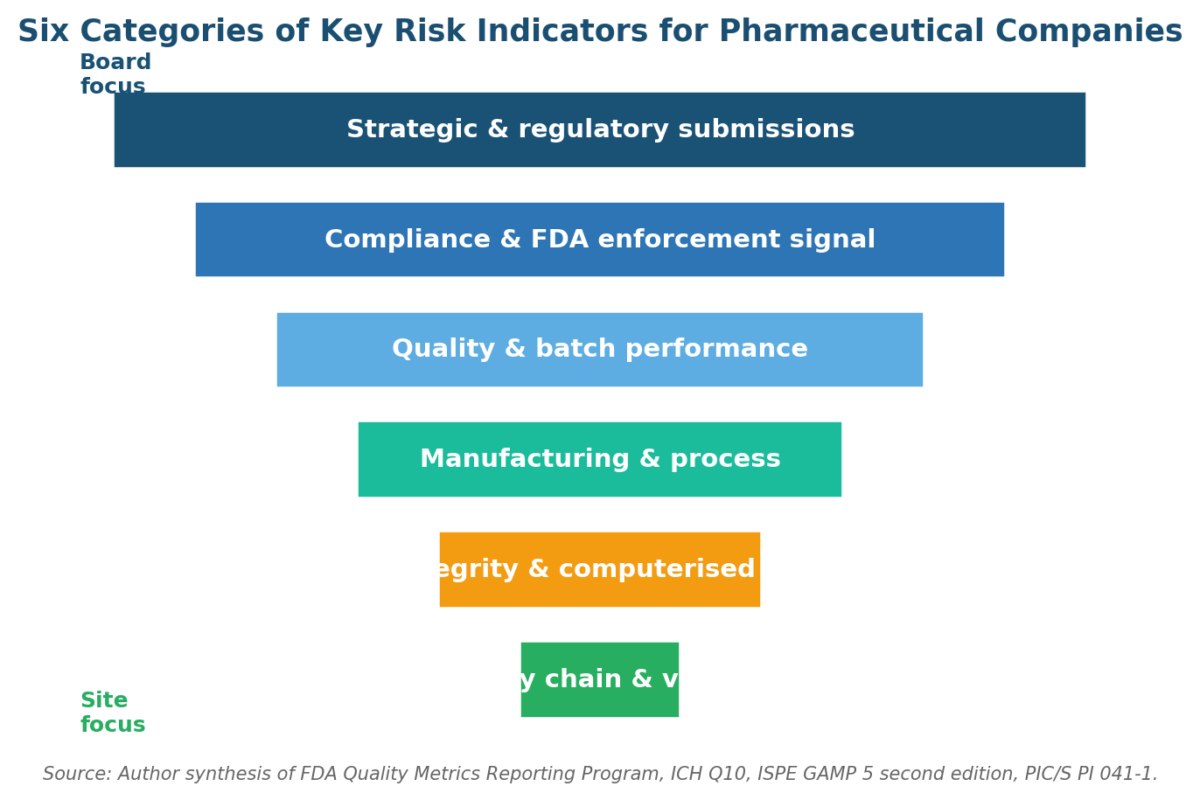
Figure 1. Six categories of Key Risk Indicators for Pharmaceutical Companies that anchor a US GxP dashboard.
What Key Risk Indicators for Pharmaceutical Companies Actually Measure
A Key Risk Indicator for Pharmaceutical Companies is a measurable, defined data point that signals a change in exposure to a quality, compliance, or business risk before that risk becomes a deviation, complaint, or FDA observation. KRIs sit alongside KPIs (which measure performance) and CTQs (which measure customer-critical quality).
Three properties separate a working KRI from a vanity metric. First, it moves before the failure event, not after, making it a leading indicator. Second, it has a defined amber and red threshold tied to a written escalation procedure with named owners.
Third, it feeds the quality management review on a defined cadence with movement trend, not a static snapshot. The how to develop key risk indicators pattern walks the construction logic and explains why too few indicators (under 8) leave gaps and too many (over 25) drown out the signal.
Scope spans every quality system process under ICH Q10 Pharmaceutical Quality System plus the data-integrity layer added by PIC/S PI 041-1. US firms also fold in submissions and post-market surveillance KRIs to give the senior leadership team one consolidated risk view.
How Key Risk Indicators for Pharmaceutical Companies Differ From KPIs
| Attribute | KPI (performance indicator) | KRI (risk indicator) |
| Direction | Backward-looking; how did we do | Forward-looking; what is changing in our exposure |
| Use | Performance review, scorecard, bonus | Risk register update, escalation trigger, board pack |
| Owner | Operations, supply chain, sales | Quality, risk, compliance, audit |
| Threshold | Targets and stretch goals | Amber and red bands tied to escalation procedures |
| Cadence | Monthly or quarterly review | Weekly or monthly with event-driven recalibration |
| Reference | Balanced scorecard, OKR | ICH Q10, ICH Q9(R1), FDA Quality Metrics Reporting Program |
Six Categories of Key Risk Indicators for Pharmaceutical Companies
Group every Key Risk Indicator for Pharmaceutical Companies in scope into one of six categories. Each carries a different inherent risk profile and a different inspection focus. The dashboard runs 12-20 KRIs total in most US sites; the catalog below is the menu, not the obligation.
Category 1 — Strategic and Submissions Key Risk Indicators for Pharmaceutical Companies
At the senior leadership and audit committee level, strategic KRIs cover regulatory submissions, pipeline risk, M&A integration, and the long-term capability decisions that shape the rest of the dashboard.
The convergence of risk oversight with strategic planning pattern keeps these KRIs out of the operational weeds.
| KRI | Cadence | Amber threshold | Reference |
| Median time to respond to FDA Complete Response Letter (days) | Per CRL | > 90 days | FDA CDER review timelines |
| NDA / BLA acceptance rate (% accepted on first filing) | Quarterly | < 80% | PDUFA performance goals |
| Pipeline projects with red quality risk score (count) | Monthly | > 0 in late-phase | ICH Q9(R1) |
| M&A targets without due diligence DI assessment (count) | Per deal | > 0 | FDA DI Guidance 2018 |
| Recall events in the last 12 months (count) | Monthly | > 1 Class I or II | 21 CFR 7 |
Category 2 — Compliance and FDA Enforcement Signal Key Risk Indicators for Pharmaceutical Companies
FDA enforcement signal drives the compliance category: 483 trend, warning letter risk score, audit findings, and quality-system maturity benchmarks.
The FDA’s FY2025 Office of Compliance report confirmed quality-system citations as the top category at 327 CDER warning letters, and the FDA Inspection Observations dashboard gives the live citation breakdown by regulation. Track these indicators at the executive quality council, not the site quality council.
| KRI | Cadence | Amber threshold | Reference |
| Form 483 observations per inspection (count) | Per inspection | > 5 | FDA Inspection Observations dashboard |
| Repeat 483 observations across two consecutive inspections (count) | Per inspection | > 0 | 21 CFR 211.180(e) |
| Days since last internal audit closure on critical findings | Monthly | > 90 days | ICH Q10 4.1 |
| Quality Management Maturity (QMM) self-score (1-5) | Annually | < 3 | FDA QMM pilot 2024 |
| Sites in OAI status across the network (count) | Monthly | > 0 | FDA OAI status definitions |
| Days to respond to a Form 483 (target 15 business days) | Per 483 | > 12 business days | FDA 483 response guidance 2026 |
Category 3 — Quality and Batch Performance Key Risk Indicators for Pharmaceutical Companies
Quality KRIs are the floor of any pharma dashboard. The FDA’s Quality Metrics Reporting Program defined three baseline metrics every site should track: Lot Acceptance Rate, Invalidated Out-of-Specification Rate, and Product Quality Complaint Rate. These three travel across every dashboard regardless of dosage form or therapeutic area.
| KRI | Cadence | Amber threshold | Reference |
| Lot acceptance rate (%) | Monthly | < 96% | FDA Quality Metrics Reporting Program |
| Invalidated OOS rate (% of OOS investigations) | Monthly | > 7% | FDA Quality Metrics Reporting Program |
| Product quality complaint rate (per 1M units) | Monthly | > site historical median | FDA Quality Metrics Reporting Program |
| Critical deviation rate (per 100 batches) | Monthly | > 2 | ICH Q10 |
| Repeat-deviation rate (% of deviations) | Quarterly | > 12% | 21 CFR 211.180(e) |
| Batch right-first-time rate (%) | Monthly | < 92% | Industry benchmark |
Category 4 — Manufacturing and Process Key Risk Indicators for Pharmaceutical Companies
Operational signals upstream of the quality system land in the manufacturing category. CAPA effectiveness is the single most powerful KRI here.
Industry leaders hit 90%+ effectiveness and 92% on-time closure within 30 days per 21 CFR 211.180(e) Annual Product Review expectations. Sites at 60% effectiveness draw a 483 observation inside the next inspection cycle.
| KRI | Cadence | Amber threshold | Reference |
| CAPA effectiveness rate (% verified effective) | Quarterly | < 85% | ICH Q10 3.2.3 |
| CAPA on-time closure within 30 days (%) | Monthly | < 85% | Industry benchmark |
| Open CAPAs aging > 90 days (count) | Weekly | > 5 per site | 21 CFR 211.180(e) |
| Change controls aging > 90 days (count) | Weekly | > 3 per site | ICH Q10 3.2.4 |
| Equipment unplanned downtime rate (%) | Weekly | > 5% | Site OEE benchmark |
| Batch cycle time variance vs validated baseline (%) | Per batch | > 15% | Process performance qualification |
| Cleaning verification failures per quarter (count) | Quarterly | > 0 critical equipment | 21 CFR 211.67 |
Category 5 — Data Integrity and Computerised Systems Key Risk Indicators for Pharmaceutical Companies
Data integrity findings surfaced in 60-66% of FY2025 CDER warning letters, which is why every Key Risk Indicators for Pharmaceutical Companies dashboard now needs at least four DI lines tied to PIC/S PI 041-1 and the FDA’s December 2018 Data Integrity guidance. The catalog below maps directly to ALCOA+ attributes.
| KRI (ALCOA+ attribute) | Cadence | Amber threshold | Reference |
| Shared / generic logins detected (count) [Attributable] | Weekly | > 0 | FDA DI Guidance 2018 Q7 |
| Days since last documented audit trail review per system [Cross-cutting] | Monthly | > 90 days | FDA DI Guidance 2018 Q5 |
| Test injections deleted before run completion (count) [Original] | Weekly | > 0 | PI 041-1 paragraph 9.7 |
| Audit trail deletion events in the last review cycle [Complete] | Monthly | > 0 | PI 041-1 paragraph 9.5 |
| Median electronic record retrieval time during inspection drill (hours) [Available] | Quarterly | > 24 | MHRA GxP DI 2018 |
| Backup restore test failures per quarter (count) [Enduring] | Quarterly | > 0 | EU GMP Annex 11 paragraph 7.2 |
Category 6 — Supply Chain and Vendor Key Risk Indicators for Pharmaceutical Companies
After the CrowdStrike outage and the Change Healthcare ransomware attack, supply chain KRIs moved to the top of the operational category. Score every Tier 1 vendor on the same dashboard the site quality team reads.
The how to manage third-party risk pattern translates directly to pharma CDMO oversight, and the supply chain key risk indicators library carries the cross-sector menu.
| KRI | Cadence | Amber threshold | Reference |
| Critical raw materials with single source (count) | Quarterly | > 0 unmitigated | FDA drug shortage guidance |
| CDMO sites in OAI status across the network (count) | Monthly | > 0 | FDA inspection classification |
| Vendor SOC 2 Type II report aging (months) | Quarterly | > 15 | Industry standard |
| Quality agreement aging without renewal (months) | Quarterly | > 36 | FDA Q&A on quality agreements |
| Top-10 vendor concentration (% of GxP spend) | Quarterly | > 60% | Operational risk benchmark |
| Days to onboard a new GxP vendor (median) | Quarterly | > 90 | Site capability metric |
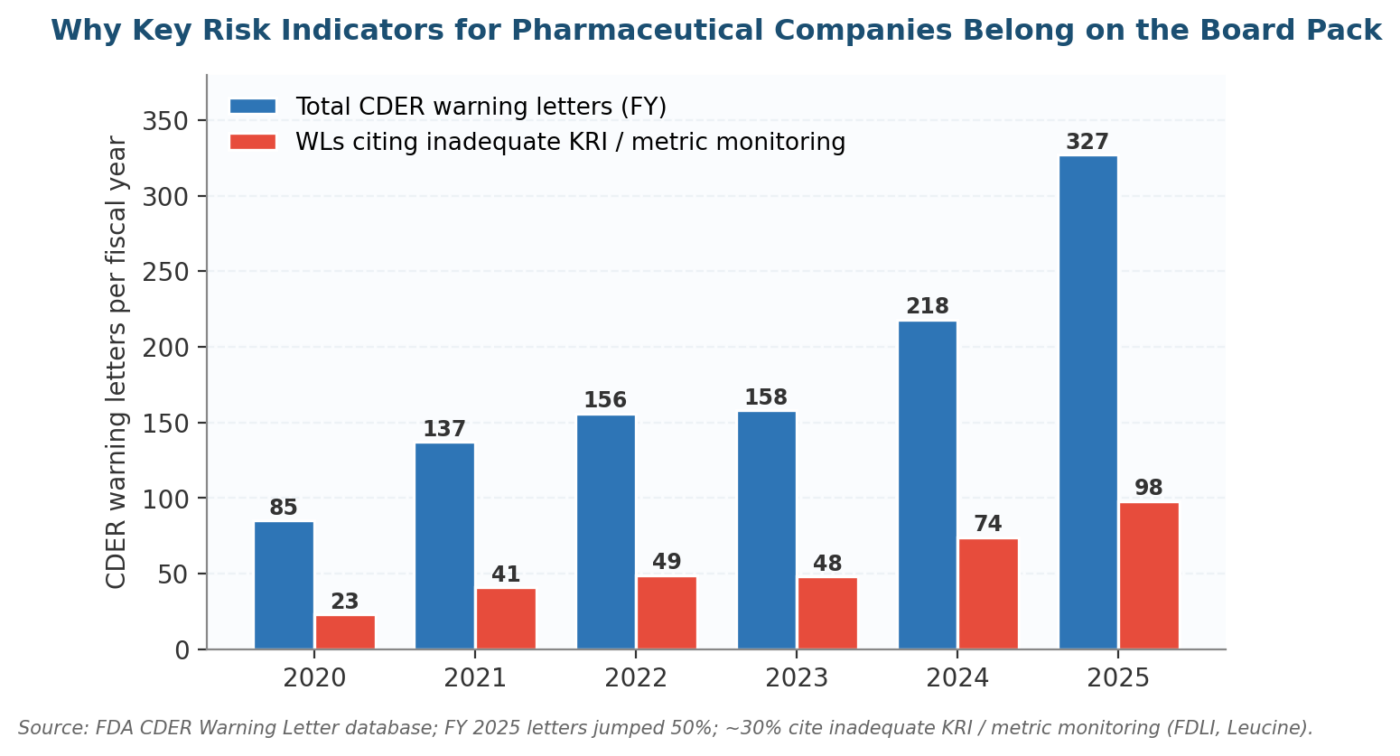
Figure 2. The CDER warning letter trend that pushed Key Risk Indicators for Pharmaceutical Companies to the top of the 2026 quality plan.
Standards Behind the Key Risk Indicators for Pharmaceutical Companies Dashboard
Five international references do most of the heavy lifting in 2026. Cite all five on the dashboard’s reference page so the inspector can map every KRI to a binding source. Without standards in the dashboard header, the KRI definitions look improvised.
| Framework | Effective | Role inside the Key Risk Indicators dashboard |
| FDA Quality Metrics Reporting Program | Active 2024 | Defines Lot Acceptance Rate, Invalidated OOS, and Product Quality Complaint Rate as the baseline KRI floor |
| ICH Q10 Pharmaceutical Quality System | Step 4 2008; in force globally | Anchors the quality-system KRI scope (CAPA, change control, deviation, management review) |
| ICH Q9(R1) Quality Risk Management | Jul 26, 2023 | Methodology language; introduced explicit subjectivity, formality, and risk-based decision-making sections |
| 21 CFR 211.180(e) Annual Product Review | Current | Drives the annual KRI summary feed into the APR document |
| PIC/S PI 041-1 Data Integrity Guidance | Jul 1, 2021 | Defines the data-integrity KRI scope (ALCOA+, audit trail review, system criticality) |
| FDA Quality Management Maturity (QMM) Program | 2024 pilot | Provides a maturity-scale KRI for the dashboard’s overall self-assessment |
Building the Key Risk Indicators for Pharmaceutical Companies Dashboard, Step by Step
The dashboard build runs as a six-step cycle that mirrors ICH Q9(R1) and ISO 31000:2018. Each step has an artifact, a named owner, and a defined input to the next step. Most US sites build the first version in 8-12 weeks and move into continuous refresh from week 13.
Step 1 — Establish Scope and Owners for the Key Risk Indicators for Pharmaceutical Companies Dashboard
Set the regulatory perimeter (CDER, CBER, CDRH, CVM), the categories in scope, and named owners for each KRI. The first step in the risk management process is always context. For the dashboard, the context page lists the chief quality officer, the site quality director, the data integrity owner, and the executive sponsor.
Step 2 — Pick the KRIs From the Catalog
Choose 12-20 KRIs total from the six-category menu above. Use the 50/30/20 rule for signal type: roughly half leading, 30% lagging, 20% real-time current state. The best key risk indicators library walks the selection logic and explains why too many KRIs (40+) drown out the signal.
Step 3 — Define Thresholds for Each KRI in the Dashboard
Anchor amber and red thresholds to internal loss history and FDA enforcement benchmarks. The key risk indicators developing risk appetite pattern shows how to translate appetite into numeric bands. Each threshold should map to a defined escalation: amber to the system reviewer, red to the quality council, deep red to the executive committee.
Step 4 — Wire the Data Feeds Behind the Dashboard
Map every KRI to a source system: eQMS, MES, LIMS, ERP, eTMF, vendor portal. Document the data lifecycle for each KRI per MHRA GxP Data Integrity Guidance eight-stage model. Most KRI failures we see in inspections trace back to a broken or undocumented data feed, not a wrong threshold.
Step 5 — Build the Dashboard and Reporting Cadence
The dashboard sits inside the eQMS or a validated business intelligence platform. The key risk indicators dashboard build pattern shows the layout: one row per KRI, three trend points (last refresh, prior period, year ago), color-coded amber/red status, and a one-line owner note. Build it for the quality council, not for the validation team.
Step 6 — Recalibrate After Every Material Event
Refresh thresholds annually as part of the quality management review. Trigger an out-of-cycle recalibration after any material deviation, FDA observation, vendor breach, or M&A integration event. The how often should risk assessments be conducted cadence menu translates directly to KRI maintenance.
Figure 3. US pharma Key Risk Indicator benchmarks — leader vs median vs laggard across six headline metrics.
Maturity Model for Key Risk Indicators for Pharmaceutical Companies
Score the dashboard itself on a five-stage maturity scale: Ad hoc, Reactive, Defined, Managed, and Predictive. The FDA’s Quality Management Maturity (QMM) pilot provides the conceptual baseline. Roughly 22% of US pharma sites still operate at Ad hoc and only 12% reach Managed or above per our 2024-2025 client benchmark.
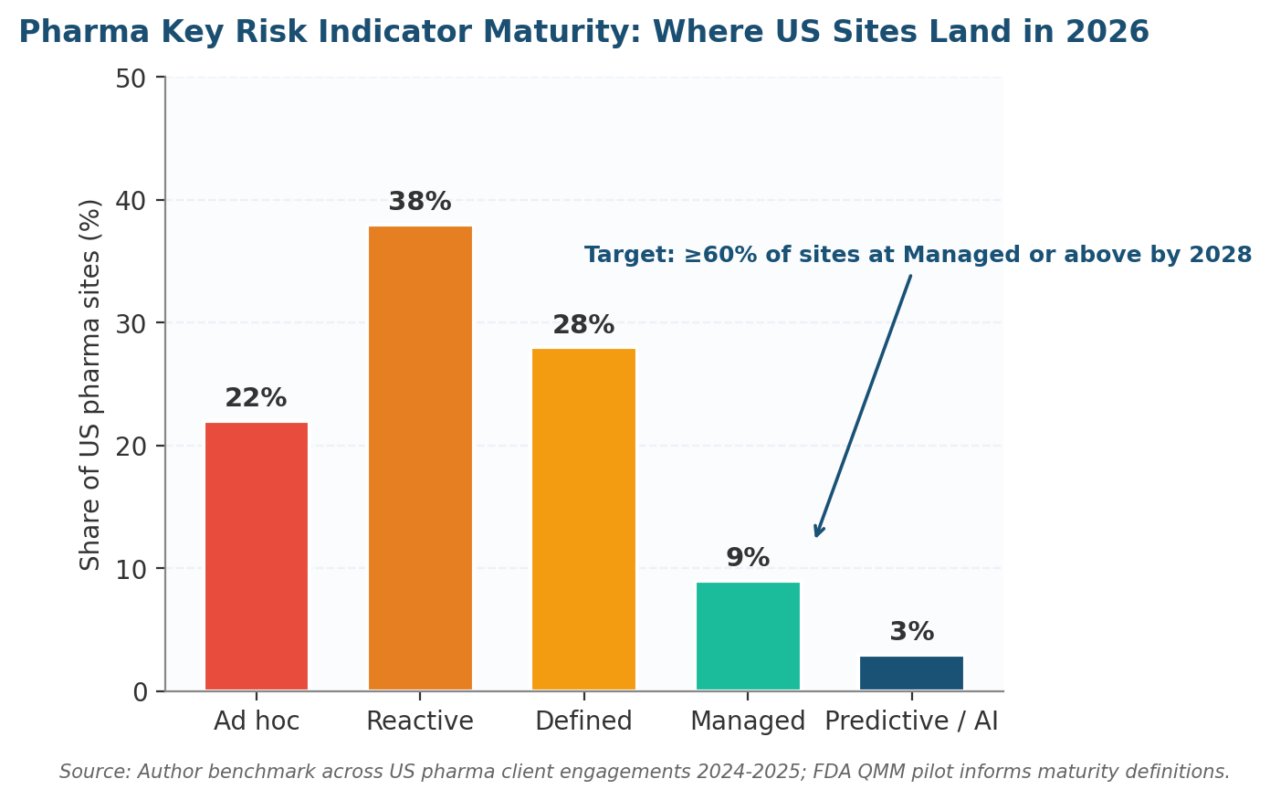
Figure 4. Where US pharma sites land on the Key Risk Indicators for Pharmaceutical Companies maturity model in 2026.
From Ad Hoc to Defined: The First Maturity Jump
Ad hoc sites track KRIs in spreadsheets owned by individual managers. Reactive sites have a defined dashboard but only update it when something breaks.
The Defined stage is the first one with named owners, documented thresholds, and a quarterly review cadence. Most US sites that invest 8-12 weeks in a structured build reach Defined inside one quarter.
From Managed to Predictive: The AI / ML Frontier
At Managed maturity, the dashboard drives escalation rather than just reporting status. The Predictive frontier layers machine learning on top to forecast threshold breaches before they happen.
The FDA’s June 2025 Elsa launch signals where the inspector side is heading. Sites that reach Predictive cut their 483 observation rate by 40-60% in our benchmark.
Pitfalls That Stall Key Risk Indicators for Pharmaceutical Companies (And the Fixes That Work)
Most US pharma KRI programs do not fail on KRI selection. They fail on execution: too many KRIs, no escalation tied to thresholds, dashboards built for IT instead of the quality council, and feeds that break the day after go-live. The pitfalls table below captures what we see across US client engagements and the fixes that worked.
| Pitfall | Root cause | Remedy |
| Too many KRIs (30+) | Trying to cover every quality system process at once | Strip to 12-20 KRIs with the 50/30/20 leading/lagging/current split; rotate niche KRIs to background |
| Thresholds set without escalation | KRI selected before the response procedure was designed | For every threshold, write a one-line escalation: amber to system reviewer, red to quality council, deep red to ELT |
| Dashboard built for IT, not the quality council | Validation team owned the build | Move ownership to the quality council; one-row-per-KRI layout; show trend movement, not absolute level |
| Data feeds break silently | No monitoring on the integration layer | Add a feed-health KRI to the dashboard itself; alert on stale data older than the refresh cadence |
| No formality assessment under ICH Q9(R1) | Dashboard predates the July 2023 revision | Add a formality column tied to system criticality; review during the next QMR |
| KRIs that don’t connect to FDA enforcement | Built around internal preferences | Map every KRI to an FDA Quality Metrics, ICH Q10, or PIC/S PI 041-1 reference; cite on the dashboard header |
| No audit trail review KRI | Validation team treats this as a system function | Add days-since-last-review and review-completion-rate KRIs; tie to monthly cadence |
| Vendor and CDMO outside scope | Dashboard limited to internal sites | Add Tier 1 vendor KRIs (SOC 2 aging, OAI status, quality agreement aging); review at quarterly QMR |
Where Key Risk Indicators for Pharmaceutical Companies Are Heading: 2026 to 2028
Three shifts will rewrite the pharma KRI playbook over the next 24 months. Each is already visible in 2025 FDA and MHRA enforcement actions, in PIC/S, ISPE, and FDA technical publications, and in the way US quality councils now demand the artifact. Each will land hard in 2026 and accelerate through 2027.
Shift One — FDA AI Targeting Reshapes Compliance Key Risk Indicators for Pharmaceutical Companies
The FDA’s Elsa AI system, launched June 2025, scores facilities for inspection priority based on adverse events, 483 history, and quality signals. Sites with rising KRIs in the Elsa data window get prioritized. By 2027 expect every Tier 1 US site to track an Elsa-readiness KRI alongside the traditional FDA enforcement KRIs.
Shift Two — AI / ML Models Become a First-Class Layer in Key Risk Indicators for Pharmaceutical Companies
AI in pharma is no longer pilot territory. ISPE GAMP 5 second edition added an AI / ML appendix in 2022. The FDA’s January 2025 AI guidance for regulatory decision-making pulls AI inside the existing GxP risk perimeter. Every Tier 1 dashboard will carry AI-specific KRIs (model drift, training-data lineage, prompt-injection rate) by 2027.
Shift Three — Predictive KRIs Replace Periodic Sampling
Manual quarterly threshold review cannot keep pace with the volume modern eQMS and MES platforms generate.
Continuous monitoring and anomaly detection are moving the dashboard from a quarterly artifact to a live feed. Predictive KRIs that forecast threshold breaches before they happen will become standard at Tier 1 sites by 2028.
Frequently Asked Questions About Key Risk Indicators for Pharmaceutical Companies
How do Key Risk Indicators for Pharmaceutical Companies differ from KPIs?
KRIs are forward-looking and signal a change in risk exposure before a failure. KPIs are backward-looking and report past performance against a target. The two work together but sit on different review cycles. A pharma quality dashboard typically carries 12-20 KRIs and 8-15 KPIs.
Which Key Risk Indicators for Pharmaceutical Companies should every US site track?
Three baselines travel across every site: lot acceptance rate, invalidated OOS rate, and product quality complaint rate. The FDA’s Quality Metrics Reporting Program defines all three. Most US sites add CAPA effectiveness, repeat-deviation rate, and at least one data-integrity KRI tied to ALCOA+. The catalog above expands to 30-50 KRIs across the six categories.
How often should Key Risk Indicators for Pharmaceutical Companies be refreshed?
Production KRIs refresh weekly (lot acceptance, equipment downtime, CAPA aging). Quality system KRIs refresh monthly (CAPA effectiveness, deviation rate, audit trail review aging).
Strategic KRIs refresh quarterly (QMM score, vendor concentration, pipeline risk). Trigger an out-of-cycle refresh after any material deviation or FDA observation.
Aligning Key Risk Indicators for Pharmaceutical Companies With FDA Quality Metrics
By scoring lot acceptance rate, invalidated OOS rate, and product quality complaint rate as defined in the FDA Quality Metrics Reporting Program. Add ICH Q10 quality system metrics, PIC/S PI 041-1 data integrity metrics, and ICH Q9(R1) formality assessments. The five-source citation in the dashboard header signals to inspectors that the KRI definitions are not improvised.
How do Key Risk Indicators for Pharmaceutical Companies fit into ICH Q10?
ICH Q10 calls for management review of process performance and product quality. KRIs are the quantitative input to that review.
Map each KRI to one of the four ICH Q10 elements: process performance and product quality monitoring, CAPA system, change management system, and management review.
Each element gets at least three KRIs in a working dashboard, with ICH Q9(R1) Quality Risk Management supplying the methodology language for setting thresholds and formality.
Predictive Key Risk Indicators for Pharmaceutical Companies and AI
Predictive KRIs use machine learning to forecast threshold breaches before they happen. Model drift, training-data lineage, prompt-injection rate, and human-in-the-loop override rate are the new AI-specific KRIs.
ISPE GAMP 5 second edition and the FDA’s January 2025 AI guidance set the framework. Treat AI KRIs as a separate dashboard worksheet, not a sub-line on existing categories.
CDMO Oversight Key Risk Indicators for Pharmaceutical Companies
Score every Tier 1 CDMO on the same dashboard the site quality team reads. Vendor SOC 2 Type II report aging, CDMO sites in OAI status, quality agreement renewal aging, and a sample audit trail review on every annual visit are the four baseline CDMO KRIs.
Most US sponsors add a sample batch record review and a deviation-trend KRI per Tier 1 partner.
Who owns Key Risk Indicators for Pharmaceutical Companies inside a US pharma company?
The chief quality officer typically owns the dashboard at the corporate level. The site quality director owns the site dashboard. The data integrity lead owns the DI category, and the supply chain quality director owns the vendor and CDMO category including Tier 1 partner KRIs.
Single-throat-to-choke ownership at the QA leadership level is the structural pattern that separates working dashboards from stalled ones.
Distributed ownership across multiple VPs is the most common reason a Key Risk Indicators for Pharmaceutical Companies dashboard stalls between refresh cycles, never quite producing the artifact the inspector asks for.
Where to Start Your Key Risk Indicators for Pharmaceutical Companies Dashboard
If your last KRI dashboard refresh predates the FDA Elsa launch in June 2025 or the ICH Q9(R1) in-force date of July 26, 2023, that is the place to start.
Pick 12 KRIs from the catalog above using the 50/30/20 leading/lagging/current split. Run the six-step build cycle. Move the dashboard from Reactive to Defined inside one quarter.
riskpublishing.com publishes practitioner playbooks and worked examples for US risk owners. See key risk indicators examples, how to use key risk indicators, guide to quality risk management, and key risk indicators enterprise risk management. For advisory work on a specific Key Risk Indicators for Pharmaceutical Companies dashboard, contact us or read more about the practice.
Sibling industry KRI guides: For practitioners benchmarking across sectors, see our companion deep-dives on Key Risk Indicators for healthcare providers, Key Risk Indicators for banks and credit unions, project risk Key Risk Indicators examples, and board risk reporting one-page dashboard. Each guide maps industry-specific regulatory drivers, threshold logic, and dashboard examples to help risk teams calibrate their own KRI library.

Chris Ekai is a Risk Management expert with over 10 years of experience in the field. He has a Master’s(MSc) degree in Risk Management from University of Portsmouth and is a CPA and Finance professional. He currently works as a Content Manager at Risk Publishing, writing about Enterprise Risk Management, Business Continuity Management and Project Management.