
On February 12, 2024, attackers affiliated with the ALPHV/BlackCat ransomware group entered Change Healthcare through a Citrix remote access portal that lacked multi-factor authentication.
The intrusion went undetected for nine days. When the breach reached 192.7 million people affected, the largest healthcare data breach ever reported to OCR, every Key Risk Indicators for Healthcare Providers program in the United States had to be re-scoped against the new baseline.
| Key Takeaways |
| A 2026 Key Risk Indicators for Healthcare Providers program covers six categories: privacy and HIPAA compliance, cybersecurity and technical safeguards, patient safety and clinical quality, workforce and credentialing, revenue cycle and billing integrity, and third-party and supply chain. |
| Change Healthcare’s February 2024 ransomware attack reached 192.7 million Americans, the largest healthcare data breach ever recorded. UnitedHealth Group disclosed $2.457 billion in direct breach response costs through Q3 2024. Attackers entered through a Citrix portal that lacked multi-factor authentication. |
| HHS Office for Civil Rights resolved 21 HIPAA penalty cases in 2025 totaling $8.33 million collected. Risk analysis failures appeared in 76% of those enforcement actions, with breach notification breakdowns the second most common citation. |
| The American Hospital Association’s March 2024 member survey found 74% of hospitals reported direct patient care impact from the Change Healthcare outage, 94% reported financial impact, and 33% saw more than half of revenue disrupted. |
| Standards and laws anchoring the catalog: HIPAA Security Rule, HIPAA Privacy Rule, HIPAA Breach Notification Rule, HITECH Act, 42 CFR Part 2 substance use confidentiality, OIG General Compliance Program Guidance (2023), Joint Commission patient safety standards, NIST CSF 2.0, NIST SP 800-66r2, and the HHS HPH CPGs. |
| A risk-aware healthcare provider program runs 45 to 60 Key Risk Indicators for Healthcare Providers in total, with 8 to 12 elevated to the audit-and-compliance committee each quarter. Fewer than 25 leaves blind spots; more than 70 dilutes board attention. |
| The 2026 HIPAA Security Rule proposed updates make MFA, encryption at rest and in transit, network segmentation, semi-annual vulnerability scans, and annual penetration testing explicit requirements rather than addressable specifications. |
UnitedHealth Group disclosed $2.457 billion in direct breach response costs through Q3 2024. An AHA survey of nearly 1,000 hospitals in March 2024 found that 74% reported direct patient care impact, 94% reported financial impact, and 33% saw more than half of their revenue disrupted within days of the outage.
The Key Risk Indicators for Healthcare Providers that could have caught the trajectory (MFA coverage on remote access, business associate breach notification readiness, vendor concentration on a single clearinghouse, and downtime procedure readiness) were either tracked late or escalated late at most affected entities. Every one of those four indicators belongs on a 2026 board paper as a standing red-amber-green item.
HHS Office for Civil Rights collected $8.33 million across 21 HIPAA enforcement actions in 2025, with 76% citing risk analysis failures. The New York Attorney General settled with Orthopedics NY (OrthoNY) for $500,000 after a breach exposed 656,000 patient records. Several of these KRIs feed directly into the HIPAA risk assessment requirements OCR enforces under its Risk Analysis Initiative.
Six categories anchor the dashboard below: privacy and HIPAA compliance, cybersecurity and technical safeguards, patient safety and clinical quality, workforce and credentialing, revenue cycle and billing integrity, and third-party and supply chain.
Each category carries 8 to 10 indicators, calibrated to a tolerance the audit-and-compliance committee can sign off on and that OCR examiners can verify on paper.
Each Key Risk Indicators for Healthcare Providers metric ties to a named standard: the HIPAA Security Rule, the OIG General Compliance Program Guidance, NIST CSF 2.0, or a Joint Commission or CMS Conditions of Participation requirement.
A US chief risk officer, chief compliance officer, or chief information security officer can pull the thresholds straight into the next quarterly board paper.
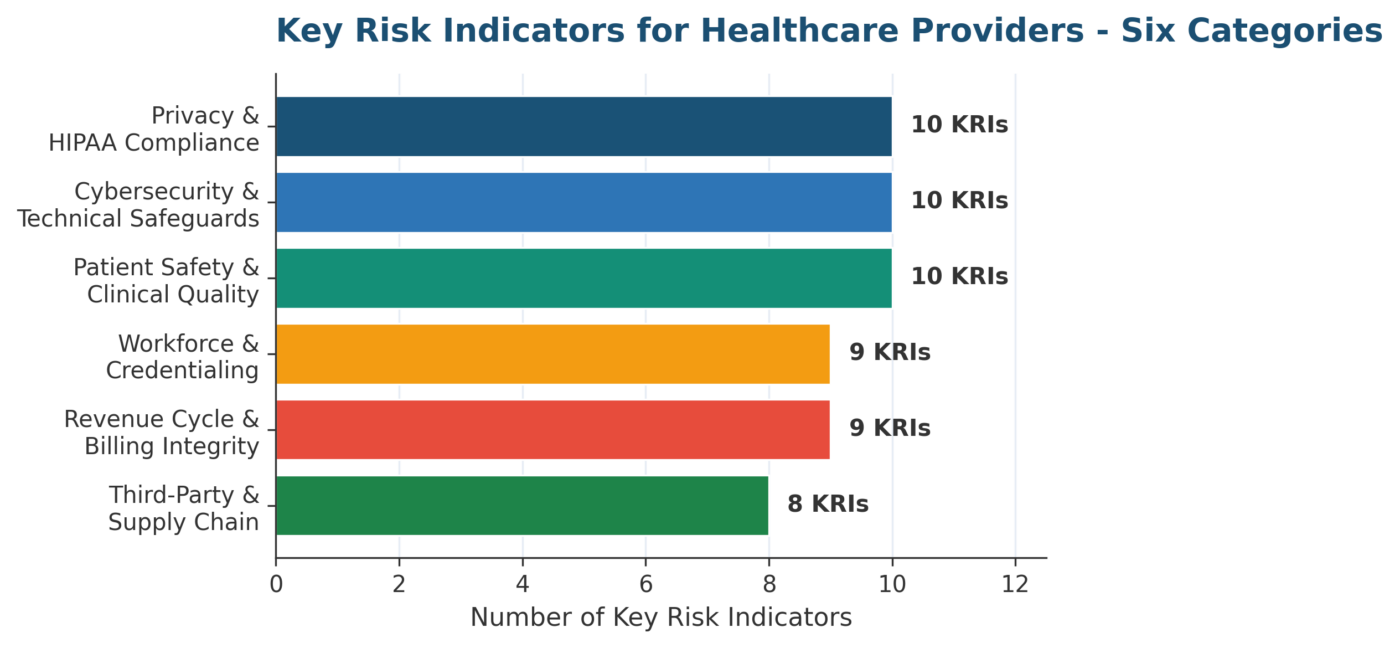
Figure 1. Key Risk Indicators for Healthcare Providers distributed across six categories used in US hospital and health system risk programs.
What Are Key Risk Indicators for Healthcare Providers?
A healthcare provider Key Risk Indicator is a leading metric that flags a HIPAA breach, patient safety event, False Claims Act exposure, or operational failure before OCR, CMS, the Joint Commission, or a class-action plaintiff finds out first. Behavioral health services add indicators drawn from risk assessment in mental health nursing, including screening and post-discharge contact rates.
The exposure spans clinical care, protected health information, billing integrity, workforce, vendor relationships, and the medical device fleet.
Performance indicators measure progress against a clinical or compliance program goal. Key Risk Indicators for Healthcare Providers measure exposure against a documented tolerance set by the audit-and-compliance committee.
The same metric (HAI rate, RN turnover, denied claim rate) can play either role depending on whether it is reported against a program target or against a board-approved threshold.
Useful Key Risk Indicators examples on a provider dashboard share four traits. They are measurable, owned by one named person (a chief compliance officer, chief medical officer, or chief nursing officer), calibrated to a green / amber / red threshold, and they move ahead of the sentinel event or OCR letter rather than after it.
How Key Risk Indicators for Healthcare Providers Differ from KPIs
| Attribute | Key Performance Indicator (KPI) | Healthcare Provider KRI |
| Direction | Measures progress against the clinical, compliance, or revenue plan (HCAHPS score, training completion, claim throughput, RVU productivity) | Measures exposure against tolerance (HAI rate, MFA coverage gap, denial rate, RN vacancy rate, BAA refresh aging, sentinel event count) |
| Time view | Lagging or current performance against plan | Leading early-warning signal of an OCR finding, sentinel event, False Claims qui tam suit, or downgrade |
| Trigger | Operations review, departmental scorecard, board quality report | Escalation memo, audit-and-compliance committee paper, board risk report, 10-K risk-factor disclosure |
| Owner | CMO, CNO, CFO, chief revenue officer | Chief risk officer, chief compliance officer, CISO, with named first-line owners by category |
| Reference | Joint Commission accreditation cycle, CMS Star Ratings, Press Ganey | HIPAA Security Rule, OCR Risk Analysis Initiative, OIG Compliance Guidance, NIST CSF 2.0, Joint Commission Sentinel Event Policy, CMS Conditions of Participation |
Privacy and HIPAA Compliance Key Risk Indicators for Healthcare Providers
Risk analysis failures appeared in 76% of OCR enforcement actions resolved in 2025. The OCR Risk Analysis Initiative expanded during the year to scrutinize not only whether a covered entity ran a risk analysis, but whether documented remediation followed.
Privacy and HIPAA Key Risk Indicators for Healthcare Providers read the program from the regulator’s seat.
Top 10 Privacy and HIPAA Compliance Key Risk Indicators for Healthcare Providers
| Privacy / HIPAA KRI | Green threshold | Amber threshold | Red threshold |
| HIPAA risk analysis aging (months) | <12 | 12-24 | >24 |
| Documented remediation on identified risks | >/=95% | 80-95% | <80% |
| Breach notification within 60-day window | 100% | 95-99% | <95% |
| Reportable breaches affecting 500+ records | 0 | 1 | >1 |
| Patient right-of-access requests overdue 30d | <3 | 3-10 | >10 |
| Workforce HIPAA training completion (qtr) | 100% | 95-99% | <95% |
| Minimum-necessary access audit findings | <5 | 5-15 | >15 |
| EHR audit-log review completeness | >/=95% | 85-95% | <85% |
| Snooping incidents detected (qtr) | 0 | 1-3 | >3 |
| Open OCR investigations or audits | 0 | 1-2 | >2 |
HIPAA risk analysis aging is the indicator OCR opens with on every investigation. A risk analysis older than 24 months reads as red regardless of how the underlying control environment has changed.
The Ogletree analysis of 2025 enforcement trends confirms inadequate risk analysis was the single most cited control failure across resolved cases.
Cybersecurity and Technical Safeguards Key Risk Indicators for Healthcare Providers
Change Healthcare’s 192.7-million-record breach ran through a Citrix portal without MFA. Attackers held access for nine days before detection.
Cybersecurity Key Risk Indicators for Healthcare Providers read whether the technical safeguards required by the HIPAA Security Rule (and tightened by the 2026 HIPAA Security Rule proposed amendments) are deployed, monitored, and tested rather than only documented.
Top 10 Cybersecurity and Technical Safeguards Key Risk Indicators for Healthcare Providers
| Cybersecurity / Technical Safeguards KRI | Green threshold | Amber threshold | Red threshold |
| MFA coverage on remote access | 100% | 95-99% | <95% |
| MFA coverage on privileged / clinical accounts | 100% | 100% | <100% |
| Critical patch latency on internet-facing assets (days) | <7 | 7-30 | >30 |
| ePHI encryption coverage at rest | 100% | 95-99% | <95% |
| ePHI encryption coverage in transit | 100% | 95-99% | <95% |
| Vulnerability scan cadence (months) | <=6 | 6-9 | >9 |
| Penetration test cadence (months) | <=12 | 12-15 | >15 |
| EDR coverage on endpoints | >/=99% | 95-99% | <95% |
| IoMT (medical device) inventory completeness | >/=98% | 90-98% | <90% |
| Phishing simulation failure rate | <5% | 5-12% | >12% |
Incomplete IoMT inventory drives most undetected cyber exposure inside a hospital. Infusion pumps, imaging consoles, and patient monitors connect to clinical networks on firmware that the device manufacturer may no longer support.
A working inventory feeds both the cyber risk register and the medical device security program required by the FDA’s 2023 Refuse to Accept guidance under section 524B.
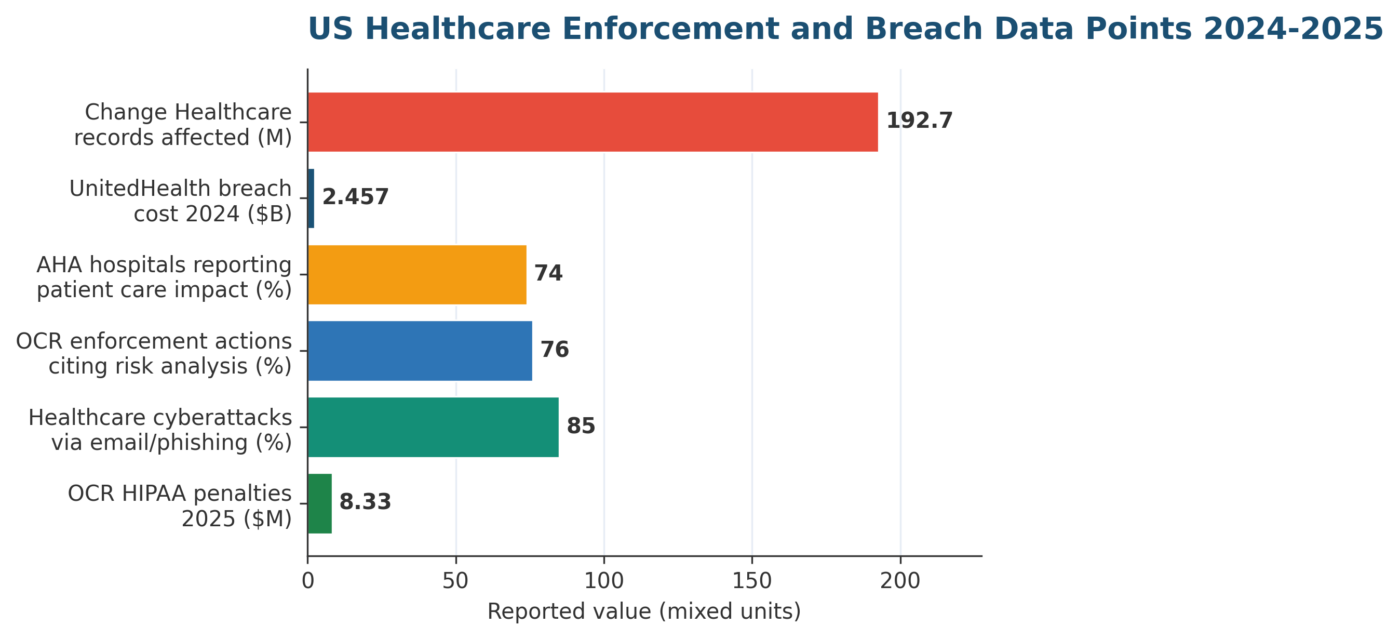
Figure 2. US healthcare enforcement and breach data points 2024-2025 driving the Key Risk Indicators for Healthcare Providers that belong on a 2026 board paper.
Patient Safety and Clinical Quality Key Risk Indicators for Healthcare Providers
Patient safety is both a clinical quality concern and an enterprise compliance concern. The OIG’s 2023 General Compliance Program Guidance explicitly tells boards to fold patient safety into the compliance risk assessment.
The Joint Commission Sentinel Event Policy defines the floor; patient safety Key Risk Indicators for Healthcare Providers read whether the program prevents events rather than only reports them after the fact.
Top 10 Patient Safety and Clinical Quality Key Risk Indicators for Healthcare Providers
| Patient Safety / Clinical Quality KRI | Green threshold | Amber threshold | Red threshold |
| Sentinel events (per quarter) | 0 | 1 | >1 |
| Hospital-acquired infection (HAI) rate per 1,000 patient-days | <1.0 | 1.0-1.5 | >1.5 |
| Central-line associated bloodstream infection (CLABSI) SIR | <0.75 | 0.75-1.0 | >1.0 |
| 30-day all-cause readmission rate | <15% | 15-20% | >20% |
| Inpatient fall rate per 1,000 patient-days | <2.5 | 2.5-3.5 | >3.5 |
| Medication errors reaching the patient per 1,000 doses | <0.5 | 0.5-1.0 | >1.0 |
| Code Blue events outside ICU (per month) | <2 | 2-5 | >5 |
| Patient safety event reporting rate (per 1,000 admissions) | >/=25 | 15-25 | <15 |
| Open Joint Commission corrective action plans | 0 | 1-3 | >3 |
| CMS HAC Reduction Program score quartile | Top 75% | 50-75% | Bottom 25% |
Underreporting of safety events is a counterintuitive red. A low reporting rate signals a culture afraid to raise concerns rather than a safer hospital.
Track reporting rate, anonymous-channel use, and event-resolution turnaround as a triangulated set so the dashboard reads program maturity rather than incident concealment.
Workforce and Credentialing Key Risk Indicators for Healthcare Providers
Registered nurse turnover ran at 18.4% nationally in the 2024 NSI National Health Care Retention and RN Staffing Report, a level that pushes contract labor spend and lifts patient safety risk together.
Workforce and credentialing Key Risk Indicators for Healthcare Providers read whether staffing volatility, clinician burnout, and credentialing gaps are creating exposure the board needs to see.
Top 9 Workforce and Credentialing Key Risk Indicators for Healthcare Providers
| Workforce / Credentialing KRI | Green threshold | Amber threshold | Red threshold |
| RN annualized turnover rate | <15% | 15-22% | >22% |
| RN vacancy rate | <7% | 7-12% | >12% |
| Contract / agency labor as % of nursing hours | <5% | 5-15% | >15% |
| Physician burnout index (validated survey) | <35% | 35-50% | >50% |
| Provider credentialing aging beyond 90 days | 0 | 1-3 | >3 |
| Expired licenses or DEA registrations | 0 | 1 | >1 |
| NPDB query exceptions on appointment | 0 | 1 | >1 |
| Sanction-list (OIG LEIE / SAM.gov) exceptions | 0 | 1 | >1 |
| Mandatory training completion (clinical staff) | 100% | 95-99% | <95% |
OIG LEIE and SAM.gov exceptions are the credentialing KRI most often missed at small and mid-sized providers.
Employing or contracting with a sanctioned individual triggers civil monetary penalties under 42 CFR 1003 and exclusion-based False Claims exposure. Run the screen monthly across all employees, contractors, volunteers, and referring providers, not annually at appointment.
Revenue Cycle and Billing Integrity Key Risk Indicators for Healthcare Providers
The Department of Justice recovered more than $2.9 billion under the False Claims Act in fiscal year 2024, with health care fraud the largest enforcement category.
Revenue cycle and billing integrity Key Risk Indicators for Healthcare Providers connect coding accuracy, denial trends, and qui tam exposure to one board-readable view of financial and compliance risk.
Top 9 Revenue Cycle and Billing Integrity Key Risk Indicators for Healthcare Providers
| Revenue Cycle / Billing KRI | Green threshold | Amber threshold | Red threshold |
| Initial claim denial rate | <5% | 5-10% | >10% |
| Denials overturned on appeal | >/=70% | 50-70% | <50% |
| Days in accounts receivable | <40 | 40-55 | >55 |
| Coding audit error rate | <3% | 3-7% | >7% |
| RAC / MAC takebacks per quarter ($) | <$100K | $100K-$500K | >$500K |
| Self-disclosed billing errors (qtr) | 0-1 | 2-4 | >4 |
| Open False Claims Act qui tam matters | 0 | 1 | >1 |
| Charity care / financial assistance denials reviewed | >/=98% | 90-98% | <90% |
| Stark / Anti-Kickback policy exceptions outstanding | 0 | 1-2 | >2 |
Days in accounts receivable jumped at hospitals reliant on Change Healthcare during the 2024 outage. Some systems saw A/R balloon past 60 days within weeks, with cash on hand pressure feeding directly into bond covenant risk.
Watch days cash on hand alongside A/R aging when a clearinghouse or major payer is on a single-vendor footing.
Third-Party and Supply Chain Key Risk Indicators for Healthcare Providers
Change Healthcare was a business associate to thousands of providers and payers. When the ransomware hit, the data those covered entities had pushed to it became their breach.
Third-party and supply chain Key Risk Indicators for Healthcare Providers read the exposure on every business associate, sub-contractor, group purchasing organization, and medical device manufacturer.
Top 8 Third-Party and Supply Chain Key Risk Indicators for Healthcare Providers
| Third-Party / Supply Chain KRI | Green threshold | Amber threshold | Red threshold |
| Business associate agreement (BAA) coverage | 100% | 95-99% | <95% |
| BAA refresh aging (months) | <24 | 24-36 | >36 |
| Business associate breach notifications (qtr) | 0 | 1-2 | >2 |
| Concentration on single clearinghouse / EDI vendor | <40% | 40-60% | >60% |
| Vendor SOC 2 / HITRUST coverage on PHI handlers | >/=95% | 80-95% | <80% |
| Vendor security questionnaires open >30 days | <5 | 5-15 | >15 |
| Drug shortages active (FDA list match) | <5 | 5-15 | >15 |
| IoMT devices on unsupported firmware (%) | <10% | 10-25% | >25% |
Single-vendor concentration is the third-party KRI most boards under-watched before Change Healthcare.
Map the top ten business associates by data volume, transaction volume, and clinical criticality, then add concentration KRIs that trigger reassessment when any one vendor passes 40% of throughput on a regulated workflow.
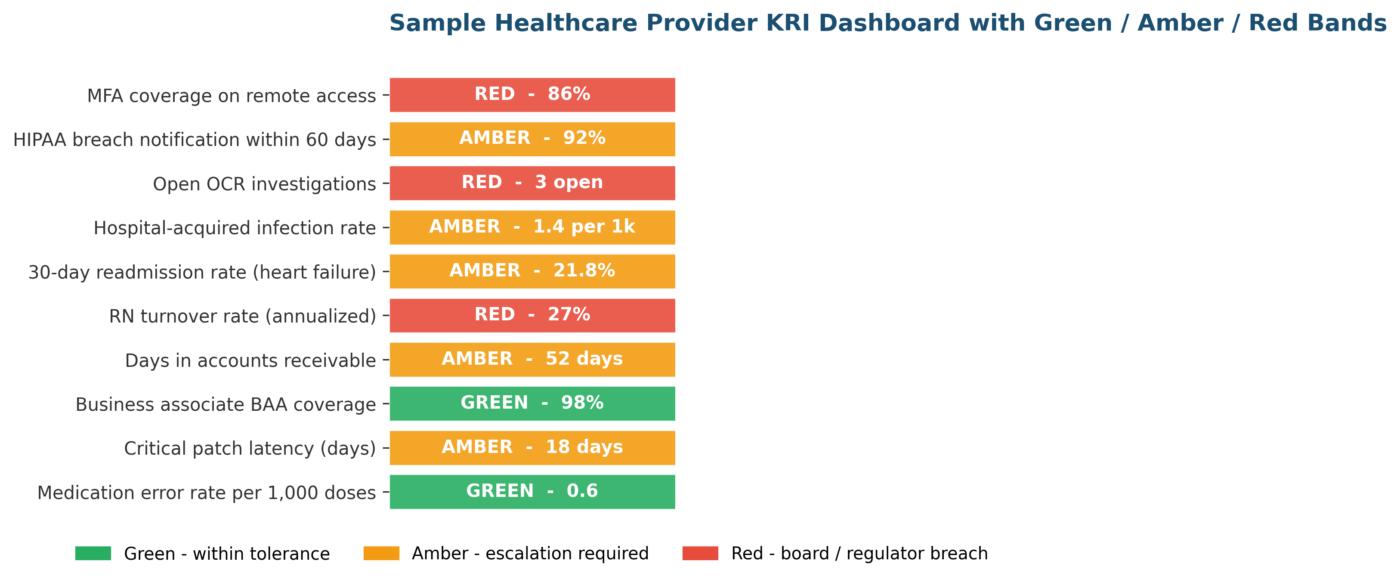
Figure 3. Illustrative threshold dashboard showing Key Risk Indicators for Healthcare Providers across categories with green / amber / red bands.
How to Implement Key Risk Indicators for Healthcare Providers
Standing up a healthcare provider KRI program is a six-step exercise inside the wider enterprise risk management framework. The reference texts are NIST SP 800-66 Revision 2 for HIPAA Security Rule implementation, the OIG General Compliance Program Guidance, and ISO 31000:2018 clause 6.6.
Six Steps to Deploy Key Risk Indicators for Healthcare Providers
- Step 1. Anchor in the healthcare risk taxonomy: Tie each indicator to a specific rule, clinical service line, or compliance domain so dashboard movement maps to a treatable exposure rather than a generic board talking point.
- Step 2. Calibrate thresholds: Set green / amber / red bands using internal trend, CMS Hospital Compare benchmarks, OCR enforcement history, and the board-approved risk appetite statement.
- Step 3. Assign owners: Every indicator gets a named first-line owner and a second-line risk partner. Patient safety KRIs go to the CMO and CNO; HIPAA KRIs to the privacy officer and CISO; revenue cycle KRIs to the CFO and chief compliance officer; workforce KRIs to the CHRO and medical staff office.
- Step 4. Define escalation: Document what happens at each band: who is notified, the response window, the compliance committee trigger, the audit committee trigger, and the board paper threshold.
- Step 5. Automate collection: Pull data from the EHR audit log, GRC tool, BAA management system, denial management platform, credentialing software, infection prevention surveillance, and incident-reporting system into a single KRI workbench updated at least weekly.
- Step 6. Review quarterly: Recalibrate thresholds, retire indicators that never breach, replace those that always breach, and add KRIs for emerging exposure (AI-enabled clinical decision support, telehealth privacy, IoMT, generative AI scribes, and the 2026 HIPAA Security Rule updates).
Common Pitfalls in Key Risk Indicators for Healthcare Providers
Implementation failures around Key Risk Indicators for Healthcare Providers repeat across academic medical centers, community hospitals, and physician group practices alike.
The traps below show up in OCR audits, OIG corporate integrity agreements, Joint Commission focused surveys, and qui tam complaints.
| Pitfall | Root cause | Remedy |
| Compliance / quality silo | HIPAA risk analysis runs separately from patient safety risk assessment and from cyber risk register | Surface privacy, security, patient safety, and revenue cycle KRIs on one audit-and-compliance committee paper |
| Activity counts treated as KRIs | Training sessions delivered and policies updated reported as risk metrics | Reframe as exposure: training completion rate by role, risk analysis aging, policy refresh aging, remediation closure rate |
| Static thresholds across cycles | Bands set at framework launch and never recalibrated as the threat or regulatory environment shifted | Quarterly review tied to OCR enforcement trends, CMS benchmarks, and internal incident history |
| IoMT and device blind spot | Medical device fleet outside the IT inventory and outside the cybersecurity KRI scope | Add IoMT inventory completeness, unsupported firmware percentage, and device patch latency to the dashboard |
| BAA paper-tiger problem | Business associate agreements signed at onboarding and never refreshed as sub-processors change | Track BAA refresh aging, sub-processor disclosure, and BA breach notifications as standing KRIs |
| Underreporting bias | Low sentinel event and near-miss counts read as program strength when they reflect culture concealment | Track event-reporting rate per 1,000 admissions as a complementary KRI; a low rate is amber, not green |
| Vanity dashboards | Color-coded heat maps that never trigger an action | Tie each amber and red band to a documented action; track action closure as a meta-KRI on the same page |
Frequently Asked Questions About Key Risk Indicators for Healthcare Providers
What are the most important Key Risk Indicators for Healthcare Providers?
Seven indicators sit at the top of most US provider dashboards: HIPAA risk analysis aging, MFA coverage on remote access, breach notification timeliness, sentinel event count, hospital-acquired infection rate, RN turnover rate, and business associate BAA coverage.
Together they cover the dominant 2026 exposures across HIPAA, cyber, clinical, workforce, and third-party risk.
Layer 40 to 50 more across the six categories for a complete program. The right starting point is the OIG 2023 General Compliance Program Guidance combined with the OCR Risk Analysis Initiative findings and the Joint Commission Sentinel Event Database lookups for your service mix.
How many Key Risk Indicators for Healthcare Providers should a hospital track?
Most US hospitals and health systems track 45 to 60 Key Risk Indicators for Healthcare Providers in total, with 8 to 12 elevated to the audit-and-compliance committee each quarter.
Tracking fewer than 25 leaves blind spots that surface during the next OCR audit or Joint Commission focused survey, especially on cybersecurity and BAA management.
Tracking more than 70 invites monitoring fatigue and dilutes board attention. The right number scales with bed count, service-line complexity, business associate footprint, and the breadth of state attorney general activity in your operating geography, not with the size of the GRC platform catalog.
How do Key Risk Indicators for Healthcare Providers differ from CMS quality measures?
CMS Hospital Compare, Star Ratings, and the Quality Payment Program measure outcomes and outputs against payer benchmarks for reimbursement and public reporting. Key Risk Indicators for Healthcare Providers measure leading exposure against a board-approved risk tolerance. CMS measures usually lag by quarters; KRIs are designed to move first.
The two sets overlap. Readmission rates, HAC scores, and patient experience appear on both. The difference is framing and ownership: CMS measures answer to the chief medical and quality officers; KRIs answer to the board through the chief risk officer and chief compliance officer.
Which standards govern Key Risk Indicators for Healthcare Providers?
The dominant references are the HIPAA Security Rule (45 CFR 164.308-164.316), the HIPAA Privacy Rule (45 CFR 164.500-164.534), the HIPAA Breach Notification Rule (45 CFR 164.400-164.414), the HITECH Act, 42 CFR Part 2, the OIG General Compliance Program Guidance, NIST SP 800-66 Revision 2, and NIST CSF 2.0.
Layered on top: Joint Commission accreditation standards, CMS Conditions of Participation, the False Claims Act, the Anti-Kickback Statute, the Stark Law, EMTALA, state-specific privacy and biometric laws, and the FDA cybersecurity guidance for medical devices under section 524B of the FD&C Act.
How often should Key Risk Indicators for Healthcare Providers be reviewed?
Operational KRIs are measured continuously where the EHR, GRC tool, infection surveillance system, denial management platform, and HRIS permit. Review weekly at the service-line and compliance-operations level, monthly at the privacy and security officer huddle, and quarterly at the audit-and-compliance committee or board.
Breach, ransomware, and sentinel event KRIs warrant real-time alerting. BAA and credentialing KRIs typically run monthly. Workforce and revenue cycle KRIs anchor on a monthly cadence tied to the financial close. Recalibrate thresholds at least once a year, and immediately after a major incident or regulator finding.
Can physician group practices use the same Key Risk Indicators for Healthcare Providers as hospitals?
Yes, with calibration. A medium-sized physician group can run the same Key Risk Indicators for Healthcare Providers catalog but should narrow scope to 20 to 30 indicators that match service mix, payer concentration, and applicable Stark / Anti-Kickback exposures. Skip inpatient-only KRIs like CLABSI SIR; keep HIPAA, denials, credentialing, and BAA KRIs in scope.
Thresholds change with patient panel size, payer mix, and the size of the business associate footprint, but the metric definitions hold. Discipline and named ownership are the binding constraints, not headcount or GRC-platform spend. A two-page board summary works as well as a 20-page enterprise dashboard.
How do Key Risk Indicators for Healthcare Providers feed board reporting?
Healthcare provider KRIs feed the quarterly board risk report through a tiered rollup. Function-level dashboards aggregate to enterprise heat maps, with the top 8 to 12 indicators reaching the audit-and-compliance committee or full board on the same agenda as the cybersecurity update and the quality and patient safety report.
The board paper should show trend, threshold breach history, owner, and remediation status, anchored to the institutional risk appetite and the OIG seven-element compliance program. Without that structure, the board sees decoration rather than decision support, and the next OCR resolution or qui tam suit inherits the same blind spots.
How does the Change Healthcare breach change Key Risk Indicators for Healthcare Providers?
The Change Healthcare attack put three KRIs on every 2026 healthcare board paper: MFA coverage on remote and privileged access, single-vendor concentration on regulated workflows, and business associate breach notification timeliness.
Each one would have caught a piece of the trajectory that ended in a 192.7-million-record disclosure.
Layer in IoMT inventory completeness, EDR coverage on clinical endpoints, and downtime-procedure readiness so the dashboard treats the technical and operational exposure on equal footing. The 2026 HIPAA Security Rule proposed updates lift many of these from addressable to required, so weak monitoring data is now a direct enforcement risk.
Looking Ahead: Key Risk Indicators for Healthcare Providers in 2026 and 2027
The 2026 HIPAA Security Rule rewrite carries the most immediate change. Multifactor authentication, encryption at rest and in transit, network segmentation, semi-annual vulnerability scanning, and annual penetration testing move from addressable to required.
Expect OCR to enforce against the new baseline once finalized, with risk analysis and risk management still the most cited control failures.
AI in clinical workflow becomes the fastest-growing KRI category. Generative AI scribes, ambient documentation tools, and clinical decision support touch PHI directly, raising training-data governance and patient safety exposure together.
Add AI inventory, AI model risk assessment coverage, and patient-facing AI consent tracking to the privacy and patient safety dashboards across 2026 and 2027.
State attorney general activity is rising in healthcare. New York’s OrthoNY settlement and California, Texas, and Washington biometric privacy enforcement signal that state AGs will continue to bring parallel actions on top of OCR penalties.
Track state-AG inquiries open, state-specific breach notification timeliness, and biometric processing-without-consent counts as standing KRIs.
A live KRI dashboard with quarterly recalibration and a clear integrated risk management approach is what holds up under OCR, OIG, CMS, Joint Commission, and qui tam scrutiny. Without it, the program rotates through the same concerns until the next $2-billion breach or 192-million-record disclosure forces one of them to the top of the agenda.
Operationalize Key Risk Indicators for Healthcare Providers
At riskpublishing.com we help US chief risk officers, chief compliance officers, and chief information security officers build Key Risk Indicators for Healthcare Providers that hold up under board questions, OCR examinations, and OIG inquiries.
The work spans the catalog, threshold calibration, owner assignment, and the quarterly board paper anchored to the OIG seven-element program.
Engagements typically include the indicator catalog, a threshold calibration workshop tied to CMS Hospital Compare benchmarks and OCR enforcement history, a function-to-enterprise rollup model, and a board paper template anchored to HIPAA, HITECH, the OIG General Compliance Program Guidance, NIST CSF 2.0, and NIST SP 800-66 Revision 2.
Explore our risk advisory services, or contact us to scope a KRI maturity review tailored to the provider’s bed count, service-line mix, business associate footprint, and 2026 HIPAA Security Rule readiness.
Related reading on riskpublishing.com (KRI library): Key Risk Indicators examples, how to develop Key Risk Indicators, how to use Key Risk Indicators, Key Risk Indicators dashboard, Key Risk Indicators in Enterprise Risk Management, and Key Risk Indicators developing risk appetite.
Related reading (compliance and security): compliance risk analysis, how to conduct compliance risk assessment, a better way to manage compliance risks, and best practices for a risk based internal audit.
Related reading (ERM and frameworks): enterprise risk management framework, ISO 31000 vs COSO ERM Framework, integrated risk management approach, risk appetite statements examples, and how to mitigate risk.
Sibling industry KRI guides: For practitioners benchmarking across sectors, see our companion deep-dives on Key Risk Indicators for pharmaceutical companies, Key Risk Indicators for insurance companies, strategic risk Key Risk Indicators examples, and board risk reporting one-page dashboard. Each guide maps industry-specific regulatory drivers, threshold logic, and dashboard examples to help risk teams calibrate their own KRI library. See the complete KRI directory for all sectors.

Chris Ekai is a Risk Management expert with over 10 years of experience in the field. He has a Master’s(MSc) degree in Risk Management from University of Portsmouth and is a CPA and Finance professional. He currently works as a Content Manager at Risk Publishing, writing about Enterprise Risk Management, Business Continuity Management and Project Management.