
Risk assessment in mental health nursing is the structured, collaborative process of gathering clinical information to understand a patient’s risk of harm, producing a shared formulation and a safety plan. Current guidance is explicit that its purpose is understanding and reducing risk, not predicting who will attempt suicide or sorting patients into risk categories.
In 2016, Matthew Large and colleagues published a meta-analysis in PLOS ONE that should have ended a practice. Pooling longitudinal cohort studies of psychiatric patients, they found suicide risk categorization achieved a sensitivity of 56 percent, meaning nearly half of the patients who died by suicide had been classified as low risk.
| Risk Assessment in Mental Health Nursing: Key Takeaways |
| Risk assessment in mental health nursing is a structured clinical conversation producing a shared formulation and a safety plan. It is not a prediction exercise, and current guidance explicitly rejects using it as one. |
| The evidence is unambiguous: Large and colleagues (PLOS ONE, 2016) found pooled sensitivity of 56%, meaning roughly half of suicides occur among patients classified as low risk. |
| NICE guideline NG225 (2022) tells clinicians not to use risk scales to predict suicide, and not to use global low/medium/high stratification to decide who receives treatment or discharge. |
| Validated instruments still matter, for identification rather than prediction: the Joint Commission’s NPSG 15.01.01 requires screening with a validated tool such as the C-SSRS or ASQ, then an evidence-based assessment. |
| What demonstrably works is intervention: the Stanley-Brown Safety Planning Intervention plus follow-up calls cut suicidal behavior 45% across 1,640 emergency department patients (JAMA Psychiatry, 2018). |
| System-level care models compound those gains; Henry Ford Health’s Zero Suicide program reduced suicide in its behavioral health population by roughly 75% within four years. |
| Documentation should record the formulation, the collaborative safety plan, means-safety counseling, and follow-up arranged, never a bare risk label that the evidence cannot support. |
Six years later, NICE guideline NG225 made the implication a formal instruction to clinicians: do not use risk assessment tools to predict suicide, and do not use low, medium, and high stratification to decide who gets treatment or discharge. Much nursing education still teaches the model those two documents retired.
If you or someone you support is in crisis: call or text 988 in the United States to reach the 988 Suicide & Crisis Lifeline, available 24/7. This article is written for clinicians and risk professionals and is not a substitute for clinical judgment, local protocol, or emergency care.
What Risk Assessment in Mental Health Nursing Actually Means
The working definition has narrowed usefully. Risk assessment in mental health nursing is a systematic clinical process: gathering history, current symptoms, protective factors, and circumstances through direct conversation, then synthesizing them into a formulation that explains what is driving risk for this person now.
That formulation, not a score, is the deliverable. It names the drivers, the warning signs, the access to lethal means, and the supports available, which tells the next clinician what to do in a way a category label never did; the distinction between assessment and management applies here as sharply as in any other domain.
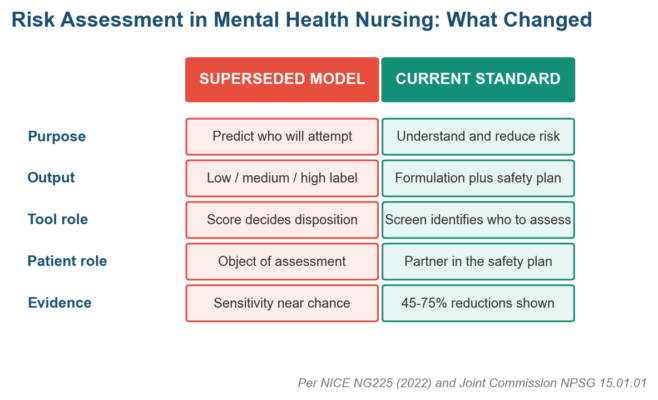
Figure 1. What changed: purpose, output, and the patient’s role all moved from prediction toward collaborative safety planning.
| Element | What it captures | Why it matters clinically |
| Presenting concerns | Current ideation, intent, plan, recent attempts | Establishes acuity and immediate safety needs |
| Formulation | Why risk is elevated for this person now | Directs the intervention; a label cannot |
| Protective factors | Connectedness, reasons for living, engagement | Anchors the safety plan in what already helps |
| Means access | Firearms, medication stockpiles, other means | Means safety is among the few proven levers |
| Safety plan | Warning signs, coping steps, contacts, crisis lines | The artifact the patient actually leaves with |
Why Prediction and Stratification Were Abandoned
The failure is statistical, not attitudinal. Franklin and colleagues reviewed 365 studies spanning 50 years in Psychological Bulletin (2017) and found that prediction of suicidal thoughts and behaviors was only slightly better than chance across every category of risk factor examined.
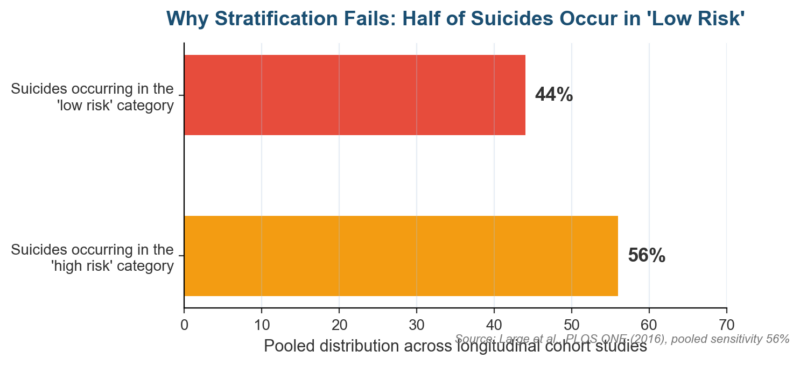
Figure 2. Pooled across cohort studies, categorization captured 56 percent of suicides, leaving nearly half in the low-risk group.
Base rates explain the arithmetic. Suicide is devastating and, statistically, rare; Large’s pooled data put suicide at 5.5 percent among high-risk patients against 0.9 percent among lower-risk patients over roughly 63 months, so the low-risk group, being far larger, still produced about half the deaths.
The clinical consequence is what makes this a safety issue rather than an academic one. A low-risk label can withdraw follow-up from someone who needs it, while a high-risk label can trigger restrictive care that damages engagement, and neither decision rests on a defensible probability.
The Tools Nurses Still Use, and What They Are For
Rejecting prediction did not retire the instruments; it re-scoped them precisely. Screening tools identify who needs a fuller clinical conversation, which is a triage function with genuine evidence behind it, and that is a different job entirely from the stratification purpose they were so often misused for.
The Joint Commission’s NPSG 15.01.01, effective July 2019, requires accredited organizations to screen all patients being evaluated or treated for behavioral health conditions using a validated tool, then complete an evidence-based assessment for everyone who screens positive. Note what the standard does not ask for: a risk tier.
| Instrument | Appropriate use | What it does not do |
| C-SSRS (Columbia) | Structured screening and severity tracking of ideation and behavior | Does not predict who will attempt or die |
| ASQ (NIMH) | Four-item screen in EDs, inpatient, and primary care | Not a full assessment; positive screens need one |
| PHQ-9 item 9 | Flags passive ideation during depression screening | Insufficient alone; requires follow-up questioning |
| Risk formulation | Synthesizes drivers, warning signs, means, supports | Not scored, not comparable across patients |
| Safety plan | Collaborative plan the patient owns and uses | Not a contract; ‘no-harm contracts’ lack evidence |
Two practical notes from the ward. The Columbia protocol and the NIMH ASQ toolkit are both free and validated, so cost is never the barrier; and a positive screen obligates a conversation, not a category, which is precisely where the qualitative assessment tradition earns its place in clinical work.
From Risk Assessment in Mental Health Nursing to Intervention
Here is the encouraging half of the evidence, and it rarely gets equal billing. While prediction stalled at chance, intervention research produced effects large enough to change practice outright, which is why the profession has moved its energy from sorting patients into tiers toward actively helping the person in front of it.
The Stanley-Brown Safety Planning Intervention is the clearest example. Across 1,640 adults presenting to emergency departments with suicide-related concerns, the intervention plus structured follow-up calls was associated with 45 percent fewer suicidal behaviors over six months and roughly double the odds of attending outpatient care.
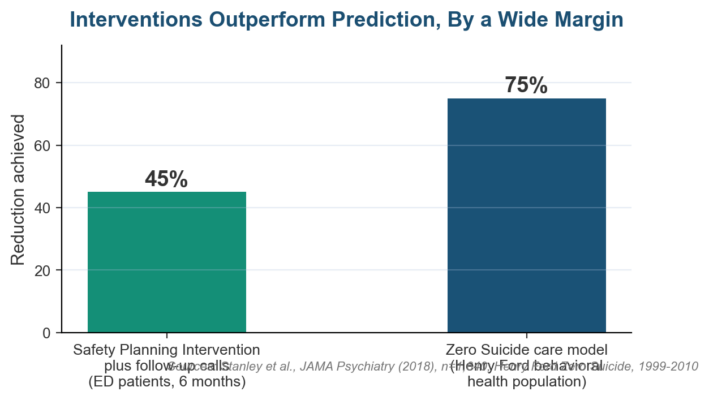
Figure 3. Intervention outperforms prediction: safety planning cut suicidal behavior 45%, and system-level care models went further.
System redesign compounds the effect. Henry Ford Health’s Zero Suicide model reduced suicide in its behavioral health population by roughly 75 percent within four years of implementation, falling from 96 per 100,000 to 24, and the Zero Suicide framework built on that work now guides health systems nationally.
Six components carry most of that benefit, and every one of them is a nursing action rather than an assessment output. None requires a new instrument, a risk score, or a category; each requires time with the patient and a system that protects that time:
- A collaborative safety plan written in the patient’s words, not clinician shorthand, before discharge
- Lethal means counseling, including firearm storage conversations with the patient and family
- Caring contacts: brief follow-up calls, texts, or letters in the days and weeks after discharge
- A warm handoff to outpatient care with the first appointment booked, not merely recommended
- Treatment that targets suicidality directly, such as CBT for suicide prevention or DBT, rather than the underlying diagnosis alone
- Re-assessment at transitions, since discharge and the first week after are the highest-acuity windows
Documenting the Assessment So It Holds Up
Documentation is where the old model does its quietest damage, long after the conversation ends. A note recording only “low risk” preserves nothing defensible: it asserts a conclusion the literature cannot support, and it strands the next clinician without any of the reasoning that produced it.
Record the reasoning instead. NICE’s NG225 recommendations direct clinicians toward a risk formulation within every psychosocial assessment. A formulation written in plain clinical language transfers usefully across shifts and settings, and it survives scrutiny in serious incident review far better than a tier ever will.
| Document this | Rather than this | Why |
| Formulation of current drivers | A low, medium, or high label | Labels have near-chance validity; reasoning transfers |
| Safety plan content and who holds it | Safety plan completed (checkbox) | Shows the patient has usable steps, not a form |
| Means-safety discussion and outcome | Denies access to means | Storage decisions are the actionable detail |
| Follow-up booked, with date and service | Referred to outpatient | Booked appointments predict attendance |
| Patient’s own words on reasons for living | Protective factors present | Anchors the plan and the next conversation |
Audit the notes the way any control gets tested. Sampling a month of assessments against those five rows tells a nurse manager more about the unit’s safety practice than any dashboard, and it fits neatly beside the healthcare key risk indicators most quality teams already track.
Where This Sits in Organizational Risk Management
Clinical risk assessment and enterprise risk management share vocabulary and almost nothing else, which trips up quality teams translating between them. A standard risk assessment scores likelihood and consequence across an organization’s exposures; a clinical assessment builds one person’s formulation and plan.
The organizational layer still matters enormously. Screening compliance, safety-plan completion, follow-up contact rates, and 7-day post-discharge attendance are all legitimate key risk indicators, and the Joint Commission’s own research documents how unevenly those recommended practices are implemented after discharge.
| Program indicator | Amber / red thresholds | What a breach signals |
| Validated screening completion | <95% / <90% of eligible patients | Standard compliance gap; audit workflow, not staff |
| Safety plan completed before discharge | <90% / <80% of positive screens | Discharge process is outrunning the intervention |
| Caring contact within 72 hours | <80% / <65% of discharges | The highest-acuity window is going uncovered |
| Outpatient appointment within 7 days | <70% / <55% attended | Handoff is a referral rather than a booking |
Keep the two registers distinct but connected. Individual formulations stay in the clinical record under HIPAA safeguards; aggregate performance flows to the quality committee, where the risk management policy defines escalation thresholds and the board’s line of sight into patient-safety risk.
Risk Assessment in Mental Health Nursing: Your Questions Answered
What is the definition of risk assessment in mental health nursing?
It is the structured clinical process of gathering history, current symptoms, means access, and protective factors through collaborative conversation, then synthesizing them into a formulation and a safety plan. Its purpose is understanding and reducing risk of harm, not predicting future suicide or assigning a risk category.
Why should nurses avoid low, medium, and high risk categories?
Because the categories do not perform. Pooled cohort data show roughly half of suicides occur among patients rated low risk, and NICE NG225 (2022) directs clinicians not to use global stratification to predict suicide or decide who is treated or discharged. Formulation replaces the label.
Which suicide risk assessment tools do mental health nurses use?
The Columbia Suicide Severity Rating Scale (C-SSRS) and the NIMH Ask Suicide-Screening Questions (ASQ) are the most widely used validated instruments in U.S. settings, both free. They identify who needs a fuller clinical assessment; neither predicts who will attempt, and Joint Commission standards treat them as screening rather than prediction.
How often should risk assessment in mental health nursing be repeated?
Reassess at every meaningful transition rather than on a fixed calendar: admission, change in presentation, before leave or pass, at discharge, and during the first week afterward, which is a peak-acuity window. Continuous clinical observation supplements, never replaces, these structured reassessments.
What is a risk formulation and how does it differ from a risk score?
A formulation is a short clinical narrative explaining why risk is elevated for this person now: the drivers, warning signs, means access, and supports. A score compresses that into a number or label that cannot be acted on. Formulations tell the next clinician what to do; scores tell them only what someone concluded.
Do no-suicide contracts reduce risk?
No. No-harm or no-suicide contracts have no evidence of reducing suicide and may create false reassurance for staff. Current practice replaces them with the collaborative safety plan, which the patient co-writes and keeps, and which has demonstrated effect when paired with structured follow-up contact.
What role does lethal means counseling play in nursing risk assessment?
It is among the few interventions with a plausible direct effect on outcome, because most suicidal crises are time-limited and method substitution is incomplete. Nurses discuss securing or removing firearms and medication stockpiles with the patient and, where appropriate, family, then document the storage decision reached.
Where Assessment Practice Still Goes Wrong
Seven patterns recur across serious incident reviews, and not one of them is a knowledge gap about which tool to use. Each reflects a system that quietly rewarded documentation over conversation, which is exactly the drift that current guidance was written to correct.
| Pitfall | Root cause | Correction |
| Screening treated as the assessment | Positive screen filed without follow-up conversation | Policy requires an assessment within a defined window of any positive screen |
| Risk label drives disposition | Category inherited from legacy protocol | Disposition follows formulation, needs, and safety plan |
| Safety plan written by the clinician | Time pressure; form completed for compliance | Patient’s own words and phone-stored copy; audit for both |
| Means access asked once, generically | Discomfort with firearm conversations | Scripted means-safety training; document the storage decision |
| No contact after discharge | Handoff considered complete at the door | Caring contacts scheduled before discharge, not after |
| Reassessment on a fixed calendar only | Assessment treated as paperwork cadence | Trigger-based reassessment at every transition point |
| Aggregate data never reviewed | Clinical and quality functions run separately | Screening and follow-up rates on the quality dashboard |
Where the Profession Is Heading
The prediction question is being reopened by machine learning, and the early results deserve measured attention rather than enthusiasm. Models trained on health-record data outperform clinician judgment in some published cohorts, yet the base-rate problem that defeated categorical stratification has not disappeared, and false positives carry real clinical cost.
Infrastructure is the more consequential change. The 988 Suicide & Crisis Lifeline has handled more than 25 million contacts since its July 2022 launch, which gives every discharge plan a nationally recognized number to build around, and gives nurses a concrete step to write into the plan rather than a vague instruction to seek help.
The clinical direction is set and unlikely to reverse. CDC provisional data recorded 48,824 U.S. suicide deaths in 2024 against 49,316 in 2023, a modest improvement that nobody attributes to better prediction; it tracks the spread of screening, safety planning, and follow-up that NIMH’s prevention research has prioritized for a decade.
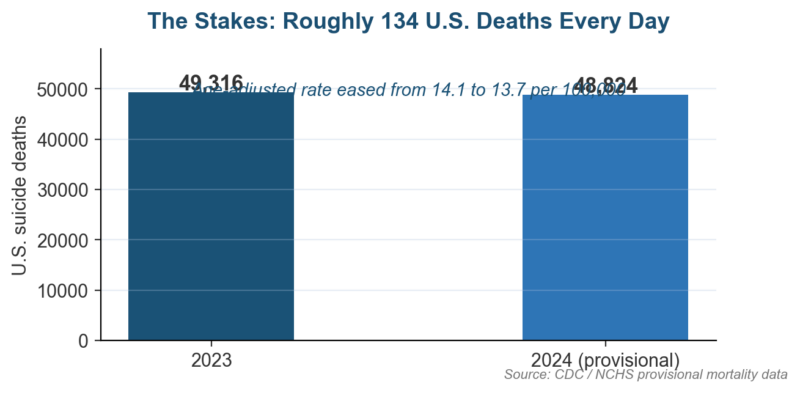
Figure 4. The stakes behind the method: roughly 134 U.S. deaths a day, with the rate easing slightly in 2024.
Riskpublishing works with healthcare quality and risk teams translating clinical safety practice into board-level assurance, from KRI design to committee reporting. Our services cover healthcare risk frameworks and indicator sets; contact us if your safety data stops at the unit door.

Chris Ekai is a Risk Management expert with over 10 years of experience in the field. He has a Master’s(MSc) degree in Risk Management from University of Portsmouth and is a CPA and Finance professional. He currently works as a Content Manager at Risk Publishing, writing about Enterprise Risk Management, Business Continuity Management and Project Management.