
To Calculate Risk Scores for Project Risk Analysis is a discipline many teams skip until a crisis forces the lesson. A mid-sized construction firm in Nairobi lost KES 47 million on a commercial building project in 2024.
The post-mortem revealed something painfully simple: the project team had identified 38 risks at the planning stage but never scored or prioritized them.
Every risk sat on a flat register with equal weight, so when a steel-supply disruption collided with a permitting delay during the same quarter, the team had no early warning and no triage protocol. The project overran by 14 months.
The lesson was not that risks were unknown — they were unsorted. Risk identification without scoring is like a fire alarm that rings at the same volume for burnt toast and a structural blaze.
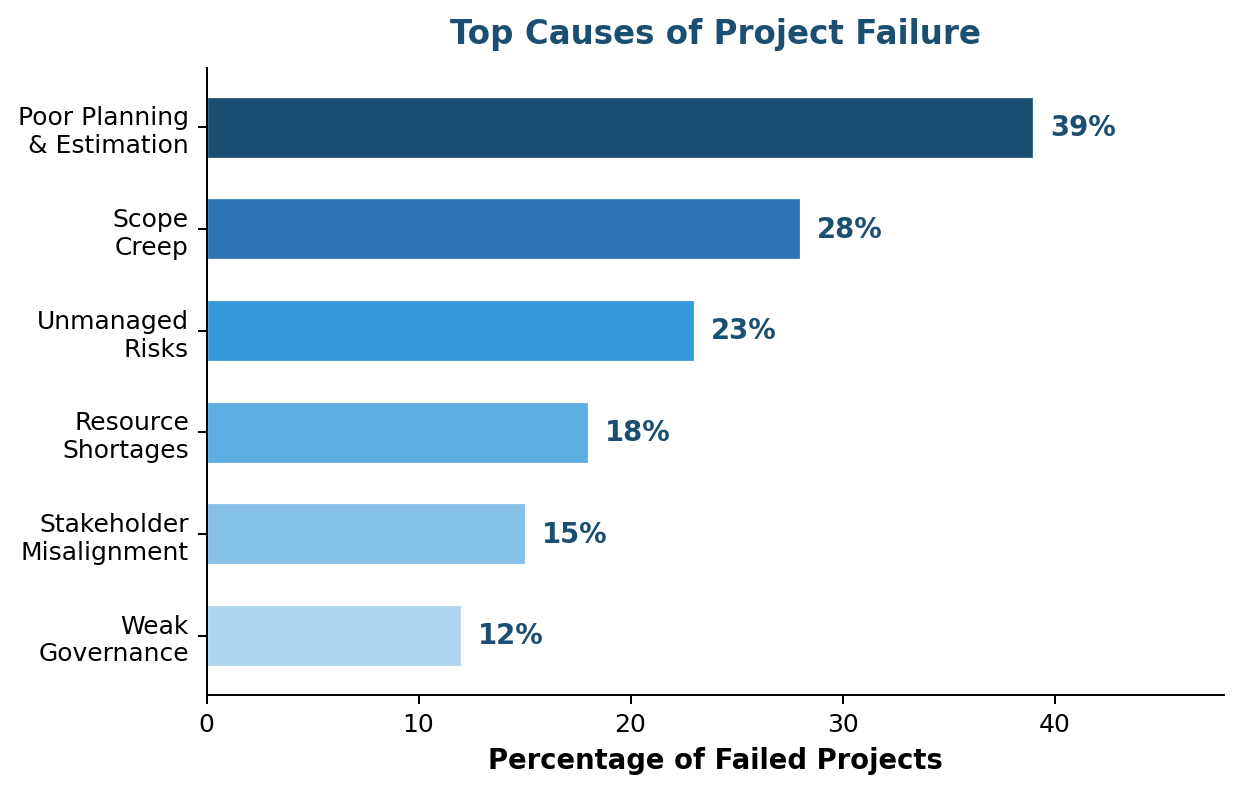
The data confirms this pattern at scale. According to the PMI Pulse of the Profession 2025 report, 70% of projects exceed their original budgets due to unmanaged risks, and poor planning accounts for 39% of project failures globally.
Organizations that implement structured risk assessment processes with defined scoring methodologies complete 85% more projects successfully than those without.
The gap between success and failure often comes down to a single discipline: turning qualitative risk language into numbers that teams can act on.
This guide walks through every method for calculating risk scores in project risk analysis — from the foundational probability-times-impact matrix to weighted scoring, Monte Carlo simulation, and board-level normalization.
Each section includes worked examples, tables you can adapt, and alignment to ISO 31000 and COSO ERM frameworks. By the end, you will have a repeatable process for scoring, ranking, and reporting project risks that drives real decision-making.
The Universal Risk Scoring Formula
At its core, every risk scoring method rests on a single equation: Risk Score = Probability × Impact. Probability represents the likelihood that a risk event will materialize during the project lifecycle. Impact captures the severity of consequences if it does — measured against schedule, cost, scope, quality, or safety objectives.
The product gives a single number that ranks one risk against another, enabling the project team to allocate finite mitigation resources where they matter most. This approach is endorsed by both ISO 31000:2018 (Clause 6.4.3) and the PMI PMBOK Guide, which positions the probability-impact matrix as a standard output of qualitative risk analysis.
The simplicity of this formula is both its strength and its trap. A 3 × 4 and a 4 × 3 both yield 12, but they demand different responses: the first is a moderate-probability, high-impact event (insure or mitigate aggressively), while the second is a high-probability, moderate-impact event (reduce frequency through controls).
Practitioners who rely solely on the aggregate score without examining the underlying dimensions miss this distinction. The sections below build on the core formula with calibration, weighting, and quantitative extensions that address this limitation.
Defining the Probability Scale
Before scoring a single risk, the project team must agree on what each probability level means. Risk assessment policy documents should formalize these definitions so they remain consistent across projects and portfolios. Consistent probability definitions make it possible to Calculate Risk Scores for Project Risk Analysis that are comparable across portfolios and review cycles.
The table below shows a standard 5-level scale aligned to ISO 31000 guidance.
| Rating | Label | Description | Indicative Range |
| 1 | Rare | Exceptional circumstances only; no history of occurrence | < 5% probability |
| 2 | Unlikely | Could occur but not expected; limited precedent | 5–20% |
| 3 | Possible | Might occur at some point during the project | 20–50% |
| 4 | Likely | Will probably occur in most circumstances | 50–80% |
| 5 | Almost Certain | Expected to occur unless specific controls are in place | > 80% |
Defining the Impact Scale
Impact scales should cover every project objective that matters. The COSO ERM framework recommends evaluating impact across multiple dimensions — not just cost.
A risk that has negligible financial impact but catastrophic reputational consequences scores differently when both dimensions are captured. The table below provides a multi-dimensional impact scale.
| Rating | Label | Schedule Impact | Cost Impact | Quality / Scope | Safety / Reputation |
| 1 | Negligible | < 1 week delay | < 1% budget | Minimal deviation | No stakeholder concern |
| 2 | Minor | 1–2 week delay | 1–3% budget | Minor rework needed | Internal escalation only |
| 3 | Moderate | 2–4 week delay | 3–7% budget | Deliverable revision | Client complaint or media mention |
| 4 | Major | 1–3 month delay | 7–15% budget | Significant redesign | Regulatory inquiry or public criticism |
| 5 | Catastrophic | > 3 month delay | > 15% budget | Project scope failure | Legal action or safety incident |
Building and Using the 5×5 Risk Matrix
The risk assessment matrix is the visual workhorse of qualitative scoring. Plotting probability on the Y-axis and impact on the X-axis creates a 25-cell grid where each cell contains a risk score from 1 (Rare × Negligible) to 25 (Almost Certain × Catastrophic).
Color-coding the grid into green, amber, orange, and red zones turns raw numbers into an instant visual that project sponsors and steering committees can interpret in seconds. Teams that use this matrix to Calculate Risk Scores for Project Risk Analysis can explain their priorities to sponsors in a single glance.

RAG Threshold Bands
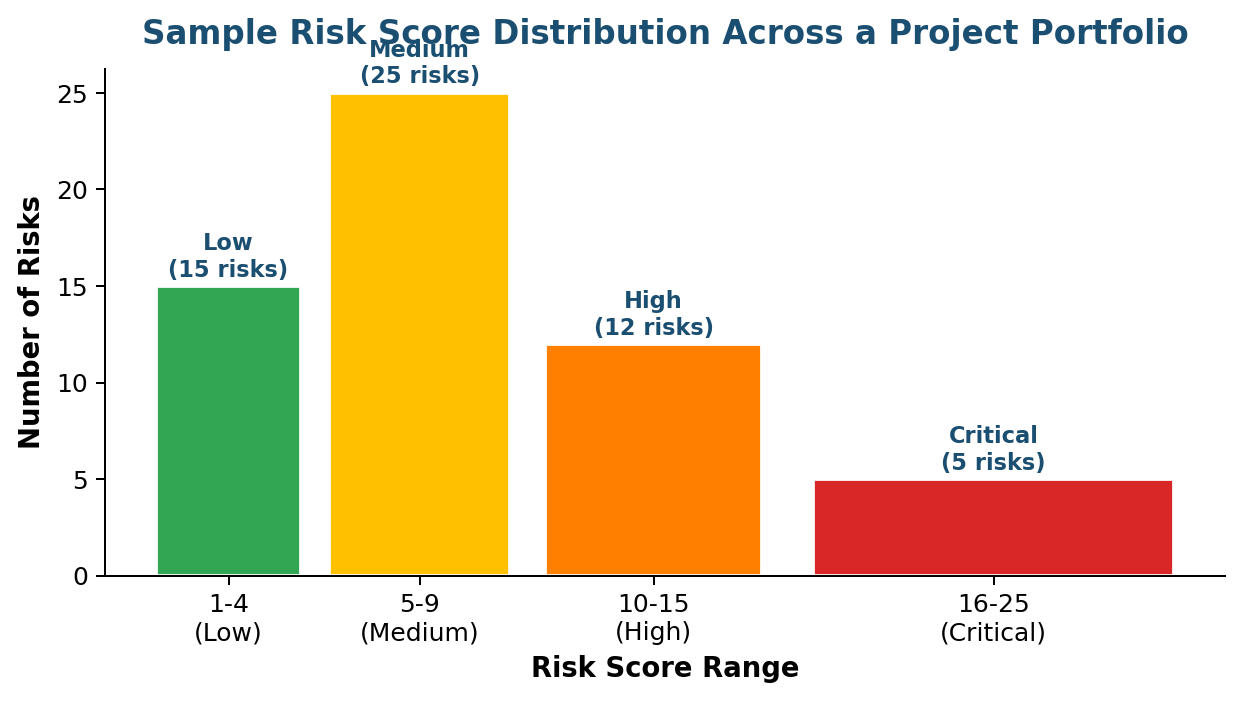
The color bands should map directly to the organization’s risk appetite statement. Risks in the red zone (scores 16–25) typically require immediate escalation and a funded response plan. Orange risks (10–15) need active monitoring with defined triggers.
Amber risks (5–9) are tracked and reviewed at regular intervals. Green risks (1–4) are accepted or monitored passively.
| Score Range | RAG Zone | Response Requirement | Escalation Level |
| 16–25 | Red — Critical | Immediate funded mitigation plan; senior sponsor ownership | Board / Steering Committee |
| 10–15 | Orange — High | Active controls with defined trigger thresholds; monthly review | Project Director / PMO |
| 5–9 | Amber — Medium | Periodic monitoring; contingency reserves earmarked | Project Manager |
| 1–4 | Green — Low | Accept or monitor passively; no dedicated budget required | Team Lead / Risk Owner |
Worked Example: Scoring Risks on a Construction Project
Consider a KES 500 million commercial building project with a 24-month schedule. The project team has identified 12 risks during the risk assessment workshop.
The table below shows how five of those risks are scored using the scales defined above, producing inherent risk scores that drive prioritization.
| ID | Risk Event | P | I (Cost) | I (Schedule) | Max I | Score (P×I) | RAG |
| R-01 | Steel price escalation exceeds contingency by > 15% | 4 | 4 | 3 | 4 | 16 | Red |
| R-02 | Key subcontractor insolvency during structural phase | 2 | 5 | 5 | 5 | 10 | Orange |
| R-03 | County permitting delays beyond 8 weeks | 3 | 2 | 4 | 4 | 12 | Orange |
| R-04 | Ground conditions require additional piling | 3 | 3 | 2 | 3 | 9 | Amber |
| R-05 | Skilled labor shortage during peak season | 4 | 2 | 2 | 2 | 8 | Amber |
R-01 scores 16 (red zone) and goes straight to the steering committee for a hedging or contract escalation strategy. R-02 and R-03 land in the orange zone and are assigned to the project director with monthly review checkpoints.
R-04 and R-05 are amber and managed by the project manager with quarterly reviews. This structured triage — driven by the scores — is what separates a living risk register from a checkbox exercise.
Weighted Risk Scoring: Beyond Probability × Impact
The basic formula treats all risks as if probability and impact are the only dimensions that matter. In practice, two additional factors change the picture significantly: detectability (how easily the risk can be spotted before it materializes) and velocity (how quickly the impact hits once the risk event occurs).
The FMEA tradition from manufacturing captures this with a Risk Priority Number: RPN = Severity × Occurrence × Detection. Project risk practitioners can adapt this approach by adding a detection multiplier to the standard score.
The Extended Scoring Formula
Weighted Risk Score = Probability × Impact × Detectability Factor × Velocity Factor
| Detectability Rating | Description | Velocity Rating | Description |
| 1.0 | Easily detected with existing controls and KRIs | 1.0 | Slow onset — weeks to months of warning |
| 1.3 | Detectable with focused monitoring effort | 1.3 | Moderate onset — days to weeks |
| 1.5 | Difficult to detect; latent until impact is felt | 1.5 | Rapid onset — hours to days |
| 2.0 | Virtually undetectable until after the event | 2.0 | Instantaneous — no lead time |
Using R-01 from our worked example: P=4, I=4, Detectability=1.0 (steel prices are publicly tracked), Velocity=1.3 (price spikes build over weeks). Weighted score = 4 × 4 × 1.0 × 1.3 = 20.8.
Compare with R-02: P=2, I=5, Detectability=1.5 (subcontractor insolvency is hard to spot), Velocity=2.0 (impact is immediate). Weighted score = 2 × 5 × 1.5 × 2.0 = 30.0. The weighted model reverses the priority order — R-02 now scores higher than R-01, reflecting its hidden, fast-moving nature.
This is a more honest representation of which risk deserves the first dollar of mitigation budget. Linking these weighted scores to key risk indicators ensures that detection gaps are systematically closed.
Quantitative Risk Scoring with Monte Carlo Simulation
Qualitative matrices give you a rank order. Quantitative methods give you a probability distribution. Monte Carlo simulation runs thousands of iterations of the project schedule or cost model, each time sampling from probability distributions assigned to risk events.
The output is not a single number but a cumulative probability curve showing the likelihood of hitting any given cost or completion date. This is the gold standard for large, complex, or high-stakes projects — and it is explicitly recommended by PMI for quantitative risk analysis.
The key inputs for a Monte Carlo model include three-point estimates (optimistic, most likely, pessimistic) for each risk-affected task, correlation coefficients between related risks, and the probability that each risk event occurs at all.
The simulation produces a histogram of possible outcomes plus key statistics: P50 (median), P80 (common contingency basis), P95 (management reserve basis), mean, and standard deviation. The distance between P50 and P80 quantifies the risk premium the project should budget for. Quantitative models give finance teams the statistical confidence they need to Calculate Risk Scores for Project Risk Analysis at the portfolio level.
When to Use Qualitative vs. Quantitative Scoring
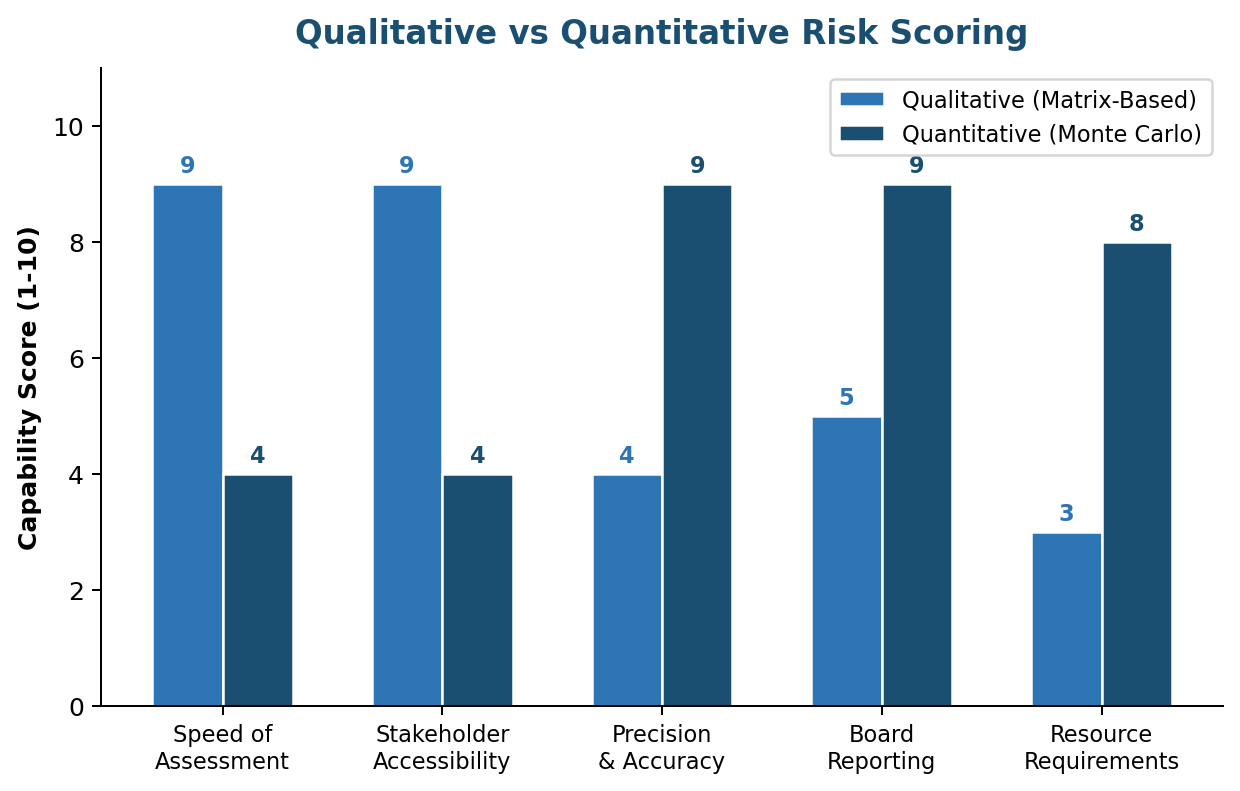
| Factor | Qualitative (Matrix) | Quantitative (Monte Carlo) |
| Best for | Early-stage risk triage, small-to-medium projects, workshops | Large capital projects, regulatory submissions, investment decisions |
| Data requirements | Expert judgment, historical categories | Three-point estimates, probability distributions, correlation data |
| Output | Risk scores (1–25), ranked register, heatmap | Probability curves, confidence intervals, contingency calculations |
| Speed | Hours (workshop-based) | Days to weeks (model build + validation) |
| Standards alignment | ISO 31000 Clause 6.4.3, PMBOK Ch. 11 | ISO 31000 Clause 6.4.4, PMBOK Ch. 11, AACE RP-41R |
| Tools | Spreadsheet, risk register template | Crystal Ball, @RISK, Primavera Risk Analysis, Python/R |
From Inherent Scores to Residual Risk
Scoring risks does not end with the inherent assessment. Every risk that receives a risk treatment response — avoid, mitigate, transfer, or accept — should be re-scored to reflect the expected effect of controls.
The gap between the inherent score and the residual score tells the board whether risk mitigation spending is delivering value.
If a KES 5 million mitigation reduces a risk from 20 to 8, the investment is visible. If it only moves the score from 20 to 18, the control is ineffective and resources should be redirected.
Control Effectiveness Rating
| Rating | Control Description | Effect on Probability | Effect on Impact |
| Strong (0.3) | Automated, tested, independently validated | Reduces by 2 levels | Reduces by 1–2 levels |
| Adequate (0.5) | Defined process, periodic testing, some manual steps | Reduces by 1 level | Reduces by 1 level |
| Weak (0.8) | Informal or untested; relies on individual judgment | Reduces by 0–1 level | Marginal reduction |
| None (1.0) | No control in place | No effect | No effect |
Residual Risk Score = Inherent Score × Control Effectiveness Rating. Returning to R-01: inherent score = 16, the team implements a fixed-price steel supply contract (strong control, 0.3).
Residual score = 16 × 0.3 = 4.8, which drops the risk from red to green. This calculation should be recorded in every project risk register alongside the control description and the responsible owner.
Normalizing Risk Scores Across a Project Portfolio
When an organization runs multiple projects simultaneously, raw risk scores from different teams using slightly different scales are not directly comparable.
Normalization converts all scores to a common 0–100 index so the PMO and risk management integration function can rank risks across the portfolio. The formula is straightforward:
Normalized Score = (Raw Score / Maximum Possible Score) × 100
A 5×5 matrix has a maximum score of 25. A risk scoring 16 normalizes to (16/25) × 100 = 64. A 3×3 matrix from a smaller project has a maximum of 9; a risk scoring 6 normalizes to (6/9) × 100 = 67.
Now both risks can be compared on the same dashboard and fed into risk quantification for board reporting. This is critical for organizations managing project portfolios where capital allocation decisions depend on a like-for-like risk comparison.
| Project | Matrix Size | Risk | Raw Score | Max Score | Normalized (0–100) |
| Alpha | 5×5 | Supply delay | 16 | 25 | 64 |
| Beta | 3×3 | Scope creep | 6 | 9 | 67 |
| Gamma | 5×5 | Permit delay | 12 | 25 | 48 |
| Delta | 4×4 | Tech failure | 12 | 16 | 75 |
Implementation Roadmap
Adopting a structured risk scoring methodology does not require a multi-year program. The roadmap below outlines a phased approach that moves from foundation-setting through calibration to full operational use. Align each phase with your risk management lifecycle and ERM framework maturity goals.
| Phase | Actions | Deliverables | Success Metrics |
| Days 1–30: Foundation | Define probability and impact scales; agree RAG thresholds; select scoring model (basic, weighted, or quantitative); train project managers on the methodology | Approved risk scoring policy; calibrated 5×5 matrix template; 2-hour training deck delivered | 100% of active PMs trained; scoring policy signed off by PMO head |
| Days 31–60: Pilot | Apply scoring to 2–3 pilot projects; run risk workshops using the new scales; test weighted scoring on one high-value project; build portfolio normalization dashboard | Scored risk registers for pilot projects; portfolio risk dashboard draft; lessons-learned log | All pilot risks scored within 5 business days of identification; dashboard shows normalized scores across pilots |
| Days 61–90: Scale | Roll out scoring methodology to all active projects; integrate scoring into monthly PMO reporting; run first Monte Carlo simulation on largest project; conduct QA review of scoring consistency | Enterprise risk scoring standard; Monte Carlo model for flagship project; QA audit report with calibration adjustments | < 10% variance in scoring between independent assessors; board risk report includes portfolio-normalized heatmap |
Common Pitfalls and How to Avoid Them
| Pitfall | Root Cause | Remedy |
| Scoring inflation (everything is red) | No agreed scales; assessors default to worst-case | Lock probability and impact definitions before the first workshop; use calibration exercises with historical data |
| Anchoring on the first score | Cognitive bias; facilitator accepts the first number offered | Use blind scoring (each expert submits independently) then discuss outliers |
| Ignoring velocity and detectability | Using basic P×I formula only | Adopt weighted scoring (P × I × D × V) for critical and high-value projects |
| Static scoring (score once, never revisit) | No review cadence defined | Embed risk re-scoring in monthly project reviews and milestone gates |
| Portfolio incomparability | Different teams use different scales | Normalize all scores to a 0–100 index before aggregating for PMO reporting |
| Confusing inherent and residual scores | Assessors score after mentally accounting for controls | Train teams to score inherent risk first (no controls assumed), then apply control effectiveness multiplier separately |
| Over-reliance on matrices for complex risks | Qualitative scoring used where quantitative analysis is warranted | Define a threshold (e.g., projects > USD 10M or > 18-month duration) that triggers mandatory Monte Carlo analysis |
Project Risk Analysis FAQs: Expert Answers to Critical Questions
These are the questions US project managers, risk officers, and PMO leads ask most often when they calculate risk scores for project risk analysis.
Short, direct answers anchored to published standards — no vendor positioning, no generic definitions, and no padding to hit a word count. Practitioners and auditors reward specificity over scope creep.
What is a risk score in project risk analysis?
A risk score in project risk analysis is a numerical value Learning to Calculate Risk Scores for Project Risk Analysis transforms a flat risk register into a prioritized action plan that senior leaders can defend and fund. When teams Calculate Risk Scores for Project Risk Analysis consistently, early warning signals surface before issues escalate, resources shift to the highest-impact threats, and governance reviews become evidence-based rather than opinion-driven. A risk score is derivedfrom multiplying probability by impact — typically on a 1–5 scale each — producing a figure between 1 and 25 that enables prioritization across a project register.
The method aligns with ISO 31000 risk management guidelines and the PMI Practice Standard for Project Risk Management, both of which anchor modern US project risk practice.
How do you calculate risk scores for project risk analysis using a 5×5 matrix?
Score probability 1–5 and impact 1–5, then multiply for inherent risk. Apply control effectiveness on the same 1–5 scale and subtract (residual = inherent − effectiveness × 5). This is the simplest, most defensible way to Calculate Risk Scores for Project Risk Analysis on US construction and software projects.
The NIST SP 800-30 risk assessment guide formalises the method for cyber risks, and the approach transfers directly to project risks. Our complete guide to the risk assessment process walks through a worked example.
What’s the difference between inherent and residual risk scores in project risk analysis?
Inherent risk is the score before controls — what the raw exposure looks like if nothing is done. Residual risk is what remains after your project controls are applied.
Boards and US auditors care about both, but they care most about the gap between them. The gap is what your controls are actually buying you. Our risk register template and guide shows how to track both.
How does Monte Carlo simulation improve project risk analysis scores?
Monte Carlo simulation runs thousands of trials against a project’s cost, schedule, or quality variables, producing a probability distribution rather than a single number. Monte Carlo results help teams Calculate Risk Scores for Project Risk Analysis that reflect real-world variability instead of single-point estimates.
The GAO Cost Estimating and Assessment Guide treats it as a standard federal project-management practice. It converts deterministic risk scores into confidence intervals — a P80 cost estimate, a P50 schedule date — that US boards and federal program offices now expect for capital projects above roughly $10 million.
How do you normalize risk scores across a project portfolio?
Portfolio-level normalization starts with a shared scoring scale, a shared impact taxonomy (financial, schedule, safety, reputational), and a weighting scheme that reflects organizational risk appetite.
Without normalization, a Critical risk in one project cannot be compared to a Critical risk in another. The COSO Enterprise Risk Management framework and our risk assessment templates library both publish consistent structures you can adopt as the portfolio standard.
What frameworks anchor project risk analysis scoring in 2026?
Four frameworks anchor US project risk practice. ISO 31000:2018 defines the discipline. PMI’s PMBOK Guide provides the project-specific mechanics.
The COSO ERM framework sits above at the enterprise layer. The IIA Three Lines Model handles governance. One strategic, one tactical project, one enterprise, one governance — that is the working 2026 US stack.
How often should project risk analysis scores be updated?
Update the scores at every stage gate and at any material project change — scope shift, schedule slip, budget revision, leadership turnover, major vendor issue. Do not wait for the quarterly steering committee.
Our risk assessment policy guide sets the governance cadence that keeps project risk analysis scores current. Monthly light review; weekly when a score exceeds a documented escalation threshold.
What are the most common mistakes in calculating risk scores for project risk analysis?
Four recurring mistakes: using qualitative labels without numeric anchors; ignoring third-party dependencies (our third-party risk management framework covers the scoring discipline); scoring impact against comfort rather than survival; and skipping residual calculation entirely.
The FAIR Institute and our explainer on what a risk assessment is both cover how to avoid each failure mode during the first scoring cycle.
Looking Ahead: Trends for 2026–2028
Risk scoring is evolving rapidly. Three trends are reshaping how project teams calculate, present, and act on risk scores.
AI-assisted risk scoring. Machine learning models trained on historical project data are starting to suggest probability and impact ratings automatically, reducing facilitator bias and accelerating workshop throughput.
Early adopters report a 40% reduction in risk assessment cycle time. The challenge is governance: AI risk assessment frameworks must be applied to the scoring models themselves to avoid introducing algorithmic bias into risk registers.
Real-time risk dashboards. Static quarterly heatmaps are giving way to live dashboards that pull leading KRI data from project management tools, financial systems, and IoT sensors on construction sites.
When a KRI breaches a threshold, the associated risk score updates automatically and triggers an escalation workflow. This shift moves risk scoring from a periodic exercise to a continuous signal.
Integration with operational resilience. Regulatory expectations around operational resilience are pushing organizations to connect project risk scores to enterprise-level impact tolerance assessments.
A project risk that could breach an impact tolerance for a critical business service now carries additional weight in portfolio prioritization — regardless of its raw score on the project matrix.
This convergence between project risk and business continuity management will accelerate through 2028 as regulators tighten expectations globally.
Ready to implement structured risk scoring on your next project? Visit our services for risk assessment templates, Monte Carlo modeling support, and hands-on ERM consulting. Have questions? Get in touch — we respond within 24 hours.
References
1. ISO 31000:2018 — Risk Management Guidelines
2. COSO Enterprise Risk Management — Integrating with Strategy and Performance (2017)
3. PMI — Risk Analysis and Management in Project Management
4. PMI Pulse of the Profession 2025 Report
5. Intaver Institute — Risk Scores and Project Risk Analysis
6. MetricStream — How to Calculate Risk Scores for Better Risk Management
7. PMI — Assessing Risk Probability and Impact: Alternative Approaches
8. Secureframe — 50+ Risk Management Statistics 2026
9. Mosaicapp — Project Failure Rates and Causes: Statistics Every PM Should Know
10. TechTarget — ISO 31000 vs COSO: Comparing Risk Management Standards
11. Asana — Risk Matrix Template: Free Guide to Score Project Risks
12. NIST Risk Management Framework (SP 800-37)
13. AACE International — Recommended Practice 41R-08: Risk Analysis and Contingency Determination 14. LogicGate — How to Determine Risk Scores: Internal and External Risks

Chris Ekai is a Risk Management expert with over 10 years of experience in the field. He has a Master’s(MSc) degree in Risk Management from University of Portsmouth and is a CPA and Finance professional. He currently works as a Content Manager at Risk Publishing, writing about Enterprise Risk Management, Business Continuity Management and Project Management.