
| Key Takeaways |
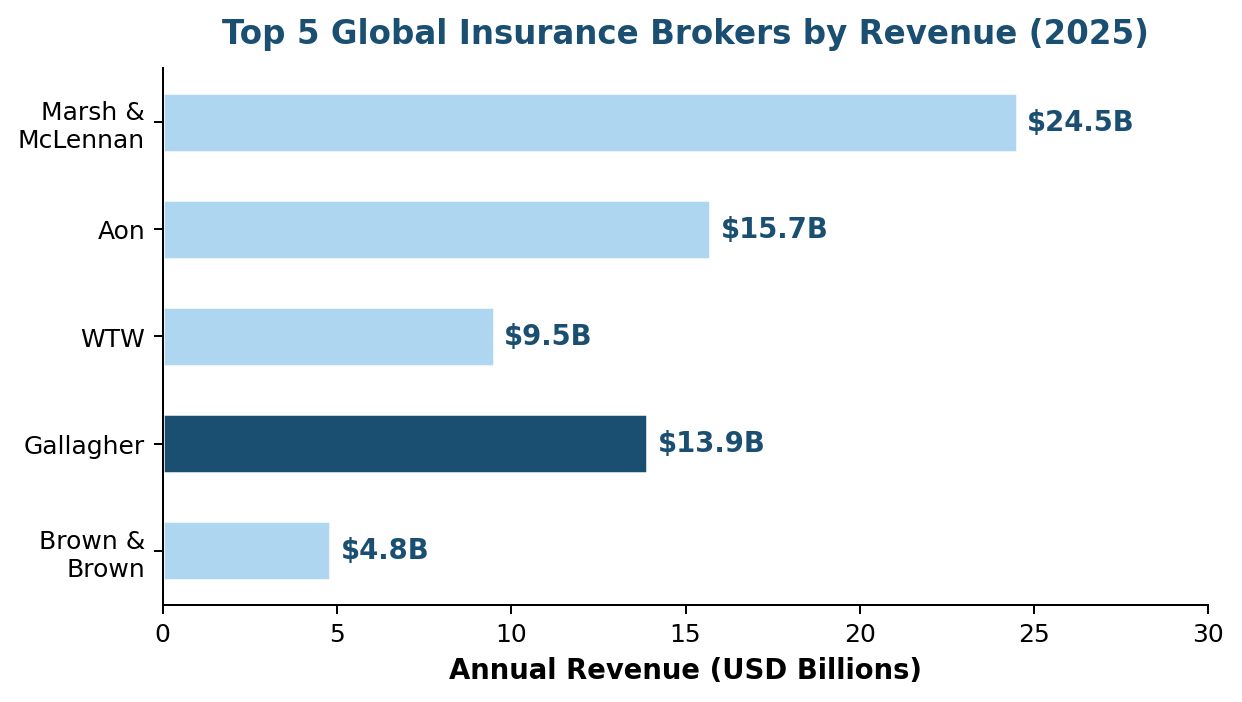
| Gallagher (Arthur J. Gallagher & Co.) is the world’s fourth-largest insurance broker by revenue, generating $13.9 billion in 2025 after closing the landmark $13.45 billion AssuredPartners acquisition. |
| The firm operates through three core segments: insurance brokerage (property/casualty and benefits), risk management services (Gallagher Bassett), and consulting/advisory — serving clients in over 130 countries with 69,000+ employees. |
| Gallagher’s risk management consulting goes beyond policy placement, offering enterprise risk assessments, stop-loss strategy design, pharmacy cost optimization, self-funded plan management, and claims analytics. |
| Risk professionals evaluating brokers should assess Gallagher against ISO 31000 criteria: risk appetite alignment, control integration, and continuous improvement — not just premium pricing. |
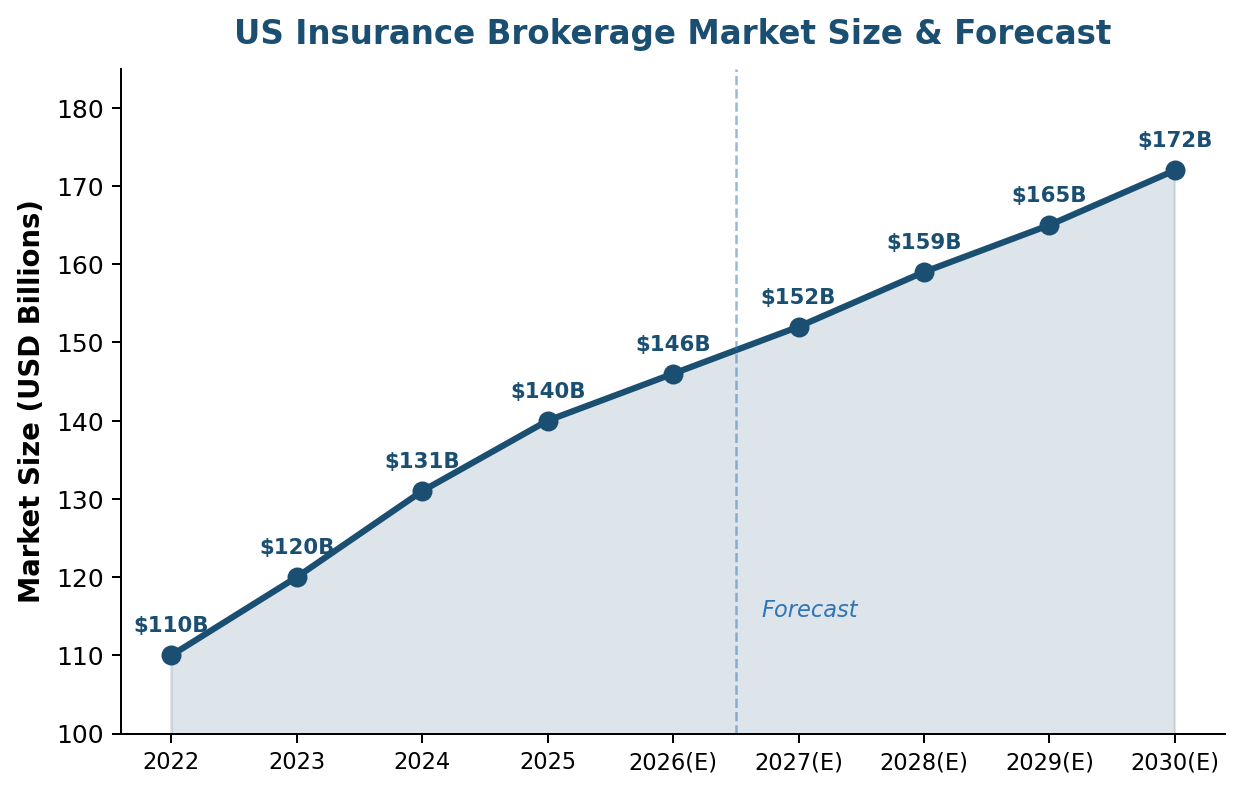
| The US insurance brokerage market is projected to reach $172 billion by 2030, with consolidation, AI-driven analytics, and cyber risk driving demand for integrated risk management consulting partners like Gallagher. |
| Employers using Gallagher’s consultative approach to self-funded benefits report 12–18% reductions in total cost of risk within the first two plan years through stop-loss optimization and pharmacy formulary management. |
Gallagher insurance risk management has become a defining solution for organizations navigating complex employee benefits, brokerage, and risk advisory challenges. When a 4,200-employee logistics company in Dallas discovered that its health plan costs had grown 23% in a single year, the CFO’s first call was not to an actuary or a benefits attorney.
The call went to their Gallagher consultant. Within six weeks, the Gallagher team had restructured the company’s stop-loss coverage, renegotiated PBM contracts, and redesigned the pharmacy formulary tier structure.
The result: a $3.8 million annual cost reduction without cutting employee benefits. That engagement illustrates what separates a brokerage that places policies from a risk management consultancy that reshapes how organizations think about, price, and transfer risk.
Arthur J. Gallagher & Co. — known simply as Gallagher — has grown from a one-man insurance agency founded in Chicago in 1927 into the fourth-largest insurance broker in the world, with $13.9 billion in revenue and more than 69,000 employees across 130+ countries.
The August 2025 closing of the $13.45 billion AssuredPartners acquisition — the largest deal in insurance brokerage history — cemented Gallagher’s position as a consolidation leader reshaping the industry. But the numbers only tell part of the story.
Gallagher’s edge for risk professionals lies in its integrated model: brokerage, risk management services (through Gallagher Bassett), and consulting all sit under one roof, creating a closed loop from risk identification through claims resolution.
This article provides a practitioner’s review of Gallagher’s insurance risk management and consulting capabilities.
The goal is not a sales pitch but an objective assessment of what Gallagher offers, where its model adds value, and how risk professionals and employers can evaluate those services against enterprise risk management frameworks like ISO 31000 and COSO ERM.
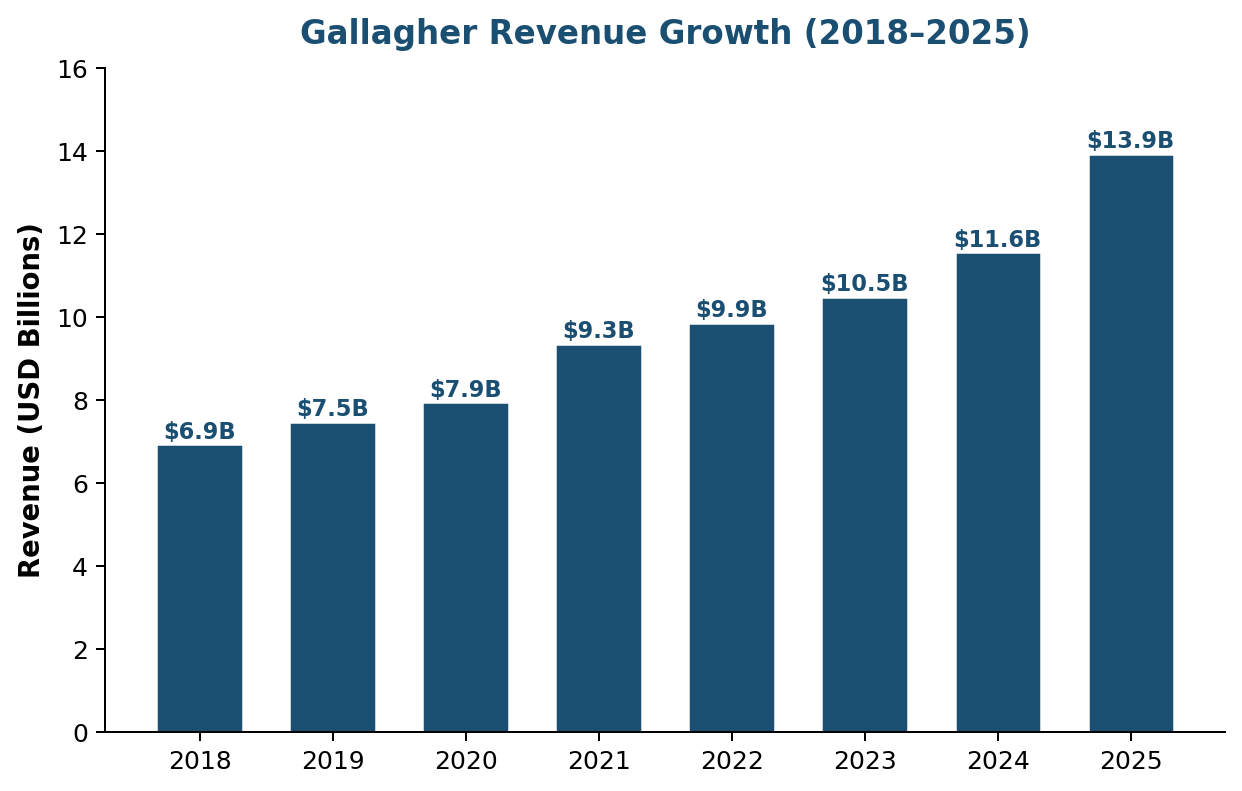
Company Overview: Gallagher Insurance Risk Management at a Glance
Understanding the scale and structure of a potential risk management partner is the first step in any third-party risk assessment.
Gallagher’s operating model is organized into three reportable segments that together create an integrated value chain from risk advisory through claims settlement.
| Metric | Detail | Metric | Detail |
| Founded | 1927, Chicago, IL | Headquarters | Rolling Meadows, IL |
| CEO | J. Patrick Gallagher Jr. | Ticker | NYSE: AJG |
| 2025 Revenue | $13.9 billion | Employees | 69,000+ |
| Countries | 130+ | Acquisitions (2025) | 33 completed |
| Segments | Brokerage, Risk Mgmt, Corporate | Largest Deal | $13.45B (AssuredPartners, Aug 2025) |
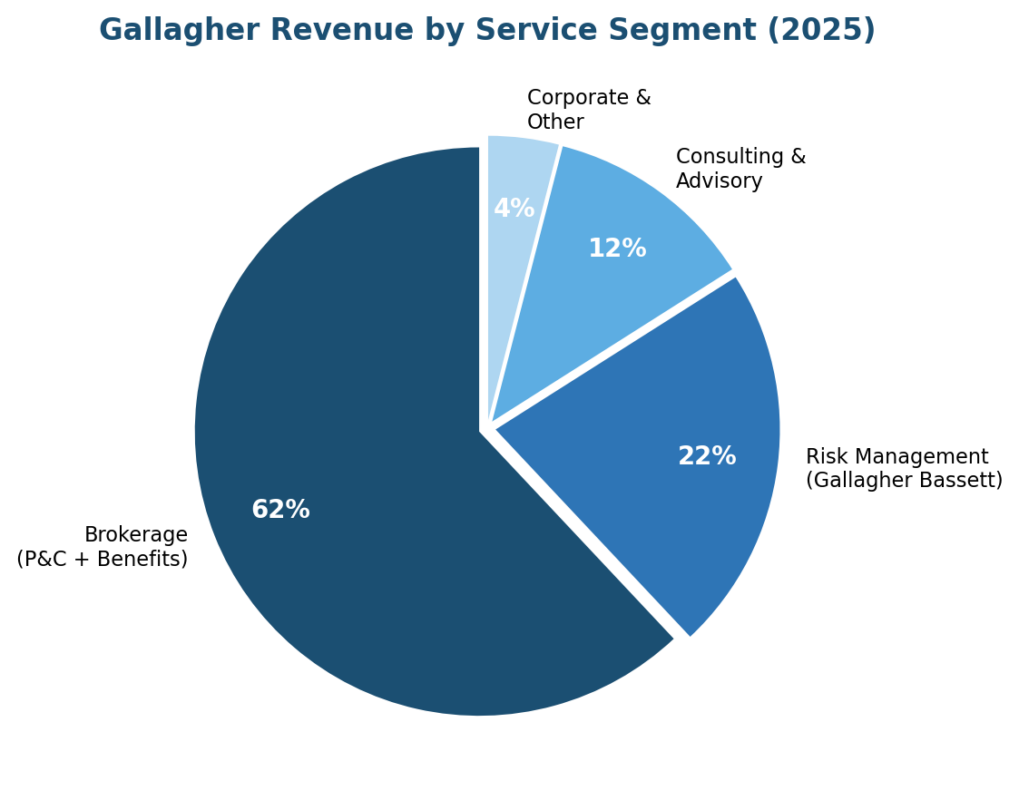
Gallagher Insurance Risk Management: The Three Operating Segments
Brokerage Segment (62% of revenue). This is Gallagher’s core business: retail and wholesale property/casualty insurance placement, employee benefits consulting, and reinsurance brokerage.
The segment serves clients ranging from middle-market employers to Fortune 500 corporations.
After the AssuredPartners acquisition, Gallagher added deep capabilities in transportation, energy, healthcare, government contractors, and public entity sectors. Brokerage revenue grew 21% in 2025, with 6% organic growth — a measure of growth excluding acquisitions.
Risk Management Segment (22% of revenue). Operated primarily through Gallagher Bassett, this segment provides third-party claims administration, loss control consulting, risk assessment services, and information management.
Gallagher Bassett manages claims for self-insured organizations, pooled trusts, and government entities. The segment also delivered 6% organic growth in 2025, demonstrating stable demand for outsourced claims management.
Consulting and Advisory (12% of revenue). Gallagher’s consulting arm covers actuarial services, human resource consulting, retirement plan design, and compliance advisory.
This segment is the connective tissue between the brokerage and risk management arms — it provides the analytical capability to design self-funded plan structures, model stop-loss attachment points, and quantify pharmacy cost drivers.
Gallagher’s Risk Management Services in Depth
Gallagher insurance risk management capabilities go far beyond standard brokerage work. Gallagher’s risk management services extend well beyond insurance placement. The firm’s consultative model aligns with the ISO 31000 risk management lifecycle: identify, analyze, evaluate, treat, and monitor.
Below is a mapping of Gallagher’s core service lines against the standard risk management process.
| ISO 31000 Phase | Gallagher Service | Deliverables | Value to Client |
| Risk Identification | Enterprise risk assessments; industry benchmarking; exposure analytics | Risk register; exposure summaries; peer benchmarking reports | Complete view of insurable and non-insurable risks |
| Risk Analysis | Actuarial modeling; claims data analytics; loss projections | Loss development triangles; frequency/severity trends; predictive models | Data-driven understanding of loss patterns and cost drivers |
| Risk Evaluation | Risk appetite workshops; coverage gap analysis; cost-of-risk benchmarking | Total cost of risk report; coverage gap matrix; prioritized risk list | Informed decisions on which risks to retain, transfer, or mitigate |
| Risk Treatment | Insurance placement; stop-loss design; captive/alternative risk transfer; pharmacy formulary management | Bound policies; stop-loss contracts; captive feasibility studies; PBM renegotiation outcomes | Optimized risk transfer at best-available pricing and terms |
| Monitoring & Review | Gallagher Bassett claims administration; KRI dashboards; stewardship reviews | Monthly claims reports; trend alerts; annual stewardship presentations | Continuous feedback loop to adjust program mid-cycle |
Stop-Loss Strategy Design
Self-funded employers face a critical decision: where to set the individual and aggregate stop-loss attachment points. Set the attachment too low and you pay excessive premiums for risk you could retain.
Set it too high and a single catastrophic claim can blow through reserves. Gallagher’s approach uses claims-level data from Gallagher Bassett to model the optimal attachment point based on the employer’s risk appetite, cash flow constraints, and historical loss experience.
The firm reports that clients who undergo a structured stop-loss review save 12–18% on total cost of risk within two plan years.
Pharmacy Cost Management
Gallagher insurance risk management programs tackle pharmacy spend head-on. Prescription drug costs represent 20–25% of total health plan spend for most employers, and pharmacy trend continues to outpace medical trend by 2–3 percentage points annually.
Gallagher’s pharmacy consulting team analyzes PBM contracts, formulary design, specialty drug pipelines, and biosimilar adoption rates to identify savings opportunities.
Common interventions include: renegotiating PBM contract terms to improve transparency, implementing step-therapy protocols for high-cost drugs, transitioning to narrow specialty pharmacy networks, and modeling the financial impact of GLP-1 drug coverage decisions.
These strategies connect directly to the firm’s broader risk mitigation philosophy — reducing exposure at the source rather than simply transferring cost.
Competitive Landscape: Gallagher vs. Peers
Gallagher insurance risk management competes in a highly consolidated market. The global insurance brokerage market is dominated by four firms that collectively control a significant share of the market.
Understanding how Gallagher compares to Marsh & McLennan, Aon, and WTW is essential for risk professionals conducting vendor assessments. The chart below shows relative revenue positioning.
| Capability | Gallagher | Marsh & McLennan | Aon | WTW |
| P&C Brokerage | Strong (mid-market focus) | Dominant (large/complex) | Strong (global programs) | Strong (analytics-led) |
| Employee Benefits | Deep (stop-loss specialty) | Broad (Mercer integration) | Solid (health solutions) | Strong (H&B consulting) |
| Risk Management/TPA | Gallagher Bassett (owned) | Marsh Advisory (separate) | Limited in-house | Limited in-house |
| Consulting/Actuarial | Integrated | Mercer + Oliver Wyman | Aon Human Capital | WTW Consulting |
| Mid-Market Focus | Core strength | Secondary focus | Secondary focus | Moderate |
| Acquisition Strategy | High-volume M&A (33 in 2025) | Selective/large-cap | Moderate | Selective |
| Cultural Model | Entrepreneurial/decentralized | Corporate/centralized | Corporate/centralized | Matrix organization |
Gallagher’s competitive differentiation rests on three pillars: the integrated brokerage-to-claims loop (enabled by Gallagher Bassett), the entrepreneurial culture that retains acquired producers, and the middle-market depth that larger competitors often underserve.
Risk managers evaluating brokers should apply the same risk assessment matrix discipline they use for other vendors: score each broker on capability, financial stability, service model, cultural fit, and total cost of risk impact.
Evaluating Gallagher Through an ERM Lens
Risk professionals should not evaluate any broker purely on premium savings. The COSO ERM framework and ISO 31000 both emphasize that risk management is about aligning risk-taking with strategy, not just minimizing insurance costs.
The table below provides a structured evaluation framework that risk managers can use to assess Gallagher — or any broker — against enterprise risk management criteria.
| ERM Evaluation Criterion | What to Look For | Gallagher Assessment |
| Risk Appetite Alignment | Does the broker help define and document your risk appetite, or just quote policies? | Gallagher’s consulting arm facilitates risk appetite workshops and maps coverage to stated tolerances — above average for the industry |
| Integrated Risk View | Can the broker connect P&C, benefits, cyber, and operational risks into a single dashboard? | The Gallagher Bassett data feed enables cross-segment analytics, though full integration requires client-side effort |
| Data & Analytics Capability | Does the broker use predictive models, benchmarking data, and loss analytics to drive decisions? | Strong — proprietary benchmarking tools, claims predictive analytics, and total cost of risk modeling |
| Three Lines Alignment | Does the broker understand your governance model and work within it? | Gallagher’s consulting team can map services to the Three Lines Model; varies by engagement team |
| Continuous Improvement | Is there a structured stewardship process with KPIs, not just an annual renewal meeting? | Gallagher mandates quarterly stewardship reviews with defined KPIs for most large accounts |
| Business Continuity | Does the broker have its own BCP and can it support yours? | Gallagher Bassett maintains ISO 22301-aligned BCP; Gallagher also advises on client-side continuity planning |
The US Insurance Brokerage Market: Context for Gallagher’s Growth
Gallagher’s aggressive growth strategy makes more sense when viewed against the macro backdrop.
The US insurance brokerage market reached approximately $140 billion in 2025 and is projected to grow to $172 billion by 2030, driven by cyber insurance demand, property catastrophe rate hardening, and data-driven advisory services.
Meanwhile, roughly 400,000 insurance professionals are expected to retire by 2026, creating a talent gap that favors large platforms like Gallagher that can absorb talent through acquisitions and offer career development at scale.
| Market Driver | Trend | Impact on Brokers | Gallagher Positioning |
| Cyber Insurance | Premium volume growing 15–20% annually | Brokers need technical underwriting + risk consulting capability | Dedicated cyber practice; Gallagher Bassett handles breach response claims |
| Consolidation (M&A) | 400+ brokerage acquisitions annually in the US | Scale advantages in data, placement capacity, and talent retention | Industry’s most active acquirer (33 deals in 2025 alone) |
| AI & Predictive Analytics | Adoption accelerating across underwriting and claims | Brokers investing in analytics platforms gain advisory edge | Investing in claims AI through Gallagher Bassett; early-stage underwriting tools |
| Regulatory Complexity | State-level insurance regulation + federal compliance (ACA, ERISA, mental health parity) | Demand for compliance advisory rising | Gallagher’s consulting arm provides regulatory compliance services |
| Talent Shortage | 400,000 retirements projected by 2026 | Brokers that attract and retain talent win | Acquisition model brings in established teams; strong producer retention culture |
Self-Funded Client Solutions: A Closer Look
Self-funded health plans cover approximately 65% of covered workers at large US employers, according to the Kaiser Family Foundation.
Managing a self-funded plan requires capabilities that go far beyond traditional brokerage: claims administration, stop-loss negotiation, pharmacy benefit management, actuarial projections, and regulatory compliance (ERISA, ACA reporting, mental health parity).
Gallagher’s integrated model positions it well for this market because the brokerage, Gallagher Bassett, and consulting functions can be packaged as a single-vendor solution.
| Self-Funded Service | What Gallagher Provides | Risk Management Benefit |
| Stop-Loss Placement | Market access to 30+ carriers; attachment point optimization using claims data | Right-sized coverage that balances premium cost against retention risk |
| Claims Administration (GB) | End-to-end TPA services: adjudication, utilization management, provider network access | Cost control through clinical review, fraud detection, and subrogation recovery |
| Pharmacy Consulting | PBM audit and renegotiation; formulary design; specialty drug strategy; GLP-1 impact modeling | 15–25% pharmacy savings for clients who implement formulary and PBM changes |
| Actuarial & Analytics | IBNR reserves; loss projections; renewal budgeting; peer benchmarking | Accurate forecasting reduces surprise assessments and improves cash flow planning |
| Compliance Advisory | ACA reporting (1094/1095-C); ERISA compliance; mental health parity testing | Reduces regulatory penalty exposure and litigation risk |
90-Day Implementation Roadmap: Engaging Gallagher (or Any Broker)
If your organization is evaluating Gallagher or any insurance risk management consultant, use this roadmap to structure the engagement.
Align each phase with your risk assessment process and ERM framework maturity.
| Phase | Actions | Deliverables | Success Metrics |
| Days 1–30: Discovery | Issue RFP to 3–4 brokers including Gallagher; define evaluation criteria (capability, cost, cultural fit, data/analytics, references); assemble evaluation committee with risk, HR, finance, and procurement | Completed RFP; evaluation scorecard template; broker shortlist of 3–4 finalists | RFP issued within 10 business days; all finalists meet minimum capability thresholds |
| Days 31–60: Evaluation | Conduct finalist presentations; request sample stewardship reports and claims analytics dashboards; complete reference checks with similarly sized clients; negotiate service-level agreements and fee structures | Finalist scoring matrix; draft service agreement; reference summary report; negotiated fee schedule | All finalists scored by committee; clear differentiation on 3+ criteria; SLAs defined with measurable KPIs |
| Days 61–90: Transition | Select broker; execute service agreement; initiate data migration (claims history, policy documents, census data); hold kickoff meeting with assigned team; agree on 12-month stewardship calendar and KPI dashboard | Signed agreement; transition plan with milestones; data migration complete; stewardship calendar published | Data migration > 95% complete; first stewardship meeting scheduled within 30 days of go-live; KPI dashboard operational |
Common Pitfalls When Selecting a Risk Management Broker
| Pitfall | Root Cause | Remedy |
| Evaluating on premium alone | Procurement-led process focused on cost, not total value | Use a total-cost-of-risk model that includes claims outcomes, consulting value, and risk reduction |
| Ignoring the service team | Buying the firm’s brand, not the people assigned to your account | Require named service teams in the RFP and lock in key personnel contractually |
| No stewardship accountability | Broker delivers at placement, then disappears until renewal | Mandate quarterly stewardship reviews with defined KPIs and escalation protocols |
| Overlooking claims integration | Brokerage and claims administration handled by different vendors with no data sharing | Evaluate brokers with integrated claims capabilities (Gallagher Bassett model) or require data-sharing agreements |
| Failing to test cultural fit | Large broker assigns junior team to mid-market account; entrepreneurial client gets corporate process | Conduct chemistry meetings with the actual service team, not just the sales team |
| Not benchmarking periodically | Multi-year relationship becomes stale; no competitive tension | Benchmark broker performance every 3 years against market alternatives, even if not switching |
| Skipping the ERM alignment check | Broker provides insurance advice disconnected from the enterprise risk framework | Require the broker to map services to your risk appetite statement and three lines model |
Looking Ahead: Gallagher and the Future of Insurance Risk Management (2026–2028)
Post-acquisition integration. The AssuredPartners deal adds 10,900 employees and significant capabilities in wholesale, reinsurance, and UK/Ireland markets.
The integration timeline will be critical — Gallagher projects $160 million in synergies over three years and 10–12% EPS accretion. Risk professionals should monitor whether the integration disrupts service quality for existing clients or enhances it through expanded capabilities and deeper talent pools.
AI-driven claims and underwriting. Gallagher Bassett is investing in AI-powered claims analytics to improve triage speed, identify subrogation opportunities, and predict high-cost claims earlier.
On the brokerage side, AI-assisted underwriting submissions could reduce placement cycle times by 30–40%. The risk for clients is ensuring that AI governance frameworks are applied to these tools to prevent algorithmic bias in claims decisions.
Embedded and parametric insurance. The next generation of risk transfer is moving beyond traditional indemnity policies. Parametric products — which pay based on a triggered index (e.g., earthquake magnitude, rainfall level) rather than proven loss — are gaining traction for property catastrophe, supply chain disruption, and agricultural exposures.
Gallagher’s scale positions it to develop and distribute these products, particularly in the infrastructure investment and public entity sectors where speed of payment matters more than proof of loss.
Convergence of risk management and operational resilience. Regulatory expectations around operational resilience are pushing organizations to connect insurance program design with business continuity management and impact tolerance assessments.
Brokers that can advise on both the transfer side (insurance) and the resilience side (BCM, disaster recovery) will capture a growing share of the advisory market. Gallagher’s breadth positions it for this convergence, though it will need to deepen ISO 22301 and operational resilience consulting capabilities.
Need help evaluating your insurance broker or building an enterprise risk management framework? Visit our services for ERM frameworks, risk assessment templates, and consulting engagements. Questions? Get in touch — we respond within 24 hours.
References
1. Arthur J. Gallagher & Co. — 2025 Full Year Financial Results
2. Insurance Journal — Gallagher Completes $13.5 Billion AssuredPartners Acquisition
3. Arthur J. Gallagher & Co. — Official Website
4. Gallagher Bassett — Risk Management Services
5. ISO 31000:2018 — Risk Management Guidelines
6. COSO Enterprise Risk Management — Integrating with Strategy and Performance (2017)
7. Kaiser Family Foundation — Employer Health Benefits Annual Survey
8. Mordor Intelligence — US Insurance Brokerage Market Forecasts to 2030
9. Gallagher 2025 Annual Report / SEC Filings
10. IBISWorld — Insurance Brokers & Agencies in the US Industry Report
11. MacroTrends — Arthur J Gallagher Revenue 2012–2025
12. ProgramBusiness — Gallagher Survey Highlights Rising AI Adoption and Ongoing Risks
13. NIST Cybersecurity Framework (SP 800-37 Rev 2) 14. Reinsurance News — Gallagher Closes $13.45bn Acquisition of AssuredPartners

Chris Ekai is a Risk Management expert with over 10 years of experience in the field. He has a Master’s(MSc) degree in Risk Management from University of Portsmouth and is a CPA and Finance professional. He currently works as a Content Manager at Risk Publishing, writing about Enterprise Risk Management, Business Continuity Management and Project Management.