
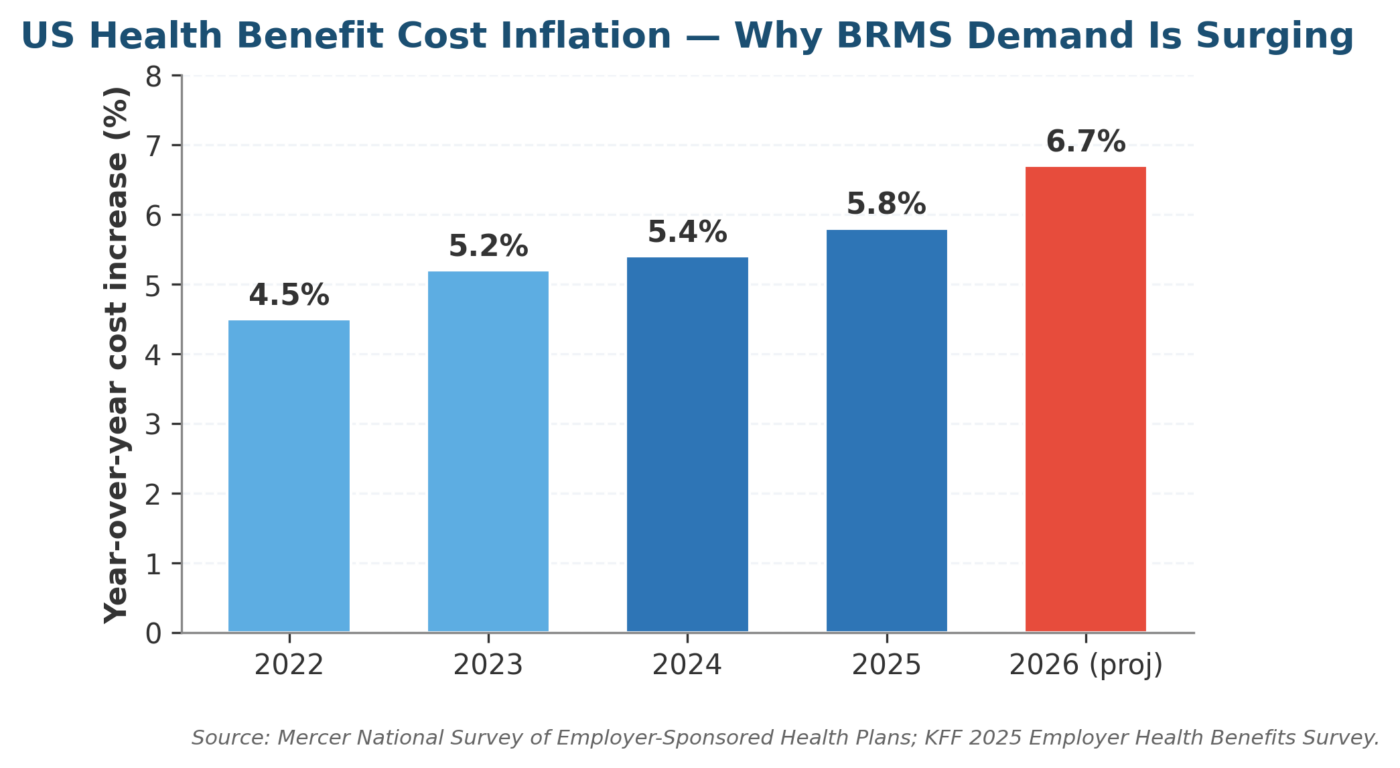
In March 2026, Mercer published a number that rattled CFO offices across the US: health benefit costs per employee are on track to rise 6.7% in 2026 — the highest single-year increase in 15 years.
That is the backdrop against which benefit and risk management services (BRMS) have moved from a specialist procurement line to a board-level cost-containment strategy.
Self-funded enrollment now covers roughly 70% of US workers with employer-sponsored coverage, and the Department of Labor has publicly signaled heightened fiduciary scrutiny under the Consolidated Appropriations Act of 2021.
Traditional fully insured plans still offer convenience — fixed premiums, predictable renewals, minimal administrative lift. But they also surrender the three levers that matter most in 2026: claims data visibility, plan design flexibility, and cost containment authority.
Benefit and risk management services bridge that gap by pairing third-party administration (TPA) with active healthcare risk management.
This guide updates our practitioner playbook for 2026: what benefit and risk management services actually deliver, why TPA selection is now a documented fiduciary act under ERISA, how to benchmark savings against the 6.7% cost headwind, and how to integrate BRMS into an enterprise risk management framework that boards can sign off on.
Key Takeaways
1. Benefit and Risk Management Services (BRMS) is a specialized category of third-party administration (TPA) that combines employee benefit plan administration with healthcare risk management to help employers control costs and improve plan performance.
2. Self-funded health plans now cover 67% of U.S. workers (Kaiser Family Foundation, 2025). Employers in these plans need a TPA to handle claims processing, compliance, care management, and vendor coordination.
3. BRMS-type providers integrate technology platforms, care management programs, pharmacy benefit management, and data analytics into a single service model—saving employers an average of 20–40% compared to traditional fully insured health plans.
4. Employer healthcare costs in 2026 are expected to increase by 6.7 %, the third consecutive year with increases above 5%. Proactive benefit risk management through TPAs offers a direct path to bending the cost curve.
5. Key services include claims adjudication, ACA compliance, stop-loss coordination, wellness programs, consolidated billing, and real-time analytics dashboards that give employers full visibility into plan spending.
Introduction: Why Benefit and Risk Management Services Matter Now
Healthcare costs continue to climb. U.S. employers face a 5.8% increase in health benefit expenses in 2025, marking the third straight year with increases above 5%.
Traditional fully insured plans offer convenience but limited visibility: employers pay fixed premiums, receive minimal claims data, and have almost no control over plan design. The result is overspending on misaligned coverage that frustrates employees and strains budgets.
Benefit and Risk Management Services (BRMS) emerged as a response to this problem. BRMS providers function as third-party administrators (TPAs) that combine benefit plan administration with proactive healthcare risk management.
They process claims, manage vendor relationships, ensure regulatory compliance, and deploy technology platforms that give employers real-time visibility into how their healthcare dollars are being spent.
This guide explains what BRMS providers do, how their services connect to broader enterprise risk management principles, and how employers can evaluate TPA partners to drive cost savings and employee satisfaction.
Benefit and risk management services selection is a fiduciary act under ERISA. Plan sponsors are fiduciaries; TPA evaluation, contracting, and monitoring must follow a documented, prudent process. Failure to document triggers personal liability exposure under ERISA sections 404 and 409.
Why Benefit and Risk Management Services Selection Is a Fiduciary Act
Under ERISA section 404(a), plan fiduciaries must discharge their duties “solely in the interest” of plan participants and with the “care, skill, prudence, and diligence” of a prudent expert.
When a plan sponsor selects, contracts with, or monitors a benefit and risk management services provider, that entire lifecycle is a fiduciary act. The Consolidated Appropriations Act of 2021 tightened this further by requiring TPAs to disclose direct and indirect compensation to plan sponsors.
The consequence is operational. Boards, benefits committees, and HR leaders can no longer treat TPA selection as a back-office procurement exercise.
Each step — needs assessment, RFP issuance, scoring, contract negotiation, performance monitoring — must be documented in a form that survives a Department of Labor audit or a participant lawsuit. Compliance risk analysis practitioners should treat this as a named risk in the risk register.
Benefit and Risk Management Services: The Quinquennial RFP Best Practice
Leading ERISA counsel — including published guidance from Nixon Peabody LLP and the National Law Review — recommends that plan fiduciaries conduct a full benefit and risk management services RFP every five years.
The logic: markets evolve, fees drift, service quality erodes, and a five-year re-benchmark is the defensible minimum a prudent fiduciary would undertake.
This does not mean switching TPAs every five years. It means running a prudent, documented re-evaluation. The incumbent can win — but only after being benchmarked against credible alternatives. Skipping the cycle is where fiduciary exposure begins.
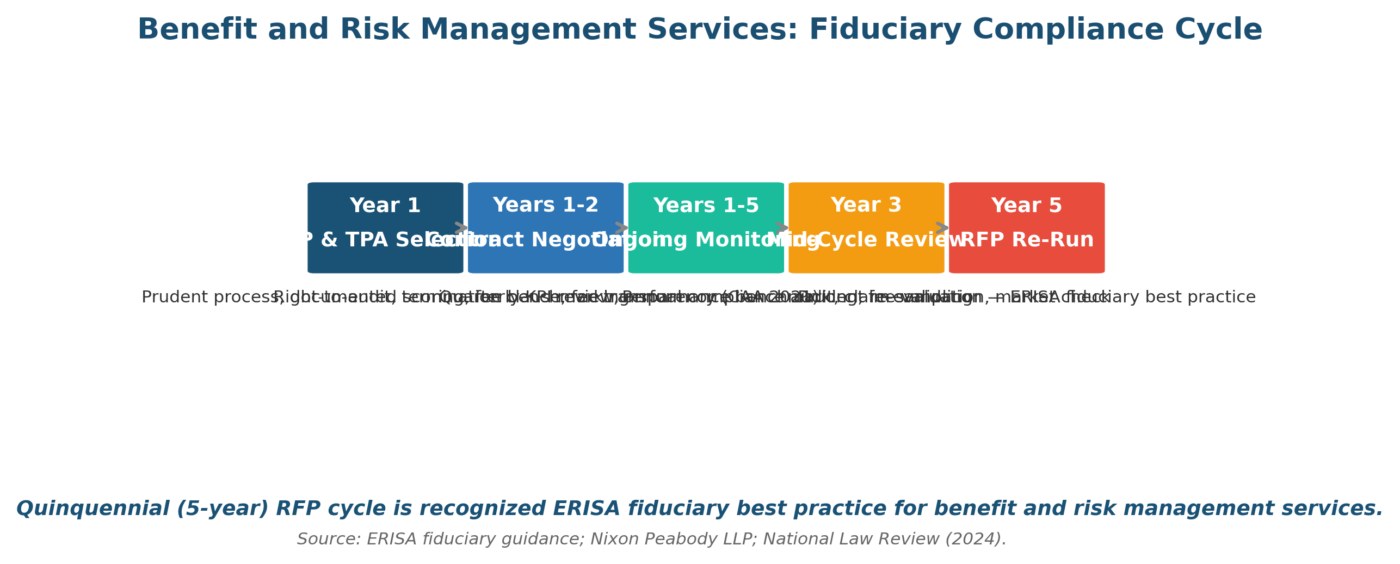
Figure 2. Benefit and risk management services fiduciary compliance cycle — the quinquennial (five-year) RFP cadence is recognized ERISA best practice for TPA oversight.
Benefit and Risk Management Services Contracting: Four Clauses ERISA Fiduciaries Must Negotiate
| Clause | What It Does | ERISA / Fiduciary Anchor |
| Right to audit | Permits plan sponsor or delegated auditor to review TPA claim samples, fee charges, and network discount application | DOL audit guidance; fiduciary duty to monitor (ERISA 404(a)) |
| Reasonable termination | Allows exit without substantial penalty within a reasonable notice period | ERISA prohibited-transaction rules; fiduciary duty of loyalty |
| Fee transparency | Requires disclosure of direct, indirect, network-discount, and PBM compensation | Consolidated Appropriations Act 2021 Section 202; ERISA 408(b)(2) |
| Performance SLAs | Quantifies claim turnaround, accuracy, call abandonment, overpayment recovery with financial penalties | Fiduciary duty to monitor; prudent-expert standard |
| Indemnification | Allocates liability for errors, breaches, or regulatory fines between sponsor and TPA | ERISA 404(a) prudence; HIPAA business-associate requirements |
| Data ownership | Confirms plan sponsor owns claims data and can port to another benefit and risk management services provider | Prevents vendor lock-in; supports quinquennial RFP |
| Clause | What It Does | ERISA / Fiduciary Anchor |
| Right to audit | Permits plan sponsor or delegated auditor to review TPA claim samples, fee charges, and network discount application | DOL audit guidance; fiduciary duty to monitor (ERISA 404(a)) |
| Reasonable termination | Allows exit without substantial penalty within a reasonable notice period | ERISA prohibited-transaction rules; fiduciary duty of loyalty |
| Fee transparency | Requires disclosure of direct, indirect, network-discount, and PBM compensation | Consolidated Appropriations Act 2021 Section 202; ERISA 408(b)(2) |
| Performance SLAs | Quantifies claim turnaround, accuracy, call abandonment, overpayment recovery with financial penalties | Fiduciary duty to monitor; prudent-expert standard |
| Indemnification | Allocates liability for errors, breaches, or regulatory fines between sponsor and TPA | ERISA 404(a) prudence; HIPAA business-associate requirements |
| Data ownership | Confirms plan sponsor owns claims data and can port to another benefit and risk management services provider | Prevents vendor lock-in; supports quinquennial RFP |
What Are Benefit and Risk Management Services?
Benefit and Risk Management Services is the integrated discipline of administering employee health benefit plans while simultaneously managing the financial and operational risks associated with those plans.
The term applies both to the service category and to specific providers—most notably Benefit & Risk Management Services, Inc. (BRMS), a national TPA founded in 1993 and headquartered in Folsom, California, with over 30 years of claims and benefit administration experience.
At the broadest level, BRMS-type services sit at the intersection of two disciplines: benefit administration (the operational mechanics of enrolling members, processing claims, managing eligibility, and ensuring compliance).
Healthcare risk management (the strategic work of identifying cost drivers, managing high-risk populations, negotiating provider rates, and deploying stop-loss insurance to protect the employer from catastrophic claims).
When these two functions operate under one roof, the employer gains a single point of accountability and a unified data set that drives better decisions.
Self-Funded vs. Fully Insured: Understanding the Context
BRMS providers primarily serve employers who self-fund their health plans. In a self-funded (self-insured) arrangement, the employer pays employee medical claims directly out of operating revenue rather than paying fixed premiums to a commercial insurer.
The employer assumes financial risk but gains plan design flexibility, cost transparency, and access to claims data.
According to the Kaiser Family Foundation’s 2025 Employer Health Benefits Survey, 67% of covered U.S. workers are enrolled in self-funded plans—reaching 80% at firms with 200 or more employees.
Because most employers lack the internal infrastructure to adjudicate claims, negotiate provider contracts, and ensure ERISA and ACA compliance, they contract with a TPA.
The TPA becomes the operational engine that makes self-funding feasible. BRMS providers differentiate themselves from generic TPAs by integrating risk management capabilities—care management, disease management, pharmacy benefit management, and predictive analytics—into the core administration platform.
Core Services Provided by BRMS and TPA Providers
Mercer’s National Survey projects a 6.7% health benefit cost increase — the largest year-over-year rise in 15 years. The Kaiser Family Foundation 2025 Employer Health Benefits Survey reports that roughly 70% of workers with employer-sponsored coverage are in self-funded plans.
And self-funded adoption skews sharply with size — only around 22% of firms with 3-199 employees self-insure, versus 90%+ of firms with 5,000+ employees.
Against that backdrop, benefit and risk management services deliver savings that cluster in six well-documented categories. The ranges below are drawn from the Self-Insurance Institute of America (SIIA) industry data and the Validation Institute published benchmarks for mid-market US employers.
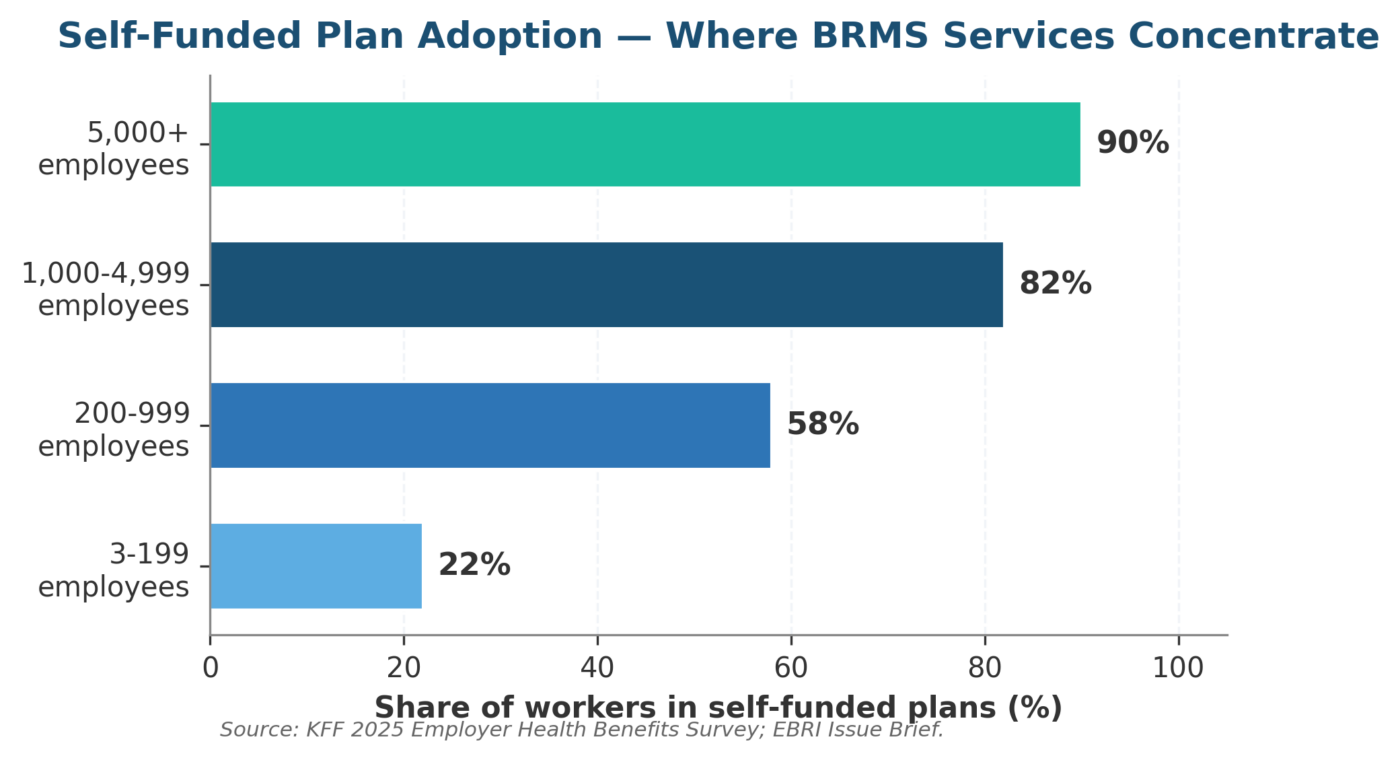
Figure 3. Self-funded plan adoption by US employer size — benefit and risk management services demand rises steeply with workforce size, hitting 90%+ at 5,000+ employees.
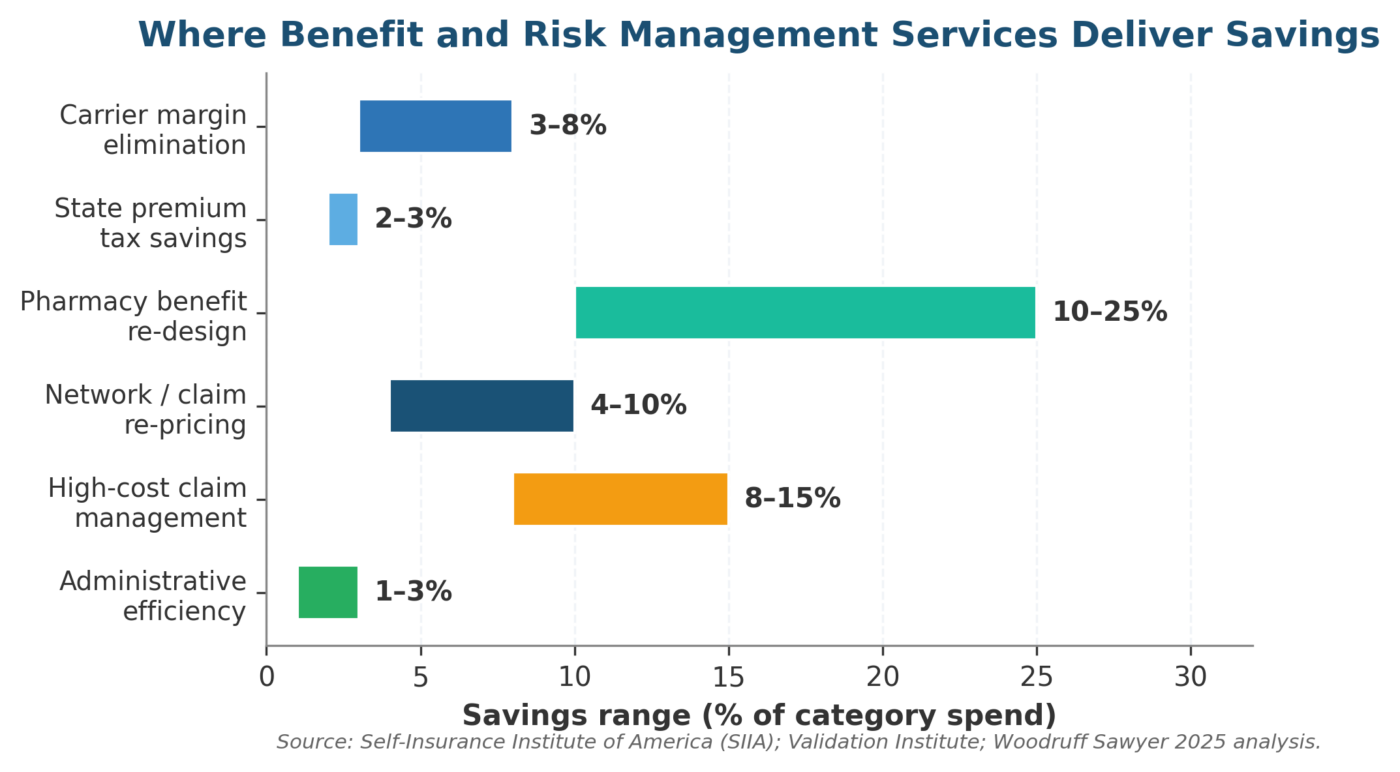
Figure 4. Where benefit and risk management services deliver savings — pharmacy benefit redesign and high-cost claim management carry the largest ranges.
Two practitioner takeaways. First, do not market benefit and risk management services on an aggregate “20-40% savings” headline — that range is dated and creates credibility risk in CFO conversations.
The 2026 honest number is closer to 8-15% total plan spend for well-run programs, with the highest gains in pharmacy and high-cost claim management. Second, the savings are not free — they require stop-loss insurance, data infrastructure, and the fiduciary process discipline outlined above.
Table 1: BRMS Core Service Categories
| Service Category | What It Includes | Business Impact | Risk Management Connection |
| Claims Administration | Claims adjudication, payment, denial management, coordination of benefits | Accurate, timely claims processing; reduced errors and overpayments | Controls financial leakage; identifies fraud patterns |
| Eligibility Management | Enrollment, termination, COBRA administration, dependent verification | Clean eligibility data prevents payment on ineligible claims | Reduces improper claim payments by 3–5% |
| Care Management | Utilization review, prior authorization, case management, disease management | Redirects high-cost members to appropriate care settings | Manages high-risk populations; reduces catastrophic claims |
| Pharmacy Benefit Management | PBM coordination, formulary management, specialty drug programs | Controls prescription drug costs (typically 15–25% of plan spend) | Pass-through pricing eliminates spread and hidden rebate retention |
| Stop-Loss Coordination | Specific and aggregate stop-loss insurance placement and management | Caps employer exposure on individual catastrophic claims and total plan spend | Transfers tail risk to the stop-loss carrier |
| ACA Compliance | Monthly hours tracking, 1094/1095 reporting, affordability testing | Avoids IRS penalties ($2,900+ per full-time employee in 2025) | Regulatory compliance risk mitigation |
| Technology Platform | Online enrollment, member self-service portal, mobile app, analytics dashboard | Reduces administrative burden; empowers employees to manage own benefits | Real-time data enables early detection of cost trends |
| Consolidated Billing | Single invoice combining medical, dental, vision, life, disability premiums | Simplifies accounts payable; reduces vendor management overhead | Reduces operational and reconciliation risk |
| Wellness Programs | Health screenings, biometric testing, health coaching, incentive programs | Improves population health; reduces long-term claims costs | Proactive risk reduction through preventive care |
| Taft-Hartley / Multi-Employer Administration | Trust fund administration, contribution tracking, collective bargaining compliance | Specialized administration serving union and multi-employer trusts | Fiduciary compliance under ERISA and DOL requirements |
How BRMS Providers Reduce Healthcare Costs
Cost containment is the primary reason employers move from fully insured plans to self-funded arrangements with a BRMS provider. The savings come from multiple levers working simultaneously.
Eliminating carrier profit margins and risk charges. Fully insured premiums include the insurer’s profit margin (typically 3–5%), administrative load, and risk charge. Self-funded employers remove these layers and pay only actual claims plus administrative fees.
Transparent pharmacy pricing. BRMS providers partner with pass-through pharmacy benefit managers (PBMs) that charge a disclosed dispensing fee rather than retaining hidden rebates and spread pricing. A pass-through PBM arrangement gives the employer the full value of manufacturer rebates.
Network optimization. Strategic partnerships with national PPO networks and narrow network arrangements enable BRMS providers to negotiate provider reimbursement rates that reduce per-claim costs by 15–40% compared to out-of-network pricing.
Care management and disease management programs. Identifying and intervening early with high-risk members—those managing chronic conditions like diabetes, heart disease, and musculoskeletal disorders—prevents costly emergency department visits and inpatient admissions.
Disease management programs have been shown to reduce per-member costs by 8–15% in target populations.
Data-driven plan design. Real-time analytics dashboards reveal where plan dollars are going: which conditions drive the most claims, which providers charge the most, and which members are underutilizing preventive care.
Employers use this data to adjust plan design, add targeted programs, and negotiate better rates. The role of insurance in supply chain risk management applies the same risk transfer principles that underpin stop-loss coordination.
Table 2: Fully Insured vs. Self-Funded with BRMS – Cost Comparison
| Cost Component | Fully Insured Plan | Self-Funded with BRMS | Savings Opportunity |
| Claims costs | Bundled into premium; employer has no visibility | Employer pays actual claims; full transparency | Varies—healthy populations save 10–30% |
| Administrative fees | 5–15% of premium (insurer overhead) | Fixed per-employee-per-month (PEPM) fee | Typically 30–50% lower than insurer admin load |
| Carrier profit / risk charge | 3–5% of premium | Eliminated | Direct savings of 3–5% of total spend |
| Pharmacy | Carrier-managed; rebates retained by PBM | Pass-through PBM; rebates returned to employer | 10–25% reduction in pharmacy spend |
| Stop-loss insurance | Not applicable—carrier absorbs risk | Employer purchases specific + aggregate stop-loss | Cost of stop-loss is typically 5–10% of premium equivalent |
| Data and analytics | Limited annual reports; no real-time access | Real-time dashboard with claims, utilization, cost trends | Enables data-driven plan design changes worth 5–15% savings |
| Plan design flexibility | Carrier-designed; limited customization | Fully customizable by employer | Cover what employees need; eliminate what they do not |
One documented example: a 260-employee company that transitioned from a fully insured medical plan costing $3.8 million annually to a captive arrangement with a national PPO network and pass-through PBM.
The group realized $625,000 in savings in the first year alone—a 16.4% reduction.
The Role of Technology in Benefit and Risk Management
Technology platforms are the differentiator separating modern BRMS providers from legacy TPAs. A robust platform centralizes eligibility management, claims tracking, benefits enrollment, document storage, and analytics into a single interface accessible to employers, HR teams, brokers, and plan members.
Online benefit administration portals allow employees to enroll in plans, view coverage details, download ID cards, submit claims, and access explanation-of-benefits (EOB) statements without calling customer service. Self-service portals reduce administrative calls by 30–50% and improve employee satisfaction scores.
Mobile applications extend platform access to smartphones, giving members instant access to their benefits information from anywhere. Mobile-first design is now an expectation, not a feature.
Analytics dashboards deliver real-time insight into plan performance: claims trends, high-cost claimants, utilization patterns, pharmacy spend by drug category, and stop-loss attachment point proximity. These dashboards enable the employer’s HR and finance teams to make data-driven decisions about plan design changes, wellness program investments, and provider network adjustments.
AI and predictive analytics represent the next frontier. Leading BRMS providers are integrating machine learning models that predict which members are likely to develop high-cost conditions, identify fraudulent claims patterns, and recommend targeted care management interventions before costs escalate.
AI tools also streamline administrative tasks like claims adjudication and prior authorization, reducing processing time and error rates.
Compliance and Regulatory Risk Management
Self-funded health plans operate under the federal Employee Retirement Income Security Act (ERISA), which sets fiduciary standards, disclosure requirements, and claims procedures.
The Affordable Care Act (ACA) adds employer mandate obligations, reporting requirements (Forms 1094-C and 1095-C), and essential health benefit considerations. The Consolidated Appropriations Act (CAA) of 2021 imposes transparency and mental health parity requirements. HIPAA governs the privacy and security of protected health information.
A BRMS provider manages this compliance burden on behalf of the employer. Failure to comply with ACA employer mandate provisions can trigger penalties exceeding $2,900 per full-time employee per year. ERISA violations carry fiduciary liability that exposes company officers personally.
HIPAA breaches can result in fines ranging from $100 to $50,000 per violation, with annual maximums reaching $1.5 million per violation category. The compliance risk assessment guide on riskpublishing.com provides a framework applicable to benefits compliance.
Table 3: Key Compliance Obligations Managed by BRMS Providers
| Regulation | Requirement | Penalty Exposure | BRMS Service |
| ACA Employer Mandate | Offer affordable, minimum-value coverage to 95%+ of FTEs | $2,900+ per FTE per year (2025) | Monthly hours tracking, affordability testing, 1094/1095 filing |
| ERISA | Fiduciary duty, SPD distribution, claims procedures, appeals process | Personal fiduciary liability; DOL enforcement actions | Plan document preparation, claims adjudication, appeals management |
| HIPAA Privacy & Security | Protect PHI; breach notification within 60 days | $100–$50,000 per violation; up to $1.5M annually | Secure technology platform, BAA execution, breach protocols |
| CAA 2021 Transparency | Machine-readable provider rates; Rx cost reporting; mental health parity | DOL and HHS enforcement; civil monetary penalties | Data file generation, gag clause attestation, parity analysis |
| COBRA | Offer continuation coverage to qualifying beneficiaries | Excise tax of $100/day per affected individual | COBRA notices, election tracking, premium collection |
| State Insurance Laws | Varies by state; some apply to stop-loss policies | State-level fines and enforcement actions | Regulatory monitoring, state filing compliance |
Connecting BRMS to Enterprise Risk Management
Employee benefit costs typically represent 20–35% of total compensation expense. When an employer self-funds, that cost becomes a variable financial risk—claims can exceed projections, catastrophic cases can blow through budgets, and regulatory non-compliance can trigger penalties.
Viewing benefit administration through an enterprise risk management lens connects healthcare spending to the organization’s risk appetite, strategic objectives, and financial planning.
A BRMS provider contributes to the ERM framework by identifying healthcare cost risks (trend analysis, large-claim projections, chronic condition prevalence), assessing the financial impact (actuarial modeling, stop-loss scenario analysis), treating risks (care management, network optimization, plan design changes), and monitoring outcomes (KRI dashboards tracking claims trend, per-member-per-month costs, and stop-loss utilization).
The ISO 31000 framework principles of risk identification, analysis, evaluation, and treatment map directly onto the BRMS service model.
Table 4: BRMS Services Mapped to the ERM Process
| ERM Step | BRMS Application | Tool / Output | Stakeholder |
| Risk Identification | Analyze claims data to identify cost drivers and high-risk member cohorts | Claims trend reports, population health dashboard | CFO, HR Director, Benefits Committee |
| Risk Assessment | Actuarial projections, large-claim modeling, stop-loss adequacy analysis | Actuarial reports, Monte Carlo cost projections | CFO, Risk Manager, Finance Team |
| Risk Treatment | Deploy care management, adjust plan design, optimize provider network | Care management referrals, plan design recommendations | HR Director, Benefits Broker, Plan Members |
| Risk Monitoring | Track KRIs: PMPM cost trend, ER utilization, Rx spend, stop-loss proximity | Real-time analytics dashboard, monthly stewardship reports | HR Director, CFO, Benefits Committee |
| Risk Reporting | Deliver annual plan performance reviews and renewal strategy recommendations | Annual stewardship report, renewal analysis | C-Suite, Board, Benefits Committee |
Key Risk Indicators for Employee Benefit Plans
Benefit plan KRIs function the same way as KRIs in any risk management framework: they provide early warning signals that allow decision-makers to intervene before costs escalate beyond acceptable thresholds. A BRMS provider should track and report on these metrics at least monthly.
Table 5: Employee Benefit Plan KRIs
| KRI | Metric | Green | Amber | Red |
| Claims cost trend | Year-over-year change in PMPM cost | ≤ 4% | 5–8% | > 8% |
| Large claims frequency | # of claims exceeding $100K in trailing 12 months | ≤ 2 | 3–5 | > 5 |
| Stop-loss attachment utilization | % of specific stop-loss limit consumed | ≤ 50% | 51–75% | > 75% |
| ER utilization rate | ER visits per 1,000 members per year | ≤ 300 | 301–400 | > 400 |
| Generic drug fill rate | % of prescriptions filled with generics | ≥ 85% | 75–84% | < 75% |
| Preventive care compliance | % of members completing annual wellness visit | ≥ 60% | 40–59% | < 40% |
| Claims processing accuracy | % of claims adjudicated correctly on first pass | ≥ 98% | 95–97% | < 95% |
| ACA compliance status | % of FTEs with confirmed offer of coverage | 100% | 95–99% | < 95% |
How to Evaluate and Select a BRMS / TPA Provider
Not all TPAs are created equal. The difference between the right partner and the wrong one is measured in dollars saved, employees served, and compliance risks avoided. Evaluate candidates across six dimensions.
1. Claims administration accuracy and speed. Ask about first-pass accuracy rates (target: 98%+), average turnaround time, and financial accuracy (dollar accuracy on claim payments). Request audit results from the past three years.
2. Technology platform capability. Evaluate the member portal, employer dashboard, mobile app, analytics depth, and integration APIs. Test the platform directly—do not rely on sales demos alone.
3. Care management depth. Verify that the TPA offers utilization management, case management, disease management, and behavioral health coordination. Ask how many active care management cases the TPA handles and what cost savings their programs have documented.
4. Compliance expertise. Confirm that the TPA handles ACA reporting, ERISA plan document preparation, COBRA administration, HIPAA compliance, and CAA transparency requirements. Ask how regulatory changes are communicated and implemented. Review their track record for audit and penalty history.
5. Network and vendor relationships. Evaluate the breadth of provider network access, PBM arrangements (pass-through vs. traditional), and stop-loss carrier partnerships. A TPA with strong vendor relationships delivers better rates and broader access.
6. Client references and financial stability. Speak with current clients of similar size and industry. Verify financial stability through audited financial statements or independent ratings. A TPA that fails financially can disrupt claim payments and member services.
Table 6: TPA Evaluation Scorecard
| Evaluation Criterion | Weight | Key Questions | Target Benchmark |
| Claims accuracy | 20% | What is your first-pass accuracy rate? Dollar accuracy? Average turnaround? | ≥ 98% accuracy; ≤ 10-day turnaround |
| Technology platform | 20% | Does the platform support real-time analytics, mobile access, and API integration? | Full self-service portal + analytics dashboard |
| Care management | 15% | What care management programs do you operate? What savings have you documented? | Documented 8–15% savings on managed populations |
| Compliance | 15% | How do you handle ACA, ERISA, HIPAA, and CAA requirements? Any penalty history? | Zero penalty history; proactive regulatory updates |
| Network & vendors | 15% | Which networks do you access? Is your PBM arrangement pass-through? | National PPO + pass-through PBM with full rebate return |
| References & stability | 15% | Can you provide 3+ client references of similar size? Audited financials? | Strong references; clean audit history |
Frequently Asked Questions About Benefit and Risk Management Services
What are benefit and risk management services in simple terms?
Benefit and risk management services (BRMS) combine third-party administration of self-funded health plans with active healthcare risk management.
A BRMS provider processes claims, administers FSA/HRA/COBRA, ensures ACA and ERISA compliance, and uses data to drive plan design, pharmacy strategy, and high-cost claim containment.
The goal is lower total plan cost and stronger fiduciary compliance than a traditional fully insured arrangement.
Are benefit and risk management services only for large employers?
No, but adoption skews toward size. Only about 22% of US firms with 3-199 employees self-insure, while 90%+ of firms with 5,000+ employees do.
Benefit and risk management services become economically compelling around 100-200 covered lives for mid-market employers who can carry stop-loss insurance and access level-funded variants. Under 100 lives, fully insured usually wins on risk diversification — above, BRMS typically wins.
How much do benefit and risk management services actually save?
Realistic 2026 savings range from 8-15% of total plan spend for well-run programs, with pharmacy benefit redesign (10-25%) and high-cost claim management (8-15%) carrying the widest ranges.
Avoid quoting older “20-40%” headlines — those numbers predate 2020s pharmacy consolidation and are now credibility risks in CFO conversations. The savings require stop-loss insurance, data infrastructure, and prudent fiduciary oversight.
Is selecting benefit and risk management services a fiduciary decision?
Yes, unambiguously. Under ERISA section 404(a), plan fiduciaries must discharge their duties with the care, skill, prudence, and diligence of a prudent expert.
Selecting, contracting with, and monitoring a benefit and risk management services provider is a documented fiduciary act. Leading ERISA counsel recommend a full benefit and risk management services RFP every five years to maintain a defensible, prudent process.
What is the difference between benefit and risk management services and a traditional TPA?
A traditional TPA processes claims and handles compliance administration. A benefit and risk management services provider does all of that plus proactive healthcare risk management — high-cost claim forecasting, pharmacy strategy, network repricing, stop-loss coordination, and integration with the sponsor’s broader enterprise risk management framework. BRMS is TPA plus active risk management.
How do benefit and risk management services integrate with enterprise risk management?
Benefit and risk management services feed three ERM domains directly: operational risk (claim processing, vendor reliance), compliance risk (ERISA, ACA, HIPAA, CAA 2021), and financial risk (plan spend volatility, stop-loss attachment).
The BRMS risk dashboard should feed the enterprise key risk indicator dashboard, with named owners in the risk register.
What KRIs should benefit and risk management services programs track?
Core benefit and risk management services KRIs include: claim turnaround (target ≤8 business days), claim accuracy (target 98%+), high-cost-claim concentration (watch list for members above $50K annualized), stop-loss attachment headroom.
ACA 95% offer rate, HIPAA breach count, PBM rebate pass-through, and participant call abandonment. Traffic-light each quarterly against the risk appetite statement.
How often should a plan sponsor re-evaluate benefit and risk management services providers?
Every five years is the recognized ERISA fiduciary best practice — a full benefit and risk management services RFP every five years, with annual performance reviews and a mid-cycle fee benchmark at year three.
The incumbent can win, but only after being prudently benchmarked. Skipping the cycle is where fiduciary exposure begins.
90-Day Roadmap: Transitioning to a BRMS Provider
Days 1–30: Assessment and Selection
Conduct a total cost of health benefits analysis comparing current fully insured or ASO costs to projected self-funded costs. Issue an RFP to three to five TPA candidates using the evaluation scorecard from Table 6.
Review technology platform demonstrations with HR, finance, and benefits broker teams. Check client references and verify compliance track records. Select the BRMS provider that scores highest on weighted criteria.
Days 31–60: Implementation Planning
Execute the TPA service agreement with clear scope, SLAs, and performance guarantees. Transfer eligibility data and historical claims files from the incumbent carrier or TPA.
Configure the technology platform: plan rules, benefit designs, deductible structures, and accumulator files. Bind stop-loss insurance coverage. Set up consolidated billing feeds from dental, vision, life, and disability carriers. Develop employee communication materials explaining the transition.
Days 61–90: Go-Live and Monitoring
Launch the new plan with member ID card distribution, portal activation, and customer service readiness. Conduct an employee benefits enrollment meeting. Activate the KRI dashboard from Table 5 and establish the monthly reporting cadence.
Hold a 30-day post-launch review with the TPA to assess claims processing accuracy, member satisfaction, and any implementation issues.
Set quarterly stewardship meetings and define the annual plan performance review cycle. Connect benefit plan KRIs to the organization’s enterprise risk management dashboard to ensure healthcare cost risks are visible at the board level.
Seven Common Pitfalls to Avoid
| Pitfall | Root Cause | Remedy |
| Treating benefit and risk management services selection as procurement, not fiduciary process | Plan sponsor views TPA RFP as a commercial exercise, not an ERISA-governed act | Document every step of the benefit and risk management services RFP; retain scoring records, meeting minutes, and decision memos for seven years |
| Skipping the quinquennial RFP | Incumbent TPA complacency; sponsor procrastination; no named fiduciary owner | Calendar a benefit and risk management services RFP every five years, even if the incumbent ultimately retains; mid-cycle fee benchmark at year three |
| Quoting outdated “20-40%” savings to CFOs | Using 2010s-era industry data that predates pharmacy consolidation | Use 2026-calibrated ranges — 8-15% total plan spend with category-specific bands for pharmacy, claims, high-cost |
| Failing to negotiate right-to-audit and fee-transparency clauses | Standard TPA contracts favor the vendor; sponsor legal team not trained on ERISA-specific clauses | Require right-to-audit, Consolidated Appropriations Act 2021 fee transparency, SLA penalties, and data-ownership in every benefit and risk management services contract |
| Ignoring stop-loss attachment drift | Stop-loss premiums rise faster than plan spend; attachment point creeps up | Quarterly stop-loss re-benchmark; make attachment-point headroom a named KRI in the benefit and risk management services dashboard |
| Under-resourcing the internal benefits lead | Assumption that the TPA replaces the internal owner | Name a benefits risk owner with board escalation authority; the TPA delivers, but fiduciary accountability stays with the sponsor |
| Disconnected benefit and risk management services and ERM | BRMS dashboard lives in HR; ERM register lives in risk; no single view | Integrate benefit and risk management services KRIs into the enterprise risk register; review at the ERM committee quarterly |
Forward Look: BRMS and TPA Trends Shaping 2025–2027
AI-driven care management is expanding rapidly. Machine learning models predict which members are at highest risk of developing expensive conditions, enabling targeted interventions months before hospitalization. AI also accelerates claims adjudication, fraud detection, and prior authorization processing.
Transparency regulation enforcement is intensifying. The CAA’s machine-readable file requirements, gag clause prohibitions, and prescription drug cost reporting obligations are now subject to active DOL and HHS enforcement. TPAs that cannot generate compliant transparency files put their employer clients at risk.
Direct primary care (DPC) and reference-based pricing (RBP) are gaining traction as alternative cost-containment strategies. Forward-thinking BRMS providers integrate these models into their service platform, offering employers additional tools to reduce per-claim costs while improving member access to care.
Mental health parity enforcement is tightening under the CAA and state mental health parity laws. TPAs must demonstrate that mental health and substance use disorder benefits are administered with the same criteria and processes as medical/surgical benefits—a compliance area where many plans fall short.
Take the Next Step
Benefit and Risk Management Services represent a strategic approach to controlling healthcare costs while managing the financial, operational, and compliance risks embedded in employee health plans.
Use the evaluation scorecard, KRI framework, and 90-day roadmap in this guide to assess your current TPA relationship, identify improvement opportunities, and build a benefit program that delivers value to the organization and its employees.
Explore more practitioner resources on riskpublishing.com: from enterprise risk management frameworks and ISO 31000 implementation guides to compliance risk assessment templates and the COSO framework explained. Subscribe to receive new posts, templates, and frameworks delivered directly to your inbox.
References and Further Reading
1. Kaiser Family Foundation. 2025 Employer Health Benefits Survey
2. Benefit & Risk Management Services, Inc. BRMS Online – About
3. Georgetown University CHIR. Third-Party Administrators – The Middlemen of Self-Funded Health Insurance (2025)
4. ACHI. The Role of Third-Party Administrators in Health Insurance Coverage
5. Personify Health. Optimizing Health Plans Using a Third-Party Administrator
6. Collective Health. Why TPAs Are the Quarterbacks of Self-Funded Health Plans
7. Roundstone Insurance. What Is a TPA? A Complete Guide for Self-Funded Health Plans
8. OnPay. Third Party Administrator and Health Insurance Explained
9. HR Tech Outlook. Benefit & Risk Management Services (BRMS) – Provider Profile
10. U.S. Department of Labor. ERISA Compliance and Employee Benefit Plans
11. IRS. Affordable Care Act Employer Provisions
12. Society of Professional Benefit Administrators. SPBA – Resources
13. enterprise risk management
15. compliance risk assessment guide
16. GRC framework
Further reading: Healthcare Risk Management Framework: HIPAA, Patient Safety, and ERM

Chris Ekai is a Risk Management expert with over 10 years of experience in the field. He has a Master’s(MSc) degree in Risk Management from University of Portsmouth and is a CPA and Finance professional. He currently works as a Content Manager at Risk Publishing, writing about Enterprise Risk Management, Business Continuity Management and Project Management.