In August 2023, The Clorox Company filed an 8-K with the SEC disclosing a cyberattack that forced the manufacturer to take large parts of its network offline. The quarter that followed showed a $356 million decline in net sales, with $49 million in direct response costs.
Clorox is a Fortune 500 producer, not a mid-size plant. Yet every US manufacturer’s board read the disclosure and asked the same question: which cybersecurity KRIs would have flashed red before the intrusion, and would the audit committee have seen them in time?
A cybersecurity KRI template for a mid-size US manufacturer answers that question with a small, measured scorecard the board reviews each quarter.
| The Practitioner Cheat Sheet on the Cybersecurity KRI Template |
| A cybersecurity KRI template for a mid-size US manufacturer is the small set of measured, threshold-aware indicators that translate the firm’s NIST CSF 2.0 risk posture into a plant-floor-ready scorecard the audit committee can read in five minutes. |
| Clorox lost $356 million of sales in the quarter after its August 2023 cyberattack and reported $49 million in direct response costs to the SEC. The disclosure changed the question every mid-size US manufacturer’s board asks: which cybersecurity KRIs would have flashed red before the intrusion? |
| IBM X-Force ranked manufacturing the #1 attacked industry for the fourth consecutive year in 2024, with 26% of all incidents. Verizon’s 2025 DBIR confirmed 1,607 manufacturing breaches, nearly twice the prior year. Ransomware drove 61% of manufacturing malware breaches. |
| CISA reported a 75% year-over-year rise in cyberattacks targeting operational technology between May 2024 and May 2025, with industrial control system ransomware events averaging $8 million in losses per incident. The cybersecurity KRI template is how mid-size plants close that gap. |
| A defensible cybersecurity KRI template carries 28-35 active KRIs across the six NIST CSF 2.0 functions: Govern, Identify, Protect, Detect, Respond, and Recover. Each KRI ships with a unit, a data source, a green/amber/red threshold, a named owner, and an escalation rule. |
| IBM’s 2025 Cost of a Data Breach found industrial-sector breaches take 199 days to identify and 73 days to contain, well above the 194 and 64 day global averages. Detect-function cybersecurity KRIs are where the mid-size manufacturer claws those days back. |
| Pair the cybersecurity KRI template with IEC 62443 zone and conduit definitions, NIST SP 800-82r3 OT controls, and the 2024 NIST CSF 2.0 Manufacturing Profile. Without that anchoring, the scorecard reads as IT metrics on plant equipment and loses standing on the shop floor. |
This template sits inside an enterprise risk management framework and maps to NIST Cybersecurity Framework 2.0, ISA/IEC 62443 for industrial automation and control systems, and the 2024 NIST CSF 2.0 Manufacturing Profile. Examiners and cyber insurers now treat the scorecard as the auditable evidence that the plant operates inside its stated cyber risk appetite.
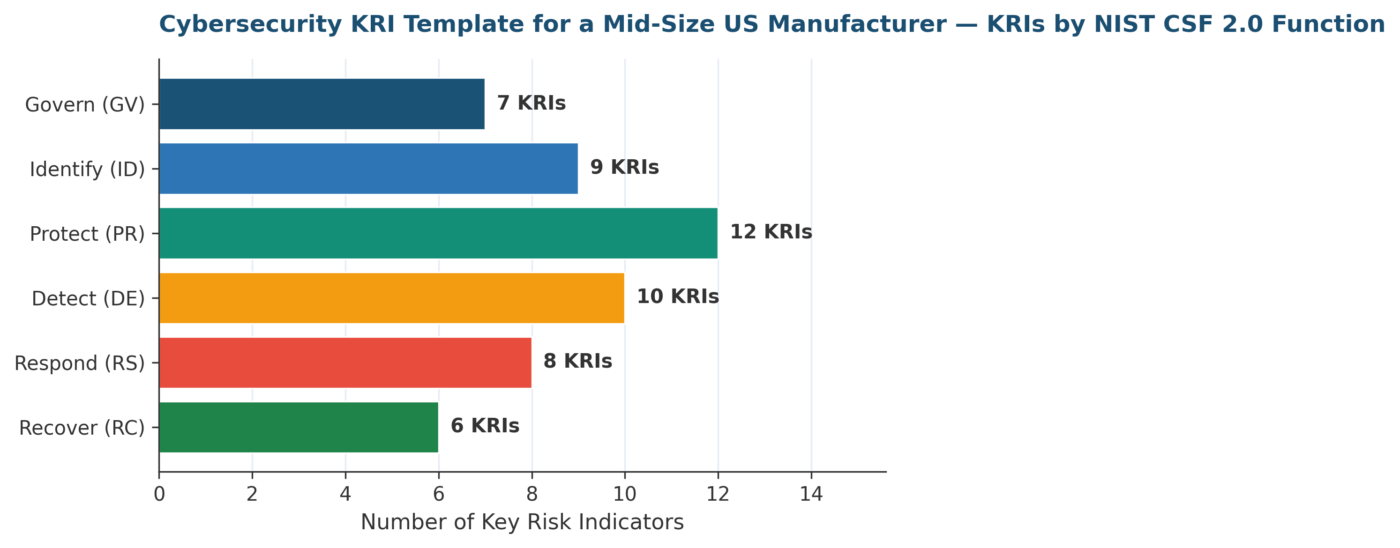
Figure 1. The cybersecurity KRI template by NIST CSF 2.0 function for a mid-size US manufacturer.
Why a Mid-Size US Manufacturer Needs a Cybersecurity KRI Template Right Now
Mid-size US manufacturers, the 100 to 2,500 employee plants that build everything from auto parts to food packaging, sit in the worst attacker math of any segment. They run enough OT to be valuable to ransomware crews, yet rarely have the SOC budget of a Fortune 500. A cybersecurity KRI template is the lowest-cost instrument that closes the visibility gap before an incident escalates.
What the Cybersecurity KRI Template Actually Replaces
Most mid-size manufacturers walk into a board meeting with a SOC dashboard screenshot and a verbal status from the IT manager. Both get replaced by one structured page listing each indicator, current value, threshold band, owner, and escalation rule. Risk Publishing’s library of cyber security KRI examples supplies the underlying indicator definitions the template draws from.
Why Mid-Size Manufacturers Face the Worst Cybersecurity KRI Math
Verizon’s 2025 DBIR confirmed 1,607 manufacturing breaches, nearly twice the prior year, and reported that small and mid-size businesses faced ransomware in 88% of their breaches. IBM X-Force ranked manufacturing the #1 attacked industry for the fourth consecutive year with 26% of all 2024 incidents. The cybersecurity KRI template is how the plant turns that exposure into measured ground.
CISA reported a 75% year-over-year rise in OT-targeted cyberattacks between May 2024 and May 2025, with average losses of $8 million per industrial control system ransomware case. CISA’s August 2025 Foundations for OT Cybersecurity guidance names both IEC 62443 and the NIST CSF as the reference standards for the plant-level visibility the cybersecurity KRI template instruments.
The Cybersecurity KRI Template Inside the Risk Universe
Inside the firm’s broader KRI program, the cyber scorecard is one slice rather than a parallel set of books. The plant cyber posture rolls up to the enterprise risk appetite statement, which in turn rolls up to the board risk committee. Risk Publishing’s primer on key risk indicators in enterprise risk management frames the layering, and the cyber template inherits that hierarchy.
Mapping the Cybersecurity KRI Template to NIST CSF 2.0
Every cybersecurity KRI on the template ties back to one of the six functions in NIST Cybersecurity Framework 2.0. NIST released CSF 2.0 in February 2024 and added Govern as the sixth function, alongside Identify, Protect, Detect, Respond, and Recover. The Manufacturing Profile published the same year tunes those functions for plant operations, OT environments, and the supply chain dependencies a mid-size manufacturer carries.
| CSF 2.0 function | KRIs in template | Example cybersecurity KRIs for a mid-size manufacturer | Primary owner |
| Govern (GV) | 7 | Cyber risk appetite breach count, board cyber session count, third-party cyber assurance coverage, cyber insurance coverage ratio | Chief Risk Officer |
| Identify (ID) | 9 | OT asset inventory coverage %, IT asset inventory coverage %, critical CVE exposure days, shadow IT incident count, supplier criticality tier coverage | Chief Information Security Officer |
| Protect (PR) | 12 | Privileged account MFA coverage %, IT/OT network segmentation index, endpoint EDR coverage %, vendor remote access session count, patch lag for critical OT controllers | IT and OT Security Lead |
| Detect (DE) | 10 | Mean time to detect hours, OT anomaly alert volume, phishing click rate plant staff %, SIEM log coverage %, EDR alert close rate | Security Operations Center |
| Respond (RS) | 8 | Mean time to contain hours, tabletop exercise completion rate, IR plan version age days, ransomware playbook readiness % | Incident Response Lead |
| Recover (RC) | 6 | Backup restore test pass rate %, mean time to restore production hours, supplier backup recovery coverage, post-incident lessons learned closure % | Chief Operating Officer |
Standards the Cybersecurity KRI Template Maps Against
Examiners, cyber insurers, and the board all want to see the cybersecurity KRI template anchored to recognized standards rather than a bespoke spreadsheet.
The mid-size manufacturer template cites five authority sources by name so every KRI on the scorecard traces to a standard a reviewer can verify.
| Authority source | What it anchors in the cybersecurity KRI template | Year referenced |
| NIST Cybersecurity Framework 2.0 | Six-function structure (Govern, Identify, Protect, Detect, Respond, Recover) and KRI taxonomy | 2024 |
| NIST CSF 2.0 Manufacturing Profile | Plant-floor tuning of CSF outcomes, OT and supply-chain priorities for the cybersecurity KRI template | 2024 |
| ISA/IEC 62443 series | Zone and conduit model anchoring Protect-function OT cybersecurity KRIs for the mid-size manufacturer | 2025 update |
| NIST SP 800-82 Revision 3 | OT-specific security controls referenced by Identify and Protect KRIs on the plant floor | 2023 |
| CISA OT Asset Inventory Guidance | Baseline for the OT asset inventory coverage cybersecurity KRI | August 2025 |
| Verizon DBIR and IBM Cost of a Data Breach | Calibration data for Detect, Respond, and Recover KRI thresholds in the cybersecurity KRI template | 2025 |
Govern Function Cybersecurity KRIs for Manufacturers
Govern is the function that signals whether the board owns the cyber program. The cybersecurity KRI template carries seven Govern KRIs in the working manufacturer template: cyber risk appetite breach count, board cyber session count, named cyber owner gap, cyber insurance coverage ratio, third-party cyber assurance coverage, regulatory cyber finding count, and cyber budget execution variance.
These seven indicators answer the question the audit committee asks most often at the quarterly meeting: does the plant have a published cyber risk appetite statement, and is the firm operating inside it? Tie each Govern KRI to the firm’s risk appetite statement so the linkage is auditable rather than narrative.
Identify and Protect Cybersecurity KRIs for the Plant
Identify KRIs answer the simplest and most ignored manufacturing question: do we know what’s plugged into the plant network? The mid-size cybersecurity KRI template tracks OT asset inventory coverage as a single percentage, refreshed monthly from the asset management system, with green at 100%, amber at 90-99%, red below 90%.
On the Protect side, the metrics that matter are MFA on privileged accounts, IT/OT segmentation maturity, EDR coverage, patch lag on critical controllers, and configuration drift. Risk Publishing’s NIST cybersecurity framework KRI catalog lists 40+ NIST CSF 2.0 mapped KRIs the template draws from directly, with the Protect set running the longest at twelve indicators.
Detect, Respond, and Recover Cybersecurity KRIs
This last block of indicators is where mid-size manufacturers recover days from the breach lifecycle. IBM’s 2025 Cost of a Data Breach Report measured 199 days to identify and 73 days to contain in the industrial sector, well above the 194 and 64 day global averages.
Inside Detect, the template watches mean time to detect, SIEM coverage, and EDR alert close rate. The Respond block follows containment hours, tabletop exercise completion, and ransomware playbook readiness. Recover indicators cover backup restore test pass rates, mean time to restore production, and post-incident lessons learned closure.
OT-Specific Cybersecurity KRIs the Plant Floor Cannot Skip
On the shop floor, the template earns shelf space only when it carries OT-specific indicators the IT scorecard ignores. Mid-size US manufacturers run mixes of programmable logic controllers, human-machine interfaces, historians, and engineering workstations. None of these show up in a generic IT KRI set, yet they carry the disruptions that hit the income statement first.
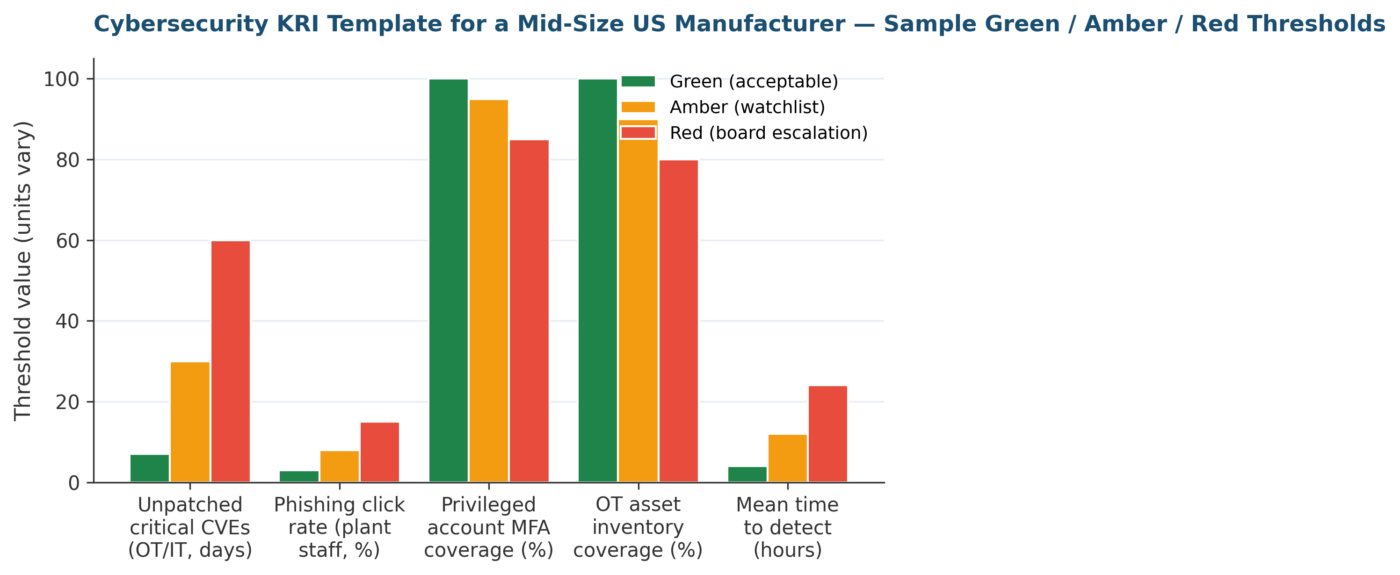
Figure 2. Sample green / amber / red threshold values for five anchor cybersecurity KRIs at a mid-size US manufacturer.
Cybersecurity KRI: OT Asset Inventory Coverage Percentage
OT asset inventory coverage is the first cybersecurity KRI any manufacturer’s template should include. The KRI is the percentage of devices on the OT network that appear in the asset management system, refreshed at least monthly from passive discovery tooling. Green sits at 100%; amber covers the 90 to 99% band; red sits below 90% and triggers a steering group review.
The August 2025 CISA, FBI, and NSA joint guidance Foundations for OT Cybersecurity: Asset Inventory Guidance treats asset inventory as the precondition for every other OT control. That is why the percentage is the first number the board sees each quarter on the scorecard, ahead of patch lag, segmentation maturity, or EDR coverage.
Cybersecurity KRI: Network Segmentation Between IT and OT
Network segmentation is the second pillar cybersecurity KRI on the manufacturer template. The indicator scores the maturity of the firm’s IT to OT separation against the ISA/IEC 62443 zone and conduit model. Green requires defined zones, enforced conduits, and active firewall policy; amber accepts defined zones with partial enforcement; red signals a flat network.
The Clorox 2023 incident showed what happens when segmentation lags. The Tufin teardown of the breach walks the segmentation failure that let the intrusion spread, and the cybersecurity KRI template tracks the same maturity score every quarter so the board sees the trend before an incident closes the gap.
Cybersecurity KRI: Remote and Vendor Access on the Plant Floor
Vendor and remote access is the third pillar OT cybersecurity KRI. The mid-size manufacturer template tracks active vendor remote session count, named vendor jump-host coverage, and session recording completeness.
Green caps active sessions at the named-vendor whitelist; amber accepts up to three exceptions per month; red flags any unmanaged remote desktop into the OT network.
| OT cybersecurity KRI | Unit | Data source | Green / amber / red threshold | KRI owner |
| OT asset inventory coverage | % | Asset management + passive discovery | 100 / 90-99 / <90 | OT Security Lead |
| IT to OT segmentation maturity | 0-5 score | IEC 62443 zone/conduit review | 5 / 3-4 / <3 | Plant IT Manager |
| Critical OT CVE exposure | Days open | Vulnerability scanner + CISA KEV | <=7 / 8-30 / >30 | OT Security Lead |
| Vendor remote sessions outside whitelist | Sessions / month | Jump-host log | 0 / 1-3 / >3 | Plant IT Manager |
| OT EDR / anomaly detection coverage | % | Vendor console | 100 / 80-99 / <80 | Security Operations Center |
| OT-segmented backup restore pass rate | % | Backup vendor restore test log | 100 / 90-99 / <90 | IT Operations |
| Phishing click rate plant staff | % | Phishing platform | <3 / 3-8 / >8 | Chief Information Security Officer |
| Privileged OT account MFA coverage | % | IAM platform | 100 / 95-99 / <95 | Identity Lead |
Setting Green / Amber / Red Thresholds in the Cybersecurity KRI Template
A cybersecurity KRI without calibrated thresholds is a number, not an indicator. The mid-size manufacturer template assigns each KRI a green, amber, and red band based on a defensible mix of regulator guidance, peer benchmarks, and the plant’s own historical baseline. Skipping the calibration leaves the board guessing whether a 92% MFA coverage figure is good news or bad news.
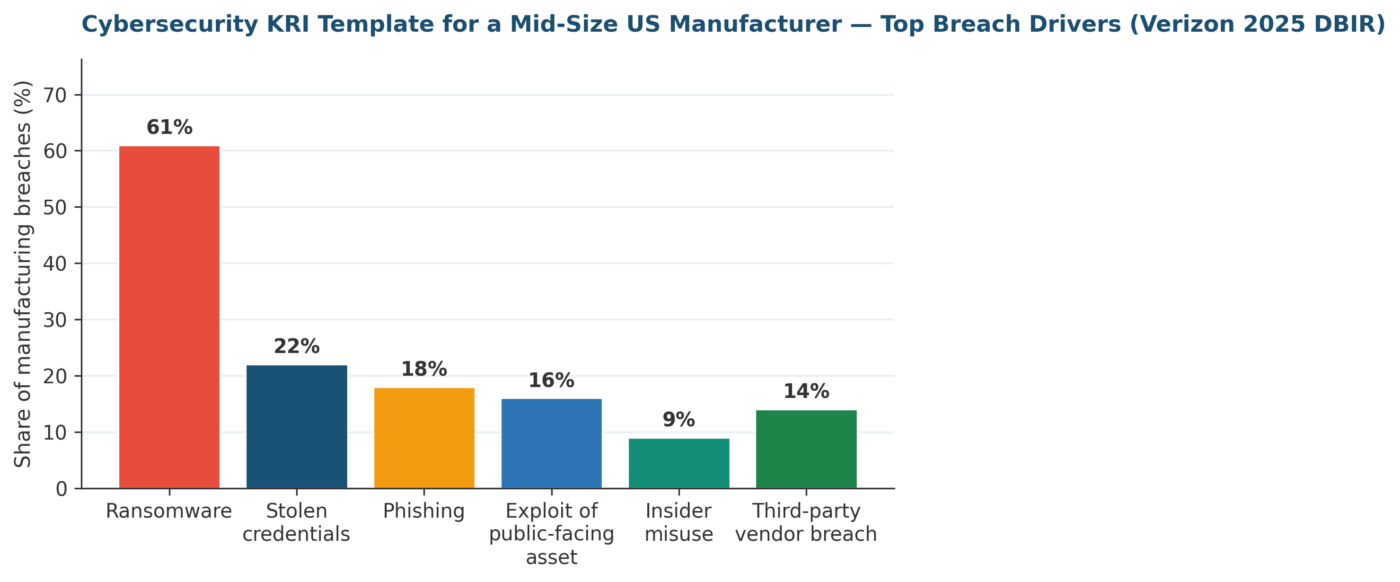
Figure 3. Top breach action vectors for manufacturing per the Verizon 2025 DBIR, the data each cybersecurity KRI threshold band is calibrated against.
Calibrating Cybersecurity KRI Thresholds for a Mid-Size Plant
Calibration starts with two reference points: where the firm operates today, and where peer benchmarks sit. Pull twelve months of historical values for each cybersecurity KRI, plot the distribution, and set amber at the 75th percentile and red at the 95th. Then sanity-check the bands against industry sources before publishing.
The Verizon 2025 DBIR, Mandiant M-Trends 2025, and IBM Cost of a Data Breach 2025 give the industry distributions a mid-size US manufacturer benchmarks against. Detect-function KRIs benchmark to the 11-day Mandiant median dwell time and the 199-day IBM industrial identify window.
When a Cybersecurity KRI Amber Has to Escalate to Red
Escalation logic is where most cybersecurity KRI templates collapse. The mid-size manufacturer template enforces one rule: any KRI sitting amber for two consecutive quarters auto-escalates to red and triggers a steering group paper, with the same paper required for any KRI that flips red in a single quarter.
Without that rule, amber indicators sit unread and the scorecard loses standing with the audit committee. Risk Publishing’s primer on the cyber risk management lifecycle walks the wider escalation cadence the cybersecurity KRI template sits inside, and the cyber steering group minutes should record every escalation decision against the corresponding KRI threshold for the auditor trail.
Tuning the Cybersecurity KRI Thresholds Over Time
Thresholds are not set once. A tuning rule belongs inside every cybersecurity KRI template: review every band annually, and revise sooner if the plant adds a new line, acquires another plant, or absorbs a regulator finding. Tuning prevents the scorecard from drifting into permanent green or permanent red.
Document each tuning decision in the steering group minutes with the data point that triggered the change, the new threshold band, and the practitioner rationale. That audit trail is what shows the cybersecurity KRI template is a live instrument rather than a static spreadsheet, and the trail is what examiners and cyber insurers ask for first during a renewal review.
Reporting Cadence and Ownership for the Cybersecurity KRI Template
A scorecard pays back only when each KRI ships with a cadence, a named owner, and a delivery channel. Mid-size US manufacturers split the cybersecurity KRI template into daily, weekly, monthly, and quarterly slices, each tuned to the audience that can act on the result. The board sees the quarterly roll-up; the plant SOC sees the daily detail.
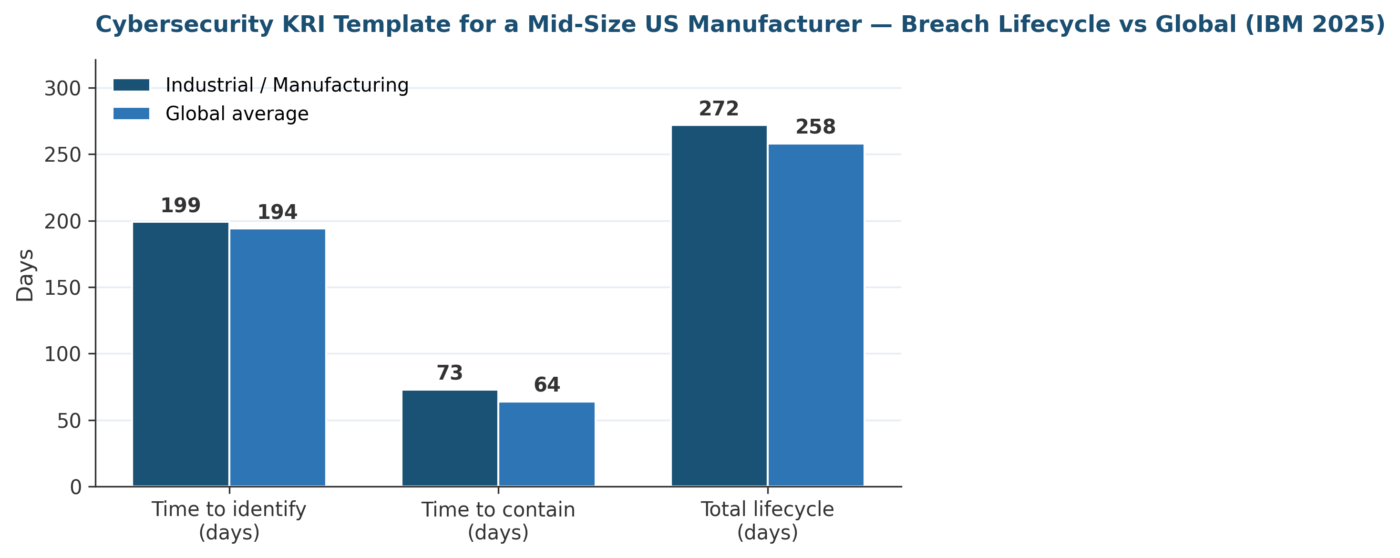
Figure 4. Industrial-sector breach lifecycle versus global average, the gap the cybersecurity KRI template’s Detect function is engineered to close.
Daily, Weekly, Monthly, and Quarterly Cybersecurity KRI Reporting
At the daily cadence, the SOC handover note carries alert volume, EDR alert close rate, phishing click count, and privileged account anomaly count. The weekly review with the plant IT manager covers patch lag, segmentation exceptions, vendor remote session count, and OT inventory drift.
At month-end, the cyber steering group reviews control test pass rate, training completion, tabletop exercise status, and third-party assurance coverage. Each quarter the audit committee sees the full cybersecurity KRI template with twelve-month trend lines, a current value, the threshold band, and the named owner for every indicator on the scorecard.
Who Owns Each Cybersecurity KRI on the Scorecard
Every cybersecurity KRI carries a named accountable executive, not a function. The mid-size manufacturer template names the CISO for IT-anchored KRIs, an OT Security Lead for plant-floor KRIs, the COO for Recover-function KRIs, the CFO for cyber insurance and budget KRIs, and the Chief Risk Officer for Govern-function KRIs.
| Reporting cadence | Audience | Cybersecurity KRIs delivered | Working accountable owner |
| Daily | Plant SOC, IR lead | Alert volume, EDR alert close rate, phishing clicks, privileged account anomalies | Security Operations Center Manager |
| Weekly | Plant IT Manager | Patch lag, segmentation exceptions, vendor remote sessions, OT inventory drift | Plant IT Manager |
| Monthly | Cyber steering group | Control test pass rate, training completion, tabletop status, third-party assurance coverage | Chief Information Security Officer |
| Quarterly | Audit committee, board risk committee | Full cybersecurity KRI template, twelve-month trend lines, escalation log | Chief Risk Officer |
Wiring Cybersecurity KRIs to the Incident Response Plan
Red signals on the cybersecurity KRI template have to trigger the incident response plan rather than another spreadsheet. Tie each red threshold to the corresponding IR playbook step, the named first responder, and the steering group notification rule. Risk Publishing’s guide on incident response plan versus business continuity walks the wider plan the cybersecurity KRI template feeds into.
Pitfalls When Building a Cybersecurity KRI Template at a US Manufacturer
Drafting the cybersecurity KRI template is straightforward; the execution is where most plants stumble. Mid-size US manufacturers tend to make the same six mistakes during rollout, and each of them is foreseeable enough that the design choices below anticipate them rather than leave them to a verbal warning at the kickoff meeting.
| Pitfall | Root cause | Remedy for the cybersecurity KRI template |
| IT-only KRI set with no OT instrumentation | Plant IT team drafts the template without OT Security Lead input | Mandate OT Security Lead co-authorship; require at least eight OT-specific KRIs across Identify, Protect, and Detect |
| Unbounded KRI count (40+ on the scorecard) | Risk function adds every measurable indicator without filtering | Cap the template at 35 KRIs total; route the rest into operational dashboards owned by the SOC |
| Thresholds set by gut feel | No twelve-month baseline, no peer benchmark | Require historical distribution (P75 amber, P95 red) and at least one external benchmark per cybersecurity KRI |
| No named KRI owner | Function-level ownership (‘IT owns this’) with no accountable executive | Require named executive on every row; rotate at most annually with handover sign-off |
| Amber KRIs sit amber for four quarters | No auto-escalation rule baked into the cybersecurity KRI template | Auto-escalate any KRI sitting amber for two consecutive quarters; trigger steering paper and remediation owner |
| No tie between cybersecurity KRI and incident response | Scorecard treated as reporting artifact, not management instrument | Wire each red threshold to the corresponding IR playbook step, named first responder, and SLA |
| Scorecard refreshed annually, not quarterly | Treated as compliance exhibit rather than operating instrument | Refresh the cybersecurity KRI template every quarter with a rolling twelve-month trend per KRI |
Frequently Asked Questions About the Cybersecurity KRI Template
How many KRIs should the cybersecurity KRI template carry for a mid-size US manufacturer?
A defensible cybersecurity KRI template carries 28 to 35 active KRIs across the six NIST CSF 2.0 functions. Below 28 the template tends to miss either OT or Govern coverage; above 35 the audit committee stops reading. The working template ships 30 KRIs and routes operational detail into separate SOC dashboards.
Does the cybersecurity KRI template need to align with NIST CSF 2.0 or IEC 62443?
Both. NIST CSF 2.0 provides the function-level structure (Govern through Recover) the cybersecurity KRI template inherits, and IEC 62443 provides the OT-specific zone and conduit model that anchors the Protect-function KRIs on the plant floor. Mid-size US manufacturers cite both in the scorecard introduction.
Who should own the cybersecurity KRI template at a mid-size manufacturer?
The Chief Risk Officer or Chief Information Security Officer owns the scorecard as a whole, with the Plant OT Security Lead co-signing the OT-specific KRIs. Every individual cybersecurity KRI on the template carries a named accountable executive. Function-level ownership without a name is the single most common pitfall.
How often should a mid-size manufacturer refresh its cybersecurity KRI template?
Refresh the cybersecurity KRI template at four cadences: daily SOC handover, weekly plant IT manager review, monthly steering group, and quarterly audit committee. Tune the thresholds annually unless a major event (new line, acquisition, regulator finding) forces an earlier review.
What KRIs in the cybersecurity KRI template matter most to cyber insurers?
Cyber insurers prioritize MFA coverage on privileged accounts, EDR coverage, segmented backup restore test pass rate, patch lag on internet-facing assets, and tabletop exercise completion. Mid-size manufacturers should highlight those five KRIs in the cybersecurity KRI template before renewal to support favorable pricing.
Where do supply-chain KRIs fit in the cybersecurity KRI template?
Supply-chain cybersecurity KRIs sit inside the Govern and Identify functions: third-party cyber assurance coverage, supplier criticality tier coverage, and vendor remote access exception count. Risk Publishing’s cyber supply chain risk management plan walks the wider supplier program the KRI template instruments.
How does the cybersecurity KRI template tie into the firm’s risk appetite statement?
Every cybersecurity KRI on the template traces to a specific clause in the cyber risk appetite statement. The appetite clause might read ‘we tolerate no critical OT controller patch lag beyond thirty days’; the corresponding KRI is the days-open count, with red set at 30. Without that linkage the scorecard reads as IT metrics rather than risk.
Looking Ahead: Cybersecurity KRI Template Trends for 2026-2027
Three forces will reshape the cybersecurity KRI template at mid-size US manufacturers between 2026 and 2027. The first is AI-driven detection. IBM’s 2025 Cost of a Data Breach Report found that organizations using AI and automation extensively shortened breach lifecycle by 80 days and saved $1.9 million per incident. The scorecard will need new Detect-function KRIs measuring AI model coverage, false positive rate, and analyst override rate by 2027.
The second force is OT-specific regulator pressure. CISA’s August 2025 OT asset inventory guidance, the NIST CSF 2.0 Manufacturing Profile, and the May 2025 OT joint guidance from CISA, FBI, and the UK NCSC have moved OT cybersecurity KRIs from optional to baseline. Insurers and auditors will treat the OT KRI block as a precondition for clean cyber coverage by 2026.
The third force is third-party and supply-chain risk. Verizon’s 2025 DBIR reported manufacturing espionage-motivated breaches climbing from 3% to 20% of incidents, a near-sixfold rise. Expect the cybersecurity KRI template to carry more supplier-driven indicators (SBOM coverage, fourth-party concentration, supplier breach disclosure latency) by the 2027 board cycle.
The mid-size US manufacturer that ships a 30-KRI cybersecurity KRI template today, refreshes it quarterly, and wires its red signals to the IR plan is the one that will absorb those three forces with the smallest scorecard rewrite. The template is the visible artifact. The underlying discipline carries the program forward: quarterly refresh, named owners, and red-signal escalation.
Infographic: Cybersecurity KRI Template Numbers Every Mid-Size Plant Should Know
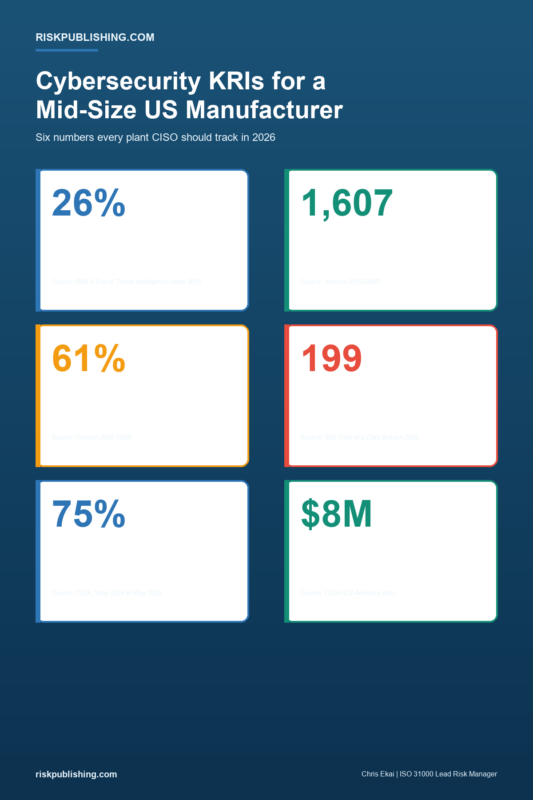
Figure 5. The six numbers shaping the cybersecurity KRI template for a mid-size US manufacturer in 2026.
Next Steps With the Cybersecurity KRI Template
Risk Publishing helps US manufacturers translate the NIST CSF 2.0 functions and IEC 62443 zones into a working cybersecurity KRI template the board reads quarterly. Review the advisory services page to see how the engagement runs, and contact the practice when the plant cyber scorecard is the next item on the

Chris Ekai is a Risk Management expert with over 10 years of experience in the field. He has a Master’s(MSc) degree in Risk Management from University of Portsmouth and is a CPA and Finance professional. He currently works as a Content Manager at Risk Publishing, writing about Enterprise Risk Management, Business Continuity Management and Project Management.