On March 10, 2023, the FDIC closed Silicon Valley Bank after a 36-hour deposit run that erased $42 billion. The Federal Reserve’s April 2023 supervisory review found that SVB’s quarterly risk packs tracked deposit concentration and unrealized AFS securities losses, but the KRI scorecard never forced the board to act when those thresholds breached.
The lesson reset every US bank’s view of what a KRI scorecard has to do. This guide on How to Build a KRI Scorecard walks US risk teams through the exact seven-step template that converts a lagging risk register into a board-grade governance instrument.
| The Practitioner Cheat Sheet on How to Build a KRI Scorecard |
| A KRI scorecard is the single board-facing instrument that translates a firm’s risk register into a small set of calibrated, threshold-aware measures with named owners and escalation rules. The scorecard is what the audit committee reads at the start of every quarterly meeting. |
| Silicon Valley Bank’s March 2023 collapse turned the KRI scorecard from a nice-to-have into a regulator priority. The Federal Reserve’s April 2023 supervisory review found that SVB’s risk metrics tracked the right exposures but never forced board action when thresholds breached. A KRI scorecard without escalation logic is decoration. |
| Deloitte’s 2025 Global Risk Management Survey found that 72% of US financial-services firms are expanding KRI use, with 58% of boards now reviewing a formal KRI scorecard at least quarterly. Mature scorecards cut average risk-event response time by 40-60% versus ad-hoc reporting. |
| Build a KRI scorecard in seven steps: pick the risk categories, define the indicators, set the thresholds, name the owners, document the data sources, design the visual layout, and wire in the escalation rules. Skipping any step breaks the chain that makes the scorecard useful. |
| A working US enterprise KRI scorecard usually carries 18-25 active indicators across six categories: operational (22%), financial (20%), cyber and technology (18%), compliance and regulatory (14%), people and culture (14%), and third-party and vendor (12%). Above 25 KRIs the scorecard loses board attention. |
| RAG (red-amber-green) threshold bands remain the universal language. Calibrate amber tightly (3-5% from target) for high-criticality KRIs like days cash on hand or critical patch lag; calibrate loose (10-20%) for noisy KRIs like customer churn or talent attrition. Document the calibration logic, not just the numbers. |
| Escalation rules are the make-or-break layer. Every red KRI must trigger a named action within a defined window: a committee meeting, a board paper, a remediation owner, a follow-up date. Without the rule, red lights become wallpaper and the scorecard loses standing with the board. |
A KRI scorecard is the single board-facing instrument that compresses a firm’s risk register into a small set of calibrated, threshold-aware measures with named owners and escalation rules.
Deloitte’s 2025 Global Risk Management Survey found 72% of US financial-services firms are expanding KRI use, and 58% of boards now review a formal KRI scorecard quarterly. This piece gives US risk leaders the seven-step template the strongest programs actually ship. How to Build a KRI Scorecard now sits at the center of US risk programs.
The KRI scorecard sits inside an enterprise risk management framework and maps cleanly to ISO 31000:2018, COSO ERM 2017, the Basel Committee Principles for Operational Risk, and the OCC’s heightened standards for large national banks under 12 CFR Part 30, Appendix D. Examiners now treat the scorecard as the working evidence that the firm operates inside its stated risk appetite.
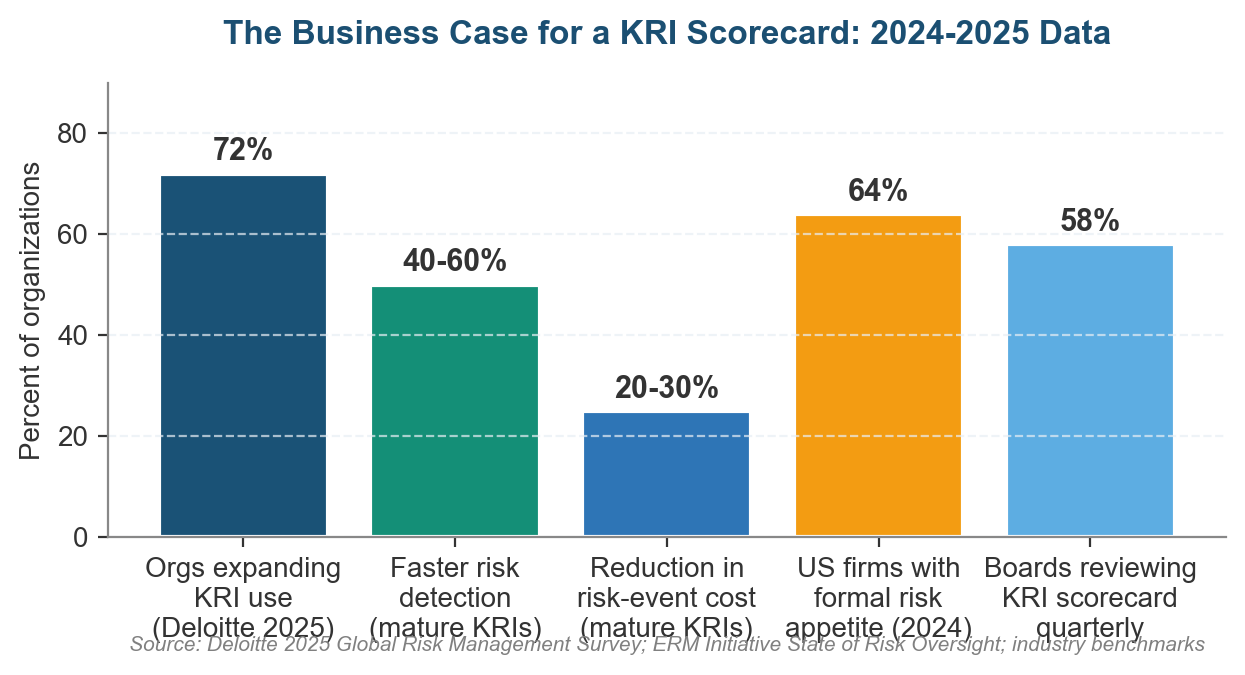
Figure 1. The 2024-2025 business case data US risk teams cite when proposing a KRI scorecard build.
What a KRI Scorecard Actually Does for the Board
Strip away the visuals and a KRI scorecard does one job: it makes the firm’s risk position legible to the people who govern the firm.
The scorecard takes the long-form risk register, picks the small number of measures that matter most, scores each against a calibrated threshold, and presents the result in a layout a director can read in three minutes. Every section of How to Build a KRI Scorecard returns to this readability test.
The Working Definition of a KRI Scorecard
A KRI scorecard is a structured one-page or two-page summary listing each key risk indicator, the current value, the amber and red thresholds, the trend versus the prior period, and the named owner. The scorecard sits above the operational dashboards and below the firm-level risk appetite statement. How to Build a KRI Scorecard that fits this one-page-plus-commentary format is the rule of thumb US risk leaders ship.
Each row also carries the action triggered when an indicator turns amber or red, which is what makes the scorecard a working management instrument rather than a passive report. Risk Publishing’s primer on what a key risk indicator is carries the underlying definition the KRI scorecard depends on. How to Build a KRI Scorecard well comes down to making those triggers explicit.
Why a KRI Scorecard Beats a Risk Register Excerpt
A risk register catalogs every identified risk; a KRI scorecard catalogs the small number of indicators that signal whether those risks are trending in or out of appetite. Directors do not have time to read a 200-row register at a quarterly meeting. Anyone planning How to Build a KRI Scorecard starts by stripping the register down to its signal layer.
A 20-line KRI scorecard with calibrated thresholds and named owners is what fits the 45-minute risk slot on a board agenda. Pair the scorecard with the key elements of a risk register so the underlying register stays intact for management use without crowding the board view. Knowing How to Build a KRI Scorecard at this size is what separates a working board pack from a paper exercise.
How a KRI Scorecard Aligns with Risk Appetite
Every KRI on a defensible scorecard ties back to a clause in the firm’s risk appetite statement. The appetite statement says “we will not exceed a 14-day AML alert backlog”; the scorecard tracks the current backlog against amber and red thresholds derived from that clause. The OCC Heightened Standards under 12 CFR Part 30, Appendix D treat that linkage as a baseline expectation for covered US banks. This appetite linkage is what separates a defensible How to Build a KRI Scorecard exercise from a vanity dashboard.
How to Build a KRI Scorecard Step 1: Pick the Risk Categories
Step one in the KRI scorecard build is picking the six to eight risk categories the scorecard will cover. Most US enterprise programs land on operational, financial, cyber and technology, compliance and regulatory, people and culture, and third-party and vendor. Strategic and ESG risk often join as supplemental categories on the audit committee version of the scorecard. Knowing How to Build a KRI Scorecard starts with this category map, which sets the structural ceiling for every later step.
| KRI scorecard category | Typical share | Example KRIs | Primary owner |
| Operational risk | 20-25% | MTTR per critical system, incident count, transaction error rate, process exception count | Chief Operating Officer |
| Financial risk | 18-22% | Days cash on hand, liquidity coverage ratio, NPL ratio, concentration limit usage | Chief Financial Officer |
| Cyber and technology | 15-20% | Critical patch lag, MTTR security incidents, phishing click rate, privileged account count | Chief Information Security Officer |
| Compliance and regulatory | 12-16% | AML alert backlog, SAR filing lag, control break count, regulatory fine count | Chief Compliance Officer |
| People and culture | 12-16% | Voluntary attrition, training completion, ethics hotline volume, conduct incident count | Chief Human Resources Officer |
| Third-party and vendor | 10-14% | Critical vendor outage hours, contract expiry past 90 days, fourth-party concentration | Chief Procurement Officer |
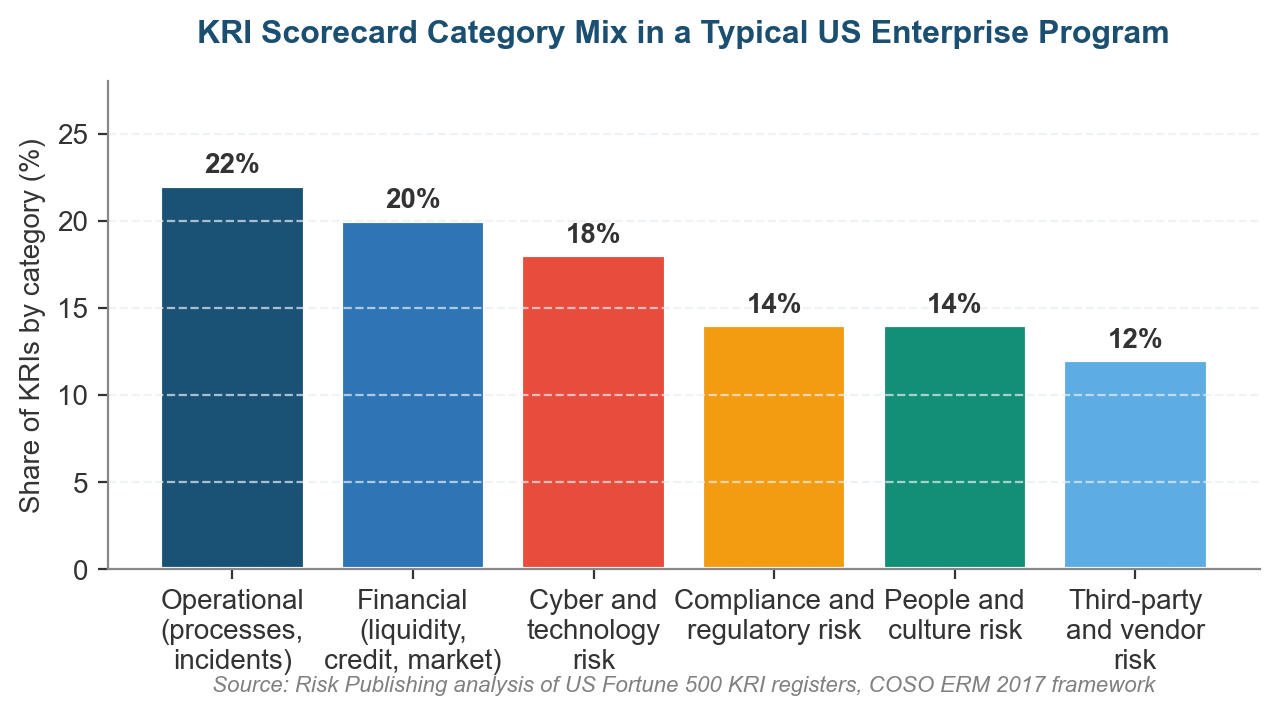
Figure 2. KRI scorecard category mix observed across US Fortune 500 risk programs in 2024-2025.
How Many KRI Scorecard Categories Is Too Many?
Eight categories is the practical ceiling for a board-facing KRI scorecard. Above eight, directors stop reading the section breaks and the scorecard reads as a long list rather than a structured view of risk, which defeats the entire reason the board commissioned the instrument in the first place. Anyone studying How to Build a KRI Scorecard should treat this ceiling as a hard rule.
Most US programs land on six categories at maturity. Strategic risk, ESG risk, and reputational risk are typically the three categories US firms add last as the underlying KRI scorecard discipline strengthens and additional executive sponsors join the second-line steering group. Teams progressing through How to Build a KRI Scorecard usually graduate to seven or eight categories only after the original six stabilize.
Mapping KRI Scorecard Categories to the Risk Universe
The categories on a defensible KRI scorecard must trace back to the firm’s full risk universe rather than the loudest issues on the second-line desk. Pull the COSO ERM 2017 framework and tag every risk in the register to one of the active scorecard categories before publishing. How to Build a KRI Scorecard that examiners accept depends on this clean trace to the underlying register.
Risks that do not fit any category are a signal to add a category, not a signal to skip the risk. The clean mapping is what gives examiners confidence that the KRI scorecard covers the underlying universe rather than just the loudest issues on the desk that quarter. How to Build a KRI Scorecard that maps cleanly to the universe is the standard examiners look for.
How to Build a KRI Scorecard Step 2: Define the Indicators
Step two takes each category and picks the two to four indicators that best signal whether the underlying risk is in appetite. A defensible KRI scorecard runs 18 to 25 active indicators in total.
Below 18 the scorecard misses categories; above 25 directors stop reading. The selection rule: every indicator must be specific, measurable, sourced from a system of record, and tied to a board-level appetite clause. How to Build a KRI Scorecard inside this 18-25 range keeps directors engaged.
What Makes a Good KRI Scorecard Indicator
A good KRI scorecard indicator passes four tests. It is leading rather than purely lagging where possible, sourced from a system of record rather than a spreadsheet, backed by at least twelve months of defensible historical baseline, and owned by a named accountable executive. These four tests sit at the center of How to Build a KRI Scorecard that examiners will respect.
Cyber patch lag predicts breach; loss-event count only confirms it. Claims systems, the general ledger, ITSM, and HRIS are the typical systems of record. How to develop key risk indicators walks the underlying selection logic in more depth for US risk teams. How to Build a KRI Scorecard that the audit committee trusts means weighting leading indicators like patch lag.
Leading vs Lagging KRI Scorecard Indicators
Leading KRIs predict where risk is heading; lagging KRIs confirm where it has already been. A mature KRI scorecard runs roughly 60% leading and 40% lagging indicators across the register, calibrated to give the board enough early warning to redirect resources before a loss event hits the income statement. Mastering How to Build a KRI Scorecard means getting this leading-versus-lagging mix right.
Days cash on hand is leading; liquidity event count is lagging. The mix matters because a KRI scorecard weighted toward lagging measures only confirms the loss events the firm has already taken, leaving the board with no early window in which to redirect resources or escalate. How to Build a KRI Scorecard that the board can act on rests on this leading-lagging balance.
How to Build a KRI Scorecard Step 3: Set the Thresholds
Threshold setting carries more examiner weight than any other step in the KRI scorecard build under the OCC heightened standards. The art of How to Build a KRI Scorecard centers on this threshold step more than any other.
For each indicator on the register, set an amber threshold for early warning and a red threshold for breach of appetite, and document both against the underlying clause in the firm’s appetite statement. How to Build a KRI Scorecard with traceable thresholds depends on documenting both bands against the appetite clause.
Threshold values come from three sources: the risk appetite statement, the firm’s historical baseline, and external benchmarks where they exist. Document the source for every threshold so the audit committee can trace the logic on the scorecard back to the underlying appetite clause without asking. How to Build a KRI Scorecard with defensible thresholds depends on documenting each source.
| KRI | Target | Amber band | Red band | Threshold source |
| Critical patch lag past 30 days | <2% | 2-5% | >5% | Equifax 2017 lessons learned; NIST CSF 2.0 |
| AML alert backlog (days) | <7 days | 7-14 days | >14 days | FinCEN guidance; FFIEC BSA/AML Exam Manual |
| Days cash on hand | >90 days | 60-90 days | <60 days | Treasury policy; rating agency baseline |
| Voluntary attrition (annualized) | <10% | 10-15% | >15% | BLS US average; HRIS 24-month baseline |
| MTTR critical system (hours) | <4 hours | 4-8 hours | >8 hours | SRE practice; SLA commitment |
| Third-party concentration | <25% | 25-40% | >40% | OCC Bulletin 2023-17; FFIEC TPRM |
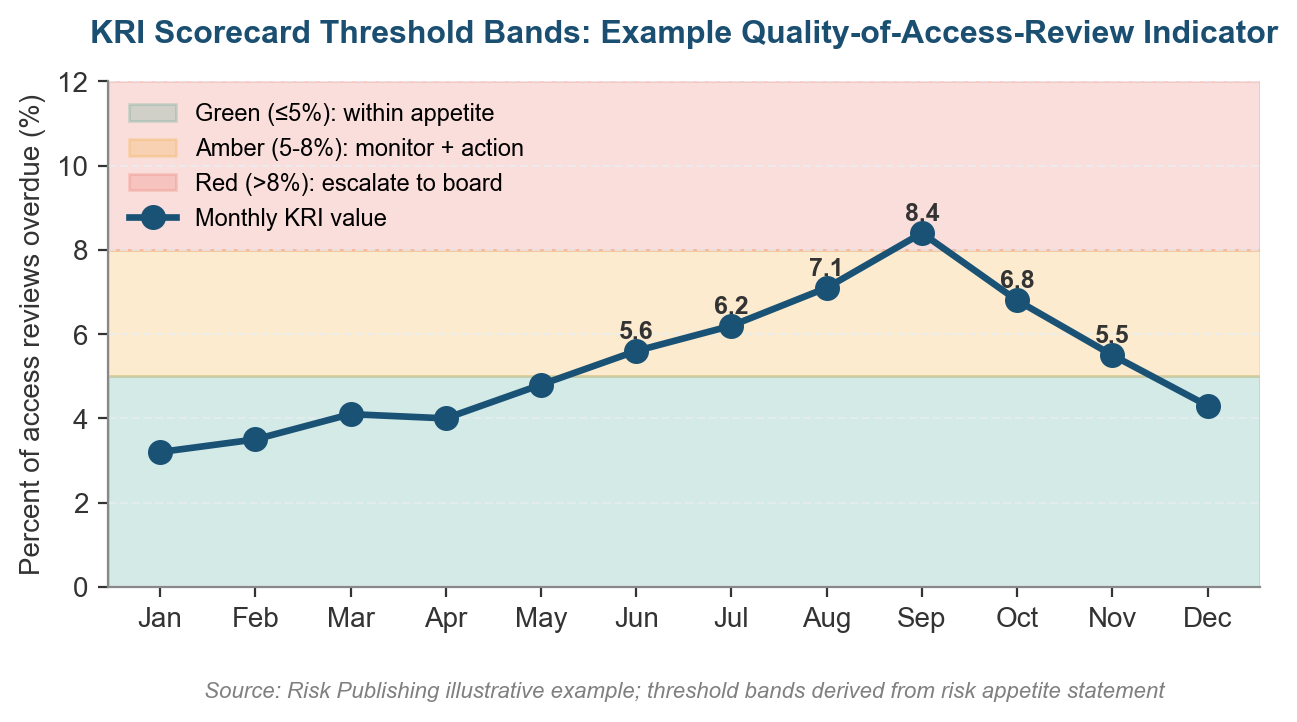
Figure 3. KRI scorecard threshold band logic with the RAG calibration ranges US risk teams use across high-criticality and noisy KRIs.
How Tight Should KRI Scorecard Thresholds Be?
Threshold tightness on the KRI scorecard depends on KRI volatility and criticality. Set amber tight (within 3-5% of target) for high-criticality KRIs where speed of response matters most: days cash on hand, critical patch lag, intraday liquidity coverage, and counterparty concentration. This calibration choice is one of the highest-leverage decisions in How to Build a KRI Scorecard.
Set amber looser (10-20%) for noisy KRIs where short-term variation is normal: customer churn, NPS, talent attrition. Document the rationale in a Threshold Calibration memo alongside the scorecard, not just the numeric values, so the audit committee can challenge the logic without rebuilding it.
Recalibrating the KRI Scorecard Thresholds
Thresholds drift as the business changes, and an unrecalibrated KRI scorecard slowly loses signal. Rebase every threshold annually at minimum, and immediately after any material change in business model, strategy, regulatory expectation, or operating footprint that shifts the underlying risk exposure.
The OCC Heightened Standards require board approval of the risk appetite statement at least annually; treat the scorecard threshold review as part of the same cycle. Save the prior thresholds in a versioned register so internal audit can trace any calibration shift back to the underlying decision.
How to Build a KRI Scorecard Step 4: Name the Owners
Step four assigns a named accountable executive to every KRI on the scorecard, and the rigor of the naming step shows up in every regulator examination. “The Compliance function” is not an owner; “the Chief Compliance Officer” is, and the swap is the difference between a defensible KRI scorecard and one examiners flag.
Owners sign off on threshold calibration, certify the underlying data, and present remediation plans for any red KRI to the executive risk committee. The named owner is what turns the KRI scorecard from a passive report into an accountability instrument the board can lean on quarter after quarter.
The Three Lines Model and KRI Scorecard Ownership
Use the IIA Three Lines Model to split scorecard ownership cleanly. First line owns the KRI value (the operating unit measures what it does); second line owns the methodology and calibration (the risk function sets the rules); third line audits both. Internal audit reviews the scorecard methodology at least biennially against the firm’s risk appetite framework.
Reporting Cadence by KRI Scorecard Owner
Every named owner on the KRI scorecard reports to the executive risk committee monthly and to the board risk committee quarterly, with the audit committee receiving the same view in parallel for a governance lens. Red KRIs trigger an interim escalation paper within five business days, separate from the standing cycle.
The cadence matters: a quarterly-only review misses the breach window for KRIs like cyber MTTR and intraday liquidity. The audit committee version of the KRI scorecard adds a separate semi-annual methodology review on the second-line scoring rules so the board sees how the underlying logic is governed.
How to Build a KRI Scorecard Step 5: Document the Data Sources
Data documentation is the unglamorous but examiner-critical part of the KRI scorecard build. For each indicator, document the source system, the data owner, the calculation rule, the refresh cadence, and the lineage chain.
The Federal Reserve SR 11-7 model risk guidance sets the precedent: any number that drives a board decision must be traceable to a source-system record without manual reconstruction.
Source Systems for KRI Scorecard Data
Most KRIs on a US enterprise scorecard pull from six source systems: the general ledger and treasury management system, the ITSM platform, the GRC tool, the HRIS, the vendor management system, and the case management system.
The FFIEC Information Technology Examination Handbook treats source-of-record integrity as a baseline expectation for any indicator that drives a board decision.
Data Quality Controls Behind the KRI Scorecard
Every KRI on the scorecard needs three data-quality controls: a source-system reconciliation, an automated completeness check, and a quarterly attestation from the data owner. Without those controls, the scorecard exposes the second line to a different risk: presenting numbers that examiners can disprove. Build the controls inside the data pipeline, not as a separate audit pass.
How to Build a KRI Scorecard Step 6: Design the Visual Layout
Design comes next, and the layout choices determine whether directors actually read the KRI scorecard. For inspiration, see dashboard formats boards actually read.
The board version fits on one or two pages with a consistent column layout: KRI name, current value, amber and red thresholds, RAG status, trend arrow, named owner, and the action triggered on any amber or red. Skip speedometer gauges and 3D effects, which read worse than a clean table.
The One-Page KRI Scorecard Layout
The one-page KRI scorecard works for executive summaries and audit committee covers. Group by category, render each KRI on its own row, and use color sparingly: RAG dots in the status column, navy header bands, white and light blue alternating rows.
The Risk Publishing key risk indicators dashboard guide covers the visualization conventions in more depth.
The Two-Page KRI Scorecard Layout
The two-page KRI scorecard adds a commentary column on page two: brief narrative for every amber and red KRI explaining the cause, the remediation plan, the owner, and the target resolution date.
The audit committee version of the scorecard almost always uses the two-page format because the commentary is the part that drives discussion. Restrict the commentary to two sentences per KRI; longer write-ups belong in the underlying paper.
How to Build a KRI Scorecard Step 7: Wire In the Escalation Rules
Step seven is the rule that turns the KRI scorecard from a passive instrument into a working management surface. Every amber KRI triggers a defined action within five business days; every red KRI triggers a board-level paper within ten business days.
Without the rule, the scorecard becomes wallpaper and red lights stop changing behavior. The escalation matrix lives next to the KRI scorecard in the board pack so directors can see the action chain attached to each indicator without flipping pages or asking the chief risk officer mid-meeting.
| RAG status | Trigger | Required action | Owner accountable |
| Green | KRI within target band | Monthly committee report; no separate paper | First-line process owner |
| Amber | KRI breaches amber threshold for 1 period | Email alert to second line + executive risk committee briefing in 5 business days | First-line KRI owner |
| Amber sustained | KRI in amber for 2 consecutive periods | Remediation plan presented to executive risk committee within 10 business days | Named accountable executive |
| Red | KRI breaches red threshold for 1 period | Board risk committee paper within 10 business days + interim board notification | Named accountable executive + CRO |
| Red sustained | KRI in red for 2 consecutive periods | Full board paper + external auditor notification + 30-day cure plan | CEO + CRO jointly |
| Threshold breach near miss | KRI within 5% of amber for 2 periods | Second-line review of calibration + early-warning briefing | Chief Risk Officer |
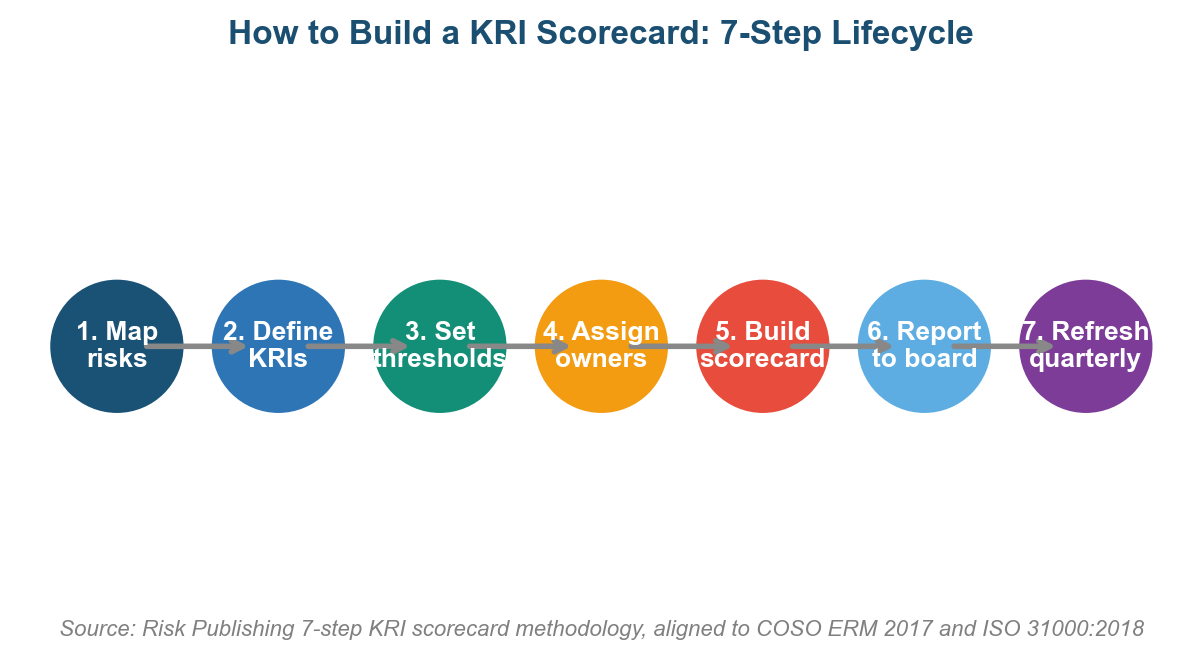
Figure 4. KRI scorecard lifecycle from monthly measurement through quarterly board review to annual recalibration.
Worked Example: How to Build a KRI Scorecard for a Mid-Cap US Bank
Picture a $40 billion US regional bank board pack for the Q1 2026 risk committee meeting. The KRI scorecard runs 22 active indicators across six categories, with two sitting red and three sitting amber heading into the quarter, and the chief risk officer has eight minutes of board time to walk the breaches. This worked example shows How to Build a KRI Scorecard under live regulator scrutiny.
The reds are critical patch lag past 30 days at 6.2% (red threshold 5%) and AML alert backlog at 16 days (red threshold 14 days). The board risk committee receives a separate paper for each red KRI within ten business days, naming the owner, the cause, and the cure timeline against the firm’s appetite statement.
The cyber red triggers a CISO-led paper covering the root cause (a Q4 2025 SCCM migration that left 1,200 endpoints orphaned), the remediation plan (30-day patch sprint with third-party assist), and the threshold reset proposal to drop red from 5% to 4% once the sprint completes.
The AML red triggers a CCO paper covering the alert-system tuning change that produced the spike, the SAR-filing surge plan, and the OCC notification under the bank’s heightened-standards obligation. Both papers carry a 30-day cure target and a follow-up date on the audit committee calendar.
Three months later the Q2 KRI scorecard shows both red KRIs back in amber with the cure plans on track. The audit committee notes the closed-loop response approvingly in the meeting minutes, and the board cites the scorecard in its annual self-assessment as evidence that risk governance is working.
The same pattern shows up across US bank examination cycles when the OCC Semiannual Risk Perspective rates a bank’s risk culture as effective. Examiners reward closed-loop evidence over slick presentation every time, and a working KRI scorecard is the cleanest place to find it.
Frequently Asked Questions About How to Build a KRI Scorecard
How many KRIs are needed when figuring out How to Build a KRI Scorecard?
A working US enterprise KRI scorecard carries 18 to 25 indicators across six categories on the board view. Below 18 the scorecard misses categories and directors lose confidence in coverage; above 25 the visual layout breaks and directors stop reading the deeper rows, which is the failure mode the discipline is designed to avoid.
Most Fortune 500 firms land at 22 active KRIs on the board version. Operational sub-dashboards handle the detail that does not need board attention each quarter, with drill-through paths back to the source-system records for any indicator the audit committee chooses to challenge.
How often should a KRI scorecard be refreshed for the board?
Refresh the KRI scorecard for the executive risk committee monthly and for the board risk committee quarterly. Cyber and intraday liquidity KRIs refresh more frequently inside the underlying dashboard, but the board version stays on the quarterly cadence to match the meeting cycle. Red KRIs always trigger an interim escalation paper between scheduled meetings.
Who owns the KRI scorecard in a US firm?
The Chief Risk Officer owns the KRI scorecard methodology and presents the scorecard to the board risk committee. Each KRI on the scorecard has its own named accountable executive (CFO, CISO, CCO, CHRO, COO, CPO) who certifies the value and presents remediation for any red breach. Internal audit reviews the methodology biennially as part of the third-line cycle.
Does the KRI scorecard satisfy the OCC Heightened Standards?
A defensible KRI scorecard is a core artifact the OCC reviews when assessing compliance with 12 CFR Part 30, Appendix D.
The scorecard demonstrates that the firm tracks risk against the appetite statement with quantitative limits, names accountable executives, and escalates breaches. Banks below the heightened-standards threshold still benefit from the same scorecard discipline because it is what examiners look for under broader supervisory review.
What are the most common mistakes in How to Build a KRI Scorecard?
Three mistakes dominate the failed KRI scorecard builds we review. Putting every measure on the scorecard rather than the 18 to 25 that drive board decisions, hardcoding thresholds inside the dashboard rather than tying them to the risk appetite statement, and skipping the escalation rules so red KRIs stay informational rather than action-triggering.
How does a KRI scorecard differ from a KPI scorecard?
A KPI scorecard tracks operational performance against business targets such as revenue, margin, and customer growth. A KRI scorecard tracks risk exposure against appetite thresholds such as loss events, control breaches, regulatory breaches, and capital adequacy, with thresholds tied to the firm’s risk appetite statement rather than to performance budgets.
The two scorecards share design conventions but serve different audiences: KPI scorecards feed the executive performance review while KRI scorecards feed the board risk committee. Risk Publishing on key risk indicators in enterprise risk management carries the distinction in more depth for US risk teams.
How should small firms approach a KRI scorecard build?
Small US firms can run a credible KRI scorecard with 10 to 12 indicators across four categories: financial, operational, compliance, and cyber.
The seven-step build stays the same, but the data sources lean more on the GL, the ITSM tool, and the GRC platform than on enterprise warehouses. Start with the appetite statement, pick the smallest set of measures that signal breach, and document the calibration.
Common Pitfalls When Building a KRI Scorecard
| Pitfall | Root cause | Remedy |
| KRI count over 25 on the board scorecard | Second line adds every measure stakeholders request | Split into a board scorecard (18-25 KRIs) and operational sub-dashboards. Move detail KRIs off the board view. |
| Thresholds set without ties to risk appetite | Initial build copied benchmarks rather than the firm’s appetite | Trace each threshold to a clause in the appetite statement. Document the linkage in a Calibration Memo. |
| No named accountable executive per KRI | Ownership written as a function (“Compliance”) rather than a person | Replace function names with role titles (“Chief Compliance Officer”). Refresh after every executive change. |
| Manual data feeds for board KRIs | Source systems were not ready when the scorecard launched | Move every board KRI to a system-of-record automated feed before the next annual cycle. |
| Escalation rules missing or undocumented | Build prioritized the visual layer over the action layer | Publish an escalation matrix alongside the scorecard. Tie each RAG status to a defined action and owner. |
| Calibration drifts after annual review | No formal recalibration cadence | Calendar an annual threshold recalibration tied to the appetite statement review. Save prior thresholds. |
| Scorecard treated as audit committee artifact only | Board risk committee version never built | Maintain two versions: audit committee (governance focus) and board risk committee (active risk focus). |
Looking Ahead: How to Build a KRI Scorecard for 2026-2028 Trends
Three forces will reshape the KRI scorecard over the next two years. The first is real-time KRI streaming, with Microsoft Fabric Event Streams launched in 2024 letting cyber and treasury KRIs refresh every few seconds rather than every few hours. These shifts change How to Build a KRI Scorecard for the next examination cycle.
US boards will expect material KRI breaches to surface inside the same business day, not at the next quarterly meeting. The closer that refresh cadence gets to the underlying risk, the more the KRI scorecard moves from a periodic artifact toward a continuous management surface examiners can review on demand.
The second force is regulatory pressure. The OCC’s Spring 2025 Semiannual Risk Perspective flagged cyber, third-party concentration, and credit-quality KRIs as elevated supervisory priorities.
The 2026 examination cycle will press large national banks harder on the linkage between the appetite statement and the scorecard thresholds, and on the escalation evidence in board minutes.
The third force is AI in the second line. Natural-language KRI exploration moves from preview to general availability across 2026, with the NIST AI Risk Management Framework setting the validation baseline that examiners now expect on the scorecard’s data dictionary alongside the threshold logic.
US risk teams that treat the KRI scorecard as a living management surface rather than a quarterly artifact will pull ahead of those that ship a snapshot per board meeting.
The discipline rewards rigor: documented methodology, calibrated thresholds, named owners, traceable data lineage, and a closed-loop escalation rule. Every breach that gets surfaced on time is an invisible success the scorecard compounds quietly across the cycle.
Infographic: How to Build a KRI Scorecard in Seven Steps
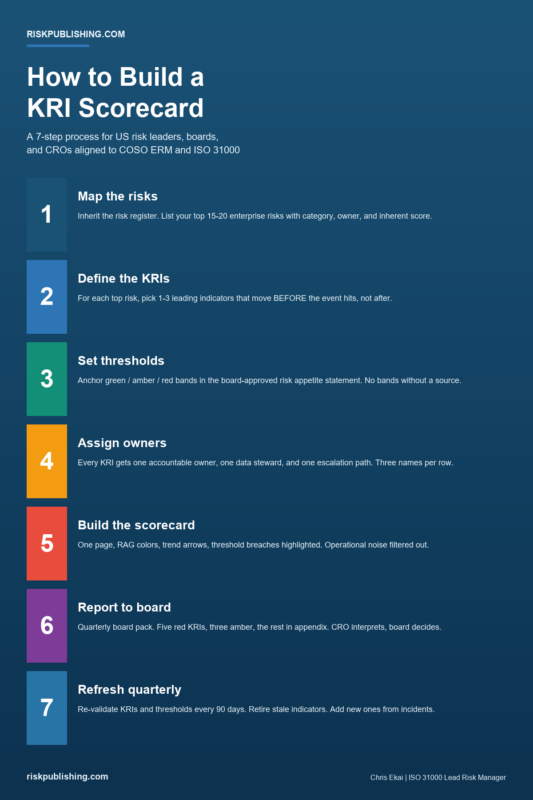
Figure 5. Process infographic summarizing the seven-step KRI scorecard build from category selection through escalation wiring.
Working with Risk Publishing on How to Build a KRI Scorecard
Risk Publishing designs KRI scorecards for US firms operating under SEC, OCC, FINRA, Federal Reserve, and Joint Commission oversight. Our practice on How to Build a KRI Scorecard maps to each examiner standard.
We map the risk categories, select the indicators, calibrate the thresholds against the appetite statement, name the owners, document the data lineage, and stand up the escalation matrix. The work maps to an operational risk management framework and the risk management lifecycle.
Continue reading the Risk Publishing KRI library, the largest free practitioner archive of US-aligned KRI content online: key risk indicators examples, 50 key risk indicators every risk manager should track, how to develop key risk indicators, how to use a key risk indicators dashboard, and the key risk indicators dashboard guide.
Adjacent reading from the framework side of the library, tied to the same ISO 31000 crosswalk this KRI scorecard piece builds on: key risk indicators enterprise risk management, supply chain key risk indicators, key risk indicators developing risk appetite, risk appetite statements examples, and the integrated risk management approach piece.
To start a conversation about a KRI scorecard build for your firm, visit the contact page or the about page. The importance of enterprise risk management piece sets the broader frame, and the convergence of risk oversight with strategic planning article maps how the scorecard layer feeds enterprise-level risk reporting.

Chris Ekai is a Risk Management expert with over 10 years of experience in the field. He has a Master’s(MSc) degree in Risk Management from University of Portsmouth and is a CPA and Finance professional. He currently works as a Content Manager at Risk Publishing, writing about Enterprise Risk Management, Business Continuity Management and Project Management.