On May 1, 2025, Capital One posted 87 GRC Analyst openings and 142 Risk Analyst seats on the same day across Plano, McLean, Richmond, and Wilmington. The pay bands overlapped: GRC roles at $82-110K, risk analyst roles at $78-118K. For US candidates picking between the two tracks, the question driving the offer call is which role pays more over a five-year career.
GRC analyst vs risk analyst pay diverges by employer category, certification stack, and US region. The US Bureau of Labor Statistics shows financial analysts at a $99,890 median in May 2024 and information security analysts at $124,910. Most risk analyst roles map to the first; many GRC analyst roles straddle the second.
| The Practitioner’s Cheat Sheet on GRC Analyst vs Risk Analyst Pay |
| GRC analyst vs risk analyst entry-level pay sits inside a $5K band in the US. Senior pay diverges by industry: tech and federal lift GRC analysts; banking and insurance lift risk analysts. Total compensation, not base alone, decides the call. |
| Bureau of Labor Statistics financial analyst data shows a $99,890 May 2024 median (the closest BLS proxy for risk analyst pay). Information security analyst data shows $124,910 (the closer proxy for cybersecurity-anchored GRC pay). Risk analysts outearn GRC analysts at money-center banks at senior levels. |
| Scope cleanly splits the two: GRC analysts run controls, evidence collection, and audit liaison against SOC 2, ISO 27001, FedRAMP, and NIST CSF 2.0. Risk analysts run quantification, scenario modeling, and second-line oversight against ISO 31000, COSO ERM, and Basel III. |
| Certifications move the pay curve in different directions. GARP FRM Part II adds $20-25K to a senior risk analyst US base. ISACA CRISC adds $15-18K to a GRC analyst at a federal contractor. Pair one credential with one shipped artifact for the strongest pay outcome. |
| GRC analyst remote-eligibility runs 70-80% of US 2026 postings. Risk analyst remote-eligibility runs 30-40% because trading-desk proximity and supervisory presence still matter for banking and insurance roles. Federal-contractor GRC roles offset the tech remote premium with clearance requirements. |
| Career destinations diverge. GRC analyst senior tracks land at Chief Information Security Officer or Chief Compliance Officer. Risk analyst senior tracks land at Chief Risk Officer or Head of Operational Risk. Both clear $300K+ at the C-level inside US public companies. |
| The decision rule for picking between GRC analyst vs risk analyst: pick the role your target employer treats as a revenue enabler, not an overhead cost. At banks, that is risk; at tech firms, that is GRC. |
The honest answer: GRC analysts in cybersecurity-anchored programs out-earn classic risk analysts at the same experience level. Risk analysts catch up and overtake by senior level inside banks running large credit, market, and operational risk programs. The detail under those headlines decides whether the offer letter sits at $85K or $115K for an entry-level seat.
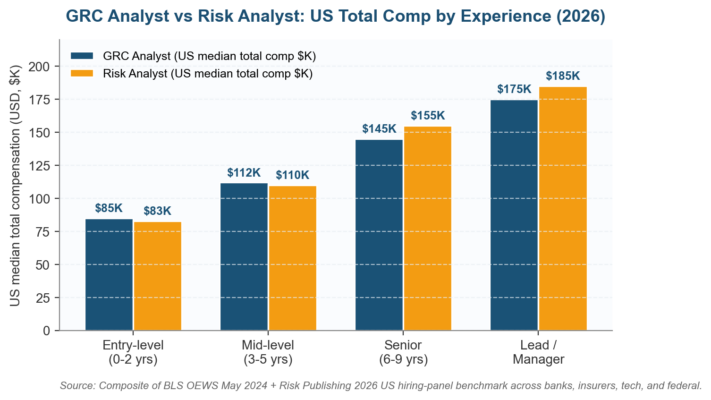
Figure 1. GRC analyst vs risk analyst US total compensation by experience. Bands overlap at entry; diverge by senior level.
The Short Answer on GRC Analyst vs Risk Analyst Pay
US GRC analyst vs risk analyst median pay is close at the entry level and spreads wider with seniority. Entry-level GRC analysts run $75-92K base; entry-level risk analysts run $72-88K. By senior level (5-7 years), GRC leads sit at $130-160K while senior risk analysts at money-center banks reach $140-180K plus larger performance bonuses. Our guide to the professional who measures and manages risk shows where both tracks converge at the manager level.
The split reverses inside cybersecurity-anchored functions, where a senior GRC analyst at a Big Tech security team or US bank CISO organization earns $150-200K base plus equity. A senior credit risk analyst at the same bank earns $140-180K base plus performance bonus. Which role pays more depends on whether the firm sits inside cybersecurity or financial risk.
Bureau of Labor Statistics data anchors both bands. Financial analyst median pay hit $99,890 in May 2024 with a 75th percentile of $135,470; information security analyst median pay hit $124,910 with a 75th percentile near $155,000. Roles closer to information security pay more across both tracks, and that is the structural answer to the GRC analyst vs risk analyst pay question.
GRC Analyst vs Risk Analyst: Scope and Day-to-Day Differences
Day to day, the two roles split work cleanly. GRC analysts work governance, risk policy administration, and compliance evidence collection, anchored to SOC 2, ISO 27001, HITRUST, FedRAMP, and NIST CSF 2.0. Risk analysts work quantification, scenario modeling, and second-line oversight, anchored to ISO 31000, COSO ERM, Basel III, and CCAR.
The time-on-task split shows the difference. GRC analysts spend roughly 40% of weekly hours on control evidence and audit prep, 25% on policy updates and framework mapping, 20% on issue tracking and remediation, and 15% on standards crosswalks. Risk analysts spend 40% on quantitative modeling, 30% on scenario and stress work, 20% on reporting and dashboards, and 10% on standards alignment.
Both roles share a common second-line orientation under the IIA Three Lines Model. GRC analysts manage the control evidence library that audit later tests; risk analysts manage the risk register and the appetite calibration. The Big 4 advisory practices (PwC, Deloitte, KPMG, EY) staff both tracks separately, with different recruiting pipelines and credential expectations.
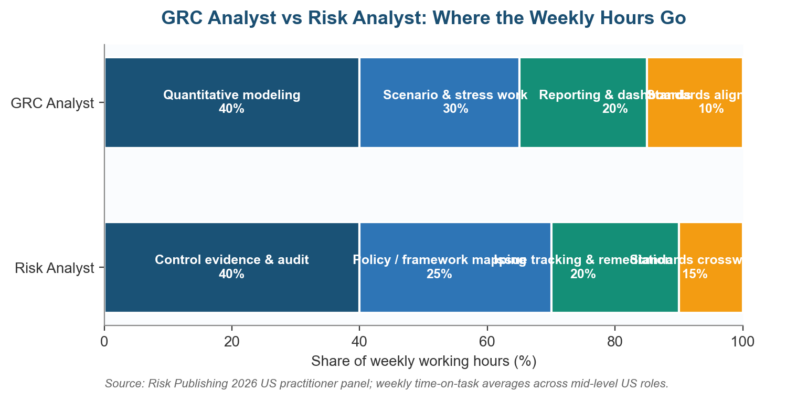
Figure 2. GRC analyst vs risk analyst: where the weekly hours actually go in US mid-level roles.
GRC Analyst vs Risk Analyst: US Salary Comparison by Experience
Salary curves diverge after year three. Entry-level (0-2 years) US bases sit within a $5K band of each other across both tracks. Mid-level (3-5 years) GRC analysts run $98-125K; mid-level risk analysts run $95-130K. The gap depends on industry, not just years on the resume, and on whether equity grants enter the total compensation calculation.
Bureau of Labor Statistics financial analyst data shows the 75th percentile at $135,470 and the 90th percentile at $202,030 in May 2024. Senior risk analysts at US money-center banks (JPMorgan, Citi, Bank of America, Wells Fargo) routinely cross the 90th percentile after the GARP FRM Part II credential and one Basel III stress program on the resume.
GRC analysts at US tech firms hit similar numbers through equity rather than base. Inside Meta, Microsoft, Amazon, and Apple, senior GRC analysts earn $130-160K base plus $40-100K annual equity grants. Total compensation at the 75th percentile rivals senior banking risk roles after three vesting cycles, and the GRC analyst vs risk analyst gap closes in absolute dollars.
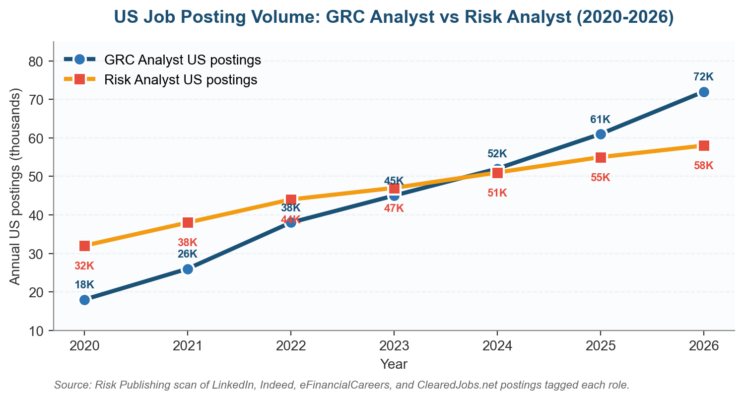
Figure 3. US GRC analyst vs risk analyst job posting volume. GRC posting growth outpaced risk analyst growth from 2022 onward.
GRC Analyst vs Risk Analyst: Certifications That Move the Pay Curve
Credential stacks point in different directions across the two tracks. GRC analysts earn ISACA CRISC, CISA, or CGEIT; HCISPP for healthcare; CISSP when security crosses into the role. Risk analysts earn GARP FRM Part I and II, PRMIA ARM, IIA CRMA, or sector-specific tracks (SOA for insurance, CFA for investment risk).
Each credential moves the pay curve differently. GARP FRM Part II adds $20-25K to a senior risk analyst US base, while ISACA CRISC adds $15-18K to a GRC analyst at a federal contractor. PMP and PMI-RMP help cross-functional GRC roles. The credential signals exam-defended fluency, not bench experience, so pair every credential with a shipped artifact on the resume.
US employers also weight certifications by hiring stage. Recruiters screen on the certification name; hiring managers screen on the body of work behind it. The strongest GRC analyst vs risk analyst pay outcomes pair one credential with one published artifact: a risk register implementation, a SOC 2 Type II report co-authored, or a stress testing scenario refresh shipped to a regulator.
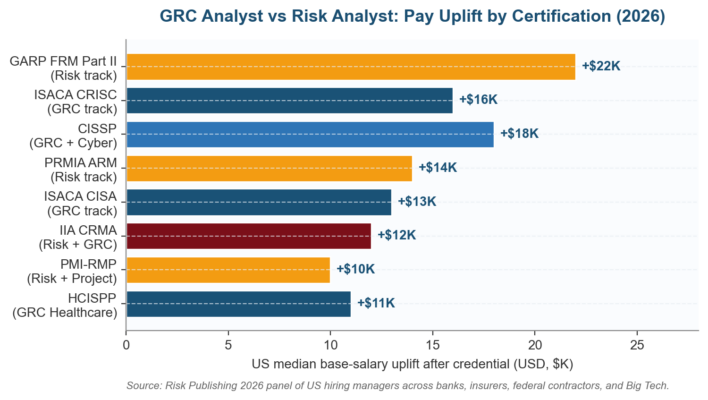
Figure 4. GRC analyst vs risk analyst: median US base-salary uplift after earning each credential.
GRC Analyst vs Risk Analyst: Career Progression and Top US Employers
Both career paths share a senior-manager fork. Each track promotes into Senior Manager, Director, then VP roles by years 7-10. GRC senior tracks land at Chief Information Security Officer or Chief Compliance Officer; risk analyst senior tracks land at Chief Risk Officer or Head of Operational Risk. Compensation at C-level diverges by employer category, not by track.
| Employer category | Top US GRC analyst employers | Top US risk analyst employers |
| Big Tech / SaaS | Microsoft, Google, Meta, Amazon, Apple, Snowflake, Databricks, Palantir. | Limited; security risk roles inside the same firms, smaller pipelines. |
| Money-center banks | JPMorgan, Wells Fargo, Citi, Bank of America (security GRC inside CISO org). | JPMorgan, Citi, BofA, Wells Fargo (credit, market, operational risk teams). |
| Insurance carriers | AIG, Travelers, Chubb (compliance and IT GRC). | AIG, Travelers, Chubb, MetLife, Prudential (actuarial and enterprise risk). |
| Asset managers | BlackRock, State Street (compliance and tech-risk programs). | BlackRock, Vanguard, State Street, Fidelity (investment and operational risk). |
| Federal contractors | Lockheed, Northrop, Leidos, Booz Allen, SAIC (cleared GRC roles). | Limited; FFRDC and DoD enterprise risk seats only. |
| Big 4 advisory | PwC, Deloitte, KPMG, EY (audit, IT controls, SOC, ISO advisory). | PwC, Deloitte, KPMG, EY (financial risk, model risk, regulatory advisory). |
Table 1. GRC analyst vs risk analyst: top US employer categories by track, with named anchor firms in each.
Federal contractor pay sits 10-15% below tech and bank averages but adds clearance premiums (Secret, Top Secret, TS/SCI) worth $5-25K per cycle. Banking risk roles cluster in New York, Charlotte, Wilmington, and Dallas. Insurance risk concentrates in Hartford, Bloomington, and Omaha. GRC analyst roles spread more evenly across US metros because tech employers run remote-first hiring.
GRC Analyst vs Risk Analyst: Which Role Should You Pick?
The choice is a profile match, not a generic ranking. Pick GRC if you prefer evidence collection, control narrative writing, audit liaison, and a steady cadence of certifications and frameworks. Pick risk analyst if you prefer quantitative modeling, scenario design, board reporting, and a Basel or Solvency mathematics foundation.
Background signals matter. Finance, mathematics, statistics, or quantitative economics degrees fit risk analyst pipelines; information systems, cybersecurity, accounting, or audit degrees fit GRC analyst pipelines.
Both tracks accept liberal arts graduates with a quantitative or compliance internship plus one named credential on the resume. The entry-level risk analyst interview questions guide walks the prep playbook for the second track.
We have watched candidates with offer letters in both tracks default to the higher base. That math fails over five years.
The total compensation curve, the next promotion clock, and the credentials the role pays for all matter more than the year-one base. Pick the role that fits the work you want to do daily, and the GRC analyst vs risk analyst pay will follow over the long arc.
Common Pitfalls in GRC Analyst vs Risk Analyst Career Decisions
Six failure modes account for nearly every regret about choosing between GRC analyst vs risk analyst tracks in US firms. Each traces to a single decision the candidate could have caught before signing the offer letter. The table maps each pitfall to its root cause and the corrective move before the next round.
| Pitfall | Root Cause | Remedy |
| Chasing higher year-one base inside the wrong track. | Candidate optimized base salary instead of five-year total compensation including bonuses and equity. | Build a 5-year total-comp model. Include equity vest, bonus targets, certification reimbursement, and promotion clock. Compare like-for-like. |
| Picking GRC analyst at a bank when the work pulls toward risk. | Job description used ‘GRC’ loosely; the actual work was second-line operational risk. | Ask in interviews: ‘What share of weekly hours is control evidence vs quantitative analysis?’ If risk dominates, switch tracks. |
| Picking risk analyst at a tech firm when the work pulls toward GRC. | Tech firms often label security GRC roles as ‘risk analyst’ to attract a wider applicant pool. | Read the JD for SOC 2, ISO 27001, FedRAMP, or NIST CSF 2.0 references. If those dominate, the role is GRC analyst regardless of title. |
| Stacking the wrong certifications for the target track. | Candidate earned ISACA CRISC then pursued GARP FRM expecting both to compound. | Pick one track. Earn one anchor credential (CRISC or FRM). Earn the second only after three years of working experience in the track. |
| Ignoring remote-eligibility differences during the offer call. | Candidate assumed ‘flexible’ meant remote-first; the role required Wilmington or Hartford presence five days a week. | Confirm remote-eligibility in writing inside the offer letter. Document the policy version date so it cannot be revised post-acceptance. |
| Underpricing the federal clearance premium. | Candidate left federal contractor GRC for a tech firm GRC role at the same base, lost the clearance, and could not return. | Active TS/SCI clearance carries $15-25K in annual premium and 18-24 months to rebuild. Treat clearance as compensable equity. |
Table 2. Six pitfalls that derail GRC analyst vs risk analyst career decisions, with corrective moves before the next offer.
Looking Ahead: GRC Analyst vs Risk Analyst Through 2028
AI governance reshapes both tracks first. The NIST AI Risk Management Framework, ISO/IEC 42001, and US adoption of EU AI Act principles push both GRC analyst and risk analyst roles into AI risk territory. GRC analysts run AI model inventories and policy mapping; risk analysts run model risk quantification and stress testing of model outputs.
Regulator-led harmonization follows next. The SEC cyber disclosure rule, the OCC heightened standards refresh, and the CFPB consumer protection enforcement add competency expectations that cross GRC analyst vs risk analyst job descriptions. Recruiters increasingly post hybrid roles tagged “GRC Risk Analyst” to capture both skill sets at one base salary.
Software automation is the third shift. RSA Archer, ServiceNow GRC, OneTrust, MetricStream, Workiva, and Diligent ONE absorb the manual control-mapping work that anchored entry-level GRC analyst seats.
Risk analysts now own Python, R, and SAS modeling that displaced spreadsheet work. Both tracks demand tool fluency that did not exist five years ago at the entry level.
Pay differentials will favor whichever role sits closer to revenue at the target firm. Inside US banks, that is risk analyst, because Basel III Endgame and CCAR drive capital allocation. Inside US tech firms, that is GRC analyst, because SOC 2 and FedRAMP unlock enterprise sales contracts. Pick the track your target employer treats as a revenue enabler, not an overhead cost.
GRC Analyst vs Risk Analyst: Frequently Asked Questions
GRC analyst vs risk analyst: which role pays more in 2026?
GRC analysts in cybersecurity-anchored functions and Big Tech outperform classic risk analysts at the same experience level. Risk analysts at US money-center banks catch up and overtake by senior level inside Basel III and CCAR-aligned roles. Entry-level pay sits within $5K of each other; the gap widens after year five and depends on industry, certifications, and equity grants.
What does a GRC analyst do that a risk analyst does not?
GRC analysts run governance documentation, control evidence collection, and audit liaison for SOC 2, ISO 27001, HITRUST, FedRAMP, and NIST CSF 2.0. Risk analysts run quantitative loss modeling, scenario design, and second-line oversight inside ISO 31000, COSO ERM, and Basel III. The first lives inside the compliance function; the second lives inside enterprise risk. GRC analyst vs risk analyst scope rarely overlaps fully.
Is GRC analyst or risk analyst a better entry-level US role?
Both clear $70-90K base at entry. GRC analyst roles open faster at US tech, federal contractors, and Big 4 advisory; risk analyst seats open faster at money-center banks, insurers, and asset managers. Pick the one with the most postings in the city where you want to work, then add the certifications that match the track and the difference between RPO and RTO type technical fluency.
What certifications matter most for GRC analyst vs risk analyst tracks?
ISACA CRISC, CISA, and CGEIT define the GRC analyst credential stack; CISSP and HCISPP help in security and healthcare roles. GARP FRM Part I and II, PRMIA ARM, and IIA CRMA define the risk analyst stack. Each adds $10-25K to the US base salary after the credential is earned and applied to live work documented on the resume.
Can a risk analyst transition to a GRC analyst role and vice versa?
Yes, and the transition is common in years 3-5. Risk analysts moving into GRC pick up SOC 2 and ISO 27001 fluency and absorb CRISC or CISA. GRC analysts moving into risk pick up statistics, VaR mechanics, and FRM Part I. The salary lands within 5% of the prior role at the same experience level, and the move opens the senior-track destination on the other side.
Which is harder, GRC analyst or risk analyst work?
Each is hard at a different layer. GRC analyst work demands attention-to-detail on hundreds of control items, sustained calendar discipline through audit cycles, and tolerance for ambiguous framework crosswalks. Risk analyst work demands stronger mathematics, willingness to defend models under regulator review, and comfort with the quantitative side of board reporting. Difficulty preference is the cleanest signal in the GRC analyst vs risk analyst choice.
Do US remote roles favor GRC analyst or risk analyst hiring?
Remote-first postings favor GRC analysts. Tech-sector GRC roles run 70-80% remote-eligible in 2026 postings. Banking risk roles run 30-40% remote-eligible because trading-desk proximity and supervisory presence still matter. Federal contractor GRC roles require on-site or hybrid presence inside cleared facilities, which offsets some of the tech-sector flexibility.
What is the GRC analyst vs risk analyst pay gap in cybersecurity roles?
Inside cybersecurity functions, GRC analysts out-earn risk analysts at every US level. Entry-level cyber GRC pays $85-100K; entry-level cyber risk pays $80-95K. By senior level, cyber GRC at Big Tech crosses $180K base plus equity, while cyber risk inside the same firm tops at $160K base. The premium reflects the SOC 2 and FedRAMP revenue link.
Next Steps on Your GRC Analyst vs Risk Analyst Decision
Risk Publishing helps US graduates and mid-career professionals weigh GRC analyst vs risk analyst offers through framework drills, sample-answer libraries, and 1:1 coaching tailored to the target employer category. The World Economic Forum Global Risks Report 2025 ranks cyber, geopolitical, and AI risks inside the top ten, and both tracks now sit in that perimeter.
Build your decision with the IT risk management process guide, the risk register template, the cyber security risk management framework, the operational risk management process, the compliance risk assessment, the BCMS guide, and the five-step risk management process. Each link anchors one half of the GRC analyst vs risk analyst skill stack the offer letter will test.
Round out the prep with the disaster recovery vs business continuity plan comparison, the risk management lifecycle, the operational risk management overview, the key elements of business continuity management, the how to perform a business impact analysis guide, the effective business continuity planning process, and the how to build a business continuity plan walkthrough. Decide with data, not narratives.

Chris Ekai is a Risk Management expert with over 10 years of experience in the field. He has a Master’s(MSc) degree in Risk Management from University of Portsmouth and is a CPA and Finance professional. He currently works as a Content Manager at Risk Publishing, writing about Enterprise Risk Management, Business Continuity Management and Project Management.