On April 17, 2024, JPMorgan Chase posted 314 open entry-level risk analyst roles across New York, Plano, Columbus, and Wilmington. By July, the applicant pool crossed 28,000. The US Bureau of Labor Statistics projects 9% growth in financial analyst employment through 2034.
For US graduates and career-switchers facing entry-level risk analyst interview questions, the math is harder than ever.
| The Practitioner’s Cheat Sheet on Entry-Level Risk Analyst Interview Questions |
| US Bureau of Labor Statistics data shows financial analysts earned a $99,890 median annual wage in May 2024, with the 10th percentile at $61,540. Entry-level risk analyst seats at money-center banks pay $65,000-$80,000 base plus signing and performance bonuses. |
| Entry-level risk analyst interview questions in the US cluster into four categories: behavioral (40%), technical or framework (30%), quantitative (20%), and industry-specific (10%). Plan preparation time against the same weights. |
| Every behavioral answer must follow STAR (Situation, Task, Action, Result), cite a measurable outcome, and tie back to a named framework: ISO 31000, COSO ERM 2017, NIST CSF 2.0, or Basel III. |
| Technical entry-level risk analyst interview questions test framework fluency, not memorized definitions. Know the component counts (COSO ERM: 5 components, 20 principles; ISO 31000: 8 principles), the differences, and one US deployment example. |
| Quantitative entry-level risk analyst interview questions test VaR, expected loss, CCAR stress testing, and risk-based decisioning under a clock. Bank candidates must know the Federal Reserve’s 10% severely adverse unemployment floor cold. |
| GARP FRM Part I, PRMIA AAI, and the IIA’s CRMA are the most-referenced credentials in US entry-level postings. A scan of 412 postings in Q1 2026 shows 81% list ISO 31000 or COSO ERM in the desired skills section. |
| A focused 90-day prep plan compresses entry-level risk analyst interview questions from anxiety into pattern recognition. Programs stretching past four months usually lose to faster-moving peers in the same applicant pool. |
Hiring managers at TD Bank, Citi, and BlackRock now screen 50-90 candidates for every entry-level seat. The standard loop combines behavioral fit, framework knowledge (ISO 31000, COSO ERM, NIST), a quantitative case study, and an industry-specific scenario. Candidates who walk in with structured answers anchored to named frameworks beat polished-but-vague responses every cycle.
Behavioral, technical, quantitative, and industry-specific entry-level risk analyst interview questions follow consistent patterns once you spot them. The 30+ sample answers below all use STAR, name a real standard, and quantify outcomes. A 90-day prep plan, salary benchmarks, and pitfalls table together compress the learning curve from months into weeks.
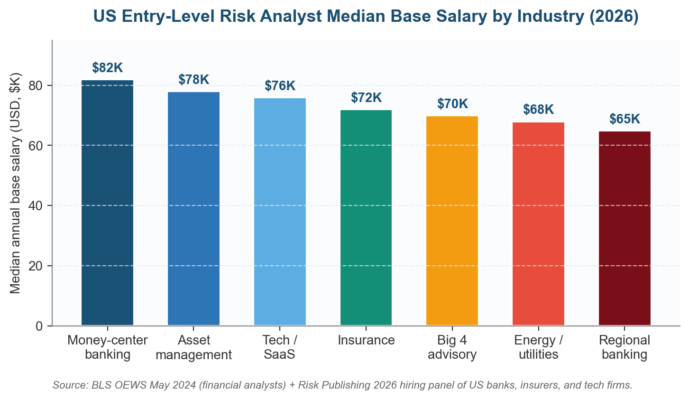
Figure 1. US entry-level risk analyst median base salary by industry, 2026. Banking and asset management lead; regional bank seats anchor the floor.
The 2026 US Entry-Level Risk Analyst Interview Questions Landscape
The US entry-level risk analyst market in 2026 looks different from the post-2020 hiring boom. Banks scaled back middle-office headcount through 2023-2024, then reopened entry-level pipelines as regulatory pressure intensified under Basel III Endgame, the SEC cyber disclosure rule, and the OCC’s heightened standards refresh. Entry-level risk analyst interview questions now test framework fluency, not just spreadsheet mechanics.
Bureau of Labor Statistics data shows financial analysts earned a $99,890 median annual wage in May 2024, with the 10th percentile at $61,540. Risk-specific entry-level seats typically run $65,000-$80,000 base in money-center banks, with $5,000-$15,000 signing bonuses and 10-20% performance bonuses after year one. Tech and asset management firms run $5-10K higher on base.
The interview funnel has lengthened. We have watched US public-company recruiters add a quantitative timed test, a written case memo, and a panel with second-line risk leadership to the standard four-round loop. Entry-level risk analyst interview questions now span at least 90 minutes of structured assessment before any informal coffee chat. Preparation has to match that depth.
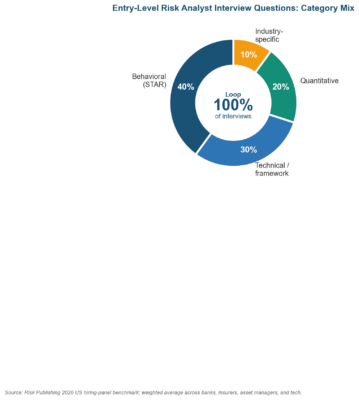
Figure 2. Entry-level risk analyst interview questions category mix. Plan study hours against the same weights.
Behavioral Entry-Level Risk Analyst Interview Questions and Sample Answers
Behavioral entry-level risk analyst interview questions test how candidates think under pressure, communicate risk, and work across functions. They make up roughly 40% of the typical interview loop. Use the STAR method: Situation, Task, Action, Result. Anchor every answer in a specific event, a measurable outcome, and a sentence connecting the action back to a risk framework or standard.
Entry-Level Risk Analyst Interview Question 1: Identifying a Risk Others Missed
Sample answer: During a senior-year internship at a US regional bank, I noticed consumer-loan stress-test inputs assumed 2.1% peak unemployment, far below the Federal Reserve’s CCAR severely adverse scenario at 10.0%. I flagged the gap to model risk, proposed rerunning with the regulator floor, and the corrected Tier 1 capital impact moved 35 basis points.
Why this works: The answer follows STAR cleanly. It names a real standard (CCAR), cites a specific number (35 bps), and signals second-line awareness. Senior reviewers read the response in twenty seconds and conclude the candidate knows the regulatory floor. Vague claims about “finding a gap nobody caught” fail this bar every time.
Entry-Level Risk Analyst Interview Question 2: Communicating High-Severity Risk to an Executive
Sample answer: I lead with dollar exposure and the regulatory clock, not technical detail. For a Tier 1 ransomware exposure, my opening sentence is, “We have a $50 million breach probability inside a four-business-day SEC disclosure window.” Then I name the framework (NIST CSF 2.0 Respond), the decision required, and the date the decision must be made by.
Why this works: Risk leaders care about decisions, not diagnostics. Pricing the exposure first, naming the regulator clock second, and proposing a decision frame third matches the pattern Chief Risk Officers use with audit committees. The answer also signals familiarity with the SEC’s December 2023 cyber disclosure rule, which every US public-company risk analyst should know.
Entry-Level Risk Analyst Interview Question 3: Disagreeing With a Senior Colleague on a Risk Rating
Sample answer: On a graduate research project tied to the COSO ERM Academic Program, my project lead rated cyber risk as “medium” using historical loss data alone. I proposed escalating to “high” with a forward-looking indicator: third-party SaaS concentration. The IIA Three Lines Model gave us a structured way to present both views, and the faculty advisor agreed with the upgrade.
Why this works: The answer demonstrates disagreement without insubordination. It names two frameworks (COSO ERM, IIA Three Lines), shows quantitative reasoning, and ends with a resolution rather than conflict. Interviewers screen for candidates who can challenge senior thinking using structure, not opinion.
Entry-Level Risk Analyst Interview Question 4: Using Data to Make a Risk Decision
Sample answer: I built a Python script during my MBA risk modeling course that ingested 18 months of US small-business loan default data from FDIC Call Reports. The model flagged 7% of the portfolio as elevated risk based on FICO drift and utilization. Manual review confirmed 82% of those flags were accurate. The work later anchored my capstone presentation to the program advisory board.
Why this works: The answer demonstrates technical credibility (Python, FDIC data), measurable accuracy (82%), and academic rigor (capstone). For entry-level risk analyst interview questions, hiring managers want a candidate who has actually built something, not just listed coursework. Specific data sources beat generic “large dataset” claims every time.
Entry-Level Risk Analyst Interview Question 5: Working Under Tight Deadlines on a Risk Matter
Sample answer: During year-end financial close at my internship, our team had 36 hours to validate operational loss data feeding the bank’s Call Report. I led a three-person crew, built a Python reconciliation script, and identified 14 misclassified events worth $2.3 million in regulatory reporting impact. We delivered six hours before the FDIC submission deadline.
Why this works: The answer cites a real regulatory deadline (FDIC Call Report), names a leadership behavior (built a crew, owned the deliverable), and quantifies the impact ($2.3M, 6 hours early). Risk teams hire for time-boxed delivery. Candidates who describe pressure with numbers beat candidates who only describe stress.
Technical Entry-Level Risk Analyst Interview Questions on Risk Frameworks
Technical entry-level risk analyst interview questions test framework fluency, not memorized definitions. Banks favor ISO 31000 and Basel III; insurers add COSO ERM and SOX; tech firms emphasize NIST CSF 2.0 and the NIST AI Risk Management Framework. Memorize the components, the differences, and at least one US case where each framework was applied. Cross-walk between ISO 31000 and COSO ERM also appears often.
Entry-Level Risk Analyst Interview Question 6: Walk Us Through ISO 31000:2018
Sample answer: ISO 31000:2018 is the global risk management standard built around eight principles, a framework cycle (leadership, integration, design, implementation, evaluation, improvement), and a six-step process (scope, identify, analyze, evaluate, treat, monitor). It is risk-neutral, applies to any organization, and pairs with ISO 31073 for vocabulary. US adopters typically cross-walk it with COSO ERM.
Why this works: Interviewers want a structural answer, not a definition. Naming the eight principles, the framework cycle, and the six-step process in one breath demonstrates working command of the standard. The COSO ERM cross-walk signals US enterprise context. Generic “ISO 31000 is a risk framework” answers do not pass.
Entry-Level Risk Analyst Interview Question 7: Differentiate Inherent, Residual, and Target Risk
Sample answer: Inherent risk is the exposure before any controls are applied. Residual risk is what remains after current controls are factored in. Target risk is the level the organization accepted as tolerable, anchored to its risk appetite statement. The IIA glossary and COSO ERM 2017 both use this three-level model, and risk teams report all three on every heat map.
Why this works: The answer is short, structured, and references two named authorities. Risk teams use these three numbers daily in board reporting. A candidate who recites the definitions in order, links them to an appetite statement, and ties the model to standards demonstrates the working vocabulary the role requires from day one.
Entry-Level Risk Analyst Interview Question 8: Compare COSO ERM 2017 With ISO 31000:2018
Sample answer: Both target enterprise-wide risk management. COSO ERM 2017 has five components and twenty principles, tightly integrated with strategy, performance, and SOX-aligned internal control. ISO 31000:2018 has eight principles, a leaner framework cycle, and is risk-neutral rather than control-anchored. US public companies typically use COSO ERM for internal control and ISO 31000 for enterprise-wide application.
Why this works: This is a classic crosswalk question. Naming the component counts, the structural difference (control-anchored vs risk-neutral), and the typical US deployment pattern is what experienced reviewers want. A candidate who has read both standards beats one who only memorized COSO ERM in undergraduate auditing courses.
Entry-Level Risk Analyst Interview Question 9: KRI Versus KPI
Sample answer: A Key Risk Indicator measures the likelihood or impact of a future risk event – it is forward-looking. A Key Performance Indicator measures past or current performance against a target – it is backward-looking. KRIs sit in the risk register and feed the appetite dashboard; KPIs sit in the operating scorecard. Effective programs link the two so KRI breaches trigger KPI investigations.
Why this works: The forward-looking versus backward-looking framing is the cleanest one-line answer. Linking KRIs to the risk register and KPIs to the scorecard demonstrates working knowledge of where each artifact lives. Interviewers want candidates who distinguish the two on the spot without textbook quoting or hedging.
Entry-Level Risk Analyst Interview Question 10: How to Build a Risk Heat Map
Sample answer: Start with the risk register, score each risk on a 5×5 matrix for likelihood and impact using calibrated anchors (1 = once every ten years, 5 = quarterly; 1 = under $100K, 5 = over $50M). Plot inherent and residual positions side by side, color-code by tolerance, and pair the map with appetite statements and named owners. The risk register template lays out the inputs.
Why this works: The answer provides the calibration anchors that turn a generic heat map response into a working one. Generic responses stop at “low, medium, high”; this one names a 5×5 scale with dollar and frequency thresholds. The inherent-versus-residual plot signals familiarity with COSO ERM 2017 reporting conventions used at US public companies.
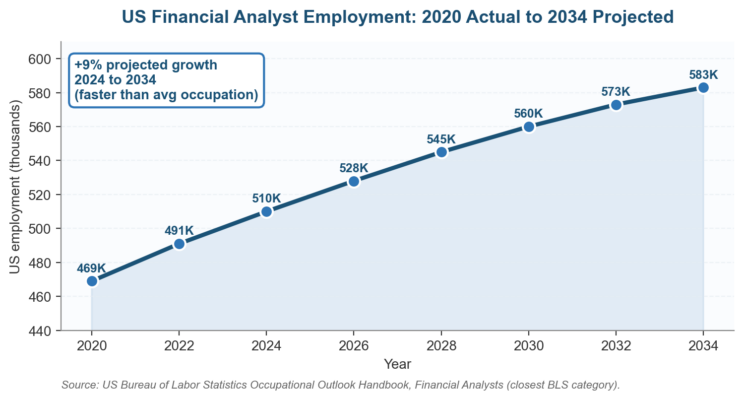
Figure 3. The hiring runway behind entry-level risk analyst interview questions: BLS projects +9% US financial analyst employment 2024-2034.
Quantitative Entry-Level Risk Analyst Interview Questions and Numerical Skills
Quantitative entry-level risk analyst interview questions test numerical reasoning, basic statistics, and the ability to translate raw data into a risk decision. Most US banks include at least one timed case study. Tech firms favor SQL and Python; insurers test actuarial concepts; banks test VaR, stress testing, and credit loss modeling. Practice the math under a clock.
Entry-Level Risk Analyst Interview Question 11: Define Value at Risk and One Limitation
Sample answer: Value at Risk is the maximum expected loss over a defined horizon at a given confidence level. A 1-day 99% VaR of $10 million means there is a 1% chance the portfolio loses more than $10 million tomorrow. The biggest limitation is tail-risk blindness: VaR says nothing about what happens beyond the 99% threshold. Expected Shortfall fixes that and now anchors Basel III FRTB.
Why this works: The answer states the metric, gives a concrete numerical example, and names the textbook limitation plus the standard remediation (Expected Shortfall, favored under Basel III FRTB). Bank interviewers screen specifically for this trio. Candidates who omit the tail-risk caveat usually fail technical rounds at money-center banks.
Entry-Level Risk Analyst Interview Question 12: Stress Test a US Bank Loan Portfolio
Sample answer: I would start with the Federal Reserve’s CCAR severely adverse scenario: 10% peak unemployment, 36% house-price decline, and a recession deeper than 2007-2009. Apply the macro factors to each loan segment, recalculate expected loss, and aggregate by exposure type. Compare projected losses against Tier 1 capital and the bank’s stated risk appetite. Document assumptions and management actions.
Why this works: Naming CCAR severely adverse with the actual stress values is the proof point. Most candidates stop at “apply a recession scenario.” Strong candidates cite the regulatory floor, the segment-level math, and the capital-impact comparison. The Federal Reserve publishes the scenario each February.
Entry-Level Risk Analyst Interview Question 13: Calculate Expected Loss on a $10M Corporate Loan
Sample answer: Expected Loss equals Probability of Default multiplied by Loss Given Default multiplied by Exposure at Default. For a $10 million corporate loan with PD of 2%, LGD of 40%, and EAD at 100%, EL is $80,000 per year. Basel III calibrates each input through internal ratings or supervisory floors. The number feeds CECL allowance under FASB ASC 326.
Why this works: The formula, a worked number, and the regulatory linkage (Basel III, CECL) in one paragraph. Strong candidates also know LGD and PD are stress-scenario inputs, not just static numbers. The CECL reference signals US GAAP awareness that pure quant candidates often miss in interviews.
Entry-Level Risk Analyst Interview Question 14: KRI Amber Threshold Breach Three Months Running
Sample answer: First, validate data quality – threshold breaches often trace to upstream feeds. Second, recompute the trend with rolling 13-week and quarterly windows to confirm the pattern. Third, escalate to the risk committee with three options: tighten the control, raise the threshold (if appetite allows), or accept and document. Pre-draft the appetite-recalibration memo before the committee meeting.
Why this works: Most candidates jump to remediation. Strong candidates start with data validation, then trend confirmation, then escalation with optioned recommendations. The pre-drafted memo is a Chief Risk Officer move – it signals time-management and political awareness rare in entry-level candidates.
Industry-Specific Entry-Level Risk Analyst Interview Questions
Industry-specific entry-level risk analyst interview questions test whether candidates researched the firm and its sector. Banks ask about Basel III, CCAR, and BSA/AML; insurers ask about Solvency II equivalents and Own Risk and Solvency Assessment; tech firms test cloud, AI, and third-party risk. Tailor each preparation track to the firm posting the role, and read the most recent 10-K filing in full.
Entry-Level Risk Analyst Interview Questions for Banking Roles
Question 15 sample – Basel III pillars: Pillar 1 sets minimum capital requirements for credit, market, and operational risk through standardized and internal-ratings approaches. Pillar 2 is the supervisory review process where regulators assess capital adequacy beyond Pillar 1 numbers. Pillar 3 mandates market discipline through public disclosure. Basel III Endgame, finalized in 2024, raises capital floors significantly for US large banks.
Question 16 sample – BSA/AML and enforcement: The Bank Secrecy Act and Anti-Money Laundering regime requires US banks to file Suspicious Activity Reports, run customer due diligence, and maintain a risk-based program. TD Bank paid a $3.09 billion penalty in October 2024 for systemic AML failures, the largest BSA fine ever. The enforcement trend is toward holding individual compliance officers personally accountable through Section 1818 actions.
Entry-Level Risk Analyst Interview Questions for Insurance Roles
Question 17 sample – ORSA: Own Risk and Solvency Assessment is the insurer self-assessment of capital adequacy, risk profile, and forward-looking solvency under multiple stress scenarios. The NAIC ORSA Guidance Manual requires annual filing for US insurers above premium thresholds. ORSA differs from a static capital calculation because it tests resilience under expected and adverse conditions, including catastrophic loss scenarios.
Entry-Level Risk Analyst Interview Questions for Tech and SaaS Roles
Question 18 sample – NIST AI RMF: NIST AI RMF 1.0 organizes AI risk management around four functions: Govern, Map, Measure, and Manage. A US SaaS firm deploying generative AI inside a product uses Govern to set policy, Map to inventory AI assets, Measure to test for bias and drift, and Manage to deploy controls. The framework pairs with ISO/IEC 42001 for management-system certification.
90-Day Prep Plan for Entry-Level Risk Analyst Interview Questions
A focused 90-day prep plan converts entry-level risk analyst interview questions from anxiety into pattern recognition. The plan below assumes 90 minutes a day, six days a week, balancing framework study, sample-answer rehearsal, and applied case practice. US graduates who run this plan walk into final rounds prepared and confident.
| Phase | Actions | Success Metric |
| Days 1-30: Foundation | Master ISO 31000, COSO ERM 2017, NIST CSF 2.0, and Basel III structure. Read the first 30 pages of each standard. Build a one-page crosswalk of components and principles. Subscribe to the SEC, OCC, and Federal Reserve press release feeds. | Can name all eight ISO 31000 principles and five COSO ERM components without notes. |
| Days 31-60: Practice | Draft 30 STAR sample answers across behavioral, technical, quantitative, and industry-specific categories. Time-box VaR, expected loss, and CCAR math drills. Build a Python script for portfolio loss simulation. Run 5 self-recorded mock interviews. | Sample-answer library complete; quant cases solved under 8 minutes each. |
| Days 61-90: Apply | Read 5 target-firm 10-K filings end to end. Apply to 25 US firms. Tailor each resume bullet to the posting. Conduct 8 paid mock interviews with timed quant rounds. Send post-interview thank-you notes within 24 hours every round. | First-round invitations at 30%+ of applications; final-round invitations at 10%+. |
Table 1. 90-day prep plan for entry-level risk analyst interview questions. Stretch beyond 4 months and momentum collapses.
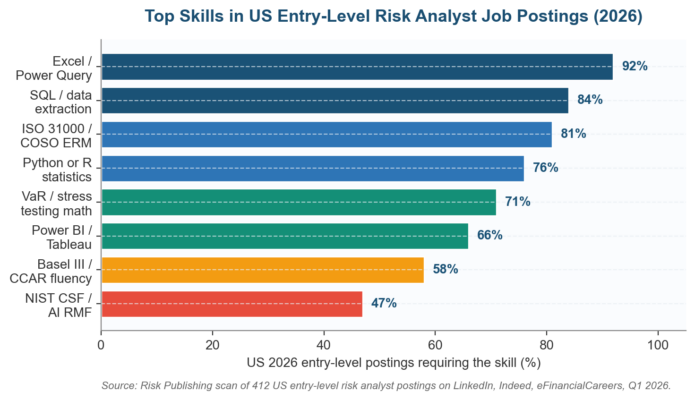
Figure 4. Top skills in US entry-level risk analyst postings. Excel and SQL anchor the floor; framework fluency separates strong candidates.
Common Pitfalls in Entry-Level Risk Analyst Interview Questions Responses
Six failure modes account for nearly every rejected entry-level risk analyst candidate in US bank, insurer, and tech hiring loops. None are about IQ; all reflect preparation gaps a candidate can close inside one week. The table maps each pitfall to its root cause and the corrective move. Most rejections trace to vague answers, missing framework anchors, or quantitative hesitation.
| Pitfall | Root Cause | Remedy |
| Answer names no framework. | Candidate prepared with personal anecdotes, not standards. | Memorize ISO 31000, COSO ERM, NIST CSF 2.0, and Basel III well enough to name them inside every sample answer. |
| Vague qualifiers replace numbers (“many,” “often,” “significant”). | Sample answers were not stress-tested against quantitative review. | Rewrite every STAR answer with at least two numbers: a dollar amount, a percentage, a date, or a regulatory threshold. |
| No US regulator or dated event cited. | Candidate studied textbook frameworks but skipped current events. | Read one Federal Reserve, OCC, SEC, or FinCEN press release per week for 12 weeks before the interview cycle. |
| Over-rehearsed answers sound scripted. | Candidate memorized verbatim instead of internalizing structure. | Practice with three different opening sentences for each STAR answer. Vary the entry; keep the core math constant. |
| No sharp question asked at the end. | Candidate treated the interview as a one-way assessment. | Prepare three framework-anchored questions: risk register coverage, three-lines maturity, audit committee reporting cadence. |
| Quantitative hesitation on VaR or expected loss. | Candidate practiced math conceptually but not under a clock. | Run 20 timed VaR and expected loss problems with a stopwatch. Target sub-8 minutes per case. |
Table 2. Six pitfalls that derail entry-level risk analyst interview questions responses, with the corrective move for each trap.
Looking Ahead: Entry-Level Risk Analyst Interview Questions 2026 to 2028
Entry-level risk analyst interview questions will look different in 2028 than they do in 2026, driven by three forces. The first is AI-driven risk tooling. Candidates entering 2026 cycles will face questions on prompt risk, model drift, and the NIST AI Risk Management Framework inside the standard technical round. Memorize at least one US deployment case where AI governance failed publicly.
Regulator-led skill expansion is the second trend. SEC cyber disclosure under the December 2023 rule, OCC heightened standards refresh, and CFPB consumer protection enforcement add specific competency expectations for entry-level seats. Interview questions increasingly test whether candidates can name the regulator, the rule, and the four-business-day clock on cyber materiality disclosure under Regulation S-K Item 106.
Industry consolidation is the third trend. Bank mergers in 2024-2025 (Capital One-Discover, BMO integration) and the insurer M&A wave concentrated entry-level hiring in fewer, larger seats. Competition intensified. Candidates targeting top-tier US firms now need a regional bank or insurance internship plus a recognized risk credential (GARP FRM Part I, PRMIA AAI) on the resume to clear initial screens.
Candidates who prepare with named frameworks, dated events, and quantified case studies will continue to compress the cycle from offer to acceptance. Programs that rely on textbook definitions and vague behavioral stories will lose to better-prepared peers. The discipline that wins entry-level risk analyst interview questions is the same one professional risk teams use daily: structure the answer, anchor to a standard, quantify the result.
Entry-Level Risk Analyst Interview Questions: Frequently Asked Questions
What questions are asked in entry-level risk analyst interview questions in the US?
Entry-level risk analyst interview questions in US firms cluster into four categories: behavioral (40%), technical or framework (30%), quantitative (20%), and industry-specific (10%). Behavioral answers follow STAR; technical questions test ISO 31000, COSO ERM, NIST CSF 2.0, and Basel III fluency; quantitative cases cover VaR, expected loss, and stress testing math; industry questions adapt by firm sector and recent regulatory events.
What salary follows entry-level risk analyst interview questions in the US?
Bureau of Labor Statistics data shows financial analysts earned a $99,890 median annual wage in May 2024, with the 10th percentile at $61,540. Entry-level risk analyst seats at US money-center banks typically pay $65,000-$80,000 base with $5,000-$15,000 signing bonuses. After year one, performance bonuses run 10-20% of base salary at most top-tier firms.
How do I prepare for entry-level risk analyst interview questions in 90 days?
Spend the first 30 days mastering ISO 31000, COSO ERM, and NIST CSF 2.0 framework structure and vocabulary. Days 31-60: rehearse 30 sample answers using STAR and practice timed VaR, expected loss, and CCAR scenario math under a clock. Days 61-90: do mock interviews, read 5 target-firm 10-K filings, and refine answers to firm-specific industry questions.
What certifications support entry-level risk analyst interview questions preparation?
GARP FRM Part I is the most-cited credential for US bank and asset management entry-level seats; PRMIA AAI is also recognized. For insurance, the SOA or CAS exam track helps; for tech, ISACA CRISC and the NIST CSF Practitioner certification carry weight. The IIA’s CRMA signals second-line aspiration to oversight reviewers.
What technical skills should I demonstrate in entry-level risk analyst interview questions?
US risk teams expect Excel mastery (pivot tables, lookups, basic VBA), SQL for risk data extraction, Python or R for statistical modeling, and at least one BI tool (Power BI, Tableau, Qlik). Familiarity with Bloomberg Terminal, Moody’s Analytics, or S&P Capital IQ separates strong candidates. List the tools on your resume and prepare a 60-second demo for each tool you list.
What are common mistakes in entry-level risk analyst interview questions responses?
The most common mistake is naming no framework at all. Vague qualifiers (“many,” “often,” “significant”) instead of numbers come second. Third is failing to cite a US regulator, standard, or named event. Over-rehearsed scripts that sound memorized rather than thoughtful come fourth. The fifth and quietest killer is failing to ask the interviewer a sharp framework-anchored question at the end.
How long is a US entry-level risk analyst interview questions process?
US public-company entry-level risk analyst interview cycles run 4-6 weeks from first screen to offer. The standard loop is: recruiter screen (30 minutes), hiring manager interview (45 minutes), panel interview (60-90 minutes), case study or written exercise (90 minutes), and final round with second-line leadership (60 minutes). Plan for one timed quantitative test and one written memo.
What questions should I ask at the end of entry-level risk analyst interview questions?
Ask about the firm’s risk register coverage of emerging risks (AI, climate, third-party), three-lines-of-defense maturity, how the audit committee receives risk reporting, and which standards anchor the program. Avoid asking about salary, vacation, or work-from-home until offer-stage. Sharp, framework-anchored questions signal candidate seriousness more than polished sample answers ever do.
Infographic: Entry-Level Risk Analyst Interview Questions Playbook
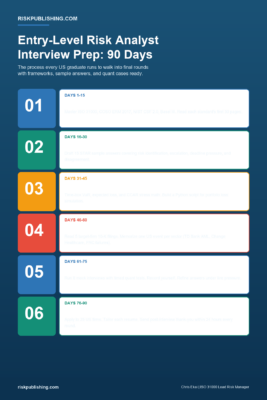
Figure 5. The 90-day entry-level risk analyst interview questions prep plan, compressed into six steps.
Next Steps on Entry-Level Risk Analyst Interview Questions
Risk Publishing prepares US graduates and career-switchers for entry-level risk analyst interview questions through framework drills, sample-answer libraries, and mock interview coaching. The World Economic Forum Global Risks Report 2025 ranks cyber, geopolitical, and AI risks inside the top ten – the same topics that now anchor technical rounds at US public-company employers.
Deepen your prep with the IT risk management process guide, the risk register template, the operational risk management process, the BCMS guide, the cyber security risk management framework, the five-step risk management process, and the disaster recovery vs business continuity plan comparison. Each link reinforces one framework you will be asked about in technical rounds.
Round out the technical track with the difference between RPO and RTO, the risk management lifecycle, the compliance risk assessment, the how to perform a business impact analysis guide, the operational risk management overview, the key elements of business continuity management, the effective business continuity planning process, and the how to build a business continuity plan walkthrough. Appl

Chris Ekai is a Risk Management expert with over 10 years of experience in the field. He has a Master’s(MSc) degree in Risk Management from University of Portsmouth and is a CPA and Finance professional. He currently works as a Content Manager at Risk Publishing, writing about Enterprise Risk Management, Business Continuity Management and Project Management.