On October 10, 2024, the DOJ, OCC, Federal Reserve, and FinCEN hit TD Bank with roughly $3.09 billion in penalties, the largest Bank Secrecy Act case in US history. Enforcement at that scale is why professionals keep asking whether a GRC certification is worth it. The answer comes down to the numbers. ISACA puts the average CRISC salary near $151,000, and surveys show a typical raise around $13,000 after certifying. Against a $575 to $760 exam fee, the math is not close.
| Is a GRC Certification Worth It? The Practitioner’s Cheat Sheet |
| Is a GRC certification worth it? For most mid-career risk, compliance, and security professionals, yes. ISACA’s CRISC averages about $151,000, and self-reported raises after certifying cluster near $13,000, against an exam fee of $575 to $760. |
| The dedicated GRC credentials are ISC2’s CGRC (formerly CAP) and OCEG’s GRCP. The adjacent risk, audit, and governance certifications employers also value are ISACA’s CRISC, CISA, CGEIT, and CISM. CRISC is the highest-earning of the group. |
| Demand is the tailwind. The ISC2 2024 Workforce Study put the global cyber and GRC talent gap at a record 4.8 million people, and 90% of organizations reported a skills shortage. |
| A GRC certification rarely substitutes for experience. Below two years in the field it mainly clears resume screens; above five years it formalizes what you already do and unlocks manager and director bands paying $150,000 to $180,000. |
| The ROI is front-loaded. A typical all-in cost near $1,500 against a reported first-year raise near $13,000 is roughly a ninefold return, with renewal costs of just $45 to $135 a year thereafter. |
| Match the credential to your lane. CGRC suits federal and NIST-aligned roles, CRISC suits enterprise and IT risk, CISA suits audit, and GRCP suits policy and program managers integrating governance across functions. |
For a mid-career risk or compliance professional, this is a real investment of money and months of study. The data below covers the major credentials, what they cost, and where a GRC certification pays off, and where it does not.
Why ‘Is a GRC Certification Worth It?’ Is the Right Question in 2026
The question matters more now because weak governance has gotten expensive fast. TD Bank’s $3.09 billion penalty was extreme only in size, and fines like it turn governance, risk, and compliance skills into a board priority. That pressure lands directly in hiring budgets.
What a GRC Certification Actually Validates
A GRC certification proves you can connect three things that usually sit in silos: governance, risk management, and compliance. In practice that means mapping regulations to controls, scoring risk, and reporting both to a board, the integration COSO’s ERM framework describes and our enterprise risk management framework guide details. Each credential leans a different way. ISC2’s CGRC is built on the NIST Risk Management Framework and federal authorization work; ISACA’s CRISC centers on IT and enterprise risk against standards like ISO 31000; OCEG’s GRCP takes the widest view, adding strategy, ethics, and compliance risk.
The Demand Driving Interest in GRC Certifications
Demand is why the credential holds value. The ISC2 2024 Cybersecurity Workforce Study surveyed 15,852 practitioners and pegged the global talent gap at a record 4.8 million, with 90% of organizations reporting a skills shortage. Governance and compliance roles sit inside that gap. The market agrees. Mordor Intelligence valued the GRC platform market near $56.7 billion in 2026, growing about 10% a year through 2031 on ESG disclosure, AI governance, and tighter cyber reporting rules. Tools that big need certified people to run them.
GRC Certification Salary Uplift: What the Data Shows
Strip away the marketing and the case rests on one number: what holders earn. The figures below come from ISACA, ISC2, OCEG, and Skillsoft’s salary survey, not from vendors selling courses. They line up across credentials. 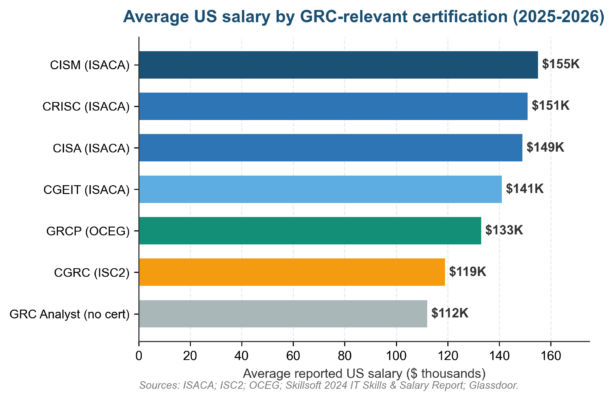 Figure 1. Average reported US salaries by GRC-relevant certification, showing why the ‘is a GRC certification worth it’ question usually resolves in favor of certifying.
Average Salaries Across the Major GRC Certifications
ISACA’s CRISC leads the dedicated risk pack near $151,000, with PayScale showing a $70,000 to $194,000 range by seniority. CISA and CGEIT sit near $149,000 and $141,000. CISM runs higher at about $155,000 for security leaders working with key risk indicators. The purpose-built GRC credentials land a notch lower but still well above median. ISC2 reports CGRC near $119,000 and OCEG’s GRCP near $133,000. Even an uncertified GRC analyst averages around $112,000, which frames the premium.
The Salary Uplift a GRC Certification Adds
Average pay shows where certified people land. Uplift shows what the credential moves. Surveys put the raise near $13,000 in the year someone earns a recognized GRC certification, and the premium is largest when it fills a gap the employer is trying to close. It is not automatic. The uplift goes to people who pair the credential with real work, not to those who collect letters. A CRISC backed by a risk management lifecycle you actually ran beats the same acronym on a thin resume.
What a GRC Certification Costs, and Whether It Is Worth the Outlay
Salary is half the ledger. A GRC certification also costs money and time, so an honest verdict has to net the raise against the full price, the way a risk assessment weighs cost against benefit. The numbers are not close.
| Certification | Exam fee | Annual upkeep | Typical study time |
| CRISC (ISACA) | $575 member / $760 non-member | $45-$85 CPE maintenance | 2-4 months |
| CISA (ISACA) | $575 / $760 | $45-$85 | 3-5 months |
| CGRC (ISC2) | About $599 | $135 AMF | 2-3 months |
| GRCP (OCEG) | $499 all-access pass | None required | 4-8 weeks |
| CISM (ISACA) | $575 / $760 | $45-$85 | 3-5 months |
Exam Fees, Maintenance, and Study Time for Each GRC Certification
The ISACA exam fee is $575 for members and $760 for non-members across CRISC, CISA, CGEIT, and CISM, plus a one-time $50 application fee and $45 to $85 a year to maintain. ISC2’s CGRC runs about $599 with a $135 annual fee, and OCEG’s GRCP is $499 for an all-access pass. Time is the bigger cost. Plan on two to five months of evening study, depending on the exam and your experience. Most employers cover the fee and materials, so the real personal investment is usually just the hours.
GRC Certification ROI and Payback Period
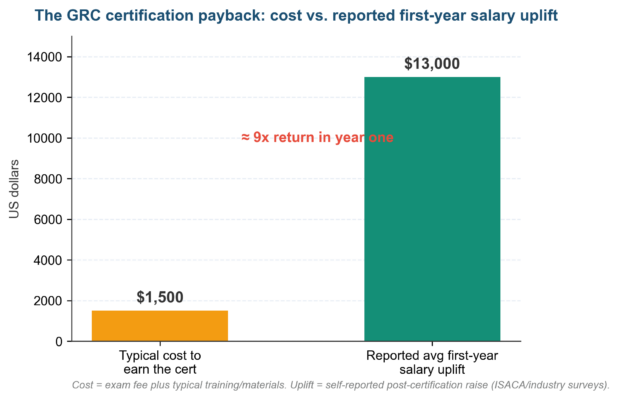 Figure 2. The GRC certification payback: a typical all-in cost near $1,500 against a reported first-year salary uplift near $13,000. Put both sides together and the payback is quick. A typical all-in cost near $1,500 against a reported first-year raise near $13,000 is roughly a ninefold return inside twelve months. Few professional investments clear that bar. Renewal stays cheap too. Annual maintenance of $45 to $135 is trivial next to a higher salary band and faster promotions. Treat it the way our how to mitigate risk guide treats any control: small recurring cost, durable payoff.
Which GRC Certification Is Worth It for Your Career Stage?
There is no single best GRC certification, only the one that fits your lane and level. A federal contractor, a bank risk analyst, and a SaaS compliance manager should not chase the same letters. This is where the worth-it question gets practical. 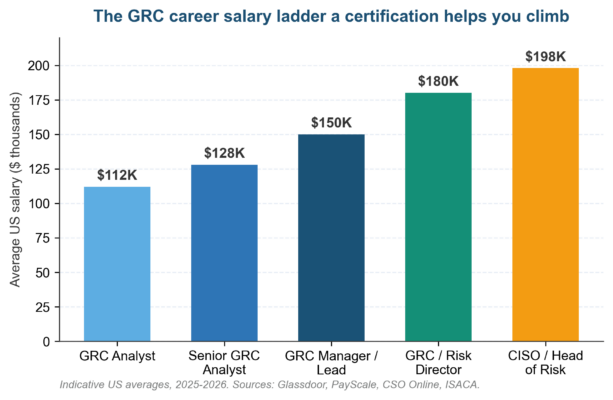 Figure 3. The GRC career salary ladder, from analyst to CISO, that a well-chosen GRC certification helps you climb.
| Certification | Best for | Prerequisites | Lane |
| CGRC (ISC2) | Federal, NIST RMF, ATO work | About 2 years experience | Security authorization |
| CRISC (ISACA) | Enterprise and IT risk roles | 3 years risk/control work | Risk management |
| CISA (ISACA) | Internal and IT audit | 5 years audit (waivers apply) | Audit and assurance |
| GRCP (OCEG) | Policy, program, integrated GRC | None | Governance and strategy |
| CGEIT (ISACA) | IT governance leadership | 5 years governance | Governance |
Early-Career: Is a GRC Certification Worth It Yet?
Under two years in, a GRC certification mainly clears resume screens and signals commitment. OCEG’s GRCP has no experience prerequisite, so it is a sensible first credential while you build the compliance risk background the harder exams assume. It opens doors more than it raises pay. The early trap is collecting credentials instead of experience. Hiring managers weigh a documented risk and control self-assessment or audit project over a stack of certificates. Earn one, apply it on real work, then add a second.
Senior and Leadership: When GRC Certifications Pay Off Most
The uplift peaks in the middle and upper bands. Add CRISC or CGRC after five years and you formalize skills you already use, opening manager and director roles paying $150,000 to $180,000. At that level the certification is a gate, not a nice-to-have. Leaders use credentials differently. A CISO near $198,000 rarely needs another exam, but the team they build is often required to hold them by clients and regulators. Tie those mandates to a clear risk appetite and they track real exposure, not vanity.
When a GRC Certification Is Not Worth It
A credible buyer’s guide names the cases where the answer flips to no. A GRC certification is not worth it for everyone. Three situations stand out, and spotting yourself in one saves a wasted year.
Signs a GRC Certification Will Not Pay Off
Skip it if you cannot apply it within a year. The credential fades when it sits unused, and the uplift depends on pairing it with real operational risk work. It also makes little sense if your employer neither requires nor rewards it and you are not moving. Be wary of niche or vendor badges sold as GRC certifications. A platform-admin certificate proves tool fluency, not governance judgment, and rarely moves pay the way CRISC, CGRC, or CISA do, per Skillsoft’s salary data. If ISC2, ISACA, or OCEG do not recognize it, treat the worth-it claim with doubt.
Experience vs. a GRC Certification: How Employers Weigh Them
Hiring managers read a GRC certification as evidence, not a substitute for experience. Given two candidates, most pick five years of hands-on internal audit or risk work over a fresh credential with no track record. The certification wins when experience is roughly equal and breaks the tie. The strongest position is both. Pair the credential with proof, a risk register you built, a control you fixed, an audit you led, and the worth-it question disappears. The market pays for judgment; the letters just make it easier to screen for.
Frequently Asked Questions: Is a GRC Certification Worth It?
Is a GRC Certification Worth It for Getting Into the Field?
For breaking in, a GRC certification is worth it mainly as a screening signal. OCEG’s GRCP needs no experience and helps an entry-level resume clear filters, but employers still want proof you can do the work. Pair it with an internship, a project, or a documented risk assessment to turn it into offers.
Which GRC Certification Is Worth It the Most for Salary?
On salary alone, ISACA’s CRISC leads the dedicated risk credentials near $151,000, with CISM higher at about $155,000 for security leaders. Among purpose-built GRC certifications, OCEG’s GRCP near $133,000 edges out ISC2’s CGRC near $119,000. Let your current role guide the choice more than the headline number. See how GRC credentials rank against all risk certifications for the wider picture.
How Long Does It Take for a GRC Certification to Be Worth It?
The payback is fast. With an all-in cost near $1,500 and a reported first-year raise near $13,000, most professionals recoup it within a year. Renewal of $45 to $135 a year is negligible against the higher salary band.
Is a GRC Certification Worth It Without IT or Security Experience?
It can be, but choose carefully. GRCP and CGRC reward governance and compliance backgrounds, while CRISC and CISA assume IT and control experience. Coming from audit, legal, or operations, start with a governance-focused credential and build technical depth on real projects first. If you are weighing financial-risk credentials instead, see how FRM and PRM stack up.
Are GRC Certifications Worth It Compared With a Degree?
They answer different questions. A degree signals broad education; a GRC certification signals current, job-ready competence in governance, risk, and compliance. For working professionals it usually delivers faster salary impact at a fraction of the cost, which is why employers often list it alongside or instead of a degree.
Is the CGRC Certification Worth It Specifically?
CGRC is worth it for federal, defense, and NIST-aligned roles where authorization and the Risk Management Framework matter. Holders average around $119,000, and the credential maps straight to security authorization work. For purely commercial enterprise risk, CRISC carries more market recognition and a higher salary.
Will a GRC Certification Still Be Worth It in a Few Years?
Yes, and arguably more so. Tightening AI, ESG, and cyber disclosure rules are expanding GRC work faster than automation is shrinking it, and the ISC2 workforce gap is still near 4.8 million. The exam may change; demand for certified governance, risk, and compliance judgment will not.
GRC Certification Mistakes That Waste the Investment
Even when a GRC certification is worth it on paper, execution can erase the return. The patterns below recur among people who certified but saw little payoff. Each fix costs nothing but discipline.
| Pitfall | Root cause | Remedy |
| Collecting certs without applying them | Treating exams as the goal | Earn one, apply it on a real project, then add another |
| Choosing the wrong credential for the lane | Picking by prestige, not role | Match the cert to your sector (CGRC federal, CRISC enterprise) |
| Paying full freight personally | Not asking the employer | Request exam and training reimbursement before enrolling |
| Letting the certification lapse | Ignoring CPE and maintenance fees | Calendar CPE credits; automate the $45-$135 renewal |
| Overpaying for boot camps | Assuming price equals pass rate | Use official ISACA/ISC2/OCEG materials plus self-study |
| Expecting a raise automatically | Confusing the credential with performance | Tie the cert to delivered results at review time |
| Stopping at the exam | Treating certification as the finish line | Keep building the experience the credential only signals |
The reimbursement point matters most. ISACA and ISC2 publish employer-friendly fee structures, and most risk teams hold a training budget because the ISC2 2024 study shows skills gaps cost more than tuition. Ask first, and a personal expense becomes a company investment.
Looking Ahead: Will a GRC Certification Be Worth It Through 2027?
The forces shaping GRC work point one way. AI governance expectations, expanding ESG disclosure, and stricter cyber-incident reporting are widening compliance faster than tools can absorb it. Credentialing bodies are already adding AI risk to their syllabi, which keeps a GRC certification current. Automation is the obvious counterargument, real but overstated. AI can draft policies and flag anomalies, but a person still has to own the judgment and answer to the regulator. Those accountabilities are what a GRC certification trains, and what an enterprise risk management system assigns to people, not tools. Pay should hold up too. With the talent gap near 4.8 million and the GRC platform market compounding near 10% a year, supply is not catching demand. A GRC certification earned in 2026 looks durable through 2027 and beyond, as long as you keep applying it.
Infographic: Is a GRC Certification Worth It in 2026?
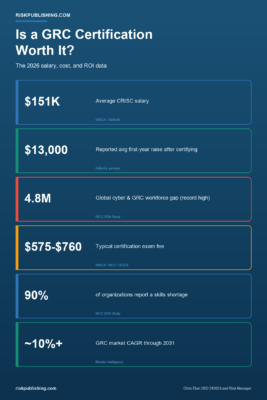 Figure 4. The salary, cost, demand, and ROI data behind the question of whether a GRC certification is worth it.
Putting Your GRC Certification to Work
A credential is only as good as the program behind it. Risk Publishing helps US risk and compliance teams turn certified talent into working governance, risk, and compliance systems that boards and regulators trust. Learn more about our work with risk leaders, and contact the practice when you are ready to put a GRC certification to work.

Chris Ekai is a Risk Management expert with over 10 years of experience in the field. He has a Master’s(MSc) degree in Risk Management from University of Portsmouth and is a CPA and Finance professional. He currently works as a Content Manager at Risk Publishing, writing about Enterprise Risk Management, Business Continuity Management and Project Management.