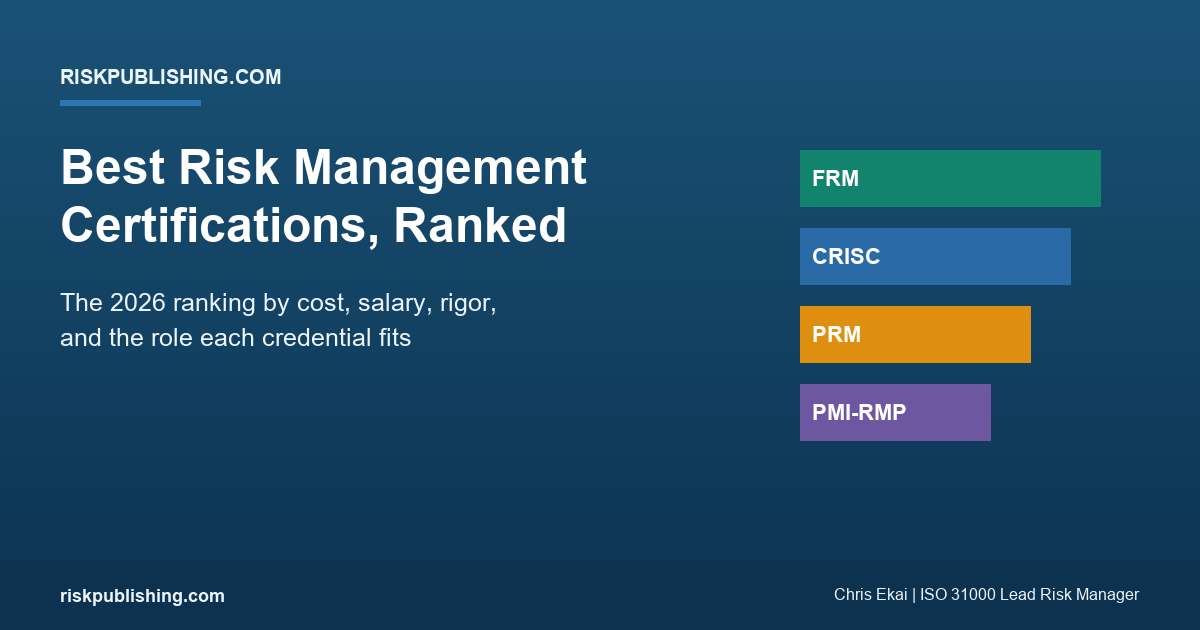
More than 30 risk management certifications compete for your tuition dollars, from financial risk to cyber to enterprise programs. Most US employers recognize fewer than a dozen, and only a handful move salary in a measurable way. The trick is knowing which credential pays for itself and which is a line on a brochure. This ranking of the best risk management certifications sorts the credentials that matter by cost, salary, rigor, and the role each one fits. Every figure comes from the issuing body or the Bureau of Labor Statistics, not a training vendor’s marketing page. The goal is one clear shortlist, not a directory of every exam in existence.
| The Fast Ranking of the Best Risk Management Certifications |
| More than 30 credentials market themselves as risk management certifications, but US employers recognize about a dozen. This ranking covers only the ones with real hiring demand and measurable salary behind them. |
| CRISC carries the highest average US salary on this list at roughly $151,000, with CISM and CISA close behind near $149,000. IT and cyber risk is the most lucrative certification lane in 2026. |
| The FRM is the finance gold standard, held by about 82,000 professionals across 190-plus countries. It is the hardest exam here, with pass rates near 45%, and recovers its cost within 12 to 18 months. |
| The RIMS-CRMP is the value pick at $375 for members and $525 for non-members. It is the only risk management certification accredited to the ISO/IEC 17024 standard. |
| Pick the domain first, then the credential. FRM and PRM for finance, CRISC and CISM for IT risk, RIMS-CRMP and ARM for enterprise risk, PMI-RMP for project risk, and CRMA or CIA for audit. |
| Every credential on this ranking clears the $49,500 all-occupation median by a wide margin, and most recover their cost within one to two years through salary uplift. |
| One credential matched to your domain beats three scattered across unrelated fields. Depth signals capability; breadth signals exam-collecting to a hiring panel. |
No single credential tops the list for everyone. The best risk management certification for a bank quant is not the one for an IT auditor or a project manager. So this guide ranks within domains, then gives a decision table that points your specific role at its best first move. If you are still choosing a career lane, start with our guide on how to become a risk analyst and the GRC analyst versus risk analyst pay comparison. Both map the roles these certifications serve, and the chief risk officer salary data shows where the top of the ladder pays out. Every salary figure here comes from the credential’s issuing body or the US Bureau of Labor Statistics, and every cost is the published 2026 fee. Where ranges are wide, the ranking uses the role-weighted average rather than the marketing headline. That keeps the comparison honest across very different domains.
How We Ranked the Best Risk Management Certifications
Ranking certifications fairly means scoring more than salary. We weighted four factors: the average US pay the credential commands, the total cost to certify, the study rigor it demands, and how widely US employers recognize it. A credential that pays well but only one niche recognizes ranks below a slightly lower-paying one with broad reach. Recognition is the factor candidates underrate most. Of the 30-plus credentials marketed as risk management certifications, US employers consistently ask for about a dozen, and the rest rarely clear an applicant-tracking filter. This ranking includes only credentials with real hiring demand behind them. The credentials this ranking leaves out share a pattern. They are cheap, fast, and unaccredited, sold on the promise that any certification helps a resume. In practice a credential no employer screens for adds a line nobody reads, which is worse than spending the same weeks on a recognized exam.
What Makes a Risk Management Certification Worth the Money
A risk management certification earns its place when the salary uplift recovers the cost within two years and the credential opens doors a resume alone cannot. The FRM, for example, recovers its higher cost within 12 to 18 months of credentialing. Recognition matters as much as rigor, because an exam nobody asks for is an expensive hobby. Watch for the accreditation signal too. The RIMS-CRMP is the only risk management certification accredited to the ISO/IEC 17024 standard, which is why enterprise risk teams treat it as a quality mark. Accreditation does not guarantee a higher salary, but it does guarantee the exam was built to a defensible standard. The issuing body matters as much as the exam. ISACA, GARP, PRMIA, PMI, the IIA, and RIMS are the names behind the credentials that clear US filters, and each publishes its standards openly. A credential governed by ISACA’s credentialing standards or aligned to ISO 31000 carries weight a private course cannot.
Mapping Risk Management Certifications to Career Domains
Risk certifications split cleanly into five domains: financial, IT and cyber, enterprise, project, and audit. Financial risk runs on FRM and PRM, IT risk on CRISC and CISM, enterprise risk on RIMS-CRMP and ARM, project risk on PMI-RMP, and audit on CRMA and CIA. Pick the domain first, then the credential. Salary is the headline most candidates chase, so the ranking opens there. The chart below shows average US pay for the eight credentials that anchor this list, and the spread runs from the high $90,000s to about $151,000. Every one clears the all-occupation median of $49,500 by a wide margin, as our risk assessment methodology guide would predict for specialized work. 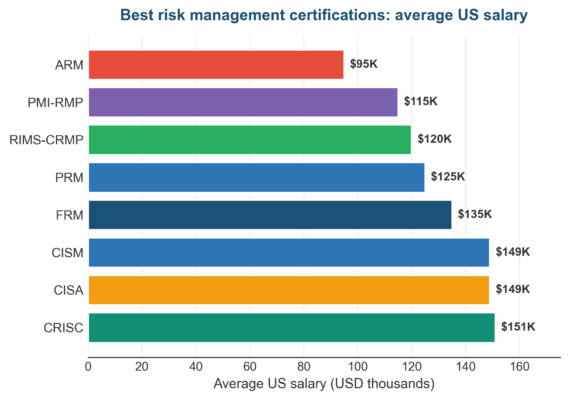 Figure 1. The best risk management certifications ranked by average US salary, from CRISC at roughly $151,000 to ARM near $95,000. Read the chart against the cost ranking that follows. CRISC and the ISACA credentials pair the highest pay with a mid-range cost, which is why they lead on return, while the FRM trades a higher cost and longer study for the widest finance recognition. Return, not raw salary, is the real ranking.
| Certification | Domain | Cost (mbr / non) | Avg US Salary | Best For |
| CRISC | IT and cyber risk | $575 / $760 | ~$151,000 | GRC and IT risk analysts |
| CISA | IT audit | $575 / $760 | ~$149,000 | IT auditors |
| CISM | Security management | $575 / $760 | ~$149,000 | Security managers |
| FRM | Financial risk | ~$1,500 total | ~$135,000 | Bank and market risk |
| PRM | Financial risk | ~$1,100 total | ~$125,000 | Corporate and ERM finance |
| RIMS-CRMP | Enterprise risk | $375 / $525 | ~$120,000 | ERM leads |
| PMI-RMP | Project risk | $520 / $670 | ~$115,000 | Project managers |
| CIA | Internal audit | ~$1,500 total | ~$110,000 | Internal auditors |
| ARM | Enterprise / insurance | ~$1,350 total | ~$95,000 | Entry ERM and insurance |
The table is the shortlist. Read it as a map, not a leaderboard, because the right credential depends on your domain rather than the top salary line. The sections that follow rank the best risk management certifications inside each domain and name the one to start with.
Best Risk Management Certifications for Financial Risk
Financial risk is the domain where certifications carry the most weight, because banks, asset managers, and insurers hire on credentials. Two dominate: the FRM and the PRM. See our FRM versus PRM compared for a side-by-side breakdown. Both are advanced, quantitative, and globally recognized, and the choice between them is the cleanest fork in the portfolio risk management path. Financial-risk credentials only pay off in financial-risk roles. A corporate ERM lead or an IT auditor gains little from the FRM’s quantitative depth, which is why the ranking keeps it inside its domain. Chasing the finance gold standard from outside finance is the most common waste on this list.
FRM: The Top Financial Risk Management Certification
The FRM from GARP is the gold standard for financial risk and the highest-recognition credential on this list. Roughly 82,000 professionals held it across more than 190 countries in 2025, and sell-side desks, buy-side risk teams, and central-bank supervisors all read it as the default signal. Two exams, a $400 enrollment fee, and pass rates near 45% make it the most demanding entry here. The rigor is the point. The FRM covers market, credit, operational, and investment risk with heavy quantitative content, which is why it pairs naturally with a quant or model-validation role. Budget 300 to 400 study hours and recover the cost within 12 to 18 months through the salary uplift.
PRM: A Governance-Focused Risk Certification
The PRM from PRMIA is the broader alternative, weighting governance and ethics where the FRM weights mathematics. It costs roughly 30% less than the FRM and suits corporate risk, energy trading, insurance, and consulting more than a trading desk. Our FRM vs PRM comparison breaks the decision down factor by factor. 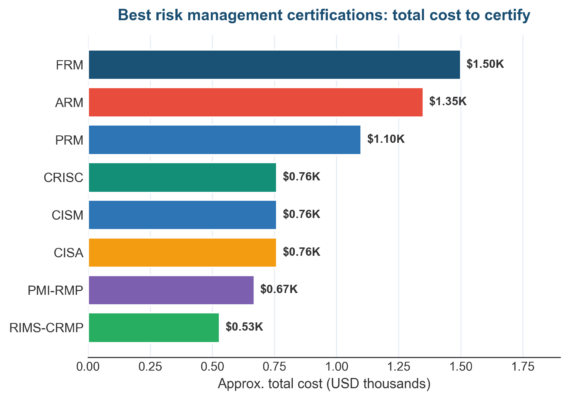 Figure 2. The best risk management certifications ranked by total cost to certify. RIMS-CRMP is the cheapest accredited option; the FRM is the most expensive.
| Factor | FRM | PRM |
| Issuer | GARP | PRMIA |
| Focus | Quantitative market and credit risk | Governance, ethics, and ERM |
| Total cost | ~$1,500 | ~$1,100 (about 30% less) |
| Recognition | Wall Street and supervisor default | Corporate, energy, and consulting |
| Best for | Quant and model-validation roles | Corporate risk and operational risk |
Top IT and Cyber Risk Management Certifications
IT and cyber risk is the fastest-growing domain, and ISACA owns it. Three credentials lead: CRISC for risk, CISM for security management, and CISA for audit. CRISC tops the entire salary ranking on this list, which makes cybersecurity risk management the most lucrative certification lane in 2026. Demand is the reason IT risk pays. Information security analyst roles are projected to grow 29% through 2034, far faster than average, and the ISACA credentials are the ones hiring managers screen for. That demand is why CRISC, not a finance credential, tops the salary chart.
CRISC: The Highest-Paying Risk Certification
The CRISC from ISACA carries the highest average US salary on this list at roughly $151,000, and it has the lowest barrier of the ISACA trio at three years of experience. It validates IT risk identification, assessment, response, and control monitoring. For a GRC analyst, it is the single best risk certification to earn first. CRISC also travels well across employers. Banks, federal contractors, and Fortune 500 technology teams all screen for it, and it appears on the US Department of Defense cyber-workforce baseline, which props up demand. Few credentials combine top pay with that breadth of recognition.
CISM and CISA as IT Risk Certifications
CISM is the leadership credential and CISA the assurance one. A security manager earns CISM to signal program ownership; an IT auditor earns CISA because its five domains mirror a controls engagement. Both pay near $149,000, and our CRISC vs CISA vs CISM guide sorts which of the three IT risk certifications to take first.
| Certification | Focus | Experience | Best For |
| CRISC | IT and enterprise risk | 3 years | GRC and risk analysts |
| CISA | IS audit and assurance | 5 years | IT auditors |
| CISM | Security management | 5 years | Security managers |
One credential sits just outside the risk lane but shapes it. The (ISC)2 CISSP is a security-engineering standard that many IT risk professionals add alongside CRISC, because the two cover different ground. CISSP proves you can build controls; CRISC proves you can govern the risk they address.
Enterprise Risk Management Certifications Worth Earning
Enterprise risk is the domain for professionals who own the whole register rather than one risk type. The credentials here are broader and less quantitative, built around frameworks like ISO 31000 and COSO that anchor the three lines model. Two stand out: the RIMS-CRMP and the ARM, with a PECB ISO 31000 credential as a framework-specific option. Enterprise credentials reward framework fluency over math. The COSO ERM framework and ISO 31000 are the two reference models these exams test, and a candidate who can map a register to either reads as ready for an enterprise role. That fluency separates an ERM lead from a single-domain specialist.
RIMS-CRMP: The Accredited Enterprise Risk Certification
The RIMS-CRMP is the value pick on this list. At $375 for members and $525 for non-members, it is the cheapest accredited credential, and it is the only risk management certification accredited to the ISO/IEC 17024 standard. It suits ERM leads, risk officers, and anyone whose job is the enterprise register rather than a single exposure. The value case is strong for career switchers too. At under $525 with about 80 study hours, the RIMS-CRMP is the lowest-risk way to test whether enterprise risk is the right lane before committing to a pricier credential. Few exams offer that much signal for so little outlay.
ARM and ISO 31000 Risk Management Certifications
The ARM from The Institutes is the entry-level enterprise option, broad and accessible at roughly $1,350 with about 120 study hours. The PECB ISO 31000 Lead credential certifies you can implement the framework itself. Neither tops the salary chart, but both build the foundation a formal risk assessment program depends on.
Project and Audit Risk Management Certifications
Two narrower domains round out the ranking. Project risk has one clear leader, and audit-focused risk has two credentials that bridge assurance and risk. None top the salary chart, but each is the best risk management certification for its specific lane, with the KPIs for risk management they support overlapping more than the titles suggest. Audit-focused credentials are quietly durable. Internal audit functions are expanding their risk remit, and a CRMA or CIA holder who can run a risk-based engagement is harder to replace than a pure auditor. The pay sits below the IT credentials, but the job security runs higher.
PMI-RMP: The Project Risk Management Certification
The PMI-RMP is the credential for project and program managers who own schedule, budget, and scope risk. It costs $520 for PMI members and $670 for non-members, and holders often report a 20% to 30% salary increase. For anyone whose risks live inside a project plan, it is the obvious first certification.
CRMA and CIA: Audit-Focused Risk Certifications
The CRMA from the IIA certifies risk-based assurance for internal auditors moving into risk, while the CIA is the broader internal-audit standard across three exam parts. Both suit professionals who test controls and want to speak the risk language fluently. They pair naturally with a risk-based internal audit practice. 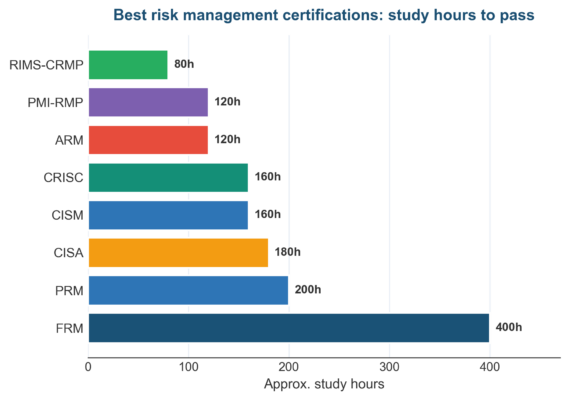 Figure 3. The best risk management certifications ranked by study hours. The FRM demands the most preparation; the RIMS-CRMP the least.
Choosing the Best Risk Management Certification for You
The ranking answers which credentials are strongest, but the right pick is personal. Match the certification to your domain, your experience level, and the role you want next. The decision table below points each common goal at its best first risk management certification. Anchor the choice in the role of the professional who measures and manages risk before paying an exam fee.
| Your Goal or Role | Best First Certification | Why |
| Break into financial risk | FRM | Highest recognition on a trading or risk desk |
| Corporate or ERM finance | PRM | Cheaper, governance-focused alternative to FRM |
| IT or cyber risk | CRISC | Top salary and the lowest ISACA experience gate |
| Security management | CISM | The leadership credential for program owners |
| IT audit | CISA | The audit standard with controls-engagement domains |
| Enterprise risk leadership | RIMS-CRMP | Accredited, affordable, and register-focused |
| Project risk | PMI-RMP | The project-risk standard with a 20 to 30% uplift |
| Internal audit into risk | CRMA | Risk-based assurance built for auditors |
Notice that the table never tells you to collect all of them. One credential matched to your domain beats three scattered across unrelated fields, because depth signals capability where breadth signals exam-collecting. Start with the one your current work backs, then add a second only as your role widens. When you do add a second credential, pick the adjacent domain rather than a random one. A CRISC holder adds CISA to cover audit; an FRM holder adds the PRM or a RIMS-CRMP to broaden into enterprise risk. The pairing should tell a career story a hiring manager can read in one line. Timing matters as much as choice. Earn the credential while you still do the work it tests, because the experience requirement and the study both go faster when the material is your day job. Waiting until a role change usually means relearning what you once knew cold.
Risk Management Certifications: Frequently Asked Questions
Common Risk Management Certification Mistakes to Avoid
Seven mistakes recur when professionals pick a risk management certification. The table pairs each with its root cause and the fix, so your money buys recognition and salary rather than a wall plaque. Most of them trace back to choosing on reputation instead of role fit.
| Pitfall | Root Cause | Remedy |
| Buying an unrecognized credential | Chasing a cheap or fast cert no employer asks for | Stick to the dozen US employers recognize |
| Picking on salary alone | Ignoring domain fit | Match the certification to your domain first |
| Starting with the FRM | Choosing the hardest exam before any experience | Begin with a domain-matched credential |
| Collecting multiple certs | Believing more letters means more value | Hold credentials your work can back |
| Skipping the experience check | Studying for a cert you cannot yet claim | Verify the experience gate before paying |
| Forgetting CPE upkeep | Missing the continuing-education cycle | Log the required hours or the credential lapses |
| Confusing accreditation with recognition | Assuming accredited means highest-paying | Weigh both recognition and accreditation |
The Best Risk Management Certifications Beyond 2026
Three forces will reshape the best risk management certifications through 2027. The first is AI risk. Boards now want credentials that cover model and data exposure, and ISACA, GARP, and PRMIA are all adding AI-risk content, which favors the IT and financial credentials that move fastest. The second force is convergence. As GRC, audit, and security functions merge into one risk office, the credentials that signal breadth gain ground over single-domain exams. A RIMS-CRMP or a stacked CRISC-plus-CISA pairing reads better to a converged enterprise risk team than one narrow specialty. The third force is accreditation pressure. As more credentials chase the ISO/IEC 17024 standard the RIMS-CRMP already holds, the gap between a recognized risk management certification and a marketing exam will widen. Buyers will reward the credentials built to a defensible standard. The durable advice outlasts all three shifts. Pick the credential your domain and role demand, earn it while the experience is fresh, and add a second only when the work widens. The best risk management certification is the one a hiring manager in your field already respects, not the one with the longest acronym.
Infographic: Best Risk Management Certifications by the Numbers
Figure 4. The best risk management certifications ranked by the numbers, from the 30-plus credentials competing to the $151,000 top salary. 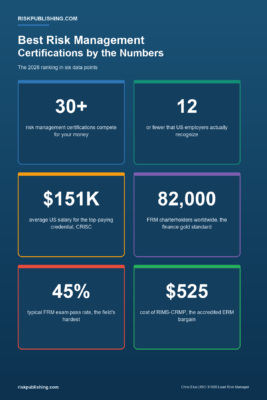
Picking Your Best Risk Management Certification
Risk Publishing helps US professionals and teams match the best risk management certification to the roles they are targeting, then build the study and experience plan to earn it. Review the advisory services page to see how the coaching runs, and contact the practice when the next credential is the next step.

Chris Ekai is a Risk Management expert with over 10 years of experience in the field. He has a Master’s(MSc) degree in Risk Management from University of Portsmouth and is a CPA and Finance professional. He currently works as a Content Manager at Risk Publishing, writing about Enterprise Risk Management, Business Continuity Management and Project Management.