In 2024, JPMorgan Chase received roughly 493,000 applications for about 4,000 summer analyst and associate seats, an acceptance rate near 0.91% and an 82% jump in applicants over the prior year. That is the wall a new risk analyst runs into when breaking into finance with no experience.
Learning how to become a risk analyst is less about beating that competition and more about the system you bring to it. The role sits at the center of every enterprise risk management framework, and the Bureau of Labor Statistics projects faster-than-average growth for the analysts who fill it through 2034.
The hardest part of figuring out how to become a risk analyst is the experience paradox. Employers want a risk analyst who has done the work, and the work seems to require a job nobody will give without experience. The path around it is a sequence of degree, skills, certification, and proof you can assemble before your first title.
A US risk analyst reads the same frameworks a chief risk officer signs off on, so understanding how to become a risk analyst also shows you the climb from entry level to the top of the function. The five steps below move from the classroom to a signed offer, with the salary and certification math at each rung of the risk management lifecycle.
What Does a Risk Analyst Do, and Why Demand Is Rising in 2026
A risk analyst identifies, measures, and reports the threats that could stop an organization from hitting its objectives. The job spans credit, market, operational, and compliance risk. The daily work is part spreadsheet, part investigation, and part translation for executives who need a decision rather than a data dump.
The Risk Analyst Role in Plain Terms
Strip away the titles and a risk analyst answers three questions for every exposure: how likely is it, how badly would it hurt, and what are we doing about it. The output is a risk register, a heat map, and a short brief that a committee can act on in one meeting.
That structure holds whether the risk analyst works at a bank, a hospital system, a manufacturer, or a federal contractor. The frameworks behind it are public: ISO 31000 for the process and COSO ERM for the governance wrapper boards expect, as our ISO 31000 vs COSO comparison lays out.
| Sector | What the Risk Analyst Does | Typical Entry Path |
| Banking | Models credit, market, and liquidity exposure; supports regulatory stress testing | Analyst rotation program or internship |
| Insurance | Prices underwriting risk, builds loss models, monitors reserve adequacy | Actuarial or underwriting trainee track |
| Healthcare | Assesses patient-safety, compliance, and operational continuity risk | Compliance or quality analyst role |
| Manufacturing | Maps supply chain, safety, and operational risk into a scored register | Operations or EHS analyst role |
| Government / Defense | Evaluates program, cyber, and third-party risk against federal standards | Federal contractor or agency analyst |
| Technology | Tracks cyber, vendor, and data-governance risk across the GRC stack | GRC or security analyst role |
The titles vary by industry, which trips up new candidates scanning job boards. A bank may post the same work as a credit risk analyst or a risk and controls analyst, while a tech firm calls it a GRC analyst and a hospital calls it a compliance risk specialist. Search the duties, not just the title, and the pool of entry roles widens fast.
Why Risk Analyst Demand Is Rising Through 2034
The Bureau of Labor Statistics projects 6% growth for financial analysts, the category that houses risk analysts, between 2024 and 2034. That pace runs faster than the all-occupation average. It works out to roughly 29,900 openings each year as the workforce grows and analysts retire or move up. Seeing what the professional who measures and manages risk actually does day to day makes the aliases easier to decode.
Financial risk specialists, the BLS code closest to a dedicated risk analyst, held about 60,500 jobs in 2024 at a median wage of $106,000. The all-occupation median was $49,500 that year. The role pays roughly double the typical US job from the day you start building toward it.
Strong demand does not mean easy entry. The same brand-name employers that post risk roles draw applicant floods, and the chart below shows the scale: a single 2024 intake at one bank pulled nearly half a million applications for a few thousand seats.
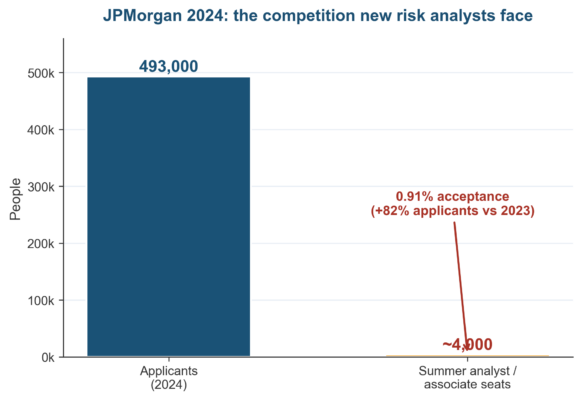
Figure 1. The competition a new risk analyst faces. JPMorgan’s 2024 intake drew roughly 493,000 applicants for about 4,000 seats, a 0.91% acceptance rate.
The lesson is not to avoid the giants. It is to apply widely across employer sizes. Target the mid-size banks, insurers, asset managers, and corporates that hire steadily and train a new risk analyst without the lottery odds a bulge-bracket internship carries.
The 5-Step Roadmap to Become a Risk Analyst With No Experience
This is the practical answer to how to become a risk analyst with no experience, and the roadmap runs through five steps, in order: degree, skills, certification, experience, and the application itself. None require a finance pedigree. Most can run in parallel during your final year of school or a career switch.
Step 1: Earn the Degree a Risk Analyst Employer Expects
The first practical move in how to become a risk analyst is the degree: most US risk analyst postings ask for a bachelor’s degree, and BLS lists one as the typical entry-level education for the field. Finance, economics, statistics, accounting, mathematics, and business analytics are the strongest majors, because they signal the quantitative comfort the work demands.
A degree in another field does not disqualify you. Risk teams hire engineers, data scientists, and even liberal-arts graduates who can show numeracy. A career switcher can close the gap with a certificate, a bootcamp, or a graduate diploma rather than a second four-year degree.
Step 2: Build the Core Risk Analyst Skills
The skills step is where most people researching how to become a risk analyst spend their effort, because employers screen a junior risk analyst on a short list of hard skills: spreadsheet modeling, SQL, a scripting language such as Python or R, and fluency in at least one risk management technique or framework. The soft skills matter just as much. The job lives or dies on clear writing and calm briefings.
Build each skill against a real artifact, not a course certificate. A working risk register, a Monte Carlo model in Excel, a SQL query that flags overdue controls, and a set of key risk indicators give a hiring manager something concrete to test in the interview.
| Risk Analyst Skill | Why It Matters | How to Prove It |
| Excel modeling | Scores risks, builds heat maps, runs sensitivity analysis | A scored 5×5 register and a Monte Carlo model |
| SQL | Pulls control, loss, and incident data from systems | A query that flags overdue or breached controls |
| Python or R | Automates scoring, builds dashboards, runs statistics | A script that scores a sample register |
| Risk frameworks | Aligns work to ISO 31000 and COSO that boards expect | A one-page assessment mapped to a standard |
| Written briefing | Turns analysis into a decision an executive can act on | A one-page risk brief with a clear recommendation |
| Stakeholder judgment | Sizes exposures and influences decisions under uncertainty | Interview stories of spotting a risk early |
Step 3: Earn an Entry-Level Risk Analyst Certification
A certification will not replace experience, but it moves a no-experience resume past the first screen. For a new risk analyst, the accessible starting credentials are the Associate in Risk Management from The Institutes, the PRM from PRMIA, and ISACA’s CRISC for the cyber and GRC track.
The Financial Risk Manager designation from GARP is the field’s gold standard, but its two exams demand 300-plus study hours and reward candidates who already work in risk. Treat the FRM as a two-year goal, not a day-one requirement. Start with a lighter credential you can finish in a quarter.
One detail saves money and signals commitment: many employers reimburse certification fees once you are hired. Sit the first exam yourself to prove intent, then let the job fund the rest, including the FRM. A credential in progress on day one often converts into an employer-sponsored finish by year two.
Step 4: Gain Experience Before You Have a Risk Analyst Job
Anyone working out how to become a risk analyst meets the experience paradox here, and it breaks when you stop waiting for a risk analyst title to do risk work. Internships, analyst rotation programs, and adjacent roles in audit, compliance risk assessment, operations, or data analytics all produce the risk reasoning a hiring manager recognizes.
Volunteer the work if you have to. Offer to map a small nonprofit’s risk register, run a tabletop business continuity exercise for a campus club, or rebuild an employer’s manual risk log into a scored operational risk model, and the result becomes a portfolio piece that reads as real experience.
Formal rotation programs hire differently from a one-off job posting. Many US banks, insurers, and Fortune 500 finance functions run one-to-two-year analyst rotations that move you across credit, operational, and enterprise risk before you specialize.
These programs hire on aptitude and coursework rather than prior risk experience, which makes them the single best entry door for a no-experience candidate.
Step 5: Apply and Interview for the Risk Analyst Role
The last stage in how to become a risk analyst is the one candidates underestimate: with a degree, skills, a certification in progress, and a portfolio, the final step is converting all of it into a risk analyst offer. Apply to 30 to 50 roles across employer sizes. Tailor each resume to the posting’s risk language, and track the pipeline like the risk register it resembles.
The interview tests whether you can think in exposures under mild pressure. Expect a behavioral round on judgment and a technical round on probability, Excel, and a framework walk-through, all of which our entry-level risk analyst interview questions set rehearses in detail.
Risk Analyst Certifications Compared: FRM, PRM, CRISC, and ARM
Certifications are a recurring question for anyone studying how to become a risk analyst, and four of them carry weight for a US risk analyst. They sort cleanly by cost, study time, and the experience they assume. The chart and table below compare them so you can pick the one that fits your background instead of defaulting to the hardest exam.
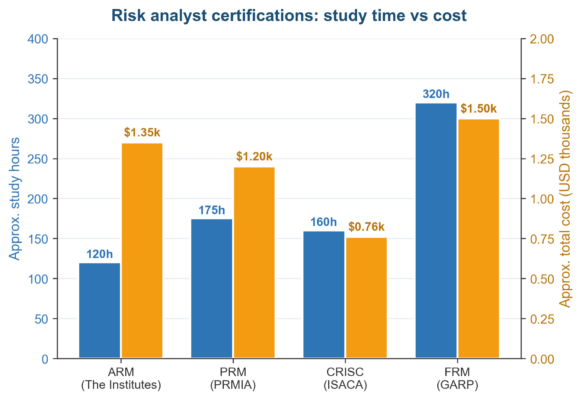
Figure 2. Risk analyst certifications compared by approximate study hours and total cost. The FRM is the most demanding; the ARM and CRISC are the most accessible starting points.
Which Risk Analyst Certification to Start With
If you are switching careers with no finance background, the Associate in Risk Management gives the broadest enterprise grounding for the lowest study load.
If your target is a bank or asset manager, the PRM signals quantitative intent without the FRM’s full commitment. Investment-focused candidates sometimes add the CFA Institute charter, though that is a multi-year commitment well beyond an entry risk role.
A cyber, IT, or GRC-leaning risk analyst should start with CRISC, which maps to the control and governance language those teams use daily, a distinction our GRC analyst vs risk analyst guide spells out. Register before you finish the portfolio, because an in-progress credential still beats none.
| Certification | Issuing Body | Best Starting Point For | Approx. Cost / Hours |
| ARM | The Institutes | Career switchers wanting broad enterprise risk grounding | $1,350 / 120 hrs |
| PRM | PRMIA | Bank and asset-management track without FRM commitment | $1,200 / 175 hrs |
| CRISC | ISACA | Cyber, IT, and GRC-leaning risk analyst roles | $760 / 160 hrs |
| FRM | GARP | Quantitative finance, as a two-year goal once working | $1,500 / 320 hrs |
Risk Analyst Salary and Career Path From Entry to CRO
Pay is the clearest argument for learning how to become a risk analyst. A risk analyst starts well above the US median wage and climbs a visible ladder. The same skills that score a single risk also run an entire enterprise risk function once you have the experience to lead one.
Risk Analyst Salary Expectations With No Experience
BLS puts the lowest 10% of financial and investment analysts under $62,410 and the median at $101,350 as of May 2024. A first risk analyst job in a US metro typically lands near $70,000. The exact number is driven by city, sector, and whether a certification is already in hand.
Banking and asset management pay the most at entry. Nonprofit, government, and smaller corporates pay less but compete on stability and training. The gap closes fast, because two years of proven risk analyst output resets your market value regardless of where you started.
Employers that run a training needs assessment for new analysts are the ones that train, so ask about it in the interview.
Base salary is only part of the package. Banking and consulting roles add performance bonuses of 10% to 30%, and senior risk analysts at large institutions often receive equity or deferred compensation. Weigh total compensation, not just base, when you compare a first risk analyst offer across cities and sectors.
The Risk Analyst Career Ladder
The climb runs from analyst to senior analyst to risk manager, then director, then chief risk officer. Each rung adds scope: a senior risk analyst owns a risk domain, a manager owns a team, and a CRO owns the risk appetite the board signs.
The top of that ladder pays in the mid-six figures and above. The BLS highest 10% of analysts already clear $180,550 before you reach the executive tier. The chart below maps the typical US progression from a first risk analyst seat to the chief risk officer chair.
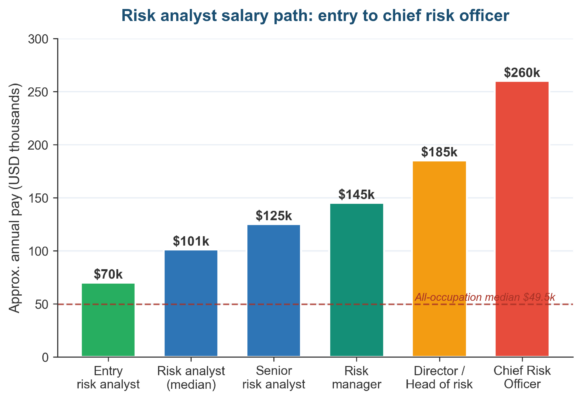
Figure 3. The risk analyst salary path from a first seat to chief risk officer, with each level well above the $49,500 all-occupation median. Figures are approximate US ranges.
| Career Level | Typical US Pay | What You Own | Experience |
| Entry risk analyst | ~$70,000 | A slice of a register under supervision | 0 to 2 years |
| Risk analyst (median) | ~$101,000 | A risk category and its reporting | 2 to 4 years |
| Senior risk analyst | ~$125,000 | A full risk domain and its methodology | 4 to 7 years |
| Risk manager | ~$145,000 | A team and a section of the framework | 7 to 10 years |
| Director / Head of risk | ~$185,000 | A function and the board reporting | 10 to 15 years |
| Chief Risk Officer | ~$260,000+ | The appetite the board approves | 15+ years |
Treat the numbers as direction, not promise. Bonuses, equity, and regional cost of living swing the figures, and our chief risk officer salary by state data shows how wide the spread runs at the top of the risk analyst career path.
How to Land Your First Risk Analyst Job With No Experience
The application stage is where most no-experience candidates stall, because they present themselves as empty rather than transferable. A hiring manager cares less about a prior risk analyst title. They want evidence you already think in likelihood, impact, and control.
Building a Risk Analyst Resume Without Risk Experience
A resume is where how to become a risk analyst becomes concrete, so rewrite past roles in risk language. A retail shift lead who cut shrinkage managed operational risk; a student who ran a budget committee managed financial exposure; a developer who patched a vulnerability ran control remediation, and each line maps to a real risk analyst competency.
Lead the resume with the portfolio. A linked risk register, a scored model, and a one-page brief near the top prove the skill before the reviewer reaches your work history, which is exactly the reassurance a no-experience hire needs to provide.
Applicant tracking systems screen a resume before a human reads it. Mirror the posting’s exact phrasing, such as risk register, key risk indicators, control testing, and the named framework, so the system scores you as a match. The portfolio links then prove the keywords are real rather than stuffed.
Risk Analyst Interview Preparation
Interviews for a junior risk analyst blend behavioral and technical rounds. The behavioral side probes judgment under uncertainty and how you handle ambiguity. The technical side tests Excel, basic statistics, and whether you can talk through a risk assessment methodology without notes.
Prepare three stories that show you spotting a risk early, sizing it, and influencing a decision. Pair them with a clean walk-through of how you would conduct a risk assessment, and rehearse against the question bank in our entry-level interview guide.
Frequently Asked Questions About How to Become a Risk Analyst
How Long Does It Take to Become a Risk Analyst?
When people ask how to become a risk analyst, the honest timeline is four to five years for most: a four-year bachelor’s degree plus several months to build skills, a starter certification, and a portfolio. Career switchers who already hold a degree can compress the path to six to twelve months. Focus on the skills, a credential, and proof of work.
Can You Become a Risk Analyst With No Experience?
Yes. You can become a risk analyst with no direct experience by translating adjacent work in audit, compliance, operations, or data analysis into risk terms and backing it with a portfolio. Internships and analyst rotation programs are the most reliable on-ramps for candidates straight out of school.
What Degree Do You Need to Become a Risk Analyst?
A bachelor’s degree is the standard entry-level education. Finance, economics, statistics, accounting, or business analytics are the strongest majors. A degree in another field still works if you can demonstrate numeracy and framework knowledge, so a non-finance graduate is not shut out of the risk analyst path.
Do You Need a Certification to Become a Risk Analyst?
No certification is legally required to become a risk analyst, but one helps a no-experience resume clear the first screen. Start with an accessible credential such as the ARM, PRM, or CRISC. Treat GARP’s FRM as a longer-term goal once you are working in the field.
How Much Does an Entry-Level Risk Analyst Make?
An entry-level risk analyst in the US typically earns around $70,000, with BLS placing the lowest 10% of financial and investment analysts under $62,410 and the median at $101,350 as of May 2024. Banking and asset management pay above that range; government and nonprofit roles pay below it.
Is Risk Analyst a Good Career in 2026?
Risk analyst is a strong career in 2026. BLS projects faster-than-average growth through 2034, and the median pay runs roughly double the all-occupation median. The role also leads to senior risk management and chief risk officer positions with mid-six-figure compensation.
What Skills Does a Risk Analyst Need?
A risk analyst needs spreadsheet modeling, SQL, a scripting language such as Python or R, and fluency in a framework like ISO 31000 or COSO ERM. The soft skills matter equally: clear writing, calm presentation to executives, and the judgment to size an exposure when the data is incomplete.
Common Mistakes When Trying to Become a Risk Analyst
Seven mistakes stall most candidates trying to become a risk analyst, and each one is fixable before it costs you an offer. The table below pairs the recurring miss with its root cause. The remedy column is what hiring managers actually respond to.
| Pitfall | Root Cause | Remedy |
| Applying only to brand-name banks | Chasing prestige into 0.91% acceptance lotteries | Apply widely to mid-size banks, insurers, and corporates that train new analysts |
| No portfolio of work | Treating courses and certificates as proof of skill | Build a risk register, a scored model, and a one-page brief reviewers can test |
| Starting with the FRM | Picking the hardest exam before any experience | Begin with ARM, PRM, or CRISC and target the FRM once working |
| Generic resume | Listing past jobs without translating them to risk | Rewrite each role in likelihood, impact, and control language |
| Waiting for a risk title | Believing risk work needs a risk job first | Do risk work through audit, compliance, ops, or volunteer projects |
| Ignoring soft skills | Over-indexing on technical tools alone | Practice the one-page brief and the calm executive walk-through |
| No framework fluency | Knowing tools but not the standards behind them | Map a sample assessment to ISO 31000 or COSO ERM |
Looking Ahead: The Risk Analyst Role in 2026-2027
Three forces will reshape how to become a risk analyst between 2026 and 2027. The first is automation. GRC platforms now draft risk scores and summaries, which shifts the junior risk analyst’s value from data entry toward judgment, validation, and the executive translation a machine cannot do.
The second force is the rise of non-financial risk. Cyber, third-party, climate, and AI exposures now sit on board agendas, and a risk analyst who can speak the NIST and ISO language across those domains is more hireable than a pure credit or market specialist.
The third force is regulatory weight on model governance. The Federal Reserve’s SR 11-7 guidance treats spreadsheet risk models as model risk, so a new risk analyst who documents, versions, and validates their work is building the exact discipline examiners now demand.
The candidate who pairs the timeless basics with these shifts has the clearest runway. Learn the enterprise risk management frameworks, prove the skills on real artifacts. Then the question stops being how to become a risk analyst and becomes how fast you climb once you are one.
Infographic: The 5-Step Risk Analyst Roadmap
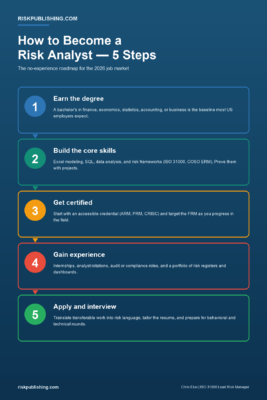
Figure 4. The five-step roadmap to become a risk analyst with no experience, from earning a degree to landing the first role.
Your Next Step to Become a Risk Analyst
Knowing how to become a risk analyst is one thing; executing the plan is another. Risk Publishing helps US professionals and career switchers build the skills, portfolio, and certification plan that turn a no-experience start into a risk analyst offer. Review the advisory services page to see how the coaching runs, and contact the practice when your first risk analyst role is the next move.

Chris Ekai is a Risk Management expert with over 10 years of experience in the field. He has a Master’s(MSc) degree in Risk Management from University of Portsmouth and is a CPA and Finance professional. He currently works as a Content Manager at Risk Publishing, writing about Enterprise Risk Management, Business Continuity Management and Project Management.