Information security analyst jobs are projected to grow 29% between 2024 and 2034, and the credentials that gate the senior risk and security roles all clear six figures. ISACA reports average US pay of roughly $151,000 for CRISC, $149,000 for CISM, and $149,000 for CISA. Demand and pay are both moving the same direction.
So the question for most US professionals is not whether to certify but the CRISC vs CISA vs CISM order: which one first. The three credentials share an issuer, an exam fee, and a pay band within a few thousand dollars. That makes the decision about fit rather than prestige. For how these three compare with every other credential, see the full risk certification rankings.
| The Fast Answer on CRISC vs CISA vs CISM |
| CRISC, CISA, and CISM all come from ISACA, share a $575 member and $760 non-member exam fee, and pay within a few thousand dollars of each other. The first-certification choice is about role fit, not prestige. |
| ISACA reports average US pay near $151,000 for CRISC and around $149,000 for both CISM and CISA. All three sit above the $124,910 median the Bureau of Labor Statistics records for information security analysts in May 2024. |
| CRISC has the lowest barrier in the CRISC vs CISA vs CISM set: three years of experience versus five for CISA and CISM. That gate often decides which credential you can claim first, regardless of which exam you prefer. |
| Take CRISC first if you own or assess risk, CISA first if you audit systems, and CISM first if you run a security program. Match the credential to your current work and you certify faster. |
| The three exams differ by domain weighting. CRISC leans on risk assessment and response, CISA on the audit process across five domains, and CISM on program development and incident management. |
| All three require 120 continuing-education hours over a three-year cycle, with a 20-hour annual minimum, plus a $45 member or $85 non-member maintenance fee. Miss the cycle and the credential lapses. |
| Stack the credentials only as your role grows into risk, audit, and management. Two certifications backed by real engagements beat three backed by cram courses in any hiring conversation. |
The right first certification depends on the work you already do. CRISC rewards risk and governance professionals, CISA rewards auditors, and CISM rewards security managers. Each also sets a different experience gate that decides whether you even qualify to hold it yet.
This decision sits inside the wider GRC career map, where pay tracks the seniority a credential signals. Our GRC analyst versus risk analyst pay guide shows the role-level spread, and these certifications are how you climb the bands it describes. A first risk analyst role often leads straight into this choice.
What CRISC, CISA, and CISM Each Certify
All three credentials come from ISACA, the global association behind COBIT and the IT audit profession. They share an exam fee, a continuing-education model, and a code of ethics. What differs is the discipline each one certifies, and that difference is the whole basis of the CRISC vs CISA vs CISM decision.
CRISC, the Certified in Risk and Information Systems Control, is the risk credential. It validates that you can identify IT risk, assess it, plan a response, and monitor the controls that hold it down. The exam reads like the job of a GRC analyst or a cyber risk manager.
CISA, the Certified Information Systems Auditor, is the oldest and most recognized of the three. It certifies that you can plan and run an information-systems audit, test controls, and report findings to a board or regulator. It is the assurance credential that risk-based audit teams expect.
CISM, the Certified Information Security Manager, targets the move from doing security to running it. It weights governance, program development, and incident management over hands-on configuration. CISM is the credential that signals you can lead an information security risk management function, not just operate inside one.
ISACA has certified IT professionals since the 1970s and counts well over 100,000 CISA holders worldwide, which is why these letters clear HR filters that newer credentials do not. The brand behind the exam is part of what you buy. That recognition is uniform across the CRISC vs CISA vs CISM set.
Underneath the three sits a shared governance foundation. All map to the control thinking in COSO and ISO/IEC 27001, which is why a professional who holds one can read the others without starting over. That overlap is what makes stacking realistic later.
CRISC, CISA, and CISM at a Glance
The fastest way to see the three side by side is a single table. It maps each credential to its full name, its primary audience, and the ISACA average salary, so the trade-off across CRISC, CISA, and CISM is visible in one view. Each also aligns to a recognized risk assessment discipline that hiring managers know.
| Credential | Full Name | Built For | Avg US Salary |
| CRISC | Certified in Risk and Information Systems Control | Risk and GRC professionals | ~$151,000 |
| CISA | Certified Information Systems Auditor | IT auditors and assurance | ~$149,000 |
| CISM | Certified Information Security Manager | Security managers and leaders | ~$149,000 |
How CRISC, CISA, and CISM Salaries Compare
The pay gap between the three is small. ISACA puts CRISC near $151,000 and both CISM and CISA near $149,000, all well above the $124,910 median the Bureau of Labor Statistics reports for information security analysts in May 2024. The certifications buy you a clear premium over the role’s baseline.
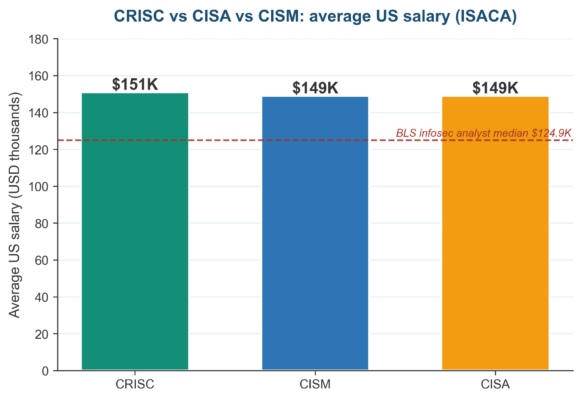
Figure 1. CRISC vs CISA vs CISM average US salaries (ISACA), all above the $124,910 BLS information security analyst median for May 2024.
The takeaway is that salary should not drive the CRISC vs CISA vs CISM choice. A few thousand dollars of average difference is noise next to the experience gate and the role fit. Those two factors decide whether the credential actually lands the next job, and the pay follows the seniority you reach, not the letters alone.
Pay also reflects where these credentials are mandated. All three appear on the US Department of Defense cyber workforce baseline lists, which props up demand across federal contractors and the banks that mirror their controls. That mandate is part of why the premium holds steady year to year.
Region swings the number more than the credential does. A CRISC holder in San Francisco or Washington DC can clear $180,000, while the same credential in a lower-cost metro sits closer to $120,000. The premium over the local baseline, not the headline average, is the figure to track.
Base pay is only part of it. Risk and security leaders with these credentials often add bonuses of 10 to 20 percent, and the certification is frequently the line item that unlocks a promotion band rather than a simple raise. Weigh total compensation against your local market, not the national average.
Exam, Cost, and Experience Across CRISC, CISA, and CISM
Where the three diverge is structure. The CRISC vs CISA vs CISM exams differ in domain weighting, in the experience each demands before you can certify, and in how the material maps to your day job. The sticker price, though, is identical across all three.
Because the exam fee is identical across the three, cost drops out of the decision entirely. What you are really comparing is the time-to-certify and the overlap with your current job. Both favor the credential closest to the work you already do, which is the thread running through this whole comparison.
Inside the CRISC, CISA, and CISM Exam Domains
Each ISACA exam is built from a job-practice analysis that weights domains by real-world time spent. CRISC splits across governance, IT risk assessment, risk response, and technology controls. CISM leans toward program development and incident management, which is the work of running a security function rather than auditing one.
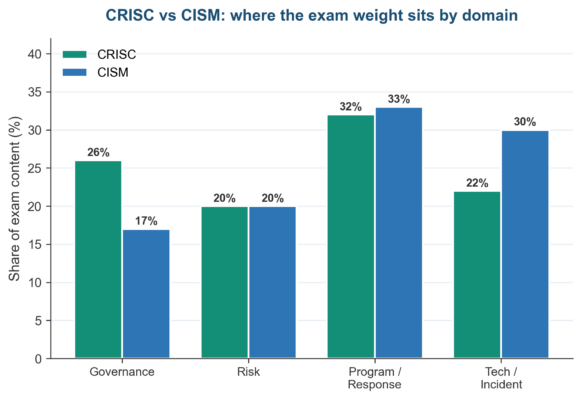
Figure 2. CRISC vs CISM exam weight by domain. CRISC concentrates on risk assessment and response; CISM concentrates on program development and incident management.
CISA runs on a different structure with five domains centered on the audit process, governance, systems acquisition, operations, and the protection of information assets. The domain map is the clearest signal of which exam matches the work you already know. Reading all three side by side usually settles the CRISC vs CISA vs CISM question on its own.
The practical read is study time. If your job already lives in one exam’s domains, you need fewer outside hours to pass it, which is the cost most candidates underweight. The cheapest exam to pass is the one your current work already teaches.
Experience Gates and Upkeep for CRISC, CISA, and CISM
The experience gate is where the order is often decided for you. CRISC asks for three years across at least two of its domains, while CISA and CISM each require five years. CISM further demands that three of those five years sit in security management, which pushes it later in most careers.
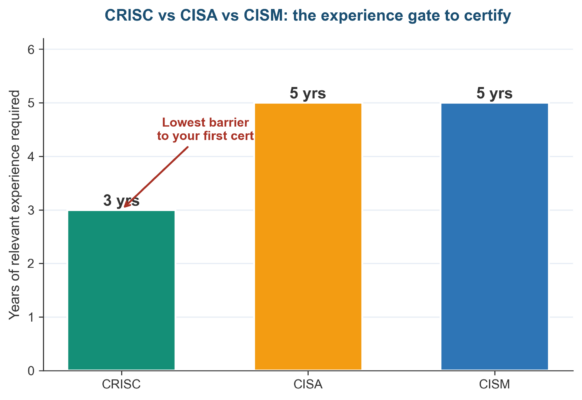
Figure 3. The experience gate in the CRISC vs CISA vs CISM decision. CRISC’s three-year requirement is the lowest barrier of the three.
All three carry the same upkeep. You pay a maintenance fee of $45 for members or $85 for non-members, and you earn 120 continuing-education hours over three years with a 20-hour annual minimum. Let the cycle slip and the credential lapses, so plan the hours the way you would plan a risk assessment methodology review.
CISA and CISM both allow limited experience waivers. A relevant degree or another approved credential can substitute for one or two of the five years, which narrows the real gap with CRISC for some candidates. Check the current ISACA substitution list before you assume you are five full years away.
| Factor | CRISC | CISA | CISM |
| Focus | IT and enterprise risk | IS audit and assurance | Security management |
| Exam fee (member / non) | $575 / $760 | $575 / $760 | $575 / $760 |
| Experience required | 3 years | 5 years | 5 years (3 in mgmt) |
| Exam domains | 4 risk domains | 5 audit domains | 4 management domains |
| CPE upkeep | 120 hrs / 3 yrs | 120 hrs / 3 yrs | 120 hrs / 3 yrs |
| Best-fit role | Risk and GRC analyst | IT auditor | Security manager |
Which to Take First: CRISC, CISA, or CISM
The first-certification rule is simple. Pick the credential that matches the job you hold now, because you certify faster and the material reinforces your daily work. The order should follow your current role, not the highest salary or the hardest exam, and the three sections below sort the CRISC vs CISA vs CISM decision by where you sit today.
Start With CRISC for Risk and GRC Roles
If you own, assess, or report on risk, CRISC is the first certification to chase. Its three-year experience gate is the lowest of the three, so it is often the only one a mid-career professional can claim immediately. Its risk-response weighting maps directly onto the NIST risk assessment work a GRC analyst or risk manager already does.
Choose CISA First for Audit and Assurance Roles
Internal auditors, external auditors, and assurance professionals should start with CISA. It is the most recognized audit credential of the three, and its five-domain structure mirrors a controls engagement from planning through reporting. For anyone whose day revolves around testing and evidence, CISA is the natural front of the CRISC vs CISA vs CISM queue.
Pick CISM First for Security Management Roles
If you run a security program or are moving from engineer to manager, CISM is the right first step. It is the leadership credential of the three, weighting program development and incident management over hands-on configuration. It signals that you can own the cyber risk management framework, not just operate the tools inside it.
| Your Current Role | Take First | Why It Fits |
| Risk or GRC analyst | CRISC | Lowest experience gate and a risk-weighted exam that mirrors the job |
| IT or internal auditor | CISA | The audit standard; domains track a controls engagement end to end |
| Security engineer to manager | CISM | Leadership and program focus for the move into security management |
| Career switcher, under five years | CRISC | The only one of the three you can claim with three years of experience |
| GRC or risk consultant | CISA | Audit literacy is the common language across client engagements |
| CISO or director track | CISM | Signals governance and program ownership at the leadership level |
Notice the pattern in the table. Two of the six routes point to CRISC, because its low experience gate makes it the safe opening move whenever your role is risk-adjacent or you are early in your career. The entry-level interview questions candidates face increasingly assume a risk credential is on the way.
Stacking CRISC, CISA, and CISM for Career Growth
The credentials are not mutually exclusive. Many senior GRC leaders hold two or all three, because the domains overlap enough to make the second and third exams faster. Stacking signals breadth across risk, audit, and security, which is exactly what a converged risk office wants.
The market backs the stack. ISACA’s salary figures rise with each additional credential, and converged risk offices increasingly post roles that ask for a risk plus an audit or management certification together. Two relevant letters after your name now signal a span that one rarely does.
Building a CRISC, CISA, and CISM Credential Stack
A common path starts with the credential that matches your role, then adds the adjacent one. A risk analyst takes CRISC, then CISA to speak the auditor’s language, then CISM to move into leadership. Each addition compounds the salary signal the chief risk officer pay data shows at the top of the ladder.
| Starting Role | First | Then | Then |
| Risk / GRC analyst | CRISC | CISA | CISM |
| IT auditor | CISA | CRISC | CISM |
| Security engineer | CISM | CRISC | CISA |
Stacking only pays if each credential reflects work you actually do. Holding all three without the matching experience reads as exam-collecting to a hiring panel. Two credentials backed by real operational risk and third-party risk engagements beat three backed by cram courses every time.
Where CRISC, CISA, and CISM Sit Next to CISSP
One question follows every CRISC vs CISA vs CISM discussion: where does CISSP fit. The (ISC)2 CISSP is a broader security-engineering credential, deeper on technical controls and lighter on audit and risk governance. Most US professionals pair a CISSP with CISM for leadership roles or with CRISC for risk roles, rather than choosing between them.
Frequently Asked Questions on CRISC, CISA, and CISM
Is CRISC, CISA, or CISM the Best First Certification?
The best first certification in the CRISC vs CISA vs CISM set is the one that matches your current role. Risk and GRC professionals start with CRISC, auditors start with CISA, and security managers start with CISM. Matching the credential to your work means you certify faster and the study reinforces the job rather than competing with it.
Which Is Harder, CRISC, CISA, or CISM?
Difficulty in the CRISC vs CISA vs CISM comparison depends on your background, not an absolute ranking. CISA is broad and detail-heavy for non-auditors, CISM is conceptual and management-focused, and CRISC is risk-centric. Candidates almost always find the exam closest to their daily work the easiest of the three to pass.
Do CRISC, CISA, and CISM Certifications Expire?
All three ISACA credentials stay valid only with maintenance. You pay an annual fee of $45 for members or $85 for non-members and earn 120 continuing-education hours over a three-year cycle, with at least 20 hours each year. Miss the requirement and the certification is revoked until you requalify.
How Much More Do CRISC, CISA, and CISM Pay?
ISACA reports average US salaries near $151,000 for CRISC and around $149,000 for both CISM and CISA. That sits well above the $124,910 BLS median for information security analysts, so any of the three signals a senior pay band. The exact figure depends more on your role and region than on which credential you chose.
Can You Take CRISC, CISA, or CISM Without Experience?
You can pass any of the three exams before you have the experience, but ISACA only awards the credential once you verify the required years. CRISC needs three years, while CISA and CISM each need five. Passing early is common, and the certification activates when your experience catches up to the requirement.
For a GRC Career, Is CRISC, CISA, or CISM Best?
For a governance, risk, and compliance career, CRISC is usually the strongest first move. It maps directly to risk assessment and response, the core of GRC work, and its lower experience gate gets you certified sooner. Pairing it later with CISA or CISM rounds out the key risk indicators and assurance language the senior roles expect.
Should You Earn CRISC, CISA, and CISM All Three?
Many senior GRC and security leaders hold two or all three, because the domains overlap and each signals breadth. Stack them only as your role grows into risk, audit, and management. Holding all three without matching experience reads as exam-collecting rather than capability, and a hiring panel can tell the difference quickly.
Which Certification Has the Best Return, CRISC, CISA, or CISM?
Return depends on how fast you can certify and how well the credential fits your next role. CRISC often wins on speed because of its three-year gate, while CISM wins on ceiling for those heading into leadership. CISA wins on breadth of recognition, since the audit credential is the oldest and most widely required of the three.
Common CRISC, CISA, and CISM Mistakes to Avoid
Seven mistakes recur when professionals choose between the three ISACA credentials. The table pairs each with its root cause and the fix. The goal is a CRISC vs CISA vs CISM decision driven by fit rather than by marketing or peer pressure.
| Pitfall | Root Cause | Remedy |
| Chasing the highest salary | Treating a few thousand dollars as decisive | Choose on role fit; the three pay nearly the same |
| Ignoring the experience gate | Studying for a credential you cannot yet claim | Check the three or five year requirement before you start |
| Taking CISM as a junior | Picking the leadership credential before managing | Start with CRISC or CISA and add CISM later |
| Exam-collecting all three | Believing more letters means more value | Hold only credentials your work can back in an interview |
| Skipping the CPE upkeep | Forgetting the 120-hour cycle | Log 20 hours a year; the credential lapses otherwise |
| Confusing CISA the cert with CISA the agency | Acronym overlap with the federal agency | Here CISA is the ISACA auditor credential, not the agency |
| Studying without the day-job link | Choosing the hardest exam for prestige | Pick the exam closest to your current work |
Most of these mistakes share one root: choosing on reputation instead of fit. The candidate who picks the credential their daily work already backs avoids six of the seven rows above without trying. Fit first and prestige second is the whole rule for the CRISC vs CISA vs CISM decision.
Looking Ahead: CRISC, CISA, and CISM Through 2027
Three shifts will shape the CRISC vs CISA vs CISM choice through 2027. The first is regulatory. The SEC’s 2023 cyber-disclosure rules and a wave of state privacy laws push governance and risk credentials up the hiring list, which favors CRISC and CISM over a pure audit path.
The second shift is AI risk. Boards now want risk professionals who can assess model and data exposure, and CRISC’s risk-response weighting maps onto the NIST AI Risk Management Framework that US enterprises are adopting. The risk credential gains fresh relevance as AI moves onto the register.
The third shift is convergence. GRC, audit, and security functions increasingly report into one risk office, which rewards professionals who stack two of the three credentials. Specializing in a single corner of the enterprise risk management framework looks narrow against a converged team that needs breadth.
The durable advice holds across all three shifts. Start with the credential your current role backs, certify while the experience is fresh, and let the sequence follow your career. Chasing the acronym with the biggest reputation, rather than the one your job supports, is how candidates waste a year of study and a few hundred dollars in exam fees.
Infographic: CRISC, CISA, and CISM Side by Side
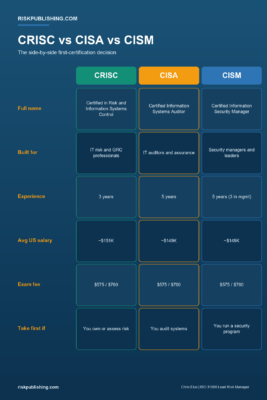
Figure 4. CRISC vs CISA vs CISM side by side across the six factors that decide which ISACA certification to take first.
Choosing Between CRISC, CISA, and CISM
Risk Publishing helps US professionals and teams map the CRISC vs CISA vs CISM path to the roles they are targeting, then build the experience and study plan that gets them certified. The plan starts from the role you want, not the exam you fear. Review the advisory services page to see how the coaching runs, and contact the practice when the next credential is the next move.

Chris Ekai is a Risk Management expert with over 10 years of experience in the field. He has a Master’s(MSc) degree in Risk Management from University of Portsmouth and is a CPA and Finance professional. He currently works as a Content Manager at Risk Publishing, writing about Enterprise Risk Management, Business Continuity Management and Project Management.