The Federal Emergency Management Agency estimates that 40% of small businesses never reopen after a major disaster, and another 25% fail within a year. The cause is rarely the disaster itself. It is the absence of a plan to keep critical functions running while the business recovers. A business continuity plan template is the fastest way to close that gap. It gives a small business the structure a large enterprise builds from scratch, packaged in a Word document you can fill out in an afternoon. The eight sections below map to ISO 22301 and turn a blank page into a working plan.
| The Fast Guide to the Business Continuity Plan Template |
| The Federal Emergency Management Agency estimates that 40% of small businesses never reopen after a major disaster, and another 25% fail within a year. A business continuity plan template closes the gap that causes most of those closures. |
| The template has eight sections: scope and governance, business impact analysis, risk assessment, recovery strategies, plan activation, crisis roles, communication, and testing. Each maps to a clause of ISO 22301. |
| A small business continuity plan should run 15 to 25 pages, stay current, and be tested. A short, exercised plan beats a long binder nobody has opened. |
| The business impact analysis is the engine. It lists critical functions, their recovery time and recovery point objectives, and their dependencies, and it drives every other section. |
| Tier the functions. A typical small business has a handful of Tier 1 functions that must recover within four hours and a longer tail that can wait a day or a week. |
| Test on a cadence the business can keep: a quarterly tabletop, a twice-yearly walkthrough, an annual functional test, and a full-scale exercise every two years. Test after any major change too. |
| A continuity plan is only as good as its last exercise. Downtime can cost a small business near $10,000 an hour, so a tested template is cheap insurance against a fast bill. |
Downtime is expensive even before a business closes for good. Industry estimates put the cost of unplanned downtime near $10,000 an hour for a small business, climbing higher when customers and contracts walk. A continuity plan template is cheap insurance against a bill that arrives fast. This template is built around ISO 22301, the international standard for business continuity management systems. You do not need certification to use it, but aligning to the standard means the plan holds up when a client, insurer, or auditor asks to see it. Every recommendation here follows ISO 22301 and the guidance US authorities publish for small business, including FEMA’s Ready.gov and the Small Business Administration. The template is the practitioner version of those standards, stripped of the enterprise overhead a small business does not need.
Why a Small Business Needs a Business Continuity Plan Template
Large enterprises run business continuity programs with dedicated teams. A small business rarely has that, which is exactly why a template matters more, not less. It compresses the discipline a continuity program needs into a document one owner can complete and one team can run. The work is smaller than it sounds. An owner who knows the business can draft the first version in a half-day workshop, then refine it with the team over a week. The template’s prompts do the thinking, so you answer questions rather than invent a structure from nothing. The alternative to a template is improvisation, and improvisation is slow. When a disruption hits, the businesses that recover fastest already decided who calls whom, which function comes back first, and where the backups live. The template is that decision-making done in advance, on a calm day.
What a Business Continuity Plan Template Includes
A complete business continuity plan template covers eight building blocks: scope, business impact analysis, risk assessment, recovery strategies, plan activation, crisis roles, communication, and testing. Each answers a question a disruption forces on you. Together they turn panic into a checklist. The template does not need to be long. A small business plan that runs 15 to 25 pages, kept current and tested, beats a 100-page binder nobody has opened since it was written, as our key elements of business continuity management guide stresses. Brevity is a feature when the building is on fire and someone needs to read step three. Keep the format simple and shareable. The template lives as a single Word file with tables for the impact analysis, the contacts, and the recovery steps, so any team member can open it, read it, and act without special software. Portability is part of resilience.
How the Business Continuity Plan Template Aligns to ISO 22301
ISO 22301:2019 structures business continuity around the Plan-Do-Check-Act cycle, and every section of this template maps to a clause. The business impact analysis sits in Clause 8.2, recovery strategies in Clause 8.3, and the plans and procedures in Clause 8.4. Following the ISO 22301 structure keeps the plan defensible. 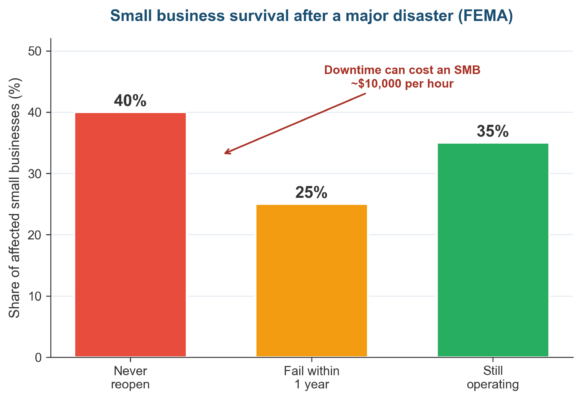 Figure 1. Small business survival after a major disaster (FEMA). A tested business continuity plan template is what separates the businesses that reopen from the 40% that do not. The numbers are the argument. A small business with a tested continuity plan recovers inside its recovery objectives; one without it joins the 40% that never reopen. The template is the difference between the green bar and the red one in the chart above. US small businesses can anchor a plan to more than one standard. ISO 22301 is the international baseline, while NFPA 1660 consolidates the US emergency and continuity standards into one reference. The template here follows ISO 22301 but stays compatible with both.
The Core Sections of a Business Continuity Plan Template
Eight sections make up a working business continuity plan template, and each has a job. The table below lists all eight with what they cover and the ISO 22301 clause they satisfy. The three that carry the most weight get their own walkthrough below. For a deeper reference on every section a complete plan needs, review the full component breakdown.
| Template Section | What It Covers | ISO 22301 |
| 1. Scope and governance | Owner, locations, functions in scope, objectives, version control | Clause 4-5 |
| 2. Business impact analysis | Critical functions, recovery objectives, dependencies | Clause 8.2.2 |
| 3. Risk assessment | Threats, likelihood, and impact the plan defends against | Clause 8.2.3 |
| 4. Recovery strategies | Workarounds, alternate sites, suppliers, and backups | Clause 8.3 |
| 5. Plan activation | Triggers, declaration authority, and the call tree | Clause 8.4.2 |
| 6. Crisis team and roles | Crisis lead, deputies, function owners, and contacts | Clause 8.4.2 |
| 7. Communication plan | Messaging for staff, customers, suppliers, and media | Clause 8.4.3 |
| 8. Testing and maintenance | Exercise schedule, review cadence, and change log | Clause 8.5-8.6 |
Scope and Governance in the Business Continuity Plan Template
The first section sets the boundaries. It names the plan owner, the locations and functions in scope, the objectives, and the version history that keeps everyone on the current copy. Skipping it is how a small business ends up with three conflicting plans and no clear owner, a problem our program roles guide addresses head on.
Business Impact Analysis in the Continuity Plan Template
The business impact analysis is the engine of the whole template. It lists every critical function, how long it can be down before the damage is severe, and what it depends on. Our business impact analysis guide walks through the method the template’s BIA table compresses into a single page. Get the business impact analysis right and the rest of the plan almost writes itself. Get it wrong, by guessing recovery times instead of asking the people who run each function, and every downstream section inherits the error. Budget the most time here, not on the cover page.
Recovery Strategies in the Business Continuity Plan
Recovery strategies answer the BIA. For each critical function, the template records the workaround, the alternate location or supplier, the backup it restores from, and who executes it, in line with NIST SP 800-34 contingency guidance. A strategy a small business can afford and run beats a gold-plated one it will never fund. The remaining sections connect the engine to the response. The risk assessment names the threats the plan defends against, plan activation sets the triggers and authority to declare an incident, and the communication plan scripts who tells customers, staff, and suppliers what, and when. None is long, but skipping any leaves a gap that shows under pressure. Section three, the risk assessment, does not need to be elaborate. A small business lists its plausible threats, scores each on likelihood and impact, and notes the controls already in place, following the ISO 22313 guidance that accompanies the standard. The point is to defend against what is likely, not to catalog every conceivable event.
Filling Out the Business Continuity Plan Template
A blank template is not a plan. Filling it out means three decisions: how fast each function must recover, who runs the response, and how you will communicate. Get those right and the rest of the template is data entry, as our guide to building a business continuity plan lays out.
Setting RTO and RPO in the BCP Template
The recovery time objective is how long a function can be down; the recovery point objective is how much data you can afford to lose. The template captures both for every critical function, tiered by urgency. Our RPO and RTO guide explains the difference the BCP template forces you to decide. 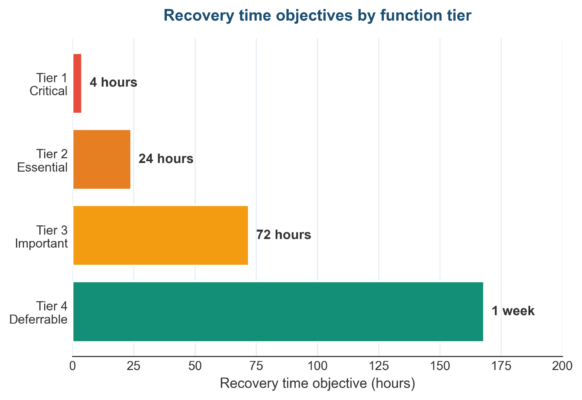 Figure 2. Recovery time objectives by function tier. The business continuity plan template captures a recovery objective for every critical function. Tier the functions rather than treating all as critical. A typical small business has a handful of Tier 1 functions that must return within four hours and a longer tail that can wait a day or a week. The table shows how the tiers map to recovery objectives.
| Tier | Function Example | RTO | RPO |
| Tier 1 (critical) | Payments, order intake, patient records | 4 hours | 1 hour |
| Tier 2 (essential) | Email, customer support, scheduling | 24 hours | 4 hours |
| Tier 3 (important) | Reporting, internal tools, HR systems | 72 hours | 24 hours |
| Tier 4 (deferrable) | Archives, analytics, marketing site | 1 week | 1 week |
Recovery point objective drives your backup schedule. A function with a one-hour RPO needs hourly backups; a function that can lose a day of data needs only nightly ones. Matching backup frequency to the RPO in the template is where many small businesses quietly overspend or dangerously underprotect. Plan activation is the trigger the template makes explicit. It defines what counts as an incident, who has the authority to declare one, and the call tree that reaches the crisis team within minutes. Ambiguity here costs the most expensive hour, the first one, when nobody is sure whether to act.
Assigning Crisis Roles in the Business Continuity Plan
A plan with no names is a wish. The template assigns a crisis lead, a deputy, and an owner for each critical function, with primary and backup contacts, and it keeps the incident response link to continuity explicit. In a small business one person often wears several hats, so the template records who covers whom when the lead is unreachable. Communication is the third decision and the one most plans underwrite. Customers forgive an outage they are told about and abandon one they are not, so the template scripts a holding message, names a spokesperson, and lists the channels before the pressure arrives. Pre-written beats improvised every time.
Testing and Updating the Business Continuity Plan Template
An untested plan is a guess. The final section of the template schedules exercises and reviews, because a continuity plan decays the moment a phone number, a supplier, or a system changes. Testing is what turns a document into a capability, a point the Business Continuity Institute makes in every maturity model.
How Often to Test the Business Continuity Plan
Test on a cadence the business can sustain. A tabletop exercise quarterly, a walkthrough twice a year, a functional test annually, and a full-scale exercise every two years is a realistic schedule for a small business. The Ready.gov continuity guidance recommends a similar rhythm, shown in the chart below. 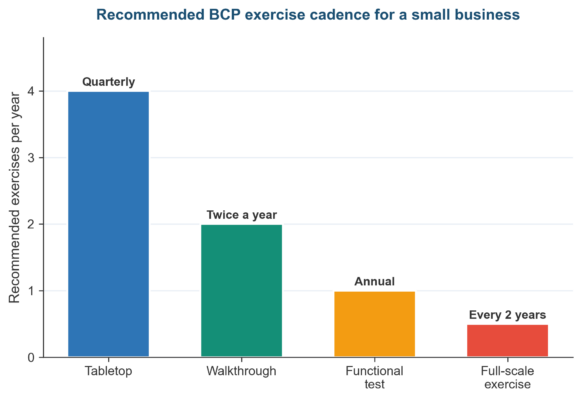 Figure 3. Recommended exercise cadence for a small business continuity plan, from quarterly tabletops to a full-scale exercise every two years. Each exercise type checks something different. Tabletops test decisions, walkthroughs test the steps, functional tests prove a recovery actually works, and full-scale exercises stress the whole plan. Skipping the small frequent ones is how a plan looks ready on paper and fails in practice. Match the exercise to the team’s maturity. A first-year plan benefits most from tabletops that build familiarity, while a mature plan needs functional tests that prove recovery under load, the progression DRI International builds into its professional practices. Escalate the rigor as the plan earns trust.
| Exercise Type | What It Checks | Frequency |
| Tabletop | Decisions and roles in a discussion-based scenario | Quarterly |
| Walkthrough | Each step of the plan, read through end to end | Twice a year |
| Functional test | A real recovery of one system or function | Annual |
| Full-scale exercise | The whole plan under realistic conditions | Every 2 years |
Keeping the Continuity Plan Template Current
Maintenance is the quiet half of continuity. The template carries a review date and a change log, and the owner refreshes contacts, suppliers, and recovery steps at least annually or after any material change, the cadence our business continuity planning process guide sets. A plan reviewed once and filed is the most common failure on this list. Document what each exercise finds. The template includes an after-action log, because the value of a test is the gaps it exposes, not the box it ticks. A finding that is recorded and fixed turns the next real incident into a rehearsal you have already run.
Choosing a Business Continuity Plan Template for Your Business
Not every small business needs the same template. A retailer worries about premises and payment systems; a software firm worries about data and uptime; a clinic worries about records and patient safety. The table points common business types at the section to prioritize first.
| Business Type | Template Focus | Priority Section |
| Retail or hospitality | Premises, payments, and staff safety | Recovery strategies |
| Professional services | Data, client files, and remote work | Business impact analysis |
| Healthcare or dental | Patient records, safety, and compliance | Plan activation and roles |
| Manufacturing | Supply chain, equipment, and logistics | Risk assessment |
| Software or SaaS | Uptime, data, and cloud dependencies | Recovery time objectives |
Size the plan to the business too. A five-person firm does not need the same depth as a fifty-person one, and the template scales down by trimming functions rather than sections. Our dental practice continuity example shows the same template applied to a single small operation. Whatever the type, pair the continuity plan with a disaster recovery plan template for the technology side. Business continuity keeps the whole organization running; disaster recovery restores the systems underneath it, and the two plans reference each other at the recovery objectives. The right template is the one you will actually maintain. A polished plan abandoned after launch protects nothing, while a plain one reviewed every quarter protects everything that matters. Choose the format your team will keep current over the one that looks most impressive in a binder.
Frequently Asked Questions on the BCP Template
What Should a Business Continuity Plan Template Include?
A business continuity plan template should include eight sections: scope and governance, a business impact analysis, a risk assessment, recovery strategies, plan activation, crisis roles, a communication plan, and a testing schedule. Each maps to a clause of ISO 22301. Together they cover what a small business needs to keep critical functions running through a disruption.
How Long Is a Small Business Continuity Plan?
A small business continuity plan usually runs 15 to 25 pages. The length depends on the number of critical functions, not the size of the company. A plan that is short, current, and tested beats a long one nobody has read since it was written.
Does a Business Continuity Plan Template Need ISO 22301?
No, a business continuity plan template does not require ISO 22301 certification to be useful. Aligning to the standard is recommended, because it gives the plan a defensible structure that clients, insurers, and auditors recognize. The template here maps each section to an ISO 22301 clause without forcing you to certify.
Can I Write a Business Continuity Plan in Word?
Yes, Word is a practical format for a small business continuity plan, which is why this template is built for it. Word is easy to edit, version, and share, and most small teams already have it. The key is keeping the document current rather than the tool it lives in.
Who Owns the Business Continuity Plan in a Small Business?
In a small business the owner or a senior manager usually owns the business continuity plan. One named person must be accountable for keeping it current and for declaring an incident. The template records that owner, a deputy, and the crisis roles so accountability never sits in a gap.
How Often Should a Business Continuity Plan Be Tested?
Test a business continuity plan at least annually, with smaller exercises more often. A workable cadence for a small business is a quarterly tabletop, a twice-yearly walkthrough, an annual functional test, and a full-scale exercise every two years. Test after any major change as well.
Is a Business Continuity Plan Template Free?
Many business continuity plan templates are free, including ones from FEMA’s Ready.gov and the Small Business Administration. A free template is a fine starting point, but the value is in filling it out and testing it. The blank document is worth nothing until the business impact analysis behind it is done.
What Is the Difference Between a Business Continuity Plan and a Disaster Recovery Plan?
A business continuity plan keeps the whole organization running through a disruption, covering people, processes, premises, and communication. A disaster recovery plan is narrower, restoring the IT systems and data underneath. A small business needs both, and the continuity plan template references the disaster recovery plan at the recovery objectives.
Common Business Continuity Plan Template Mistakes
Seven mistakes turn a business continuity plan template into shelfware. The table pairs each with its root cause and the fix, so the plan works when it is needed rather than gathering dust. Most trace back to writing the document once and never testing it.
| Pitfall | Root Cause | Remedy |
| Filling the template once | Treating it as a compliance exercise | Schedule exercises and an annual review |
| No business impact analysis | Skipping the hardest section | Complete the BIA first; it drives everything |
| Every function marked critical | No tiering of functions | Tier functions so Tier 1 gets the resources |
| No named owners | A plan written by committee | Assign an owner and a deputy per function |
| Out-of-date contacts | No maintenance cadence | Refresh contacts and suppliers at least annually |
| Plan only on one laptop | A single point of failure | Store offline and offsite copies the team can reach |
| No communication plan | Focusing only on recovery | Add internal, customer, and supplier messaging |
The Business Continuity Plan Template Beyond 2026
Three forces are reshaping the business continuity plan template through 2027. The first is cyber. Ransomware and cloud outages now top the threat list for small businesses, so the template’s recovery strategies increasingly assume a digital disruption, which the CISA and NIST Cybersecurity Framework guidance both reflect. The second force is regulation. Frameworks like the FFIEC handbook for banks and the EU’s DORA for financial services are pushing continuity expectations down the supply chain, so a small vendor now gets asked for its plan by larger clients. A template ready to share is becoming a sales requirement. The third force is supplier concentration. As small businesses lean on a handful of cloud and payment providers, a single provider outage can halt operations, so the template now tracks third-party dependencies as carefully as internal ones. Our implementing BCMS guide shows how the pieces connect. The durable advice outlasts every trend. Fill the template honestly, tier the functions, name the owners, and test on a cadence you can keep. A business continuity plan template is only as good as the last time a small business actually ran it.
Infographic: The Business Continuity Plan Recovery Timeline
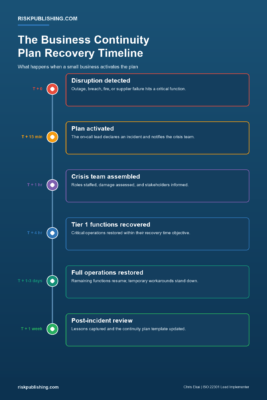 Figure 4. The business continuity plan recovery timeline, from disruption detected to the post-incident review that updates the template.
Get Your Business Continuity Plan Template Right
Risk Publishing helps US small businesses build and test the business continuity plan template that keeps them open when a disruption hits, aligned to ISO 22301 without the enterprise overhead. Review the advisory services page to see how the engagement runs, and contact the practice when continuity is the next priority. Before an audit, run through this pre-audit readiness checklist to confirm nothing is missing.

Chris Ekai is a Risk Management expert with over 10 years of experience in the field. He has a Master’s(MSc) degree in Risk Management from University of Portsmouth and is a CPA and Finance professional. He currently works as a Content Manager at Risk Publishing, writing about Enterprise Risk Management, Business Continuity Management and Project Management.