When the Project Management Institute published its 14th Edition salary survey in 2024, one number traveled fast: a median US salary of $173,000 for project managers who had held the PMP for more than a decade. For a risk specialist weighing PMP vs PMI-RMP, that figure reframes the usual question of which exam is harder into a sharper one about career signal.
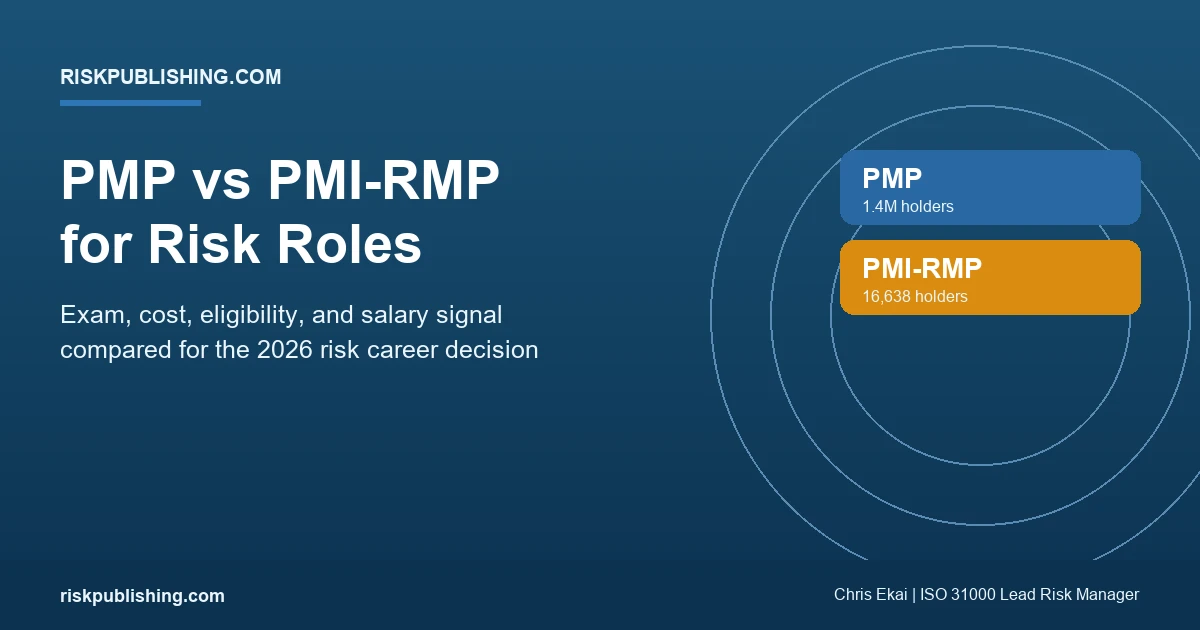
The PMP, the Project Management Professional credential, is held by more than 1.4 million people across 200-plus countries. The PMI-RMP Risk Management Professional credential counted just 16,638 active holders as of 2023.
| Key Takeaways: PMP vs PMI-RMP for Risk Roles |
| PMP vs PMI-RMP is breadth against depth. The PMP, held by more than 1.4 million people, certifies whole-project delivery. The PMI-RMP, held by 16,638 professionals as of 2023, certifies specialist risk depth. The exam’s risk content draws on the standard for risk management in portfolios, programs, and projects, reissued as PMI’s 2024 practice guide. |
| Both come from PMI, so the choice is one product against another, not one standards body against another. That removes the credibility debate other certification comparisons get stuck on. |
| The exams differ in shape. PMP runs 180 questions in 230 minutes across delivery; PMI-RMP runs 115 questions in 150 minutes, weighted toward quantitative risk analysis. |
| Cost is closer than people assume. At member rates the PMI-RMP exam ($520) is pricier than the PMP ($425); training narrows the gap further. Set both against the field in our risk certification ranking. |
| Recognition is the widest gap. Recruiters screen for PMP by default; PMI-RMP scarcity becomes an advantage only where deep risk expertise is the job. |
| For most risk professionals the answer is sequencing. Earn the PMP first for portable signal, then add the PMI-RMP within two years for specialization. |
That scarcity sits at the center of the PMP vs PMI-RMP question: ubiquity and breadth on one side, depth and specialization on the other.
The comparison below runs PMP vs PMI-RMP across exam design, eligibility, cost, recognition, and salary signal, written for people who manage risk or want to.
Both credentials rest on the same PMI standards that shape the risk management lifecycle and most enterprise risk management frameworks, so the real decision is emphasis, not allegiance.
What PMP vs PMI-RMP Means for a Risk Career
The PMP certifies that you can lead a project end to end: scope, schedule, budget, stakeholders, and delivery. It is a breadth credential, recognized across construction, IT, healthcare, and finance alike. For risk professionals, the PMP signals that you understand the delivery context where most project risk lives.
The PMI-RMP goes the other way, certifying depth in one discipline: identifying, assessing, and responding to project risk. PMI built it for people who own the risk register, run quantitative analysis, and brief sponsors on exposure. In the PMP vs PMI-RMP split, this is the specialist track.
Neither credential replaces the other. A PMP with no risk depth can miss the exposures that sink a project, and a PMI-RMP with no delivery context can model risks no one will act on. The strongest risk leaders read the PMP vs PMI-RMP choice as a sequence rather than a fork.
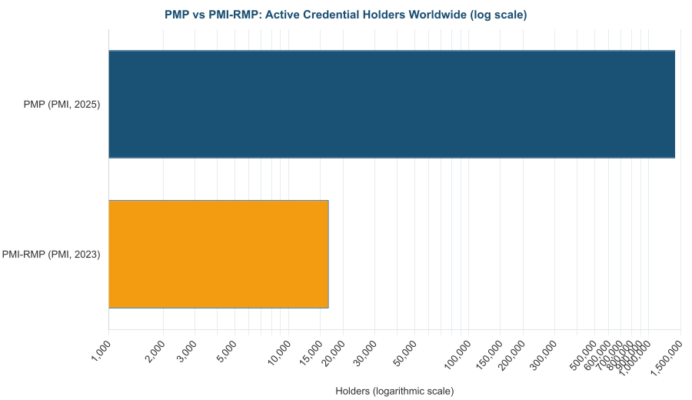
Figure 1. PMP vs PMI-RMP active credential holders worldwide on a logarithmic scale. The PMP population outnumbers the PMI-RMP by roughly 84 to 1. Source: PMI credential data, 2023-2025.
Who Issues the PMP and PMI-RMP, and Why It Matters
Both credentials come from the same body, the Project Management Institute, founded in 1969 and headquartered in Newtown Square, Pennsylvania. That single-issuer fact removes a variable other comparisons wrestle with: in PMP vs PMI-RMP, you weigh one PMI product against another, not one standards body against a rival.
The PMP rests on the PMBOK Guide and PMI standards, refreshed on a multi-year cycle. The PMI-RMP rests on The Standard for Risk Management in Portfolios, Programs, and Projects, PMI’s dedicated risk standard. Both align with ISO 31000 and the COSO ERM framework, the anchors most enterprise programs cite.
Credibility is not in question for either credential. The PMP is the most widely held project qualification in the world, and the PMI-RMP carries the same governance, exam psychometrics, and continuing-certification rules. The PMP vs PMI-RMP gap is about market familiarity, not legitimacy, and that distinction shapes how you read the cost and salary sections.
Exam Structure and Eligibility: PMP vs PMI-RMP
The two exams diverge in length and focus, and that shapes how you prepare. The PMP runs 180 questions in 230 minutes and spans people, process, and business environment.
The PMI-RMP runs 115 questions in 150 minutes, concentrated on risk strategy, identification, analysis, response, and monitoring.
Exam Format at a Glance: PMP vs PMI-RMP
| Attribute | PMP | PMI-RMP |
| Questions | 180 (175 scored, 5 unscored) | 115 (100 scored, 15 pretest) |
| Time | 230 minutes, two 10-minute breaks | 150 minutes, no scheduled break |
| Question types | Multiple choice, multiple response, hotspot, matching | Predominantly multiple choice |
| Focus domains | People, process, business environment | Risk strategy, identification, analysis, response, monitoring |
| Delivery | Pearson VUE center or online proctored, year-round | Pearson VUE center or online proctored, year-round |
| Retakes | One-year eligibility, up to three attempts | One-year eligibility, up to three attempts |
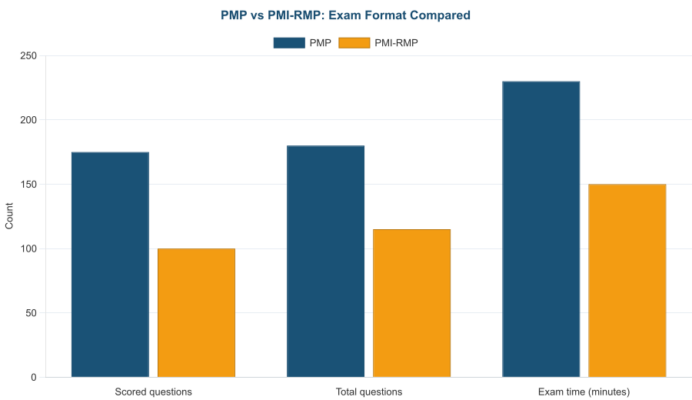
Figure 2. PMP vs PMI-RMP exam format compared by scored questions, total questions, and time. The PMP is the longer sitting; the PMI-RMP is narrower and deeper on risk.
Eligibility Requirements for PMP vs PMI-RMP
Eligibility is where PMP vs PMI-RMP separates most clearly, since each credential counts a different kind of experience. The PMP wants general project leadership hours; the PMI-RMP wants hours spent specifically on project risk. Both bodies audit a random share of applications, so log your risk identification and analysis work carefully before you apply.
| Requirement | PMP | PMI-RMP |
| With a four-year degree | 36 months leading projects within 8 years | 24 months on project risk within 5 years |
| With a secondary diploma | 60 months leading projects within 8 years | 36 months on project risk within 5 years |
| Required training | 35 contact hours of project management education | 30 contact hours of risk management education |
| Application audit | Random PMI audit of experience and education | Random PMI audit of experience and education |
The practical read: most working risk analysts already hold the analysis hours the PMI-RMP wants, while the PMP demands broader delivery leadership many specialists have to go collect. Mapping your experience against the critical components in a risk assessment shows which window you can already satisfy.
Counting the Cost of PMP vs PMI-RMP
Sticker price is closer than most candidates expect. The PMP exam costs $425 for PMI members and $675 for non-members; the PMI-RMP costs $520 and $670. At the member rate, the risk credential is the pricier exam, which surprises people who assume the flagship costs more.
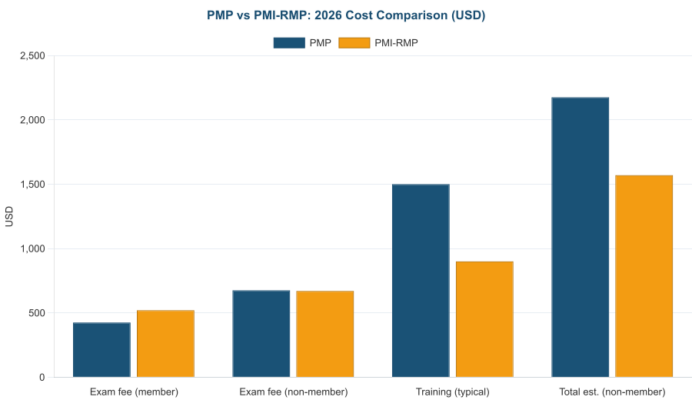
Figure 3. PMP vs PMI-RMP cost breakdown including exam fees, typical training, and a non-member total. 2026 pricing from PMI fee schedules; training is a market midpoint.
Return on Investment: PMP vs PMI-RMP
Cost per unit of career lift is the better lens. PMI’s 14th Edition salary survey reports US PMP holders earning a median $120,000 and 33% more on average than uncertified peers. A $159 membership plus the member exam fee pays back within weeks of a single certified raise.
PMI does not publish a separate PMI-RMP salary median, so treat the RMP as a specialization premium rather than a headline number. In risk-heavy sectors such as energy, pharma, and defense, the PMI-RMP signals depth that a risk appetite conversation with a sponsor tends to reward.
Curriculum Depth: How PMP vs PMI-RMP Treat Risk
On paper both cover risk, but the weighting differs sharply. The PMP devotes part of its process domain to risk, enough to manage a register competently. The PMI-RMP spends its entire blueprint on risk, from qualitative and quantitative analysis through Monte Carlo simulation and reserve analysis.
| Topic area | PMP coverage | PMI-RMP coverage |
| Risk strategy and planning | Part of broader project planning | Dedicated domain, roughly a fifth of the exam |
| Risk identification | Tool list and basics | Deep: techniques, bias, prompt lists |
| Qualitative analysis | Probability and impact basics | Scoring schemes, risk attitude, urgency |
| Quantitative analysis | Light touch | EMV, decision trees, Monte Carlo, sensitivity |
| Response planning | Avoid, transfer, mitigate, accept | Strategy selection, secondary and residual risk, reserves |
| Monitoring and governance | Status and control | Audits, reserve tracking, escalation |
For a risk professional, the quantitative gap is the deciding line. If your role touches scenario-based risk analysis, contingency reserves, or stochastic forecasting, the PMP vs PMI-RMP answer leans hard toward PMI-RMP. If you mainly need to run delivery and mitigate risk with awareness, the PMP carries you.
Recognition and Salary Behind PMP vs PMI-RMP
Recognition is the widest gap in the whole PMP vs PMI-RMP comparison. Recruiters and applicant-tracking systems screen for PMP by default, and many have never parsed PMI-RMP. The flip side is scarcity value: per the PMI credential registry, 16,638 PMI-RMP holders worldwide means the credential stands out where risk depth is the job.
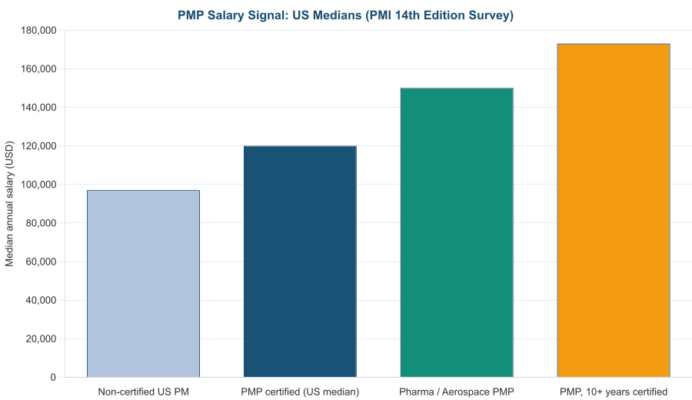
Figure 4. US salary medians tied to the PMP, drawn from PMI’s 14th Edition survey. PMI publishes no separate PMI-RMP median, so the RMP payoff shows up as role access rather than a single figure.
Typical Risk Roles for PMP vs PMI-RMP
| Role | PMP fit | PMI-RMP fit |
| Project or program manager | Strong, often required | Useful add-on |
| Project risk manager or analyst | Accepted | Strong, often preferred |
| PMO risk lead | Good fit | Strong fit |
| Construction and infrastructure risk | Good fit | Strong (reserve and schedule risk) |
| Enterprise risk (ERM) analyst | Accepted | Accepted, pair with ERM credentials |
| Delivery advisory consulting | Strong fit | Strong when stacked with PMP |
Sector tilts the read. In US federal, defense, and large-cap engineering programs, the PMI-RMP is taken seriously because reserve discipline and operational risk are board-level concerns. In generalist commercial IT, the PMP still opens more doors, so the PMP vs PMI-RMP answer shifts with where you want to work.
Who Should Choose PMP vs PMI-RMP
Here is the decision rule we give candidates, and it dissolves most of the PMP vs PMI-RMP agonizing. Count how many statements in each list describe you, follow the longer column, then revisit the choice in two years as your role evolves and your risk responsibilities deepen.
Lean PMP if two or more of these fit:
- You lead or want to lead whole projects, not only their risk.
- Your employer or target job postings name the PMP explicitly.
- You work across industries and need the most portable credential.
- You manage risk informally today but own delivery outcomes.
- You need a credential a non-risk recruiter recognizes instantly.
Lean PMI-RMP if two or more of these fit:
- You own the risk register, the analysis, and the response plans.
- Your work involves quantitative modeling, reserves, or Monte Carlo.
- You operate in energy, pharma, defense, construction, or financial services.
- You already hold the PMP and want to specialize.
- You want a scarce credential that signals deep risk expertise.
Holding both is the senior-leader move. Stack the PMP first for portable recognition, then add the PMI-RMP within two years for depth, the same sequence that maps onto a mature five-step risk management process. For most risk professionals, PMP vs PMI-RMP is a question of order, not exclusion.
Frequently Asked Questions on PMP vs PMI-RMP
Is PMP vs PMI-RMP really an either-or choice?
No. Many risk leaders hold both, stacking the PMP first for recognition and adding the PMI-RMP later for depth. The credentials complement each other, since the PMP covers delivery and the PMI-RMP covers risk specialization. Treat PMP vs PMI-RMP as a sequence whenever budget and time allow.
Which is harder, PMP vs PMI-RMP?
The PMP is longer and broader at 180 questions across 230 minutes, while the PMI-RMP is shorter at 115 questions but deeper on quantitative risk. Most candidates rate the PMP harder to pass cold, and the PMI-RMP harder if your math is rusty. In PMP vs PMI-RMP terms, breadth versus depth decides which one stings.
Can I get a risk job with PMI-RMP but no PMP?
Yes, especially specialist project risk roles in energy, defense, construction, and financial services. In generalist delivery roles, the absence of a PMP can filter you out at the applicant-tracking stage. Check live postings in your target firms before you commit to one side of PMP vs PMI-RMP.
Does PMP vs PMI-RMP matter for enterprise risk management roles?
Both are project-risk credentials, not enterprise ones. For ERM hiring, pair either with frameworks through the ISO 31000 vs COSO ERM lens, since the PMI-RMP analysis depth transfers but the role often wants different signals. PMP vs PMI-RMP is one input into an ERM path, not the whole answer.
How long does each take in the PMP vs PMI-RMP path?
Most candidates finish PMP preparation in 8 to 12 weeks of focused study and the PMI-RMP in 6 to 10 weeks. Both require meeting the experience and contact-hour eligibility first, which can add months. The PMP vs PMI-RMP timeline therefore depends more on your logged experience than on raw study speed.
Do employers pay for PMP vs PMI-RMP?
PMP reimbursement is common and often paired with a completion bonus. PMI-RMP reimbursement is less standardized but routine in risk-heavy sectors and consulting firms. Confirm your firm’s education benefit and any bonus before registering, because that policy often settles the PMP vs PMI-RMP question on its own.
What does PMP vs PMI-RMP cost to maintain?
Both need professional development units in a three-year cycle, 60 for the PMP and 30 for the PMI-RMP, plus a renewal fee. Units earned for one PMI credential can often count toward the other, which is why PMI continuing certification makes holding both cheaper than people expect.
Where PMP vs PMI-RMP Candidates Go Wrong
| Pitfall | Root cause | Remedy |
| Picking on price alone | Treating a small fee gap as the decision | Model the role you want in three years, then match the credential to it |
| Assuming PMI-RMP is an easier PMP | Misreading the shorter exam as lighter | Expect heavier quantitative content; drill EMV, decision trees, and Monte Carlo |
| Chasing PMI-RMP with no PMP signal | Underestimating ATS screening for the PMP | If you target generalist delivery roles, earn the PMP first |
| Earning PMP and ignoring risk depth | Believing breadth covers specialist risk work | Add risk-specific training even if you skip the PMI-RMP exam |
| Missing the experience window | Logging hours outside the look-back period | Map your 5-year (RMP) or 8-year (PMP) experience before applying |
| Underbudgeting contact hours | Skipping the 30 to 35 required training hours | Complete an accredited course early, since it doubles as exam prep |
| Stopping after one credential | Losing momentum after the first pass | Lock the second exam date if you intend to hold both |
The 2026-2028 Outlook for PMP vs PMI-RMP
Three shifts will sharpen the PMP vs PMI-RMP decision through 2028. First, AI is moving into project delivery and risk analysis at once. PMI added artificial intelligence and data content across its 2024-2025 exam updates, and the NIST AI Risk Management Framework is pushing model risk into the project manager remit.
Second, large-project failure rates keep risk specialization in demand. McKinsey research on major projects has long shown most run over budget and schedule, and sponsors increasingly want the reserve discipline the PMI-RMP teaches. That demand favors the specialist side of the PMP vs PMI-RMP split.
Third, the credentials are converging on shared development-unit pathways, making the stack cheaper to maintain. PMI’s continuing-certification rules let qualifying units count across credentials, which lowers the cost of holding both. Expect PMP-then-PMI-RMP sequencing to become the standard recommendation for risk-track project professionals.
None of this collapses the core PMP vs PMI-RMP tradeoff; it sharpens it. Breadth and recognition favor the PMP, while risk depth and scarcity favor the PMI-RMP. Use the decision rule above and align the credential with the risk management techniques your target role actually rewards.
Infographic: PMP vs PMI-RMP at a Glance
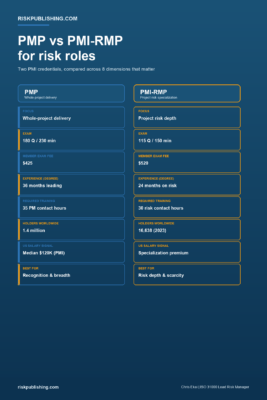
Figure 5. PMP vs PMI-RMP compared across eight dimensions that matter for risk roles, from exam design to typical salary signal.
Mapping your risk certification path? We advise candidates and employers on matching credentials to career targets, exam budgets, and timelines, and we disclose that relationship up front. Start with the riskpublishing.com services page or get in touch directly to talk through PMP vs PMI-RMP sequencing for your situation.

Chris Ekai is a Risk Management expert with over 10 years of experience in the field. He has a Master’s(MSc) degree in Risk Management from University of Portsmouth and is a CPA and Finance professional. He currently works as a Content Manager at Risk Publishing, writing about Enterprise Risk Management, Business Continuity Management and Project Management.