The IT risk management lifecycle is a continuous five-stage loop: identify technology risks, assess their likelihood and impact, treat them with controls or transfer, monitor key indicators, and report results to decision makers. NIST SP 800-37 and ISO/IEC 27005:2022 both codify the IT risk management lifecycle, which repeats as systems, vendors, and threats change. For the rating scales used at the assessment stage, see how to perform a qualitative risk assessment. At delivery level, software project risk management inside sprint ceremonies applies the same loop at two-week tempo.
In August 2023, hackers from the Scattered Spider group phoned the Cognizant help desk that handled password resets for The Clorox Company and asked for credentials.
According to the court transcript, the agent replied, “let me provide the password to you,” and no identity check ever happened.
The attackers took down manufacturing systems and left US store shelves short of Clorox products for months. In July 2025, Clorox sued Cognizant for $380 million in California state court, arguing that the outsourced service desk skipped its own verification procedures on call after call.
Every dollar of that loss maps to a stage in the IT risk management lifecycle this guide walks through.
A password reset procedure is a treatment control, vendor call logs are monitoring data, and the months of disruption were the reporting stage arriving too late.
What Is the IT Risk Management Lifecycle?
Clorox’s loss started as an unmanaged technology risk, which is exactly what the lifecycle exists to catch. The IT risk management lifecycle is the repeating process an organization uses to find, size, treat, watch, and report the risks created by its technology estate.
Two documents anchor the practice. NIST SP 800-37 Revision 2 defines a seven-step Risk Management Framework for federal systems that private companies borrow freely, and ISO/IEC 27005:2022 gives the equivalent guidance for information security risks inside a certified ISO 27001 program.
The same loop drives our cyber risk management lifecycle and security risk management lifecycle guides, and the enterprise version described in the risk management lifecycle overview. This page focuses on the IT estate: infrastructure, applications, data, and the vendors with keys to all three.
For the payoff argument, the numbers case for running all five stages is made in our benefits of IT risk management lifecycle steps guide; the short version is that each stage exists because skipping it has a known and documented price.
| Stage | Core question | Owner | Standing output |
| 1. Identification | What can hurt us? | Asset and platform owners | Risk register entries with named assets |
| 2. Assessment | How likely, how bad? | Risk analyst with system owners | Scored likelihood and impact ratings |
| 3. Treatment | What do we do about it? | Control owners and budget holders | Treatment plan with dates and owners |
| 4. Monitoring | Is it working? | Security operations and internal audit | KRI dashboard and patch metrics |
| 5. Reporting | Who needs to know? | CIO or CISO to board committee | Quarterly risk report and escalations |
Treat the table as a contract between the risk function and the technology teams. When a stage has no named owner and no standing output, the IT risk management lifecycle breaks at that point, and the break stays invisible until an incident or an auditor finds it.
Why an Annual Assessment Cannot Keep Up
Owners matter because the estate they watch keeps growing. Gartner forecasts worldwide IT spending of $6.37 trillion in 2026, up 14.2% in a single year, with AI infrastructure leading the surge. Every new platform that money buys arrives with risks no annual review has scored.
The cost of missing one keeps climbing in the United States. IBM’s Cost of a Data Breach Report 2025 puts the average US breach at a record $10.22 million, up 9% in a year, even as the global average fell to $4.44 million on faster AI-assisted containment.
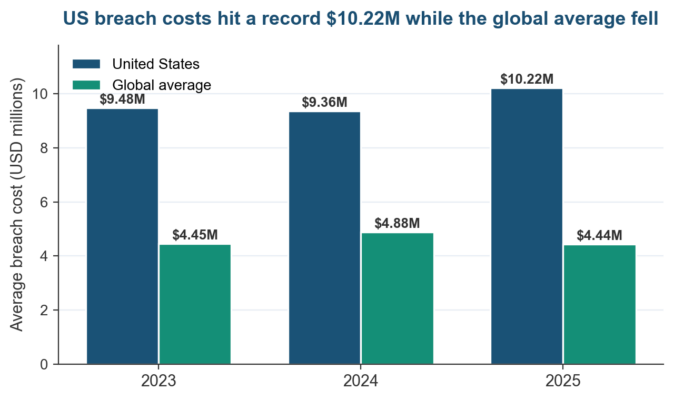
Figure 1. US breach costs rose to a record $10.22 million while the global average declined, the loss the IT risk management lifecycle exists to reduce. Source: IBM Cost of a Data Breach Report 2025.
Attackers moved faster than review cycles too. Verizon’s 2026 Data Breach Investigations Report names vulnerability exploitation the top initial access vector for the first time in the report’s 19-year history, displacing stolen credentials. A flaw published in March does not wait for a December risk workshop.
We see the same pattern across risk functions: the annual assessment reads well, then a quarter later the register no longer matches the network. A lifecycle with quarterly and event-driven review triggers, like the cadence in our cyber security risk management plan guide, closes that gap.
The Five Stages of the IT Risk Management Lifecycle
Closing that gap means running each stage deliberately. The five stages below follow the sequence in ISO 31000 and NIST guidance, and each one ends with a concrete artifact: a register entry, a score, a treatment plan, a dashboard, or a report a director can read.
Stage 1: Risk Identification
Identification builds the inventory of what can go wrong, anchored to what you actually run. Start from the asset side because attackers do: unmanaged servers, stale admin accounts, and shadow SaaS rarely appear in interviews but sit in configuration data waiting to be pulled.
- Configuration and asset databases, cross-checked against cloud billing to surface unmanaged systems
- Threat catalogs such as MITRE ATT&CK, which map real adversary techniques to the platforms you run
- Incident and near-miss records from your service desk and incident management tooling
- Vendor access lists, because every outsourced service desk or managed provider is an entry path
Log every finding in a structured register. Our guides to the key elements of a risk register and the risk register template walk through the fields that matter; the shortcut is that each entry needs a named asset, a named threat, and a named owner before scoring starts.
Identification is also where the lifecycle meets the tool stack. The platforms in our IT risk management tools roundup automate discovery and register upkeep, though a spreadsheet register run on the cadence above still beats an idle enterprise GRC platform.
Stage 2: Risk Assessment
NIST SP 800-30 remains the reference method for scoring likelihood and impact on technology risks, and assessment turns the register into a ranked queue. A five-by-five matrix is still the fastest way to make the ranking visible to the non-specialists who fund treatment.
For vulnerability-driven risks, add exploit probability to the score. The FIRST Exploit Prediction Scoring System estimates the chance a flaw is exploited within 30 days, which separates the handful of urgent CVEs from the thousands that can wait for a normal patch window.
Stage 3: Risk Treatment
Treatment decides what happens to each scored risk, and the four options have not changed since ISO 31000 named them. What changed is the discipline regulators expect around the choice: a documented decision, a named owner, and a firm review date.
| Strategy | Choose it when | IT example | Watch for |
| Avoid | The risk exceeds appetite and the system is replaceable | Retiring an unsupported OS instead of buying extended support | Hidden dependencies on the retired platform |
| Reduce | Controls cut likelihood or impact at reasonable cost | MFA on every remote access path, tested restore procedures | Controls that decay without a named owner |
| Transfer | A third party can carry the financial impact | Cyber insurance, contractual liability clauses with providers | Policy exclusions for unpatched known flaws |
| Accept | The cost of control exceeds the exposure | Legacy app risk accepted with quarterly review | Acceptances that outlive the person who signed them |
Reduction carries most of the load in practice. The control families in our risk mitigation in project management guide apply directly to technology work, and the three lines of defense model settles who builds controls and who independently checks them.
Clorox’s suit shows why transfer needs the same rigor as any control. Outsourcing the service desk moved the work to Cognizant, and the lawsuit turns on whether the contract’s verification procedures were followed; the risk itself never left Clorox’s income statement.
Stage 4: Risk Monitoring
Monitoring is where most programs are losing ground right now. The 2026 DBIR found organizations fully remediated only 26% of vulnerabilities listed in the CISA Known Exploited Vulnerabilities catalog, down from 38% a year earlier, while median time to patch stretched from 32 to 43 days.
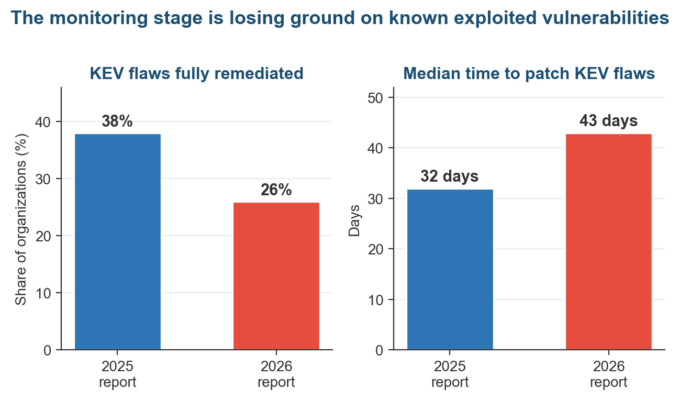
Figure 2. Remediation of CISA known exploited vulnerabilities fell while patch times lengthened, the Stage 4 signal the IT risk management lifecycle is built to catch. Source: Verizon DBIR 2026.
Numbers like those become manageable when they run as standing indicators with thresholds. Our key risk indicators for IT departments library and cybersecurity KRI examples supply tested starting sets; the table below shows the shape a working IT dashboard takes.
| Key risk indicator | Green | Amber | Red |
| Median days to patch KEV-listed flaws | Under 15 | 15 to 30 | Over 30 |
| Systems past end of support | Under 2% | 2 to 5% | Over 5% |
| Privileged accounts without MFA | Zero | 1 to 5 | Over 5 |
| Vendor accounts unused for 30+ days | Under 1% | 1 to 3% | Over 3% |
| Critical backups passing restore tests | 100% | 95 to 99% | Below 95% |
- Any red threshold held for two consecutive weeks goes to the CIO with a dated remediation plan
- A new KEV listing that touches an internet-facing system triggers an out-of-cycle assessment within 48 hours
- A vendor losing its SOC 2 attestation or disclosing a breach reopens its risk entries the same week
- Two amber quarters on the same indicator force a treatment review rather than another observation period
Stage 5: Risk Reporting and Review
Reporting closes the IT risk management lifecycle by putting results in front of people who can move budgets. Since December 2023, SEC rules give US public companies four business days to disclose a material cyber incident on Form 8-K, a deadline only a standing reporting process can meet.
Boards do not need CVE counts; they need trend, exposure, and a decision to make. The formats in our key risk indicators dashboard examples translate patch metrics into that language, and a one-page quarterly summary beats a forty-slide deck every time.
Mapping the Stages to NIST RMF, CSF 2.0, and ISO 27005
One loop can satisfy several rulebooks at once if you map it deliberately. NIST released Cybersecurity Framework 2.0 in February 2024 with a new Govern function, and the FFIEC IT Handbook points examiners at the same territory for US financial institutions.
| Lifecycle stage | NIST RMF step | CSF 2.0 function | ISO/IEC 27005:2022 focus |
| Identification | Categorize | Identify | Context and risk identification |
| Assessment | Select | Identify (risk assessment) | Risk analysis and evaluation |
| Treatment | Implement | Protect | Risk treatment |
| Monitoring | Assess and Monitor | Detect | Monitoring and review |
| Reporting | Authorize | Govern and Respond | Communication and consultation |
The mapping is not perfectly one to one, and that is fine. RMF’s Prepare step and CSF’s Govern function both sit above the IT risk management lifecycle, setting appetite and roles; our NIST CSF 2.0 implementation guide and CSF versus ISO 27001 comparison cover those governance layers in detail.
ISACA’s Risk IT framework adds the business-value lens that pure security frameworks miss, and appetite statements give the IT risk management lifecycle its thresholds. If your organization has never written one, start with our board-ready risk appetite statement guide before tuning any KRI.
Software delivery teams can embed the same loop directly in their build cadence. Our guide to how risk is managed in the spiral lifecycle model shows the stages inside an SDLC, where every prototype cycle opens with objectives and closes with a documented risk review.
Vendor Access Belongs Inside the IT Risk Management Lifecycle
Frameworks agree on something many programs still miss: a vendor with credentials is part of your attack surface. Verizon’s 2026 DBIR found third parties involved in 48% of breaches, triple the share two report editions earlier, and only 23% of third-party organizations fully fixed known MFA gaps.
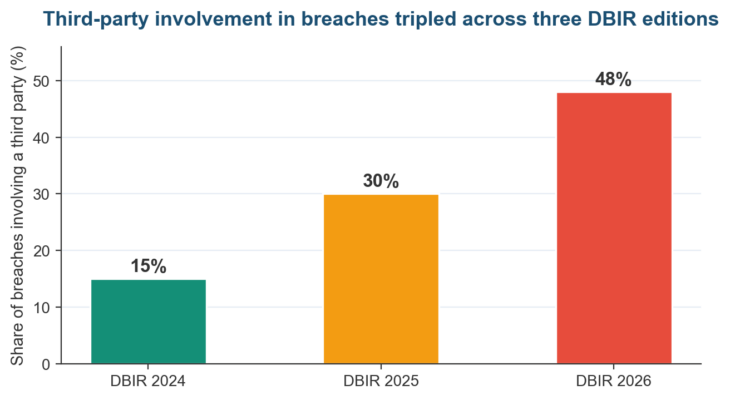
Figure 3. Share of breaches involving a third party across the last three Verizon DBIR editions, evidence that vendor access belongs inside the IT risk management lifecycle. Source: Verizon Data Breach Investigations Report, 2024 to 2026.
Run vendors through the same five stages as internal systems. Identify who holds access, assess them with the NIST vendor risk assessment questionnaire, treat with contract clauses and least privilege, monitor their accounts weekly, and report concentration risk to the same committee that sees patch metrics.
The Clorox transcript reads like a checklist of skipped stages, which is why it belongs in every vendor review deck. Our third-party risk management framework and vendor risk platform comparison show how to build the program; the court filings show what its absence costs.
Where IT Risk Programs Stall (and the Fixes That Work)
Six causes explain most stalled programs, and none of them are exotic. Each row below names one, traces its root, and gives the correction that restarts the IT risk management lifecycle, on the assumption that the stage owners from the first table exist and hold budget.
| Pitfall | Root cause | Remedy |
| Register grows but treatment never starts | Scoring treated as the finish line | Give every red risk a funded owner and a date at the same meeting where it is scored |
| Patch metrics reported without thresholds | No agreed appetite for exposure | Adopt KRI bands like the table above and tie red status to escalation |
| Vendor risks live in procurement only | Lifecycle scoped to internal assets | Add vendor access to identification and monitor vendor accounts weekly |
| Annual assessment mistaken for a lifecycle | Compliance calendar drives the work | Add event triggers: new system, new KEV listing, vendor breach |
| Risk acceptances never expire | No review dates on decisions | Re-approve every acceptance annually or it converts to a treatment task |
| Board reports list CVEs, not decisions | Reporting written by engineers for engineers | Report trend against appetite plus the one decision being requested |
IT Risk Management Lifecycle Checklist
Use this as the standing agenda for the IT risk management lifecycle. Every line needs a named owner, a dated output, and evidence a reviewer can open.
- Identify: asset, data, and vendor inventory refreshed; new systems logged within 30 days of go-live.
- Assess: likelihood and impact scored against risk appetite; the top ten technology risks re-scored quarterly.
- Treat: accept, mitigate, transfer, or avoid, each recorded with an owner, a due date, and closure criteria.
- Monitor: key risk indicators live with thresholds, covering median days to patch, MFA coverage, and privileged access reviews.
- Report: one board page per quarter showing movement, tolerance breaches, and the decisions being asked for.
A quarterly walk through this checklist keeps the IT risk management lifecycle auditable against ISO/IEC 27005 and NIST SP 800-37, and it gives internal audit a clear trail. Programmes that skip the walk usually find the IT risk management lifecycle has stalled at one stage, most often monitoring.
Frequently Asked Questions About the IT Risk Management Lifecycle
What are the five stages of the IT risk management lifecycle?
The five stages are risk identification, risk assessment, risk treatment, risk monitoring, and risk reporting with review. They run as a continuous loop rather than a yearly project, and each pass updates the risk register that the next pass starts from.
How often should the IT risk management lifecycle repeat?
Run monitoring continuously, refresh assessments quarterly for critical systems, and reassess everything at least annually. Event triggers matter more than the calendar: a new KEV-listed flaw, a major system change, or a vendor incident should each restart the IT risk management lifecycle for the affected assets within days.
Who should own the IT risk management lifecycle?
Give the IT risk management lifecycle a single accountable owner, usually the CISO or IT risk manager, with stage-level owners underneath. The three lines model keeps it honest: technology teams own and treat risks, the risk function sets method and challenges scores, and internal audit checks the IT risk management lifecycle itself.
How does the IT risk management lifecycle map to the NIST RMF?
Identification aligns with Categorize, assessment with Select, treatment with Implement, and monitoring with the Assess and Monitor steps, while reporting supports Authorize decisions. RMF’s Prepare step sits above the loop, establishing the governance, roles, and risk appetite the other steps depend on.
Which KRIs prove the IT risk management lifecycle is working?
Track median days to patch known exploited vulnerabilities, the share of systems past end of support, privileged accounts without MFA, dormant vendor accounts, and backup restore test results. Falling patch times and shrinking red thresholds quarter over quarter are the clearest evidence the IT risk management lifecycle is functioning.
Does the IT risk management lifecycle cover vendors and cloud providers?
Yes, and the 2026 DBIR’s finding that 48% of breaches involve a third party makes vendor coverage the fastest-growing part of the job. Identify every external party with system access, assess them on the same scale as internal risks, and monitor their accounts continuously.
What certifications support a career running the IT risk management lifecycle?
CRISC is the closest match because it tests governance, assessment, response, and monitoring, the same arc as the lifecycle. Our CRISC versus CISM comparison helps you choose between the risk and management tracks, and either pairs well with hands-on register experience.
Looking Ahead: What the IT Risk Management Lifecycle Must Absorb by 2027
Three changes will test IT risk programs over the next 18 months. AI systems are entering production faster than controls mature, and CSF 2.0’s Govern function gives boards the vocabulary to demand oversight of them. Expect model inventories to join asset inventories in the identification stage.
Regulatory clocks keep shortening. The SEC’s four-day disclosure window is now tested in practice, and examiners using the FFIEC IT Handbook increasingly ask for lifecycle evidence, from register extracts to KRI trend lines. A program that exists mainly on paper cannot answer that request.
Third-party exposure will keep climbing before it improves, because the DBIR’s 48% is a lagging measure of contracts signed years ago. The practical response is concentration limits in vendor strategy plus the monitoring triggers above, applied to every provider that touches production.
If your register has not moved since the last audit, that is the place to start. We help IT and risk leaders stand up the full loop, from register design to board reporting, through our advisory services. Contact us and we will benchmark your current lifecycle against the five stages in this guide.

Chris Ekai is a Risk Management expert with over 10 years of experience in the field. He has a Master’s(MSc) degree in Risk Management from University of Portsmouth and is a CPA and Finance professional. He currently works as a Content Manager at Risk Publishing, writing about Enterprise Risk Management, Business Continuity Management and Project Management.