Hire an independent risk management consultant when the problem is defined and senior judgment matters more than headcount. Hire a risk management firm when you need parallel workstreams, a multi-disciplinary bench, and institutional liability cover. The cost gap runs three to ten times per senior hour, and regulators accept both.
When FTX collapsed in November 2022, the Delaware bankruptcy court did not hand the cleanup to a committee. It handed the company to one man, John J. Ray III, at $1,300 an hour, the same restructuring professional who had unwound Enron two decades earlier.
The firms billed alongside him. Sullivan & Cromwell charged $388 to $2,165 an hour and collected roughly $42 million in seven months, per court filings. One engagement, two models, and a live demonstration of exactly what each one costs and delivers.
| Risk Management Consultant vs Firm: Key Takeaways |
| Hire an independent risk management consultant for a defined problem needing senior judgment; hire a firm when you need parallel workstreams, a deep bench, and institutional liability cover. |
| Cost gaps are real and documented: FTX paid restructuring chief John J. Ray III $1,300 per hour while Sullivan & Cromwell billed $388 to $2,165 per hour and $42 million in seven months. |
| The in-house baseline matters: BLS puts the median management analyst at $101,190 a year (May 2024), roughly $49 an hour, with 9% projected growth through 2034. |
| True independents are fee-only: the Society of Risk Management Consultants requires members to take no commissions from insurers or brokers, which is your first vetting question. |
| Regulators shape the choice: OCC and SEC consent orders routinely mandate an independent consultant or monitor, and the order’s scope usually dictates firm-scale resources. |
| Vet any risk management consultant on five factors: problem definition, scale required, cost per senior hour, speed to start, and provable independence with named credentials. |
What a Risk Management Consultant Actually Does
A risk management consultant identifies, assesses, and helps treat the risks that threaten an organization’s objectives, then builds the framework that keeps doing it after they leave. The work spans risk assessments, register and appetite design, control testing, and board reporting against ISO 31000 or COSO ERM.
The US labor market prices this expertise clearly. BLS data for management analysts, the category covering most risk management consultant roles, shows a median of $101,190 a year as of May 2024, 9% projected growth through 2034, and about 98,100 openings annually.
Independence has a formal definition worth knowing before you shortlist anyone. The Society of Risk Management Consultants requires members to work fee-only, taking no commissions from insurers, brokers, or vendors. A consultant paid by the products they recommend is a salesperson wearing a risk framework as a costume.
Three Ways to Buy the Expertise
Every buyer is choosing among the same three options: an independent professional, a consulting firm, or a permanent hire. Each buys a different mix of judgment, capacity, and continuity, and each fails in a different way when matched to the wrong problem. The risk management career market feeds all three.
| Dimension | Independent consultant | Consulting firm |
| What you buy | One senior brain applied directly to your problem | A team, a method, and a bench behind the partner |
| Cost shape | One negotiated rate, minimal overhead | Blended rates; pyramid staffing bills juniors at partner-adjacent prices |
| Speed to start | Days; one calendar to clear | Weeks; staffing, conflicts checks, engagement letters |
| Scale ceiling | One person’s hours; subcontracts add fragility | Effectively unlimited; parallel workstreams are the product |
| Accountability | Personal reputation and professional indemnity insurance | Firm liability, QA review layers, partner rotation risk |
| Knowledge transfer | Direct coaching of your team, if contracted | Method deliverables; retention depends on your absorption |
The permanent hire is the quiet third contender at $49 per median hour on BLS numbers. When the work is continuous, an employee beats both external options on cost, and an external engagement becomes the bridge you use while recruiting, not the destination.
Why the Choice Matters: Cost, Accountability, Regulators
The money gap is not marginal, and the FTX docket documents it cleanly. One senior independent ran the entire estate at $1,300 an hour while the lead firm’s partners billed up to $2,165, with the meter multiplied across 32 partners and thousands of associate hours.
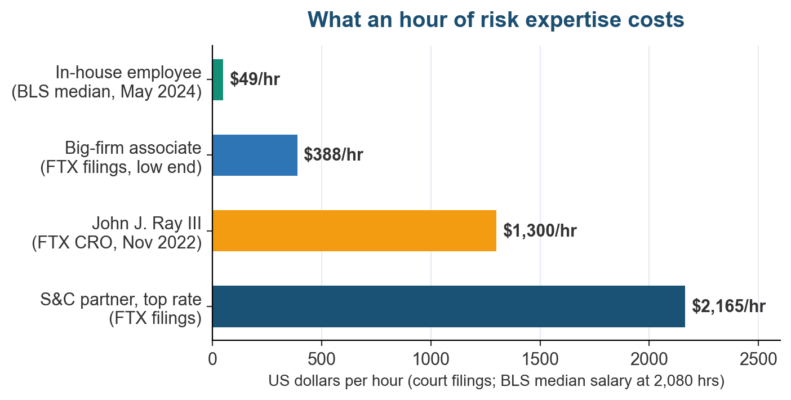
Figure 1. Risk management consultant vs firm economics, all figures from court filings and BLS: the spread per hour runs from $49 in-house to $2,165 at the top of big law.
Accountability differs in kind, not just degree. An independent stakes a personal reputation on every engagement; a firm offers institutional liability, quality review, and a bench if your lead gets staffed elsewhere. The Three Lines Model treats both as external assurance, but boards feel the difference when something goes wrong.
Regulators quietly set the floor for many buyers. OCC enforcement actions and SEC settlements routinely order an independent consultant or compliance monitor, and the order’s scope decides the model for you. A multi-year lookback across millions of transactions is firm-scale work; a targeted compliance risk assessment often is not.
How to Choose: The Five-Factor Test
Five factors decide the model before any proposal arrives, and scoring them takes one honest hour with the risk register open. Weight each factor for your situation rather than counting wins. One decisive factor, a consent order or a hard deadline, can outvote the other four.
- Problem definition: sharply defined problems favor an independent; ambiguous, sprawling mandates favor a firm’s diagnostic capacity
- Scale: count the parallel workstreams; more than two running simultaneously points to a firm
- Cost per senior hour: ask who actually does the work, then price the senior hours you are really getting
- Speed: an independent can start Monday; firm staffing cycles run two to six weeks
- Independence requirements: regulator-ordered reviews and audit-adjacent work need provable, conflict-free independence either way
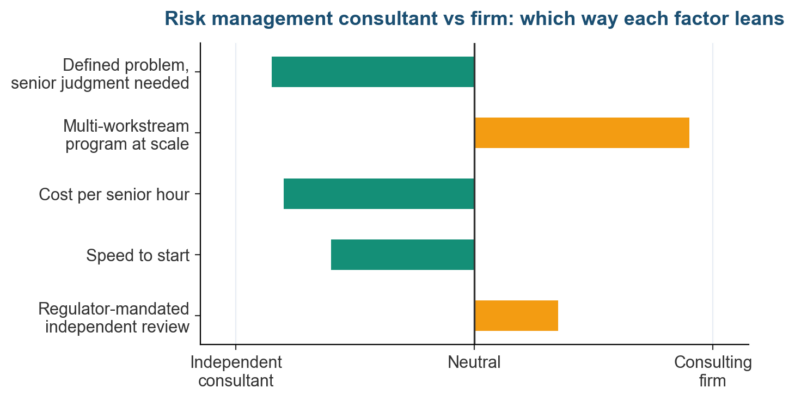
Figure 2. Which way each factor leans: judgment, cost, and speed favor the independent risk management consultant; scale and mandated monitorships favor the firm.
Run the test against a worked example. A regional bank needing its RCSA program rebuilt scores independent on four of five factors; the same bank under a consent order requiring transaction lookback plus monitorship scores firm on the two factors that outweigh everything else.
How to Vet a Risk Management Consultant Before You Sign
Vetting a risk management consultant is mostly verification, not interviewing. Credentials, references, and independence can each be checked in an afternoon, and the candidates who survive all three checks are rarer than proposal volume suggests. Certifications signal method; delivered engagements signal judgment.
- Credentials: look for ISO 31000 lead risk manager training, GARP FRM, CFE, or equivalent, and verify them with the issuer
- Track record: three named, reference-checked engagements in your sector beat any deck; ask what changed after they left
- Independence: confirm fee-only status in writing, including no insurer, broker, or software commissions
- Method: ask which framework they anchor to and why; a good answer compares ISO 31000 and COSO rather than reciting one
- Aftermath: require a knowledge-transfer clause so the register, KRIs, and methodology stay usable when they leave
Test method depth with one question: how would they connect key risk indicators to the board’s risk appetite statement? Anyone senior sketches the thresholds-to-appetite chain on a whiteboard in five minutes; anyone reciting framework acronyms without the chain is reselling templates.
| Check | What passes | What fails |
| Certification claim | Verifiable ISO 31000, FRM, or CFE with issuer confirmation | Vague ‘certified risk expert’ with no issuing body |
| Reference call | Client describes decisions changed and metrics still in use | References only confirm dates and politeness |
| Independence letter | Written fee-only confirmation covering all revenue sources | Reluctance, or ‘preferred partner’ vendor language |
| Sample deliverable | Redacted register or KRI dashboard with client-specific logic | Generic consulting template indistinguishable across clients |
Pricing Models and Contract Terms That Protect You
Engagement structure moves more money than rate negotiation. The same risk management consulting scope priced three ways can differ by half, because the model allocates who carries utilization risk. Fixed-fee suits defined deliverables, time-and-materials suits discovery, and retainers suit ongoing oversight.
| Model | Use when | Contract protection to demand |
| Fixed fee per deliverable | Scope is definable: framework build, risk assessment, training | Acceptance criteria per deliverable; staged payments |
| Time and materials | Diagnostic or remediation consulting with genuine unknowns | Rate card by seniority; monthly cap; named-person clause |
| Retainer | Fractional CRO or standing advisory need | Defined monthly hours; unused-hour rollover; exit on 30 days |
| Contingent or commission | Never for risk work | Walk away; it fails every independence test |
Whichever model wins, write the named-person clause. Firm proposals are sold by partners and delivered by juniors, which is the pyramid staffing model working as designed, per McKinsey’s own risk practice writing. Naming the senior hours you are buying is the single highest-value sentence in the contract.
Frequently Asked Questions About Hiring a Risk Management Consultant
What does a risk management consultant do day to day?
They run risk assessments, build and quality-check registers, design key risk indicators, test controls, and translate findings into board-ready reporting. On longer engagements they coach risk owners and stand up the framework that continues after departure. The best ones leave behind a working system, not a binder.
How much does a risk management consultant cost?
Anchor on three documented numbers: the median in-house analyst costs about $49 an hour on BLS May 2024 data, FTX paid one elite independent $1,300 an hour, and big-firm rates in the same case ran $388 to $2,165. Mid-market independents typically land well below firm blended rates for equivalent seniority.
Is a risk management consultant a good career?
The market data says yes: BLS projects 9% growth for management analysts through 2034, roughly 98,100 openings a year, on a $101,190 median salary. Independents add rate upside in exchange for utilization risk. Credentials like the FRM and ISO 31000 lead training compound earnings fastest early.
When should I choose a firm over an independent risk management consultant?
Choose a firm when parallel workstreams exceed what one senior person can run, when a regulator’s order demands monitorship scale, or when institutional liability cover matters to your board. Choose the independent when the problem is defined, speed matters, and you want every hour billed to be a senior hour.
Do regulators require an independent risk management consultant?
Frequently, yes. OCC, Federal Reserve, and SEC enforcement actions routinely order an independent consultant, compliance monitor, or lookback reviewer as a condition of settlement. The order defines required qualifications and approval rights, and its scope usually decides whether one professional or a firm-scale team is realistic.
What qualifications should a risk management consultant have?
Look for verifiable method credentials such as ISO 31000 lead risk manager, GARP’s FRM, CFE for fraud-adjacent work, and sector depth matching your regulatory exposure. Then weigh delivered engagements more heavily than any certificate. Fee-only independence, confirmed in writing, is the qualification most buyers forget to check.
How do I measure whether the risk management consultant worked?
Define success before signing: a register the executive team actually uses, KRIs with owners and thresholds, control gaps closed on schedule, and a framework your team runs unaided ninety days after exit. If nothing measurable survives the consultant’s departure, you bought a document, not a capability.
Common Hiring Pitfalls and Their Remedies
| Pitfall | Root cause | Remedy |
| Buying the partner, getting the juniors | Pyramid staffing economics | Named-person clause with minimum senior hours |
| Commission-conflicted advice | Consultant paid by insurers or vendors | Written fee-only confirmation before shortlisting any consultant |
| Deliverables nobody uses | Scope written around documents, not decisions | Acceptance criteria tied to decisions and metrics in use |
| Independent with no backup | Single-person capacity risk on long engagements | Continuity clause; escrowed working files |
| Firm methodology grafted whole | Template reuse across clients | Require client-specific risk logic in every deliverable |
| No knowledge transfer | Exit not contracted | Transfer sessions and documentation as paid deliverables |
Where Risk Advisory Is Heading After 2026
The independent side keeps gaining infrastructure. Fractional CRO arrangements, talent platforms, and insurer-recognized certifications are eroding the firms’ old monopoly on credibility, while BLS growth projections keep pulling experienced practitioners out of in-house risk careers and into fee-only consulting practices of their own.
Firms are answering with technology rather than rates. Expect proposals bundling GRC platforms, AI-assisted control testing, and continuous KRI monitoring alongside advisory hours. Evaluate the software on its own merits; a platform subscription wrapped in consulting branding still needs the five-factor test.
Regulatory demand for independence is the steadiest tailwind of all. Consent-order monitorships, NIST-aligned assessments, and audit-adjacent reviews all require conflict-free outsiders by design, and that requirement does not soften with budget cycles. The buyers who win keep a vetted shortlist ready before the order arrives.
Infographic: Consultant vs Firm at a Glance
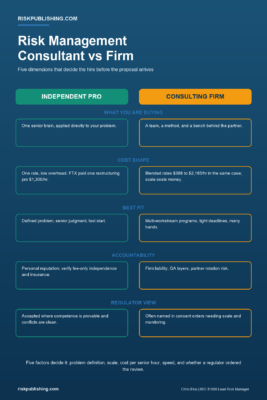
Figure 3. Risk management consultant vs firm across five dimensions: what you buy, cost shape, best fit, accountability, and how regulators see each option.
If you are weighing this decision now, we sit on the independent side of it and will say so plainly. Review our services, then contact us for a scoping conversation that tells you honestly whether your problem needs one professional or a bench.

Chris Ekai is a Risk Management expert with over 10 years of experience in the field. He has a Master’s(MSc) degree in Risk Management from University of Portsmouth and is a CPA and Finance professional. He currently works as a Content Manager at Risk Publishing, writing about Enterprise Risk Management, Business Continuity Management and Project Management.