A fire risk assessment does not expire under UK or US law. It lasts as long as it still matches the premises. Good practice reviews it every 12 months, renews it in full every 3 to 5 years, and repeats it immediately after any material change, fire, or near miss. The NFPA 99 risk assessment tool applies the same trigger logic to hospital utility systems.
The Grenfell Tower Inquiry published its final report on September 4, 2024, seven years after the June 2017 fire killed 72 people in a building whose paperwork never caught up with its refurbishment. Ask how long does a fire risk assessment last and that report answers grimly: exactly as long as the building stays the same.
The legal answer is shorter than most consultancies admit. No UK statute gives a fire risk assessment an expiry date, and no US federal rule does either. Validity is conditional, not calendrical, which means the real question is what ends it.
| How Long Does a Fire Risk Assessment Last: Key Takeaways |
| A fire risk assessment has no statutory expiry date under the UK Fire Safety Order 2005; it lasts only as long as it remains suitable and sufficient for the premises as they are today. |
| Good practice runs two clocks: a desk review every 12 months (24 for genuinely low-risk sites) and a full reassessment every 3 to 5 years, or annually where people sleep. |
| Ten change triggers end a fire risk assessment’s validity immediately, including refurbishment, occupancy changes, new processes, and any fire or near miss; the review happens then, not at the next anniversary. |
| Since 1 October 2023, Section 156 of the Building Safety Act requires every UK responsible person to record the full assessment, which makes an undated, unreviewed document indefensible. |
| US facilities face the same question through different rules: OSHA 29 CFR 1910.39 fire prevention plans, NFPA 551 reviews, and fire marshal inspection cycles set the cadence. |
| NFPA counted 1.39 million US fires, 3,670 civilian deaths, and $23 billion in property damage in 2023; a stale assessment is a bet against that ledger. |
This guide gives you the two clocks that competent duty holders run, the ten triggers that stop both, the UK legislation and US rules behind them, and a review cadence you can defend to an inspector, an insurer, or a courtroom. The framework mirrors how risk assessments generally should be kept current.
The Short Answer: How Long Does a Fire Risk Assessment Last?
A fire risk assessment lasts until it stops describing your premises. The Regulatory Reform (Fire Safety) Order 2005 requires the assessment to be suitable and sufficient and to be reviewed regularly, but Article 9 sets no interval and no expiry. The document does not lapse; its accuracy does.
Practice has converged on two overlapping cycles. A desk review happens every 12 months, checking whether anything material changed, and a full reassessment happens every 3 to 5 years, redone by a competent assessor from first principles. Premises where people sleep compress both cycles to annual.
| Cycle | What happens | Typical frequency |
| Desk review | Walk the premises against the existing findings; confirm nothing material changed; record the check | Every 12 months (24 for low-risk sites) |
| Full reassessment | New assessment from scratch by a competent person, replacing the old document | Every 3 to 5 years; annually for sleeping risk |
| Triggered review | Immediate review after any material change, fire, or near miss | Whenever the trigger fires, same month |
Treat those intervals as ceilings rather than guarantees. The Fire Protection Association gives the same answer the regulators give: review regularly, and review immediately when there is reason to suspect the assessment no longer holds. An anniversary date never overrides a changed building.
What UK Law Actually Requires
Four instruments now shape the fire risk assessment lifecycle, and each one tightened it. The 2005 Order created the duty, the Fire Safety Act 2021 pulled external walls and flat entrance doors into scope after Grenfell, and the Fire Safety (England) Regulations 2022 added recurring duties for multi-occupied residential buildings.
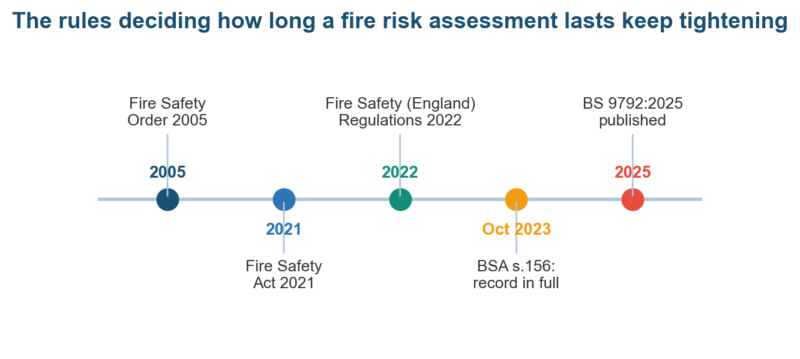
Figure 1. How long does a fire risk assessment last in law: each reform since 2005 shortened the practical answer.
Section 156 of the Building Safety Act 2022, in force since 1 October 2023, matters most for validity arguments. Every responsible person must now record the fire risk assessment in full, whatever the size of the business. An unrecorded or undated review is no longer a paperwork gap; it is a breach.
Enforcement runs through fire and rescue services, and official government guidance tells duty holders plainly to review regularly and after changes. Inspectors ask two questions about the fire risk assessment on arrival: when was this assessed, and what has changed since. A well-kept risk register answers both in one page.
Review or Redo? The Two Clocks
The annual fire risk assessment review and the multi-year reassessment answer different questions. The review asks whether the old findings still describe reality, a comparison exercise any trained facilities lead can run against a structured checklist. The reassessment asks what the risk actually is now, which needs assessor competence.
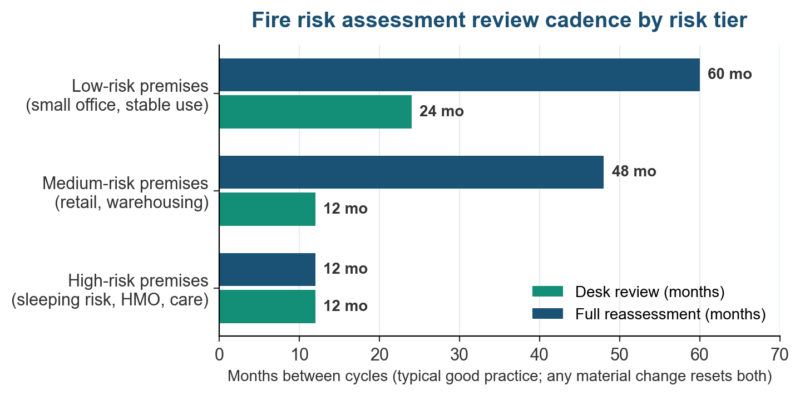
Figure 2. Cadence by risk tier: sleeping risk collapses both fire risk assessment clocks to twelve months.
Risk tier sets the tempo. A small, stable office can defend a 24-month fire risk assessment review and a five-year redo, while a care home, hotel, or house in multiple occupation cannot defend anything past twelve months on either clock. The likelihood and impact logic is the same one used across risk assessment methodology.
Insurers and licensing authorities often run faster clocks than the statute. HMO licensing commonly expects a fire risk assessment younger than twelve months, and property insurers increasingly ask for the review date at renewal. The strictest clock you have accepted contractually is the one that governs you.
Ten Triggers That End Validity Early
Calendar reviews catch slow drift; triggers catch events. The moment any of the changes below lands, the existing fire risk assessment stops being suitable and sufficient, and the review obligation crystallizes immediately. Wise duty holders wire these triggers into their change management and risk processes so nobody has to remember them.
| Trigger | Why it invalidates the assessment |
| Refurbishment, extension, or structural change | Escape routes, compartmentation, and detection coverage all shift with the fabric of the building |
| Change of use or occupancy profile | An office becoming a gym or adding night workers changes evacuation assumptions entirely |
| Significant staffing changes | Fire warden coverage, PEEPs, and out-of-hours arrangements stop matching the roster |
| New processes, equipment, or storage | New ignition sources and fuel loads appear that the fire risk assessment never scored |
| A fire, near miss, or unwanted alarm pattern | The event is evidence that the current controls failed or misfired |
| Changes to neighboring premises | Shared escape routes and party-wall risk change without anything inside your walls moving |
| Legislative or guidance change | The 2021 Act and 2022 Regulations both widened scope overnight |
| Failed drill or audit finding | A drill that overruns its evacuation target contradicts the assessment’s assumptions |
| Vulnerable occupants arriving | New disabled, elderly, or sleeping occupants change the evacuation strategy |
| Assessor competence doubts | Grenfell’s inquiry showed an assessment is only as valid as the person who signed it |
Score each trigger the way you would score any hazard-to-risk conversion, and record the decision either way. A documented decision that no review was needed is itself evidence of a live system when an inspector asks. Three steps keep it fast:
- Identify the change and date it entered the building
- Judge whether it touches ignition, fuel, people, or escape routes
- Record the review-or-no-review decision with a one-line rationale
Fire Risk Assessment Rules for US Facilities
US readers meet the same validity question through different instruments. OSHA 29 CFR 1910.39 requires a written fire prevention plan that must be kept current with workplace changes, and portable extinguisher rules impose annual maintenance checks. Neither sets a fire risk assessment expiry; both punish staleness.
| Requirement | US instrument | UK equivalent |
| Written fire plan | OSHA 29 CFR 1910.39 fire prevention plan | Fire risk assessment under the Fire Safety Order 2005 |
| Currency duty | Keep the plan current with workplace changes | Review regularly and on material change |
| Assessment evaluation | NFPA 551 guide for the authority having jurisdiction | Suitable and sufficient test, Article 9 |
| Inspection cadence | Fire marshal cycles, commonly annual | Fire and rescue service risk-based audits |
NFPA 551, the guide for evaluating fire risk assessments, tells authorities having jurisdiction to check that an assessment reflects current conditions and gets reviewed when the building, process, or occupancy changes. Lightning is one ignition source the fire file rarely prices, which is why an NFPA 780 lightning risk assessment belongs on the same review calendar. Fire marshals then set inspection cycles locally, commonly annual for assembly and healthcare occupancies.
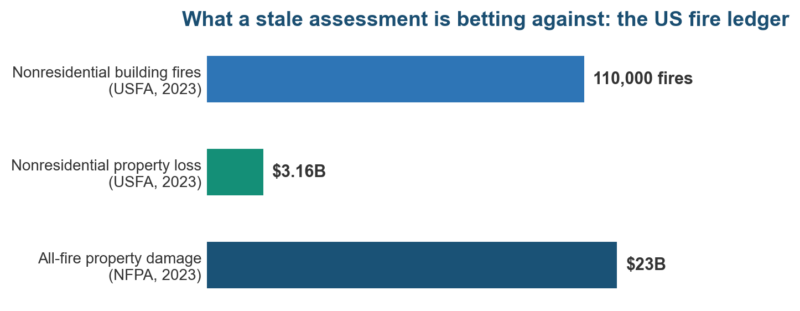
Figure 3. The 2023 US fire ledger per NFPA and USFA: the downside a current assessment is holding back.
The stakes carry hard numbers. NFPA’s fire loss research counted 1.39 million US fires in 2023, killing 3,670 civilians and destroying $23 billion in property, while USFA data attributes 110,000 fires and $3.16 billion of that to nonresidential buildings. Those are the odds a five-year-old fire risk assessment quietly re-prices.
Who Should Do the Reviewing, and How
Competence decides whether a review means anything. The Grenfell Phase 2 report devoted sustained criticism to assessor qualification, and UK reform now points toward mandatory competence requirements for anyone completing or reviewing an assessment. Third-party certification schemes already give duty holders a defensible selection test.
The annual desk review can sit in-house if the reviewer is trained and follows a written protocol built on the original findings, template in hand. The 3-to-5-year reassessment, and any review after a serious trigger, belongs with a certified external assessor. London Fire Brigade guidance draws the same line.
Record what a court would want to read, and feed the actions into the same tracking system as your physical security and business continuity assessments, because separate registers are where fire risk assessment actions go to die. Every review entry needs five fields:
- The date of the review and the date of the assessment it examined
- Who reviewed it, with the qualification that makes them competent
- What was checked, room by room or system by system
- What had changed since the last entry, or a recorded nil return
- What action followed, with an owner and a deadline
| Task | Who does it | Cadence |
| Fire risk assessment desk review, no material change | Trained in-house reviewer with a written protocol | Every 12 months |
| Full reassessment | Third-party certified assessor | Every 3-5 years; annual for sleeping risk |
| Post-incident or post-trigger review | External assessor; notify the insurer | Immediately after the event |
Frequently Asked Questions About Fire Risk Assessment Validity
How long does a fire risk assessment last in the UK?
It lasts until the premises change or the review clock you have adopted runs out, because the Fire Safety Order 2005 sets no expiry date. Good practice reviews the assessment every 12 months and redoes it fully every 3 to 5 years. Sleeping-risk premises should treat both cycles as annual.
Does a fire risk assessment expire after 5 years?
No statute makes a fire risk assessment expire at five years or any other age. Five years is the outer edge of professional practice for a full reassessment of a low-risk, unchanged building. Most assessors, insurers, and licensing authorities expect faster cycles, and any material change ends validity immediately regardless of age.
How often should a fire risk assessment be reviewed?
Review it every 12 months as a baseline, stretch to 24 only for genuinely low-risk and stable premises, and review immediately after any material change, fire, or near miss. Run a full reassessment every 3 to 5 years. Where residents sleep, compress every one of those intervals to twelve months.
What makes a fire risk assessment invalid?
Change makes it invalid: refurbishment, altered escape routes, new occupancy or use, new processes or storage, staffing shifts that break warden coverage, vulnerable occupants, neighboring-premises changes, or new legislation. A fire or near miss invalidates it as evidence that controls failed. Age alone matters only because change accumulates with it.
Who can review a fire risk assessment?
A trained in-house person can run the annual desk review against a written protocol if nothing material changed. Full reassessments and post-incident reviews belong with a competent assessor, ideally third-party certified. The Grenfell Inquiry’s criticism of assessor competence means the reviewer’s qualifications are now part of the assessment’s defensibility.
How long does a fire risk assessment take to complete?
A small, simple workplace takes two to four hours on site plus reporting time, while a complex or multi-occupied building can take several days. The annual review is faster, typically an hour or two against the existing findings. Time on site tracks building size, complexity, and the quality of existing records.
Is a fire risk assessment a legal requirement in the US?
Not under that name federally, but the substance is required. OSHA 29 CFR 1910.39 mandates a current written fire prevention plan for most workplaces, state and local fire codes impose inspection cycles, and NFPA 551 guides how authorities evaluate fire risk assessments where they are used. Insurers frequently require them contractually.
Common Pitfalls That Undermine Validity
The same failures surface wherever a fire risk assessment program drifts from live system to filed document. Each pitfall below traces to one root cause, and each has a remedy that costs less than commissioning a fresh fire risk assessment after every inspection.
| Pitfall | Root cause | Remedy |
| Treating the fire risk assessment as a certificate | Assessor cover pages that carry a review date read like an expiry | Run trigger-based reviews; the date is a backstop, not the test |
| Reviews recorded nowhere | Walkarounds happen but leave no evidence | Log date, reviewer, scope, and outcome every time, even when nothing changed |
| Renovation without review | Project teams never told fire safety about the works | Add fire review sign-off to every change and capital project gate |
| One clock for every site | Portfolio policy ignores risk tiers | Set cadence per premises risk tier and record the rationale |
| Actions divorced from the register | Findings live in a PDF nobody owns | Track actions in the corporate risk register with owners and dates |
| Unqualified reviewer | Cost pressure pushes reviews to whoever is free | Certify in-house reviewers; use third-party assessors for reassessment |
Where the Rules Go Next
Assessor competence is the next statutory shoe to drop in the UK. The Building Safety Act already contains the power to require it, Grenfell’s final report demanded it, and government has signaled that formal competence requirements for anyone completing a fire risk assessment are a matter of when rather than whether.
Expect the recorded fire risk assessment to become a living dataset. The golden-thread duty on higher-risk buildings points where regulation is heading: assessments stored digitally, version-controlled, and inspectable on demand. A dated Word file in a shared drive will read as legacy practice within a few years.
Standards are consolidating too. BS 9792:2025 now carries the methodology for residential assessments, and periodic review sits inside the method rather than beside it. US practice moves the same direction as scenario-based assessment and data-driven inspection targeting spread through fire services.
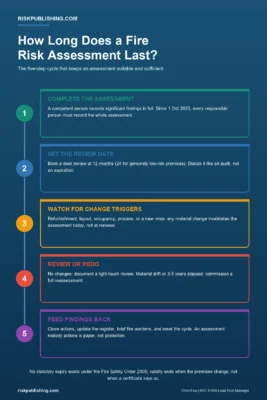
Build the habit before the mandate arrives, and give the review the same planning discipline as any continuity exercise. Regulators and insurers both reward systems that were already running before enforcement made them fashionable. Three practical moves future-proof the review cycle now:
- Put both clocks, review and reassessment, in the compliance calendar with named owners
- Wire the ten triggers into change management so projects cannot close without a fire review sign-off
- Version-control the fire risk assessment digitally so the golden-thread duty finds you ready
Facilities and risk leaders ask us one version of this question: would our fire risk assessment survive an inspector’s first two questions. We build review calendars, trigger registers, and assessor selection criteria that answer yes. Explore our services and contact us to pressure-test your review cycle before an inspection does.

Chris Ekai is a Risk Management expert with over 10 years of experience in the field. He has a Master’s(MSc) degree in Risk Management from University of Portsmouth and is a CPA and Finance professional. He currently works as a Content Manager at Risk Publishing, writing about Enterprise Risk Management, Business Continuity Management and Project Management.