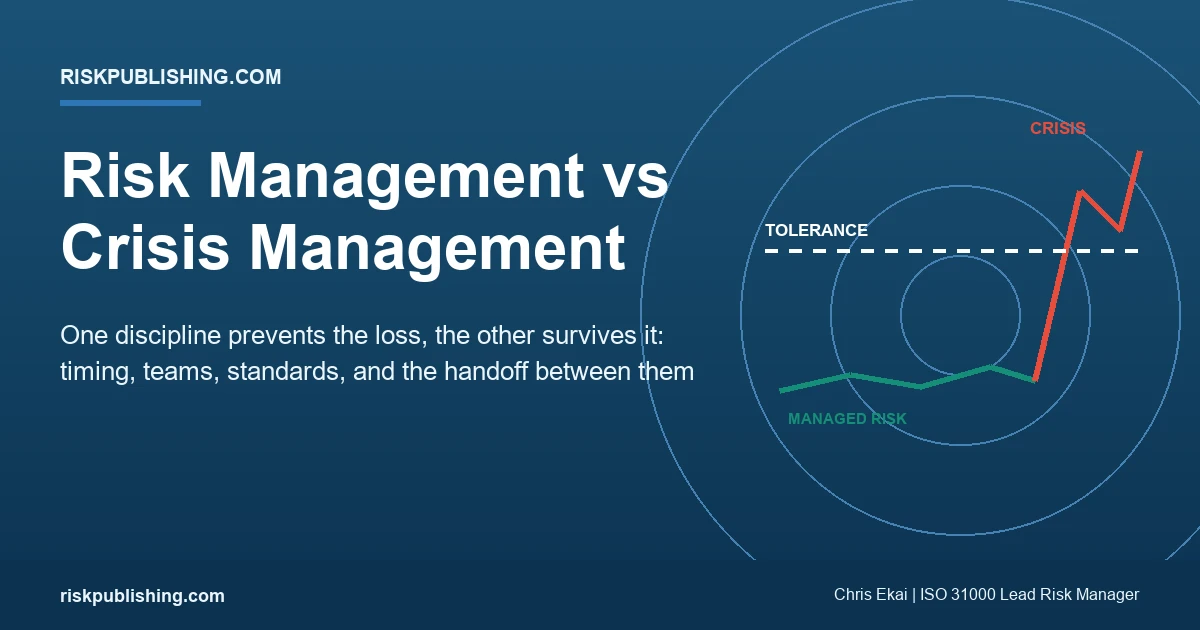
Risk management reduces the likelihood and cost of events before they happen. Crisis management contains the damage once one does. One runs on a calendar measured in months and years; the other activates on a trigger and is judged in minutes. Mature organizations run both, joined by pre-agreed escalation criteria. Planned transitions call for a third discipline entirely, the change manager roles and responsibilities that carry an organization between steady states.
On Thursday, March 9, 2023, depositors tried to pull $42 billion out of Silicon Valley Bank in a single day, and another $100 billion was queued for the next morning. The difference between risk management and crisis management stopped being a seminar question that week; it became the reason a $209 billion bank ceased to exist.
Risk management is the discipline that should have acted months earlier, while rising rates were quietly eroding the bond portfolio. Crisis management is what the bank needed once the run began, when decisions had to land in minutes. Most organizations blur the two, and the blur is exactly where they fail.
| Risk Management vs Crisis Management: Key Takeaways |
| Risk management works on probabilities before an event; crisis management works on facts during one. SVB showed the cost of confusing them when $42 billion left in a day. |
| ISO 31000:2018 governs the risk discipline and ISO 22361:2022 governs the crisis discipline; none of the top-ranking comparisons cite either, and both are free to preview. |
| PwC found 96% of organizations experienced disruption within two years, so the question is not whether the crisis team activates but how fast and under whose authority. |
| The Fed’s Barr review found SVB failed to manage its risks and carried 31 unaddressed supervisory warnings, triple the peer average, before the crisis phase ever began. |
| Pre-agreed escalation triggers turn a risk register entry into a declared crisis by threshold, not by debate; map every high-rated risk to a The prevention side is where you mitigate risk in business before it escalates into something the crisis team has to own. contingency plan that pre-assigns responses and an activation authority. |
| Since December 2023 the SEC’s Form 8-K Item 1.05 gives US issuers four business days to disclose a material cyber incident, pulling crisis management into securities law. |
Risk Management vs Crisis Management: The Core Difference
ISO 31000:2018 defines risk management as coordinated activities to direct and control an organization with regard to risk, where risk is the effect of uncertainty on objectives. The work is continuous, forward looking, and probabilistic. Nothing needs to have gone wrong for the five-step risk management process to be earning hard money.
Crisis management, per ISO 22361:2022, deals with abnormal and extraordinary events that threaten an organization’s strategic objectives, reputation, or viability. A crisis is present tense. The discipline exists for the moment probability collapses into fact, which is why crisis management platforms optimize for speed of notification rather than depth of analysis.
| Dimension | Risk management | Crisis management |
| Orientation | Proactive: anticipate, assess, and treat uncertainty before impact | Responsive: contain, decide, and communicate while impact is unfolding |
| Time horizon | Months to years; quarterly reviews and annual reassessments | Minutes to weeks; the first hour usually shapes the outcome |
| Trigger | Calendar and threshold driven; runs whether or not anything happens | Event driven; activates only on declared criteria |
| Team | CRO, risk committee, and risk owners embedded in functions | Crisis commander, communications lead, legal counsel, operations chiefs |
| Core artifact | Risk register, appetite statement, key risk indicators | Activation criteria, playbooks, holding statements, decision log |
| Success measure | Losses stay inside stated appetite; fewer surprises reach the board | Speed to decision and stakeholder trust intact after the event |
The table understates one point: the two disciplines are a single investment seen at different temperatures. A mature risk program shrinks the crisis surface by treating the causes it can see, and a rehearsed crisis capability caps the damage from whatever the register never scored. They compete for budget, never for purpose.
Why the Distinction Matters
Collapsing the two disciplines into a single function is the most common structural failure, and it is an expensive one.
- Disruption is close to certain. PwC found 96% of organizations hit serious disruption within two years, so a program built only on prevention is planning for a world that does not exist.
- The two clocks are incompatible. Quarterly risk reviews cannot produce decisions in the first hour of an event, and crisis playbooks cannot spot a bond portfolio eroding over eighteen months.
- Disclosure is now timed. The SEC’s four business day cyber clock makes crisis response a compliance artifact, not just a reputational one.
- Failure happens at the seam. SVB did not lack a risk function. It lacked a trigger that converted a known interest rate exposure into a declared crisis before depositors moved.
Where Each Discipline Leads Across the Disruption Lifecycle
PwC’s Global Crisis and Resilience Survey found that 96% of organizations had experienced disruption in the previous two years, and 91% took at least one hit unrelated to the pandemic. Disruption is no longer a tail event. The lifecycle below shows which discipline carries the load at each stage.
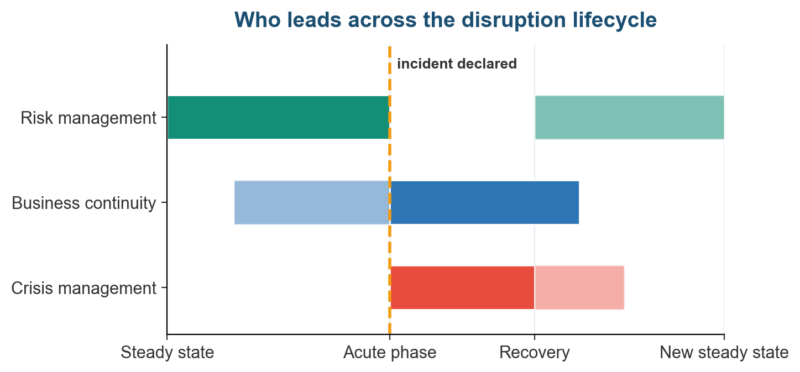
Figure 1. Risk management vs crisis management across the disruption lifecycle: risk work dominates steady state, the crisis team owns the acute phase, and both feed recovery.
Before any event, the risk function runs the register, calibrates risk appetite, and treats what it can see. Business continuity planning converts that analysis into recovery strategies and recovery time objectives. Once an incident is declared, authority shifts to the crisis team, and the plans either hold or they do not.
After stabilization the flow reverses, and the post-incident review feeds new entries and revised scores back into the risk management lifecycle. ISO 22301 formalizes that feedback loop for continuity programs, and disciplined teams close it within thirty days of stand-down rather than letting findings age into folklore.
The SVB Lesson: Two Disciplines in 48 Hours
The Federal Reserve’s April 28, 2023 review, led by Vice Chair for Supervision Michael Barr, concluded that SVB’s board and management failed to manage their risks. The full report counted 31 unaddressed supervisory warnings at failure, triple the peer average, and noted the bank ran without a chief risk officer for roughly eight months of 2022.
| When | What happened | Discipline on point |
| April 2022 | Chief risk officer departs; the seat stays effectively empty into January 2023 | Risk management |
| Through 2022 | Rate hikes build unrealized losses in the held-to-maturity bond portfolio | Risk management |
| March 8, 2023 | SVB announces a $1.8 billion securities loss and a capital raise; the raise fails | Handoff point |
| March 9, 2023 | Depositors attempt to withdraw $42 billion in one day | Crisis management |
| March 10, 2023 | Another $100 billion queued; regulators close the bank mid-morning | Crisis management |
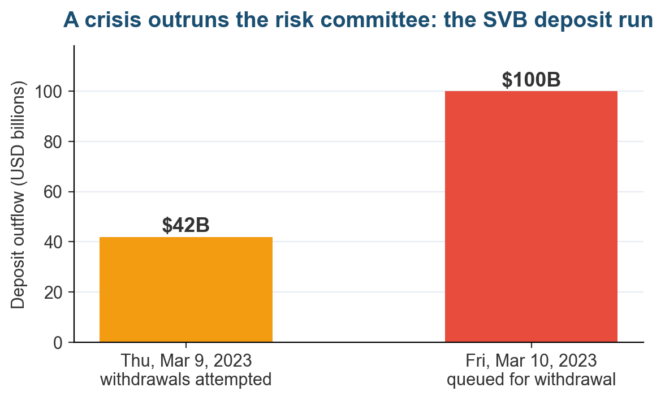
Figure 2. Two days, $142 billion in attempted outflows: the acute phase moves at a speed no committee can match.
The lesson is not that a better war room could have saved SVB. It is that no crisis capability can outrun a risk function that stopped doing its job, because by the time the run started every remaining option was bad. Risk management buys options, and crisis management spends them; key risk indicators existed for every warning the Fed catalogued.
The Standards Behind Each Discipline: ISO 31000 and ISO 22361
Neither discipline lacks codification; practitioners just rarely read across the whole shelf. The risk side leans on ISO 31000 and COSO’s enterprise risk management framework, the crisis side on ISO 22361, and the connective tissue runs through ISO 22301, NIST incident response guidance, and the SEC’s disclosure rules.
| Standard or rule | What it covers | Use it for |
| ISO 31000:2018 | Principles and process for managing any risk type | Designing the enterprise risk framework and register cadence |
| COSO ERM (2017) | Risk integrated with strategy and performance | Board reporting and strategy-linked risk appetite |
| ISO 22361:2022 | Crisis management principles, structure, and leadership | Standing up the crisis team, activation criteria, and playbooks |
| ISO 22301:2019 | Business continuity management systems | Recovery strategies, RTOs, and exercising between the two disciplines |
| NIST SP 800-61r3 | Cyber incident response as a risk management activity | Wiring security incidents into both the register and the playbooks |
| SEC Form 8-K Item 1.05 | Material cyber incident disclosure within four business days | Building the materiality assessment into crisis communications |
The SEC rule deserves particular attention from US issuers. Since December 2023, a material cybersecurity incident must be disclosed on Form 8-K Item 1.05 within four business days of the materiality determination, which drags crisis management into securities law. The disclosure clock runs while the war room is still working the problem.
On the technical seam, NIST SP 800-61 Revision 3 reframes incident response as a risk management activity aligned to CSF 2.0, which settles an old turf question. Whether you start from ISO 31000 or COSO, the sequence agrees: assess and treat continuously, respond decisively, then feed the lessons back into the NIST-style assessment.
Who Runs Each Discipline: Teams, Tools, and Metrics
Ownership diverges sharply between the disciplines. Risk management belongs to a chief risk officer, a committee calendar, and named owners who feed the risk register; crisis management belongs to a commander with pre-delegated authority, a communications lead, and counsel who will defend every decision afterwards.
| Aspect | Risk management practice | Crisis management practice |
| Cadence | Monthly KRI refresh, quarterly committee, annual deep reassessment | Standing readiness; quarterly tabletop, annual full-scale exercise |
| Leading metrics | KRI breaches, treatment aging, losses versus appetite | Time to activate, time to first statement, decisions per hour logged |
| Rehearsal | Risk and control self-assessments, scenario workshops | Tabletops, simulations, and no-notice activation drills |
| Failure mode | Stale register scores that no longer describe the business | Playbooks nobody has opened since the last reorganization |
Metrics differ because the clocks differ. Risk functions track key risk indicators, loss events against appetite, and treatment aging, while crisis teams measure activation speed and recovery against RTO and RPO targets. CISA’s tabletop exercise packages give crisis teams free, structured rehearsal material for both dimensions.
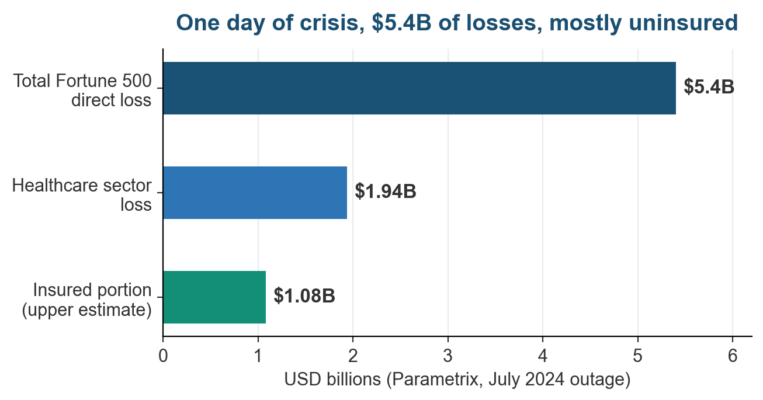
Figure 3. Parametrix’s loss estimate for the July 19, 2024 CrowdStrike outage: $5.4 billion in Fortune 500 damage, four fifths of it uninsured.
The July 19, 2024 CrowdStrike outage shows the bill when the acute phase arrives at scale. Parametrix put direct Fortune 500 losses at $5.4 billion, healthcare’s share at $1.94 billion, and the insured portion at no more than $1.08 billion. Uninsured crisis cost is the strongest budget argument a risk team owns.
Connecting the Risk Register to the Crisis Playbook
Integration is a handoff problem, and handoffs fail without pre-agreed triggers. The fix is mechanical rather than cultural: every high-rated register entry gets an escalation criterion, a named activation authority, and a mapped playbook, so a scenario-based risk assessment becomes a declared crisis by threshold instead of by meeting.
| Register entry (residual High) | Escalation trigger | Crisis activation |
| Ransomware on core order systems | Outage exceeds 4 hours or exfiltration is confirmed | Cyber playbook; commander: COO; SEC materiality assessment opens |
| Sole supplier plant failure | Confirmed stoppage longer than 72 hours of buffer stock | Supply playbook; commander: VP Operations; customer notice drafted |
| Liquidity stress at house bank | Counterparty downgrade below board floor or deposit freeze | Treasury playbook; commander: CFO; alternate facilities drawn |
| Viral product safety allegation | Verified injury report or 10x mention spike in monitored media | Reputation playbook; commander: GC; holding statement in 60 minutes |
Exercises are where the seam actually gets tested. FEMA’s Homeland Security Exercise and Evaluation Program supplies the doctrine for scenario design, and a business impact analysis tells you which processes deserve the drills first. Run one joint exercise a year where the risk committee watches its own register go live.
Score the seam the way continuity professionals score maturity: trigger coverage across high risks, exercise cadence with findings closed, and feedback loops that measurably change register scores. Ready-made exercise scenarios shortcut the design work. Boards fund what gets scored, and this seam is no exception to that rule.
Common Pitfalls When the Two Disciplines Overlap
| Pitfall | Root cause | Remedy |
| One team owns both disciplines in name only | Budget pressure collapses two clock speeds into one committee | Separate owners, shared register, one joint exercise per year |
| Risk register never maps to playbooks | Register built for reporting, not for activation | Add trigger, authority, and playbook columns to every High risk |
| Crisis plan assumes information that will not exist | Plans written in calm conditions by people who expect certainty | Drill no-notice scenarios with deliberately missing data |
| KRIs tracked but never escalated | Indicator breaches lack a forcing mechanism | Tie each KRI red band to a named decision and deadline |
| Disclosure treated as a legal afterthought | SEC four-day clock unknown to the crisis team | Put the materiality assessment inside the playbook’s first hour |
| Post-crisis lessons never reach the register | Stand-down fatigue and no closure owner | Thirty-day feedback deadline owned by the risk function |
Where Both Disciplines Head After 2026
- Start with the regulatory seam. The SEC’s four business day disclosure clock now sits inside every material cyber crisis at a US issuer, and banking supervisors keep pressing operational resilience expectations that assume disruption will occur rather than model it away. Crisis performance is quietly becoming a compliance artifact.
- Expect the boundary between the disciplines to keep thinning as monitoring gets faster. The same telemetry that feeds cybersecurity risk management dashboards now drives automated escalation, which means a KRI breach can page a crisis commander before a human reads the report. Trigger design, not detection, becomes the scarce skill.
- Regulators outside the US are already legislating the integration. The EU’s DORA regime, applicable since January 2025, requires financial entities to classify incidents, test resilience, and report on deadlines, and its contrast with NIS2 previews where US sector rules are heading. Firms operating across borders should build one seam, not two.
- Fund the unglamorous middle. The organizations that performed best through the CrowdStrike outage were not those with the thickest registers or the largest war rooms, but those whose continuity planning had rehearsed degraded operations. Budget follows incidents; resilience follows rehearsal done before anyone was watching.
Frequently Asked Questions About Risk Management vs Crisis Management
What is the main difference between risk management and crisis management?
Risk management anticipates and treats potential events before they happen, working on probabilities across months and years. Crisis management responds to an actual event that is already damaging the organization, working on facts across minutes and hours. One reduces the odds and size of trouble; the other limits trouble already underway.
Can prevention replace crisis response?
No, and PwC’s finding that 96% of organizations faced disruption inside two years explains why. Risk management shrinks the crisis surface but cannot eliminate novel events, cascading third-party failures, or deliberate attacks. Treat the two as complements: prevention lowers frequency, and rehearsed response lowers severity when prevention runs out.
Who owns risk management and who owns crisis management?
Give risk management to a chief risk officer or equivalent, reporting to a board committee with named risk owners in each function. Give crisis management to a designated commander with pre-delegated authority, typically an operations or general counsel role. Keep the owners different but force them to share one register and one exercise calendar.
Which ISO standards cover risk and crisis management?
ISO 31000:2018 and COSO ERM 2017 govern the risk management side, while ISO 22361:2022 is the dedicated crisis management standard. ISO 22301:2019 covers business continuity between them, and NIST SP 800-61r3 wires cyber incident response into risk practice. US issuers add the SEC’s Form 8-K Item 1.05 disclosure rule.
Where does business continuity fit in?
Business continuity converts risk analysis into recovery capability before an event, then executes under crisis leadership during one. The business impact analysis ranks processes, recovery strategies set RTO and RPO targets, and exercises prove the plans. In practice it is the bridge discipline: fed by the register, commanded by the crisis team.
What triggers the handoff from risk to crisis?
Pre-agreed activation criteria attached to each high-rated risk, such as outage duration, confirmed data exfiltration, casualty reports, or a counterparty downgrade below a board floor. When a threshold is crossed, a named authority declares the crisis and the playbook takes over. Without written triggers, the handoff happens by debate and arrives late.
How do you measure risk and crisis management performance?
Measure risk management by losses against stated appetite, key risk indicator breaches, and treatment plan aging. Measure crisis management by time to activation, time to first public statement, and recovery time against objectives from the continuity plan. Both sets belong on one board dashboard so underinvestment in either side is visible.
Close the Gap With Risk Publishing
If your register and your playbooks have never met, that seam is where the next loss lands. We help risk leaders build escalation triggers, exercise programs, and board dashboards that hold up under a real event. Review our services, then contact us to put your handoff on paper this quarter.

Chris Ekai is a Risk Management expert with over 10 years of experience in the field. He has a Master’s(MSc) degree in Risk Management from University of Portsmouth and is a CPA and Finance professional. He currently works as a Content Manager at Risk Publishing, writing about Enterprise Risk Management, Business Continuity Management and Project Management.