The advantages and disadvantages of risk management split cleanly on the evidence: mature programs correlate with a 25 percent firm-value premium, $6 saved per mitigation dollar, and fewer earnings surprises, while the drawbacks are real cost, added bureaucracy, and false assurance when process substitutes for action. The data favors risk management, but only when leadership actually uses it.
On July 29, 2021, Credit Suisse published a 172-page independent report by Paul, Weiss into how the March 2021 default of Archegos Capital Management, Bill Hwang’s New York family office, cost the bank $5.5 billion. The investigators ran more than 80 interviews and reviewed over 10 million documents.
| Advantages and Disadvantages of Risk Management: Key Takeaways |
| Mature enterprise risk management correlates with a 25% firm-value premium (Tobin’s Q), per Farrell and Gallagher’s 2015 study in the Journal of Risk and Insurance. |
| Hazard mitigation returns $4 to $13 per dollar invested, with federal grants averaging $6 saved per $1 spent across 23 years of NIBS and FEMA data. |
| The costs are real: global enterprise GRC spend hit $72.4 billion in 2025 (Grand View Research), on top of a total cost of risk near $9.95 per $1,000 of revenue (RIMS). |
| Process is not protection. Credit Suisse lost $5.5 billion on Archegos in 2021 with risk systems that flagged the exposure; the Paul Weiss report called it a fundamental failure of management and controls. |
| Only 11% of 273 U.S. finance leaders say their risk process delivers real strategic advantage (AICPA and NC State, 2025), so most programs are paying the costs without collecting the benefits. |
| The deciding variable is top-down executive engagement: the same maturity research found leadership culture, not tooling, drives the valuation premium. |
Their conclusion cut deeper than any missing tool: the bank’s risk architecture was adequate, the exposures were visible in its own systems, and losses still followed a fundamental failure of management and controls. Credit Suisse had paid for risk management and received none of it, which is exactly the tension this article prices out.
Advantages and Disadvantages of Risk Management at a Glance
Weighing the advantages and disadvantages of risk management honestly requires evidence on both sides, and vendors only ever show one. The tables below pair each claimed benefit and each real cost with a named, dated source, so the comparison starts from data rather than from a sales deck.
| Advantage | Evidence | Source and year |
| Higher firm value | 25% valuation premium (Tobin’s Q) for mature ERM programs | Farrell & Gallagher, JRI, 2015 |
| Cheaper losses | $6 saved per $1 of federal mitigation spend; up to $13 best case | NIBS / FEMA, 2019 |
| Fewer surprises | Risks surfaced and treated before they reach earnings | ISO 31000; COSO ERM |
| Market rewards | Commercial insurance pricing fell 4% in 2025 for well-controlled risks | Marsh Global Insurance Market Index |
| Operational resilience | Redundancy decisions made before the $1M+ outage, not after | Uptime Institute, 2025 |
Each advantage above is conditional on execution, which is what the second table prices. The disadvantages are not arguments against managing risk; they are the documented costs of doing it badly, and every row below has shown up in a real survey result, audit file, or loss report.
| Disadvantage | Evidence | Source and year |
| Direct cost | $72.4B global enterprise GRC spend in 2025, growing 13.7% a year | Grand View Research, 2026 |
| Total cost of risk | $9.95 per $1,000 of revenue, before program staffing | RIMS Benchmark Survey |
| False assurance | $5.5B Archegos loss with functioning risk systems in place | Paul Weiss report, 2021 |
| Bureaucratic drag | 64% of finance leaders say the process adds minimal strategic value | AICPA & NC State, 2025 |
| Checkbox drift | Only 11% report risk management as a real competitive advantage | AICPA & NC State, 2025 |
Why the Question Deserves Real Evidence
Boards approving risk budgets face a genuine paradox, documented in the AICPA and NC State 2025 State of Risk Oversight survey of 273 U.S. finance leaders. Sixty-one percent said risk volume and complexity rose mostly or extensively over five years, so the need is not in question.
The payoff is. Only 11 percent of those same leaders called their risk process a competitive advantage, while 64 percent conceded it delivers minimal strategic value. Something between the enterprise risk management framework on paper and the practice in the building keeps eating the benefit.
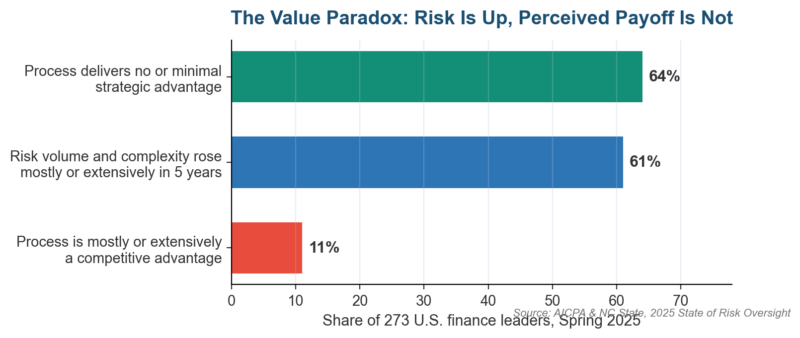
Figure 1. The value paradox: 61 percent of U.S. finance leaders report sharply rising risk, yet only 11 percent say their program is a competitive advantage.
That gap frames every section that follows. The advantages below are what well-run programs demonstrably collect, and the disadvantages are what the other 89 percent are paying while collecting little, a distinction the risk management lifecycle only closes when each stage produces a decision someone acts on.
The Advantages, With the Data Behind Them
A Measurable Firm-Value Premium
Farrell and Gallagher’s study in the Journal of Risk and Insurance scored firms on RIMS’ five-point Risk Maturity Model from 2006 to 2011 and found mature ERM associated with a statistically significant 25 percent valuation premium on Tobin’s Q. RIMS’ summary drew a direct line from maturity to value growth.
The decomposition matters more than the headline. The premium tracked top-down executive engagement and the cascade of risk culture through the firm, which means the valuation upside follows leadership behavior rather than software, a finding any COSO ERM implementation should be designed around from day one.
Losses Prevented at a Documented Multiple
The National Institute of Building Sciences tracked 23 years of federal mitigation grants and found $6 in avoided losses per $1 invested, with model building codes returning $11 and best-case strategies up to $13. FEMA’s fact sheet confirms the multiple across FEMA, HUD, and EDA programs.
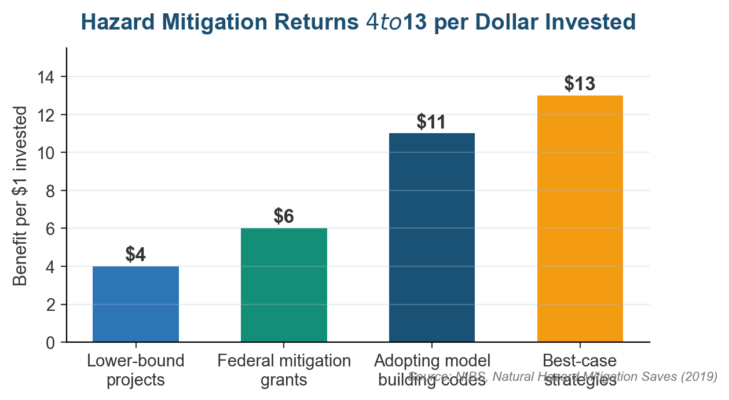
Figure 2. Documented mitigation returns run $4 to $13 per dollar invested, per NIBS’ 23-year federal grant analysis.
Better Decisions and Fewer Surprises
A working program forces risk identification and treatment choices before capital is committed, which is where ISO 31000 positions risk management: as an input to decisions, not a report about them. The practical test is simple. Count how many board decisions last quarter cited the register. Our walkthrough of how organizations actually manage risk shows what that looks like in a working quarter.
Markets and Regulators Price the Discipline
Insurers reward evidence of control: Marsh’s Global Insurance Market Index recorded commercial pricing falling 4 percent through 2025, and underwriters increasingly ask for the risk assessment file before quoting. The SEC’s 2023 cybersecurity disclosure rule pushes the same way, making risk processes a disclosed, comparable fact for U.S. public companies.
Resilience That Beats the Outage Economics
Redundancy decisions made in advance are cheaper than the loss: Uptime Institute’s 2025 survey found 57 percent of operators’ most recent major outages cost over $100,000 and one in five over $1 million. Business continuity planning is the risk discipline that makes those calls before the invoice does.
The Disadvantages Nobody Puts in the Brochure
It Costs Real Money, Every Year
Enterprise GRC platforms alone consumed $72.4 billion globally in 2025, per Grand View Research, compounding at 13.7 percent annually toward a projected $203.7 billion by 2033. Staffing, training, consulting, and internal audit time all sit on top of that software line.
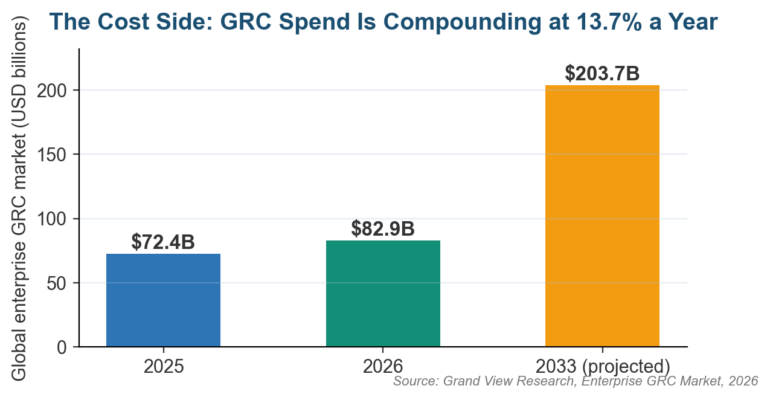
Figure 3. The cost side compounds: enterprise GRC spend is projected to nearly triple between 2025 and 2033.
The RIMS Benchmark Survey put the total cost of risk at $9.95 per $1,000 of revenue, a two percent year-over-year rise even before the current market cycle. For a $500 million revenue firm, that is roughly $5 million a year with no guarantee of return.
False Assurance: The Archegos Problem
The most dangerous disadvantage is a program that exists but does not act. Paul Weiss found Credit Suisse’s risk systems repeatedly flagged Archegos concentrations, and limits were raised or ignored rather than enforced; the presence of the apparatus made everyone feel covered while $5.5 billion walked out.
A risk and control self-assessment that never fails a control, or key risk indicators that trip without consequence, reproduce the same pattern at smaller scale. Assurance theater costs more than running no program at all, because the money buys complacency on top of the overhead.
Bureaucracy and Slower Decisions
Every register entry, sign-off layer, and quarterly attestation consumes practitioner hours that could fund an engineering fix instead. The 64 percent minimal-value finding is what accumulated process without decision rights looks like from the CFO’s chair, and it is the honest core of the disadvantages of risk management.
Three warning signs separate governance from drag, and they show up early enough to act on. None needs a consultant to spot; an hour with the minutes and the register surfaces all of them, and any two together predict the 64 percent outcome:
- Risk reviews that can delay a decision but never change one
- Registers maintained for the auditor, with no owner able to name last quarter’s actions
- Scoring debates about whether a risk is a 12 or a 16, with identical treatment either way
The Illusion of Measurement
Ordinal heat-map scores multiply ranks as if they were quantities, and the false precision can misdirect capital toward the wrong risks. Pairing qualitative and quantitative methods restores some rigor, but boards should treat any single risk score as an argument, never as arithmetic.
Weighing the Advantages and Disadvantages of Risk Management
The balance is not the same for every organization, and pretending otherwise is how the 89 percent end up with cost and no advantage. Size, regulatory exposure, and loss volatility decide how much formality pays, so weigh the advantages and disadvantages of risk management against your own profile first.
| Organization profile | Where the balance sits | Right-sized posture |
| Regulated or public company | Advantages dominate; disclosure rules remove the choice | Full ERM with board reporting and assurance |
| Mid-market, volatile losses | Strongly positive if focused on top exposures | Lean register, funded treatments, few strong KRIs |
| Small business, thin margins | Positive only when kept nearly free | Owner-led reviews, insurance, contract discipline |
| Stable niche, low hazard | Costs can exceed benefits at full formality | Annual review plus monitored acceptance |
Four tests keep the weighing honest, whatever the profile happens to be. Run them at budget setting each year rather than as a one-off exercise, because the balance shifts steadily as the organization grows, regulation tightens, and the loss history accumulates:
- Trace every program dollar to a named risk it reduces, transfers, or prices, using the 12 risk management techniques as the menu
- Compare program cost against expected annual loss avoided, the same math as any risk mitigation plan
- Check residual exposure against the board’s written risk appetite, not against comfort
- Count decisions changed per quarter; a program that changes none is overhead by definition For the ground-level definition, see what risk in finance means and how it is measured, with April 2025 numbers attached.
Keeping the Upside, Shedding the Overhead
The maturity research already names the lever: executive engagement drives the premium, so fixes that pull leadership into risk decisions beat fixes that add documentation. Start where the five steps of the risk management process meet real spending choices, and prune everything that never reaches one.
Practically, that means fewer, sharper instruments. Cut the register to the exposures leadership will actually fund, build KRIs with thresholds that trigger named actions, and test the big scenarios with scenario exercises instead of adding another attestation layer nobody reads.
| Measure | What it proves | Healthy signal |
| Decisions citing risk analysis | The program reaches choices | Rising quarter over quarter |
| Treatment actions closed on time | Findings convert to work | Above 80% closure |
| Cost per high risk treated | Overhead stays proportionate | Falling as the register tightens |
| Surprises outside the register | Identification actually works | Near zero, reviewed when not |
Operational risk teams that run this way earn the premium the research describes, because the discipline shows up in operational risk management outcomes rather than in binder thickness. Watch decisions changed per quarter first; every other metric follows that one.
FAQ: Advantages and Disadvantages of Risk Management
What are the main advantages and disadvantages of risk management?
The main advantages are a documented 25 percent firm-value premium for mature programs, $6 saved per $1 of mitigation spend, fewer surprises, and better insurance pricing. The main disadvantages are direct cost ($72.4 billion in global GRC spend in 2025), bureaucratic drag, and false assurance when process replaces action.
Do the advantages and disadvantages of risk management balance differently for small businesses?
Yes. Small firms cannot amortize program overhead, so formality must stay near free: owner-led risk reviews, insurance and contract discipline, and a shortlist of watched exposures. The advantages arrive through avoided losses and cheaper cover, while the disadvantages bite the moment documentation grows faster than decisions.
What are the advantages and disadvantages of risk management software?
Software centralizes registers, automates monitoring, and standardizes reporting, which is a real gain in large programs. The disadvantages are cost inside a $72.4 billion market growing 13.7 percent a year, and the temptation to mistake a populated dashboard for managed risk, the exact failure Paul Weiss documented at Credit Suisse.
How do you measure whether the advantages and disadvantages of risk management net out positive?
Count decisions changed, losses avoided against program cost, and treatment actions closed on time. If board decisions cite risk analysis, closure runs above 80 percent, and surprises outside the register stay rare, the advantages are winning; if the program only produces reports, the disadvantages already won.
What are the advantages and disadvantages of risk management standards like ISO 31000?
Standards supply tested vocabulary, principles, and a defensible process, which shortens implementation and satisfies regulators and auditors. Their disadvantage is ritual: certification pressure can reward documentation over decisions. ISO 31000 itself is principles-based and uncertified precisely to resist that, unlike auditable management-system standards.
Can the disadvantages of risk management ever outweigh the advantages?
Yes, in two documented cases: small, stable organizations where full formality costs more than expected losses, and any organization running assurance theater. The AICPA and NC State data suggests most programs sit in the second case today, paying full cost while 64 percent of leaders see minimal strategic value.
Where the Balance Tips the Wrong Way
Watch six recurring patterns; each converts an advantage into a disadvantage quietly, and each is visible in a one-hour review of the register and the minutes. I check the decisions column first in every program I assess, because a register without decisions is the earliest symptom on this list.
| Pitfall | Root cause | Remedy |
| Assurance theater | Systems flag risks nobody is obliged to act on | Tie every threshold breach to a named owner and deadline |
| Register bloat | Every workshop adds risks, none retires them | Cap the register; force annual retirement or escalation |
| Score theology | Ordinal matrix numbers treated as arithmetic | Use scores to rank, money to decide |
| Compliance capture | Program answers auditors instead of decision-makers | Report decisions supported, not documents produced |
| Tool-first spending | Platform bought before process exists | Prove the process on spreadsheets, then automate it |
| Risk aversion creep | Every initiative needs sign-off, so fewer are proposed | Track opportunities declined alongside losses avoided |
Looking Ahead: The Evidence Through 2027
Disclosure is turning risk management from an internal choice into a public record. The SEC’s cybersecurity rule already makes U.S. filers describe their risk processes, and comparable operational-resilience expectations from banking supervisors mean the advantage of a working program increasingly includes not being the outlier in your peer group’s filings.
The evidence base itself is improving. As registers digitize, the correlation studies of the 2010s are being rerun on richer data, and boards should expect sharper answers to the value question than Tobin’s Q proxies; the importance of enterprise risk management will be argued with loss curves, not slogans. For the mechanisms behind each advantage, see how risk management adds value to an organization.
AI will press on both pans of the scale at once. Anomaly detection makes monitoring nearly free, which shrinks the bureaucracy disadvantage, while model risk adds a new exposure class that demands the same treatment choices as any other. The programs that win 2027 will be smaller, faster, and closer to decisions.
Infographic: The Evidence on Both Sides
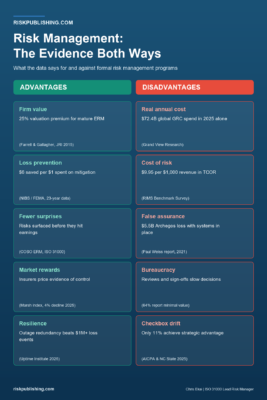
Figure 4. Five evidence-backed advantages paired against five sourced disadvantages of risk management.
Riskpublishing helps U.S. mid-market risk leaders build programs that pass the decisions-changed test, from register design to board reporting that earns its meeting slot. Our services include program right-sizing reviews; contact us if your register is thicker than its results.

Chris Ekai is a Risk Management expert with over 10 years of experience in the field. He has a Master’s(MSc) degree in Risk Management from University of Portsmouth and is a CPA and Finance professional. He currently works as a Content Manager at Risk Publishing, writing about Enterprise Risk Management, Business Continuity Management and Project Management.