Risk assessment vs risk management comes down to scope: a risk assessment is the point-in-time diagnostic that identifies, analyzes, and evaluates risks, while risk management is the continuous discipline that sets context, treats the exposures, monitors them, and reports to decision-makers. Under ISO 31000, assessment is one stage inside the management process, never a substitute for it.
When Hurricane Helene dropped historic rainfall on western North Carolina on September 27, 2024, the flood risk in Buncombe County was already assessed: FEMA’s flood maps existed, and Moody’s models rated the exposure. Yet an Asheville Watchdog analysis of NFIP and Census data found only 0.7 percent of the county’s 137,000 housing units carried flood insurance.
| Risk Assessment vs Risk Management: Key Takeaways |
| Risk assessment vs risk management starts with scope: a risk assessment is the point-in-time diagnostic (identification, analysis, evaluation), while risk management is the continuous discipline that also sets context, treats, monitors, and communicates. ISO 31000 nests the first inside the second at clause 6.4. |
| Assessment without management is how Buncombe County entered Hurricane Helene with FEMA flood maps on file and 0.7% of housing units insured, leaving an 88% protection gap and roughly $9.5 billion in uninsured residential losses. |
| Risk assessment vs risk management produces different artifacts: an assessment yields a scored register and heat map; management yields funded treatments, KRIs with thresholds, appetite statements, and board reporting. |
| Frameworks keep risk assessment vs risk management separate on purpose: NIST publishes SP 800-30 for assessing and SP 800-39 for managing, and the HIPAA Security Rule cites risk analysis and risk management as two distinct implementation specifications. |
| Only 11% of 273 U.S. finance leaders told AICPA and NC State in 2025 that their risk process delivers competitive advantage, and assessment-only programs are a leading reason the other 89% stall. |
| Ownership differs: an assessment can be delegated to a facilitator or consultant; risk management cannot, because treatment budgets, appetite, and acceptance decisions belong to line leadership and the board. |
Moody’s put the county’s flood protection gap at 88 percent, and uninsured residential losses from the storm reached an estimated $9.5 billion, a failure GAO’s work on the National Flood Insurance Program had foreshadowed for years. The risk was assessed; it was never managed. That distinction between risk assessment vs risk management is the entire subject here.
Risk Assessment vs Risk Management: The Core Difference
ISO 31000:2018 settles the vocabulary at clause 6.4: risk assessment is the combined exercise of risk identification, risk analysis, and risk evaluation. Risk management is the full process wrapped around it, adding scope and criteria, risk treatment, monitoring and review, recording, and communication with stakeholders. The six types of risk assessment all operate inside that clause 6.4 span.
Put plainly, risk assessment vs risk management splits along the line between diagnosis and decision: an assessment answers the question of what could hurt you and how badly, then stops. Management answers what you will do about it, who owns each action, and how you will know the position changed, questions a risk assessment alone was never designed to carry.
| Dimension | Risk assessment | Risk management |
| Question answered | What could go wrong, how likely, how severe? | What are we doing about it, and is it working? |
| Timeframe | Point in time, repeated on a cycle | Continuous, embedded in operations |
| Core output | Scored risk register, heat map, evaluation against criteria | Funded treatments, KRIs, appetite statement, board reporting |
| Owner | Facilitator, risk analyst, or consultant can run it | Line leadership and the board; cannot be delegated out |
| Standard anchor | ISO 31000 clause 6.4; IEC 31010 techniques | ISO 31000 full process; COSO ERM components |
| Failure mode | Stale register nobody reads | Assessed risks that never receive a treatment or owner |
Where the Confusion Costs Real Money
Buncombe County is the clearest recent case study in risk assessment vs risk management. The hazard information existed at every level, from FEMA flood-zone mapping to commercial catastrophe models, which is textbook assessment. Managing the risk meant buying cover, elevating structures, or funding retention, and at 0.7 percent take-up, almost nobody had.
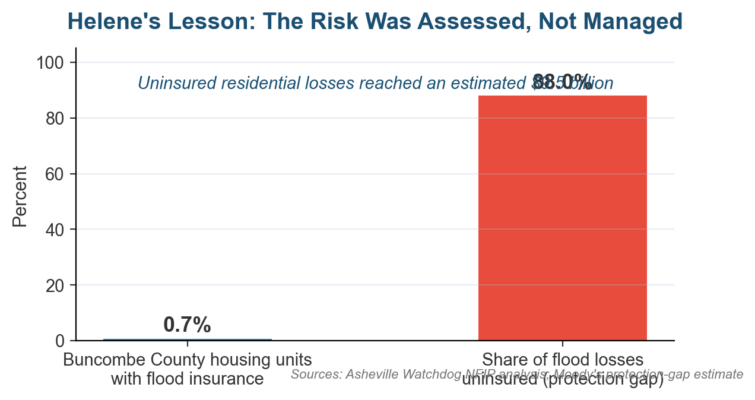
Figure 1. Helene’s lesson: mapped, modeled, assessed flood risk still produced an 88 percent uninsured-loss gap.
Corporate registers reproduce the same risk assessment vs risk management pattern quietly. The AICPA and NC State 2025 survey found 61 percent of finance leaders reporting sharply higher risk complexity while only 11 percent call their process a competitive advantage, and a register full of assessed-but-untreated risks is a leading way that gap opens.
Three signs reliably mark an assessment-only shop, and any experienced auditor can spot all of them in a single afternoon with nothing more than the register, the committee minutes, and the last two board packs. Each is a symptom of the same disease, scores traveling without decisions:
- A risk register updated annually, with no treatment column, owner, or due date beside the scores
- Heat maps presented to the board with no decision requested and none recorded
- The same top risks, at the same ratings, three review cycles in a row
Inside the Risk Assessment: Three Stages
On the assessment side of risk assessment vs risk management, identification comes first: surfacing the events, causes, and consequences that could block objectives, using the structured prompts covered in approaches and tools for risk identification. Workshops, process walks, loss data, and horizon scans all feed this stage, and a risk never identified is a risk never managed.
Analysis then sizes each risk through likelihood and consequence, using anything from five-point scales to Monte Carlo simulation; the qualitative and quantitative methods trade rigor against speed. Evaluation closes the loop by comparing analyzed risk against the criteria set upfront, deciding which exposures sit outside appetite.
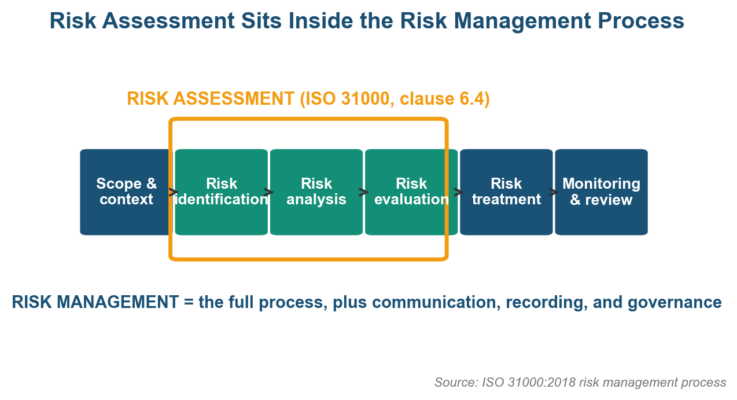
Figure 2. Risk assessment vs risk management, visualized: the three assessment stages sit inside the six-step ISO 31000 risk management process.
| Assessment stage | Question it answers | Typical techniques |
| Identification | What could happen, and why? | Workshops, checklists, HAZOP, loss-event review |
| Analysis | How likely, and how severe? | Probability-impact scales, bow-tie, Monte Carlo |
| Evaluation | Does it exceed our criteria? | Appetite comparison, risk ranking, ALARP tests |
IEC 31010 catalogs more than 40 assessment techniques across those three stages, and choosing among them is its own discipline; the risk assessment methodology guide and the step-by-step walkthrough cover selection in depth. What no technique on the list can do is fund a control or accept a residual risk, which is exactly where risk assessment vs risk management parts ways.
What Risk Management Adds Beyond the Assessment
In risk assessment vs risk management, everything decision-shaped lives on the management side. Context-setting fixes the criteria and risk appetite that evaluation will use; without it, scoring floats free of any threshold that forces action. Appetite is a board artifact, which is the first clue that management cannot be delegated to a facilitator.
Treatment converts evaluated risks into funded action through the 12 risk management techniques, from avoidance and engineering controls to insurance, hedging, and monitored acceptance. Each treatment needs an owner, a budget line, and a date, the machinery a risk mitigation program exists to run.
Monitoring keeps the whole thing alive between assessments: key risk indicators with thresholds, escalation paths, and re-assessment triggers, plus the reporting cadence that puts risk in front of decision-makers. The risk management lifecycle closes by feeding monitoring results back into the next assessment cycle.
| Management element | What it adds beyond assessment | Where it lives |
| Context and appetite | Criteria that make evaluation mean something | Board-approved appetite statement |
| Risk treatment | Funded, owned, dated actions on evaluated risks | Treatment plans and budget lines |
| Monitoring and review | Evidence that exposure actually moved | KRIs, thresholds, escalation paths |
| Communication and reporting | Decisions requested from the right forum | Committee packs, disclosure filings |
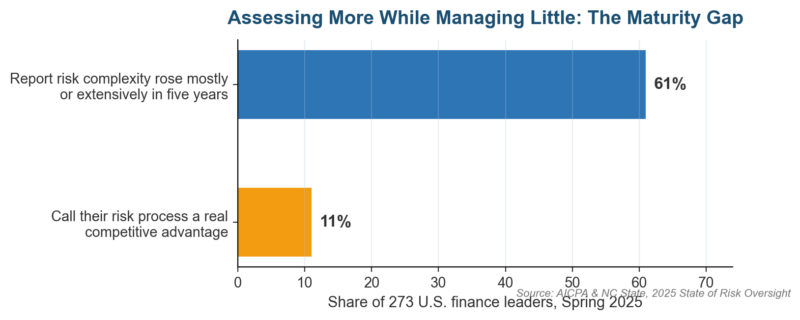
Figure 3. Complexity is rising for 61 percent of U.S. finance leaders, yet only 11 percent say their risk process delivers advantage.
How the Two Work Together in Practice
Picture risk assessment vs risk management inside a mid-size U.S. food manufacturer running its annual cycle. February’s facilitated risk assessment scores 22 risks and flags four outside appetite, including a single-source packaging supplier and an ammonia leak scenario at the main plant. That file, on its own, changes nothing.
Management is what happens next: the COO qualifies a second supplier by June, the ammonia system gets an engineering retrofit approved at $410,000, insurance deductibles are rebalanced at renewal, and two new KRIs begin reporting monthly. By the October board meeting, two of the four risks sit back inside appetite, with evidence.
The handoff between the two is where programs most often tear, so make the handover explicit and checkable. Five items convert an assessment into management, and a risk assessment flowchart should end at item one rather than at the heat map:
- Every evaluated risk outside appetite gets a named treatment owner before the workshop closes
- Treatments carry budget lines and dates, not intentions; unfunded treatment is acceptance in disguise
- Each treated risk gets a KRI or milestone that will show whether exposure actually fell
- Acceptance decisions are documented with the accepting executive’s name, per the five-step process
- A re-assessment trigger is set: date-based at minimum, event-based for volatile risks
Risk Assessment vs Risk Management Across Major Frameworks
Standard-setters keep risk assessment vs risk management deliberately separate, and the split repeats across domains. NIST publishes SP 800-30 purely for conducting assessments and SP 800-39 for managing information security risk across its frame, assess, respond, and monitor cycle; one document feeds the other by design.
| Framework | Assessment artifact | Management artifact |
| ISO 31000 / IEC 31010 | Clause 6.4 assessment; 40+ techniques | Full process: context, treatment, monitoring, reporting |
| NIST (federal / cyber) | SP 800-30 risk assessments | SP 800-39 frame-assess-respond-monitor cycle |
| HIPAA Security Rule | Risk analysis, 164.308(a)(1)(ii)(A) | Risk management, 164.308(a)(1)(ii)(B) |
| OSHA / NIOSH | Hazard identification and job hazard analysis | Hazard prevention and control program |
| COSO ERM (2017) | Assesses severity within Performance | Five components spanning governance to reporting |
Regulators enforce the risk assessment vs risk management distinction, not just the vocabulary. The HIPAA Security Rule lists risk analysis and risk management as separate implementation specifications, and OCR enforcement actions routinely cite entities that produced the analysis yet never ran the management program. OSHA’s guidance draws the same line between finding hazards and controlling them through the NIOSH hierarchy.
The same risk assessment vs risk management logic decides where money flows. The National Institute of Building Sciences documents $6 saved per $1 spent on hazard mitigation, and every dollar of that return is earned on the management side; the assessment only told FEMA where to point the grants. Disclosure rules such as the SEC cybersecurity rule now ask public companies to describe both.
FAQ: Risk Assessment vs Risk Management
Which comes first: risk assessment or risk management?
In risk assessment vs risk management, context-setting comes first, then assessment, then the rest of management. You cannot evaluate risks without the criteria and appetite that context-setting defines, and you cannot treat risks you have not assessed. In ISO 31000 sequence: scope and criteria, then identification, analysis, evaluation, then treatment and monitoring.
What does risk assessment vs risk management mean in ISO 31000 terms?
ISO 31000:2018 defines risk assessment at clause 6.4 as the overall process of risk identification, risk analysis, and risk evaluation. Risk management is the full clause 6 process, which adds communication and consultation, scope and criteria, risk treatment, monitoring and review, and recording and reporting around that assessment core.
Can you do risk management without a risk assessment?
Not credibly. Treatment choices made without assessment are guesses, and monitoring without evaluated baselines has nothing to compare against. The reverse failure is far more common in practice: organizations run competent annual assessments and stop, which is how Buncombe County met Helene with maps but only 0.7 percent insurance take-up.
How do risk assessment vs risk management vs risk analysis differ?
Risk analysis is the middle stage of a risk assessment, where likelihood and consequence get sized. The assessment wraps analysis with identification before it and evaluation after it. Risk management then wraps the whole assessment with context, treatment, monitoring, and communication, so each term nests inside the next like measuring cups.
What is the difference between a risk assessment and an audit?
A risk assessment is forward-looking and owned by management: it estimates what could happen and feeds treatment decisions. An audit is backward-looking and independent: it tests whether controls and processes actually operated as claimed. Auditors often use risk assessments to plan their work, but the audit exists to challenge management’s picture, not to draw it.
Who owns risk assessment vs risk management in an organization?
Assessments can be facilitated by a risk analyst, internal audit, or an outside consultant, because they produce information. Risk management belongs to line leadership and the board, because it allocates money and accepts residual exposure. A CFO can commission an assessment; only the business can manage the risk it reveals.
Where Organizations Blur the Line
Six patterns account for most of the damage when risk assessment vs risk management gets conflated. I look for the second one first in any program review, because a completed-assessment milestone celebrated as finished risk management is the exact Buncombe pattern wearing a lanyard.
| Pitfall | Root cause | Remedy |
| Assessment treated as the finish line | Compliance deadlines reward the deliverable, not the outcome | Gate sign-off on treatment plans, not on the register |
| Heat map as the only board artifact | Scores are easier to present than decisions | Report treatments funded, closed, and overdue alongside scores |
| Consultant-owned register | Assessment outsourced, ownership never transferred | Assign every risk an internal owner before the engagement ends |
| Annual-only risk thinking | Assessment cycle mistaken for the management rhythm | Run KRIs and event-based triggers between cycles |
| Criteria invented during scoring | Context-setting skipped, so evaluation floats | Fix appetite and criteria before identification starts |
| Untreated risks relabeled as accepted | Acceptance used as a filing category, not a decision | Require a named accepting executive and a review date |
Looking Ahead: From Assessed to Managed by 2027
Disclosure regimes are collapsing the space where assessment-only programs hide. The SEC’s cybersecurity rule already makes U.S. filers describe how assessed risks are actually governed, and insurers are pricing the same distinction, asking for treatment evidence rather than register extracts at renewal. Paper diagnostics are losing their audience.
Continuous monitoring keeps shrinking the gap in risk assessment vs risk management. As anomaly detection and control telemetry mature, the annual assessment becomes a calibration point inside always-on operational risk management rather than the main event, and re-assessment triggers fire on data instead of dates; assessment frequency becomes a risk-based decision itself. At that point it also pays to evaluate the risk management side of the equation, scoring the system as well as its outputs.
The skills follow the shift. Teams that only facilitate workshops will feel the squeeze, while those that can carry an enterprise risk management framework from scoring through funded treatment and KRI evidence will own the budget conversation. Helene’s 88 percent gap is the argument: knowing was never the hard part.
Infographic: Assessment Inside the Management Cycle
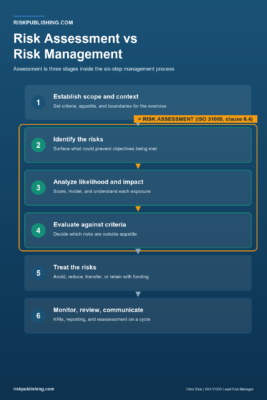
Figure 4. Risk assessment vs risk management at a glance: risk assessment’s three stages sit inside the six-step risk management process; the surrounding steps are what turn findings into protection.
Riskpublishing helps U.S. risk teams close the risk assessment vs risk management gap and convert assessments into working management systems: register design, treatment governance, KRI builds, and board reporting that requests decisions. Our services cover the full cycle; contact us if your heat map is the last slide anyone acts on.

Chris Ekai is a Risk Management expert with over 10 years of experience in the field. He has a Master’s(MSc) degree in Risk Management from University of Portsmouth and is a CPA and Finance professional. He currently works as a Content Manager at Risk Publishing, writing about Enterprise Risk Management, Business Continuity Management and Project Management.