In May 2025, the U.S. Department of Transportation finally put a price on rebuilding the technology that runs U.S. air traffic control: roughly $31.5 billion to replace radar, telecom networks, and aging control centers by 2028.
Stack that on top of a record airport-construction pipeline, and aviation project manager jobs have moved from a niche specialty to one of the most in-demand careers in U.S. infrastructure.
For civil engineers, construction managers, and aviation professionals weighing their next move, the timing is unusually good. Airport authorities and consulting firms are competing hard for people who can run complex capital programs under federal scrutiny, and the pay reflects it.
Aviation project manager jobs now routinely clear six figures, and this guide covers what the work involves, what it pays in 2026, and how to position yourself to win one.
Why Aviation Project Manager Jobs Are Surging in 2026
The demand spike is already funded, not hypothetical.
The 2021 Bipartisan Infrastructure Law committed $25 billion over five years to airport and air traffic control upgrades, and by early 2025 the FAA had pushed more than $332 million in a single grant round to 171 projects across 32 states.
Money at that scale needs managers who can spend it cleanly and on schedule.
The larger number sits just ahead.
Airports Council International–North America estimates that U.S. airports need $173.9 billion in capital investment between 2025 and 2029, a 15% jump over its prior projection, just to handle close to a billion passengers a year.
Every terminal expansion, runway rehabilitation, and baggage-system overhaul inside that figure eventually lands on a project manager’s desk.
The workforce math points the same way.
The Project Management Institute projects a global shortfall of 30 million project professionals by 2035, and the World Economic Forum’s 2025 outlook ranks project manager among the fastest-growing roles worldwide.
For aviation project managers specifically, that scarcity converts straight into bargaining power and stronger offers.
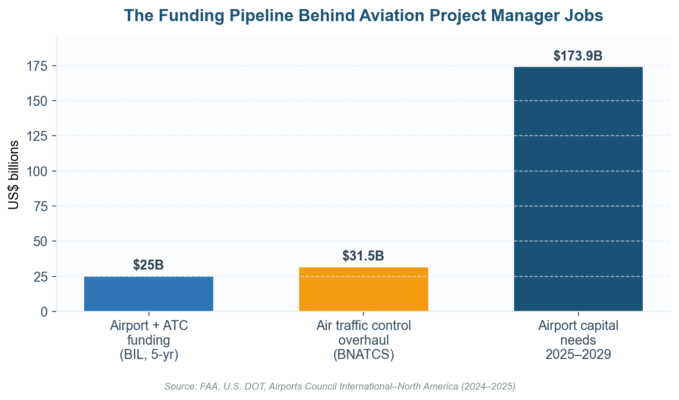
Federal commitments and industry needs underwrite a multi-year runway of aviation project manager jobs.
Federal labor data fills in the supply side.
The U.S.
Bureau of Labor Statistics projects roughly 46,800 annual openings for construction managers and 78,200 for project management specialists through 2034, the talent pools that aviation project manager jobs draw from.
With construction-manager employment growing 9% and few of those openings aimed squarely at aviation, qualified specialists stay in short supply.
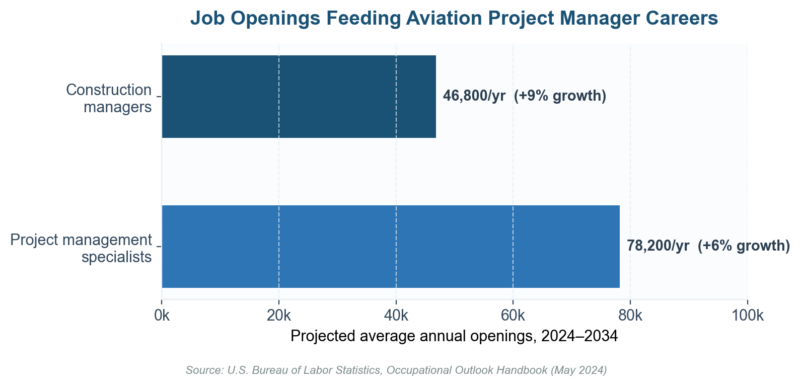
Broad project-management hiring underpins the funnel into aviation project manager jobs.
What Aviation Project Manager Jobs Actually Involve
Behind the demand sits a role that is easy to romanticize and hard to do.
Strip away the job-board boilerplate, and aviation project management comes down to one job: turning federal funding and airline ambition into finished, certified infrastructure that actually opens.
The aviation project manager owns the schedule, the budget, and the safety case from concept through commissioning, usually while a live airport keeps running beside the work zone.
That ownership is coordination-heavy. On any given week, an aviation project manager is aligning architects, civil engineers, contractors, airport operations staff, and FAA reviewers, then translating their competing priorities into a plan the airport director and the funding agency both accept.
The discipline mirrors a structured risk management lifecycle, where each phase has gates, owners, and evidence.
| Responsibility area | What it looks like on an aviation project |
| Scope & planning | Define deliverables, sequence phases, and build the master schedule for terminals, runways, or systems |
| Budget & cost control | Track federal grant spend, forecast cost-to-complete, and defend variances to funders |
| Stakeholder coordination | Align airlines, contractors, airport operations, and FAA reviewers around one plan |
| Compliance & safety | Keep design and construction inside FAA standards and the airport’s safety management system |
| Risk & issue management | Maintain the risk register, escalate threats, and keep mitigation actions moving |
Core duties that define day-to-day aviation project manager jobs.
None of this works without disciplined documentation.
The most reliable aviation project managers treat the key elements of a risk register and a clear change-control log as the spine of the project, not as paperwork.
When a runway closure slips or a steel order is delayed, that record is what protects the budget and the manager’s credibility once the questions start.
Aviation Project Manager Salary: What the 2026 Numbers Show
Pay is where the demand story becomes personal.
Aggregated U.S. data from ZipRecruiter puts the average aviation project manager salary near $121,000 a year in early 2026, with most roles landing between $81,000 and $155,500.
Top earners in the 90th percentile clear $173,500, and metros with heavy capital programs pay more, with Washington, D.C. averaging about $137,000.
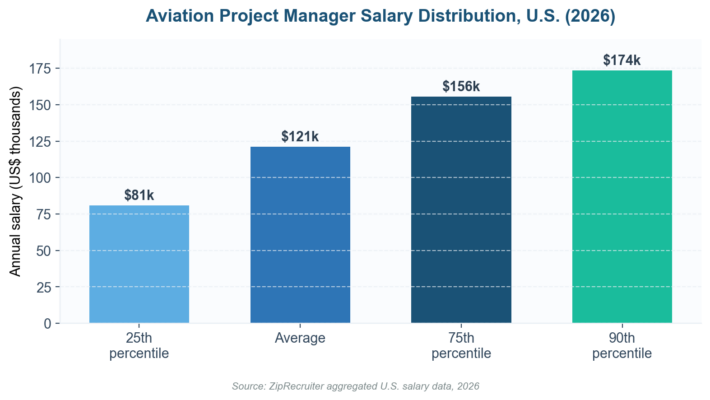
Aviation project manager salary climbs steeply from the 25th percentile to top-decile capital-program roles.
Title and setting shift the number meaningfully.
Airport-authority project managers trade a little cash for public-sector stability, while senior aviation project managers at consulting firms running large capital programs sit at the top of the range.
For context, the U.S.
Bureau of Labor Statistics reports a 2024 median of $106,980 for construction managers and $100,750 for project management specialists.
Aviation tends to pay a premium over both.
One credential moves the needle more than any other.
PMI’s salary research shows PMP-certified project managers earn a U.S. median of $135,000 versus roughly $109,000 for non-certified peers, and the gap widens with tenure to about $173,000 after a decade.
In a field where aviation project manager jobs already pay well, the certification is the cheapest raise most candidates will ever buy.
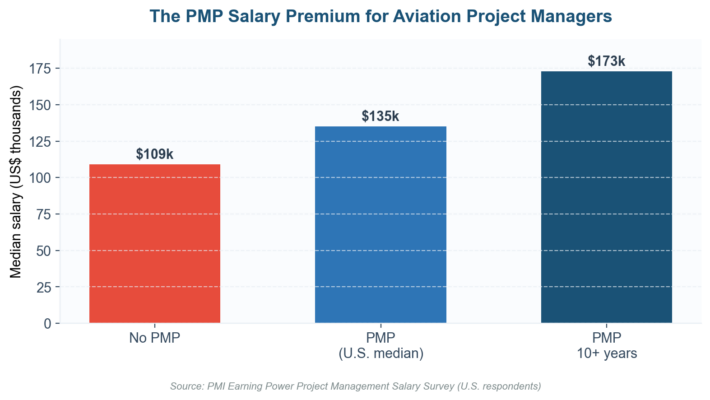
A PMP certification adds a measurable premium across the aviation project manager pay curve.
Skills That Define Strong Aviation Project Managers
Salary follows capability, so it helps to be specific about what separates a strong aviation project manager from a competent one.
Three skill clusters do most of the work: technical fluency, stakeholder communication, and disciplined cost and leadership control.
Generalist project managers can learn the aviation layer, but the candidates who win the best roles usually arrive with all three already in motion.
Technical Skills for Aviation Project Managers
Technical credibility is the price of entry. An aviation project manager has to read engineering design reports, interpret civil and structural drawings, and hold a working grasp of airfield systems, terminal MEP, and FAA design standards.
You do not need to be the design engineer, but you must ask the questions that expose a flawed assumption before it becomes a poured-concrete problem and a change order.
Communication and Stakeholder Skills in Aviation Project Management
Aviation project management is, in practice, a translation job. The manager moves constantly between airline schedules, contractor realities, airport operations constraints, and FAA requirements, keeping each party informed without losing the thread.
Clear, well-timed communication is also a control: it surfaces issues early, manages expectations on budget and schedule, and prevents the small misunderstandings that quietly compound into disputes.
Leadership and Cost Control in Aviation Project Manager Jobs
The senior tier of aviation project manager jobs rewards judgment under pressure. Leading multidisciplinary teams, holding a capital budget to forecast, and making defensible calls when a runway closure window is shrinking all demand more than process knowledge.
The best managers pair firm cost discipline with proven risk management techniques, so trade-offs are deliberate rather than reactive.
Certifications and Education for Aviation Project Manager Jobs
If skills win the role, credentials get you into the room. Most aviation project manager jobs expect a bachelor’s degree in engineering, construction management, or aviation management, paired with several years of delivery experience.
From there, a focused stack of certifications signals that you can be trusted with federal money and a live airfield, and it measurably lifts pay.
| Credential | Why it matters for aviation project manager jobs |
| Bachelor’s degree | Engineering, construction management, or aviation management is the standard baseline |
| PMP certification | Increasingly a hiring floor; tied to a ~24% U.S. salary premium in PMI data |
| FAA / aviation knowledge | Familiarity with FAA airport design standards and Part 139 operations separates specialists |
| Six Sigma / Lean | Signals process discipline for systems, baggage, and operational-efficiency projects |
| MBA or aviation master’s | Preferred for program-director and senior capital-program roles |
The credential stack that strengthens applications for aviation project manager jobs.
Treat certifications as a sequence, not a shopping list. Early-career candidates should prioritize the PMP, because PMI’s earning-power salary research consistently ties it to higher pay and faster advancement.
Layer aviation-specific knowledge and a Lean or Six Sigma credential next, and reserve the MBA or aviation master’s for the point where you are targeting program-leadership roles rather than project delivery.
The Risk Discipline Behind Every Aviation Project Manager Job
Here is the part most job descriptions undersell: aviation project management is risk management wearing a hard hat. Aviation is a safety-critical, heavily regulated environment, and the manager is accountable for the safety case as much as the schedule.
Since May 2024, the FAA’s expanded Safety Management Systems rule under 14 CFR Part 5 has pushed structured safety risk management deeper into the industry.
That regulatory backdrop makes risk literacy a core skill, not a nice-to-have. A capable aviation project manager runs a recognizable operational risk management process on every program: identify hazards, assess likelihood and impact, and assign owners.
The same logic that separates a hazard from a risk in safety doctrine governs how delays, cost overruns, and contractor failures get triaged on site.
The strongest practitioners borrow tools straight from enterprise risk. They track project health with key risk indicators and stress-test the schedule through scenario-based risk assessment.
Every trade-off then gets weighed against a defined risk appetite, and when something does go wrong, a documented risk mitigation plan turns a crisis into a managed response rather than a scramble.
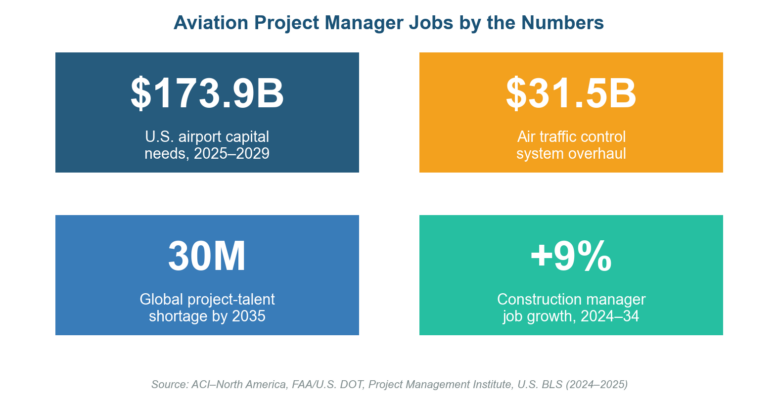
The numbers that make risk-literate aviation project managers a scarce, well-paid resource.
Two risk domains deserve special attention in aviation work.
Aircraft and equipment procurement exposes programs to supply chain risk, where a single delayed long-lead item can reset a schedule, and a roster of contractors and vendors makes third-party risk management unavoidable.
Mapping these against the five steps of the risk management process keeps a sprawling program coherent.
Compliance is the other constant. Federal funding carries audit obligations, and a disciplined compliance risk analysis protects both the grant and the airport’s reputation.
Pairing that with a resilient business continuity plan, so construction never strands operations, is what distinguishes aviation project managers who get promoted from those who merely survive their first program.
Types of Projects Aviation Project Managers Lead
The label “aviation project manager” covers a wide spread of work, and the variety is part of the appeal. One year you might be managing concrete and steel; the next, a software cutover or a security-technology rollout.
The common thread is delivery under regulation, but the specific projects demand different technical partners and risk profiles.
- Terminal construction and expansion: new concourses and renovations, coordinated around live passenger flow.
- Runway rehabilitation: repaving, extensions, and lighting upgrades sequenced into tight closure windows.
- Air traffic control modernization: facility and systems work tied to the national airspace overhaul.
- Baggage and operational systems: handling, scanning, and scheduling platforms that must integrate without disruption.
- Sustainability initiatives: electrification, waste, and energy projects that cut an airport’s footprint.
- Security and biometric programs: screening technology and access systems with strict compliance demands.
Each of these maps to a different transition path. Construction-heavy projects favor candidates from a civil or construction-management background, while systems and security work rewards technology delivery experience.
Knowing which lane fits your history is the fastest way to target aviation project manager jobs where your existing skills already count.
Where Aviation Project Manager Jobs Are Heading: 2026–2030
Look past the current pipeline and the trajectory steepens.
The FAA’s Brand New Air Traffic Control System aims to replace core infrastructure across the National Airspace System by 2028, a generational program that will absorb project managers for years.
With a $12.5 billion down payment already committed, this is funded work, not a wish list.
Passenger demand keeps the pressure on. ACI–North America projects U.S. enplanements rising from roughly one billion in 2025 toward 1.4 billion by 2040 and 1.7 billion by 2050, which means terminals and airfields built today will need expansion again within a decade.
For anyone entering aviation project manager jobs now, that curve is close to a guarantee of sustained work.
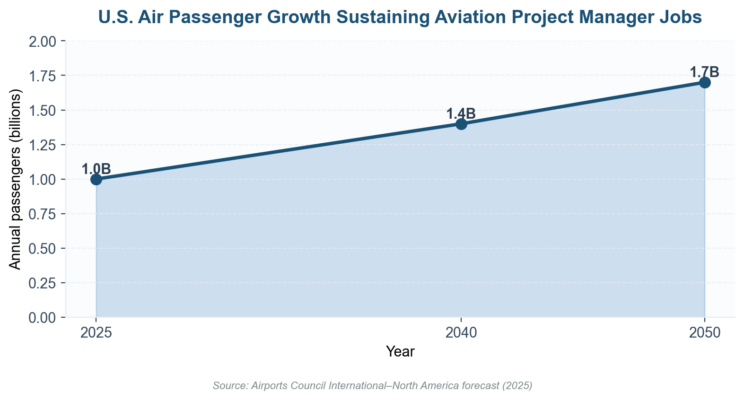
Rising passenger volume locks in long-term demand for aviation project managers.
The nature of the work is shifting too.
Sustainability mandates, digital twins, and data-driven delivery are becoming standard expectations, and the aviation project managers who pair classic schedule-and-budget control with comfort in enterprise risk frameworks and emerging technology will command the strongest positions.
The next five years reward range, not just tenure.
Mistakes That Stall Aviation Project Manager Careers
Not every promising candidate converts the opportunity, and the failure modes are predictable.
The most common is treating aviation project management like generic construction.
That means underestimating the regulatory load, the FAA review cycles, and the safety documentation a live airport demands.
A close second is neglecting the credential stack while more certified peers quietly out-earn and out-rank you.
- Ignoring the safety case: treating FAA compliance as an afterthought instead of a core deliverable.
- Weak risk discipline: skipping the risk register until a problem is already a crisis.
- Stalling on certification: delaying the PMP while certified peers advance faster.
- Poor stakeholder communication: letting airlines, contractors, and operations drift out of alignment.
- No specialization: staying a generalist when employers increasingly pay for domain depth.
The fix is structural, not heroic.
Build a step-by-step risk assessment habit into every program, invest early in certification, and choose a project type to go deep on.
Candidates who treat risk mitigation as a daily practice rather than a compliance chore are the ones who turn a first aviation project into a durable career.
The Bottom Line on Aviation Project Manager Jobs
| Key takeaways for aviation project manager jobs
• A funded pipeline underwrites aviation project manager jobs well into the 2030s: $25B in federal airport money, a $31.5B ATC overhaul, and $173.9B in five-year capital needs. • Pay clusters between $81,000 and $155,500, averaging near $121,000, with top-decile and major-metro roles clearing $173,000. • The role is risk management in disguise: the safety case, FAA compliance, and capital-budget control decide who succeeds. • A PMP certification paired with genuine aviation domain knowledge beats either credential on its own. • Demand is outpacing supply, which hands qualified aviation project managers real negotiating leverage. |
Aviation Project Manager Jobs: Your Questions Answered
What do aviation project manager jobs pay in 2026?
Aviation project manager jobs in the United States average about $121,000 a year, with most roles paying between $81,000 and $155,500.
Top earners clear $173,000, and major metros like Washington, D.C. pay above the national average. Pay rises with PMP certification, large capital-program experience, and willingness to relocate to airports running active expansions.
What qualifications do aviation project manager jobs require?
Most aviation project manager jobs ask for a bachelor’s degree in engineering, construction management, or aviation management, plus roughly three to seven years of project experience.
A PMP certification is increasingly a baseline rather than a bonus. Familiarity with FAA design standards and live airport operations is what separates strong candidates from generalist project managers.
How is an aviation project manager different from a general project manager?
An aviation project manager works inside a tightly regulated, safety-critical environment that a general project manager rarely touches.
You build beside live runways, answer to FAA reviewers, and manage federal grant compliance on every dollar. The schedule and budget discipline transfers directly, but the safety case and regulatory load are specific to aviation.
Are aviation project manager jobs in demand?
Yes, and on multiple fronts. A record airport-construction pipeline, a $31.5 billion air traffic control overhaul, and a projected global shortage of 30 million project professionals by 2035 all point the same direction.
Aviation project managers sit at the center of turning that funding into built infrastructure, which keeps demand running well ahead of supply.
Which sectors hire aviation project managers?
Airport authorities, engineering and construction firms, airlines, defense contractors, and aviation consultancies all hire aviation project managers, alongside equipment makers and airport-technology vendors.
Public-sector airport roles offer stability, while consulting firms managing large capital programs tend to pay at the top of the range. Defense aviation work adds security-clearance requirements and unusually steady federal funding.
Do aviation project manager jobs require relocation or travel?
Often, yes.
Construction-heavy aviation project manager jobs are tied to a specific airport, so on-site presence matters during active phases.
Many firms now offer hybrid arrangements for design and planning work, but commissioning, inspections, and stakeholder coordination still pull managers into the field.
A willingness to relocate widens your options considerably.
How do you move into aviation project manager jobs from another field?
Construction managers, civil engineers, and military logistics officers transition into aviation project manager jobs most smoothly.
Pair your existing delivery experience with a PMP, study FAA airport design standards, and target an assistant or associate role on a funded capital program.
From there, a senior project manager track typically opens within a few years.
The opportunity in front of aviation project managers is rare: a decade of funded work, a credential path with a clear payoff, and demand that employers cannot fill fast enough.
Treat the role as the risk-led discipline it really is, build the certifications early, and the aviation project manager jobs reshaping U.S. air travel become a career rather than a single assignment.

Chris Ekai is a Risk Management expert with over 10 years of experience in the field. He has a Master’s(MSc) degree in Risk Management from University of Portsmouth and is a CPA and Finance professional. He currently works as a Content Manager at Risk Publishing, writing about Enterprise Risk Management, Business Continuity Management and Project Management.