
| Key Takeaways |
| Diligent commands 32.9% market share and serves 75% of the Fortune 500, offering the broadest governance-to-risk platform that connects board management, enterprise risk, compliance, and audit in a single ecosystem. |
| Cybersecurity oversight has tripled since 2019: 77% of large U.S. companies now assign cyber risk to the audit committee, making risk reporting dashboards a non-negotiable feature in Best Board Risk Reporting & Board Portal Software selection. |
| The PwC 2025 Annual Corporate Directors Survey reveals 55% of directors say at least one board member should be replaced, and 71% want more tech/cyber expertise, intensifying demand for Best Board Risk Reporting & Board Portal Software that surfaces risk intelligence. |
| Nasdaq Boardvantage differentiates on transparent pricing and stable renewal costs, with G2 ranking it among the Best Board Risk Reporting & Board Portal Software for enterprises with 97% quality-of-support rating. |
| OnBoard targets mid-market organizations with the strongest ease-of-use scores and fastest implementation timelines, making it a strong Best Board Risk Reporting & Board Portal Software fit for boards adopting their first digital governance platform. |
| BoardEffect delivers Best Board Risk Reporting & Board Portal Software to nonprofits, healthcare systems, and education institutions with purpose-built governance features at the most accessible price point for mission-driven organizations. |
| AI-powered board reporting is emerging as the next differentiator for Best Board Risk Reporting & Board Portal Software, with nearly half of Fortune 100 companies already highlighting AI in board risk oversight disclosures. |

Figure 1: Audit committee cybersecurity oversight has tripled from 25% to 77% of large U.S. companies since 2019, driving demand for risk-integrated board portals (Source: EY, 2025).
The Best Board Risk Reporting & Board Portal Software unifies governance, compliance, and cyber oversight in one platform. Board governance has shifted from a paper-driven formality to a technology-enabled strategic function powered by Best Board Risk Reporting & Board Portal Software. The catalyst is risk. Boards are now expected to oversee cybersecurity risk, AI governance, ESG disclosures, and regulatory compliance alongside traditional financial oversight.
The 2025 PwC Annual Corporate Directors Survey found that 55% of directors believe at least one fellow board member should be replaced, the highest percentage ever recorded, and 71% say their board needs more technology and cyber expertise delivered through Best Board Risk Reporting & Board Portal Software.
Boards are under pressure to perform, and the right Best Board Risk Reporting & Board Portal Software determines whether risk intelligence reaches the boardroom in time to act on it.
The financial stakes reinforce the urgency of investing in Best Board Risk Reporting & Board Portal Software. U.S. data breach costs hit a record $10.2 million in 2025, according to IBM Security.
SEC cybersecurity disclosure rules now require material incident reporting within four business days, a timeline that only Best Board Risk Reporting & Board Portal Software can reliably support.
Nearly half of Fortune 100 companies highlight AI in their board risk oversight disclosures. Directors who lack real-time risk reporting dashboards inside Best Board Risk Reporting & Board Portal Software are making governance decisions on stale information.
This Best Board Risk Reporting & Board Portal Software comparison evaluates four leading board portal platforms through the lens of a risk practitioner focused on board risk reporting quality.
Each platform is scored against board book management, risk reporting and dashboards, meeting management, security, integration breadth, AI capabilities, usability, and cost.
Best Board Risk Reporting & Board Portal Software: Why It Matters

Figure 2: Director replacement pressure hit an all-time high of 55%, and demand for AI expertise more than doubled from 22% to 48% between 2023 and 2025 (Source: PwC Annual Corporate Directors Survey).
Best Board Risk Reporting & Board Portal Software Pricing Transparency
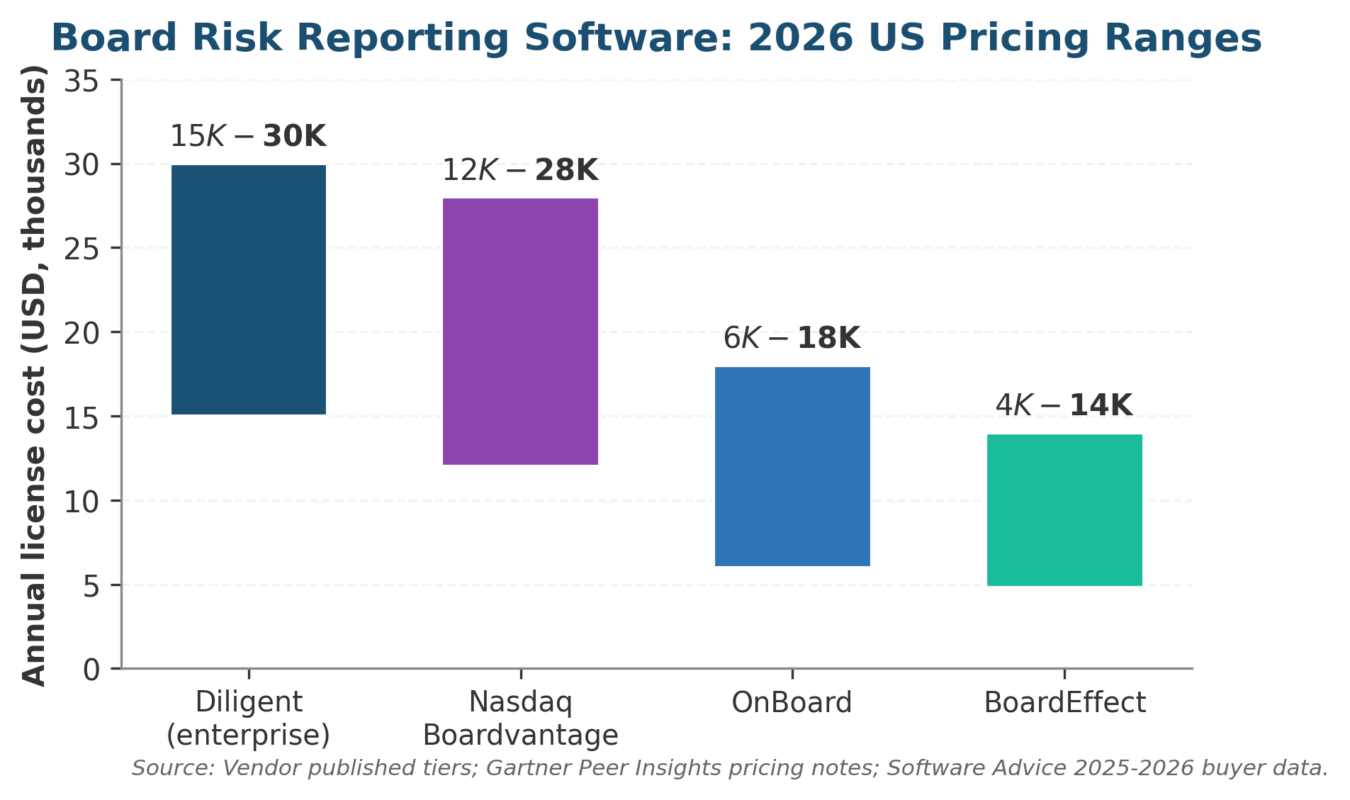
Pricing for board risk reporting software in 2026 spans a wide US range depending on board size, number of users, feature set, and contract term.
Vendors rarely publish list prices; the ranges below are drawn from Gartner Peer Insights, G2, Software Advice buyer data, and vendor-quote disclosures shared with practitioners.
| Vendor | Annual range (USD) | Typical board size | Notes |
| Diligent | $15,000 – $30,000+ | Large public boards; F500 | Enterprise tier; AI features bundled; discounted for multi-year |
| Nasdaq Boardvantage | $12,000 – $28,000 | Public companies, financial institutions | Strongest for Nasdaq-listed issuers; regulatory integrations |
| OnBoard | $6,000 – $18,000 | Mid-market, private companies, nonprofits | Best usability scores; smaller enterprise footprint |
| BoardEffect | $4,800 – $14,000 | Nonprofits, associations, healthcare systems | Strong nonprofit feature set; entry-level pricing |
Three practitioner takeaways. First, a credible board risk reporting software implementation in the US mid-market rarely comes in under $10,000 per year when you include implementation and training.
Second, Diligent and Nasdaq Boardvantage pricing is largely negotiable; request quotes from both even if your short list is finalized, to calibrate. Third, do not let pricing decide on its own — the cheapest tool that board secretaries refuse to use is the most expensive choice.
The gap between what boards need and what traditional governance processes deliver is widening. Audit committees are responsible for cybersecurity oversight at 77% of large companies, up from 25% in 2019.
Yet most audit committee members lack deep cyber expertise. The board portal bridges this gap by presenting key risk indicators in visual, decision-ready formats that non-specialist directors can act on.
Aggregate user ratings across G2, Gartner Peer Insights, and Capterra track closely, with all four Best Board Risk Reporting & Board Portal Software vendors scoring between 4.3 and 4.7 out of 5. The practitioner signal underneath the ratings is more useful than the averages.
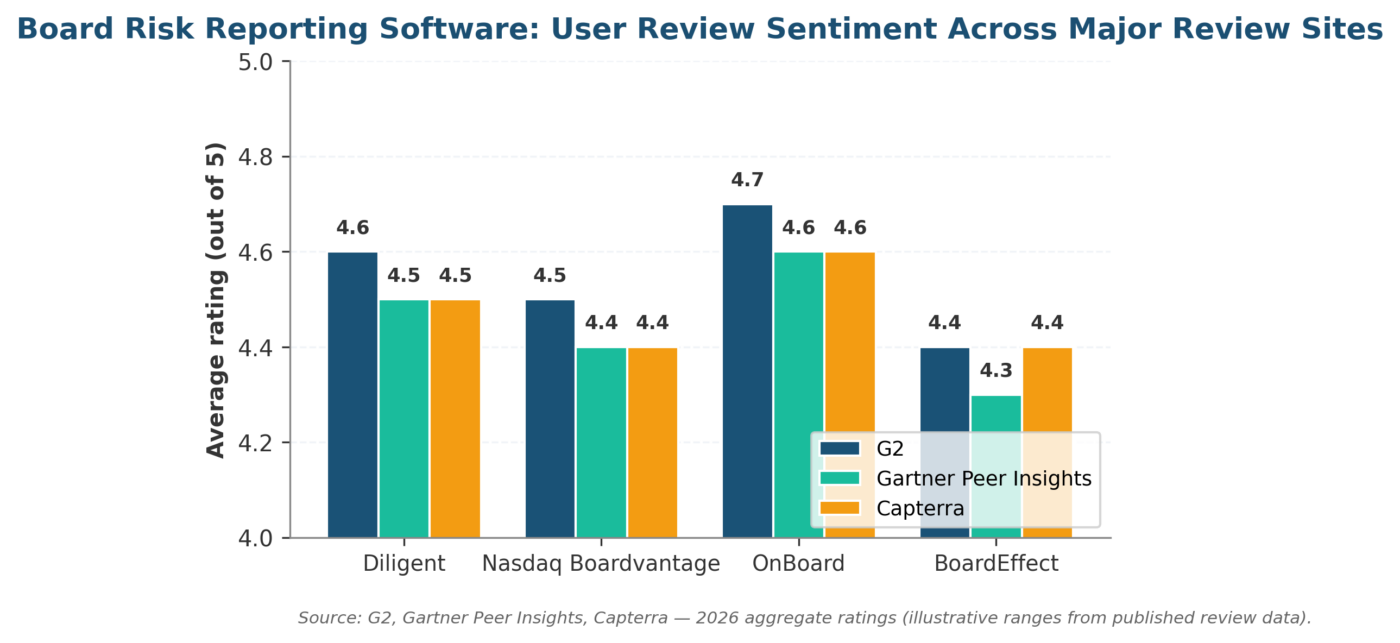
Figure 2. Board risk reporting software user review sentiment across three major review sites — ratings cluster tightly between 4.3 and 4.7 out of 5.
| Vendor | What users praise | What users flag |
| Diligent | Breadth of modules; AI features; brand recognition; Fortune 500 trust | Pricing opacity; heavy onboarding; UI complexity vs competitors |
| Nasdaq Boardvantage | Security posture; Nasdaq ecosystem fit; regulatory integrations | Less intuitive UX; customization lag; slower release cadence |
| OnBoard | Usability; modern UX; mobile experience; faster implementation | Enterprise feature depth vs Diligent; smaller partner ecosystem |
| BoardEffect | Nonprofit and healthcare fit; price point; training support | Limited advanced analytics; smaller third-party integration catalog |
A modern board portal does more than distribute meeting materials. The platforms evaluated in this article integrate risk dashboards, enterprise risk management data, compliance status tracking, and AI-powered briefing summaries directly into the board’s workflow.
The three lines model depends on effective upward reporting, and the board portal is where third-line assurance findings, second-line compliance monitoring, and first-line risk ownership converge for director oversight.

Figure 3: U.S. data breach costs hit a record $10.2M in 2025 (global avg $4.4M), reinforcing why boards need real-time cyber risk reporting in their governance portals (Source: IBM Security / Ponemon).

Figure 4: Cybersecurity (89%) and AI governance (72%) top the list of risk areas boards want surfaced in their portal reporting.
Evaluation Framework: Scoring the Best Board Risk Reporting & Board Portal Software
The Best Board Risk Reporting & Board Portal Software evaluation framework reflects both traditional board management needs and the emerging requirement for integrated risk reporting.
Eight weighted Best Board Risk Reporting & Board Portal Software dimensions capture the full spectrum of governance capability that determines whether Best Board Risk Reporting & Board Portal Software delivers strategic value or remains a glorified document repository.
| Dimension | Weight | What It Measures |
| Board Book Management | 15% | Digital board book assembly, agenda building, annotation tools, document version control, and offline access for directors traveling |
| Risk Reporting & Dashboards | 20% | Integrated risk dashboards, KRI visualizations, heatmaps, traffic-light status summaries, and the ability to drill from board-level summary to underlying risk data |
| Meeting Management | 12% | Agenda creation, resolution tracking, minutes automation, voting/approval workflows, action item assignment and follow-up |
| Security & Compliance | 15% | End-to-end encryption, role-based access controls, remote wipe capability, audit logging, SOC 2 compliance, and data residency options |
| Integration Breadth | 12% | Native connectors to ERM platforms, GRC suites, financial reporting tools, HRIS, and third-party data sources for risk intelligence |
| AI & Automation | 10% | AI-powered meeting summaries, risk briefing generation, document search, and predictive analytics for governance insights |
| Ease of Use | 10% | Director-facing UI quality, mobile app experience, onboarding time, and adoption rates among non-technical board members |
| Total Cost of Ownership | 6% | License structure, implementation fees, ongoing support costs, and pricing stability at renewal |
Platform Comparison: Diligent vs OnBoard vs Nasdaq Boardvantage vs BoardEffect

Figure 5: Radar chart scoring all four platforms across eight evaluation dimensions. Diligent leads on risk reporting and security; OnBoard and BoardEffect win on ease of use and cost.

Figure 6: Diligent holds 32.9% market share, followed by Nasdaq Boardvantage at 13.0% and OnBoard at 8.5%.
Head-to-Head Summary: Best Board Risk Reporting & Board Portal Software
| Capability | Diligent | OnBoard | Nasdaq Boardvantage | BoardEffect |
| Primary strength | Enterprise governance + GRC | Mid-market usability | Enterprise stability + pricing | Nonprofit governance |
| Risk dashboards | Best-in-class (ERM-linked) | Basic (improving) | Strong (financial focus) | Basic templates |
| AI capabilities | AI insights, risk briefings | AI meeting prep | AI document analysis | Limited |
| Security | SOC 2, end-to-end encryption, remote wipe | SOC 2, encryption | SOC 2, FINRA-grade, encryption | SOC 2, encryption |
| Market share | 32.9% (#1) | 8.5% (#3) | 13.0% (#2) | 5.2% (#4) |
| Fortune 500 adoption | 75% | Growing (mid-market) | Major financial institutions | Nonprofits, healthcare |
| Pricing model | Custom (premium) | Transparent tiers | Custom (stable renewals) | Accessible tiers |
| Best fit | Enterprise boards needing GRC integration | First-time digital boards | Financial services, publicly traded | Nonprofits, education, healthcare |
Diligent
Diligent is the market leader with 32.9% mindshare, serving over 25,000 organizations and 1 million users globally, including 75% of the Fortune 500. The platform’s competitive advantage is breadth.
Diligent Board is not a standalone portal; it is the governance layer of the Diligent One Platform that integrates board management with enterprise risk management, compliance tracking, internal audit, and ESG reporting.
Risk dashboards pull directly from the organization’s risk registers and KRI monitoring systems, providing directors with live risk intelligence rather than static quarterly updates.
AI capabilities include automated meeting briefings, document search with natural language queries, and risk trend analysis. Security is FINRA-grade with end-to-end encryption, remote device wipe, and granular access controls.
The trade-off is cost and complexity. Diligent commands premium pricing and implementation timelines that can extend to months for full GRC integration. Smaller boards or organizations that only need core meeting management may find the platform over-engineered.
OnBoard
OnBoard positions itself as the modern, intuitive alternative to legacy board portals. The platform consistently earns the highest ease-of-use ratings on G2 and Capterra, making it the strongest choice for boards transitioning from paper-based or email-driven governance for the first time.
Directors who struggle with complex enterprise software adopt OnBoard quickly, which is critical when board member technology proficiency varies.
The platform covers core board management: digital board books, agenda management, annotations, voting, minutes, and action tracking. Risk reporting capabilities are more basic than Diligent’s, but OnBoard is investing in this area.
Integration options connect the portal to productivity suites and document management systems. Pricing follows transparent tiers rather than opaque enterprise custom quotes, making budget planning straightforward.
The best fit: mid-market organizations, growing companies preparing for an IPO, and boards adopting digital governance tools for the first time.
Nasdaq Boardvantage
Nasdaq Boardvantage leverages the credibility and regulatory expertise of the Nasdaq brand.
The platform is purpose-built for publicly traded companies and financial institutions that need governance software aligned with SEC, FINRA, and exchange requirements. G2 ranks Nasdaq Boardvantage as the enterprise leader in board management with a 97% quality-of-support rating.
The differentiator is pricing stability. Nasdaq emphasizes transparent pricing with no sudden increases at renewal, a significant concern for organizations locked into multi-year agreements with competitors.
The platform delivers strong document collaboration, meeting management, and security features. Risk reporting integrates financial data and supports the structured board reporting formats that publicly traded companies need for proxy materials and committee charters. ROI data shows customers report seeing return on investment within 11 months of deployment.
BoardEffect
BoardEffect serves a distinctly different market: nonprofits, healthcare systems, credit unions, education institutions, and community foundations.
The platform is designed for mission-driven boards that need governance rigor without enterprise complexity or pricing. Features include meeting management, board books, surveys, evaluations, and committee collaboration.
Risk reporting capabilities are more template-driven than analytics-driven, which matches the needs of organizations where the board oversees strategic risk at a higher level rather than managing detailed risk registers.
BoardEffect’s pricing model is the most accessible of the four platforms evaluated, making it viable for organizations with limited governance technology budgets. The trade-off: organizations scaling toward enterprise complexity or needing deep GRC integration will eventually outgrow BoardEffect’s architecture.
Key Risk Indicators for Board Portal Software
Track these key risk indicators to confirm your Best Board Risk Reporting & Board Portal Software is strengthening governance and risk oversight. These align with leading vs lagging KRI frameworks.
| KRI | Definition | Green | Amber | Red |
| Board material distribution lead time | Calendar days between board book distribution and meeting date | >7 days | 3-7 days | <3 days |
| Director portal adoption rate | % of directors accessing materials through the portal vs email/print | >95% | 80-95% | <80% |
| Risk dashboard refresh frequency | How often risk data in portal dashboards is updated | Real-time/daily | Weekly | Monthly or less |
| Action item closure rate | % of board action items completed by target date | >90% | 75-90% | <75% |
| Meeting preparation compliance | % of directors who access materials before the meeting | >85% | 65-85% | <65% |
| Security incident rate | Number of unauthorized access attempts or data exposure events per quarter | 0 | 1-2 | >2 |
| Board evaluation completion | % of annual board self-assessment/evaluation responses submitted | >90% | 70-90% | <70% |
Decision Matrix: Choosing the Best Board Risk Reporting & Board Portal Software
| Board Profile | Recommended Platform | Rationale |
| Fortune 500 or large enterprise board needing integrated governance, risk, compliance, and audit oversight | Diligent | Market leader (32.9% share); 75% Fortune 500 adoption; deepest GRC integration; AI-powered risk dashboards; enterprise security |
| Publicly traded company or financial institution needing SEC/FINRA-aligned governance with pricing stability | Nasdaq Boardvantage | Nasdaq brand credibility; FINRA-grade security; transparent pricing with stable renewals; 97% G2 quality-of-support rating; 11-month ROI |
| Mid-market company or growing organization adopting digital board governance for the first time | OnBoard | Highest ease-of-use scores; fastest onboarding; transparent tier pricing; directors adopt quickly regardless of tech proficiency |
| Nonprofit, healthcare system, credit union, or education institution needing accessible governance tools | BoardEffect | Purpose-built for mission-driven boards; most accessible pricing; governance rigor without enterprise complexity; strong nonprofit community |
| Global board with members across multiple jurisdictions needing data residency and multi-language support | Diligent or Nasdaq | Both offer global data center infrastructure, data residency options, and multi-language support for geographically dispersed boards |
Implementation Roadmap for Best Board Risk Reporting & Board Portal Software
| Phase | Actions | Deliverables | Success Metrics |
| Days 1-30: Foundation | Select platform and negotiate contract; configure portal structure (committees, workspaces, user roles); import historical board materials; set up security policies and device enrollment | Portal configured with committee structure; all directors provisioned; historical materials migrated; security policies active | 100% director accounts active; portal structure mirrors board committee charter; security audit passed |
| Days 31-60: First Meeting Cycle | Conduct first fully digital board meeting cycle; build risk dashboard with live KRI feeds; train directors on portal navigation, annotation, and voting; configure automated agenda and minutes workflows | First digital board package distributed via portal; risk dashboard live with enterprise risk data; all directors trained | Board materials distributed >7 days before meeting; >80% director portal adoption; zero paper fallback requests |
| Days 61-90: Optimization | Expand to all committee meetings; integrate portal with ERM and compliance platforms; launch board self-evaluation module; establish KRI monitoring dashboard for governance team | All committee meetings running in portal; ERM integration delivering live risk data; board evaluation cycle launched; governance KRI dashboard operational | >95% director adoption; risk dashboard updated daily; action item closure >85%; zero security incidents |
Best Board Risk Reporting & Board Portal Software: Pitfalls to Avoid
| Pitfall | Root Cause | Remedy |
| Selecting based on brand name alone without evaluating risk reporting needs | Board defers to corporate secretary preference without involving risk or compliance leadership in evaluation | Include CRO, compliance officer, and CISO in evaluation criteria definition; weight risk reporting as 20% of scoring |
| Underestimating director onboarding resistance | Directors accustomed to printed board books resist digital transition; inadequate training provided | Provide white-glove onboarding for each director; offer dedicated 1-on-1 sessions; ensure strong mobile app experience for tablet users |
| Deploying without risk dashboard integration | Portal launches as meeting management tool only; risk reporting remains in separate PowerPoint presentations | Require ERM/GRC integration as part of implementation scope; build risk dashboards before first board meeting in portal |
| Ignoring data residency requirements | Global boards with directors in EU, APAC, and Americas; platform selected without verifying data center locations | Map director locations and regulatory requirements; verify platform offers regional data residency; document in vendor assessment |
| No post-launch adoption tracking | Portal goes live but adoption is assumed rather than measured; directors quietly revert to email for sensitive materials | Track director adoption KRI weekly for first 90 days; follow up with low-adoption directors; set 95% target before declaring success |
Frequently Asked Questions About Board Risk Reporting Software
What is board risk reporting software?
Best Board Risk Reporting & Board Portal Software is a secure digital platform US boards use to distribute risk dashboards, risk registers, committee minutes, and regulatory filings, and to hold board meetings with voting, annotations, and audit trails.
Leading Best Board Risk Reporting & Board Portal Software in 2026 includes Diligent, Nasdaq Boardvantage, OnBoard, and BoardEffect. A modern Best Board Risk Reporting & Board Portal Software deployment integrates with the enterprise risk management system, the GRC platform, and the KRI dashboard so the board sees the same numbers the CRO sees.
What is the Best Board Risk Reporting & Board Portal Software for US public companies?
For US public companies, Diligent and Nasdaq Boardvantage dominate. Diligent is the most common Fortune 500 choice and the broadest feature set.
Nasdaq Boardvantage is strongest for Nasdaq-listed issuers and for boards with heavy regulatory disclosure workflows. OnBoard wins on usability for boards that prioritize director adoption over feature depth.
BoardEffect is rarely the choice for public companies but dominates the nonprofit and healthcare segment.
How does board risk reporting software help with SEC cybersecurity disclosure?
The SEC cybersecurity disclosure rule requires public companies to disclose material cybersecurity incidents on Form 8-K within four business days and to describe their board’s cybersecurity oversight in the annual 10-K.
Board risk reporting software provides the audit trail — who saw what, when, and how the board deliberated — that the SEC disclosure language references. Without it, 10-K cybersecurity-oversight paragraphs rely on memory, which is a legal problem.
How much does board risk reporting software cost in 2026?
US board risk reporting software pricing ranges from roughly $4,800 per year at the entry tier (BoardEffect for small nonprofits) to $30,000+ per year at the enterprise tier (Diligent for large public boards).
OnBoard and Nasdaq Boardvantage fall in between. Implementation, training, and integration services typically add 15% to 30% to the first-year cost. Multi-year contracts unlock discounts of 10% to 25%.
Which board risk reporting software has the best user reviews?
Aggregate user ratings across G2, Gartner Peer Insights, and Capterra cluster tightly between 4.3 and 4.7 out of 5 for all four major board risk reporting software vendors.
OnBoard consistently scores highest on usability; Diligent on feature breadth; Nasdaq Boardvantage on security posture; BoardEffect on training support. Review scores alone do not decide the selection — fit to the board’s regulatory profile and existing technology stack matters more.
What KRIs should a board risk reporting software dashboard track?
A 2026 board risk reporting software dashboard should surface key risk indicators for cyber (mean time to patch critical CVEs, phishing click-through rate), financial (liquidity ratio trajectory,
Regulatory capital headroom), operational (claims or incident frequency), regulatory (open findings, upcoming examination milestones), third-party (top-tier vendor residual risk), and strategic (risk-appetite utilization). Color-band each KRI and tie thresholds to the risk appetite statement.
How do we integrate board risk reporting software with our ERM platform?
Most board risk reporting software platforms offer SAML or OIDC single sign-on, REST APIs for KRI ingest, and connectors for common GRC platforms (Archer, LogicGate, AuditBoard, ServiceNow IRM, OneTrust).
The integration pattern is: the GRC platform is the source of truth; the board portal is the rendering layer. Do not duplicate the risk register in the portal — push a read-only slice for the quarterly pack and keep the live register in the GRC system.
Is board risk reporting software worth it for smaller private US boards?
Yes, above a threshold. Private US companies with 5+ board members, a regulated industry, or a plan to file an S-1 within three years should invest in board risk reporting software.
Below that, Google Drive with strong access controls and a mature secretary can suffice. The threshold shifts lower when the board covers cyber, AI, or ESG oversight — audit trails and structured minutes become a legal asset.
Looking Ahead: Board Governance Technology Trends for 2026-2028
AI-powered board intelligence will reshape how directors prepare for meetings. Rather than reading 200-page board books cover to cover, directors will receive AI-generated briefing summaries highlighting the three most critical risk changes since the last meeting, regulatory developments requiring board action, and KRIs that have breached thresholds.
Diligent and Nasdaq are both investing heavily in this capability. The organizations already using KRI dashboards at the management level will find the board-level extension architecturally familiar.
Real-time risk integration will replace quarterly risk committee presentations. Boards will access live enterprise risk management data through their portal, with automated alerts when risk appetite limits are approached or breached.
The risk appetite statement will become an operational governance tool tied directly to portal dashboards rather than a static document reviewed annually.
ESG and AI governance disclosures are accelerating. The OECD Corporate Governance Factbook 2025 indicates that sustainability must be integrated into strategy and operations with direct board oversight.
Board portals will need to surface ESG metrics, climate risk data, and AI governance status alongside traditional financial and operational risk reporting. Platforms that treat ESG as an afterthought will lose ground to those embedding it as a native governance module.
Cybersecurity governance will intensify further. With U.S. breach costs at $10.2 million and SEC four-day disclosure requirements in effect, boards need cybersecurity KRIs surfaced in their portal alongside business continuity readiness indicators.
The next generation of board portals will integrate with security operations centers and NIST CSF 2.0 maturity assessments to deliver real-time cyber posture reporting at the governance level.
Ready to elevate your board’s risk oversight? Visit riskpublishing.com for frameworks, templates, and consulting services that help risk practitioners build effective board risk reporting programs. Start with our risk quantification for boards guide and KRI dashboard best practices to establish the reporting foundation before selecting your portal platform.
References
1. EY: Cyber and AI Oversight Disclosures in 2025 — EY Board Matters, 2025.
2. PwC 2026 Corporate Governance Trends: Five Priorities for Directors — PwC Governance Insights Center, 2026.
3. Risk Management and the Board of Directors — Harvard Law School Forum on Corporate Governance, 2025.
4. OECD Corporate Governance Factbook 2025 — OECD, 2025.
5. Diligent Corporate Governance Trends in 2026 — Diligent, 2026.
6. IBM Cost of a Data Breach Report 2025 — IBM Security / Ponemon Institute, 2025.
7. Diligent vs Nasdaq Boardvantage Detailed Comparison — Board-Room.org, 2025.
8. Nasdaq Boardvantage vs Diligent — Nasdaq, 2025.
9. G2: Diligent Boards vs Nasdaq Boardvantage — G2, 2025.
10. ESG Trends From 2025 and What to Expect in 2026 — Donnelley Financial Solutions, 2025.
11. New Year, New Cyber Threats: How Boards Are Stepping Up — Corporate Compliance Insights, 2025.
12. Board Reporting for Cybersecurity: What Executives Need to See — Meriplex, 2025.
13. SEC Cybersecurity Disclosure Rules — U.S. Securities and Exchange Commission, 2023.
14. NIST Cybersecurity Framework 2.0 — National Institute of Standards and Technology, 2024.
15. ISO 31000:2018 Risk Management Guidelines — International Organization for Standardization.

Chris Ekai is a Risk Management expert with over 10 years of experience in the field. He has a Master’s(MSc) degree in Risk Management from University of Portsmouth and is a CPA and Finance professional. He currently works as a Content Manager at Risk Publishing, writing about Enterprise Risk Management, Business Continuity Management and Project Management.