At 12:09 a.m. Eastern on July 19, 2024, a faulty CrowdStrike Falcon update began knocking 8.5 million Windows devices offline, and Delta Air Lines spent the next five days canceling roughly 7,000 flights. Chief executive Ed Bastian put the bill at $500 million, and Delta sued CrowdStrike that October.
By procurement’s math, CrowdStrike was a minor Delta vendor, which is the blind spot critical supplier identification exists to remove. Parametrix priced the same update at $5.4 billion in direct Fortune 500 losses, with three-quarters of Fortune 500 healthcare companies hit.
| Critical Supplier Identification and Tiering: Key Takeaways |
| Critical supplier identification scores suppliers on what their failure does to revenue, safety, and compliance; Delta’s roughly $500 million CrowdStrike bill in July 2024 came from a vendor no spend ranking would flag. |
| Six criteria do the sorting: substitutability, time-to-impact, volume at risk, data and system access, regulatory exposure, and financial fragility, each scored against evidence from the BIA and bill of materials. |
| Four tiers are enough: critical (3-5% of the base), strategic, important, and transactional, each with its own assessment depth, contract standard, and review cadence. |
| Visibility is the binding constraint: McKinsey’s 2025 pulse found 95% of leaders see tier-one supplier risk but only 42% see past it, so map the suppliers behind the critical tier first. |
| The IT vendor inventory belongs in the supplier universe; the 2024 outage lists were full of small-ticket software agents that procurement had never tiered. |
| Refresh on triggers, not anniversaries: re-confirm the critical tier quarterly and re-score any supplier within ten business days of a merger, credit event, or sector disruption. |
Spend-ranked vendor lists cannot see that kind of dependency. A working critical supplier identification and tiering methodology scores suppliers on what their failure stops, then matches oversight depth to the tier, with ISO 31000 carrying the scoring discipline and the June 2023 US interagency guidance setting the regulatory floor.
Why Critical Supplier Identification Fails When Spend Leads
Procurement systems rank suppliers by invoice total because that is the data they hold. Yet the 2024 outage casualty lists were full of small-ticket software agents, clearinghouses, and niche component makers, while the top-spend lists were full of freight and packaging with same-week substitutes. Once suppliers are tiered, evaluate supplier performance by tier with a scorecard whose weights match the tier.
Change Healthcare had made the identical point five months before CrowdStrike. When the UnitedHealth subsidiary went down in February 2024, hospitals nationwide lost a claims pipe few had tiered as critical, and the American Hospital Association called it the most significant incident of its kind in US health care history. AHA polling later found 94% of hospitals financially hit.
Dependency, Not Dollars: The Critical Supplier Identification Test
The test is counterfactual. Remove the supplier for two weeks and trace what stops: production lines, patient claims, payroll runs, regulatory filings. Ranked that way, the supplier list reorders itself, and a few thousand-dollar software vendors climb above eight-figure freight contracts.
Classic segmentation grids under-weigh this. The Kraljic profit-impact and supply-risk matrix dates to 1983, long before cloud concentration existed, so a modern enterprise supplier risk management program adds the failure-mode questions the original never asked, starting with recovery time and shared software dependencies.
The Visibility Data Behind Critical Supplier Identification
McKinsey’s 2025 supply chain risk pulse shows why identification stalls: 95% of surveyed leaders see tier-one supplier risk, but only 42% see anything past it. The 2024 edition had recorded deep-tier visibility falling for the second consecutive year before that rebound.
What the Numbers Say About Critical Supplier Visibility
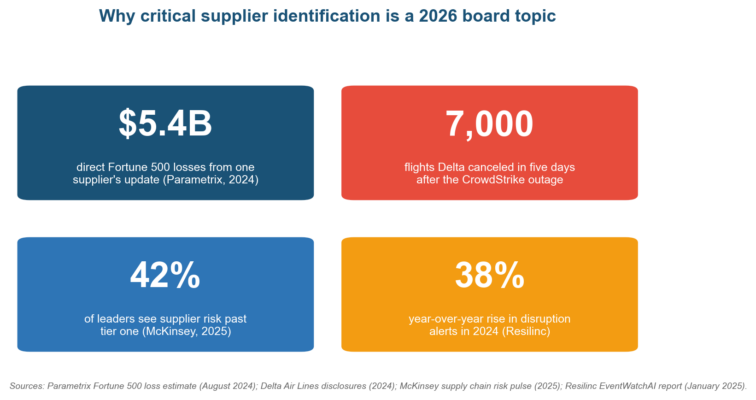
Figure 1. Four numbers that put critical supplier identification on 2026 board agendas: one supplier’s update, priced portfolio-wide.
Disruption volume keeps the clock running. Resilinc logged 22,522 supply chain disruption alerts in 2024, a 38% jump in one year, and McKinsey Global Institute still counts a month-plus disruption arriving roughly every 3.7 years for the average company.
| Visibility level | Share of organizations | What it means for tiering |
| Tier-one supplier risks visible | 95% (McKinsey, 2025) | Identification can start this quarter |
| Visibility beyond tier one | 42% (McKinsey, 2025) | Sub-tier mapping is a project, not a query |
| Tier-two suppliers mapped | 58% (McKinsey, 2025) | Maps exist; regular contact is rarer |
| Deep-tier visibility trend, 2023-2024 | Two consecutive annual declines | The 2025 rebound is recent and fragile |
Deloitte’s global third-party surveys keep finding the same gap between confidence and coverage, and fourth-party risk management is where it bites: the clearinghouse behind your biller, the fab behind your contract manufacturer. Critical supplier identification has to reach at least one tier past the contract.
Criteria for Critical Supplier Identification
Six criteria separate critical suppliers from merely large ones. Weight them for your industry, score each supplier against evidence held by the risk register owner, and let the risk appetite statement draw the tier lines instead of a workshop vote.
| Criterion | What to measure | Red-flag threshold |
| Substitutability | Qualified alternates and realistic switch time | No alternate inside 90 days |
| Time-to-impact | Days until failure stops revenue or safety | Under 5 business days |
| Volume at risk | Share of output or claims the supplier touches | Above 20% of throughput |
| Data and system access | Records held, tokens and network paths granted | Regulated data or broad system access |
| Regulatory exposure | Filings, patient safety, sanctioned inputs | Any single point of compliance |
| Financial fragility | Credit signals, customer concentration | Distress with no qualified alternate |
Single Points of Failure in Critical Supplier Identification
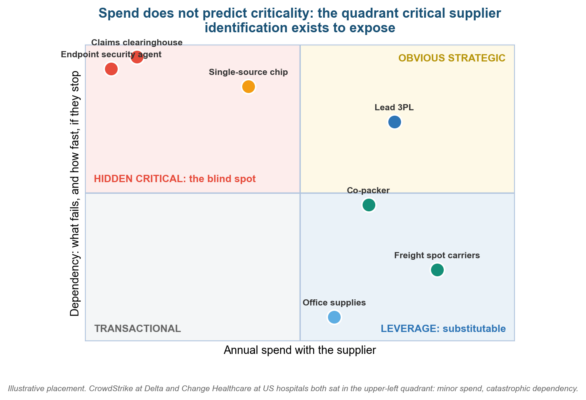
Figure 2. The quadrant that matters: low-spend, high-dependency suppliers hide where spend-ranked reviews never look.
Plot spend against dependency and the blind spot names itself: the upper-left quadrant is where CrowdStrike and Change Healthcare both lived. Concentration risk in third-party relationships compounds that quadrant whenever several business units quietly share the same vendor without anyone summing the exposure.
A business impact analysis is the fastest source of time-to-impact numbers. Where the BIA names a system or material with a two-day tolerance, the suppliers behind it inherit the criticality, and qualitative and quantitative risk assessment turns that inheritance into a defensible score.
The Four-Tier Critical Supplier Tiering Methodology
Four tiers are enough for almost any portfolio. Each tier has to carry a distinct assessment depth, contract standard, and review cadence, and no team staffs seven versions of that. The tiers below plug into the supply chain risk management plan most US manufacturers already run.
| Tier | Definition | Share of base | Oversight |
| 1 Critical | Failure stops revenue, safety, or compliance in days; no ready substitute | 3-5% | Full assessment, exit plan, quarterly review |
| 2 Strategic | Hard to replace within a quarter; competitive impact | 10-15% | Annual deep assessment, KRIs wired |
| 3 Important | Replaceable in weeks; moderate exposure | 20-30% | Questionnaire every 1-2 years |
| 4 Transactional | Commodity, substitutable in days | 50-65% | Automated onboarding checks |
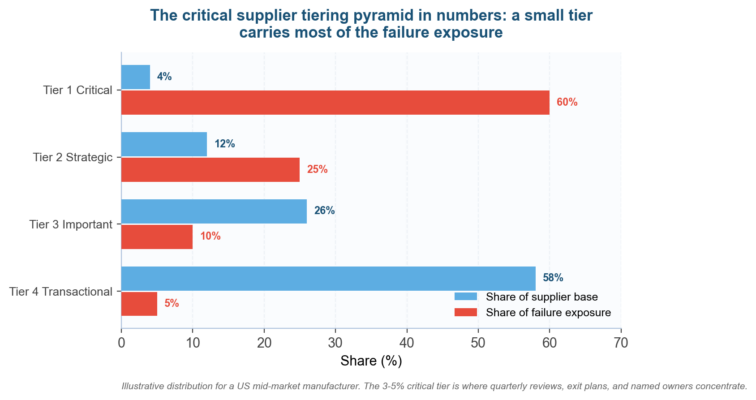
Figure 3. The tiering asymmetry: a critical tier under 5% of the supplier base carries most of the failure exposure, which is where oversight belongs.
That asymmetry is also the budget argument. A tier holding 4% of suppliers and 60% of failure exposure justifies quarterly attention in a way no flat questionnaire cycle can, and it hands the CFO a denominator: oversight spend per point of exposure retired, rather than per vendor touched.
Assessment Depth by Critical Supplier Tier
Depth follows the tier. Tier-one critical suppliers get financial monitoring, site or virtual audits, tested exit plans, and the dual-sourcing options in how to avoid supply chain disruptions; tier-four gets automated checks at onboarding and nothing more, deliberately, because attention is the scarce resource.
Three standards do the heavy lifting here. ISO 28000 frames security of supply, ISO 22301 pulls tier-one suppliers into business continuity requirements, and NIST SP 800-161 adds the sub-tier flow-down language US federal contractors already answer to in solicitation clauses.
Running Critical Supplier Identification in Six Steps
Budget four to six weeks for the first pass at a mid-market manufacturer, most of it data assembly rather than analysis. A working risk assessment in supply chain practice shortens the schedule, and the sequence below keeps the output audit-ready from day one.
| Step | What you do | Evidence it produces |
| 1 | Pull the full supplier universe: AP spend, contracts, bill of materials, IT vendor list | One deduplicated supplier master |
| 2 | Screen against the six criteria; flag single sources and shared nodes | A candidate critical list with evidence |
| 3 | Run time-to-impact against the BIA for each candidate | Dependency scores, not opinions |
| 4 | Assign tiers and name an owner for every tier-one supplier | The tiered register, owners attached |
| 5 | Match assessment depth, contract clauses, and KRIs to each tier | An oversight calendar and trigger list |
| 6 | Set refresh triggers: incidents, M&A, new contracts, KRI breaches | A living tiering, not an annual file |
Step two is where force-ranking earns its keep. Screening two thousand suppliers against six criteria sounds heavy until the thresholds do the cutting; in practice the red-flag lines leave 80 to 150 candidates for the BIA pass, a workload one analyst clears in a fortnight.
Data Sources That Feed Critical Supplier Identification
Five sources cover most portfolios: accounts payable for the universe, the bill of materials for single sources, the BIA for tolerances, the IT vendor inventory for software dependencies, and contract metadata for notice periods. The IT list is the one procurement forgets, and it is the list that held CrowdStrike.
Save sub-tier mapping for the second pass. Map the suppliers behind your tier-one critical list before attempting the whole base, the sequencing managing supply chain risk recommends, and use supply chain key risk indicators to watch the nodes you cannot yet map.
Governance and Refresh for Critical Supplier Tiers
Tiering decays quietly. Suppliers merge, volumes shift, a tier-three vendor wins a bigger contract, and nobody re-scores it, which is why the OCC, Federal Reserve, and FDIC interagency guidance expects criticality to drive the entire oversight lifecycle at US banks.
| Trigger | Action | Owner |
| Quarterly, standing | Re-confirm tier-one list against BIA and incidents | Supplier risk lead |
| New contract or new data access | Tier at signing, not after onboarding | Procurement |
| Supplier M&A, credit event, leadership exit | Re-score within 10 business days | Category manager |
| Sector disruption or named-event watch | Re-check every affected tier placement | Risk function |
| Annual, portfolio-wide | Full re-tier with criteria weights reviewed | ERM function |
Between reviews, indicators do the watching. Days of supply at single sources, the financial-stress signals in supplier performance risk management, and access changes each map to a tier placement, and how often risk assessments should run sets the floor for the calendar, never the ceiling.
Software platforms only help once the method exists, and the order matters. The third-party risk management software market automates screening and financial monitoring, and how to manage third-party risk frames the governance those tools plug into. Neither substitutes for criteria the business has signed off in writing.
Frequently Asked Questions About Critical Supplier Identification
What is critical supplier identification?
Critical supplier identification is the process of finding the suppliers whose failure would stop revenue, safety, or compliance within days, regardless of contract size. It scores substitutability, time-to-impact, volume at risk, data access, regulatory exposure, and financial fragility, then feeds the result into a tiering methodology.
How do you identify a critical supplier?
Run the counterfactual: remove the supplier for two weeks and trace what stops, using the BIA, bill of materials, and IT vendor inventory as evidence. Delta’s roughly $500 million CrowdStrike bill came from a vendor a spend ranking would never have flagged as critical.
How does a critical supplier tiering methodology work?
A tiering methodology sorts the supplier base into tiers by criticality and matches oversight to each: full assessments, exit plans, and quarterly reviews for tier-one critical suppliers, automated checks for transactional vendors. Four tiers with genuinely distinct treatment work better than seven that blur.
What share of suppliers should critical supplier identification flag?
Expect 3-5% of the supplier base in the critical tier and roughly 15-20% across critical and strategic combined. When the process flags 30%, the criteria are measuring size rather than dependency, and the tier will collapse under its own assessment workload.
How often should critical supplier tiers be refreshed?
Re-confirm the critical tier quarterly and re-tier the full base annually, with event triggers in between: supplier M&A, credit events, new data access, or any sector disruption. Re-score an affected supplier within ten business days of a trigger firing, and log the decision either way.
Is spend a good proxy in critical supplier identification?
No. Spend measures how much you buy, never what breaks when the supplier fails. CrowdStrike and Change Healthcare were small line items with catastrophic dependency, while many top-spend categories, freight and packaging among them, have substitutes available inside a week.
Pitfalls That Undermine Critical Supplier Identification
Most tiering programs fail in the design, months before any supplier does. The recurring mistakes below each pair a root cause with the remedy that keeps critical supplier identification a working control instead of a procurement slide that ages in a drawer.
| Pitfall | Root cause | Remedy |
| Spend used as the criticality proxy | AP data is easy; dependency data is work | Score the six criteria against the BIA |
| Software vendors missing from the universe | IT inventory never merged with AP | Join AP, contracts, BOM, and IT lists |
| Too many tiers | Precision confused with rigor | Four tiers, each with distinct oversight |
| Everything flagged critical | No appetite line, so politics fills the gap | Cap tier one near 5% and force-rank |
| One-time exercise | Tiering treated as a project deliverable | Quarterly confirmation plus event triggers |
| Sub-tier blindness | The contract view ends at tier one | Map suppliers behind the critical tier first |
Where Critical Supplier Identification Goes Next: 2026-2027
Tariff volatility has pushed tiering from procurement hygiene to board agenda. McKinsey’s 2025 pulse put tariffs and trade policy at the top of supply chain leaders’ concerns, and every rerouted lane changes substitutability scores that were true a quarter earlier.
Expect regulators to keep pulling the methodology upward. The interagency guidance already anchors criticality at US banks, CISA’s supply chain security program pushes software dependencies onto the same register as physical inputs, and federal flow-down clauses keep spreading NIST language into commercial contracts.
Software concentration will supply the next CrowdStrike-shaped surprise somewhere. The World Economic Forum’s January 2025 analysis found digital leaders separating from laggards on disruption response, and the gap starts with knowing which agents, platforms, and clearinghouses sit in the critical tier.
Delta’s lawsuit will turn on contract caps, but the risk lesson is already settled. The airline’s most critical supplier that July sat filed under miscellaneous software, and no verdict recovers the five days. Critical supplier identification is the cheaper way to learn the same fact.
Infographic: The Critical Supplier Tiering Pyramid
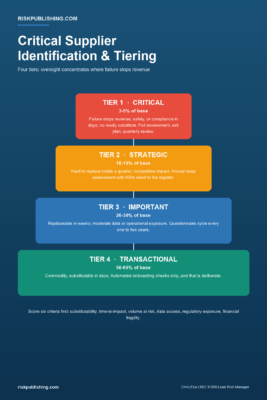
Figure 4. Critical supplier identification and tiering on one page: six criteria feed four tiers, and oversight concentrates at the top.
Build Critical Supplier Tiering with Risk Publishing
Risk Publishing helps US supply chain and risk teams stand up critical supplier identification that survives an examiner, from criteria weights to the resilient supply chain investments behind tier one, with vendor risk mitigation built into the contracts. Start with our services, then contact us while the tier list is still your call rather th

Chris Ekai is a Risk Management expert with over 10 years of experience in the field. He has a Master’s(MSc) degree in Risk Management from University of Portsmouth and is a CPA and Finance professional. He currently works as a Content Manager at Risk Publishing, writing about Enterprise Risk Management, Business Continuity Management and Project Management.