Drywall project manager jobs put one person in charge of a wall and ceiling subcontract from bid review to closeout. The drywall project manager estimates and buys out the work, schedules crews against the general contractor’s sequence, holds quality to GA-216 and ASTM C840, keeps the site inside OSHA’s fall and scaffold rules, and submits the monthly pay application.
On January 28, 2026 the Associated Builders and Contractors said the construction industry must attract 349,000 net new workers in 2026 and 456,000 in 2027, with chief economist Anirban Basu attributing most of the 2026 figure to retirements. The same month the Associated General Contractors reported that 80% of firms with openings find salaried positions hard to fill.
That is the market a drywall project manager walks into. Pay averaged $97,768 on ZipRecruiter’s September 10, 2026 reading, employers still expect to hire, and the scarce skill is estimating, sequencing, and closing out a wall and ceiling package without giving margin back. The duties, requirements, pay, and risks below are what that market is paying for.
| Drywall Project Manager Jobs: The Bottom Line |
| Drywall project manager jobs put one person in charge of a wall and ceiling subcontract from bid review to closeout: estimate and buyout, schedule against the general contractor’s sequence, quality to GA-216 and ASTM C840, safety under OSHA Subpart L and M, and the monthly pay application. |
| ZipRecruiter put average pay at $97,768 a year on September 10, 2026, with the middle half earning $75,000 to $119,000 and the 90th percentile at $137,000. The BLS median for all construction managers was $114,990 in May 2025. |
| The Associated General Contractors’ January 2026 outlook found 80% of firms with openings struggle to fill salaried positions, 63% still expect to add headcount, and 40% raised base pay by more than they did in 2024. |
| The Associated Builders and Contractors estimates the industry must attract 349,000 net new workers in 2026 and 456,000 in 2027, most of them to replace retirements. |
| Volume is steady rather than growing: USGS estimates 26 billion square feet of wallboard sold in 2025 against plant capacity of 34 billion, so margin comes from estimating accuracy and schedule control. |
| Typical requirements are a construction management degree or equivalent field experience, five to ten years in commercial framing and drywall, estimating software, and blueprint reading; PMP or CCM certification helps at senior level. |
| The job is a risk job. Five of the ten OSHA standards most cited in FY2025 are construction standards a drywall crew works under every day, led by fall protection with 6,992 citations. |
What Drywall Project Manager Jobs Involve
A drywall project manager runs a subcontract rather than a building. The general contractor owns the master schedule; the drywall project manager owns the wall and ceiling scope: metal framing, insulation, gypsum board, taping and finishing, and often acoustical ceilings. Our project manager job description template gives the generic frame; the table below adds the drywall version by phase.
| Phase | What the drywall project manager does | Standard or document | Evidence produced |
| Bid and award | Reviews plans, specifications, and addenda; checks the estimator’s takeoff; prices alternates and exclusions; negotiates scope with the general contractor | Contract documents; Division 09 specifications | Scope letter with inclusions and exclusions; signed subcontract |
| Buyout and setup | Orders board, studs, and finishing materials; sets budget by cost code; issues submittals and RFIs; books crews | ASTM C1396 (board), ASTM C840 (application), GA-216 | Approved submittals; buyout log; job budget |
| Execution | Sequences framing, in-wall inspections, hanging, and finishing with the MEP trades; tracks productivity against budget; prices change orders | General contractor schedule; IBC Chapter 7 fire-rated assemblies | Weekly look-ahead; change order log; daily reports |
| Quality and safety | Inspects framing before board, checks fastener spacing and joint finish level, runs toolbox talks, verifies scaffold and stilt use | GA-214 finish levels; OSHA 29 CFR 1926 Subparts L and M | Inspection checklists; safety audits; corrected punch items |
| Billing and closeout | Prepares the monthly pay application with schedule of values, collects lien waivers, closes out warranties and as-builts | Subcontract payment terms; AIA G702/G703 format | Approved pay applications; retention release; closeout package |
Employers describe the job the same way. Southwest Drywall’s project manager posting asks for a complete review of the contract documents, job setup and buyout, purchase orders and change order documentation, and monthly pay applications in On Center and PlanGrid. Swinerton’s drywall senior project manager role adds negotiating subcontract and material purchases and developing safety plans with the superintendent.
The standards decide what a finished wall must look like. GA-216, the Gypsum Association’s application specification, and ASTM C840 set fastener spacing, joint treatment, and storage; the finish level (0 to 5) in the specification decides labor hours per square foot. A project manager who prices level 4 and is held to level 5 loses the job’s margin.
Why the Role Is Hard to Fill in 2026
Three numbers set the hiring picture: how many contractors want to hire, how many can, and how much board there is to hang. The AGC’s 2026 Construction Hiring and Business Outlook (951 responses, late 2025) answers the first two: 63% expect to add headcount, 15% expect to cut, and 80% of those with openings find salaried positions hard to fill.
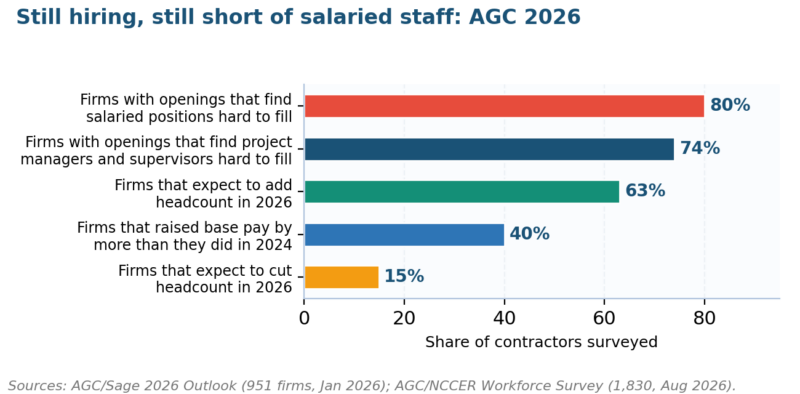
Figure 1. Four in five contractors with openings cannot easily fill salaried roles, and two in five raised base pay faster in 2025 than in 2024.
In the AGC and NCCER workforce survey of 1,830 respondents (July and August 2026), 74% of firms with openings said project managers and supervisors were hard to fill, behind superintendents at 75% and ahead of estimators at 72%. Forty percent of outlook respondents raised base pay faster than in 2024.
The third number is volume, and it is flat. The US Geological Survey’s Mineral Commodity Summaries 2026 estimates 26 billion square feet of wallboard sold in 2025, down from 27.2 billion in 2024, against plant capacity of about 34 billion square feet. Demand for drywall project managers comes from retirements and margin pressure, not from a growing market.
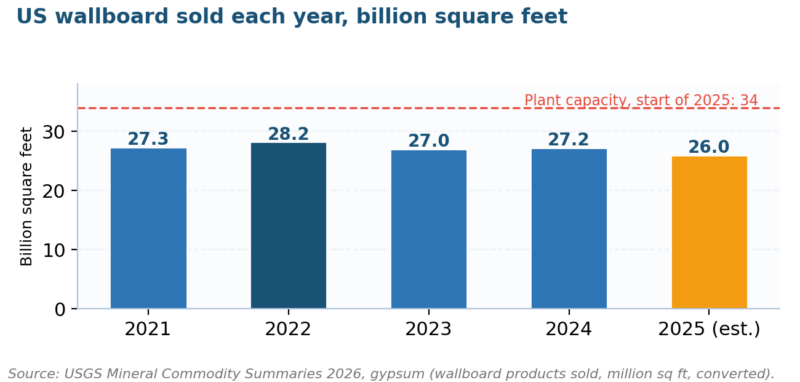
Figure 2. Wallboard sales have moved in a two-billion-square-foot band for five years. Flat volume means the job is won on estimating and control.
| Signal | Figure | Source and date | What it means for candidates |
| Net new workers needed | 349,000 in 2026; 456,000 in 2027 | ABC, January 28, 2026 | Retirements open senior seats; expect faster promotion |
| Salaried roles hard to fill | 80% of firms with openings | AGC outlook, January 2026 | Negotiating leverage on pay and remote administration days |
| Firms raising base pay faster | 40% | AGC outlook, January 2026 | Ask for the current range, not last year’s |
| Wallboard sold | 26 billion sq ft (2025 est.) | USGS MCS 2026 | Flat market; employers hire for margin protection |
| Largest wall and ceiling contractor | Performance Contracting Group, $1.28 billion | Siteline compilation of ENR and W&C lists, updated June 2026 | The top firms run structured PM ladders and formal training |
| Construction managers, all sectors | 609,100 jobs; 9% growth 2025 to 2035; about 49,700 openings a year | BLS Occupational Outlook Handbook | The wider ladder a drywall PM can move onto |
For the employer side the same figures are a risk. A wall and ceiling contractor that cannot staff its project management seats takes on work it cannot supervise, and our guide to construction risk management treats staffing capacity as a pre-award check for that reason.
Requirements: Education, Experience, and Certifications
Job postings agree on the core requirements and differ on the degree. The BLS Occupational Outlook Handbook lists a bachelor’s degree as typical entry education but notes that several years of trade experience substitutes; in drywall the substitution is common, and a former foreman with estimating software skills is a stronger candidate than a graduate without field time.
| Requirement | Assistant or associate PM | Project manager | Senior project manager |
| Education | Associate or bachelor’s in construction management, or trade background | Bachelor’s preferred; equivalent field experience accepted | Bachelor’s or equivalent plus a record of profitable projects |
| Experience | 0 to 3 years, often as field engineer or estimator | 3 to 8 years in commercial framing and drywall | 8 to 10+ years, as Swinerton specifies, including supervising other PMs |
| Technical | Blueprint reading; Excel; PlanGrid or Procore | Estimating software (On Center, Bluebeam); scheduling; change order pricing | Contract law basics; project accounting; procurement strategy |
| Standards | GA-216 and finish levels | ASTM C840, IBC fire-rated assemblies, OSHA 1926 Subparts L and M | UL assembly selection; acoustic and fire testing documentation |
| Certification | OSHA 30 preferred | OSHA 30; AWCI courses | PMP or CCM adds weight; AWCI Excellence in Construction Quality |
| People | Coordinates with foremen | Runs crews of 10 to 40 through foremen; negotiates with the GC | Mentors PMs; sets company estimating and buyout procedures |
Certification is optional and useful. The Project Management Institute’s PMP and the Construction Management Association of America’s Certified Construction Manager both appear in senior drywall postings; the Association of the Wall and Ceiling Industry (AWCI) runs the trade-specific courses on framing, fire-rated assemblies, and estimating. Our comparison of risk management certifications covers which an employer will pay for.
The skill most postings understate is estimating. A drywall project manager who cannot check a takeoff cannot defend a change order or a pay application, and a training needs assessment for new PMs in wall and ceiling firms usually puts takeoff verification and finish-level pricing at the top of the gap list.
What the Role Pays in 2026
Salary data comes from job boards, so treat each figure as a range with a method attached. ZipRecruiter’s September 10, 2026 estimate, built from active postings and third-party data, puts the average at $97,768, the 25th percentile at $75,000, the 75th at $119,000, and the 90th at $137,000, with postings running from $42,500 to $150,000.
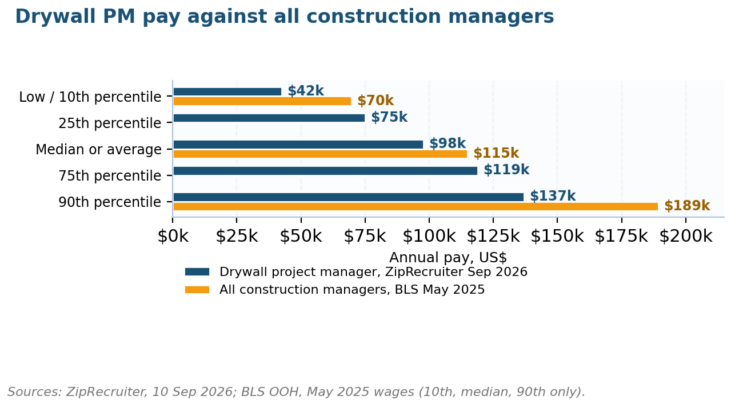
Figure 3. The drywall project manager median sits below the all-construction-manager median, but the 90th percentile at $137,000 shows what senior commercial PMs command.
| Source | Figure | Method | Read it as |
| ZipRecruiter, Sep 10, 2026 | $97,768 average; $75,000 to $119,000 middle half | Active postings plus third-party data | The current asking market for the exact title |
| PayScale, Sep 1, 2026 | $70,638 average base; $62,000 to $84,000; bonus $5,000 to $10,000 | Nine self-reported profiles | Small sample; skews to smaller residential firms |
| Lightcast via Franklin University, 2023 data | $98,571 median; advertised median $101,760 | Job posting analytics | Confirms the ZipRecruiter band from a second dataset |
| BLS OEWS, May 2025 | $114,990 median; $69,690 10th; $189,440 90th | Employer survey, all construction managers | The wider ceiling for PMs who move to general contracting |
Location moves the number by a fifth. ZipRecruiter’s top-paying cities are in Alaska and the San Francisco Bay Area, where Berkeley averages $119,711 and San Francisco $115,192, about 18% above the national average; Texas, Georgia, and Florida, which carry the most drywall volume, sit at or below it. The BLS May 2025 national wage table shows the same geography.
Two things move a candidate up faster than tenure: a record of jobs finished at or above estimated margin, which senior postings ask for directly, and scope. A project manager running $10 million of annual wall and ceiling revenue across several jobs is paid at the 75th percentile; one running a single $1 million job is paid at the 25th.
How the Job Is Done: Estimate, Schedule, Quality, Safety
The four duties that decide margin are estimating, sequencing, quality control, and safety, and each has a number attached. The worked example below prices the board for a 40,000-square-foot office fit-out with about 1,200 linear feet of full-height partition; the figures are illustrative, and the method is the point.
| Line item | Quantity | Basis | Project manager’s check |
| Partition wall area, both faces | 24,000 sq ft | 1,200 LF x 10 ft high x 2 faces | Confirm heights from sections, not the plan legend |
| 5/8-inch Type X board, 4 x 12 sheets | 550 sheets | 24,000 sq ft / 48 sq ft per sheet, plus 10% waste | Waste rises to 15% with many door and window openings |
| Metal studs, 3-5/8 inch at 16 inches on center | About 900 studs plus track | 1,200 LF x 12 in / 16 in, plus doubles at openings | Check gauge on the structural drawings for tall walls |
| Hang labor | 24 crew days | About 1,000 sq ft per two-person crew per day | Productivity drops on rated walls and above 10 ft |
| Finish labor at level 4 | 30 crew days | About 800 sq ft per crew day including sanding | Level 5 skim adds roughly 40% to finish hours |
| Fire-rated assemblies | Corridor and shaft walls per IBC Chapter 7 | UL design numbers on the drawings | Every penetration needs a listed firestop detail |
Sequencing is where the GC schedule meets the drywall crew. Framing cannot close until the MEP rough-in is inspected; board cannot hang until insulation and in-wall inspections pass; finishing cannot start until the building is dried in and holds the 50 degrees Fahrenheit minimum ASTM C840 sets for joint treatment. A two-week look-ahead against those holds is the main tool.
Safety on a drywall job is mostly about height. OSHA’s fall protection standard, 29 CFR 1926.501, and the scaffold standard, 1926.451, cover the lifts, baker scaffolds, and stilts finishing crews use every day, and the FY2025 citation data shows what inspectors find.
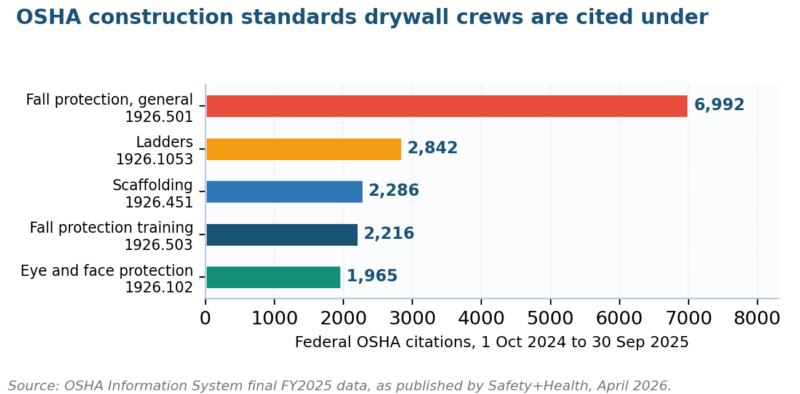
Figure 4. Fall protection drew 6,992 federal citations in FY2025, scaffolding 2,286, and fall protection training 2,216. Penalties stayed at $16,550 per serious violation for 2026.
The final FY2025 data from Safety+Health shows five construction standards in OSHA’s top ten, all on a drywall crew’s daily exposure list, and NAHB’s June 2026 note confirms penalties held at $16,550 per serious violation. A drywall project manager who documents 1926.503 training and inspects scaffolds each shift removes two of the five before an inspector arrives.
Quality control on a drywall job happens at three points, and each has a written reference the inspector can be shown. Checking all three costs a few hours per floor; missing the first costs a remove-and-rehang, because a wall that is out of plumb or short of backing cannot be fixed once the board is on:
- Before board: framing plumb and on layout, backing installed, in-wall inspections signed, fire-rated wall lines confirmed against the UL design.
- After hanging: fastener spacing per GA-216 (typically 12 inches on ceilings and 16 inches on walls with screws), board type matching the assembly, no joints over door corners.
- After finishing: joint treatment to the specified level under GA-214, checked with critical lighting where level 5 is called, and a documented punch list before the painter mobilizes.
Estimate, sequence, quality, and safety are the project risk management of the trade under different names. Our step-by-step construction project guide lays out the same sequence from the general contractor’s side, and the fundamentals of construction risk management article explains why the subcontractor’s version is the one that decides the building’s schedule.
The Drywall Risk Register a Project Manager Actually Runs
Every drywall project manager keeps a risk register, whether or not it is called one. The version below lists the eight risks that recur on commercial wall and ceiling work, each with the trigger that tells the manager it is happening and the control that keeps it inside the estimate. The structure follows our project risk management plan template.
| Risk | Trigger the PM watches | Control | Standard or tool |
| Material price movement between bid and buyout | Supplier quotes valid under 30 days; PPI for gypsum products rising | Buy out board and studs within the quote window; price escalation clause in the bid | AGC PPI tracking; subcontract terms |
| Crew shortage against the GC schedule | Foreman reports crews split across three jobs | Confirm crew allocation at award; second-tier labor subcontract on standby | AGC 2026 workforce data; labor agreement |
| Sequencing clash with MEP trades | Look-ahead shows rough-in inspections behind framing | Weekly coordination meeting; hold board until inspections are signed | GC master schedule; two-week look-ahead |
| Moisture and mold in stored or installed board | Board stored on grade or building not dried in | Store flat, off the floor, under cover; refuse to finish below 50 F | ASTM C840 storage and environmental conditions |
| Fire-rated assembly deficiency | Penetrations without listed firestop; wrong board type on shaft walls | Rated-wall walk with the inspector before closing; UL details on the wall | IBC Chapter 7; UL design numbers |
| Fall from scaffold, lift, or stilts | Scaffold not inspected each shift; no guardrails on baker scaffolds | Competent-person inspection; documented 1926.503 training | OSHA 1926.451 and 1926.501 |
| Unpriced scope growth | Field directives arriving without change order numbers | No work without a signed change order or time-and-material ticket | Subcontract change clause; change order log |
| Retention and closeout delay | Punch list open; lien waivers missing from suppliers | Closeout checklist started at 80% complete; waivers collected with each pay application | AIA G702/G703; subcontract payment terms |
The moisture row is the one most often missed, because it looks like a quality problem. Board stored on a slab before dry-in absorbs water, the paper face supports mold, and the fix is a full remove-and-rehang plus lost finishing days. The USG Gypsum Construction Handbook sets storage and acclimation requirements that belong in the buyout plan.
A register also gives the drywall project manager a language the general contractor’s risk team already speaks. Our guides to identifying risks and to the difference between a risk register and a risk log cover the format, and the contingency plan article covers what to hold in the estimate for the rows that cannot be prevented.
The Career Ladder From Assistant to Senior PM
The ladder in wall and ceiling contracting has four rungs, and the top firms on the ENR and Walls & Ceilings lists, led by Performance Contracting Group at $1.28 billion in revenue, run them formally. Smaller firms compress them. The table gives the typical scope, pay band, and the move that gets a candidate to the next rung.
| Rung | Scope | Typical pay band (2026) | What earns the promotion |
| Assistant or associate PM | Submittals, RFIs, material tracking, and pay application support on one or two jobs under a PM | $60,000 to $75,000 | Owning a small tenant improvement job end to end at estimated margin |
| Project manager | Two to five commercial jobs, $3 million to $10 million annual revenue, crews through foremen | $75,000 to $119,000 (ZipRecruiter middle half) | Three consecutive jobs at or above margin; clean safety record; change orders recovered |
| Senior project manager | Largest and most complex jobs; mentors PMs; sets buyout and estimating procedures | $119,000 to $137,000 and above | Winning repeat work from a general contractor; building a PM team |
| Operations or division manager | All projects in a region; hiring, estimating oversight, backlog | BLS 90th percentile for construction managers: $189,440 | Regional P&L and a proven bench of PMs |
Two side moves are common. Estimating and project management are one career in most wall and ceiling firms, so a PM who spends two years in the estimating department returns better at pricing change orders and defending pay applications. And project controls roles at general contractors recruit drywall PMs for their productivity data, which few other trades track as closely.
Our Kansas City project manager guide covers a mid-size market where postings cluster around the national average; in the Bay Area pay runs about 18% higher and competition is heavier. Candidates who read the questionnaire we use for project risk assessment before an interview arrive with the questions a hiring manager expects a senior PM to ask.
The Drywall Project Manager Jobs Questions Candidates Keep Asking
What do drywall project manager jobs pay in 2026?
ZipRecruiter’s September 10, 2026 estimate puts the national average at $97,768 a year, with the middle half earning $75,000 to $119,000 and the 90th percentile at $137,000. PayScale’s smaller sample shows $70,638 average base plus a $5,000 to $10,000 bonus. Location, annual revenue managed, and margin record move an individual offer within that band.
What qualifications do drywall project manager jobs require?
Most postings ask for a construction management degree or equivalent field experience, three to eight years in commercial framing and drywall for a project manager and eight to ten for a senior role, blueprint reading, estimating software, and OSHA 30. PMP or CCM certification and AWCI coursework help at senior level but are rarely mandatory.
How are drywall project manager jobs different from general construction project manager jobs?
A drywall project manager runs a subcontract inside someone else’s schedule, so the job is built around sequencing with other trades, defending scope through change orders, and getting paid through the general contractor’s pay application cycle. A general contractor’s PM owns the whole building and the client. The technical standards, GA-216, ASTM C840, and fire-rated assemblies, are also trade-specific.
Are drywall project manager jobs in demand?
Yes, mostly because of retirements. The AGC’s January 2026 outlook found 80% of firms with openings struggle to fill salaried positions and 63% still plan to add headcount, while ABC expects 349,000 net new workers to be needed in 2026, mostly for retirements. Wallboard volume itself was flat at about 26 billion square feet in 2025.
What software do drywall project manager jobs use?
Estimating and takeoff tools such as On Center On-Screen Takeoff and Bluebeam, field management platforms such as Procore or PlanGrid, the general contractor’s scheduling software, and Excel for budgets and pay applications. Postings from Southwest Drywall and Swinerton name these directly, and fluency in the general contractor’s system is often the deciding skill at interview.
Can you get drywall project manager jobs without a degree?
Yes. The BLS notes that several years of relevant trade experience substitutes for a bachelor’s degree in construction management, and wall and ceiling firms promote foremen and estimators into project management regularly. The candidates who make the move fastest add estimating software skills, OSHA 30, and a documented record of jobs finished at margin.
What are the biggest risks in drywall project manager jobs?
Unpriced scope growth, material price movement between bid and buyout, crew shortages against the general contractor’s schedule, moisture damage to stored board, fire-rated assembly deficiencies, and falls from scaffolds or stilts. Fall protection drew 6,992 federal OSHA citations in FY2025, and the register in this guide gives a trigger and a control for each risk.
Seven Traps That Derail Drywall Projects
| Trap | How it shows up | Fix |
| Pricing the wrong finish level | Bid at level 4, specification or lighting demands level 5; finish hours run 40% over | Confirm finish level and critical lighting in the scope letter before award |
| Buying out late | Board price rises after the quote window closes; margin lost before the first sheet is hung | Buy out within the quote validity period; carry an escalation clause |
| Boarding before inspections | Walls closed over unsigned rough-in; rework to open and re-hang | Hold board until in-wall inspections are signed in the look-ahead |
| Storing board on the slab | Moisture uptake, mold, remove-and-replace | Store per ASTM C840 and the USG handbook; refuse delivery before dry-in |
| Working to verbal directives | Field changes with no change order; disputed at closeout | No work without a signed change order or T&M ticket |
| Scaffold and stilt exposure | No competent-person inspection; missing guardrails; citation under 1926.451 | Daily inspection log; documented training under 1926.503 |
| Starting closeout at the end | Lien waivers and as-builts missing; retention held for months | Closeout checklist opened at 80% complete; waivers with every pay application |
Where Drywall Project Manager Jobs Are Heading Through 2027
Replacement demand will outrun volume. ABC’s 456,000 figure for 2027 is larger than 2026’s, and the AGC finds 38% of contractors expect salaried hiring to stay hard or get harder. For a drywall project manager that means senior seats opening faster than the market grows, and for employers it means the pay bands in Figure 3 keep moving up.
Panelized framing and prefinished wall systems move labor hours from the site to the shop, and that changes the job more than any software does. The project manager who can price, sequence, and inspect prefabricated assemblies against the same GA-216 and fire-rating standards becomes the scarce one. Firms on the top wall and ceiling contractor list already run prefabrication divisions.
Compliance exposure grows with the paperwork. Fire-rated assembly documentation under the 2024 IBC, firestop inspection records, and OSHA training files are increasingly requested at closeout and in disputes; a drywall project manager who keeps them the way a compliance requirements register keeps obligations settles those disputes in days.
Wall and ceiling crews already produce daily productivity numbers per square foot, and those numbers will decide who gets the senior seat. A project manager who turns them into key risk indicators for schedule and margin, and who runs a mitigation plan against them, is doing what the general contractor’s risk team does at a fraction of the scale.
If you run a wall and ceiling contractor and your project managers carry the risk in their heads, we build the register, the estimating checks, and the closeout controls into a system a new hire can run in a month. Review what we do and send us the job list to start with the three largest projects in backlog.

Chris Ekai is a Risk Management expert with over 10 years of experience in the field. He has a Master’s(MSc) degree in Risk Management from University of Portsmouth and is a CPA and Finance professional. He currently works as a Content Manager at Risk Publishing, writing about Enterprise Risk Management, Business Continuity Management and Project Management.