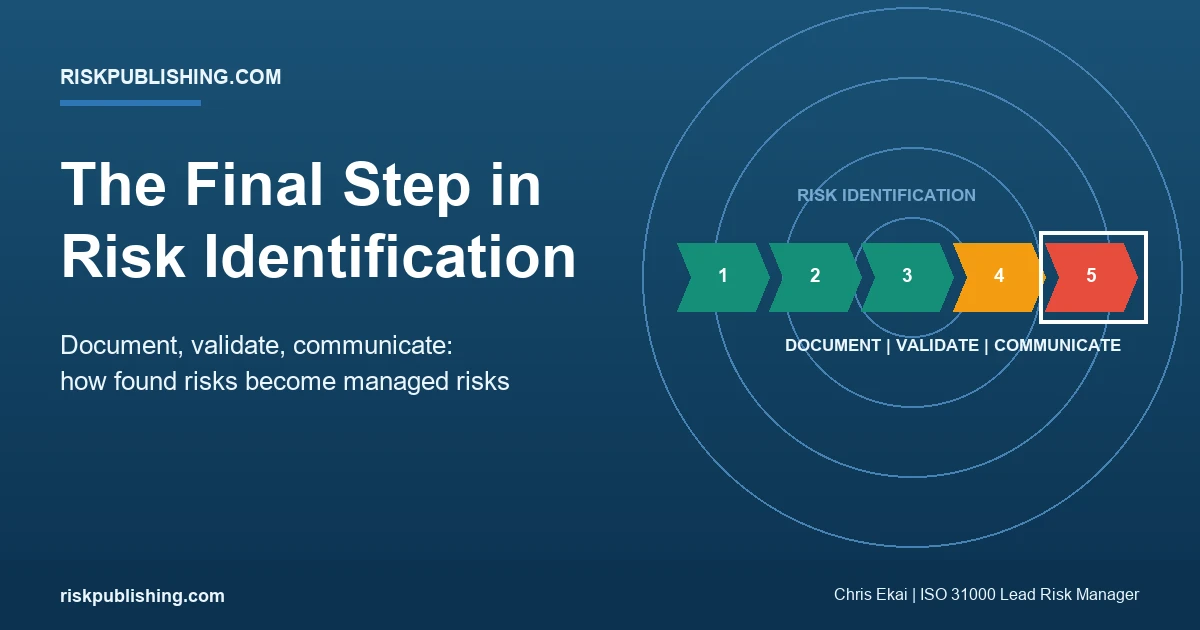
The final step in the risk identification process is documenting the identified risks in the risk register and communicating them to their owners and stakeholders. Each risk is written as cause, event, and consequence, assigned an owner, and validated, which hands a complete inventory to risk analysis.
In January 2018, OceanGate’s director of marine operations, David Lochridge, handed senior management a written inspection report identifying critical safety risks in the Titan submersible, including a viewport certified to 1,300 meters on a craft meant to dive 4,000. He was fired the same month and escorted from the building.
On June 18, 2023, Titan imploded on descent to the Titanic, killing all five aboard, including chief executive Stockton Rush. The US Coast Guard’s Marine Board of Investigation concluded on August 5, 2025 that the loss was preventable, citing intimidation of staff who raised safety concerns and an ineffective whistleblower process under the Seaman’s Protection Act.
| Final Step in the Risk Identification Process: Key Takeaways |
| The final step in the risk identification process is documenting risks in the register, validating the inventory, and communicating it to owners and stakeholders; analysis begins only after that handoff. |
| OceanGate proves the stakes: David Lochridge’s January 2018 inspection report identified the Titan’s risks, he was fired the same month, five people died on June 18, 2023, and the Coast Guard ruled the loss preventable (August 5, 2025). |
| Write every risk as cause, event and consequence, with a named owner; ‘cyber risk’ is a category, and a category cannot be analyzed. |
| Validation has teeth only when entries can fail it: statements parse, duplicates merge, owners confirm in writing. |
| Communication is audience-matched, from owner confirmations within days to board escalation per the appetite criteria. |
| Identification loops: set the re-identification cadence (quarterly, plus event triggers) as part of closing the final step in the risk identification process. |
Lochridge ran risk identification correctly: he found the risks, wrote them down, and communicated them upward. What OceanGate lacked was a governed final step in the risk identification process: a register with owners, validation and escalation that no manager could quietly bury. Identification that ends in an inbox has not ended at all.
The Final Step in the Risk Identification Process, Defined
The Titan record shows what the step must accomplish. Under ISO 31000, risk identification closes when every found risk is documented in the risk register as a structured statement, validated for completeness, assigned to a named owner, and communicated to the stakeholders who must act; only then does risk analysis begin.
Some practitioners name documentation as the final step and treat validation as the start of analysis, a split ISO Guide 73’s vocabulary tolerates; others fold both together. We teach the wider reading, because a documented risk nobody has confirmed or owned is only a note, and the Titan record shows how notes get buried.
| Action | What it means | Evidence it happened |
| Document | Each risk written as cause, event and consequence in the register, with metadata | Register entry with unique ID and date |
| Validate | Inventory checked for completeness, duplicates and categories; owners confirm their entries | Sign-off minutes; validation checklist |
| Communicate | Owners, sponsors and affected teams briefed on the inventory and what happens next | Distribution record; briefing on file |
Why an Undocumented Risk Is an Unidentified Risk
The definition is strict because of the Everett, Washington company that ignored it. The Coast Guard’s final report found OceanGate leadership fired senior staff and threatened terminations to dissuade employees and contractors from expressing safety concerns; the identification pipeline itself had become the hazard.
Figure 1. Seven years from written warning to official ruling: the cost of identification without governance.
The same failure shape appears without fatalities every week. Risks surface in workshops and audits, live briefly in slide decks, and never reach a governed register; twelve months later the loss event arrives and the post-mortem finds someone knew. The identification techniques upstream mean nothing if the final step in the risk identification process never receives their output.
Because burial is quiet, we test for it directly in program reviews. Any of these five signals means identified risks are dying between discovery and the register, and the final step in the risk identification process needs rebuilding before the next identification workshop is scheduled:
- Workshop outputs that never appear as register entries with IDs
- Risks raised in emails or minutes with no owner recorded anywhere
- A register whose entry count has not changed in two quarters
- Staff who say raising risks is career-limiting, in any phrasing
- Post-incident reviews that keep finding prior warnings on file
The Five Steps That Come Before It
Placing the final step in the risk identification process needs the whole sequence visible. Risk identification runs as five moves, opening from the first step in the risk management process, scope and criteria, and closing with the documentation step this article defines; the flow below is the version we install.
Figure 2. Step five closes identification and opens analysis; the loop returns on a set cadence.
| Step | What happens | Common tools |
| 1 | Scope, objectives and risk criteria agreed before any risk is named | Context workshop, appetite statement |
| 2 | Evidence gathered: loss data, audits, near misses, external scans | Loss registers, horizon scans, PESTLE |
| 3 | Structured techniques surface candidate risks | Workshops, interviews, checklists, HAZOP |
| 4 | Candidates deduplicated, categorized and screened | Draft register, affinity grouping |
| 5 | The final step in the risk identification process: register entries finalized, owners assigned, briefings held | Register, sign-off, distribution list |
Step five, the final step in the risk identification process, is where IEC 31010 places recording and reporting, and where PMI’s project practice places the risk register update. Different vocabularies, same architecture: the sequence ends when the inventory is written, confirmed and in the hands of people accountable for what happens next. NIST SP 800-30 encodes the same close for information risk.
Identification also loops rather than terminates. New risks emerge as conditions change, so the final step in the risk identification process includes setting the re-identification cadence, quarterly in most registers and more often where volatility demands, with scenario exercises feeding fresh candidates into the register between formal cycles, drawn from the full toolkit of identification approaches.
Building the Register Entry That Survives an Audit
Documentation quality decides whether the final step in the risk identification process holds, and quality is testable. Every entry in the risk register carries the fields below, and the discipline that matters most is the three-part risk statement: cause, event, consequence, in one sentence an auditor can parse.
Figure 3. Seven fields per entry: the statement line is the one auditors test first.
| Field | What goes in it | Why it matters |
| Risk ID and title | Unique identifier and short name | Traceability across reviews and systems |
| Risk statement | Because of [cause], [event] may occur, leading to [consequence] | Makes the risk analyzable and falsifiable |
| Category and objective | Taxonomy branch and the objective at stake | Aggregation and reporting roll-ups |
| Owner | A named accountable individual, never a department | Someone must answer for treatment |
| Source and method | The workshop, audit, near miss or scan that surfaced it | Shows the pipeline works; supports assurance |
| Initial screening | Coarse likelihood-impact reading | Feeds prioritization into analysis |
| Attributes | Velocity, detectability, interdependencies | Deeper sorting once analysis begins |
Weak statements are the commonest audit finding at this step. ‘Cyber risk’ is a category, and ‘we might get hacked’ is a fear; ‘because remote access lacks MFA, credential theft may occur, leading to member-data exposure’ is an identified risk. The risk attributes layer adds velocity and detectability once the statement stands.
Registers live in tools, and the tool matters less than the fields. A spreadsheet register runs most programs honestly; what no tool fixes is an entry without an owner, which is why validation reviews check the owner column first, then the key elements in order.
Communicating and Validating: The Handoff to Analysis
A perfect register that nobody reads reproduces OceanGate with better paperwork. The final step in the risk identification process therefore closes with two governed acts: validation, confirming the inventory is complete and correctly owned, and communication, putting the risks in front of the people who fund and perform analysis and treatment.
| Audience | What they receive | When |
| Risk owners | Their entries, with statements and screening | Within days, for written confirmation |
| Line leadership | Department view of new and changed risks | At the validation review |
| Risk committee / ExCom | Top additions, themes, coverage gaps | Next scheduled meeting |
| Assurance (audit, compliance) | Full inventory access | Continuous, via the register |
| Board or sponsor | Material new exposures only | Per the escalation criteria in the appetite statement |
Validation has teeth only when someone can fail it. We run a signed checklist: every statement parses, categories fit the taxonomy, duplicates are merged, each owner has confirmed in writing, and coverage is checked against objectives and known risk types so blind spots surface before a screening matrix prices anything.
The handoff itself deserves one formality: a dated note recording that identification closed, what the register now holds, and when re-identification runs next. That single page is what three-lines assurance reviewers ask for, and it is the proof OceanGate’s warnings never produced: that the message left the room with an owner attached.
Risk Identification FAQs Every Professional Should Know
The questions below repeat across trainings, audits and exam prep, phrased as people actually ask them. Answers lead with the direct call; where a fuller method exists on this site, the link carries it, and the OceanGate record above answers the why behind every one.
What is the final step in the risk identification process in project management?
In PMI-style project practice the final step in the risk identification process is updating the risk register and communicating it to stakeholders: each identified risk recorded with statement, owner and initial rating, feeding qualitative analysis next. The vocabulary differs from ISO 31000, but the architecture is identical: document, validate, communicate, hand off.
What comes after risk identification?
Risk analysis: estimating likelihood and impact for each documented risk on anchored scales, then evaluation against appetite and treatment selection. The register built in the final step in the risk identification process is the input; if entries lack owners or parseable statements, analysis inherits the gaps and prices the wrong things.
Who is responsible for documenting identified risks?
The risk function or project manager administers the register, but each risk must carry a named business owner who confirms the entry; administration and ownership are different jobs. Validation sign-off makes the split visible, which is why our register guide treats the owner column as the first audit stop.
How often should risk identification be repeated?
Quarterly refresh suits most registers, with immediate ad-hoc identification after incidents, near misses, major changes or new ventures; annual-only identification is how registers fossilize. Set the cadence as part of the final step in the risk identification process, and treat a register whose count never changes as a warning sign; annual top-risk surveys make cheap seed material for each refresh cycle you run.
Is a risk register the output of risk identification?
Yes, the populated and validated register is the primary output of the final step in the risk identification process, together with the communication record showing owners and stakeholders were briefed. The key elements of a risk register go beyond identification fields, because the same document later carries analysis scores, treatments and monitoring status through the whole lifecycle.
Can AI tools complete the risk identification process?
AI can widen discovery, scanning incidents, contracts and news for candidate risks humans miss, and it drafts statements quickly. It cannot complete the final step in the risk identification process: validation and ownership are accountability acts only named people can perform, so keep machine output upstream of the sign-off, never in place of it.
Where Programs Stall and How to Unstick Them
Identification programs stall at the same six points, and five of the six sit inside the final step in the risk identification process. The table names each stall, the mechanism behind it, and the unsticking move we apply in reviews; the OceanGate row needs no elaboration by now.
| Stall | Mechanism | Unsticking move |
| Workshop risks never reach the register | No named scribe or deadline | Assign register updates in the workshop, dated |
| Entries without owners | Departments listed instead of people | Validation fails any entry without a name |
| Raising risks feels career-limiting | Messengers punished, OceanGate-style | Leadership answers first reports visibly and well |
| Register bloat of vague fears | No statement standard enforced | Require cause-event-consequence at entry |
| Identification closed once, forever | No cadence or triggers set | Re-identification calendar plus event triggers |
| Communication equals one mass email | No audience-specific briefing | Match the communication matrix above |
The third row is cultural and outweighs the rest combined. The Coast Guard board cited an ineffective whistleblower process among Titan’s contributing factors, and OSHA’s hazard-reporting expectations exist for the same reason: identification only works where reporting is safe, and how you manage risk starts with hearing about it.
Emerging Threats Your Program Isn’t Ready For
The next identification cycles will be stress-tested by risk types that move faster than quarterly refreshes. CISA’s known-exploited-vulnerabilities catalog adds entries weekly, AI-driven fraud mutates monthly, and climate exposures shift seasonally; a final step in the risk identification process with no cadence and no event triggers cannot keep a register honest against any of them.
Regulators are moving toward the same conclusion. The SEC’s incident-disclosure rules assume a company can connect what it knows to what it files within days, and the WEF’s 2026 risk outlook reads as a standing argument for continuous identification; the direction is registers wired to live feeds, with the validation step run monthly.
None of that changes the human core the Titan board documented. Tools will surface more candidates, faster; only governance makes them documented, owned and acted on, and the organizations that hardwire the final step in the risk identification process now will absorb the faster risk environment without relearning Everett’s lesson at their own scale.
Audit your own final step in the risk identification process this week: pick three risks raised in the last quarter and trace them to register entries with owners. If any trail goes cold, that is the gap we close; our services describe the register rebuild work, and the contact page reaches us with a note about which trail broke.

Chris Ekai is a Risk Management expert with over 10 years of experience in the field. He has a Master’s(MSc) degree in Risk Management from University of Portsmouth and is a CPA and Finance professional. He currently works as a Content Manager at Risk Publishing, writing about Enterprise Risk Management, Business Continuity Management and Project Management.