
On September 8, 2016, the Consumer Financial Protection Bureau, the OCC, and the Los Angeles City Attorney announced a $185 million settlement with Wells Fargo. The action followed staff opening roughly 2 million unauthorized customer accounts to hit aggressive sales targets.
By June 2025, cumulative fines and consumer redress had crossed $4.9 billion, and the Federal Reserve’s $1.95 trillion asset cap had constrained Wells Fargo for more than seven years. The case has become the standard reference for how operational risk failures escalate into enterprise-level damage.
| Operational Risk vs Enterprise Risk: The Practitioner Cheat Sheet |
| Operational risk is the risk of loss from failed people, processes, systems, and external events inside a single business unit or function. Enterprise risk spans the whole organization and includes strategic, financial, operational, compliance, and reputational risk. |
| Wells Fargo’s 2016 fake-accounts scandal is the textbook case of operational risk vs enterprise risk failing at the boundary. A sales conduct ORM issue cost $4.9 billion in cumulative fines and a Federal Reserve asset cap that ran from 2018 until June 2025. |
| Basel III treats operational risk as one of three Pillar 1 capital charges, alongside credit and market risk. ISO 31000:2018 and COSO ERM 2017 treat enterprise risk as the umbrella; operational risk is a subset that rolls up to ERM. |
| The cleanest split: the Director of Operational Risk owns process, transaction, vendor, and cyber loss events. The CRO and the Risk Committee own strategic, financial, compliance, and reputational risk. Both meet at the ERM dashboard. |
| Three lines blur in 2026 practice: cyber risk, conduct and culture risk, and third-party risk. Each starts as operational risk and crosses to enterprise risk at a defined trigger. Set the trigger in writing. |
| The IIA Three Lines Model places operational risk in the first line and ERM in the second. Internal Audit in the third line tests both. Confusing the layers is the most common ORM vs ERM governance failure. |
| Anchor every escalation rule to written risk appetite. “Any single loss event above $5M” or “any open Matter Requiring Attention from a federal regulator” are working triggers that move the issue from ORM to ERM. |
That sequence is the operational risk vs enterprise risk boundary failing in real time. Sales conduct fraud at the branch level escalated into a capital constraint, a board overhaul, and a regulatory consent order that shaped the bank’s strategy for a decade. Scope is what separates the two, as our explainer on what enterprise risk management actually covers sets out.
This guide gives the US CRO a working separation of operational risk vs enterprise risk for 2026 and the rules governing when one becomes the other. It is built for practitioners who need to defend the boundary in front of regulators, auditors, and the board.
The framework draws on ISO 31000:2018, COSO ERM 2017, the Basel III operational risk standard, and the IIA Three Lines Model. Stats and named events come from CFPB, Federal Reserve, OCC, and Wells Fargo SEC filings.
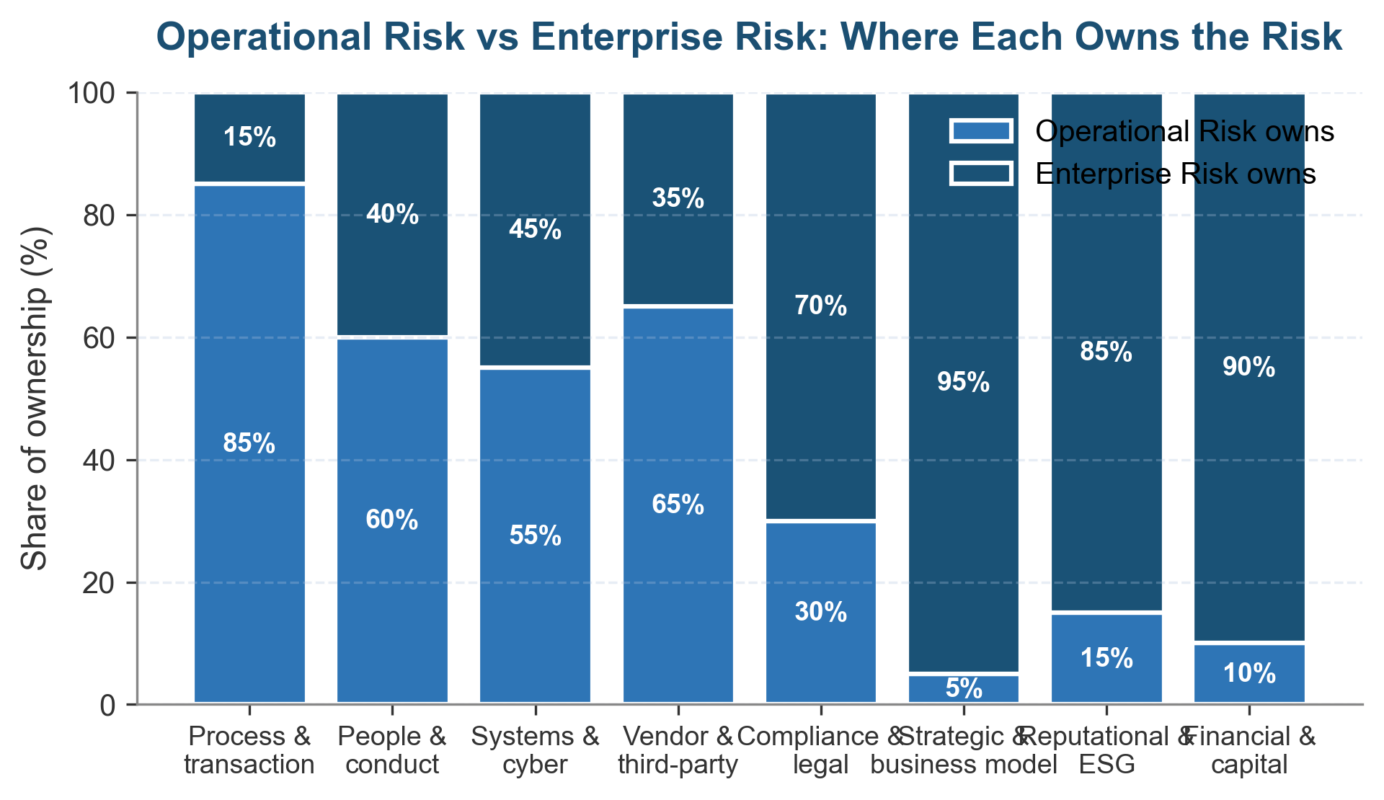
Figure 1. Operational risk vs enterprise risk: where each function owns the risk across eight common categories.
Defining Operational Risk vs Enterprise Risk
The distinction between operational risk and enterprise risk is not academic. Basel III defines operational risk as the risk of loss from inadequate or failed internal processes, people, and systems, or from external events.
ISO 31000 and COSO treat enterprise risk as everything the board needs to see, including operational risk plus strategic, financial, compliance, and reputational categories. The operational risk management discipline sits inside ERM, not next to it.
What Operational Risk Means in 2026
Operational risk covers the loss exposures generated by the day-to-day running of the business. That includes transaction errors, system outages, fraud, vendor failures, model errors, cyber incidents, and legal disputes arising from operations.
The operational risk management framework assigns each category to a named first-line owner who runs the controls. The Director of Operational Risk in the second line monitors aggregated exposure against appetite.
Under Basel III’s Standardized Approach, operational risk drives a discrete Pillar 1 capital charge calculated from the bank’s business indicator component multiplied by an internal loss multiplier. That capital number is reported separately from credit and market risk and remains the single largest operational risk disclosure for US banks above $250 billion.
For non-bank firms, operational risk examples still drive board-level scrutiny even without an explicit capital number. The category is large, granular, and run by the first line.
What Enterprise Risk Means in 2026
Enterprise risk is the consolidated view of every risk the organization runs. Under COSO ERM 2017, it covers five components: governance and culture, strategy and objective-setting, performance, review and revision, and information and communication.
The enterprise risk management framework pulls operational risk loss data into a wider picture that also includes strategy, financial, compliance, and reputational risk. That aggregated view is what the Board Risk Committee uses to set appetite and challenge management.
The CRO owns ERM. The Risk Committee reviews it monthly and the Board reviews it quarterly.
ERM is not the sum of all the individual silo risks. It is the cross-cut view that makes the trade-offs visible: where operational risk capital should be spent to reduce strategic exposure, or how a third-party concentration in operations creates a compliance risk under the OCC heightened standards.
Where Operational Risk and Enterprise Risk Should Stay Separate
Healthy programs draw a bright line between operational risk vs enterprise risk for the metrics each owns, the committee that reviews them, and the appetite they answer to. The table below shows the clean split that most US Fortune 500 firms running mature programs adopt.
| Dimension | Operational risk owns | Enterprise risk owns | Owner |
| Loss event capture | All loss events at the transaction level (errors, fraud, outages, vendor breaches) | Aggregated loss view at portfolio level; cross-category concentrations | ORM / CRO |
| Capital and reserve | Basel III Pillar 1 operational risk capital; OCC AMA model output | Total economic capital; ICAAP; capital allocation to strategy | ORM / CFO |
| KRIs | Process error, system downtime, MEL dispatch, fraud, complaints, transaction failure rate | Strategic, financial, reputational, ESG, M&A integration KRIs | ORM / CRO |
| Risk appetite line | Process-level loss limits and ratios; transaction error tolerance | Board-approved enterprise appetite; growth, balance-sheet, and reputational limits | ORM / Board |
| Reporting cadence | NOC daily; Op Risk Committee weekly; CRO monthly summary | Risk Committee monthly; Board quarterly; full ERM refresh annual | ORM / Board |
| Regulator interface | Process examiners; AML/BSA; OCC operational risk reviews | Heightened Standards; full-scope CAMELS; SEC 10-K risk factors | CCO / CRO |
Keeping these split protects both teams. The Director of Operational Risk can act fast on a vendor SLA breach without convening the full Risk Committee.
The CRO can keep the Board focused on strategy without drowning in transaction-level error rates. Mixing the layers is how programs end up with a 600-line risk register nobody reads.
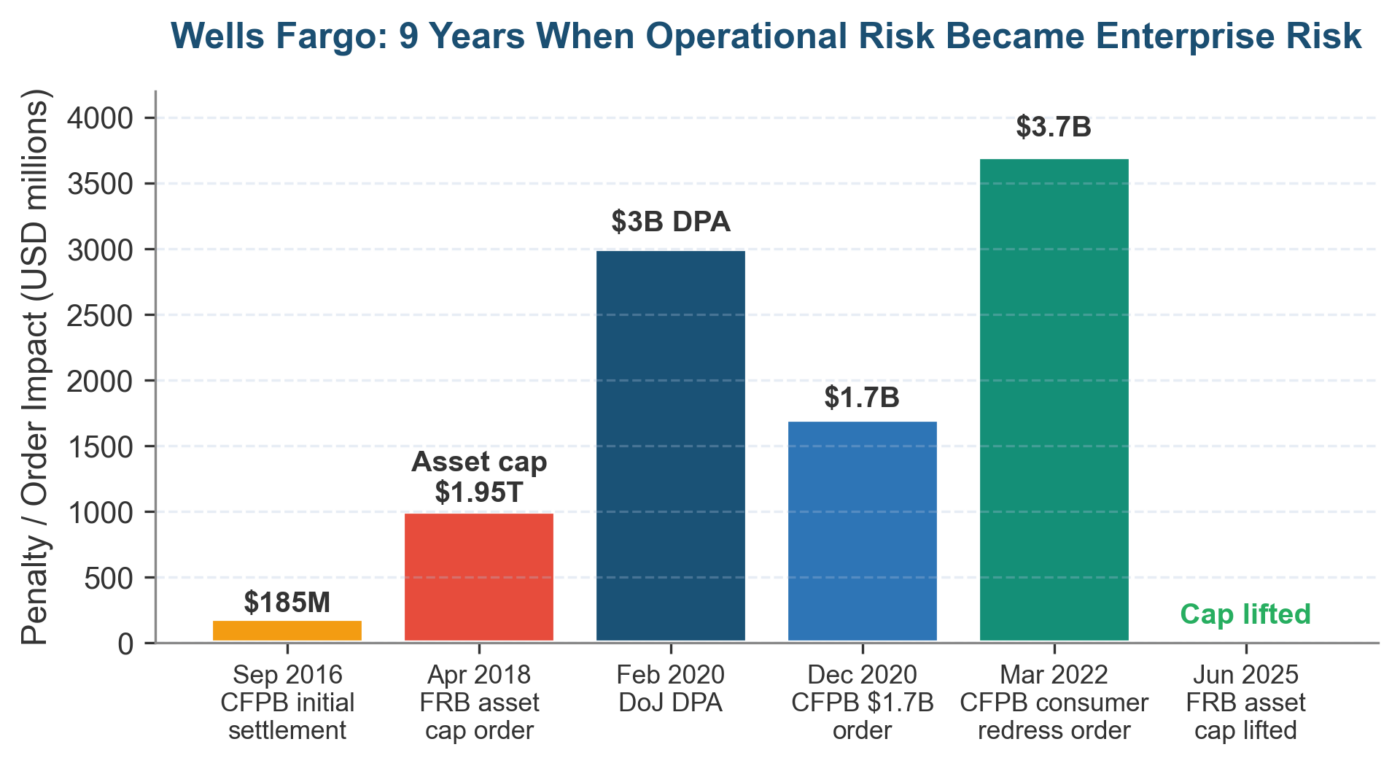
Figure 2. Wells Fargo: nine years of operational risk vs enterprise risk boundary failure.
Where Operational Risk and Enterprise Risk Lines Blur
Three categories sit right on the boundary in 2026 and they cost firms the most when the boundary fails. Cyber risk, conduct and culture risk, and third-party risk start operational and turn enterprise when a threshold trips. Define the trigger in writing before the trigger fires.
Cyber Risk as the Classic Operational Risk vs Enterprise Risk Crossover
Cyber events start as operational risk. A phishing click, an unpatched server, a vendor breach are first-line operational issues run by the CISO and the Director of Operational Risk.
The cyber security risk management framework sets the day-to-day controls. The cyber security key risk indicators track the operational exposure.
Cyber crosses to enterprise risk at a defined point. The Citigroup OCC and Federal Reserve fines in 2020 and 2024 were data governance findings, but regulators treated them as enterprise risk because they implicated capital and board oversight.
Set a written trigger: any 8-K disclosure, any breach affecting more than 10,000 customer records, or any regulator inquiry escalates from ORM to ERM. Review the trigger language with general counsel and the CISO at least once a year.
Conduct and Culture: Where Operational Risk Becomes Enterprise Risk
Wells Fargo is the case study. Sales conduct was an operational risk for years before it became enterprise risk.
Complaints, employee terminations, and ethics hotline volume were tracked at the branch level. The aggregated pattern never escalated to the ERM table until the CFPB and the OCC arrived in 2016.
Conduct risk crosses to enterprise risk on three signals. First, any pattern visible to a regulator triggers ERM ownership; second, any control failure linked to compensation incentives moves to ERM because the board sets compensation.
Third, any risk appetite breach on ethics or culture indicators moves to ERM automatically. The FSB Guidance on Risk Culture sets the international expectation for that escalation.
Framework Alignment: Operational Risk vs Enterprise Risk Under Basel, ISO, COSO
Mature programs anchor operational risk vs enterprise risk to four frameworks at once. Basel III defines operational risk for banks while ISO 31000 vs COSO ERM defines enterprise risk for everyone else. The IIA Three Lines Model places the functions in the organization.
| Framework | Operational risk treatment | Enterprise risk treatment | Reach |
| Basel III (2017 revisions) | Pillar 1 capital charge under Standardized Approach; loss data + business indicator | Pillar 2 ICAAP covers all material risk; Pillar 3 disclosure to market | US banks > $250B |
| COSO ERM 2017 | One of five risk categories under Performance component | Five components covering governance, strategy, performance, review, communication | All US public companies |
| ISO 31000:2018 | Clause 6.4 risk assessment applied at process level | Whole standard; principles, framework, process applied enterprise-wide | Global, all sectors |
| IIA Three Lines Model | First line ownership; second line ORM function | Second line CRO and ERM function; third line internal audit tests both | All sectors |
| OCC Heightened Standards | Section II.D risk management framework includes operational risk | Risk governance framework + risk appetite at enterprise level | US banks > $50B |
| SEC 10-K Risk Factors | Disclosed when material; technology, cyber, vendor concentration | Required at enterprise level; strategic, financial, market, competitive | All US public companies |
Reporting Lines and Governance for Operational Risk vs Enterprise Risk
Reporting lines are where most US firms get operational risk vs enterprise risk wrong. The Director of Operational Risk should report to the CRO, not to the COO.
The CRO should report to the CEO with a dotted line to the Board Risk Committee. The convergence of risk oversight with strategic planning only works when those lines are in place.
Most mature programs run three committees. The Operational Risk Committee meets monthly to review loss data, vendor incidents, and process exceptions. At the executive level, a Risk Committee covers the full enterprise dashboard on the same monthly cadence.
The Board Risk Committee meets quarterly and reviews the enterprise risk appetite, the top ten risks, and the year-on-year ERM maturity assessment. Minutes from each session feed directly into the next CEO and CRO certifications.
Frequently Asked Questions on Operational Risk vs Enterprise Risk
Six questions surface in every US risk-committee onboarding. The answers below reflect Basel III, ISO 31000, COSO ERM 2017, and OCC Heightened Standards as of May 2026.
Is operational risk a subset of enterprise risk, or are they parallel?
Operational risk is a subset of enterprise risk. COSO ERM 2017 lists operational risk as one of five risk categories under the Performance component. Basel III treats operational risk as a Pillar 1 capital charge, but the overall risk profile (Pillar 2 ICAAP) sits at enterprise level.
Programs that run operational risk vs enterprise risk as parallel functions usually duplicate effort, fight for budget, and produce two competing risk registers. Regulators read that duplication as a governance weakness rather than a strength.
Should the Director of Operational Risk report to the CRO or the COO?
The Director of Operational Risk should report to the CRO. COO reporting creates a conflict because the COO owns the operations the ORM function challenges.
The IIA Three Lines Model requires second-line independence from the first line. OCC examiners now ask this question in every CAMELS review of US banks above $50 billion.
How does operational risk vs enterprise risk play out in a US Fortune 500 non-bank?
Non-banks run the same split. Operational risk covers process, technology, vendor, and conduct losses at the business-unit level. Enterprise risk covers strategic, financial, compliance, and reputational risk at the C-suite and board level.
The importance of enterprise risk management for non-banks is the same as for banks: regulators (SEC, FTC, DOL, EPA) increasingly hold boards accountable for enterprise risk oversight. A clean ORM-to-ERM boundary is the easiest way to evidence that oversight in a 10-K or proxy filing.
What triggers escalation from operational risk to enterprise risk?
Five triggers move an issue from operational risk to enterprise risk: a loss event above a written dollar threshold (commonly $5M or $10M); a regulatory MRA or MRIA; an 8-K disclosure trigger; a breach of board-approved enterprise appetite on any KRI; a pattern of related operational events that signals a systemic problem. Document the triggers in the ERM policy and review them quarterly.
How do operational risk and enterprise risk share KRIs?
They share data sources but not metrics. The operational key risk indicators drill into process, vendor, and cyber detail, while the enterprise risk KRIs roll those up into category-level RAG status.
The key risk indicators in enterprise risk management function as the translation layer: the board sees ten enterprise KRIs while the Op Risk Committee sees one hundred operational KRIs. Both teams should be able to trace each enterprise KRI back to its operational sources.
What was the operational risk vs enterprise risk failure at Wells Fargo?
Wells Fargo’s sales conduct issue was tracked as operational risk for years but never escalated to the ERM table. The pattern was visible long before the regulators arrived.
Branch-level complaints, employee terminations, and ethics hotline reports were captured but not aggregated, even though the pattern visible in retrospect was a clear ERM signal. No single committee owned the cross-cut view that would have surfaced the issue in time.
The $4.9 billion cumulative cost and the 2018-2025 Federal Reserve asset cap are the price of getting operational risk vs enterprise risk escalation wrong. Every US risk committee should rerun the Wells Fargo timeline against its own escalation triggers at least once a year.
Challenges in Separating Operational Risk vs Enterprise Risk
Five failure modes recur across US programs that try to draw the line between operational risk vs enterprise risk. Watch for them before your next OCC or SEC review.
| Challenge | Root cause | Remedy |
| Two parallel risk registers | ORM and ERM functions run as siloed peers with separate taxonomies | One taxonomy. ORM register feeds ERM register. The CRO owns both. |
| No written escalation trigger | Reliance on judgment about when an operational risk becomes enterprise | Five written triggers: dollar threshold, regulatory action, 8-K, appetite breach, pattern. Document in ERM policy. |
| Director of Operational Risk reports to COO | Convenient reporting line that breaches IIA second-line independence | Move reporting to CRO. Document in committee charter. OCC examiners check this. |
| Cyber treated only as ORM | CISO reports through CIO, never reaches ERM table until breach | Pull cyber KRIs into enterprise dashboard. Tie thresholds to 8-K trigger and SEC cyber disclosure rule. |
| Conduct and culture not on ERM agenda | Treated as HR matter rather than enterprise risk | Add conduct KRIs to ERM dashboard. Wells Fargo proved this category is enterprise-defining. |
| No aggregated loss view | ORM captures loss events but ERM never sees the aggregated pattern | Quarterly loss-aggregation report to Risk Committee. Pattern detection is the whole point of ERM. |
Looking Ahead: Operational Risk vs Enterprise Risk in 2026-2028
Three forces will reshape operational risk vs enterprise risk over the next two years. The first is regulatory convergence.
The SEC’s 2024 cyber disclosure rule, OCC Heightened Standards, and EU DORA all pull cyber, third-party, and operational resilience into enterprise-level disclosure. Cyber risk programs that still report only to the CISO will not satisfy 2026 examiner expectations.
Generative AI is the second force. AI risk is currently being captured as operational risk inside model risk management under Federal Reserve SR 11-7.
It will move to enterprise risk by late 2026 because boards now ask about AI strategy directly. Expect a new ERM category covering AI governance, model performance drift, and human-in-the-loop oversight by year-end 2026.
Climate and ESG is the third force. The SEC climate disclosure rule finalized in March 2024 forces public companies to disclose climate-related risk in enterprise terms, transitioning climate from a sustainability conversation into hard ERM.
Operational risk owns the day-to-day climate exposure while ERM owns the strategic and disclosure exposure, with both reporting into the same Board Risk Committee. The split mirrors how cyber and conduct risk are now governed in mature programs.
Firms that maintain a clean operational risk vs enterprise risk separation through this period will outpace those running merged or siloed programs. The boundary is what lets management react fast at the process level while still giving the board a coherent enterprise view.
The clean separation is the operational layer of a credible ERM; the merger of insights into a unified board view is where enterprise risk actually pays off. Programs that get both layers right tend to spend less on remediation and more on growth.
Working with Risk Publishing on Operational Risk vs Enterprise Risk Programs
Risk Publishing designs the boundary between operational risk and enterprise risk in US firms running under OCC, SEC, and FRB scrutiny. Our work focuses on the moments where the boundary is most likely to break.
We map the taxonomy, set the escalation triggers, draft the committee charters, and tie the output to your integrated risk management approach and operational risk management process. The deliverables are designed to survive an examiner challenge.
Continue reading the Risk Publishing operational risk and ERM library: operational risk management complete guide, operational risk management framework, how to carry out operational risk management, differences between strategic and operational risks, and role of an enterprise risk management system. Each guide extends one slice of the framework laid out in this article.
Adjacent reading: COSO ERM vs ISO 31000 risk management standards, implement COSO enterprise risk management, all enterprise risk management framework, how to mitigate risk, and convergence of risk oversight with strategic planning. These sources cover the standards and adjacent disciplines referenced throughout this comparison.
To start a conversation, visit the contact page or the about page. The risk management lifecycle and operational risks examples pages give the parent frame for this operational risk vs enterprise risk comparison.

Chris Ekai is a Risk Management expert with over 10 years of experience in the field. He has a Master’s(MSc) degree in Risk Management from University of Portsmouth and is a CPA and Finance professional. He currently works as a Content Manager at Risk Publishing, writing about Enterprise Risk Management, Business Continuity Management and Project Management.