
On November 3, 2023, the Iowa Division of Banking closed Citizens Bank of Sac City and named the FDIC receiver. The FDIC Office of Inspector General later traced the failure to lax lending practices: trucking loans had climbed to 43 percent of the portfolio by June 2023, far past any sensible concentration limit.
| Key Takeaways |
| A 2026 program of Key Risk Indicators for Banks and Credit Unions spans six categories aligned to CAMELS: capital adequacy, asset quality and credit, liquidity and funding, interest rate and market sensitivity, compliance and BSA/AML, and operational, cyber and IT. |
| The NCUA reported credit union system delinquency at 103 basis points in Q4 2025, up 23 bp from Q1 2025. Credit-card delinquency held at 215 bp. Both belong on the executive risk committee agenda inside any modern KRI program. |
| The FDIC 2026 Risk Review flagged unrealized securities losses, CRE concentration, and uninsured deposit reliance as the dominant 2025 risk drivers across community banks. Each maps directly to a board-level KRI threshold. |
| The FFIEC removed 92 references to reputation risk from the IT Examination Handbook in February 2026. The shift toward measurable financial risk drivers makes quantitative KRIs more important, not less. |
| Citizens Bank of Sac City, Iowa failed in November 2023 with trucking loans at 43% of its book. A working concentration KRI calibrated to NCUA and OCC limits would have triggered escalation 18 months earlier. |
| Standards: FFIEC IT Examination Handbook, NCUA CAMELS Appendix A, FDIC Risk Review, OCC Heightened Standards, BCBS Principles, ISO 31000, ASC 326 (CECL), Regulation Y stress testing, and Federal Reserve SR 11-7. |
| A working catalog runs 40 to 60 indicators total, with 10 to 15 elevated to the executive risk committee each quarter. Fewer than 25 leaves blind spots; more than 70 invites monitoring fatigue. |
The right set of Key Risk Indicators for Banks and Credit Unions would have flagged the slope 18 months earlier. Single-sector exposure above 25 percent of capital is an OCC-recognized red flag, and 43 percent of the book in one trucking niche should have triggered second-line escalation in early 2022, not a failed-bank receivership in late 2023.
Fifteen months later, the NCUA Q4 2025 quarterly data showed the credit union system delinquency rate at 103 basis points, up from 80 bp at the start of 2025.
Credit-card delinquency held at 215 bp and non-commercial real estate delinquency reached 88 bp. The FDIC 2026 Risk Review simultaneously flagged CRE concentration, uninsured-deposit reliance, and unrealized securities losses as the 2025 risk drivers.
This catalog of Key Risk Indicators for Banks and Credit Unions is built for a single named reader: the chief risk officer of a US community bank or federally insured credit union who needs the thresholds, source citations, and CAMELS mapping for the 2026 board paper.
Every threshold is calibrated to FFIEC peer ranges, NCUA supervisory expectations, and OCC Heightened Standards.
Six categories cover the field: capital adequacy, asset quality and credit, liquidity and funding, interest rate and market sensitivity, compliance and BSA/AML, and operational with cyber and IT. The Key Risk Indicators for Banks and Credit Unions assembled below align with FFIEC IT Examination Handbook, NCUA CAMELS Appendix A, and BCBS Principles for the Management of Credit Risk.
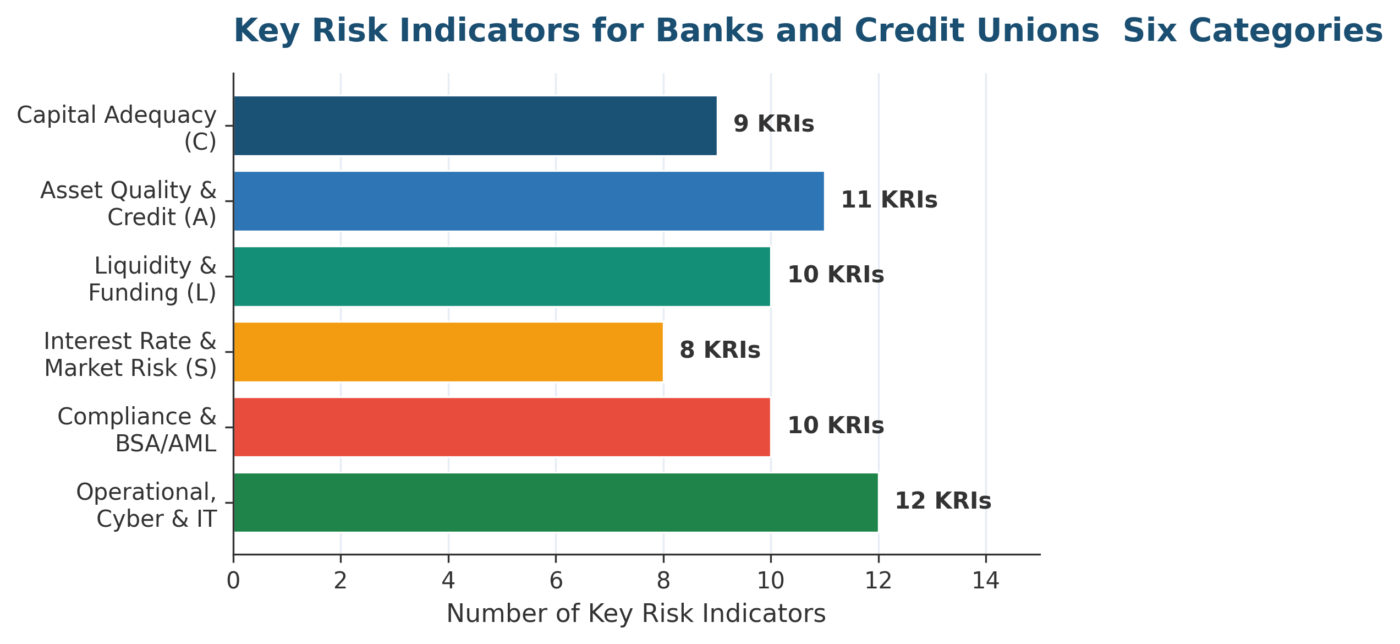
Figure 1. Key Risk Indicators for Banks and Credit Unions distributed across six CAMELS-aligned risk categories.
What Are Key Risk Indicators for Banks and Credit Unions?
A Key Risk Indicator is a leading metric that flags rising exposure before the loss is booked. In a depository institution, that exposure is shaped by FFIEC peer data, NCUA supervisory expectations, OCC Heightened Standards, and the CAMELS rating that drives every examination cycle.
KPIs measure performance against a goal. Key Risk Indicators for Banks and Credit Unions measure exposure against a documented tolerance. Net charge-off rate against budget is a KPI. Net charge-off rate against an OCC peer-band amber threshold is a KRI on the same number.
Useful Key Risk Indicators examples on a banking dashboard share four traits. They are measurable in single-digit decimals or basis points, owned by one named first-line lead, calibrated to a documented green-amber-red threshold, and they move ahead of the loss event the institution is trying to prevent rather than confirming it.
How Key Risk Indicators for Banks and Credit Unions Differ from KPIs
| Attribute | Key Performance Indicator (KPI) | Key Risk Indicator (KRI) |
| Direction | Measures progress against a target (loan growth, NIM, fee income, ROA) | Measures exposure against a tolerance (NPL, NCO, concentration, watchlist, ACL coverage) |
| Time view | Lagging or current performance | Leading early-warning signal of CAMELS deterioration |
| Trigger | Branch scorecard, executive lending committee | Escalation memo, executive risk committee paper, board appetite review |
| Owner | Line-of-business head, branch manager, lender | First-line risk owner plus second-line risk function (CRO, CCO) |
| Reference | Annual operating plan, OKRs, business unit scorecard | FFIEC IT Handbook, NCUA CAMELS, OCC Heightened Standards, BCBS, SR 11-7, ASC 326 |
The same metric can play either role. NPL ratio reported against a budget is a KPI; reported against a board-approved amber threshold of 1.5 percent, it is a KRI.
Document the threshold and the target separately, then show them side by side on the board paper.
Capital Adequacy Key Risk Indicators for Banks and Credit Unions
Capital is the C in CAMELS and the first line every examiner reads. Bank holding companies report risk-based capital and leverage ratios; federally insured credit unions report the net worth ratio.
The NCUA Q4 2025 data showed system net worth at 11.26 percent, up from 11.07 percent a year earlier.
Among the 283 credit unions reporting under the Risk-Based Capital framework, the average RBC ratio was 15.38 percent in Q4 2025.
Banks above $10 billion report Common Equity Tier 1, Tier 1, and Total Capital ratios under the Basel III final rule framework. Both regimes feed the same capital KRI dashboard.
Top 9 Capital Adequacy Key Risk Indicators for Banks and Credit Unions
| Capital KRI | Green threshold | Amber threshold | Red threshold |
| Net worth ratio (CU) / Tier 1 leverage (bank) | >9.0% | 7.0-9.0% | <7.0% |
| CET1 ratio (bank, Basel III) | >10.0% | 7.0-10.0% | <7.0% |
| Total risk-based capital ratio | >12.0% | 10.0-12.0% | <10.0% |
| RBC ratio (CU) | >12.0% | 10.0-12.0% | <10.0% |
| CET1 buffer over Stress Capital Buffer (bp) | >200bp | 100-200bp | <100bp |
| Unrealized AFS securities losses / Tier 1 | <10% | 10-25% | >25% |
| AOCI impact on tangible common equity | <10% | 10-20% | >20% |
| Dividend payout ratio (rolling 4Q) | <40% | 40-60% | >60% |
| Capital plan stress shortfall ($M) | 0 | 0-50 | >50 |
Unrealized AFS securities losses deserve a dedicated KRI in 2026. The FDIC 2026 Risk Review flagged AFS unrealized losses as elevated relative to historical norms across community banks.
The metric drives both regulatory capital optics and liquidity risk optics, and a sale to raise liquidity crystalizes the loss into capital. Track the trend and the underlying duration.
How Key Risk Indicators for Banks and Credit Unions Differ by Charter
Banks and credit unions share most of the CAMELS architecture but diverge on specific KRI names, thresholds, and regulators.
A KRI catalog written for one charter type and lifted into the other without recalibration will fail at the next examination cycle.
The NCUA CAMELS rating system assesses six components on a 1-5 scale identical in structure to the FFIEC system used for banks.
The differences live in the specific indicators each regulator weights most heavily and the peer ranges that calibrate the thresholds.
Bank vs Credit Union Key Risk Indicators for Banks and Credit Unions Side by Side
| CAMELS Component | US bank KRI (FFIEC / OCC / FDIC) | Credit union KRI (NCUA) |
| Capital (C) | Tier 1 leverage, CET1 ratio, Total RBC ratio, SCB buffer | Net worth ratio (PCA), RBC ratio for complex CUs, capital cushion to 7% |
| Asset quality (A) | NPL ratio, NCO ratio, classified assets / Tier 1+ALLL, CRE concentration | Delinquency ratio, NCO ratio, loan-to-share concentration, MBL concentration |
| Management (M) | Compliance exception rate, BSA SAR backlog, exam matter ratings | Compliance Risk Indicators (NCUA), exam DORs, member complaints rate |
| Earnings (E) | Net interest margin, ROA, efficiency ratio, fee income share | Net interest margin, ROA, operating expense / average assets, fee income |
| Liquidity (L) | Loan-to-deposit, uninsured deposit share, on-balance-sheet liquidity, FHLB advances | Loan-to-share ratio, share concentration, borrowings to assets, contingent funding |
| Sensitivity (S) | EVE under +/-200bp, NII at risk, AFS unrealized losses, derivatives exposure | NEV under +/-300bp, IRR supervisory tests, AFS exposure under NCUA IRR rule |
The NCUA Compliance Risk Indicators framework defines six risk categories examiners evaluate inside a credit union (credit, interest rate, liquidity, transaction, compliance, strategic).
The KRI catalog should mirror those six and feed the CAMELS rollup directly, not run as a parallel taxonomy that examiners then have to translate during the next field visit.
Liquidity and Funding Key Risk Indicators for Banks and Credit Unions
Liquidity is the L in CAMELS and the one that moves fastest in a crisis. The FDIC Community Bank Liquidity Risk guidance after the 2023 regional bank runs put loan-to-deposit, uninsured deposit share, and contingent funding capacity at the top of every supervisory checklist.
Credit unions face a parallel set of metrics built on shares rather than deposits. NCUA’s supervisory focus on liquidity since April 2022 widened the L component to evaluate not just policies and limits but actual sources of liquidity against funding needs. Both regulators expect documented thresholds.
Top 10 Liquidity Key Risk Indicators for Banks and Credit Unions
| Liquidity / Funding KRI | Green threshold | Amber threshold | Red threshold |
| Loan-to-deposit ratio (bank) | <85% | 85-95% | >95% |
| Loan-to-share ratio (CU) | <80% | 80-90% | >90% |
| Uninsured deposit share | <25% | 25-40% | >40% |
| On-balance-sheet liquidity / total assets | >15% | 10-15% | <10% |
| Wholesale funding / total liabilities | <15% | 15-25% | >25% |
| FHLB advances / total assets | <10% | 10-15% | >15% |
| Brokered deposits / total deposits | <10% | 10-20% | >20% |
| Top-10 depositor concentration | <10% | 10-15% | >15% |
| Contingent funding capacity coverage (days) | >60 | 30-60 | <30 |
| 30-day liquidity coverage (proxy LCR) | >110% | 100-110% | <100% |
Uninsured deposit share moved from technical metric to board-level KRI after the March 2023 regional bank failures.
The FDIC Risk Review 2025 tied deposit composition directly to the speed of run risk. A community bank above 40 percent uninsured deserves the same scrutiny as a CRE concentration over 300 percent of capital.
Contingent funding capacity is the operational KRI most often missed in community institutions.
Document the cash equivalents, FHLB capacity, Federal Reserve discount window readiness, and uncommitted lines, then express the total as days of net stressed outflow. The ERM framework should treat that figure as a hard KRI.
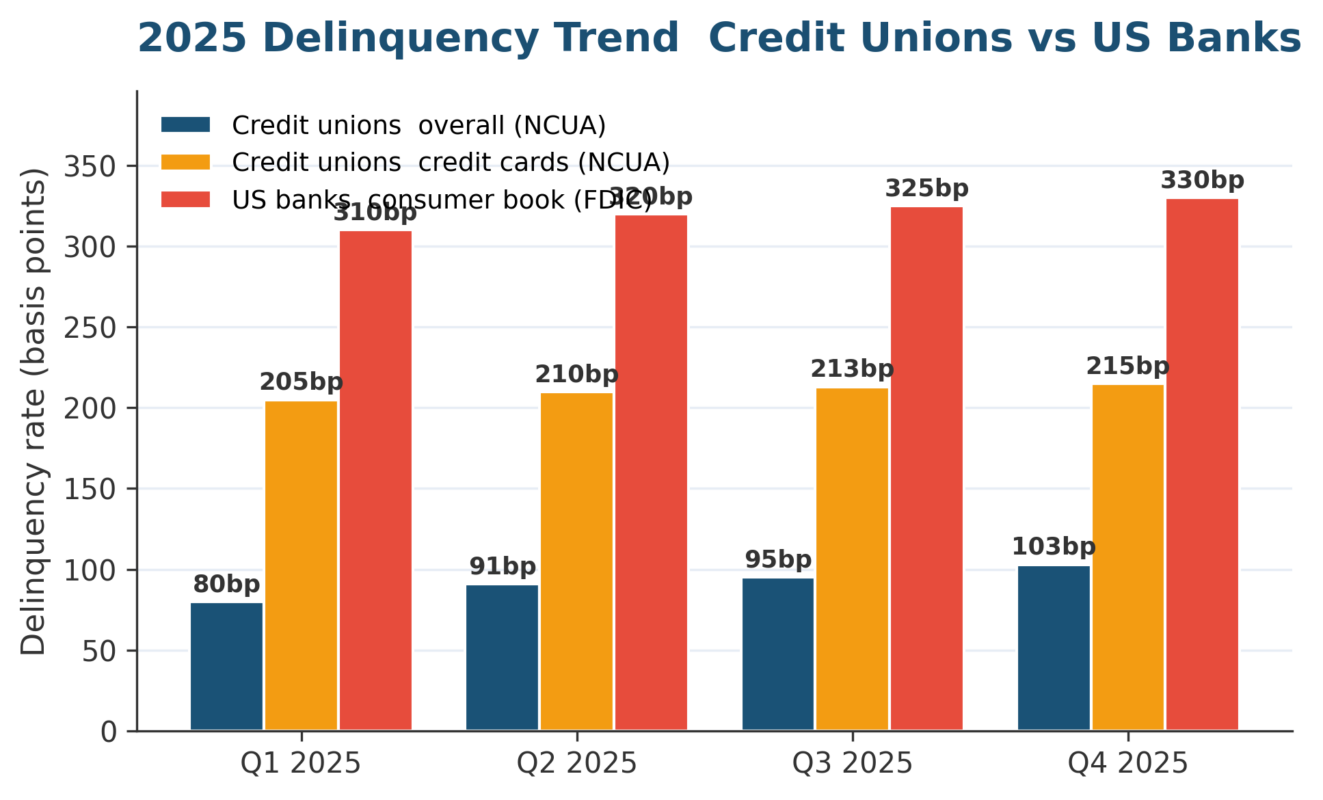
Figure 2. Key Risk Indicators for Banks and Credit Unions tracked through 2025 across NCUA credit union books and the US banking consumer portfolio.
Credit and Asset Quality Key Risk Indicators for Banks and Credit Unions
Asset quality is the A in CAMELS and the source of most loss-curve surprises. NCUA reported credit-card delinquency at 215 bp and non-commercial RE delinquency at 88 bp in Q4 2025, both higher than a year earlier.
The Federal Reserve DFAST 2025 projected $472 billion in aggregate loan losses across 22 large banks under severely adverse conditions.
Concentration is the failure pattern that repeats across the system, with the Citizens Bank of Sac City receivership the most recent reminder.
Mid-sized US banks report median CRE concentrations near 300 percent of Tier 1 plus reserves, with office segment delinquencies climbing past 5 percent.
Credit unions face parallel concentration risk in member business loans and indirect auto.
Top 11 Credit Key Risk Indicators for Banks and Credit Unions
| Credit / Asset Quality KRI | Green threshold | Amber threshold | Red threshold |
| NPL or delinquency ratio (90+ DPD) | <0.75% | 0.75-1.5% | >1.5% |
| Net charge-off ratio (annualized) | <0.50% | 0.50-1.0% | >1.0% |
| 30-89 DPD ratio (early stage) | <1.0% | 1.0-2.0% | >2.0% |
| ACL / total loans (CECL coverage) | >1.5% | 1.0-1.5% | <1.0% |
| ACL coverage of NPLs | >200% | 100-200% | <100% |
| CRE concentration / Tier 1 + ALLL | <200% | 200-300% | >300% |
| C&D concentration / Tier 1 + ALLL | <100% | 100-150% | >150% |
| Member business loan concentration (CU) | <10% | 10-12.25% | >12.25% |
| Single-name exposure / Tier 1 (or net worth) | <15% | 15-25% | >25% |
| Indirect auto share of consumer book | <25% | 25-40% | >40% |
| Watchlist + criticized assets ratio | <5% | 5-10% | >10% |
Member business loan concentration is the credit union KRI that maps to the FCU Act statutory cap of 12.25 percent of assets, with carve-outs that examiners watch closely.
The compliance risk assessment walk-through should treat any concentration above 10 percent as amber regardless of the carve-out.
Interest Rate and Market Risk Key Risk Indicators for Banks and Credit Unions
Interest rate risk is the S in CAMELS for both regulators. NCUA’s interest rate risk supervisory framework requires Net Economic Value tests at +/-300 basis points; the FFIEC parallel for banks runs Economic Value of Equity and Net Interest Income at risk under +/-200 bp. Both regimes produce KRI thresholds.
Net interest margins improved across community banks in 2025, reaching 3.77 percent (the highest since 2018) as funding costs declined faster than asset yields.
But the FDIC 2025 Risk Review still flagged unrealized losses on securities portfolios as elevated. The KRI dashboard must read both signals.
Top 8 Interest Rate Key Risk Indicators for Banks and Credit Unions
| Interest Rate / Market KRI | Green threshold | Amber threshold | Red threshold |
| EVE change under +/-200bp shock | <15% | 15-25% | >25% |
| NEV change under +/-300bp shock (CU) | <25% | 25-50% | >50% |
| NII at risk under +/-200bp (1-year) | <10% | 10-20% | >20% |
| Net interest margin (rolling 4Q) | >3.0% | 2.5-3.0% | <2.5% |
| Unrealized AFS securities losses / capital | <15% | 15-30% | >30% |
| Held-to-maturity / total securities | <40% | 40-60% | >60% |
| Duration of investment portfolio (years) | <4 | 4-6 | >6 |
| Non-maturity deposit beta (assumption) | <35% | 35-55% | >55% |
Deposit beta deserves separate visibility from the rate-shock metrics. An institution running a NEV shock test with a 25 percent non-maturity deposit beta is producing comfort-grade output.
Stress the beta to 45-55 percent and rerun the test; the KRI should sit on the second result, not the first.
Compliance and BSA/AML Key Risk Indicators for Banks and Credit Unions
Compliance KRIs catch policy drift before the consent order hits. The NCUA Compliance Risk Indicators framework defines six risk categories examiners evaluate inside the M (management) component of CAMELS. BSA/AML, fair lending, UDAAP, and consumer protection compliance feed the same dashboard.
The CFPB’s 2024-2025 enforcement docket included a $9 million Citizens Bank credit-card servicing order and an $18.5 million deposit-credit penalty.
The dismissed Capital One lawsuit involved a claimed $2 billion in consumer interest. A working compliance risk analysis treats each enforcement category as a KRI lane.
Top 10 Compliance Key Risk Indicators for Banks and Credit Unions
| Compliance / BSA-AML KRI | Green threshold | Amber threshold | Red threshold |
| BSA SAR backlog (open >30 days) | 0 | 1-5 | >5 |
| CTR filing accuracy rate | >99% | 97-99% | <97% |
| OFAC sanctions screening hits resolved <24h | >98% | 95-98% | <95% |
| Consumer complaint volume (CFPB + state) per 10k accounts | <2 | 2-5 | >5 |
| UDAAP review findings open >90 days | 0 | 1-3 | >3 |
| Fair lending HMDA disparity index | <1.20x | 1.20-1.50x | >1.50x |
| Reg E error resolution within 10 BD | >98% | 95-98% | <95% |
| Compliance training completion (annual) | >98% | 95-98% | <95% |
| Compliance Risk Indicators score (NCUA scale) | 1-2 | 3 | 4-5 |
| Open consent order or DOR items | 0 | 1-2 | >2 |
The BSA SAR backlog is the compliance KRI most likely to surface in an enforcement narrative.
FinCEN expectations and the BSA program self-assessment cycle treat any SAR open past 30 days as elevated risk. A backlog above five SARs typically signals an investigations-team capacity gap, not a one-off case.
Operational, Cyber and IT Key Risk Indicators for Banks and Credit Unions
Operational and cyber risk sits inside the M component of CAMELS but commands its own dashboard. The FFIEC IT Examination Handbook was updated in February 2026 to remove 92 references to reputation risk, shifting examiner focus to measurable financial impact. The KRI catalog must follow.
Ransomware, business email compromise, ACH fraud, and third-party software supply chain breaches drove the bulk of operational losses across US depositories in 2025.
The information security risk management program should feed cyber KRIs straight into the executive risk committee, not a separate IT dashboard.
Top 12 Operational and Cyber Key Risk Indicators for Banks and Credit Unions
| Operational / Cyber / IT KRI | Green threshold | Amber threshold | Red threshold |
| Ransomware or extortion detections per quarter | 0 | 1-2 | >2 |
| Phishing simulation click-through rate | <5% | 5-10% | >10% |
| MFA coverage on privileged accounts | 100% | 95-99% | <95% |
| Critical patches open beyond SLA | 0 | 1-5 | >5 |
| System availability (core banking) | >99.9% | 99.5-99.9% | <99.5% |
| RTO compliance for tier-1 applications | 100% | 90-99% | <90% |
| Fraud loss / total revenue (rolling 4Q) | <0.05% | 0.05-0.15% | >0.15% |
| ACH return rate (admin returns) | <0.30% | 0.30-0.50% | >0.50% |
| Card-fraud basis points on signature volume | <5bp | 5-10bp | >10bp |
| Third-party critical-vendor breaches | 0 | 1 | >1 |
| Privileged access reviews completed on time | >98% | 95-98% | <95% |
| Cyber insurance retention vs. probable max loss | >3x retention | 1-3x | <1x |
Third-party vendor breaches now appear on more enforcement narratives than internal control failures. A third-party risk management KRI tracks each critical vendor, their SOC 2 status, last penetration test, and any disclosed incidents. Treat a single critical-vendor incident as amber by default and a confirmed breach as red.
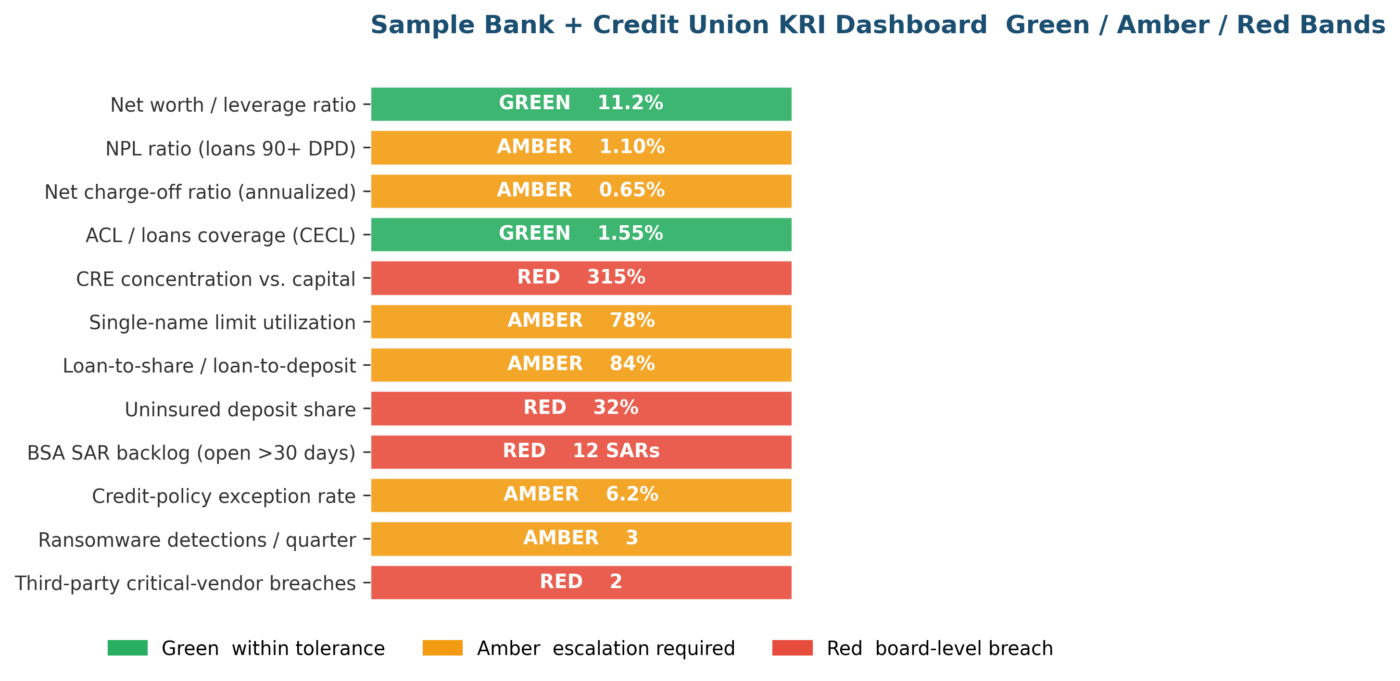
Figure 3. Illustrative dashboard of Key Risk Indicators for Banks and Credit Unions with green / amber / red bands across CAMELS components.
Mapping Key Risk Indicators for Banks and Credit Unions to CAMELS
Every KRI catalog inside a depository institution rolls up to the six CAMELS components the examiner rates.
Build the catalog inside the rating framework and the same indicators that drive the dashboard also drive the next examination response, the audit committee paper, and the supervisory follow-up. Skip that mapping and the work is done twice every quarter.
CAMELS Rollup for Key Risk Indicators for Banks and Credit Unions
| CAMELS | Primary KRIs feeding the component | Examiner reference / standard |
| Capital (C) | Net worth, Tier 1 leverage, CET1, RBC, AFS unrealized loss / capital, capital plan shortfall | Basel III final rule, PCA categories, NCUA Risk-Based Capital Rule |
| Asset quality (A) | Delinquency, NCO, ACL coverage, classified assets, CRE concentration, MBL concentration | OCC Heightened Standards, ASC 326 (CECL), NCUA examiner guide |
| Management (M) | BSA SAR backlog, complaint volume, exception rate, exam DOR aging, audit findings | FFIEC IT Handbook, NCUA Compliance Risk Indicators |
| Earnings (E) | NIM, ROA, efficiency ratio, fee-income share, non-interest expense growth | FDIC Quarterly Banking Profile, NCUA Quarterly Data Summary |
| Liquidity (L) | Loan-to-deposit / share, uninsured deposit share, wholesale funding, contingent capacity | FDIC community bank liquidity guidance, NCUA Letter 22-CU-08 |
| Sensitivity (S) | EVE / NEV shock results, NII at risk, deposit beta, securities duration, AOCI | FFIEC IRR guidance, NCUA IRR rule (Part 741.12) |
Tie each KRI to one CAMELS component on the dashboard. When the examiner asks how the bank or credit union monitors the L component, the answer is six indicators with thresholds and breach history, not a narrative paragraph.
A key risk indicators dashboard structured this way also feeds the audit committee paper without rework.
How to Implement Key Risk Indicators for Banks and Credit Unions
Standing up a program of Key Risk Indicators for Banks and Credit Unions is a six-step exercise inside the wider enterprise risk management framework.
The reference texts are BCBS Principles for Credit Risk Management, ISO 31000:2018, and Federal Reserve SR 11-7.
Six Steps to Deploy Key Risk Indicators for Banks and Credit Unions
- Step 1. Anchor in the CAMELS rating: Map every KRI to one CAMELS component. Multi-component KRIs (operational losses, compliance findings) get a primary tag and a cross-reference, not split ownership.
- Step 2. Calibrate thresholds: Set green / amber / red bands using internal trend data, FFIEC Uniform Bank Performance Report or NCUA Financial Performance Report peer percentiles, and the board-approved risk appetite statement.
- Step 3. Assign owners: Every KRI has one named first-line owner and one second-line risk partner. The CCO owns BSA SAR backlog; the CFO owns NIM and AOCI; the CIO owns ransomware detection and patch SLA; the CRO owns the rollup.
- Step 4. Define escalation: Document who is notified at each band, the response window, the executive risk committee trigger, and the board-paper threshold. Escalation without timelines is decoration, not governance.
- Step 5. Automate collection: Pull data from the core banking system, GL, GRC tool, ALLL workbench, BSA/AML transaction monitoring, vendor management portal, and external feeds (FRED, FFIEC UBPR, NCUA FPR) into a single workbench.
- Step 6. Review quarterly: Recalibrate thresholds against the latest peer report, retire indicators that never breach, replace those that always breach, and add KRIs for newly identified risks (AI underwriting, climate, geopolitics).
Common Pitfalls in Key Risk Indicators for Banks and Credit Unions
Implementation failures around Key Risk Indicators for Banks and Credit Unions tend to recur at every institution size.
Global systemically important banks and $200 million credit unions alike, the traps below keep coming up in supervisory examinations, internal audit reviews, and post-failure FDIC OIG reports.
| Pitfall | Root cause | Remedy |
| KPI / KRI confusion | NPL or NCO reported as both with a single threshold | Document the threshold (KRI) separately from the budget target (KPI); report side by side on the same dashboard |
| Concentration blind spot | Trucking, office CRE, indirect auto, or MBL buried inside totals | Surface concentrations by sector, geography, and product as distinct KRIs on the executive risk committee paper |
| Static thresholds | Bands set at framework launch and never recalibrated | Quarterly review tied to FFIEC UBPR or NCUA FPR peer percentiles and internal loss trends |
| Reputation risk over-rotation | Catalog still anchored to a removed FFIEC concept | Translate reputation indicators into measurable financial drivers (complaints, fraud loss, deposit attrition) |
| CECL silo | ACL coverage reported only to controller and audit committee | Promote CECL coverage, reserve build, and Q-factor weight to the credit risk dashboard |
| Vanity dashboards | Beautiful charts no committee acts on | Tie each amber / red band to a triggered action; track action closure as a meta-KRI |
| Annual-only cadence | KRIs reviewed once per year for the audit committee | Quarterly delta review of high-severity KRIs; weekly automated alerts on delinquency, deposit, and cyber metrics |
Frequently Asked Questions About Key Risk Indicators for Banks and Credit Unions
What are the most important Key Risk Indicators for Banks and Credit Unions?
The seven most important Key Risk Indicators for Banks and Credit Unions are net worth or Tier 1 leverage ratio, NPL or delinquency ratio, net charge-off ratio, ACL coverage of NPLs, CRE or MBL concentration vs. capital, uninsured deposit share, and BSA SAR backlog. They map directly to four CAMELS components.
Add 30 to 50 more across the six categories for a full FFIEC- and NCUA-aligned program. The seven above earn permanent slots on the executive risk committee paper because each carries a documented enforcement, failure, or supervisory-criticism precedent in the past five years.
How many Key Risk Indicators for Banks and Credit Unions should an institution track?
US community banks, regional banks, and federally insured credit unions typically run 40 to 60 Key Risk Indicators for Banks and Credit Unions in total, with 10 to 15 elevated to the executive risk committee each quarter. Tracking fewer than 25 leaves CAMELS blind spots.
Tracking more than 70 invites monitoring fatigue and dilutes committee attention. The right number scales with asset size, charter type, and complexity, not with the GRC tool’s library. A $500 million community bank does not need the same catalog as a $50 billion regional.
How do Key Risk Indicators for Banks and Credit Unions differ from KPIs?
Key Risk Indicators for Banks and Credit Unions measure exposure against a tolerance, while KPIs measure performance against a goal. A KPI tells the lending team whether originations hit plan. A KRI tells the board whether the risk of charge-offs missing plan is rising.
The same raw metric (NPL ratio, deposit growth, exception rate) can serve both purposes if its threshold (KRI) and target (KPI) are documented separately and shown side by side on the board paper. Conflating them is the most common audit finding.
Which standards govern Key Risk Indicators for Banks and Credit Unions?
The dominant references are the FFIEC IT Examination Handbook, NCUA CAMELS rating system (Appendix A), OCC Heightened Standards, Basel III final rule, BCBS Principles for the Management of Credit Risk, ISO 31000:2018, ASC 326 (CECL), and Federal Reserve SR 11-7 model risk.
Banks above $250 billion in assets add CCAR, DFAST, and the Stress Capital Buffer rules. Credit unions add the NCUA IRR rule (Part 741.12), the MBL rule (Part 723), and the Compliance Risk Indicators framework as direct examination references.
How often should Key Risk Indicators for Banks and Credit Unions be reviewed?
Key Risk Indicators for Banks and Credit Unions should be measured continuously where the core banking system, ALLL workbench, and BSA/AML monitoring permit. Review weekly at the operating level, monthly at the executive risk committee, and quarterly at the board or audit-and-risk committee.
Delinquency, deposit-runoff, and cyber-detection KRIs warrant real-time alerts wired into the executive risk committee chat or pager channel.
CECL coverage, interest-rate-shock, and capital-buffer KRIs run on a monthly cadence tied to the ALLL workbench and the treasury IRR model. Origination-quality KRIs anchor on each quarterly vintage cohort once the data has seasoned enough to be reliable.
Can credit unions use the same Key Risk Indicators for Banks and Credit Unions as banks?
Yes, with calibration. Credit unions and banks share most of the CAMELS architecture, so the same KRI definitions apply. The differences live in specific names (loan-to-share vs. loan-to-deposit), regulatory thresholds (12.25 percent MBL cap), and peer ranges (NCUA FPR vs. FFIEC UBPR).
Thresholds change with asset size, business mix, and charter type, but the metric definitions do not. The most common mistake is lifting a bank KRI catalog into a credit union without recalibrating the thresholds against NCUA peer data. The dashboard fails the next examination.
How does the 2026 FFIEC IT Handbook update affect Key Risk Indicators for Banks and Credit Unions?
The February 2026 FFIEC update removed 92 references to reputation risk from the IT Examination Handbook.
Key Risk Indicators for Banks and Credit Unions should now translate the old reputation indicators into measurable financial drivers: consumer-complaint volume, deposit-attrition velocity, fraud losses, social media incident counts, and earnings impact.
The cultural shift is bigger than the wording. Examiners now weight indicators that can be tied to capital, earnings, or liquidity above ones that read as brand or perception. Update the KRI catalog accordingly and document the rationale in the next risk appetite refresh.
How do Key Risk Indicators for Banks and Credit Unions feed board reporting?
Key Risk Indicators for Banks and Credit Unions feed the quarterly board paper through a tiered CAMELS rollup.
Function-level dashboards aggregate to enterprise heat maps, with the top 10 to 15 indicators reaching the audit-and-risk committee or the full board. Each row shows trend, breach history, owner, and remediation status.
The board paper should anchor every KRI to the institution’s risk appetite statement and the CAMELS component it serves. Without that structure, the directors see decoration rather than decision support, and the next examination cycle exposes the gap. A key elements of a risk register walk-through helps tighten the rollup.
Looking Ahead: Key Risk Indicators for Banks and Credit Unions in 2026 and 2027
Commercial real estate sits at the top of the 2026 agenda for both charters. The $2 trillion CRE debt maturity wall runs through 2026-2027, with office credit at the center. CRE concentration ratios, office-segment delinquency, and CMBS extension activity will dominate the credit-side KRI dashboard.
Consumer credit normalization runs alongside CRE. NCUA delinquency reached 103 bp in Q4 2025 and credit-card delinquency held at 215 bp. Bank consumer books trended similarly. Consumer-portfolio KRIs and household debt-service KRIs will keep board attention through 2026 even as charge-offs plateau.
FFIEC’s reputation-risk removal pushes the catalog toward measurable financial drivers. Cyber, third-party, fraud, and BSA/AML indicators move further up the dashboard.
AI underwriting and AI-driven fraud detection become net-new KRI lanes that did not exist three years ago. The 2026-2027 catalog will look meaningfully different from the 2023 version.
A live KRI dashboard with quarterly recalibration is what holds up under OCC, FDIC, NCUA, and Federal Reserve scrutiny. Without it, boards rotate through the same concerns until the next loss-curve surprise or supervisory finding forces one of them to the top of the agenda.
Ready to Operationalize Key Risk Indicators for Banks and Credit Unions?
At riskpublishing.com we help US community banks, regional banks, and federally insured credit unions build catalogs of Key Risk Indicators for Banks and Credit Unions that hold up under board questions, FFIEC examinations, NCUA reviews, rating-agency surveillance, and internal audit testing across capital, asset quality, liquidity, sensitivity, compliance, and operational risk.
The work usually includes the KRI catalog, a threshold calibration workshop tied to FFIEC UBPR or NCUA FPR peer ranges, a function-to-CAMELS rollup model, and a quarterly board-paper template anchored to the FFIEC IT Handbook, NCUA CAMELS, OCC Heightened Standards, Basel III, ASC 326, and SR 11-7.
Explore our risk advisory services, or contact us to scope a KRI maturity review tailored to your charter type, asset size, portfolio mix, examination cycle, and 2026-2027 regulatory priorities.
A typical engagement closes with a board-ready dashboard and a quarterly recalibration playbook tied to FFIEC UBPR or NCUA FPR peer percentiles.
Related reading on riskpublishing.com: Key Risk Indicators examples, how to develop Key Risk Indicators, how to use Key Risk Indicators, best Key Risk Indicators, Key Risk Indicators developing risk appetite, Key Risk Indicators Enterprise Risk Management, cybersecurity risk management, and the integrated risk management approach.
Sibling industry KRI guides: For practitioners benchmarking across sectors, see our companion deep-dives on Key Risk Indicators for insurance companies, Key Risk Indicators for healthcare providers, strategic risk Key Risk Indicators examples, and board risk reporting one-page dashboard. Each guide maps industry-specific regulatory drivers, threshold logic, and dashboard examples to help risk teams calibrate their own KRI library. Browse KRI guides for every sector in one place.

Chris Ekai is a Risk Management expert with over 10 years of experience in the field. He has a Master’s(MSc) degree in Risk Management from University of Portsmouth and is a CPA and Finance professional. He currently works as a Content Manager at Risk Publishing, writing about Enterprise Risk Management, Business Continuity Management and Project Management.