Carbon accounting software stopped being a sustainability-team luxury on June 24, 2026, when the California Air Resources Board extended the first SB 253 reporting deadline from August 10 to November 10, 2026. US companies with over $1 billion in revenue doing business in California now have under four months to file their first scope 1 and 2 emissions reports.
| Carbon Accounting Software: Key Takeaways |
| CARB extended the first-ever SB 253 deadline on June 24, 2026: US companies over $1 billion in revenue doing business in California now file scope 1 and 2 emissions by November 10, 2026, with penalties up to $500,000 per year. |
| Scope 3 capability decides the shortlist: CDP’s supply chain analysis puts value-chain emissions at 26 times operational emissions on average, and SB 253 scope 3 reporting starts in 2027. |
| The carbon accounting market sits at $21.96 billion in 2025 and is projected to reach $79.46 billion by 2030, a 29.3% annual growth rate, per Mordor Intelligence. |
| Watershed leads for enterprise decarbonization programs, Persefoni for audit-grade financial rigor, Sweep for AI-led value-chain modeling, Greenly for mid-market speed, and Microsoft Sustainability Manager for Microsoft-stack integration. |
| Treat the purchase as an assurance decision: the platform’s audit trail, emission-factor versioning, and GHG Protocol alignment matter more than its dashboard once limited assurance begins. |
| Every deployment should feed the risk program: emissions data drives climate KRIs, transition risk assessment, and the supplier engagement your scope 3 number depends on. |
The stakes are written into the statute: penalties of up to $500,000 per entity per year for non-filing or late filing, per CARB’s implementing regulation adopted in February 2026. Scope 3 reporting follows in 2027, and PwC’s analysis of the rules counts thousands of companies in scope, most of which have never produced an audit-ready emissions inventory.
We compare five leading carbon accounting software platforms through a risk practitioner’s lens: Watershed, Persefoni, Sweep, Greenly, and Microsoft Sustainability Manager. The test is not which dashboard looks best, but which system produces a defensible number on a regulatory clock and feeds the ESG risk management program around it.
Why Carbon Accounting Software Moved from Optional to Audited
California opened the era of mandatory US emissions reporting, and it did not act alone. Over 40 jurisdictions are progressing ISSB-aligned climate disclosure under IFRS S2, the EU’s CSRD brings delayed waves of companies into scope from 2027, and EPA’s Greenhouse Gas Reporting Program already covers large US emitters at the facility level.
| Regime | Who it reaches | First carbon deadline | Assurance path |
| California SB 253 | US companies >$1B revenue doing business in CA | Scopes 1-2 by Nov 10, 2026; scope 3 in 2027 | Limited assurance phasing in |
| California SB 261 | US companies >$500M revenue in CA | Climate-risk reports began January 2026 | Public posting, biennial |
| EU CSRD / ESRS | Large EU companies; non-EU groups later | Delayed waves resume 2027-2028 | Limited assurance mandatory |
| ISSB IFRS S2 | 40+ adopting jurisdictions | Rolling by jurisdiction | Jurisdiction-set |
| EPA GHGRP | Large US emitting facilities | Annual, established | EPA verification |
The market has priced this shift already. Mordor Intelligence sizes carbon accounting at $21.96 billion in 2025, projected to reach $79.46 billion by 2030 at a 29.3% annual growth rate, which is the clearest signal that emissions data is becoming standing financial infrastructure.
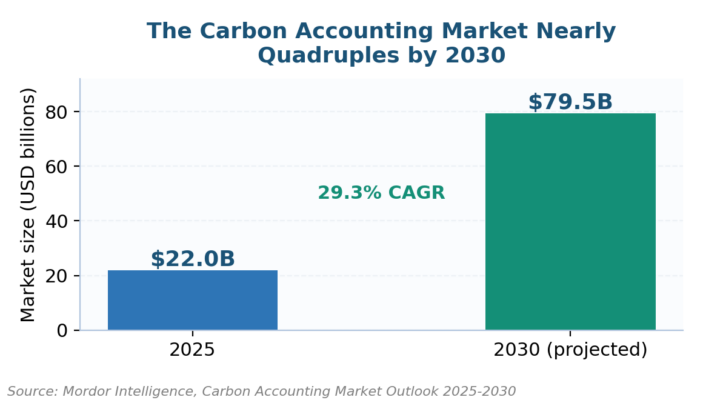
Figure 1. A near-quadrupling in five years, per Mordor Intelligence.
For US risk teams the practical translation is simple. Emissions numbers now carry filing deadlines, penalty exposure, and assurance requirements, which moves them from the sustainability report into the same governance category as the disclosures covered in our guide to SEC climate rules and their ERM implications.
What Carbon Accounting Software Actually Does
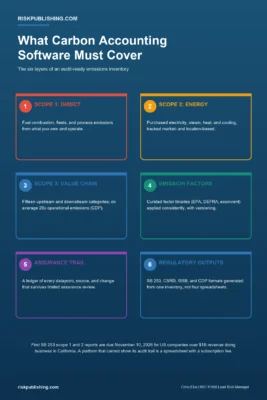
Strip the branding away and every platform performs the same four jobs: collect activity data, apply emission factors, allocate results across the GHG Protocol Corporate Standard’s three scopes, and generate outputs regulators and auditors accept. The differences that matter live in data lineage, factor versioning, and scope 3 modeling depth.
| Scope | What it covers | Where the data comes from |
| Scope 1 | Direct emissions: fuel combustion, fleets, process and fugitive emissions | Fuel invoices, meter data, refrigerant logs, ERP records |
| Scope 2 | Purchased electricity, steam, heat, and cooling (market- and location-based) | Utility bills, energy contracts, renewable certificates |
| Scope 3 | Fifteen value-chain categories, purchased goods to product use and disposal | Supplier data, spend records, logistics files, product models |
Scope 3 is where platforms earn or lose their fee. CDP’s supply chain analysis puts value-chain emissions at 26 times operational emissions on average, a multiple BCG’s joint release confirmed across more than 23,000 disclosing companies, and SB 253 brings those categories into mandatory reporting in 2027.
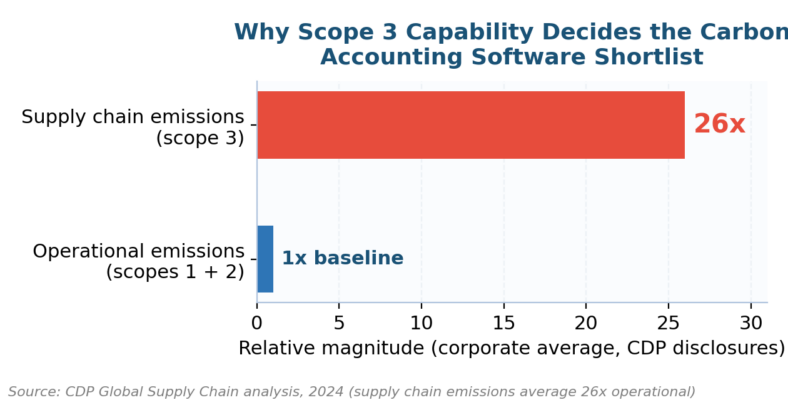
Figure 2. The 26x multiple is why scope 3 modeling quality decides the purchase.
That multiple also means a carbon accounting inventory is only as good as the supplier data feeding it. Platforms that automate supplier outreach connect directly to the supplier performance risk management and critical supplier tiering work your procurement and risk teams already run.
Head-to-Head: Five Carbon Accounting Software Platforms Compared
The five carbon accounting software platforms below span the deployment spectrum, from enterprise decarbonization programs to mid-market teams producing a first inventory. Verdantix named Watershed and Sweep leaders in its 2026 Green Quadrant, and each vendor’s own materials are linked in the profiles for verification.
| Capability | Watershed | Persefoni | Sweep | Greenly | Microsoft SM |
| Core strength | Finance-grade enterprise carbon and ESG in one platform | Audit-ready carbon ledger built like financial accounting | AI-led value-chain and portfolio modeling | Fast deployment with expert support for mid-market | Native integration across the Microsoft stack |
| Scope 3 depth | Deep, supplier-level engagement tooling | Strong, incl. financed emissions (PCAF) | Deep via value-chain trees | Spend-based plus activity upgrades | Category coverage via connectors |
| Frameworks | CSRD, ISSB, CDP, GRI, SB 253 | CSRD, ISSB, SEC-style, SB 253 | CSRD, SBTi, CDP, SB 253 | GHG Protocol, CDP, CSRD basics | GHG Protocol, ESRS templates |
| Best fit | Large enterprises running decarbonization programs | Financial institutions and audit-focused filers | Complex value chains and portfolios | SMBs and mid-market first filers | Organizations standardized on Azure and Dynamics |
| Watch for | Premium pricing | Finance-first learning curve | Modeling setup effort | Lighter enterprise controls | Configuration over turnkey |
Watershed: Enterprise Carbon Accounting at Decarbonization Scale
Watershed positions carbon accounting as the start of a reduction program rather than a filing exercise, pairing finance-grade measurement with marketplace access to clean power and supplier engagement. It aligns to more than ten disclosure frameworks including CSRD, ISSB, and CDP, and suits enterprises with experienced sustainability teams.
Persefoni: Carbon Accounting Built Like Financial Accounting
Persefoni treats emissions the way controllers treat ledgers: its Footprint Ledger carries SOC 1 and SOC 2 certifications and is designed to survive financial-grade audit. Financial institutions get PCAF-aligned financed-emissions accounting, which makes it the default shortlist entry for banks, insurers, and asset managers preparing for assurance.
Sweep: AI-Led Carbon Accounting Across the Value Chain
Sweep models organizations as connected trees, mirroring subsidiaries, suppliers, and portfolios so scope 3 rolls up without spreadsheet gymnastics. A Verdantix 2026 Green Quadrant leader, it fits companies whose emissions live mostly in complex value chains and who want automation carrying the collection burden.
Greenly: Carbon Accounting for Mid-Market Speed
Greenly gets a first defensible inventory live in weeks, combining spend-based estimates with activity-data upgrades and analyst support along the way. Mid-market US filers pulled into SB 253 scope through the $1 billion revenue test will find it the fastest route to a November-ready number.
Microsoft Sustainability Manager: Carbon Accounting Inside the Microsoft Stack
Microsoft Sustainability Manager pulls emissions and operational data directly from Azure, Dynamics 365, and Power Platform sources, so organizations standardized on Microsoft avoid building a separate data pipeline. The trade is configuration effort: it behaves like a platform to implement rather than a turnkey product.
How to Evaluate Carbon Accounting Software Before You Buy
Run the carbon accounting software evaluation like an assurance exercise, because that is exactly what it becomes within two reporting cycles. The six criteria below separate demo-room winners from the platforms still standing after an auditor’s first data-lineage request lands.
| Criterion | What to test | Disqualifier |
| Audit trail | Trace one number from report back to source invoice | Aggregates that cannot be decomposed |
| Emission factors | Library sources, versioning, and override logging | Unversioned or undocumented factors |
| Scope 3 method | Spend-based vs activity-based mix; supplier data workflow | Spend-only with no upgrade path |
| Regulatory outputs | SB 253, CSRD/ESRS, ISSB, and CDP formats from one inventory | One framework per re-keyed dataset |
| Integration | ERP, utility, and procurement connectors; API access | CSV-only data movement at enterprise scale |
| Assurance readiness | Prior audits survived; SOC certifications; reviewer access | No assurance track record at all |
Weight the criteria by your filing exposure, not by feature count. A $1.2 billion revenue company facing November’s deadline needs audit trail and regulatory outputs first, while a mid-market voluntary reporter can trade some rigor for speed, the same portfolio logic our ESG reporting software comparison applies to the disclosure layer.
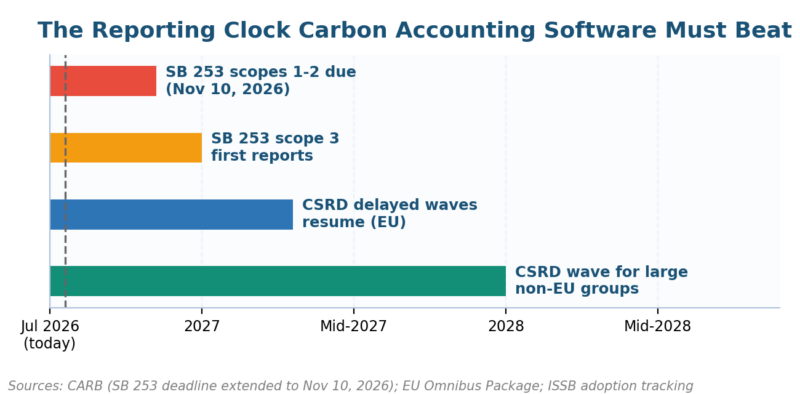
Figure 3. The clock as of July 2026: California first, scope 3 and CSRD waves close behind.
Connecting Carbon Accounting Software to the Risk Program
The inventory is not the finish line; it is a data feed for risk management. Emissions trends, factor volatility, and supplier data-quality rates all make strong climate risk KRIs, and the transition exposures the numbers reveal belong in your climate transition risk assessment and risk register rather than a sustainability silo.
| Buyer profile | Primary recommendation | Pair it with |
| Enterprise with decarbonization mandate | Watershed | SBTi target-setting; supplier engagement program |
| Bank, insurer, or asset manager | Persefoni | PCAF financed-emissions rollout |
| Complex value chain or portfolio | Sweep | Supplier tiering and outreach workflow |
| Mid-market, first SB 253 filing | Greenly | Analyst support through first assurance |
| Microsoft-standardized IT estate | Microsoft Sustainability Manager | Dynamics and Azure data connectors |
Decarbonization targets close the loop. Once the baseline is assured, platforms feed Science Based Targets initiative submissions and progress tracking, and the supply-chain reduction levers connect back to NIST’s C-SCRM guidance your vendor-risk program already uses. Measurement without a reduction pathway is an expensive receipt.
Ownership seals the connection. Give the carbon accounting platform a named business owner who answers for data quality the way a controller answers for the ledger, and put emissions data-completeness on the same KRI scorecard the risk committee already reads, because unowned inventories decay within two reporting cycles.
What Goes Wrong in Carbon Accounting Software Rollouts and the Fixes That Work
Rollout failures repeat across industries, and most trace to treating the purchase as an IT project instead of a reporting control. The six below come from published assurance findings and buyer post-mortems, and each fix costs less than a restated emissions number.
| Failure mode | Why it happens | Fix |
| Spend-based scope 3 forever | Estimates were easy in year one | Contract an activity-data upgrade path by category |
| Factor library drift | Updates applied without versioning | Require factor version logs and change approvals |
| Utility data by hand | Connectors deferred to phase two | Automate scopes 1-2 feeds before go-live |
| Inventory built by one contractor | Knowledge leaves with the engagement | Named internal owner plus documented methodology |
| Platform picked by sustainability alone | Finance and audit join at assurance time | Controller and internal audit sit in vendor demos |
| Numbers never reach risk | Emissions treated as a reporting artifact | Wire outputs into KRIs and the risk register from day one |
Frequently Asked Questions About Carbon Accounting Software
What is carbon accounting software?
Carbon accounting software measures, manages, and reports an organization’s greenhouse gas emissions across scopes 1, 2, and 3 of the GHG Protocol. It collects activity data from systems and suppliers, applies versioned emission factors, and generates regulator-ready outputs for SB 253, CSRD, ISSB, and CDP with an auditable trail.
Who needs carbon accounting software for SB 253?
US companies with over $1 billion in annual revenue doing business in California must report scope 1 and 2 emissions by November 10, 2026, and scope 3 from 2027, with penalties up to $500,000 per year. Suppliers below the threshold will feel it too, because in-scope customers need their data for scope 3.
Which carbon accounting software is best for large enterprises?
Watershed leads for enterprises running full decarbonization programs, and Persefoni leads where audit-grade rigor and financed emissions matter most, with both recognized in analyst evaluations. Sweep competes strongly when value-chain complexity dominates. Shortlist two, then test the audit trail with your own invoices before signing anything.
How much does carbon accounting software cost?
Pricing is quote-based across the market: mid-market platforms such as Greenly typically start in the low tens of thousands per year, while enterprise deployments with scope 3 modules and assurance support run well into six figures. Budget separately for data integration and the first assurance cycle, which buyers consistently underestimate.
Can carbon accounting software handle scope 3 emissions properly?
The strongest platforms combine spend-based estimates for coverage with activity-based data for the categories that dominate your footprint, then automate supplier outreach to upgrade quality over time. Given scope 3 averages 26 times operational emissions per CDP, the upgrade path from estimates to primary data is the capability to interrogate hardest.
How does carbon accounting software fit into risk management?
Treat the platform as a control and a data source: its outputs feed climate KRIs, transition risk assessment, and the five-step risk management process like any other exposure data. Filing deadlines and penalty clauses also make the software itself a compliance dependency worth registering, alongside the ERM platforms it should integrate with.
What’s Coming Next for Carbon Accounting Software: 2026 to 2028
Assurance is the next filter. California phases in limited assurance, CSRD already mandates it, and platforms will separate into those whose audit trails survive external review and those that quietly re-position as estimation tools. Buy for the audited world, not the voluntary one.
Expect consolidation with the broader risk stack. Carbon data is converging with ESG data platforms and operational resilience tooling, and the vendors that expose clean APIs into ERM systems will outlast standalone calculators as boards ask for one integrated exposure picture.
Supplier-level primary data will replace industry averages faster than most roadmaps assume. As thousands of SB 253 and CSRD filers request the same supplier numbers, disclosure becomes a commercial qualification, and the platforms that manage that outreach at scale will set the standard everyone else licenses.
Choose Carbon Accounting Software With Risk Publishing
If your first SB 253 filing is due in November and your inventory still lives in spreadsheets, the selection decision is now a deadline decision. Explore our services or contact us for an independent, framework-mapped platform selection built around your filing exposure and assurance path.

Chris Ekai is a Risk Management expert with over 10 years of experience in the field. He has a Master’s(MSc) degree in Risk Management from University of Portsmouth and is a CPA and Finance professional. He currently works as a Content Manager at Risk Publishing, writing about Enterprise Risk Management, Business Continuity Management and Project Management.