A business continuity management program is what separated the airlines on July 19, 2024, when a defective CrowdStrike update crashed 8.5 million Windows machines and cost the Fortune 500 an estimated $5.4 billion. Delta alone absorbed $500 million and days of cancellations, while competitors flying the same software recovered over a weekend. For the boundary at the top of the discipline, see the difference between risk management and crisis management and where continuity sits between them.
The gap was preparation, and the exposure keeps growing. Uptime Institute’s Annual Outage Analysis 2025 found one in five operators’ most recent serious outage cost more than $1 million, while Splunk and Oxford Economics put downtime at $400 billion a year across the Global 2000.
| Business Continuity Management Program: Key Takeaways |
| The July 2024 CrowdStrike outage cost the Fortune 500 $5.4 billion, and Delta’s $500 million share showed how differently prepared airlines absorbed the same event. |
| Uptime Institute’s 2025 analysis found one in five operators’ most recent serious outage cost more than $1 million; 54% crossed $100,000. |
| A business continuity management program runs a six-stage annual cycle: policy, business impact analysis, strategy, plans, exercises, and review, per ISO 22301:2019. |
| The BIA is the load-bearing stage: recovery time objectives set there drive every downstream plan, workaround, and technology investment. |
| Exercise at least twice a year; a plan that has never hit its recovery targets in a drill will not hit them in a disruption. |
| This hub links every riskpublishing.com business continuity guide, template, and software comparison in one place, organized by program stage. |
This page is the hub for our full business continuity library. It walks the program cycle end to end, then points you to the detailed guide, template, or software comparison for each stage, so treat it as the table of contents a working continuity program deserves.
What a Business Continuity Management Program Includes
Start with the distinction that trips up most first-time builders. A plan is a document; a business continuity management program is the standing capability that produces, tests, and maintains that document, with governance, budget, and a named owner. ISO 22301:2019 defines the management-system version of that capability.
| Program component | What it establishes | Deep-dive guide |
| Policy and governance | Scope, roles, budget, and board oversight | Key elements of BCM |
| Business impact analysis | Critical activities, RTOs, RPOs, and dependencies | How to perform a BIA |
| Risk assessment | Disruptive threat scenarios and their controls | BC plan risk assessment |
| Strategy and solutions | Recovery options costed against downtime tolerance | Effective BC planning process |
| Plans and procedures | Response, recovery, and restoration playbooks | Essential BCP components |
| Exercises and maintenance | Drills, scoring, and continuous improvement | 15 ready exercise scenarios |
If you are still making the case internally, our primer on why you need a business continuity plan carries the argument, and the management-system view of BCM shows what the capability looks like once it matures past a binder on a shelf.
Size changes the packaging, never the logic. A ten-person firm can run the whole program in a twenty-page document and one afternoon drill a year, while a bank runs the same six components as a certified management system with dedicated staff. Scale the artifacts to the organization, and keep the components intact.
Vocabulary drifts across frameworks, so pin it down once for your organization. Program, plan, BCMS, and framework get used interchangeably in vendor material, and our overview of business continuity management as a discipline untangles the terms before they cause scoping arguments in your steering committee.
The Business Case for Business Continuity Management in 2026
Boards fund continuity when the numbers are framed as exposure, so lead with the distribution rather than the average. Most outages stay survivable, and the tail is where the program pays: the million-dollar-plus events that Uptime Institute finds behind one serious outage in five.
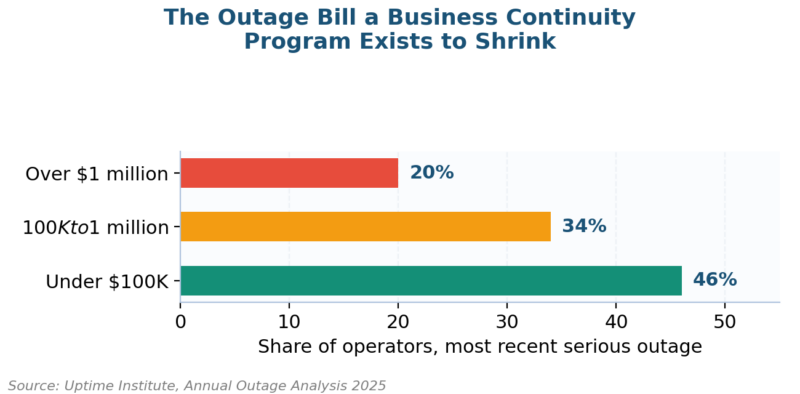
Figure 1. The tail funds the program: one in five serious outages now clears $1 million.
The 2024-2025 record supplies the named cases. The October 2025 AWS US-EAST-1 outage ran roughly 15 hours and degraded a thousand services, and Amazon’s own postmortem is a free education in dependency risk. Change Healthcare’s ransomware event became a $3 billion-plus disruption for UnitedHealth.
Sector guides make the business continuity case concrete for whichever audience you brief next: business continuity planning in banking carries FFIEC expectations, dental and clinical practices face patient-safety stakes, and crypto and digital-asset firms run continuity against 24/7 markets with no closing bell.
Insurance rounds out the argument, because most of the loss never comes back. Reinsurance estimates put insured CrowdStrike losses at a fraction of the $5.4 billion total, and the same pattern held for the AWS event, so the business continuity program is effectively self-insurance for the uninsurable majority of downtime cost.
The Business Continuity Management Program Cycle
Funding secured, the program runs as an annual cycle rather than a project with an end date. Six stages repeat, each feeding the next, and the FFIEC Business Continuity Management handbook and ISO 22301 both describe essentially this loop with different vocabulary.
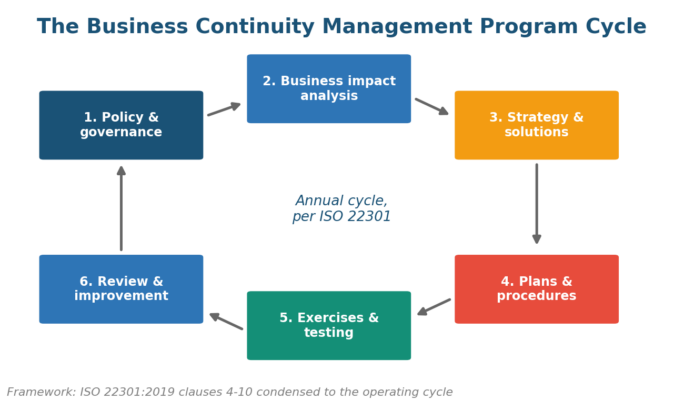
Figure 2. Six stages, one loop: review findings restart the cycle as policy updates.
Policy and Governance in the Business Continuity Program
Governance decides whether the cycle actually turns. The policy names the executive owner, defines scope in terms of products and services rather than departments, and commits a budget line that survives the years when nothing goes wrong. Those three commitments are what auditors read first.
Board reporting closes the governance loop. One annual continuity report covering exercise results, open gaps, and maturity trend keeps the program visible without exhausting the audience, and it creates the paper trail that regulators and certification auditors both ask for by name.
From Business Impact Analysis to Business Continuity Strategy
The BIA is the stage that decides whether everything downstream is evidence or guesswork. Rank critical activities, set recovery time and recovery point objectives with service owners, and map dependencies, then cost recovery strategies against those targets. Our step-by-step BIA guide includes the workshop structure.
Exercising and Maturing the Business Continuity Program
Plans decay from the day they are approved, so the exercise calendar is the program’s honesty mechanism. Run at least two per year across varied scenarios, score results against the continuity maturity model, and log gaps as owned actions. DRI International’s Professional Practices set the competency bar for the people running them.
Continuity also has neighbors it must shake hands with. The incident response plan handles the first hours before continuity arrangements take over, disaster recovery restores the technology layer, and supply chain response plans cover the vendor-origin disruptions that now dominate the threat mix.
The Business Continuity Library: Guides, Templates, and Software
This is the shelf the rest of the hub points to. Every link below is a full riskpublishing.com guide, organized by what you are trying to produce, and the templates are ready to adapt rather than admire. Start with the plan checklist if you need momentum today.
| Build this | Use this guide or template |
| A first business continuity plan | Word BCP template for small organizations |
| A complete plan section list | Essential components of a business continuity plan |
| A pre-audit readiness check | Business continuity plan checklist template |
| The BIA that anchors the program | How to perform a business impact analysis |
| An exercise calendar with scripts | 15 ready business continuity exercise scenarios |
| A maturity score for the board | Business continuity maturity model scoring guide |
| An ISO 22301 implementation path | ISO 22301 business continuity management guide |
| The incident-side response plan | Incident response plan template walkthrough |
Read them in program order rather than alphabetically. The template gets a first plan drafted this quarter, the BIA guide makes the second draft honest, the exercise scenarios prove it, and the maturity model tells the board how far the business continuity program has actually come since last year.
Tooling comes last, once the program shape is set, because software automates a design instead of supplying one. Our comparison series ranks the current vendor field for each layer of the resilience stack, and we refresh the rankings as products and pricing move through the year.
| Software layer | Current comparison |
| Business continuity management platforms | Best business continuity management software compared |
| Crisis management and mass notification | Top crisis management software compared |
| Operational resilience suites | Best operational resilience software compared |
| Incident management tooling | Best incident management software |
Business Continuity Regulations and Standards
The regulatory floor keeps rising under business continuity programs, and citing the right anchor shortens every internal argument about scope and budget. US practitioners answer to sector-specific rules first, while ready.gov’s continuity guidance gives smaller organizations a free federal baseline to start from.
| Standard or rule | Who it reaches | What it expects |
| ISO 22301:2019 | Any organization seeking certification | A full BCMS: policy, BIA, strategy, plans, exercises, improvement |
| FFIEC BCM booklet | US financial institutions | Board-owned, enterprise-wide continuity with tested recovery |
| NIST SP 800-34 | Federal systems and their contractors | IT contingency plans mapped to system impact levels |
| DORA (EU) | EU financial entities and their US parents | Digital resilience testing, ICT continuity, incident reporting |
| CISA playbooks | US critical infrastructure, advisory | Standardized response and recovery integration |
Federal anchors help technology-heavy programs most. NIST SP 800-34 remains the reference for IT contingency planning and maps cleanly onto BIA impact levels, while CISA’s response and recovery playbooks give continuity teams a shared vocabulary with the incident responders they hand off to.
EU-touching firms should pair this hub with our DORA incident classification guide and the DORA versus NIS2 comparison, because European resilience rules now reach US parent companies through subsidiaries, branches, and service contracts, and the reporting clocks they impose are measured in hours.
Red Flags in a Business Continuity Program (And Green Lights to Chase)
Program reviews surface the same warning signs across industries, and each has a positive counterpart worth engineering toward. The table below is the shorthand we use in client assessments of business continuity programs, and the middle column is diagnosable from documents alone.
Use the table as a thirty-minute self-assessment before commissioning anything larger. Score one point per green light, and treat anything under four as the agenda for the next steering committee, because these six signals predict how the business continuity program performs under a real disruption.
| Signal area | Red flag | Green light |
| BIA currency | RTOs older than 18 months or set by IT alone | Service owners re-confirm targets annually |
| Exercise record | Tabletops only, always passed | Failed drills documented with closed actions |
| Plan scope | Cyber-only or building-only scenarios | One framework spanning vendor, cyber, and physical |
| Governance | Continuity parked in IT with no board line | Named executive owner; board sees results yearly |
| Third parties | No continuity clauses in critical contracts | Vendor RTOs contracted and tested jointly |
| Maintenance | Plans updated after incidents only | Trigger-based updates: change, exercise, incident |
Business Continuity Management Program: Your Questions Answered
What is a business continuity management program?
A business continuity management program is the standing organizational capability that keeps critical operations running through disruption. It spans policy and governance, business impact analysis, recovery strategy, documented plans, exercises, and continuous improvement, cycling annually. ISO 22301:2019 defines the certifiable management-system version of the same capability.
Where should a new business continuity program start?
Start with a scoped business impact analysis of your ten most critical activities, because recovery targets drive every later decision. Draft policy and governance in parallel, then build plans for the top activities first. Our planning process guide sequences the first year month by month.
How is business continuity different from disaster recovery and incident response?
Incident response stabilizes the event in the first hours, disaster recovery restores technology, and business continuity keeps the business functioning throughout, whatever the technology is doing. The three share severity criteria and a war room. Our continuity versus disaster recovery comparison draws the boundaries precisely.
How often should a business continuity plan be tested?
At least twice yearly, mixing one tabletop with one live or simulation exercise, and after any material change in systems, suppliers, or structure. Rotate scenarios so cyber, vendor failure, and facility loss each get exercised over a rolling cycle. Score every exercise and track the actions to closure.
What does ISO 22301 add to a business continuity program?
ISO 22301 turns a collection of plans into an auditable management system, with leadership accountability, documented performance evaluation, and certification available as external proof. Customers and regulators increasingly accept the certificate as continuity due diligence. Our ISO 22301 implementation guide maps the clauses to practical artifacts.
How much does a business continuity management program cost to run?
Budget scales with scope, but the anatomy is stable: a program manager’s time, roughly two exercise cycles a year, plan maintenance, and optionally software and certification. Set the number against your exposure, because Uptime Institute’s finding that one serious outage in five now exceeds $1 million prices the alternative clearly.
Who should own the business continuity management program?
An executive owner outside IT, typically the COO or chief risk officer, with a named program manager running the cycle day to day. Business units own their plans and recovery targets, and the core elements of BCM split cleanly along those lines. Board visibility at least annually is non-negotiable.
Emerging Threats Your Business Continuity Program Isn’t Ready For
Concentration risk leads the list. The AWS outage showed how many continuity plans quietly assume one region of one cloud provider stays up, and we expect documented multi-region evidence to become a contract-level demand on critical vendors within two years.
Vendor-origin disruption is overtaking direct attack as the dominant continuity scenario. CrowdStrike and Change Healthcare were both someone else’s incident first, which moves the program’s center of gravity toward supplier tiering, contractual recovery obligations, and joint exercises with the handful of vendors your BIA marks critical. Lifeline coordination runs through government too, which is covered in our guide to how national disaster risk management works.
Plan for AI dependencies before they harden. Business processes are quietly rebuilding themselves around AI services whose failure modes are new, and IBM’s breach-cost research already shows ungoverned AI adding measurable loss. Inventory those dependencies in the next BIA cycle, and treat BCI’s horizon scanning work as the annual radar check. Remember that lean operation management removes the buffers continuity relies on, so the BIA should price each one before it goes.
Expect the exercise bar to keep rising too. Regulators who once accepted attestation now ask for evidence that recovery targets were hit in a drill, and DORA’s threat-led testing regime previews where US supervision is heading. Programs that treat exercising as the core product will be ready either way.
Benchmark Your Business Continuity Management Program With Risk Publishing
A program that has never been scored is a program running on hope. Review our services or contact us for an ISO 22301-aligned program benchmark, and arrive with your last two exercise reports, because that is where every assessment we ru

Chris Ekai is a Risk Management expert with over 10 years of experience in the field. He has a Master’s(MSc) degree in Risk Management from University of Portsmouth and is a CPA and Finance professional. He currently works as a Content Manager at Risk Publishing, writing about Enterprise Risk Management, Business Continuity Management and Project Management.