
Change manager roles and responsibilities center on seven duties: planning the change, building the sponsor coalition, assessing impacts, leading the change team, managing resistance, running stakeholder communication, and measuring adoption until it sticks. The change manager owns the people side of a transition; the project manager owns the delivery side.
On January 13, 2025, Sonos chief executive Patrick Spence left the company eight months after a rushed app redesign locked customers out of basic functions. The company told investors the repair bill alone would run $20 to $30 million, before counting delayed product launches and a battered brand.
| Change Manager Roles and Responsibilities: Key Takeaways |
| A change manager owns seven duties: planning, the sponsor coalition, impact assessment, the change network, resistance, communications, and adoption measurement through reinforcement. |
| Sonos priced the missing role: a May 2024 app change with no rollback or staged adoption cost $20-30 million to repair and the CEO his job by January 13, 2025. |
| Gartner: employees absorbed 10 planned changes in 2022 against two in 2016, while willingness to support change fell from 74 to 38 percent; only 32 percent of leaders report healthy adoption (2025). |
| Change manager vs project manager: adoption against delivery. Separate the roles whenever adoption risk would erase the business case. |
| US pay: roughly $116,000-131,000 average, $87,500 entry, $155,600 senior, directors to $203,000 (Indeed, Salary.com, SalaryExpert). |
| Staff the role at business-case stage, never at go-live; late hiring is the failure mode rescue engagements share. |
Sonos shipped the May 2024 change with no rollback path, thin user communication, and no staged adoption plan, which is the textbook checklist a change manager exists to enforce. The board replaced Spence with interim chief executive Tom Conrad and spent the next year rebuilding trust.
That is the role in one cautionary sequence: change lands on people, and someone must own how they receive it. We staff and coach these roles in transformation programs, and the responsibilities split cleanly into seven duties that survive any framework debate.
What a Change Manager Actually Owns
Sonos shows the cost; the definition sets the boundary. A change manager plans, coordinates, and measures the human side of an organizational transition, owning adoption the way a risk assessment owner owns exposure: from identification through treatment to monitored closure. Delivery mechanics belong elsewhere; readiness, buy-in, and usage belong here.
Two frameworks dominate the toolkit and reward fluency in both. Prosci’s ADKAR model tracks each person through awareness, desire, knowledge, ability, and reinforcement, while SHRM’s change toolkit frames the organizational mechanics; most working change managers run ADKAR inside a Kotter-style program arc.
| Scope element | In scope for the change manager | Out of scope |
| Adoption and usage | Readiness, training uptake, behavior change | Feature delivery dates |
| Stakeholders | Mapping, engagement, resistance response | Vendor contract terms |
| Communication | Message sequence, channels, feedback loops | Technical documentation |
| Sponsorship | Coalition building, executive coaching | Budget approval itself |
| Measurement | Adoption metrics, fatigue signals, benefits | System performance SLAs |
The title also travels under aliases. Job boards mix change manager, change lead, organizational change management (OCM) consultant, and transformation manager for near-identical duty sets, so evaluate postings by the seven duties in the next section rather than the label on top.
Why the Role Exists: The Cost of Unmanaged Change
The duties matter because the operating environment turned hostile. Gartner found the average employee absorbed 10 planned enterprise changes in 2022, up from two in 2016, while willingness to support change collapsed from 74 percent to 38 percent across the same window.
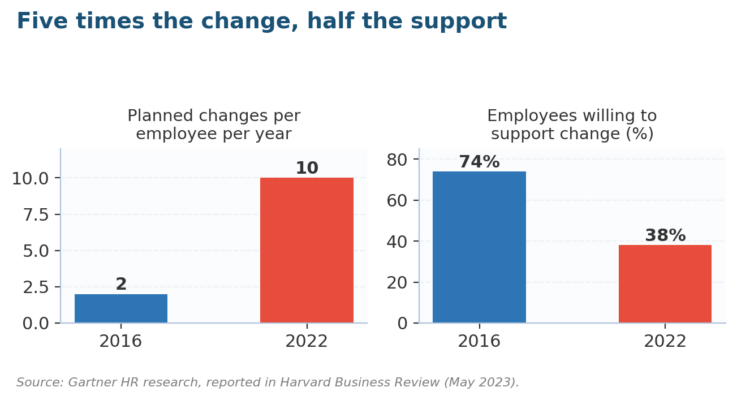
Figure 1. Five times the change, half the support: the fatigue math every change manager now inherits.
The fatigue data kept worsening. In a July 2025 release, Gartner reported only 32 percent of business leaders achieve healthy change adoption, which means two of three transformations are burning goodwill they cannot bill anywhere. Fatigue is now the default state a change manager inherits on day one.
Sonos put a dollar figure and a career on that failure mode. The sequence deserves study because every element was preventable with standard change discipline, the kind operational risk teams would flag in any pre-launch review of a customer-facing system.
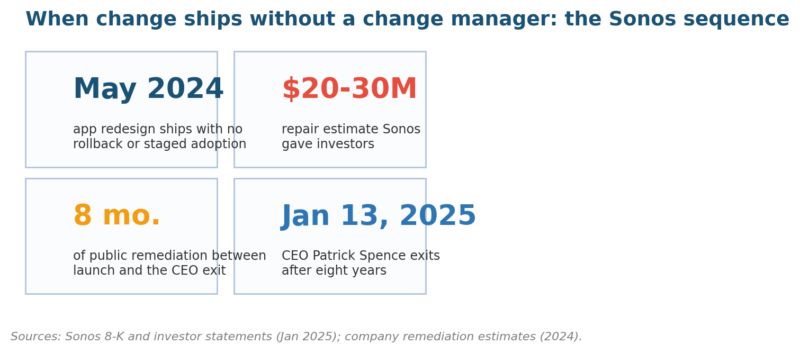
Figure 2. The Sonos sequence: eight months from unmanaged change to a chief executive transition.
Because fatigue arrives before failure, we train change managers to watch for its early markers the way key risk indicators flag drift on a dashboard, and to deliberately slow the change calendar when any two of them appear in the same quarter:
- Survey participation falling two cycles running
- Rising sick days or attrition concentrated in the most-changed teams
- Training completion without any measurable behavior change
- Sponsor absences at steering and town-hall commitments
- Sarcasm replacing questions in open forums
Change Manager Roles and Responsibilities: The Core Seven
Here is the full set, written as owned duties with evidence. Each row names what the change manager does, what it looks like in a working week, and the artifact that proves the duty happened, because in audits and steering reviews the artifact is the answer.
| Duty | In a working week | Artifact on file |
| Plan the change | Sequencing, milestones, readiness gates | Change plan with go/no-go criteria |
| Build the sponsor coalition | Coaching executives to show up visibly | Sponsor roadmap and activity log |
| Assess impact and readiness | Mapping who changes what; readiness surveys | Impact assessment by group |
| Lead the change network | Recruiting champions across functions | Champion roster with coverage map |
| Manage resistance | Listening sessions, targeted responses | Resistance log with actions taken |
| Run communications | Message sequence by audience and channel | Comms calendar with feedback loops |
| Measure adoption | Usage, proficiency, benefit tracking | Adoption dashboard reviewed monthly |
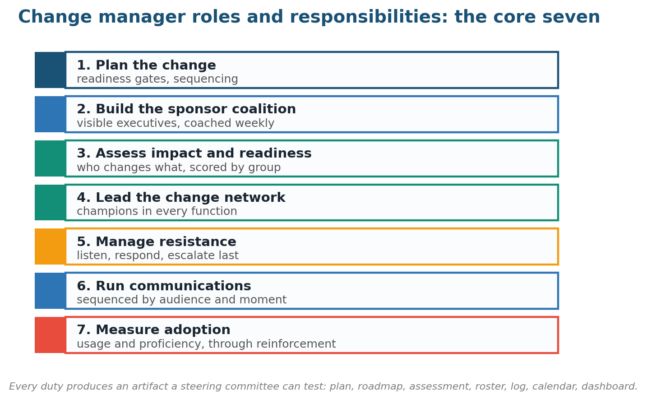
Figure 3. The core seven: every duty ends in an artifact a steering committee can test.
Impact assessment is where the risk toolkit transfers directly. A change impact analysis is a step-by-step risk assessment wearing different clothes: the same identification techniques, the same severity-by-group scoring, and the same rule that untreated findings get owners and dates before anything ships.
Resistance management earns the most folklore and needs the least. Kotter’s Harvard Business Review work established three decades ago that transformations fail on under-communication by a factor of ten, and the fix is procedural: listen first, answer specifics, adjust what the feedback proves wrong, and escalate only the holdouts who block others, a sequence any risk treatment owner recognizes.
For a change manager landing in a new program, the first three weeks decide credibility. We give new hires this opening checklist, each item producing one of the artifacts from the table above and each one testable by the sponsor:
- Meet every named sponsor one-to-one and log their commitments
- Publish the draft impact map within ten working days
- Stand up the resistance log and the champion roster
- Agree adoption metrics and baseline them before go-live pressure builds
- Calendar the communications sequence through reinforcement, past launch day
Change Manager vs Project Manager: Where the Lines Sit
The seven duties clarify the oldest confusion in the field. The project manager delivers the thing; the change manager delivers the organization that uses the thing, and PMI treats the two as distinct disciplines with distinct plans that must interlock at every milestone.
| Dimension | Change manager | Project manager |
| Primary question | Will people adopt it? | Will it ship on time and budget? |
| Scope | Everyone the change touches | The delivery team and workplan |
| Success metric | Adoption, proficiency, benefit realization | Schedule, cost, scope, quality |
| Timeline | Starts earlier; ends after reinforcement | Bounded by project close |
| Toolkit | ADKAR, impact assessments, comms plans | WBS, critical path, RAID logs |
| Escalation path | Sponsor coalition | Steering committee |
Small programs merge the two roles into one person, which works until it does not. The merge point to watch is go-live: project pressure optimizes for shipping while adoption pressure optimizes for readiness, and one person cannot hold both incentives honestly when the date slips. Separate the roles wherever failed adoption would dent business resilience rather than just the schedule.
Reporting lines follow the same logic and deserve a plain answer. Change managers report to the CEO or chief transformation officer on enterprise transformations, to the CIO on system programs, and to the CHRO on restructures; wherever they sit, they need standing access to the enterprise risk framework and the sponsor’s calendar.
Skills, Certifications, and What the Role Pays
Duties set the skill list, and the market prices both. The working core is stakeholder fluency, structured communication, data literacy for adoption analytics, and enough delivery knowledge to argue with a project plan; certifications signal the frameworks, with ACMP’s CCMP and APMG’s Change Management credential the two employers name most.
- Stakeholder fluency: reading a boardroom and a shop floor in the same day
- Structured communication: sequencing messages by audience, channel, and moment
- Data literacy: building and defending an adoption dashboard with KPI dashboard discipline
- Delivery literacy: enough project vocabulary to negotiate milestones credibly
- Pacing judgment: protecting teams from the fatigue curve charted above
Our certifications ranking covers how credentials trade against experience across risk roles, and the change field behaves the same way: the certificate opens the interview, the artifact portfolio wins it. Bring a redacted impact assessment and an adoption dashboard to every hiring conversation.
US pay replaced the folklore with published data. Salary.com puts the average change manager at $130,502 as of August 2025, Indeed reports $115,959 across its postings, and SalaryExpert brackets the arc from $87,545 entry-level to $155,594 at senior; directors clear $200,000 in large programs.
Figure 4. The US pay ladder for the change profession, entry analyst through director.
| Level | Typical US base | Anchor |
| Change analyst (1-3 years) | $85,000-$95,000 | SalaryExpert entry average $87,545 |
| Change manager | $116,000-$131,000 | Indeed and Salary.com averages |
| Senior change manager (8+ years) | $150,000-$160,000 | SalaryExpert senior average $155,594 |
| Director of change management | $127,500-$203,000 | Salary.com range; program scale drives the spread |
For a government-grade anchor, the closest BLS occupational profile, management analysts, showed a $99,410 median in its May 2023 data; change managers price above it because the role carries executive exposure. Treat vendor salary sites as directional and negotiate on the duty list, not the title.
The Change Manager Questions Boards and Executives Keep Asking
These come from steering committees and hiring panels more than from search bars, which is exactly why they belong here. Each answer front-loads the decision and links the deeper method where one exists, so lift what the next meeting needs.
What are the main roles and responsibilities of a change manager?
Seven duties cover the role: planning the change, building the sponsor coalition, assessing impact and readiness, leading the change network, managing resistance, running communications, and measuring adoption through reinforcement. Every other task in a change manager job description is one of these seven wearing local vocabulary.
Who does a change manager report to?
It tracks the change type: the CEO or chief transformation officer for enterprise transformations, the CIO for technology programs, the CHRO for restructures. What matters more than the box is access; a change manager without standing time with the sponsor is a communications coordinator with a bigger title.
What qualifications does a change manager need?
Employers name ACMP’s CCMP and Prosci certification most, with APMG’s Change Management credential common in project-heavy shops; a degree in business, psychology, or HR is typical but negotiable. The portfolio outweighs all of it: impact assessments, comms plans, and adoption dashboards you can walk through under questioning.
How much does a change manager earn in the United States?
Averages cluster between $116,000 and $131,000 for mid-level roles, per Indeed and Salary.com, with entry positions near $87,500 and senior roles around $155,600 per SalaryExpert; directors range to $203,000. Location, program scale, and industry move the number more than certification does.
When does a project need a dedicated change manager?
When the change touches more than one function, alters daily work for more than roughly fifty people, or carries adoption risk that would erase the business case, staff the role separately from the project manager. Below that line, a trained project manager running risk management techniques can carry both hats.
Which KPIs measure a change manager’s success?
Adoption rate, proficiency scores, time-to-competence, sponsor activity, resistance-log closure, and benefit realization against the original case, tracked with the same dashboard discipline any risk function uses. If the metrics all sit green while usage tells a different story, audit the metrics; scenario testing finds the gap, and the KRI development method rebuilds them.
What Goes Wrong and the Fixes That Work
Change programs fail on patterns visible from the first steering deck. The table collects the six we correct most often in rescue engagements, and half of them trace to the role being staffed late, under-ranked, or merged into delivery against the evidence above.
| What goes wrong | Root cause | Fix that works |
| Change manager hired after design freeze | Role seen as communications support | Staff at business-case stage |
| Sponsor delegates visibility | Calendar pressure; discomfort with the message | Coach one visible 15-minute act weekly |
| Training counted as adoption | Easy metric substituted for the real one | Measure usage and proficiency; training is an input |
| One launch blast, then silence | Launch-centric communications planning | Sequence messages through reinforcement |
| Resistance handled as discipline | Signal misread as insubordination | Listening sessions plus targeted responses |
| Fatigue ignored until attrition | No change-load metrics anywhere | Track change load per team per quarter |
The first row is the expensive one, because a change manager hired at go-live inherits decisions no communication can repair. Sonos could not message its way out of removed features; the time to fund the role is when the business continuity and benefits cases are still drafts.
Three Shifts That Will Rewrite the Playbook
Shift one is volume: change is now continuous, and the WEF’s Future of Jobs research projects heavy skill churn through 2030, which turns the change manager from a program hire into standing infrastructure. Budget the role like how you manage risk budgets treatments: permanently.
Shift two is measurement. Adoption analytics are moving from surveys to system telemetry, which gives change managers the live dashboards risk teams already run, and makes the 32 percent healthy-adoption figure a benchmark you can finally beat because the data arrives daily.
Shift three is AI inside the change itself. The next transitions embed machine judgment in daily workflows, where resistance is often rational and trust becomes the adoption metric; the change managers who can assess those impacts honestly will set the market rate for the whole field.
If a transformation is on your roadmap and the change role is still a line item, that ordering is the first risk to fix. We scope, staff, and coach change management functions alongside the risk work; our services page shows the formats, and the contact form reaches us fastest with your go-live date attached.

Chris Ekai is a Risk Management expert with over 10 years of experience in the field. He has a Master’s(MSc) degree in Risk Management from University of Portsmouth and is a CPA and Finance professional. He currently works as a Content Manager at Risk Publishing, writing about Enterprise Risk Management, Business Continuity Management and Project Management.