
A contingency plan in business is a documented set of pre-approved responses an organization executes when a specific disruption strikes, such as a system outage, supplier failure, or natural disaster. The document names activation triggers, owners, resources, and recovery steps for each scenario, so operations continue while the primary way of working is unavailable.
On December 21, 2022, Southwest Airlines began cancelling what became 16,700 flights in ten days, stranding more than two million passengers when its crew-scheduling system buckled under a winter storm. The airline booked a $1.2 billion pre-tax hit, and in December 2023 the Department of Transportation added a record $140 million penalty.
Other carriers flew through the same storm and recovered within days. Southwest lacked a workable fallback for matching crews to aircraft once the primary system failed, which is precisely the gap a contingency plan exists to close before the weather arrives.
| Contingency Plan in Business: Key Takeaways |
| A contingency plan in business pre-assigns people, actions, and resources to a named disruption scenario, so the response starts in minutes instead of being invented mid-crisis. |
| Southwest Airlines cancelled 16,700 flights in December 2022, absorbed a $1.2 billion pre-tax hit, and later paid a record $140 million DOT penalty after its fallback procedures failed. |
| ITIC’s 2025 survey puts median downtime at $9,000 per minute for large enterprises, and 35% of respondents report that a single hour of outage costs more than $1 million. |
| Nationwide’s February 2025 survey found 21% of US businesses still hold no continuity plan, even though 90% maintain formal risk management policies. |
| Build the plan in seven steps: scope, risk and impact assessment, response strategy, roles and triggers, communications, testing, and scheduled maintenance, aligned to ISO 22301 and NIST SP 800-34. |
| Untested contingency plans are hypotheses: exercise at least annually, score results against RTO targets, and track findings to closure the way FFIEC examiners expect. |
This guide defines the document, separates it from its continuity cousins, and walks through a seven-step build a practitioner can finish in one quarter. Throughout, we draw on ISO 22301, NIST SP 800-34, and disruption data from PwC, the BCI, ITIC, and Nationwide.
How a Contingency Plan Differs From Continuity and Crisis Documents
Southwest held continuity documents; what it lacked was a scenario-specific fallback with named owners, which is the contingency plan’s whole job. The document answers one question: when this particular thing breaks, who does what, with which resources, inside which timeframe.
The confusion is understandable because four overlapping documents share the shelf. A business continuity plan keeps priority operations running through any disruption, disaster recovery restores the technology layer, and our guide to risk management versus crisis management covers the escalation boundary between planned response and executive improvisation.
| Document | Question it answers | Typical trigger | Usual owner |
| Contingency plan | When scenario X happens, what do we do instead? | A named, foreseen scenario materializes | Process or function leader |
| Business continuity plan | How do priority activities keep running through any disruption? | Impact thresholds breached, cause aside | Continuity manager |
| Disaster recovery plan | How do systems and data come back within target times? | Technology outage or data loss | CIO or IT operations |
| Crisis management plan | Who decides and speaks when the event is severe or ambiguous? | Threat to people, viability, or reputation | Executive crisis team |
Scope is the practical difference. Contingency plans go narrow and deep on one scenario each, while the continuity management program stays broad, and ISO 22301 treats scenario responses as outputs of that wider system. Treat each contingency plan as a playbook chapter inside the continuity library.
Why the Numbers Argue for Preparation
The financial case rests on measured losses. PwC’s Global Crisis and Resilience Survey found 91% of organizations suffered at least one disruption beyond the pandemic, averaging 3.5 events over two years, and 76% said their most serious event hit operations at medium-to-high severity.
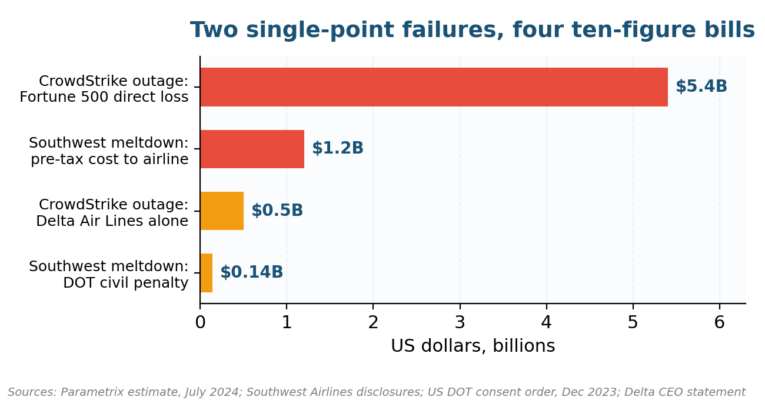
Figure 1. The contingency planning case in two incidents: Parametrix put Fortune 500 direct losses from the July 2024 CrowdStrike outage at $5.4 billion; Southwest’s December 2022 meltdown cost the airline $1.2 billion before tax.
The July 19, 2024 CrowdStrike update failure crashed 8.5 million Windows devices and cost Fortune 500 companies an estimated $5.4 billion in direct losses, with only 10% to 20% insured. Delta Air Lines alone absorbed roughly $500 million, while carriers holding tested fallbacks rebooked passengers within hours.
Downtime pricing turns the whole argument into simple arithmetic. ITIC’s 2025 survey puts the median outage cost at $9,000 per minute for enterprises above 1,000 employees, and IBM’s 2025 report adds an average $10.22 million bill for a US data breach.
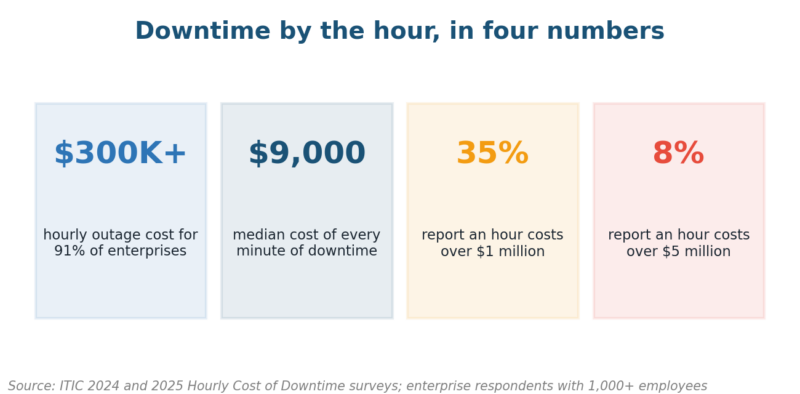
Figure 2. ITIC’s 2024 and 2025 downtime surveys price the hours a tested contingency plan buys back.
Set those figures against what contingency planning costs: facilitated workshops, documentation, and two exercises a year, typically a five-figure annual budget at mid-market scale. The asymmetry is the entire business case, and it is the same treatment logic ISO 31000 applies to any risk, viewed through a business resilience lens.
The Scenarios Worth Planning For
Money justifies contingency planning; scenario selection directs it. The BCI Horizon Scan Report 2025 ranks cyber-attack as practitioners’ top concern for the coming year with extreme weather second, and weather already caused 13.3% of recorded disruptions, its largest share since 2017.
Start from your own exposure rather than a generic threat list. A structured risk identification exercise and a scenario-based risk assessment surface the candidates, which you then rank on likelihood and impact using the five-step risk management process. Most US mid-market registers converge on five scenario families:
- Technology and cyber: ransomware, cloud or SaaS outage, failed vendor update, data breach
- Physical and weather: hurricane, flood, wildfire, facility loss, extended power interruption
- People: sudden loss of key staff, labor action, pandemic-scale absenteeism
- Third parties: sole supplier failure, logistics disruption, critical infrastructure outage
- Financial and market: funding shortfall, demand collapse, interest rate or currency shock
| Example scenario | Likelihood signal | Impact signal | Planning call |
| Ransomware on production systems | High: top BCI concern for 2025 | High: multi-day outage plus data loss | Write a deep plan first |
| Hurricane at a coastal site | Medium: seasonal, forecastable | High: facility and staff disruption | Write a deep plan |
| Sole supplier insolvency | Medium: watch financials | High: production stops | Write a deep plan |
| Key-person departure | High: normal turnover | Medium: knowledge gap | Cover with cross-training |
| Demand collapse in one segment | Low: cyclical | High: revenue concentration | Monitor with KRIs |
Concentrate written plans on the top-right of that matrix. A business continuity risk assessment workbook speeds the scoring, and key risk indicators give every scenario an early-warning tripwire, so activating the contingency plan becomes a data event rather than a judgment call.
How to Write a Business Contingency Plan in Seven Steps
With scenarios ranked, the writing follows a repeatable path. The seven steps below compress ISO 22301’s planning clauses and NIST SP 800-34’s contingency planning process into a sequence a mid-size firm can complete inside a single quarter without any external help.
| Step | What you do | What lands on file |
| 1. Scope | Name the scenario, the activities it threatens, and the recovery objectives | One-page charter with RTO and RPO targets |
| 2. Assess | Score likelihood and impact; run a business impact analysis on affected activities | Ranked scenario register |
| 3. Strategize | Choose workarounds, alternate suppliers, manual procedures, failover arrangements | Response strategy sheet per scenario |
| 4. Assign | Appoint one activation authority, response owners, and measurable triggers | RACI chart plus trigger thresholds |
| 5. Communicate | Draft notification trees, holding statements, and stakeholder scripts | Contact tree and message templates |
| 6. Test | Walk through, simulate, and time the response against its RTO | Exercise report with scored gaps |
| 7. Maintain | Schedule reviews, track corrective actions, retrain contingency plan owners | Version log and action tracker |
Step two leans on a proper business impact analysis, and recovery targets come from the RPO and RTO distinction. Write both as numbers with clocks attached, because a target of as fast as possible has never staffed a recovery or satisfied an examiner.
Triggers deserve special care because vague activation criteria have sunk more responses than weak strategies ever did. A trigger someone must debate is not a trigger, it is a meeting. Make every activation condition observable, measurable, and time-bound, for example:
- Primary system unavailable for more than 30 minutes with no estimated restore time
- A sole supplier declares force majeure or misses two consecutive committed shipments
- The National Weather Service issues a hurricane warning covering a critical site
- Ransomware is confirmed on any production server, activating the incident response runbook
- Absenteeism exceeds 30% in a critical team for three consecutive days
You do not have to draft a contingency plan from a blank page. Our continuity plan template for small teams, the continuity policy template, and the continuity strategy template carry the surrounding program structure, while the disaster recovery plan template covers the technology chapter of the same story, built out fully in our disaster recovery plan guide.
Testing Turns Paper Into Reflex
A written contingency plan is a hypothesis until an exercise confirms people can run it. The FFIEC Business Continuity Management booklet, the strictest widely used US testing standard, expects exercises that escalate in complexity and documented proof that findings get fixed on schedule.
| Exercise type | Cadence | What it proves |
| Plan walkthrough | Quarterly, 60 minutes | Owners know their sections and every contact number still works |
| Tabletop simulation | Twice a year | Decisions and communications hold up under scenario pressure |
| Functional drill | Annually per critical system | Failover, manual workarounds, and notification trees actually operate |
| Full-scale exercise | Every 12 to 24 months | The organization meets its recovery time objective end to end |
Score every contingency plan exercise against its recovery targets and log misses in a corrective action register with owners and due dates. Our business continuity maturity model turns those results into a scale boards understand, and NFPA 1600 supplies the exercise vocabulary US regulators and insurers recognize.
We have watched tabletop exercises expose gaps no document review would catch, like a notification tree routing through one manager’s personal cell phone. Ready.gov’s exercise guidance is free, and a two-hour tabletop this quarter beats a flawless binder nobody has opened.
Keeping the Plan Current After Launch
Contingency plans decay from the day they are approved because organizations keep changing around them. Nationwide’s February 2025 survey shows the pattern: 90% of US business owners maintain formal risk policies, yet 21% hold no continuity plan and only 54% feel highly protected.
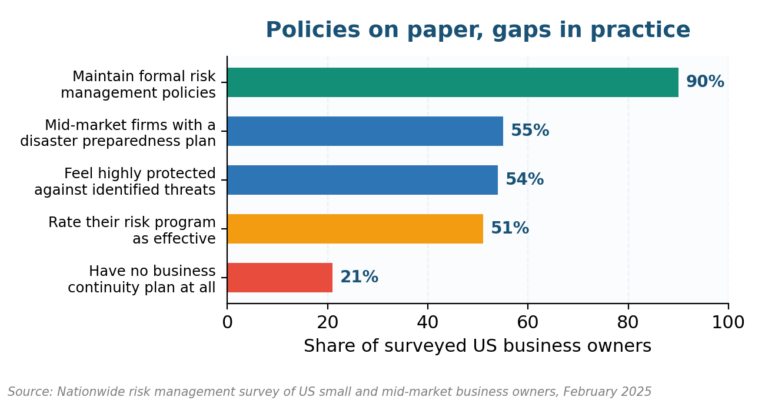
Figure 3. Nationwide’s 2025 survey of US small and mid-market owners: formal policies are near-universal, working contingency plans are not.
Mark McGhiey, Nationwide’s commercial lines risk management leader, calls the missing plans a critical vulnerability, and the fix is administrative rather than intellectual. Put maintenance on a calendar with named owners, and treat the version log as evidence for auditors and insurers.
Between scheduled reviews, specific events should force an out-of-cycle update. We recommend writing these into the contingency plan itself as maintenance triggers, mirroring the activation triggers in step four, so the document tells you when it has gone stale instead of waiting for the annual review:
- Any activation of the plan, however partial, within 30 days of stand-down
- A new critical supplier, system, product line, or facility enters service
- An exercise finding closes out and changes procedures or contact trees
- Reorganization moves a named response owner or the activation authority
- A regulator, customer, or insurer imposes new continuity requirements
Third-party exposure moves fastest. Supply chain contingency arrangements and the wider supplier risk management approach need revisiting whenever concentration shifts, and public companies must also keep pace with the SEC’s 2023 cybersecurity disclosure rules, which put material incident reporting on a four-business-day clock.
Finally, wire the plan into daily operations through indicators. The same tripwires that trigger activation also reveal when scenario likelihoods drift, and recurring operational risk events make realistic scripts for the next tabletop, keeping the exercise program grounded in the risks the business actually runs.
Common Contingency Plan Questions Practitioners Ask
How often should a business update its contingency plan?
Review every contingency plan at least annually, and immediately after any activation, exercise finding, leadership change, or new critical dependency. NIST SP 800-34 treats maintenance as a defined lifecycle phase, and FFIEC examiners ask for the version history, so date each revision and record what changed.
What is the difference between a contingency plan and a business continuity plan?
A contingency plan answers one scenario in depth, naming the triggers, owners, and workarounds for that specific event. A business continuity plan keeps priority operations running across any disruption and acts as the umbrella document. Most organizations run one continuity program containing many scenario-specific contingency plans.
What should a contingency plan in business include?
Six elements: the scenario and scope, measurable activation triggers, response procedures and workarounds, named roles under one activation authority, a communication tree with message templates, and recovery targets written as RTO and RPO numbers. Add a version log so any reviewer can see the plan is alive.
Who should own the contingency plan in a small business?
The person who owns the process at risk should own its contingency plan, with the owner or general manager holding activation authority. In a ten-person firm that usually means the founder plus one deputy, and Nationwide’s 2025 data shows 21% of businesses have assigned it to nobody.
How much does contingency planning cost a business?
A contingency planning budget is mostly staff time: a scoping workshop, a business impact analysis, drafting, and two exercises a year. Mid-market programs typically land in the low five figures annually, a rounding error against ITIC’s $9,000-per-minute median downtime cost for large enterprises.
Can a contingency plan cover every possible business risk?
No, and it should not try. Write deep contingency plans for the high-likelihood, high-impact scenarios your risk assessment surfaces, and let the continuity plan’s broader recovery structure absorb everything else. Exercising the few plans that matter builds more capability than drafting a chapter for every conceivable event.
Where Plans Break Down and How to Repair Them
Every failed activation we have reviewed traces back to a small set of repeating causes, and none of them are exotic. The table below pairs the six most common with corrections that fit inside a normal quarter’s workload, before the next storm or vendor update runs the test for you.
| Pitfall | Root cause | Remedy |
| Contingency plan lives in one expert’s head | Documentation debt | Write the playbook chapter, then test it with that expert deliberately absent |
| Contact tree is stale on activation day | No maintenance triggers | Verify every contact in the quarterly walkthrough |
| Triggers require a debate to interpret | Vague activation criteria | Rewrite as measurable thresholds under one activation authority |
| Plan assumes the systems that just failed | Circular dependency | Store copies offline and pre-stage manual workarounds |
| Staff below leadership never heard of it | Training gap | Brief new hires and run an all-hands tabletop annually |
| Exercise lessons never change the document | No corrective action log | Track findings to closure with owners and due dates |
The Road Ahead for Corporate Preparedness
Three forces will shape contingency planning through 2027. Regulators keep converting resilience from good practice into obligation, with the SEC’s four-business-day incident disclosure already in force and US banking supervisors examining continuity capability through the FFIEC lens at every cycle.
Weather is the second force. The BCI recorded extreme weather as the largest single cause of disruption in 2025, its first time leading since 2017, and hurricane, wildfire, and flood scenarios now sit inside mainstream operational planning at most US firms, per Ready.gov’s continuity guidance.
The third force is concentration. One vendor’s flawed update reached 8.5 million machines in July 2024, and boards noticed that third-party failure holds a top-five slot in every recent threat ranking. Expect contingency plans for named critical suppliers to become a standard contract exhibit.
If you own continuity for a mid-market US firm and need scenario plans that survive a live exercise, that is work we do every month. Look through our services, then reach us through the contact page, and bring your top three scenarios to the first conversation.

Chris Ekai is a Risk Management expert with over 10 years of experience in the field. He has a Master’s(MSc) degree in Risk Management from University of Portsmouth and is a CPA and Finance professional. He currently works as a Content Manager at Risk Publishing, writing about Enterprise Risk Management, Business Continuity Management and Project Management.