The ISO Survey counted 4,595 valid ISO 22301 certificates covering 11,387 sites worldwide in its 2024 edition, and every single one began with the same short document. Clause 5.2 of ISO 22301:2019 requires top management to establish a business continuity policy before anything else counts. The policy should also reflect
how risk management differs from crisis management, since each discipline needs its own authority in the document.
The business continuity policy template below gives you that document as a board-ready Word download. It also reflects the newest change to the standard:
Amendment 1:2024 added climate action considerations, which is why the template’s policy statement names climate-related disruption explicitly.
A business continuity policy template is deliberately short, and that brevity is the discipline. Three to four pages of intent, scope, commitments, and named roles are what a board can actually approve and an examiner can actually check, while the operational detail lives in the
plans and procedures underneath.
Download the Business Continuity Policy Template (Word)
The file is
business-continuity-policy-template-word-download, free to adapt, and shaped by the same structure we use when writing continuity policies for regulated institutions. Every bracketed field is red, so nothing gets missed, and it pairs naturally with our
risk management policy template and the
continuity plan template one layer down.
Need the whole set?
The free file above stays free. The Risk Manager’s Toolkit bundles it with 39 other templates practitioners use: risk register, RCSA, business impact analysis with RTO and RPO, heat map, KRI scorecard, business continuity and disaster recovery plans, ISO 27001 and GDPR assessments. One download, Excel and Word, ready to edit.
Instant download after payment. 30-day refund, no questions. Secure checkout by Lemon Squeezy.
| Template section |
What it establishes |
| Cover and approval block |
Owner, approver, version, next review date, and applicability |
| 1. Policy statement |
The commitment, including climate-related disruption per Amendment 1:2024 |
| 2. Purpose and objectives |
Life safety first, recovery within agreed timeframes, obligations met |
| 3. Scope |
Sites, units, services, and outsourced activities covered, with stated exclusions |
| 4. Policy commitments |
Seven auditable commitments: BIA, plans, exercising, budget, suppliers, reporting, review |
| 5. Roles and responsibilities |
Board, executive sponsor, BC coordinator, managers, and all staff |
| 6. Program requirements |
The BCM cycle the policy mandates, ISO 22301-aligned |
| 7. Compliance and exceptions |
Mandatory within scope; written, expiring exceptions only |
| 8. Review and revision history |
Annual review trigger plus the change log examiners look for |
Fill the bracketed fields in the business continuity policy template in one sitting with the executive sponsor in the room, because every bracket is a governance decision rather than a writing task. Naming the sponsor and the coordinator out loud is usually where the real conversation starts.
What a Business Continuity Policy Does (and What It Never Does)
The business continuity policy template is the authority layer, and confusion about that single fact produces most bad policies. It commits the organization and assigns accountability; the
program turns commitments into a cycle, the
business impact analysis supplies evidence, and plans carry the phone numbers.
| Document |
It answers |
It never contains |
| Policy (this template) |
Why we do this, who is accountable, what we commit to |
Procedures, contact lists, system names |
| Program / framework |
How the cycle runs: methods, governance, reporting |
Board-level commitments |
| Plans and procedures |
Who does what, in what order, during disruption |
Intent statements and scope debates |
Keep the layers honest and every audit shortens. When
FFIEC examiners review a bank’s continuity arrangements, the policy’s approval date and commitments are the first exhibit, and the same logic drives
continuity planning in banking generally: authority first, mechanics second.
What ISO 22301 Requires From a Business Continuity Policy
Clause 5.2 is specific about the minimum. The policy must be appropriate to the organization’s purpose, provide a framework for objectives, commit to satisfying applicable requirements, and commit to continual improvement, then be communicated, available, and maintained as documented information.
Notice what the clause does not require: length, eloquence, or a consultant’s vocabulary. Auditors check that the four commitments exist, that communication actually happened, and that the maintained document trail shows review. A plain four-page policy with a fresh signature beats an elegant twelve-page one signed three years ago.
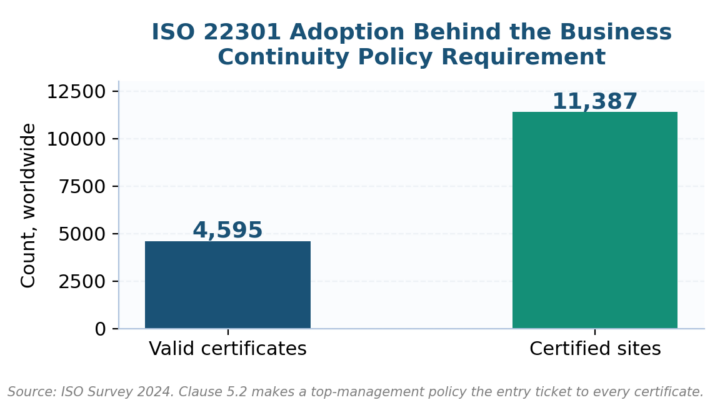 Figure 1. The certificate population keeps growing, and clause 5.2 puts a policy at the front of every audit trail.
Guidance exists for every clause you find ambiguous.
ISO 22313:2020 is the official companion that expands each requirement into practice,
summarized well by ANSI, and our own
ISO 22301 implementation guide maps the clauses to the artifacts each one expects.
US organizations outside the certification track still inherit the same shape.
NFPA 1660, the consolidated emergency management and continuity standard, expects a documented program with leadership commitment, and
NIST SP 800-34 starts federal contingency planning from a policy statement too.
Business Continuity Policy Requirements Across US Regulators
Certification is optional in the United States, but the policy itself rarely is. Sector rules keep arriving at the same demand from different directions: a written, approved, periodically reviewed continuity commitment. The table maps the expectations most US organizations actually face to the section of the template that satisfies each one.
| Rule or standard |
Who it reaches |
What it expects from the policy |
| ISO 22301 clause 5.2 |
Any certifying organization |
Top-management policy with framework, compliance, and improvement commitments |
| FFIEC BCM booklet |
Banks and credit unions |
Board-approved program with documented oversight and annual reporting |
| FINRA Rule 4370 |
Broker-dealers |
Written BCP, designated principal, and annual review of the arrangements |
| HIPAA 164.308(a)(7) |
Healthcare covered entities |
Contingency planning as a required administrative safeguard |
| NFPA 1660 |
Emergency management programs |
Documented program with stated leadership commitment and scope |
| NIST SP 800-34 |
Federal systems and contractors |
Contingency planning policy as the first step of the seven-step process |
Two of these carry teeth worth noting.
FINRA Rule 4370 makes the annual review examinable for broker-dealers, and the
HIPAA Security Rule lists contingency planning among required safeguards, so a healthcare policy that skips it is a compliance gap, not a style choice.
Writing the Business Continuity Policy: Section by Section
The Policy Statement and Scope of the Business Continuity Policy
Write the statement in first-person organizational voice and keep every sentence falsifiable. We identify critical activities, we resource their recovery, we exercise plans, we improve: commitments an auditor can test. Scope earns equal care, because an exclusion nobody wrote down becomes a finding the day that site floods.
Roles and Accountability in the Business Continuity Policy
Name roles, not people, so the policy survives staff turnover, and give the program exactly one executive sponsor. Boards approve and oversee, the sponsor is accountable, a coordinator runs the
planning cycle, managers own their functions’ readiness, and all staff carry the duty to know their part.
Commitments and Cadence: the Teeth of the Business Continuity Policy
The seven commitments in Section 4 are the teeth: annual BIA, documented plans, two exercises a year, budget, supplier arrangements, board reporting, and annual review. Each is deliberately checkable, and the
exercise scenarios library plus the
maturity model give the coordinator ready instruments for two of them.
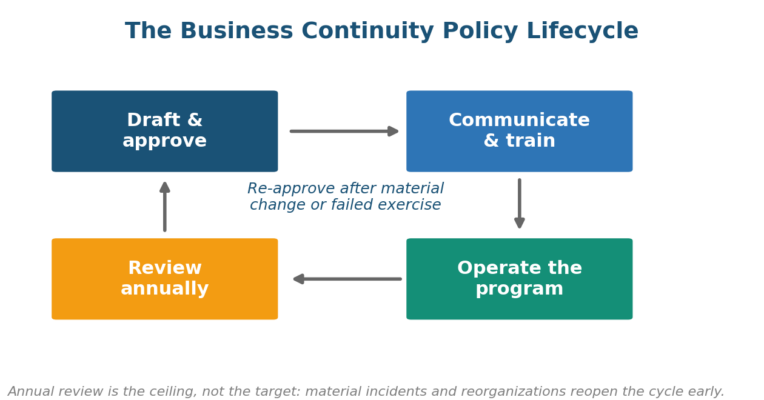 Figure 2. The policy is a cycle, not a certificate: approval starts it and annual review restarts it. The same architecture governs the enterprise-wide risk management policy template, which sits one level above continuity in the document stack.
Getting the Business Continuity Policy Approved and Adopted
Approval is the moment the policy becomes real, so stage it deliberately. Bring the draft, the BIA headline numbers from the
BIA template, and a one-page cost of the commitments, because a board asked to approve unpriced commitments will defer, and deferred policies age in drawers.
Adoption is communication plus consequence. Publish the approved policy where staff actually look, brief managers on their named responsibilities, and let the exception process carry the message that compliance is expected: written exceptions, compensating measures, expiry dates, no silent opt-outs.
A 30-Day Rollout Plan for the Business Continuity Policy
A month is enough to move from blank template to approved, communicated policy if the sequence stays tight. The plan below assumes a mid-sized organization with an engaged sponsor; smaller firms compress it, and firms still mid-BIA should finish that evidence first rather than approving commitments they cannot yet price.
| Days |
Action |
Output |
| 1 to 5 |
Draft with the executive sponsor; settle scope and named roles |
Complete draft, zero open brackets |
| 6 to 10 |
Circulate to legal, HR, IT, and operations for comment |
Consolidated redline, one round only |
| 11 to 15 |
Price the seven commitments; prepare the board pack |
One-page cost and coverage summary |
| 16 to 20 |
Present for approval; log conditions in the revision table |
Signed policy, version 1.0 |
| 21 to 25 |
Publish internally; brief managers on their duties |
Communication evidence for the audit file |
| 26 to 30 |
Schedule the first exercise and the annual review date |
Calendar entries the program runs on |
Resist the temptation to let the comment round run long, because a policy circulating for six weeks signals that nobody owns it. One consolidated redline, one decision meeting, and conditions recorded in the revision history keep momentum while still giving every function a genuine voice.
Small businesses get a lighter on-ramp with the same spine.
Ready.gov’s business program and the
SBA’s preparedness guidance both start from a short written commitment, and a two-page version of this template satisfies both while leaving room to grow into
the full management system.
Seven Traps That Derail Business Continuity Policies
Policy failures are quieter than plan failures, which makes them last longer before anyone notices. The seven below come from reviewing continuity policies across regulated and unregulated firms over the years, and each trap pairs with a fix already built into the template’s structure.
| Trap |
How it shows up |
Fix in the template |
| Policy written like a plan |
Twelve pages, phone numbers, system names |
Four-page ceiling; detail pushed to plans |
| No named executive sponsor |
Program orphaned between departments |
Section 5 forces one accountable role |
| Commitments nobody can audit |
Vague pledges to ‘ensure resilience’ |
Seven checkable commitments with cadences |
| Approval never refreshed |
2019 signature on a 2026 program |
Review triggers plus revision history table |
| Scope by silence |
Excluded site discovered during the event |
Scope section demands stated exclusions |
| Supplier blind spot |
Critical vendor with no arrangements |
Commitment 5 covers proportionate supplier evidence |
| Climate clause ignored |
Policy predates Amendment 1:2024 |
Statement names climate-related disruption |
Business Continuity Policy Template: Your Questions Answered
What is a business continuity policy template?
It is a pre-structured document that captures top management’s continuity commitment: policy statement, scope, commitments, roles, program requirements, exceptions, and review cycle. This one aligns to ISO 22301:2019 clause 5, includes the 2024 climate amendment, and downloads as an editable Word file.
How long should a business continuity policy be?
Three to four pages. Anything longer is usually a plan wearing a policy’s title, and boards do not approve twelve-page documents with attention. The template enforces the ceiling by design: commitments and roles stay, procedures and contact lists move down a layer.
What is the difference between a business continuity policy and a business continuity plan?
The policy is the board’s commitment and assignment of accountability; the plan is the documented response people execute during disruption. Policy authorizes and funds, plan operates. Our
plan components guide and this template cover the two layers respectively, and
the disciplines around them divide the same way.
Who should approve the business continuity policy?
The highest governance body you have: the board where one exists, otherwise the owner or CEO. ISO 22301 assigns the policy to top management explicitly, and examiners read the approval line first. Approval by a committee two levels down signals exactly how seriously the program is taken.
Does the business continuity policy template work for ISO 22301 certification?
Yes. A business continuity policy template serves as the clause 5.2 artifact: it carries the four required commitments, communication and maintenance provisions, and the documented-information trail via its revision table. Certification needs the rest of the management system too, which our
ISO 22301 guide sequences clause by clause.
Is a business continuity policy required by law in the United States?
Not universally, but sector rules make it effectively mandatory for many: FINRA Rule 4370 for broker-dealers, the HIPAA Security Rule’s contingency safeguard for healthcare, and FFIEC expectations for banks. Even unregulated firms meet the requirement indirectly, because enterprise customers now demand the policy during vendor due diligence.
How often should the business continuity policy be reviewed?
Review your business continuity policy template annually at maximum interval, and immediately after a material incident, a reorganization, or an exercise that fails. Review does not always mean rewrite: most years the outcome is a dated confirmation in the revision history, which is itself the evidence auditors want to see.
The Regulatory and Technology Horizon for Business Continuity Policy
Climate language is becoming standard equipment. Amendment 1:2024 pushed climate action into ISO 22301’s clause structure, and we expect certification audits from 2026 onward to ask where the policy acknowledges climate-related disruption, which is why the template’s first paragraph already does.
Supplier commitments are hardening from courtesy to contract. Policies increasingly promise that critical vendors hold proportionate continuity arrangements, and procurement teams are learning to ask for the policy itself during due diligence, making the document a sales asset as much as a control.
Expect the policy to stay human-written while everything below it automates.
Continuity platforms now draft plans and track exercises, and
DRI’s practices and
BCI’s research both point the profession toward governance as the durable human layer. Four pages of clear intent is the part no tool writes for you.
Infographic: Where the Business Continuity Policy Sits
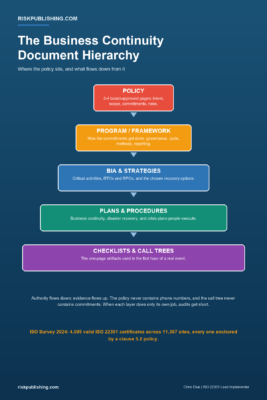 Figure 3. Authority flows down, evidence flows up: the policy tops a five-layer document hierarchy.
Get Your Business Continuity Policy Board-Ready With Risk Publishing
A policy that cannot survive ten minutes of board questions is not ready for a disruption’s first hour either. Explore
our services or
contact us and we will pressure-test your draft against ISO 22301 clause 5,
FEMA-aligned expectations, and the questions your own board will actually ask.
Chris Ekai is a Risk Management expert with over 10 years of experience in the field. He has a Master’s(MSc) degree in Risk Management from University of Portsmouth and is a CPA and Finance professional. He currently works as a Content Manager at Risk Publishing, writing about Enterprise Risk Management, Business Continuity Management and Project Management.