
ISC2 closes enrollment in its One Million Certified in Cybersecurity program on May 20, 2026, ending the largest free entry-level credential giveaway US learners have ever seen. The voucher covered the $199 exam, the self-paced course, and the first year of ISC2 candidate access. Any US learner planning a 2026 cyber pivot has eight days left to use it.
The urgency is real because the demand is real. CyberSeek’s June 2025 update tracked 514,000 cyber job postings in the US over the prior 12 months against a workforce supply ratio of 74, leaving roughly 265,000 unfilled seats.
| Key Takeaways |
| ISC2 closes its One Million Certified in Cybersecurity program on May 20, 2026, ending free access to the entry-level CC training and exam. US learners with eight days left should enroll first and study second. |
| The BLS projects 29 percent employment growth for information security analysts from 2024 to 2034, versus 3 percent across all US occupations. The median pay was $124,910 in May 2024 with about 16,000 openings each year. |
| CyberSeek’s June 2025 update tracked 514,000 US cyber job postings against a workforce supply ratio of 74, leaving roughly 265,000 unfilled US seats. The gap is widest in the Virginia / Maryland / DC federal corridor. |
| A credible Free Cyber Security Course stack pairs four to five tracks: Harvard CS50, ISC2 CC, Cybrary, CISA FedVTE, and a portfolio from TryHackMe or Hack The Box free rooms. Each step maps to a NICE work role. |
| The NIST NICE Workforce Framework codifies cybersecurity work into seven categories and roughly 50 work roles. Map every Free Cyber Security Course to a NICE work role before enrolling; federal screeners on USAJOBS search by that language. |
| Free does not mean useful. Watch for awareness-only content, vendor-locked free intros, stale 2018-era material, and certificates without graded labs. Pair every course with a public portfolio artifact (script, lab writeup, CTF flag). |
| After the Free Cyber Security Course stack, the next 12 months typically adds CompTIA Security+ and one cloud-vendor entry credential (AWS Cloud Practitioner, Microsoft SC-900). The portfolio plus paid cert is the standard 2026 entry resume. |
The US Bureau of Labor Statistics projects 29 percent employment growth for information security analysts from 2024 to 2034 against a 3 percent baseline across all occupations.
A well-chosen Free Cyber Security Course is the cheapest credible on-ramp into the field. A US learner can stack four or five free tracks across a single quarter and assemble a portfolio that maps to NICE work roles, BLS occupational titles, and the entry-level certifications employers actually screen for in 2026.
Eleven sections cover the field: why now, top US providers, core curriculum, free versus paid, NICE mapping, skills, career paths, selection steps, common pitfalls, the FAQ, and the 2026-2027 horizon.
Every recommendation cites a named US provider, federal agency, or standards body. No vendor lock-in. No closed paywalls disguised as free training.
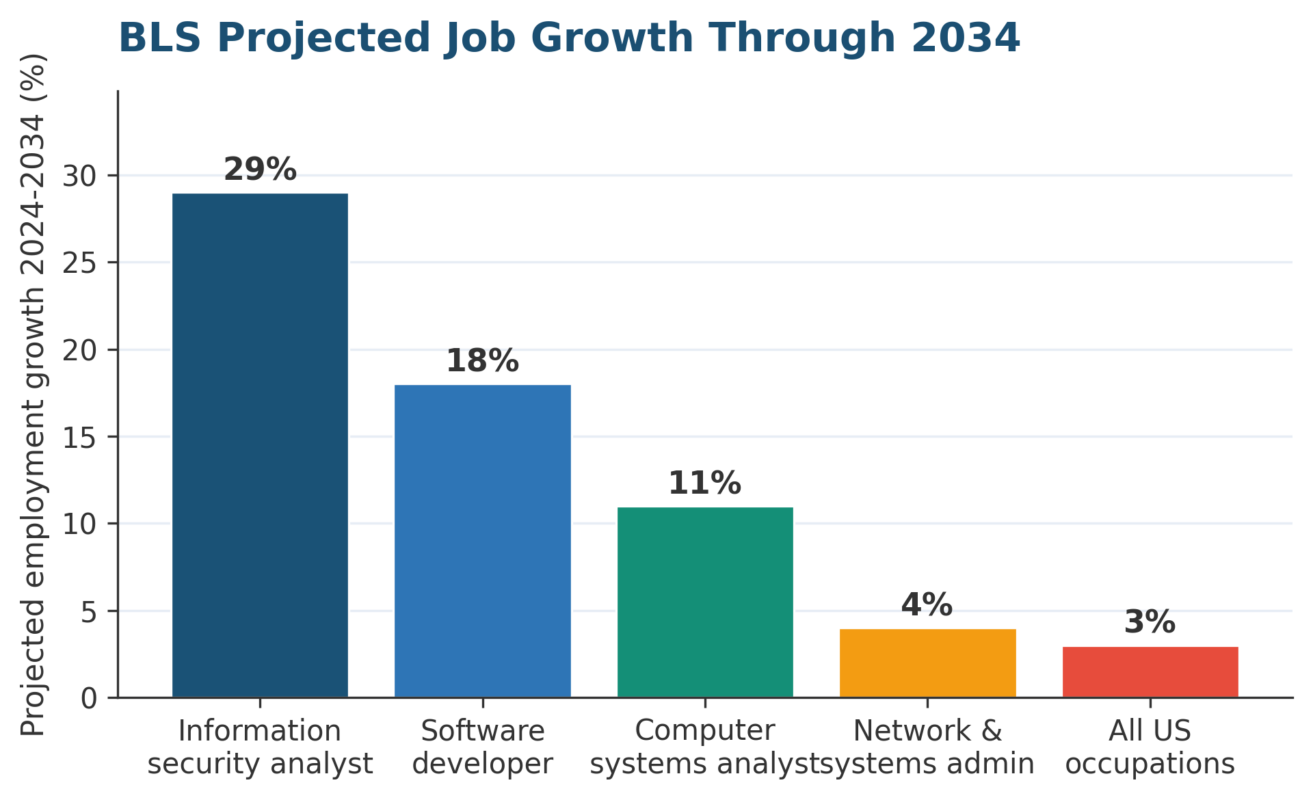
Figure 1. BLS-projected employment growth across US tech occupations highlights cybersecurity demand through 2034.
Why a Free Cyber Security Course Matters in 2026
A Free Cyber Security Course is no longer a hobbyist artifact. The US workforce gap, BLS projections, and federal hiring through NICE-mapped work roles have turned credible free programs into a viable entry point.
ISC2, CISA, NIST, and major US universities now deliver entry-level content at zero cost, with verifiable certificates and direct alignment to the credentials employers screen for.
The shift is structural, not promotional. The 2025 ISC2 Cybersecurity Workforce Study reported global unfilled cyber positions at 4.8 million, up 19 percent year over year.
US employers cannot fill seats fast enough through traditional four-year pipelines, and a documented Free Cyber Security Course track that maps to a NICE work role is reading as comparable signal in many entry-level hiring pipelines.
The free window will not stay open forever. ISC2’s One Million Certified program closes May 20, 2026. CISA Cyber Education and Workforce Development programs face continued appropriations review.
Universities cycle their free certificate offerings each year. Treat the current Free Cyber Security Course inventory as a time-limited shelf the way a cybersecurity risk management team treats a regulatory comment window.
The Best Free Cyber Security Course Providers for US Learners
Free Cyber Security Course providers cluster into four families: US universities releasing audit tracks, federal agencies running training portals, certification bodies giving entry vouchers, and platform aggregators hosting third-party content.
Each family carries a different signal weight in US hiring. Knowing which family a particular course belongs to is the first selection question to answer before enrolling.
The Harvard CS50 cybersecurity track sits at the top of the academic family. The course material is free on Harvard OpenCourseWare with a free certificate available through the open track or a paid verified credential through edX.
The MIT 6.858 Computer Systems Security materials and Stanford CS155 Computer and Network Security lecture archives round out the elite academic free options.
Federal options have grown sharply. CISA hosts free training through the NICCS catalog covering thousands of courses indexed by NICE work role. CISA’s Federal Virtual Training Environment opened to the public in 2020 and remains free for any US learner.
Both qualify as credible Free Cyber Security Course pathways that examiners and federal recruiters recognize on a resume without explanation.
Top 10 Free Cyber Security Course Providers (US-Relevant)
| Provider | Best free track | Time | Certificate |
| Harvard CS50 | Introduction to Cybersecurity (David Malan) | ~50 hrs / 5 wks | Free OCW cert or paid edX verified |
| MIT OCW 6.858 | Computer Systems Security (lectures + labs) | ~80 hrs | No certificate |
| Stanford CS155 | Computer and Network Security archive | ~70 hrs | No certificate |
| ISC2 (closes May 20) | Certified in Cybersecurity (CC) self-paced | ~30 hrs | Free voucher + ISC2 credential if exam passed |
| CISA NICCS / FedVTE | Cyber Defense Analyst, IR, malware tracks | 20-100 hrs / track | Course completion (FedVTE transcript) |
| Cybrary | MITRE ATT&CK Defender, intro IR tracks | 40+ hrs | Free platform completion certs |
| Cisco Networking Academy | Introduction to Cybersecurity | 15 hrs | Free issued completion certificate |
| edX (audit) | HarvardX, MITx, IBM, ISC, Microsoft cybersecurity | Self-paced | Audit free, verified cert paid ($49-$199) |
| Coursera (audit) | Google Cybersecurity Professional, University of Maryland | Self-paced | Audit free, verified cert paid |
| SANS Cyber Aces | Operating systems, networking, sysadmin foundations | 30+ hrs | Course completion certificate |
Four providers anchor any 2026 Free Cyber Security Course plan this month: ISC2 CC before the May 20 cutoff, Harvard CS50 Introduction to Cybersecurity, CISA Federal Virtual Training Environment, and Cybrary’s MITRE ATT&CK Defender path.
Together they cover entry-level foundations, applied incident response, and a recognized vendor-neutral credential. That stack reads as a credible portfolio on a 2026 entry-level US resume.
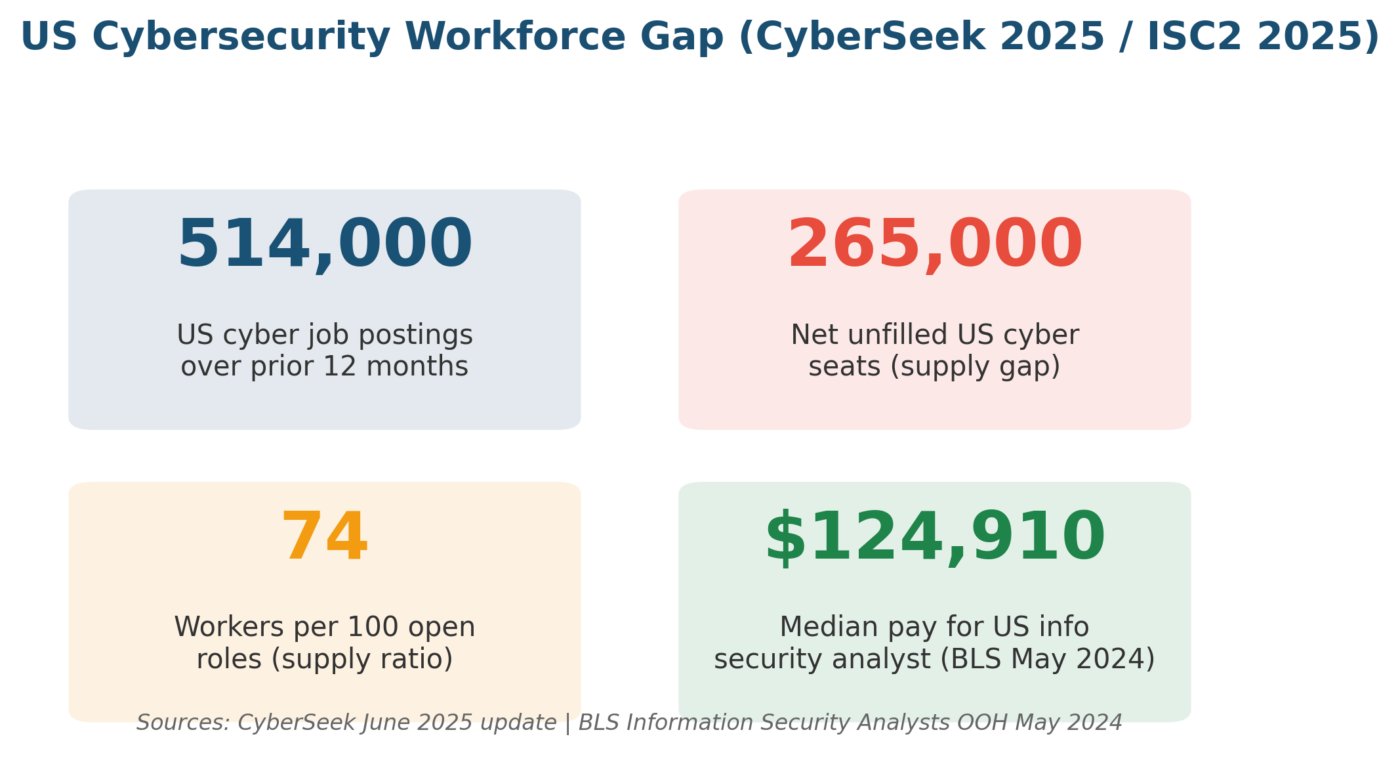
Figure 2. The US cyber workforce gap and median pay justify the time investment in a Free Cyber Security Course stack.
What Every Free Cyber Security Course Should Teach
The 2026 NICE Workforce Framework for Cybersecurity codifies cyber work into seven categories and roughly 50 work roles, each tied to specific Tasks, Knowledge, and Skill statements.
Any Free Cyber Security Course aspiring to feed a working-role pipeline should cover the core knowledge areas behind those work roles, not generic awareness material. Use the NICE framework as a syllabus filter before enrolling.
Core Topics in Every Free Cyber Security Course
| Topic | Why it belongs in every free track | Best free source |
| CIA triad and access control | Foundation for every NICE work role | ISC2 CC, Harvard CS50 |
| Cryptography fundamentals | Required for analyst, dev, GRC roles | Stanford CS155, Khan Academy |
| Network security and firewalls | Required for SOC, IR, network defender | Cisco Networking Academy |
| Threat modeling and NIST 800-30 risk | Required for analyst, architect, GRC | NIST SP 800-30, Cybrary |
| Incident response and digital forensics | Required for IR analyst, threat hunter | Cybrary, CISA FedVTE |
| Identity and access management | Required for SOC, IAM admin | Microsoft Learn, ISC2 CC |
| Cloud security fundamentals | Required for modern SOC and engineering | AWS Cloud Practitioner free path |
| Application security and OWASP Top 10 | Required for AppSec, secure dev | OWASP free, MIT 6.858 |
Treat any Free Cyber Security Course that stops at definitions and the CIA triad as a starter course only. The course earns its place on a serious resume when it builds toward a NICE work role: incident response, vulnerability analysis, defensive cybersecurity, systems security analysis, or one of the dozens of other roles listed in the NICCS Cyber Career Pathways tool.
The NIST SP 800-30 risk assessment guide and the NIST Cybersecurity Framework 2.0 round out the standards reading every Free Cyber Security Course should reference. NICE work-role mapping is the qualifying resume signal US employers and federal recruiters screen for, and the two NIST documents anchor the language.
Free Cyber Security Course vs Paid Certification
Free Cyber Security Course content gets a US learner to the entry door. Paid certifications get the learner past the screening filter at many employers.
The honest framing is sequencing, not substitution. The free tracks build the knowledge base; the paid credential validates it. The two stages should run in the order most learners reverse, where the credential is bought before the knowledge is built.
Free Cyber Security Course Compared with Paid Certifications
| Track | Time | Out of pocket | Renewal | Resume read |
| Harvard CS50 OCW (free) | 5 weeks | $0 | None | Strong academic foundation signal |
| ISC2 CC (closes May 20) | ~30 hrs | $0 + $50 AMF/yr | Annual AMF | Entry-level vendor-neutral credential |
| CompTIA Security+ | ~150 hrs | $392 exam | 3-year + CEUs | Standard floor for SOC roles |
| ISACA CISA | ~100 hrs | $760 exam | 3-year + CPE | Audit and assurance signal |
| ISC2 CISSP | ~200 hrs | $749 exam | 3-year + experience | Senior-level credential |
| SANS GIAC GSEC | ~6 weeks | $8,295 course + cert | 4-year renewal | Premium vendor-neutral signal |
Sequence the spend deliberately. The most efficient 2026 US entry path runs Free Cyber Security Course foundations (CS50 + ISC2 CC + Cybrary) into CompTIA Security+ into a specialized vendor-neutral credential two to three years in.
Spending $749 on a CISSP exam before the underlying information security risk management knowledge is built is the second most common mistake new US entrants make.
Mapping a Free Cyber Security Course to NICE Work Roles
The NICE framework is the US public-sector reference for cyber work, and federal hiring portals like USAJOBS index by NICE work role.
Mapping the Free Cyber Security Course track to one or two target work roles before enrollment lets the learner pull NICE-aligned task and knowledge statements directly into the resume language federal screeners search. Without that alignment, the certificate reads as a hobby project.
Free Cyber Security Course to NICE Work Role Map
| Work Role Category | NICE work role | Best matching Free Cyber Security Course |
| Protect and Defend | Cyber Defense Analyst | CISA FedVTE, Cybrary MITRE ATT&CK Defender |
| Analyze | Threat Analysis | SANS Cyber Aces, FBI Cyber Most Wanted reading |
| Securely Provision | Secure Software Development | MIT 6.858, OWASP free tracks |
| Investigate | Digital Evidence Analysis | Cybrary DFIR free, SANS DFIR primers |
| Operate and Maintain | Systems Security Analysis | Harvard CS50 + Cisco Networking Academy |
| Oversee and Govern | Cybersecurity Policy and Planning | NIST CSF 2.0 self-study, OpenLearn |
| Collect and Operate | Cyber Intelligence Planner | CIA / DOD open intel reading, FedVTE |
Federal cybersecurity work runs through the NICE framework whether the candidate uses the language or not.
A Free Cyber Security Course documented against a specific NICE work role earns measurable resume credit at federal agencies and at prime contractors serving DOD, DHS, and the intelligence community.
Search USAJOBS for any NICE work role and the listings cite the same task and skill statements the framework defines.
Skills You Gain from a Free Cyber Security Course
Skills accrue across three layers in a credible Free Cyber Security Course track. Technical foundations cover operating systems, networking, cryptography, and application security primitives.
Defensive operations cover detection, incident response, threat hunting, and forensic analysis. Governance covers risk, compliance, and the controls catalogs that map cyber work to enterprise outcomes.
A balanced free track touches all three; a thin track stops at the first.
Top 10 Skills from a Free Cyber Security Course
| Skill | What it enables | Best free signal |
| OS hardening (Windows + Linux) | SOC tier 1, sysadmin | SANS Cyber Aces OS modules |
| Network packet analysis | SOC, incident response | Cybrary Wireshark free labs |
| Python scripting for security | Automation, malware analysis | Harvard CS50P (Python) |
| Cryptography and PKI fundamentals | Analyst, architect, secure dev | Stanford CS155 lectures |
| Threat modeling (STRIDE, PASTA) | Architect, AppSec, secure dev | OWASP free threat modeling kit |
| Incident response playbooks | IR analyst, SOC | Cybrary IR free track |
| Risk assessment under NIST 800-30 | GRC, analyst, auditor | NIST SP 800-30 PDF |
| Cloud security fundamentals (AWS, Azure) | Cloud SOC, security engineer | AWS Cloud Practitioner free |
| Identity and access management | IAM analyst, security engineer | Microsoft Learn free SC-900 path |
| Compliance reading (CSF, HIPAA, FFIEC) | GRC, audit, security analyst | NIST CSF 2.0 PDF, free |
The portfolio test is whether the Free Cyber Security Course track produces evidence employers can verify. GitHub repositories with security scripts, lab writeups posted publicly, completed CTF challenges on TryHackMe or Hack The Box free tiers, and screen-recorded OWASP lab walkthroughs all count.
A certificate alone is paperwork. The portfolio is the actual hiring signal, much like a documented key risk indicators dashboard outweighs a generic risk policy.
Career Paths a Free Cyber Security Course Opens
The BLS reported $124,910 median pay for information security analysts in May 2024, with 29 percent projected employment growth through 2034.
Entry-level US roles like SOC tier 1, junior analyst, and IAM associate sit in the $70,000-$90,000 band in 2026 US metros. A documented Free Cyber Security Course portfolio plus an entry credential routinely lands the first interview slot at major US SOC employers.
Salary by Free Cyber Security Course-Aligned Role (BLS + CyberSeek 2025)
| Role | Free course on-ramp | US salary band | Primary source |
| SOC analyst (tier 1) | Cybrary + Security+ | $70K-$90K | CyberSeek 2025 |
| GRC analyst | NIST CSF + Cybrary | $90K-$140K | ISACA 2025 |
| Incident response analyst | CISA FedVTE + Cybrary | $85K-$115K | BLS 2024 |
| Penetration tester | TryHackMe + OSCP path | $95K-$135K | CyberSeek 2025 |
| Information security analyst | Harvard CS50 + Security+ | $90K-$150K | BLS May 2024 median $124,910 |
| Cloud security engineer | AWS Cloud Practitioner + Sec+ | $120K-$170K | CyberSeek 2025 |
| Cybersecurity architect | MIT 6.858 + CISSP | $150K-$220K | BLS 2024 |
| CISO (multi-year stack) | Career-long credential stack | $200K-$400K+ | ISC2 2025 study |
The most reliable Free Cyber Security Course pipeline runs through the SOC tier 1 role at a US managed security services provider or a Fortune 500 internal SOC.
From there, two-to-three year promotion paths into incident response, threat hunting, AppSec, and cloud security are documented in the BLS Employment Projections 2024-2034 release.
The free portfolio earns the first US interview; on-the-job depth earns the promotion trajectory over time. The same logic applies inside risk and audit careers, where a documented how to use Key Risk Indicators practice earns board confidence faster than a credentialed but undocumented dashboard ever could.
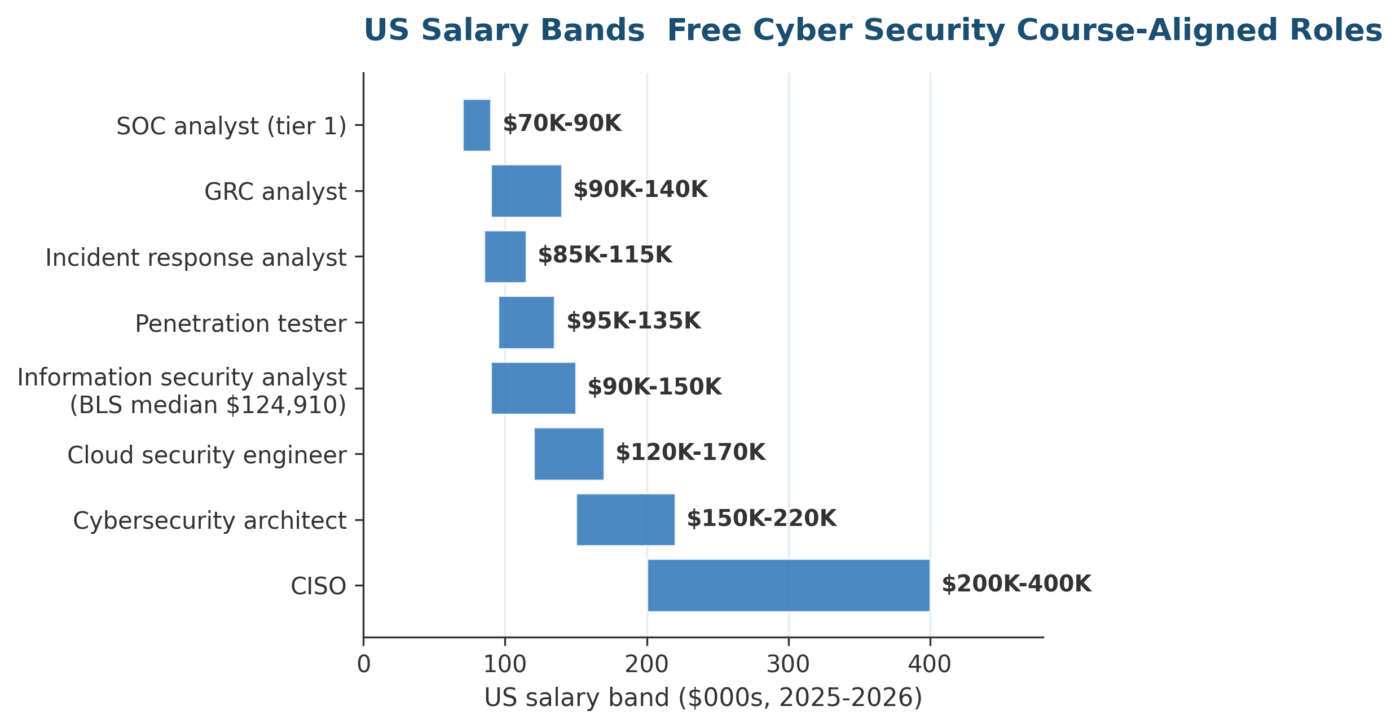
Figure 3. US salary bands across roles a Free Cyber Security Course portfolio can credibly open in 2026.
How to Pick a Free Cyber Security Course in 2026
Five questions filter the universe of free cybersecurity content down to the courses worth the time.
Each is a yes-or-no check on the source, the alignment, the assessment, the certificate, and the portfolio output. Skip any one and the Free Cyber Security Course turns into watch-only content that does not move the resume. Treat the five steps as a pre-enrollment checklist.
Five Steps to Pick a Free Cyber Security Course
- Step 1. Verify the source: Is the provider a US university, federal agency, recognized standards body, or established certification organization? Anonymous YouTube channels and generic LMS uploads do not count toward the resume.
- Step 2. Confirm NICE alignment: Does the course map to one or more NICE work roles? Run it through the NICCS Cyber Career Pathways tool before enrolling so the resume language lines up with federal hiring.
- Step 3. Look for graded assessment: Does the course end in a quiz, lab, or capstone the learner can fail? Awareness videos without grading do not build skills the way labs and quizzes do.
- Step 4. Capture the certificate: Is the certificate free, audit-track no-cert, or paid verified? Choose deliberately and screenshot every completion either way for the portfolio file.
- Step 5. Build portfolio output: Does the course produce a script, a writeup, a lab artifact, or a CTF flag? If not, pair it with a TryHackMe or Hack The Box free room and publish the writeup.
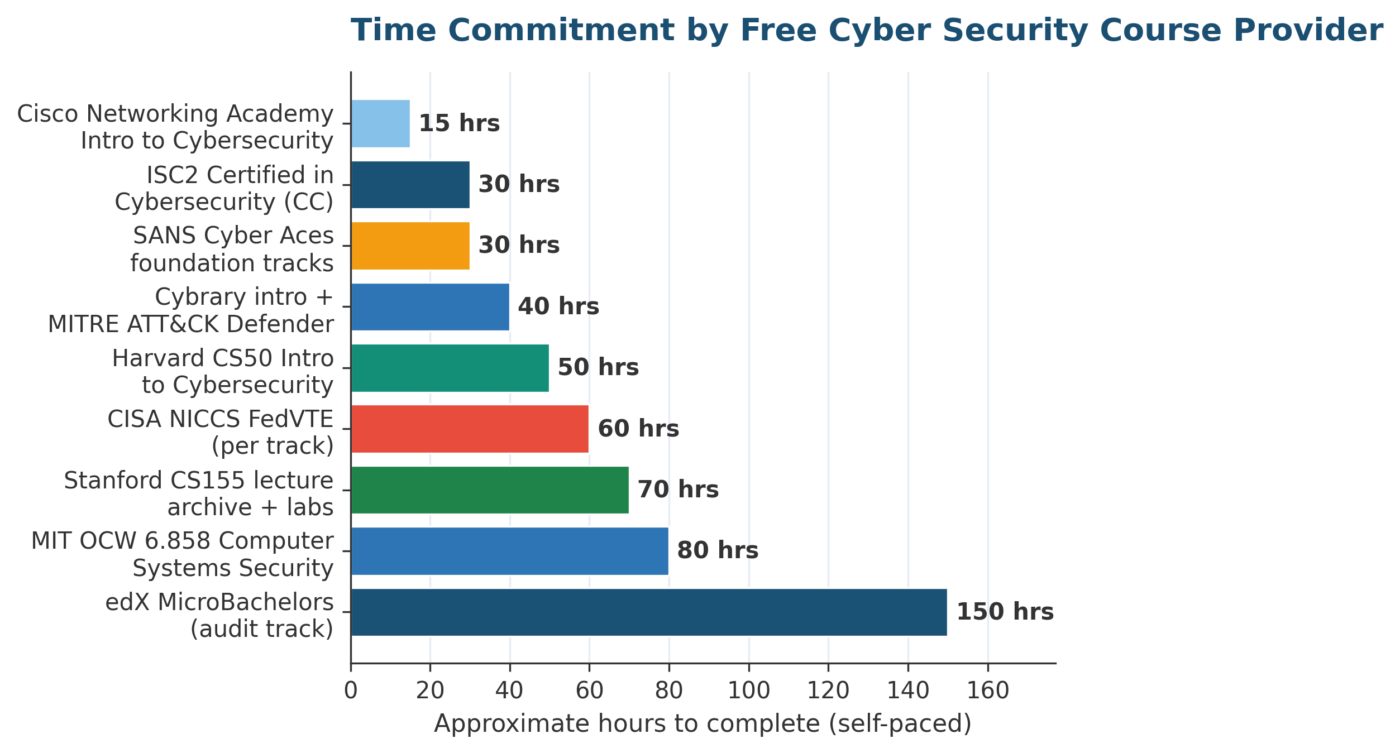
Figure 4. Time commitment by Free Cyber Security Course provider for US learners planning a stacked 2026 track.
Pitfalls to Avoid in Any Free Cyber Security Course
Free does not mean useful. Free Cyber Security Course providers run from elite US university tracks to generic YouTube playlists, and the resume signal varies by orders of magnitude.
Six patterns surface repeatedly at US hiring panels and on cybersecurity forums, each worth flagging before enrollment. Every pitfall comes with a documented root cause and a working remedy.
| Pitfall | Root cause | Remedy |
| Awareness-only content treated as training | Confusing exposure with skill-building | Pick courses with graded labs, quizzes, or capstones; cross-verify with the NICCS catalog |
| Free-certificate chase without learning | Treating the PDF as the goal | Build a portfolio artifact alongside every certificate; publish writeups on GitHub |
| Vendor-lock content disguised as free | Free intro that gates everything substantive | Stick to vendor-neutral free sources: CS50, NIST, MIT, OWASP, Cybrary, CISA |
| Skipping the NICE mapping | Course not tied to any work role | Run every Free Cyber Security Course through the NICCS Cyber Career Pathways tool |
| Stale 2018-era content | Outdated TTPs, dead URLs, retired tools | Filter for 2024+ updates; check release dates and last-revised tags |
| No portfolio output | Watched videos, no artifacts | Pair every course with a TryHackMe or Hack The Box free room and publish the writeup |
Frequently Asked Questions About a Free Cyber Security Course
Is a Free Cyber Security Course enough to land a US cybersecurity job?
A Free Cyber Security Course alone rarely lands the first US cyber job in 2026. The credible entry path stacks two to four free tracks (Harvard CS50, ISC2 CC, Cybrary, CISA FedVTE) with an entry credential like CompTIA Security+ and a public portfolio. That stack reads as the hiring signal, not any single certificate on its own.
SOC tier 1 roles at US managed security service providers and Fortune 500 internal SOCs remain the highest-volume entry path.
Hiring managers verify portfolios more than they verify certificates. A documented Free Cyber Security Course track plus a public lab writeup beats a paid bootcamp with no artifacts every time.
Which Free Cyber Security Course is best for absolute beginners?
Harvard CS50’s Introduction to Cybersecurity is the strongest beginner-friendly Free Cyber Security Course in 2026.
The course is taught by David Malan, is free through Harvard OpenCourseWare with a free certificate option, and assumes no prior technical background. The five-week scope covers practical concepts that map directly to NICE work roles.
ISC2 Certified in Cybersecurity is the strongest free credential-bearing option, with the One Million Certified program offering free training and the exam at no cost through May 20, 2026.
The CC track is structured for absolute beginners and produces a real ISC2 credential on completion, contingent only on the $50 annual maintenance fee.
How long does a Free Cyber Security Course take?
A typical Free Cyber Security Course runs between 20 and 50 hours of structured content. ISC2 CC sits at about 30 hours of self-paced material.
Harvard CS50 Introduction to Cybersecurity is five weeks at six to twelve hours per week. CISA FedVTE courses range from 10 to over 80 hours each, depending on the work-role focus.
A working US learner can stack four credible free tracks in three to four months alongside a full-time job. The honest commitment is eight to twelve hours per week.
Less than that and the stack reads as scattered exposure rather than focused skill-building when a US hiring panel asks for evidence at first-round screening.
Can a Free Cyber Security Course lead to a remote US cyber job?
Yes. US cybersecurity jobs are among the most remote-friendly in the workforce. The 2025 ISC2 Cybersecurity Workforce Study reported a large share of SOC, incident response, threat hunting, and GRC roles are filled remotely.
A Free Cyber Security Course portfolio plus an entry credential routinely clears the screen for fully remote SOC tier 1 roles paying $70,000 to $90,000 nationally.
The Virginia, Maryland, and DC corridor still concentrates federal cyber demand, but private-sector remote positions stretch the geography.
CyberSeek 2025 data tracked over 500,000 US job postings, with remote-eligible roles climbing each year. US geography is less of a constraint than the depth of the portfolio and the NICE-role alignment.
Which Free Cyber Security Course providers issue real certificates?
ISC2 CC, Cisco Networking Academy, Cybrary’s free tracks, Harvard OpenCourseWare CS50, and CISA NICCS all issue verifiable certificates at no cost to the learner.
ISC2 CC produces an actual ISC2 cybersecurity credential. Cisco issues a course completion certificate. Cybrary issues platform certificates with verification URLs. CISA records completion through the FedVTE transcript.
Audit-track courses on edX and Coursera show course content for free but require a paid upgrade for the verified certificate.
The audit track still produces a screenshot-evidence record and full content access. Whether to pay $49 to $199 for the verified credential depends on whether the resume needs the specific brand cert for the target US employer.
Does a Free Cyber Security Course count toward CompTIA Security+ CEUs?
Some Free Cyber Security Course content counts toward CompTIA continuing education units. CompTIA tracks CEUs through documented training hours, and recognized free providers like Cybrary, ISC2 CC training, and certain Cisco Networking Academy modules qualify for credit.
The CompTIA CE portal lists approved sources and submission rules for documenting free course completion as CEU credit.
Verify each course against the CompTIA CE approval list before assuming the hours qualify.
Free university audit tracks generally do not count automatically because they lack the structured CE submission paperwork. Cybrary, ISC2-affiliated, and ISACA-affiliated programs are the most reliable Free Cyber Security Course paths for documented Security+ CEU credit.
What is the next step after finishing a Free Cyber Security Course track?
After completing a stacked Free Cyber Security Course track, the next step is one of three: book the CompTIA Security+ exam, apply to SOC tier 1 roles at US managed security service providers, or contribute to an open-source security project to build verifiable public work. Most successful 2026 US entrants do all three in sequence over six months.
The next twelve-month track typically adds vendor-neutral certifications like ISC2 CC into Security+ into CySA+ or PenTest+, alongside cloud-vendor entry certs (AWS Cloud Practitioner, Microsoft SC-900).
Each layer stacks on top of the free foundation. Layered credentials plus a portfolio is the standard 2026 US entry-level cyber resume.
How does a Free Cyber Security Course relate to the NIST NICE framework?
The NIST NICE Workforce Framework for Cybersecurity defines roughly 50 work roles across seven categories, each with discrete Tasks, Knowledge, and Skill statements.
Every credible Free Cyber Security Course can be mapped to one or more NICE work roles using the NICCS Cyber Career Pathways tool. The mapping is what makes the resume legible to US federal recruiters.
Federal cybersecurity hiring at DOD, DHS, Treasury, and the intelligence community routes through NICE-aligned job descriptions on USAJOBS.
A Free Cyber Security Course track with documented NICE work-role alignment translates directly into the resume language federal screeners search. Skip the mapping and the same content reads as undifferentiated general learning.
Looking Ahead: Free Cyber Security Course Trends in 2026 and 2027
The 2026-2027 horizon includes the close of the ISC2 One Million Certified program on May 20, 2026, the rollout of new NICE work roles in operational technology and AI security, and the expansion of CISA Cyber Education and Workforce Development programs under continued federal appropriations review.
Each shift opens or closes a specific Free Cyber Security Course pathway US learners should track quarterly.
AI-driven content delivery is the next inflection. Platforms are wiring large language models into adaptive learning paths, and US universities are piloting AI tutors for free introductory tracks.
A 2026 Free Cyber Security Course increasingly includes adaptive labs and personalized review questions. The credentialing standard has not yet caught up with the delivery model, so portfolio evidence matters more than ever.
The third 2027 trend is the consolidation of free entry credentials. As Security+ pricing climbs and ISC2 CC enrollment closes, alternatives like Google’s Cybersecurity Professional Certificate (Coursera audit free) and IBM Cybersecurity Analyst Professional Certificate are picking up signal weight at entry-level US hiring.
A Free Cyber Security Course choice in 2027 will factor in which brand cert pipelines are still open.
Watch the appropriations calendar for federal cyber education programs, the renewal schedule for major US university free tracks (CS50, MIT OCW, Stanford CS155), platform rosters from edX, Coursera, and SANS Cyber Aces, and the entry-credential roster from ISC2, ISACA, CompTIA, and the major cloud vendors.
A working shortlist of credible Free Cyber Security Course options shifts each quarter and benefits from a quarterly refresh inside any enterprise risk management framework.
Ready to Map Your Free Cyber Security Course Plan?
At riskpublishing.com we help US cybersecurity career entrants build twelve-month roadmaps that pair Free Cyber Security Course tracks with the right paid credentials, NICE work-role alignment, and portfolio milestones.
The work usually closes with a written plan, a documented credential schedule, and a quarterly review cadence tied to current US workforce data.
Explore our risk advisory services, or contact us to scope a tailored Free Cyber Security Course roadmap aligned to your target NICE work role, US metro, employer type, and one-year career outcome. The engagement closes with a written learning plan, a credential calendar, and a 90-day check-in milestone.
Related reading on riskpublishing.com: cybersecurity risk management, cyber security risk management framework, information security risk management, guide to information security risk management, NIST risk assessment, key risk indicators examples, how to develop key risk indicators, risk management lifecycle, risk appetite statements examples, best Key Risk Indicators, how to mitigate risk, how to conduct a risk assessment, and the five steps of the risk management process.

Chris Ekai is a Risk Management expert with over 10 years of experience in the field. He has a Master’s(MSc) degree in Risk Management from University of Portsmouth and is a CPA and Finance professional. He currently works as a Content Manager at Risk Publishing, writing about Enterprise Risk Management, Business Continuity Management and Project Management.